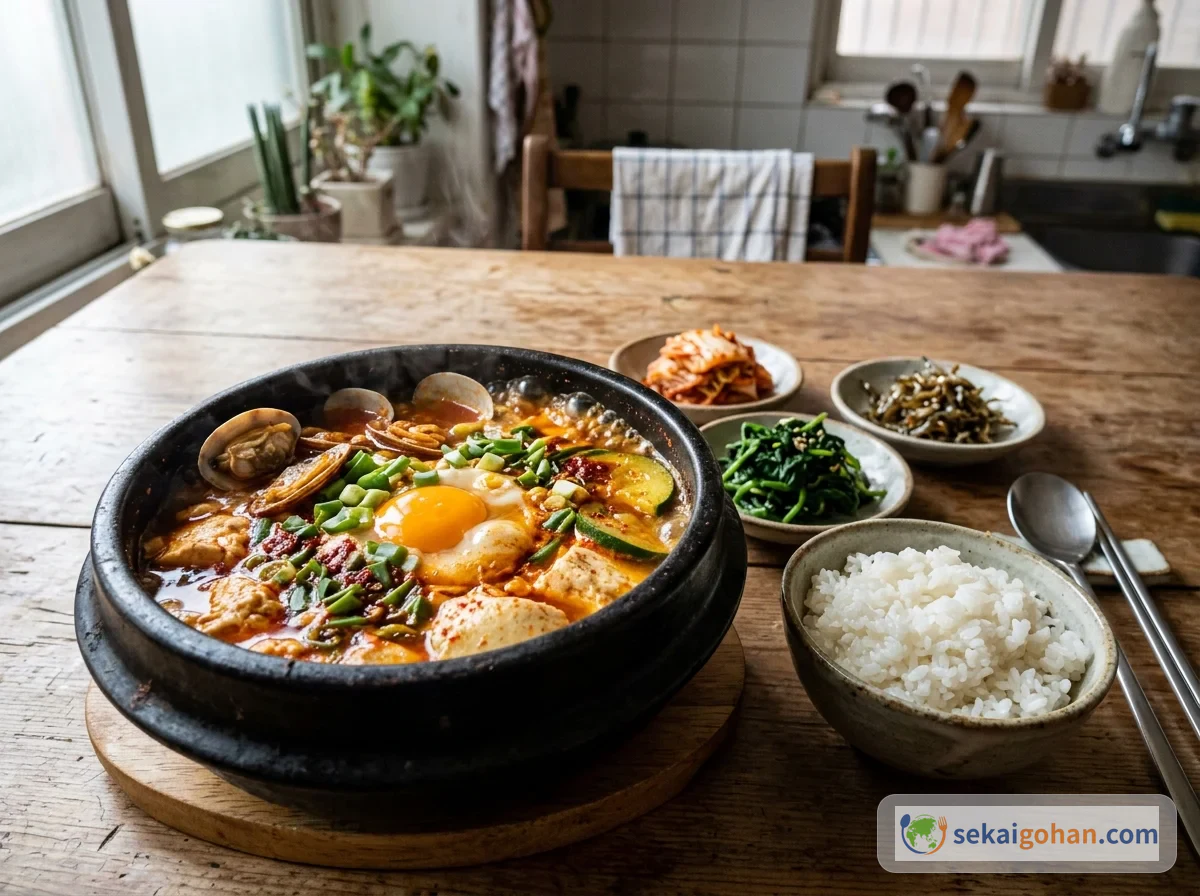
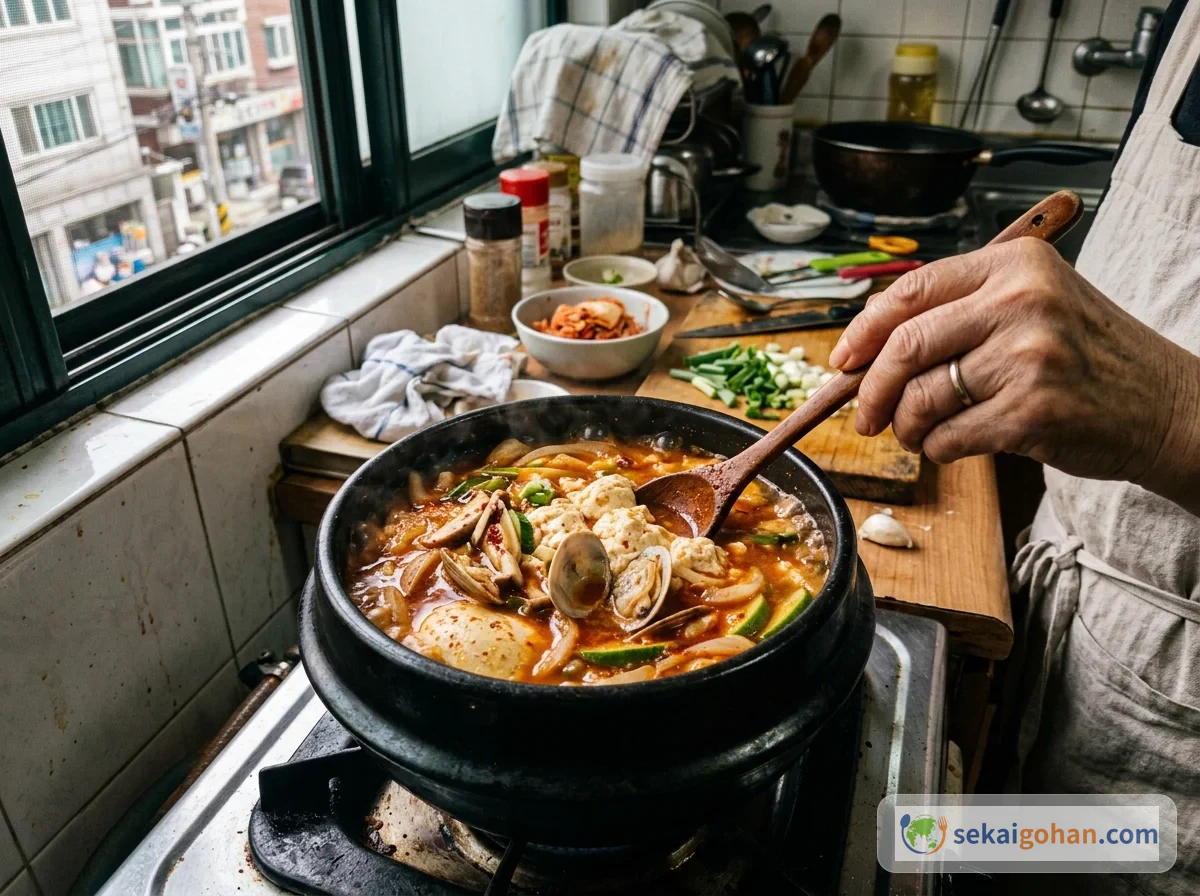
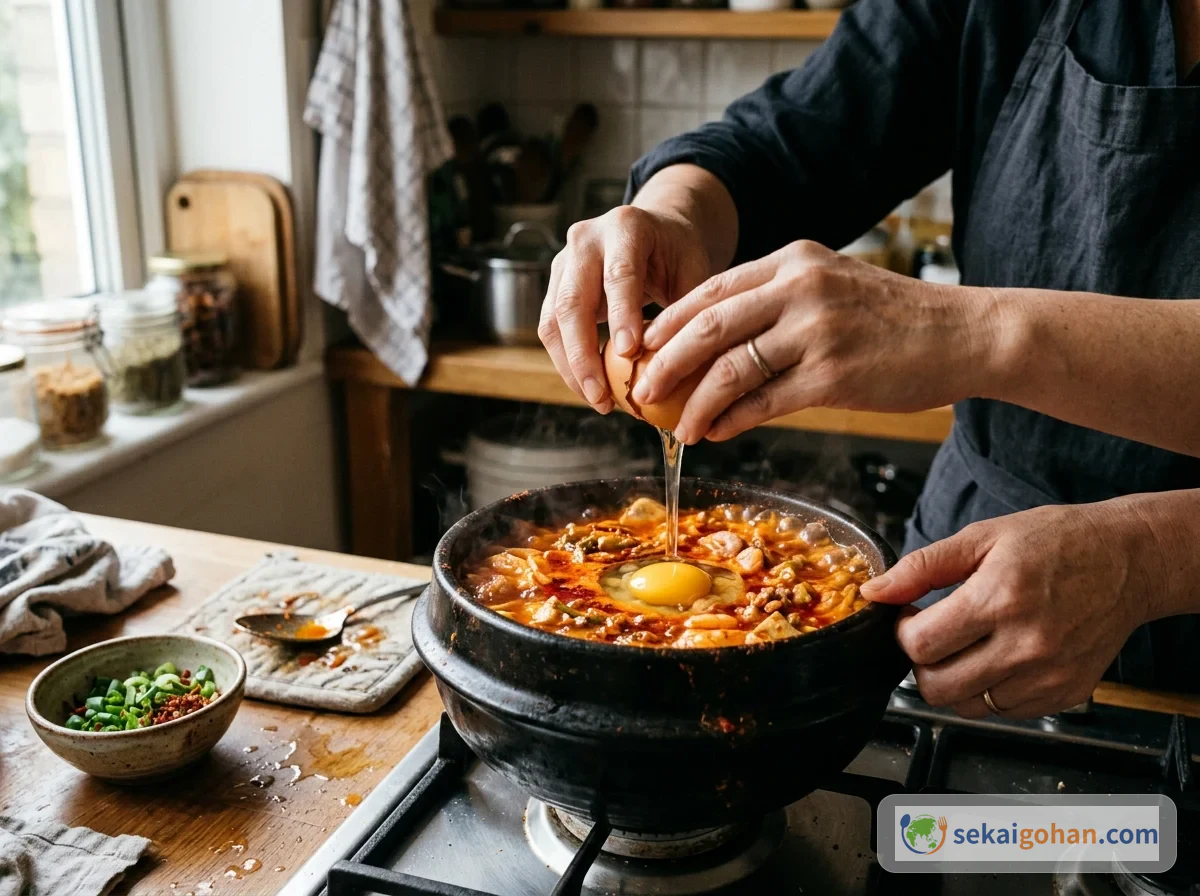
At 4 a.m. in Gangneung's Chodang Tofu Village, fire goes under the big cauldrons. Seawater goes into the boiled soy milk, and white curds drift together in the steam before the tofu has fully set. That is sundubu: tofu before it is pressed into molds and firmed, so soft it falls apart when scooped. Sundubu-jjigae takes this tofu before setting as its star and simmers it with red chili oil and seafood savor. It arrives at the table still boiling in its earthenware pot (ttukbaegi), and an egg is cracked in before your eyes.
Written 순두부찌개. "Sundubu" is soft tofu scooped out at the stage where soy milk begins to set, without pressing it into a mold. "Jjigae" refers to a stew with plenty of liquid. It is eaten with white rice and side dishes.
Sundubu-jjigae and Chodang Tofu
Seawater tofu in Gangneung
Chodang is a district of Gangneung with nearly twenty sundubu restaurants in a row, all using domestic soybeans and seawater. The tofu has no grassy beaniness, just a nutty aroma, and it is so soft it crumbles and quivers in the mouth. The seawater of the East Sea (the sea off Korea's east coast) holds enough magnesium and calcium to set soy milk without being concentrated.
The method goes like this. White soybeans are soaked and ground, and the soy milk is boiled at 98–100°C, then cooled to 176°F (80°C). Adding seawater at 3.5–4% salinity makes sundubu; pressing it for about 20 minutes more gives modubu, close to firm tofu.
The village became known beyond the town in the 1970s and 80s, after residents began selling home-made tofu in Gangneung city and restaurants gathered. The traditional way of eating it there is lightly seasoned, so you taste the soy aroma and the faint saltiness of the seawater, with bean sprouts and aged kimchi alongside. Some places in Gangneung still serve sundubu white and mild.
The name Chodang comes from Heo Yeop (1517–1580), a mid-Joseon scholar-official whose pen name was Chodang. The story goes that he made soy milk with spring water in front of his house and set it with seawater, and his pen name became the place name. No document backs this up, though. A record from Munjong's first year already describes seawater as a coagulant, so the idea is probably older, and whether the tradition has passed down unbroken is unclear.
The red stew
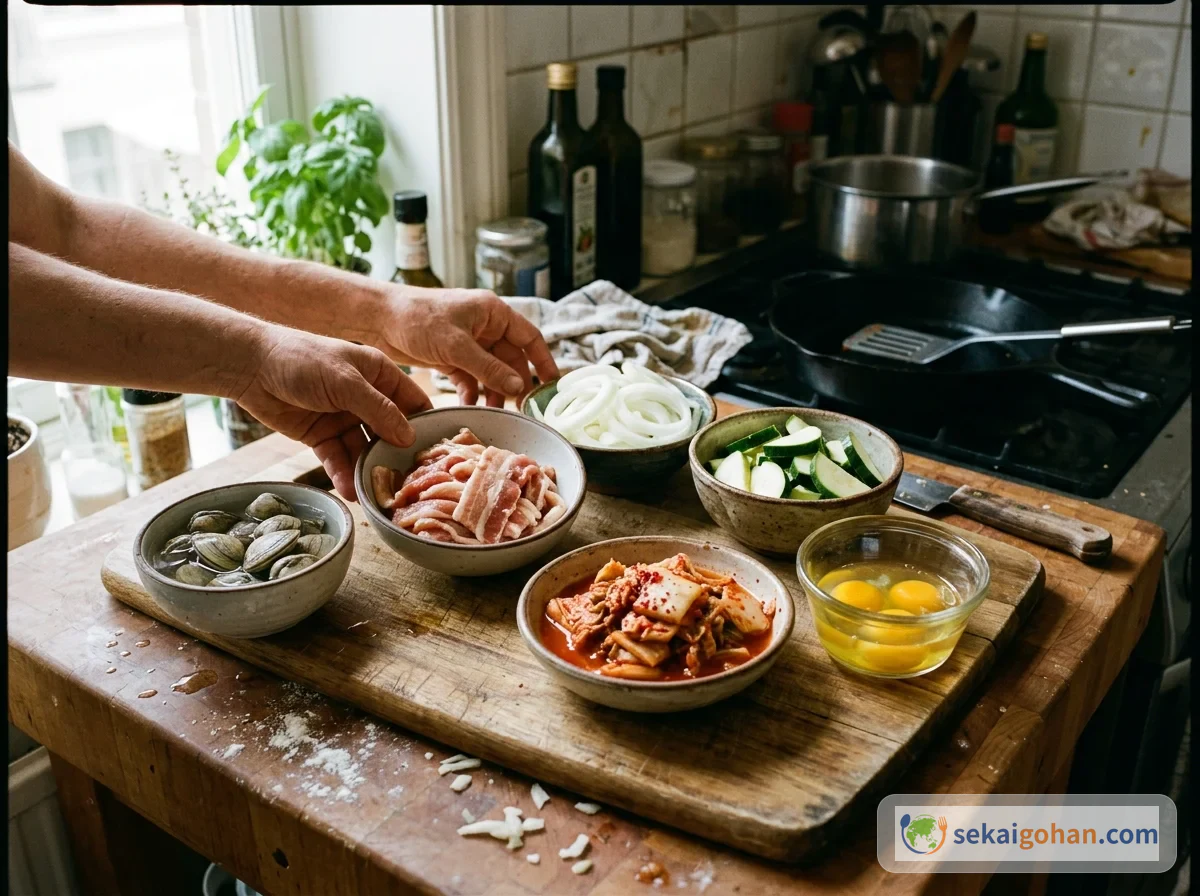
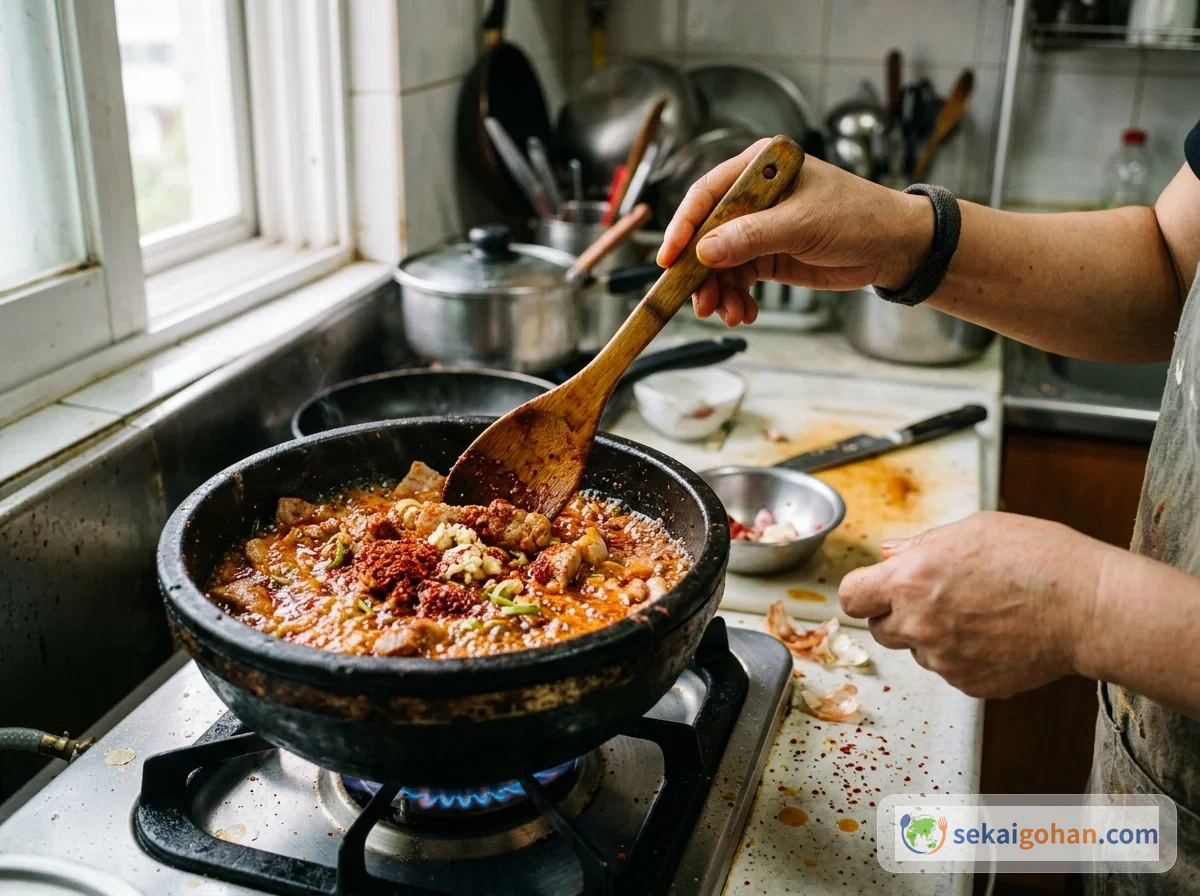
Spicy red sundubu, along with the jjamppong-like "jjamppong sundubu," is a relatively recent variation, which is why a white tofu and a red stew share the same name. For the red version, chopped pork fat goes into an earthenware pot, followed by sundubu, seasoning sauce and shelled clams, all cooked over high heat while stirring. No water or stock is needed, since the sundubu releases its own liquid. In 2005 sundubu-jjigae was called "the most ideal winter food."
The local table
At restaurants the pot comes out still boiling, and the egg is cracked in on the spot. Around it go white rice, kimchi, bean sprouts, fried flat fish, pickled chili and pickled radish. Some shops serve stone-bowl rice (dolsot-bap), and hot water is poured over the scorched layer to eat it as nurungji.
Sundubu in Los Angeles
The stew crossed the sea, and one place it landed is Koreatown in Los Angeles. BCD Tofu House opened on Vermont Avenue in 1996, and the shop it opened on Wilshire Boulevard in 2000 became known for its 24-hour service. You pick your heat from mild to extra hot, and the scorched layer of the stone-bowl rice is eaten as nurungji.
Ingredients (serves 4)
Four servings is the amount made in one large pot and divided. To make single portions in individual vessels, divide the ingredients by four and simmer. Use 10.5 oz (300 g) shell-on clams; if already purged of sand, they can be used the same day. To purge sand, soak them in 3% salt water (15 g salt in 2 cups (500 ml) water) in a dark place for 1–2 hours. The egg is cracked in and set by heat, so use fresh ones, and crack each into a separate small bowl first so no shell goes in the pot.
This dish contains soy (tofu), egg, shellfish (clams), wheat (soy sauce) and sesame (sesame oil). Some kimchi and gochugaru products contain shrimp or seafood extract. Check ingredient labels.
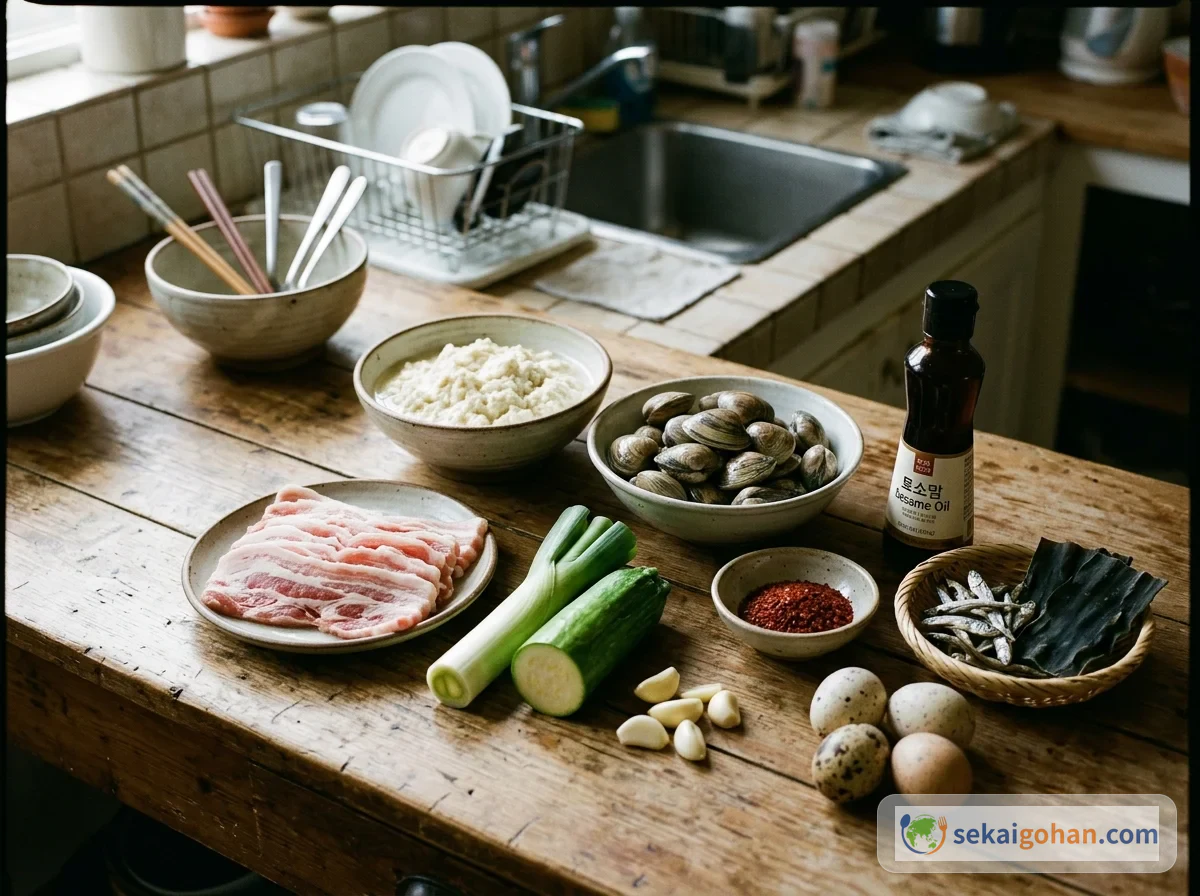
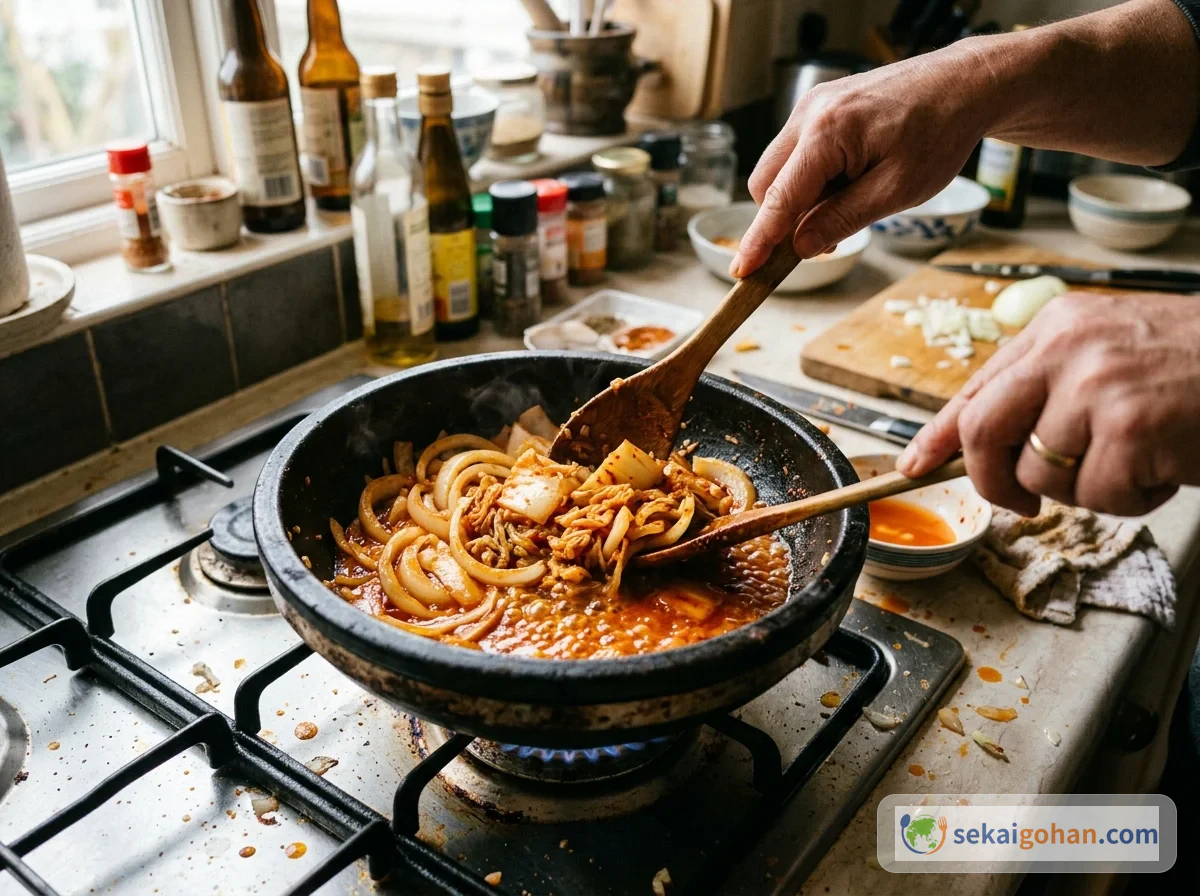
The red oil is made by putting gochugaru and chopped garlic into sesame oil. It is the base of the stew's color and aroma, so it is also the deciding point of flavor.
You can make it with regular sesame oil. But freshly opened Korean sesame oil has a strong toasted-sesame aroma, and in a dish like this where the oil itself becomes the aroma, that is where the difference shows.
Choose coarse gochugaru. Fine grind scorches easily and finishes powdery. At the store look for ones labeled "Korean," "coarse" and "for seasoning." The aim is color and aroma more than heat, so adjust heat by quantity. You can buy it at Korean or import grocers and online. If you cannot find it nearby, the coarse type for soups rather than for kimchi is enough. Keep opened sesame oil in a cool, dark place and use it up soon to avoid oxidation.
Choosing Tofu and a Pot for Sundubu-jjigae
Tofu
Fresh sundubu is hard to find outside Korea, and seawater-set tofu can't be reproduced at home, but soft tofu with spicy oil gets close. Your best bet is soft tofu curds, such as unpressed fresh tofu or tofu sold as "soft" or "curd" style; they are closest to the form before full setting. Silken tofu comes next. Firm tofu holds too tightly to give that quivering feel, so skip it.
Korean grocery stores sometimes sell sundubu in tubes. If you find it, use the same amount in place of the tofu.
Scoop a pack of about 14 oz (400 g) into the pot with a spoon in chunks of 4–5 cm, without breaking it up much. Cutting squares with a knife loses the wavy cross-section typical of sundubu. Skip draining, too: the tofu's water becomes part of the liquid, and if there is a lot of it, reduce the stock.
The pot
A thick-walled pot or earthenware pot about 9.5 inches (24 cm) across works fine at home. A dedicated vessel does have its perks, though: it stays hot after serving and lets the egg set to a soft yolk. If you can, you can also cook in a heavy pot and divide it into small bowls, pouring the hot broth over rice so it stays warm.
A flameproof ceramic or stone bowl is worth buying if you want piping hot single portions or make bibimbap and jjigae often; a small earthenware pot that can go over direct flame works too. If you cook this once a year, a regular pot is enough. When shopping, check that it is rated for direct flame (gas), that its inner diameter fits your stove's grate, and that you have enough for four servings. Some aren't usable on induction, so read the label. Heating a ceramic pot empty or cooling it suddenly can crack it.
Fixing Common Sundubu-jjigae Problems
Earthenware and heavy pots spread heat evenly, so even on medium the edges start to bubble. On high heat, too much water comes out of the tofu and the flavor goes blurry. Tofu also releases water and breaks apart as it heats, which is why it goes in last and shouldn't be overcooked. Some mistakes can be fixed; one can't.
- The gochugaru scorched and is bitter: this stew can't be rescued. If it is dark brown and smells burnt, wash the pot and start over. Next time keep it on low heat, and take the pot off the burner if the oil gets too hot.
- The broth is watery and the flavor blurry: water has come out of the tofu. Simmer uncovered over medium 2–3 minutes to reduce, or add soy sauce 1/2 tsp at a time. Next time reduce the stock by 3.5 tbsp (50 ml).
- Too spicy: crack in an egg and stir, add tofu, or add 2–3 tbsp milk to mellow the heat. Adding water to dilute the powder doesn't work.
- The tofu broke up and clouded white: stirring while it boiled caused it. Next time use medium-low heat and only shake the pot. The flavor is unchanged, so go ahead and eat it.
- Clams did not open: throw away any that stay closed after cooking. If sand remains, strain the broth once before serving.
- Too salty: the salt of the kimchi and clams adds up. Add hot water 3.5 tbsp (50 ml) at a time, tasting as you go.
Serving and Variations
At home, white rice is all you need. Spoon the broth over the rice, breaking up the tofu as you go, and break the egg yolk while it is still soft to ease the heat.
The ingredients bend to taste. Add seafood (shrimp, squid, oysters), use beef, add more mushrooms, drop the pork and use only seafood, or leave out the kimchi. Leftover tofu is delicious on its own, too, topped with soy sauce and chopped scallion.
FAQ
Can I make it with firm tofu?
You can, but the texture is different. Firm tofu has little water and holds tightly, so scooping it with a spoon tends to crumble it. Tear it into big pieces by hand instead, shorten the cooking by 2 minutes, and reduce the liquid a little, to 1½ cups (350 ml) of stock.
Can I make it without clams?
Yes. Frozen shelled clams, canned scallops (with their liquid), shrimp or squid can replace them. It also works with only pork and kimchi, but the savor is weaker, so make the anchovy stock stronger. Without clams, you also skip purging sand.
How do I make it for children or people who dislike heat?
Use 1 tbsp gochugaru and adjust the amount at the red oil stage. For children, set aside some tofu, clams and stock before they go into the red oil, season them without heat, and add spice to the rest a little at a time. An extra egg also mellows the heat.
Can I make it ahead or store it?
Refrigerate it for up to 1 day. It contains egg, tofu and clams, so eat it soon. For the best texture, store it before the egg goes in and add the egg after reheating. Reheating makes the tofu release water and thins the taste, so adjust with a little soy sauce. Freezing changes the tofu's texture and isn't recommended. Leftover clams keep better with the shells removed.