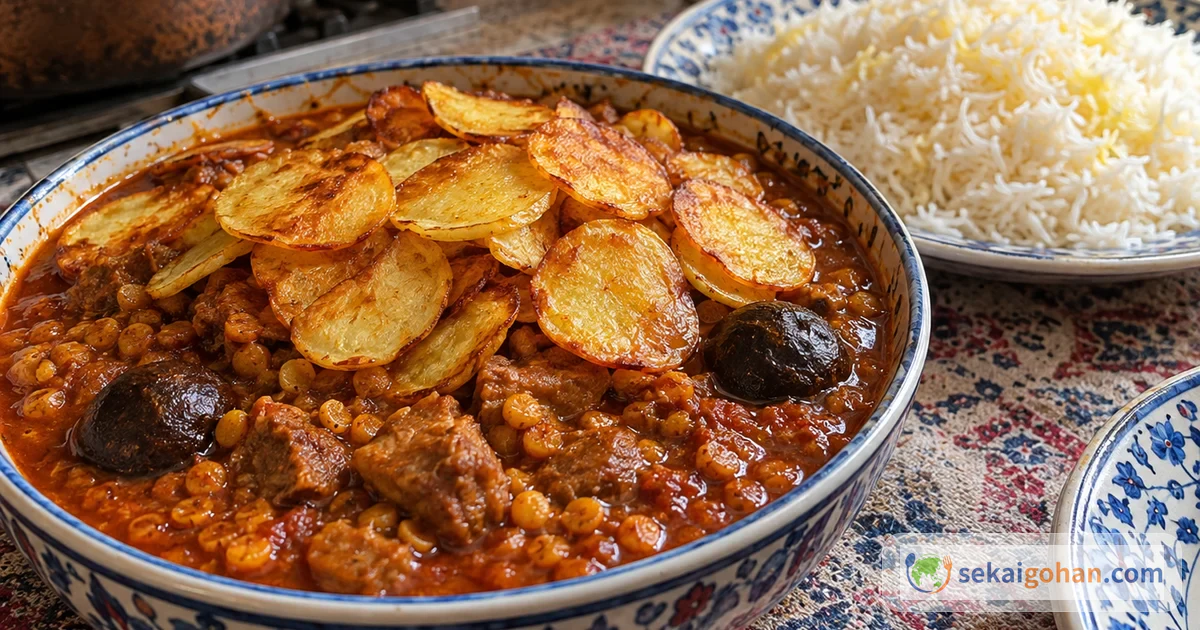
Spread chopped parsley, cilantro, and scallions in hot oil and at first they give off blue-green steam. Then the water at the bottom of the pan disappears and the color deepens to dark olive. Simmer those herbs with beef, beans, and dried lime and you have ghormeh sabzi, the great herb stew of Iranian home cooking. It isn't a hot dish. Instead, a green aroma, the savoriness of meat, and a dry sourness stack on top of each other.
Ghormeh sabzi and the Iranian khoresh
A thick herb stew
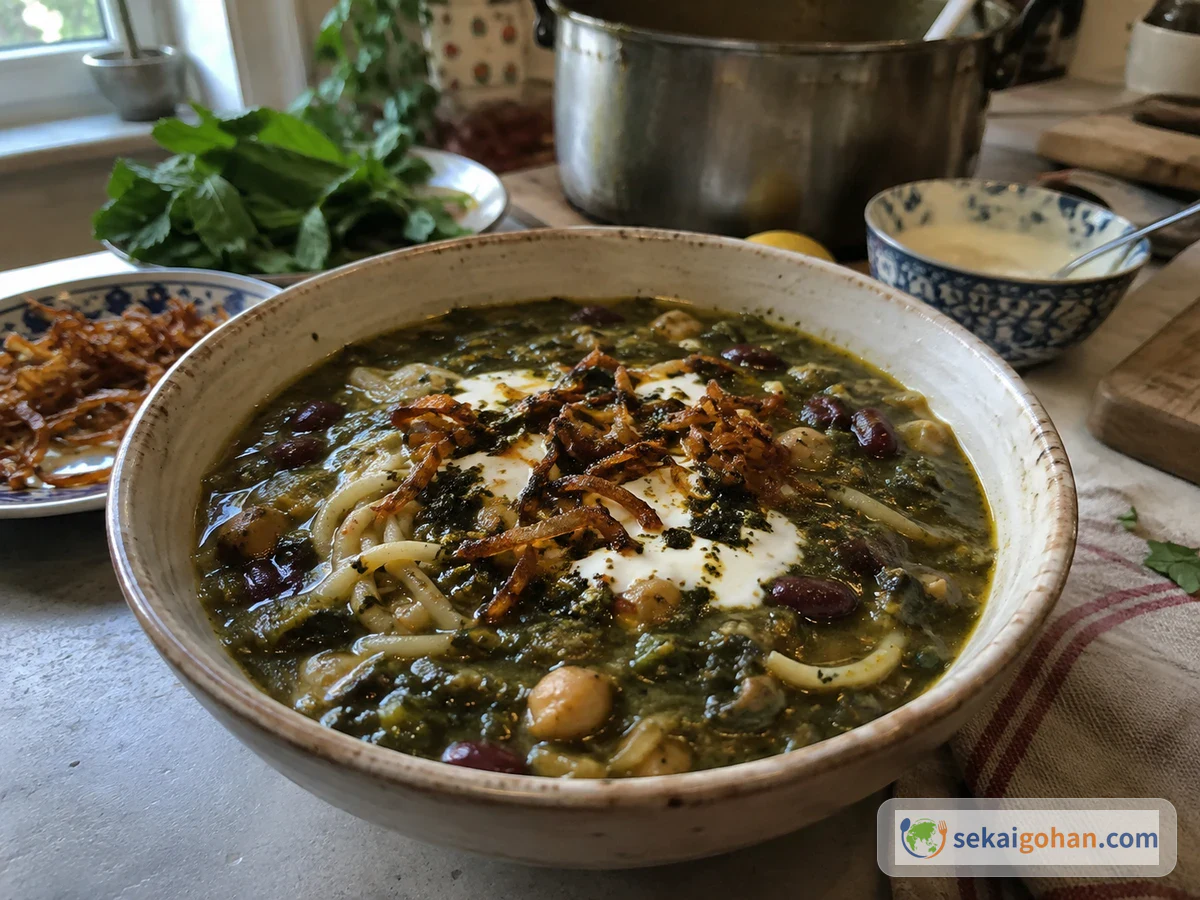
Ghormeh sabzi (qorma-sabzi) is one of the best-known khoreshes of modern Iranian cuisine. Khoresh (khoresht) is the Persian name for a stew with little liquid, made by frying onion and meat in oil and adding herbs or vegetables fried beforehand, beans, or dried fruit. Set it beside the sweet-and-sour brown of fesenjan or the golden color of tahchin and you can see how far Iranian cooking ranges in flavor and color.
Unlike curry or a Western stew, the pot holds very little liquid. The finished stew should be thick enough that it doesn't run off the rice, yet still coat the meat and beans. Frying the herbs until their water is gone takes the sharp edge off the green. Stop when the steam has thinned and the color has deepened, well before anything turns bitter.
Three things hold the flavor of this dish: fry the herbs before simmering, keep the stew thick enough to serve with rice, and adjust the sourness at the end. Matching the exact cut of meat or brand of beans matters far less than getting these three right.
Served with rice and raw herbs

In Iran, khoresh always comes with white rice. It is spooned over the rice in small amounts, or set alongside so each bite is mixed with a spoon. Every grain picks up the herb oil and acidity, which is why the pot doesn't need heavy seasoning to taste complete at the table. Rice took its large place in Iranian cooking through the Safavid court kitchen: rice dishes spread by the end of the 16th century, and chelow khoresh, white rice paired with a khoresh, took hold.
The plate of raw herbs and radishes on the side matters too. Sabzi khordan, a plate of parsley, cilantro, scallions, and the like with radishes, adds crunch and green fragrance to a rich stew. Even a small plate of radishes, mint, and parsley is enough, and those cold, raw greens bring out the sourness of ghormeh sabzi better than another meat dish would.
Regional and household differences
The differences from place to place are small enough that the name never changes. Some Tabriz households add tomato paste or tomato wedges, and the beans vary among red kidney beans, pinto beans, and black-eyed peas. Some families love fenugreek while others hold back, and the herbs may be chopped fine for a dark green or left coarser.
Ingredients: settle the herbs and the sourness first
Shop for ghormeh sabzi by thinking about the herbs before the meat. Parsley and scallions alone make it monotonous, and too much cilantro pushes the dish toward something else. Dried fenugreek is strong in small amounts, so do not overdo it.

Serves 4
What can be substituted and what cannot
Beef can be chuck, shank, or belly in a block. Chuck is for when you want it done sooner; shank gives a deeper stew. Thin-sliced meat cooks quickly but its fibers fall apart too much over a long simmer, so cubes are more reliable the first time.
The herbs are parsley, cilantro, and scallions. Where tareh, the thin, flat-leaved leek-like herb used in Iran, is hard to find, use scallions with a little garlic chives. Dried fenugreek is the core of the aroma, but above 2 g the bitterness comes forward. The first time, stop when it is a little too faint, then increase it next time.
Dried lime is hard to replace fully with lemon juice. It gives more than sourness: a dry fragrance and the slight bitterness of the rind that stays in the stew. It also works in kabsa and other Gulf rice dishes, so a small bag is worth keeping if you keep cooking Middle Eastern food. Simmering whole limes and adding powder in small amounts are different methods, so do not swap them at the same quantity.
Pierce whole dried limes with a skewer and put them in the liquid so the fragrance transfers slowly. Start ground dried lime at 1/2 tsp and add small amounts at the end after tasting. The ground form releases the bitterness of pulp, rind, and seeds together, and a large amount added at the start is hard to undo.
What to look for when shopping
Dried lime, basmati rice, and a small amount of saffron for the rice are the items worth seeking out at a Middle Eastern or South Asian grocery or online. Beef, onion, parsley, cilantro, scallions, and red kidney beans can all come from an ordinary supermarket.
With whole dried lime, the aroma changes slowly inside the stew. If you buy ground dried lime, check that the label says "Ground" and lists dried lime as the only ingredient, and use 1/2 tsp in place of 2 whole limes to start. Some ground products carry shared-facility warnings for wheat, tree nuts, soy, or sesame, so anyone with allergies should check the product page and the package itself before buying.
Basmati is a long-grain rice that stays light even under sauce. A 2.25 lb (1 kg) bag is more than the 10.5 oz (300 g) this recipe uses, so it suits cooks who will also make biryani or other khoreshes. Saffron is optional: white rice works on its own, and since only 0.1 g is used to color part of the rice, a 1 g container is a convenient size. If you do not normally cook with saffron, skip it and serve white rice.
Choosing herbs, dried lime, meat, and beans for ghormeh sabzi
The ratio of herbs shapes the whole pot. More parsley softens the green, while more cilantro pushes the aroma forward. Fenugreek is enough in small amounts.
Dried lime is called limoo amani in Iran, loomi in Oman, and noomi basra in Iraq. The sun-dried fruit is used whole, sliced, or powdered, and in Iran it sours stews and soups. Whole limes in the cooking liquid release the fragrance of the rind slowly, while powder can be added a little at a time and tasted, so either form works.
Beef chuck is easy to find and easy to judge for doneness the first time; lamb gives a stronger aroma. For the beans, pinto beans bring a chestnut-like sweetness and black-eyed peas a light skin texture. If you use canned beans, drain them before adding and adjust the salt at the end. With dried beans, soak 3.5 oz (100 g) overnight and cook them soft in a separate pot, so the bean cooking water never reaches the herb-frying step.
Method: fry the herbs, then simmer slowly
Throwing everything into a pot at once leaves ghormeh sabzi's aroma blurred. The work comes down to driving the water out of the herbs, browning the meat and onion, and letting the dried lime give its sourness without breaking it. Keep the heat moderate and reduce only at the end.
When frying the herbs, stop when no water remains on the bottom of the pan and the bright green has turned dark olive. For simmering, keep the heat low enough that the surface barely bubbles and the meat moves slowly. If the sound gets loud, lower the heat; if the liquid drops too far, add ½ cup (100 ml) at a time.
Step 1: Wash and chop the herbs (20 minutes)

Takes 20 minutes, with no heat. Wash 4 oz (120 g) parsley, 2.75 oz (80 g) cilantro, and 2.75 oz (80 g) scallions and press them dry with a cloth or paper towels. Remove the hard stems of the parsley and cilantro and chop the leaves and tender stems into 0.125 inch (3 mm) pieces. Slice the scallions into 2–3 mm rounds. Wet herbs steam in the pan and lose their aroma, so after chopping spread them out and leave them for about 5 minutes.
Do not mix in the 2 g of dried fenugreek yet. Fried as long as the fresh herbs, it turns bitter easily, so it goes in later. A food processor can save effort, but do not run it until the herbs become a paste. The more texture remains, the better the mouthfeel once stewed.
Step 2: Brown the meat and onion (10 minutes)

Takes 10 minutes over medium to medium-high heat. Heat 2 tbsp oil in a heavy pot over medium heat and fry the sliced onion for 3 minutes. When it is translucent and lightly golden at the edges, add 1 lb (500 g) of 1 inches (3 cm) beef cubes and raise the heat to medium-high. Brown the surface for 4–5 minutes, then add 1 tsp turmeric, 1/4 tsp black pepper, and 1 tsp salt and fry for 1 minute.
A little brown fond on the bottom of the pot is a good sign. If it turns black it will taste bitter, so if the onion darkens suddenly, add 2 tbsp water and scrape the bottom with a wooden spoon. The meat does not need to cook through here. This step builds surface savoriness and onion sweetness first.
Step 3: Fry the herbs to a deep green (18–20 minutes)

Takes 18–20 minutes over medium, then medium-low heat. In a separate skillet, heat 3 tbsp oil and spread out the herbs chopped to 0.125 inch (3 mm). For the first 5 minutes cook over medium heat to drive off the water, then drop to medium-low once the steam thins. Turn with a wooden spoon until the bright green becomes dark olive and no water collects on the bottom.
With 3 minutes left, add the 2 g dried fenugreek. Stop when the aroma lifts and the oil coats the herbs. If you fry until black flecks multiply, the bitterness will not leave even after simmering. This step decides the flavor of the dish, but it is not for scorching. When in doubt, stop a little early and let the simmer blend it.
Step 4: Add beans and dried lime and simmer (80–90 minutes)

Takes 80–90 minutes, over low heat once it boils. Add the fried herbs, 8.5 oz (240 g) red kidney beans, and 2½ cups (600 ml) water to the meat pot. Pierce the 2 whole dried limes in 2–3 places with a skewer and add them. If using powder, dissolve 1/2 tsp into the liquid here and add the rest at the end after tasting. Once it boils, lightly skim the surface, set the lid slightly ajar, and lower the heat to low. Keep the surface at a quiet bubble with the meat moving slowly.
If the liquid drops too far along the way, add ½ cup (100 ml) water. A hard boil breaks the beans and releases sudden bitterness from whole dried limes. Ground lime spreads through the whole liquid, so do not add more without tasting. After 60 minutes, take out one piece of meat and check that a chopstick goes in without resistance. With shank, it can take another 20–30 minutes. Salt is adjusted at the end, so slightly under-seasoned is fine at this stage.
Step 5: Adjust thickness and sourness (15–20 minutes)

Takes 15–20 minutes over medium-low heat. Remove the lid and reduce while running a wooden spoon along the bottom. The target is sauce that clings to the spoon with a little greenish oil seeping at the edge of the pot. Add 1/2 tsp salt and check the sourness. If the dried lime's fragrance is enough, leave it; if the sourness is weak, add 2 tsp lemon juice.
Pressing hard on whole dried limes releases bitterness from the rind. To add fragrance, just dip the pierced side into the sauce without crushing the fruit. When adding sourness with ground lime, stir in 1/4 tsp at a time, simmer about 30 seconds, then taste. If the result is watery, raise the heat a little and cook 5 more minutes. If it is too heavy, add 3.5 tbsp (50 ml) water and heat until it bubbles.
Step 6: Serve with rice (5 minutes)

Takes 5 minutes, with no heat. Cook the 10.5 oz (300 g) basmati separately until the grains are fluffy and separate, with no hard center, and spread it lightly on the plate. Do not cover the whole bed of rice with ghormeh sabzi; spooning it onto one side lets each person adjust the richness as they eat. Shirazi-style salad, plain yogurt, and herbs such as mint or basil keep a rich stew from tiring you out.
If using saffron, soak 0.1 g in 1 tbsp lukewarm water for 10 minutes and mix it into part of the cooked rice to make yellow. The whole rice does not need to be yellow. A little yellow among white rice changes the look of the table. Put a separate plate of sabzi khordan with radishes, mint, and parsley alongside and eat the stew by layering small amounts over the rice.
Ghormeh sabzi problems and fixes
When ghormeh sabzi goes wrong, it is almost always the herbs, the sourness, or the simmering time. More spice rarely helps; correcting the state of the pot is more reliable.
The herbs taste raw and grassy
Usually the frying was too shallow. If grassiness remains after cooking, reduce over medium-low heat for another 10 minutes or so. Next time, dry the herbs thoroughly before chopping and fry until the steam thins.
It tastes bitter
Look at how the fenugreek and dried lime were handled. Start fenugreek at 2 g and don't fry it too long. Pierce whole dried limes rather than breaking them, and start powder at 1/2 tsp, adding no more once bitterness appears. A bitter pot is easier to eat if you serve more rice, yogurt, and salad to dilute it across the table than if you add lemon juice.
It is watery
The final uncovered reduction was too short. Reduce until a trail left by a wooden spoon along the bottom stays visible for a moment. If it is about to scorch, lower the heat before driving off more moisture, and scrape the bottom often.
Only the sourness stands out
Either lemon juice went in too early or the dried lime was pressed too hard. Deciding the sourness mid-simmer makes the flavor feel thin before the meat is tender. To rescue a sour pot, add 3.5 tbsp (50 ml) water, simmer on low for 10 minutes, and add only a pinch of salt at the end. Letting rice, yogurt, and cucumber salad settle it on the plate keeps the herb character better than rounding it off with sugar.
The meat is tough
This comes down to cut and time. Chuck softens in about 90 minutes, while shank can take close to 120. Too much salt midway makes toughness more noticeable, so keep it lightly seasoned until the final adjustment.
Serving ghormeh sabzi and variations
Rice and side dishes
Because ghormeh sabzi carries herb oil, lighter rice suits it. If you have no basmati, use jasmine rice, or cook short-grain rice with slightly less water. Rather than mixing the whole khoresh into the rice, set it alongside and combine a bite at a time, so you can adjust the sourness and herb intensity as you eat.
A Shirazi-style salad of finely diced cucumber, tomato, and onion dressed with lemon juice and salt goes well. A small bowl of yogurt with cucumber, like mast-o-khiar, also soaks up the intensity of the herbs. Sour, cold side dishes show off ghormeh sabzi far better than another meat dish.
Tabriz-style and pressure-cooker versions
For a Tabriz-leaning flavor, add 2 tsp tomato paste to the onion in Step 2 and 3.5 oz (100 g) tomato wedges along with the beans. The sourness grows stronger and the green takes on a slight red tint. It's worth making the first pot without tomato to learn the balance of herbs and dried lime, then trying the tomato version the second time. The meat can also be lamb, beef, or chicken, or left out entirely (see the FAQ).
A pressure cooker saves time, but pressure-cooking the herbs from the start loses their green aroma and makes the thickness hard to read. Pressure-cook only the beef, onion, and 1¾ cups (400 ml) water. Once the pressure is released, add the fried herbs, beans, and dried lime and simmer on low for 20 minutes.
Storage, make-ahead, and FAQ
Ghormeh sabzi tastes more settled the day after it is made. Stored together with rice, though, the rice absorbs the liquid and turns heavy, so keep stew and rice separate. Don't leave a pot of meat and beans at room temperature: divide it into shallow containers and refrigerate within 2 hours, or within 1 hour if the temperature is above 90°F (32 °C).

Refrigerated at 39°F (4 °C) or below, it keeps about 3–4 days. To reheat, return it to a pot, add 2–3 tbsp water, and warm over low heat. In a microwave, heat at 600 W for 2 minutes, stir once, then heat 1 more minute. Make sure the center is hot and the sauce is bubbling.
Do not leave the pot at room temperature, and when cooling, divide it into shallow containers. Keep the rice in another container and combine only what you will eat. When reheating refrigerated stew, confirm that the center is hot.
To freeze, divide into single servings and use within 2–3 weeks for the best flavor. Remove the dried lime first so bitterness is less likely after reheating. If the aroma seems weak after thawing, stir in 1 tsp lemon juice and a little chopped parsley at the end.
Q1. Can I make it without fenugreek?
Yes, but the deep aroma that marks ghormeh sabzi will be weaker. Leaving it out the first time is fine; next time, try just 2 g of dried fenugreek or kasuri methi. A small amount ties everything together, and more makes the dish no more authentic.
Q2. Is it fine if I do not like cilantro?
Yes. Reduce cilantro to 1.5 oz (40 g) and raise parsley to 5.5 oz (160 g). Removing it entirely flattens the aroma, so raise the scallions by 20 g and mix in just 20 g of garlic chives to help it hold together. The strength of cilantro softens a good deal in the stew anyway.
Q3. What if I do not have dried lime?
Add 1 tbsp lemon juice at the end. You get sourness, but not the dry fragrance and slight bitterness that dried lime leaves. If you have ground dried lime, add it to the liquid starting at 1/2 tsp, simmer about 30 seconds, then taste. Lemon is fine for a first batch, but if you keep cooking dishes like ghormeh sabzi, kabsa, and machboos, try dried lime once and the difference is easy to taste.
Q4. Can I make it without meat?
Yes. Quarter 7 oz (200 g) mushrooms and fry them with the onion, and raise the beans slightly to 10.5 oz (300 g). It won't have the savoriness of meat, so add 2 tsp olive oil at the end of cooking.
Q5. What should I serve with it?
For an all-Iranian table, pair it with the sweet-and-sour fesenjan and compare the pomegranate brown with the herb green. When you want rice to be the star, go to tahchin. For a sour salad, Lebanon's tabbouleh heads in a similar direction.
Sources
The following sources were reopened on 23 August 2026 and checked to confirm that the dish's position, the way it is eaten with rice, regional differences, dried lime uses, and storage conditions match the text.
- Encyclopaedia Iranica, "ĀŠPAZĪ" (regional differences in Iranian cooking; rice dishes and the formation of chelow khoresh. Accessed and checked 2026-08-23)
- Encyclopaedia Iranica, "ḴOREŠ" (khoresh ingredients, low-liquid finish, how meat and rice are eaten, position of qorma-sabzi. Accessed and checked 2026-08-23)
- Persian Mama, "Ghormeh Sabzi – Persian Herb Stew" (sabzi khordan, Tabriz tomato version, household differences in beans and fenugreek. Accessed and checked 2026-08-23)
- Slow Food Foundation, "Loomi (Sun Dried Lime)" (names limoo amani, loomi, and noomi basra; sun drying; whole and ground uses. Accessed and checked 2026-08-23)
- FoodSafety.gov, "Cold Food Storage Chart" (refrigerator and freezer times for meat stews. Accessed and checked 2026-08-23)