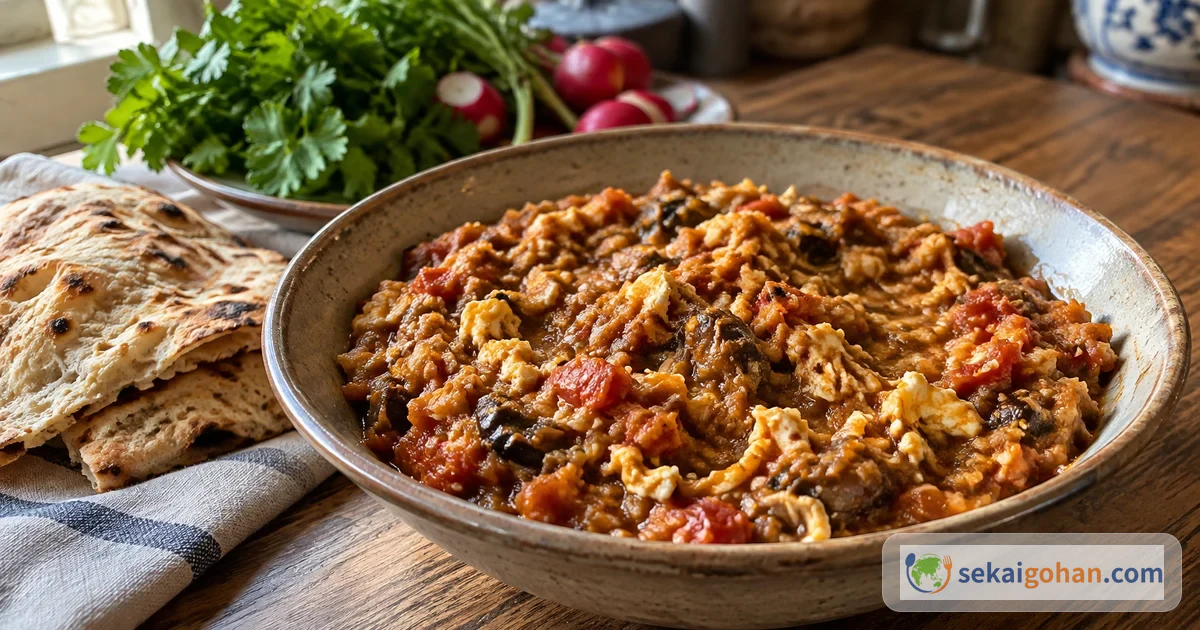
Trace the bottom of the pot with a wooden spoon. The trail should hold for about a second before the sauce slowly closes back in, and waiting for that thickness is what keeps fesenjan from turning into "a pomegranate-flavored chicken stew." Fesenjan is a Persian khoresh built on pomegranate and walnuts. The meat isn't the star. The sauce is: walnut oil and fine grains of walnut, the sourness of pomegranate, and white rice all meet in a single bite.

Fesenjan, a Persian pomegranate and walnut khoresh
A stew with many forms
Khoresh is the family of Persian stews served over rice, and fesenjan can be made with chicken, duck, or meatballs. It was never a single fixed recipe. An 1881 cookbook records ten kinds, made with walnuts, almonds, eggplant, beans, fruit, fish, and more. Duck and chicken versions sit side by side for the same reason: the dish has always changed with daily life.
Gilan style and the home version
Gilan cooking favors sourness, and there khoresh is served alongside rice. Gilan-style fesenjan uses pomegranate paste, walnuts, and poultry. It is rich and sour and traditionally made without sugar. Spoon a sugar-light pot over basmati in small amounts, and the sourness comes up before the meat.
A home version adds a little sugar to chicken so it sits more easily with rice. Neither is wrong. Stew it first, then match the sweetness and sourness to your own rice and side dishes.
Fesenjan on the Iranian table
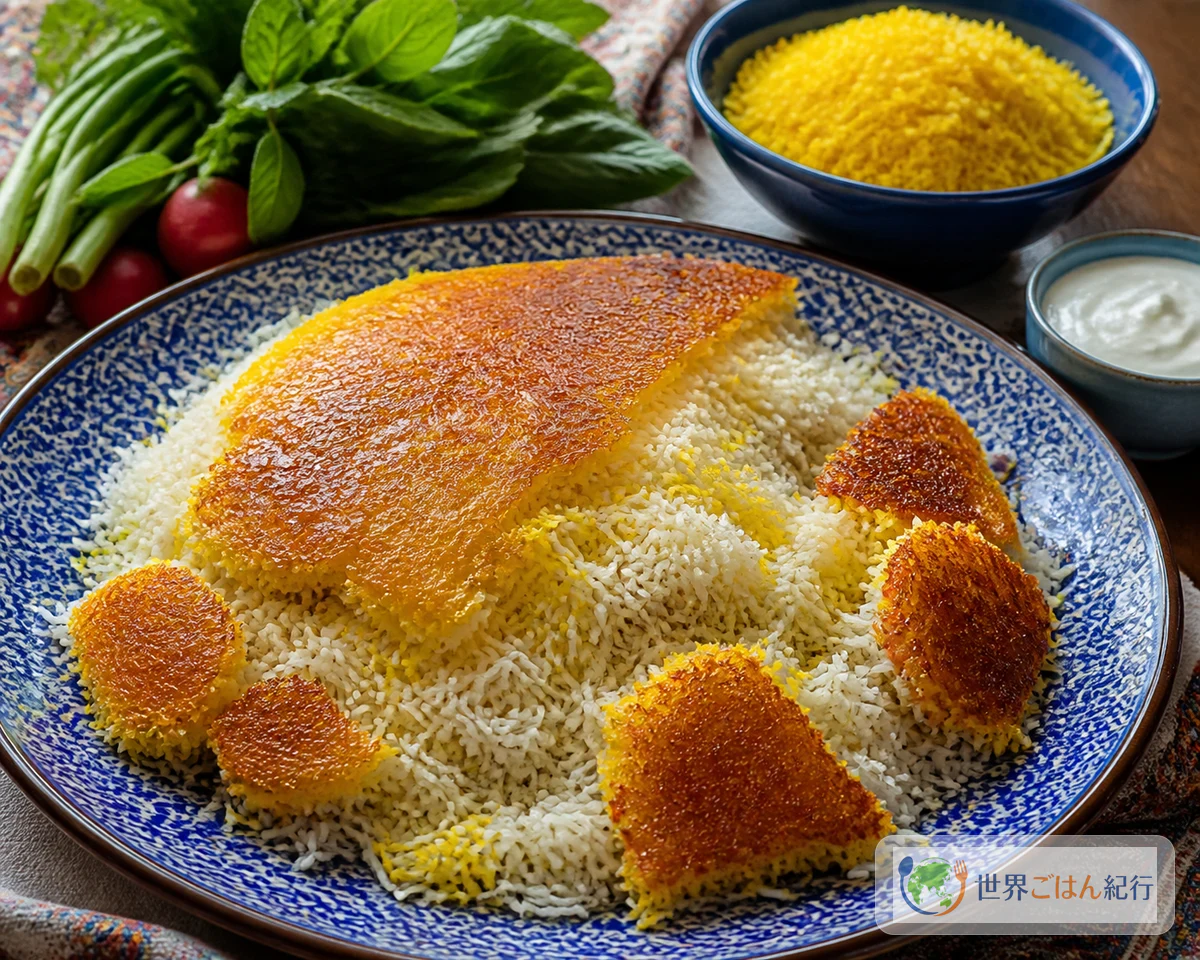
At the Iranian table, a meal is built by serving khoresh alongside rice, so the sauce is less something that wraps the meat than a layer of flavor passed to the rice. That is why it is reduced this far. Set fesenjan beside the golden rice dish tahchin, and you can see how a plate that makes rice the star differs from one that makes the sauce the star.

Pomegranate also appears on the table of Yalda, the winter solstice in Iran, when families gather at an elder's home around red fruits such as pomegranate and watermelon, nuts, and dried fruit. For more on the custom, see Yaldā and Chella. Fesenjan isn't only a Yalda dish, but pomegranate and walnuts clearly suit a festive table or a long night.
In English there are several spellings, such as Fesenjan, Fesenjoon, and Khoresh Fesenjan. When looking for products or recipes, "pomegranate walnut stew" is also a useful search term.
This recipe uses 8 oz (220 g) of walnuts. It is not suitable for people with a nut allergy. If you serve store-bought pomegranate molasses, stock, or yogurt alongside, check each one's ingredient label as well.
Ingredients (serves 4)
There are not many ingredients, but two have roles that are hard to replace. Walnuts give the sauce its oil and body, and pomegranate molasses is the core of the sourness. The chicken, onion, and rice can be put together from ordinary ingredients.

Reduce 1¼ cups (300 ml) of nearly unsweetened pomegranate juice in a small pot to about ½ cup (100 ml), then add 2 tsp lemon juice and 1 tsp sugar. It has less astringency than store-bought molasses, but you can match the direction of the sourness. If the drinking juice has a lot of sugar, taste before adding any sugar.
What is worth looking for when shopping
Buy pomegranate molasses and walnuts with care, since these two matter most. Pomegranate molasses sets the sourness, and walnuts set the body of the sauce. You don't need the most expensive brand. Check the ingredients, size, and shipping, and decide whether it is worth it for this one pot.
If you buy pomegranate molasses first, check whether a 14-ounce size is one bottle or a two-bottle set. Also compare the ingredients, price, stock, and shipping cost, including international shipping. Sizes can differ between sellers, so don't assume two products are the same just because the label size matches.
You don't need imported walnuts. Buy unsalted walnuts with no stale smell when the bag is opened, and make sure you can get 8 oz (220 g) at once. If only roasted ones are available, shorten the dry-toasting to about 1 minute. If you also bake or make salads, a 7 oz (200 g) bag labeled raw walnuts is a good choice.
You don't need special rice for this recipe. Choose basmati if you want its light texture to balance the thick sauce and can use the rest of 2.25 lb (1 kg) for other dishes. For one pot, ordinary rice cooked with a little less water is the easier choice. If you buy basmati, check the country of origin, size, any certification, and current price.
Choosing ingredients for fesenjan
Swapping duck for chicken is easy, and so is using your usual rice. What's hard to replace is the sourness of pomegranate and the walnut oil that moves into the sauce, so when shopping, focus on those two rather than on anything rare.

Pomegranate molasses
"Pomegranate molasses" and "pomegranate syrup" look alike but differ in sweetness and thickness. For fesenjan, choose one with pomegranate juice or pomegranate concentrate at the top of the ingredients, one that falls slowly off a spoon rather than pouring like a drink. If only a sweet syrup is available, omit the sugar in the recipe and adjust at the end.
The all-natural pomegranate molasses is a 12.5 oz (350 g) product made of 100% pomegranate juice. Sizes vary between sellers, so check the size, ingredients, and price where you buy.
To substitute juice, pick one that is nearly unsweetened and reduce it to about ½ cup (100 ml), then add lemon juice 1 tsp at a time at the end. Juice reduced too far scorches easily, and it's worth letting it cool before you measure it.
Walnuts
If the bag smells like stale frying oil the moment you open it, don't use them. 8 oz (220 g) looks like a lot, but the walnuts alone give this sauce its thickness; cut back too far and adding liquid won't bring it back. Unsalted raw walnuts are the standard. If yours are roasted, shorten the dry-toasting in Step 1. Salted ones make the final seasoning hard to read, since the salt spreads unevenly once crushed, so avoid them the first time.
A food processor is worth buying only if you regularly chop walnuts or aromatic vegetables in quantity; the larger models take real storage space. For one pot, a bag and a rolling pin, or a knife, will do.
Chicken or duck
In Gilan, duck and other poultry are cooked with pomegranate and walnuts. Duck skin renders fat and gives the sauce more body than chicken, so keep an eye on how much it releases. Chicken thighs for four on a weeknight, skin-on duck legs for special days: that balances ease of shopping with the character of the dish.
Rice
Basmati, whose grains stay separate, goes well with a thick sauce. If buying it would leave you with 2.25 lb (1 kg) for a single pot, ordinary rice cooked with a little less water is enough.
Method
Fesenjan is not a dish made by driving off moisture over high heat. You draw out the walnuts' oil, simmer the pomegranate sourness until it rounds, and finally bring it to a thickness that clings to rice. The peaks of the work are making the walnuts fine and not scorching the bottom of the pot.
Step 1: Grind the walnuts fine and dry-toast them (10 minutes)

Grind 8 oz (220 g) walnuts finely in a food processor. The target is slightly finer than breadcrumbs, grains that hold together moistly when pinched. Turning them into a paste makes the sauce heavy, so pulse a few seconds at a time and check.
For a single pot, you can also put them in a heavy bag and crush them with a rolling pin or chop them with a knife. Even if some grains remain, the dish works if simmered over low heat.
Put a skillet over medium-low heat and dry-toast the walnuts for 3–4 minutes. They do not need to darken. Turn off the heat when the aroma rises and the surface has loosened a little. Scorched bitterness does not disappear in the stew, so watch the aroma rather than the color.
Step 2: Sear the chicken (8 minutes)

Season 1.5 lb (700 g) chicken with 1/2 tsp salt, a little black pepper, and 1/2 tsp turmeric. Put 1 tbsp neutral oil in a heavy pot and warm over medium heat. Add the chicken and sear 3 minutes per side, starting skin side down if it has skin.
It does not need to cook through to the center. Take it out when the surface has a light browning. The browning on the bottom of the pot becomes the base of the sauce, but black scorching turns to bitterness, so remove it here if you find any.
Step 3: Combine the onion and walnuts (12 minutes)

In the same pot, put 1 finely chopped onion and cook over medium-low heat for 7–8 minutes. When it turns translucent and gives off a sweet aroma, add the dry-toasted walnuts and 1/4 tsp cinnamon.
Add ½ cup (100 ml) water and mix, tracing the bottom of the pot with a wooden spoon. Walnuts suddenly get heavy once they absorb water, so lower the heat if the bottom looks about to dry out. Move on when the onion and walnuts move like damp sand rather than one thick paste.
Step 4: Add the pomegranate molasses and water (5 minutes)

Add 5 tbsp pomegranate molasses and 2 cups (500 ml) water or chicken stock. Mix from the bottom, breaking up the lumps of walnut. It is fine when the sauce is an even pale brown, flows smoothly off the spoon, and no large lumps remain.
When it boils, lower to low heat so that only the edge of the pot trembles slightly. The sourness will be strong at this point. Adding sugar now makes it hard to judge the thickness after stewing.
Step 5: Return the chicken and simmer (60–75 minutes)

Return the seared chicken to the pot. With the lid slightly ajar, simmer 60–75 minutes over low heat. Every 10–15 minutes, stir gently from the bottom. When turning the chicken too, do not break the meat; just guide the wooden spoon along the bottom.
If the liquid reduces so far that you can see the bottom, add water 2–3 tbsp at a time. The finish is not a soup but a sauce that slowly clings to rice. Move on to the final adjustments when the thick parts of the chicken are cooked through and a little walnut oil floats on the surface.
Step 6: Adjust sweetness, sourness, and salt (10 minutes)

Add 2 tsp sugar and taste. Only if the edge of the sourness remains, increase by 1 tsp at a time, with 1 tbsp as the upper guide. Do not add the remaining 1 tsp salt at once; add it a pinch at a time.
Trace the bottom of the pot with the wooden spoon: if the trail stays about a second, it is done. If too thick, add water 1 tbsp at a time; if thin, remove the lid and reduce a few minutes at a time. Scatter with pomegranate seeds and spoon over saffron rice or white basmati.
The walnut grains sink to the bottom of the pot easily and scorch first over high heat. If a burnt smell appears, don't scrape the bottom. Move only the sauce and chicken above into another pot. Stirring the blackened part back in lets the bitterness overpower the sourness.
Fixing common fesenjan problems
Most fesenjan failures come from rushing the thickness, not from the flavor. Too thin, and the rice can't hold the sauce; reduced too far, and the walnuts scorch on the bottom. Before you fix the taste, check the trail of the wooden spoon and the bottom of the pot.

Too sour
First simmer 10 minutes over low heat; the sourness softens once the walnut oil and liquid blend in. If it is still sharp, add sugar 1 tsp at a time, and stop once the edge is rounded, well before it turns into a sweet dish.
Too sweet
Add lemon juice or pomegranate molasses 1 tsp at a time, add a pinch of salt, and then judge. Adding only sourness can make the flavor thin, so check at the same time whether it needs salt.
Grainy sauce
Grains in the sauce mean the walnuts were ground too coarsely. Stirring the whole pot hard would break up the chicken, so take out one ladleful of sauce, smooth it with an immersion blender, and return it. Next time, grind a little finer, stopping before it becomes a paste.
Little oil on the surface
Not much oil on top isn't a failure in itself. How much comes out depends on the type, roasting, and grain size of the walnuts. If the sauce clings slowly to rice and the sourness and salt are balanced, it's done. Before adding oil, take the lid off and simmer just 10 minutes over low heat.
Fesenjan variations, serving, and storage
Fesenjan changes not only in how sweet or sour it is but in what the sauce holds. Decide first whether you're aiming for the sour Gilan style or a weeknight meal with chicken and a little sugar; the variations follow from there.
| Axis of eating | What happens in the pot | Judgment at home |
|---|---|---|
| Gilan-leaning | Stronger sourness, less sugar | A day you can get duck or poultry; cook the rice lightly |
| Home chicken version | Chicken thighs and a little sugar for roundness | Weeknight for four, with yogurt alongside |
| Eggplant form | No meat; grilled eggplant absorbs the sauce | A day you don't buy meat; cook the onion longer |

Rich duck fesenjan
With duck legs, the walnut oil and duck fat combine. Sear the skin side first, and if a lot of fat comes out, leave about 1 tbsp and discard the rest before simmering. Duck pairs well with pomegranate's sourness, so don't bury it under sugar.
Fesenjan with meatballs
Mix onion, salt, and pepper into ground beef or a beef-and-pork mix, shape small meatballs, and simmer them in the sauce. Doneness is easier to see than with chicken, and they're easy to portion. Lower the heat before adding them so they hold together in the pot.
Eggplant fesenjan
There is also a version without meat, where thickly cut eggplant is grilled and added. Grilling first keeps the eggplant from turning watery and helps it soak up the sauce. Without meat for savor, the onion needs to be cooked to a golden brown.
Sweeter or more sour
The recipe as written sits at a middle point that goes easily with rice and unsweetened yogurt. To go sour, hold the sugar to 1 tsp and add 2 tsp more molasses. Even for a sweeter pot, keep the sugar to 1 tbsp and taste at the end; sweeten early and you'll misread the flavor once the walnut oil comes out.
Serving fesenjan
Set out white basmati rice, unsweetened yogurt, and small plates of cucumber and tomato, and you have a table that can take the thick sauce. Borani, grilled eggplant with yogurt, adds coolness after the sourness. And beside the golden tahchin and the green ghormeh sabzi, made with dried lime, the plain brown of fesenjan becomes the center of the table once it's spooned over white rice.

Beside a thick stew, set a salad of cucumber, tomato, and onion tossed with lemon and salt, unsweetened yogurt, and herbs. For one more dish, a small sour, herby plate such as tabbouleh catches the heaviness of the sauce.
Storage and reheating
Keep the sauce and rice in separate containers. Rice left in the sauce absorbs moisture and stays heavy even after reheating.

As fesenjan cools, the sourness and walnut oil blend. If making it the day before, cool slightly and refrigerate, then the next day add 2–4 tbsp water and warm over low heat. After warming, recheck the sugar and salt.
Once cooled slightly, move it to a shallow container, refrigerate, and eat within 2–3 days. To freeze, portion by serving and use within 2–3 weeks. Thaw in the refrigerator, then warm in a small pot with 2–4 tbsp water or chicken stock. In the microwave, stir once partway and check that the center is hot all the way through.
Cold sauce looks stiff but loosens as it warms, so add liquid 1 tbsp at a time over low heat rather than a lot at once. At the end, taste for sourness, salt, and thickness, and add a pinch of sugar if needed. Leftover sauce is also good on grilled eggplant, steamed pumpkin, and roasted chicken, which helps if you're wondering whether you'll use up a bottle of pomegranate molasses.
Frequently asked questions

Q1. Can I make it without pomegranate molasses?
Yes. The closest substitute is nearly unsweetened pomegranate juice reduced to about ½ cup (100 ml), with a little lemon juice and sugar. Balsamic vinegar or blueberry jam on its own changes the sourness and aroma, so stick with pomegranate juice.
Q2. Can I reduce the walnuts?
You can go down to about 6.5 oz (180 g), but the sauce loses some body. Halved, it's hard to get the thickness even with less liquid, and the oil layer typical of fesenjan is harder to see. Keeping the walnuts is better for the flavor than making up the thickness with flour.
Q3. Can I make it with chicken breast?
Yes. After searing, take it out, simmer only the sauce for about 45 minutes, then return the breast for the last 20 minutes. Breast cooks faster than thigh, so stop as soon as it's cooked through to the center. The first time, thigh stands up better to the thick sauce.
Q4. What do I do when eating with children?
There's no chili, but the sourness of pomegranate and richness of walnuts are noticeable. A little more sugar, plus extra rice and unsweetened yogurt, makes it easier for children. It contains walnuts, so do not serve it to anyone with a nut allergy.
Q5. What should I serve with it?
White long-grain rice, unsweetened yogurt, and a cucumber and tomato salad are the basics. Add hummus as an appetizer, kebab as a savory meat dish, or machboos to compare rice dishes, and the regional differences in rice and stews come into view.