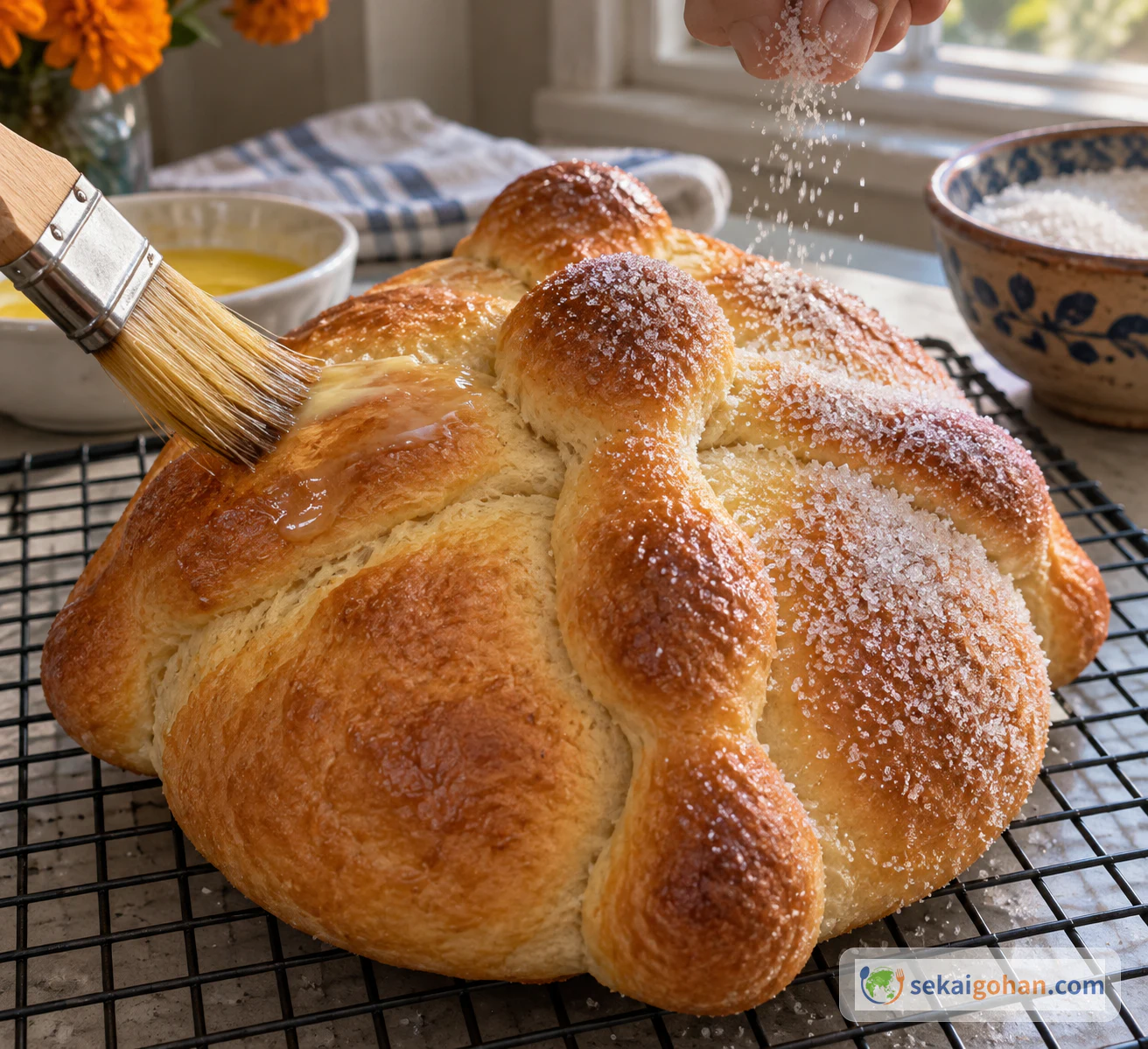
Pan de Muerto: Orange and Anise Bread for Mexico's Day of the Dead

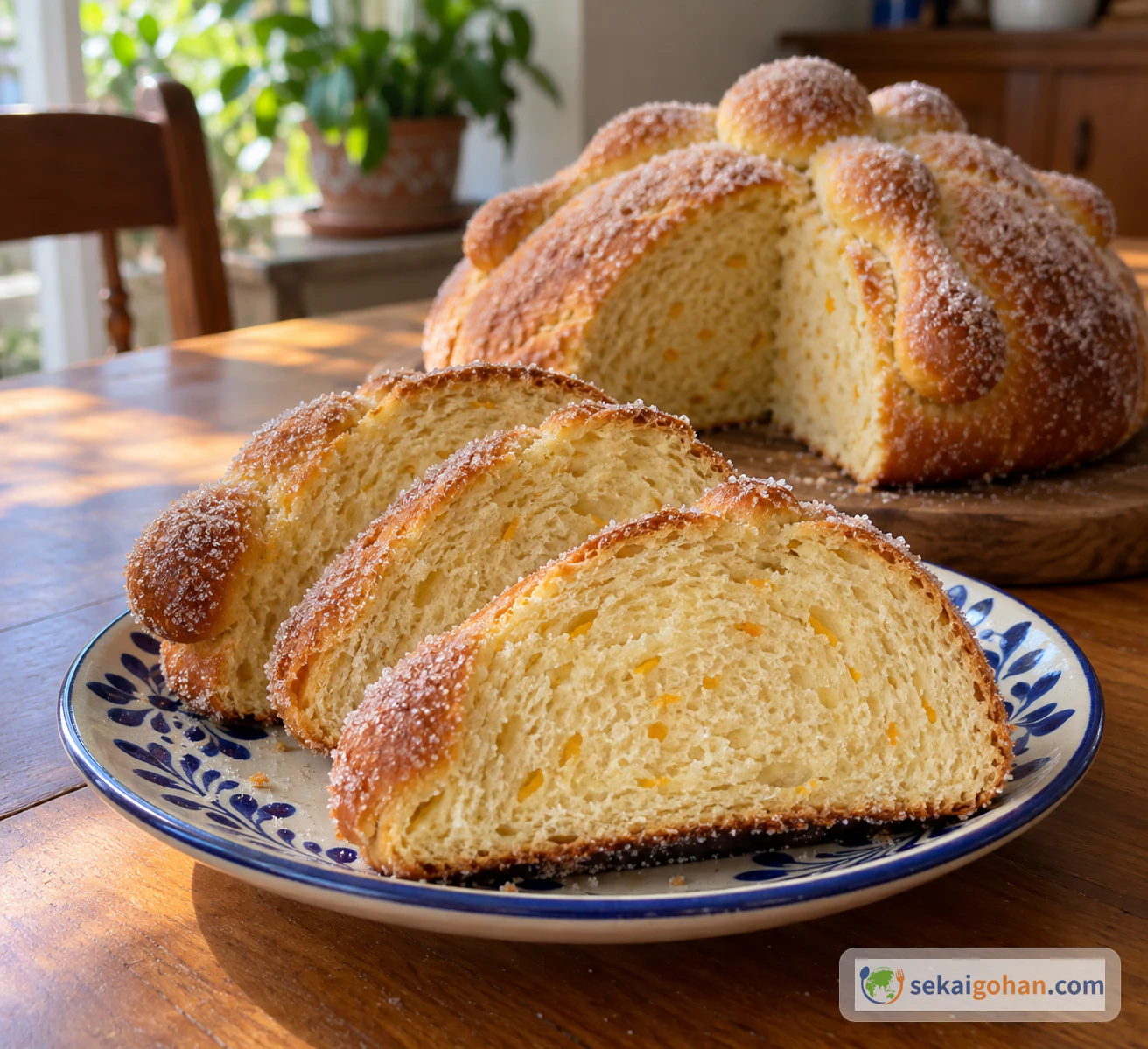
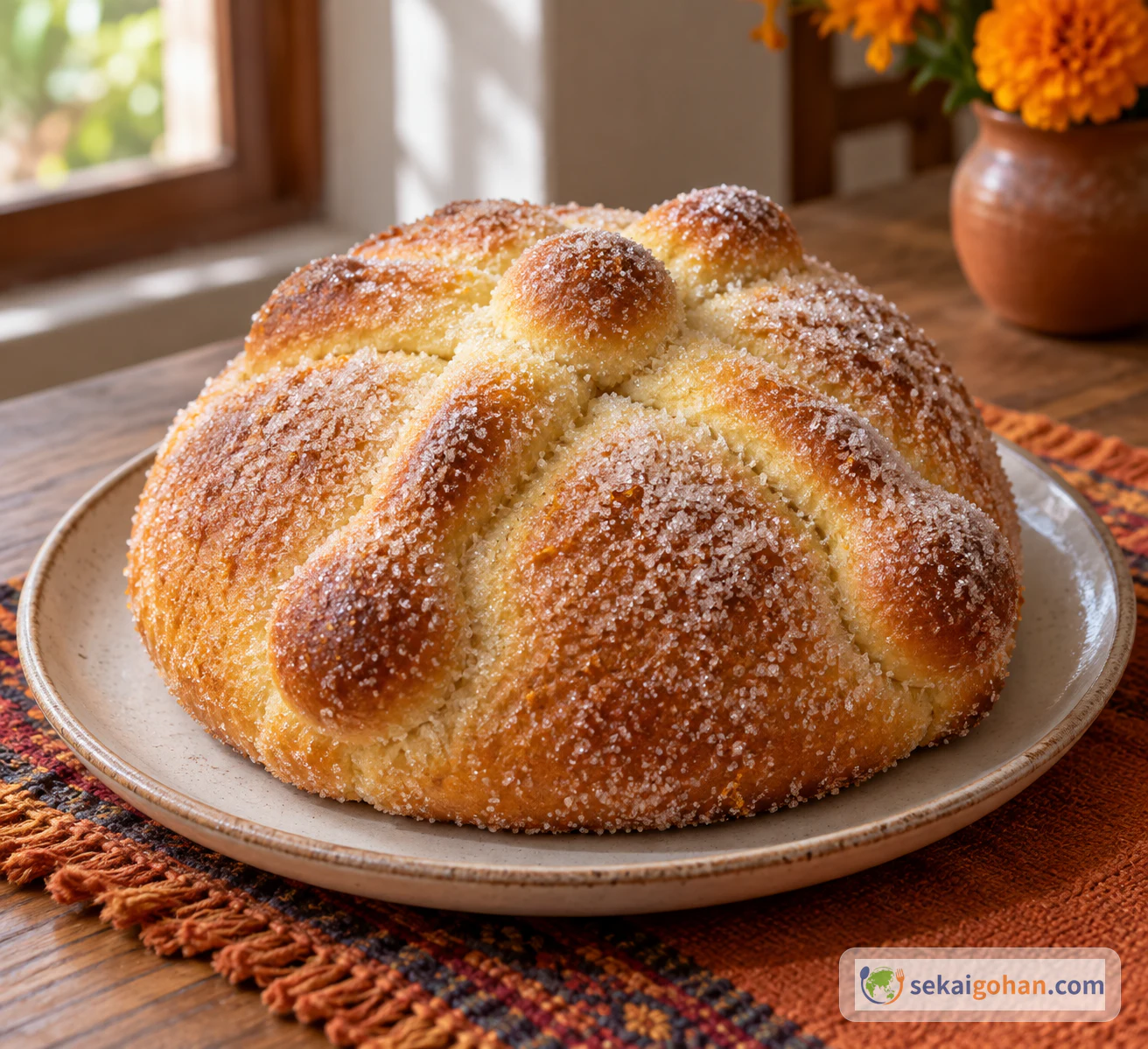
A round, sugar-coated pan de muerto with dough bones crossed over the top
Serves
2 round loaves, about 8 inches (about 20 cm) across
Cuisine
Mexican

How to make pan de muerto, the sugar-coated sweet bread of Mexico's Día de Muertos, in the round, bone-decorated style familiar from central Mexico. Covers what each ingredient does, the long rise and overnight chill, shaping the bones, judging doneness, choosing ingredients, and how the bread differs across Mexico.

Cooking flow

Cooking steps

STEP11 / 10

Make the preferment

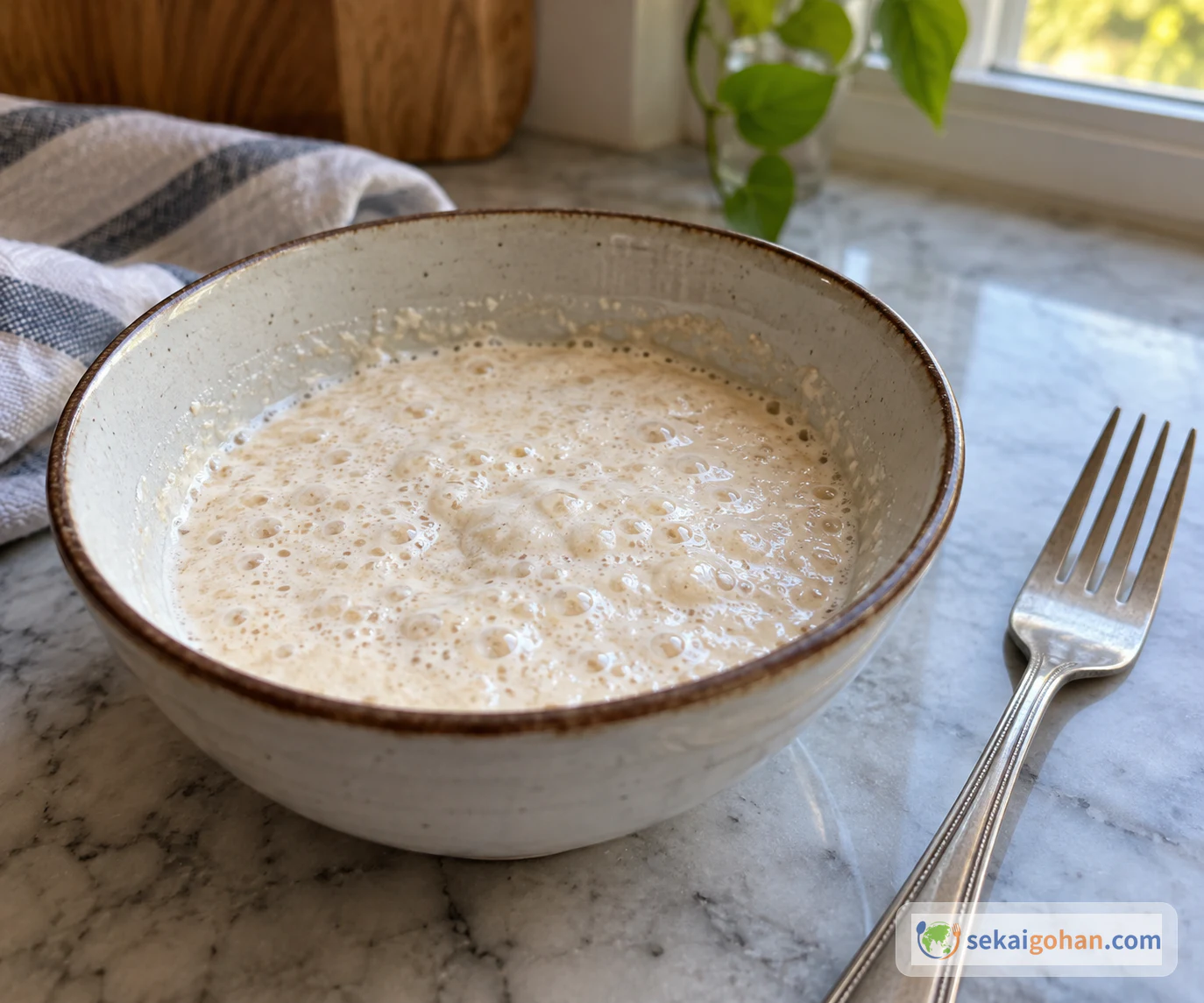
A preferment of milk, yeast, a little sugar and flour, just starting to bubble
Move on once small bubbles begin to form

In a bowl, mix 1/2 cup (113g) lukewarm milk, 1 tbsp instant yeast, 1 tsp sugar and 1/2 cup (60g) bread flour. Cover and leave for 20–25 minutes, until bubbles start to appear on the surface.

If no bubbles appear, check that your yeast is active before going on.

STEP22 / 10

Mix and knead the dough, without the butter

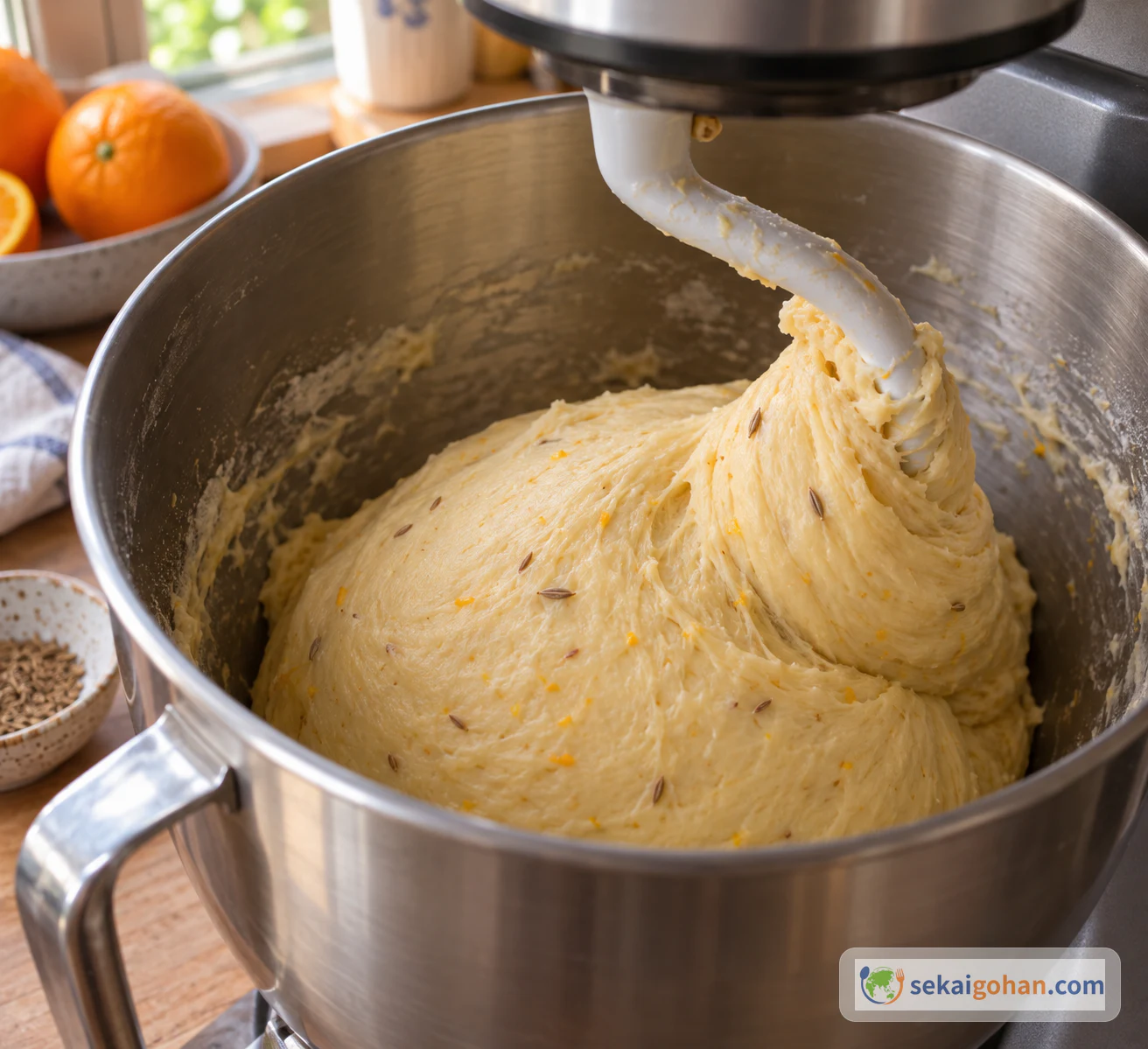
Dough of the preferment, eggs, flour, sugar, orange zest and anise, before any butter is added
Knead until the dough pulls away from the sides of the bowl

Add the orange blossom water (or water), orange zest, anise seeds, 3 1/2 cups (420g) bread flour, salt, 1/2 cup (99g) sugar and the 4 eggs to the preferment. Mix on low speed until combined. Keep the butter aside for now.

Switch to medium speed and knead with the dough hook for 10–12 minutes, until the dough pulls away from the sides of the bowl and you can hear it slapping against the bowl.

STEP33 / 10

Add the butter a little at a time

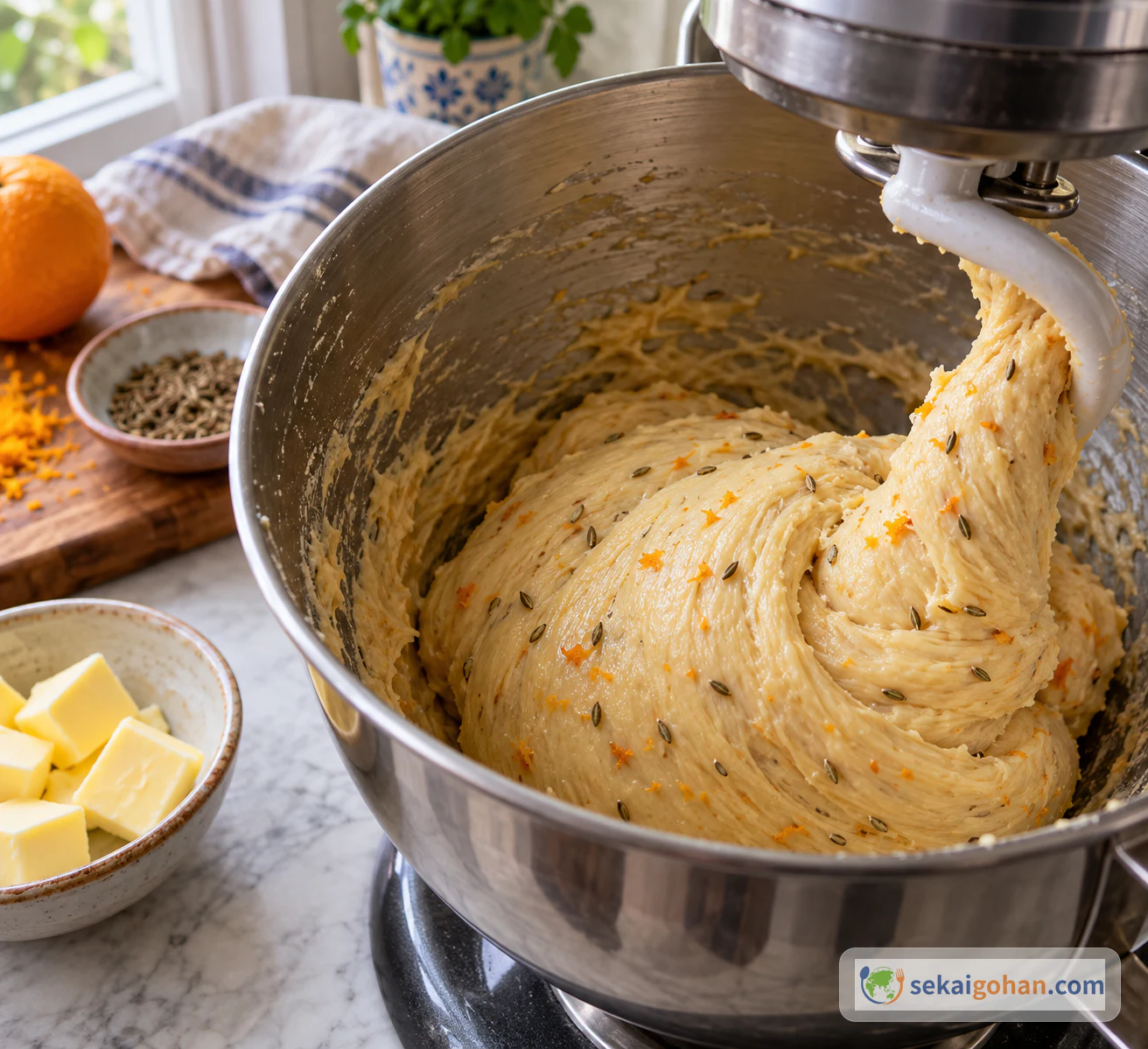
Smooth, slightly sticky dough after room-temperature butter cubes have been worked in gradually
Add the next piece of butter only after the last has disappeared into the dough

With the mixer on low, add the 8 oz (226g) of room-temperature butter cubes about 3 tbsp at a time. Wait until each addition is fully worked in before adding the next. Once all the butter is in, knead on medium speed for 8–10 more minutes.

The dough should be smooth but still a little sticky. That is how it is meant to be; do not add flour.

STEP44 / 10

Let the dough rise

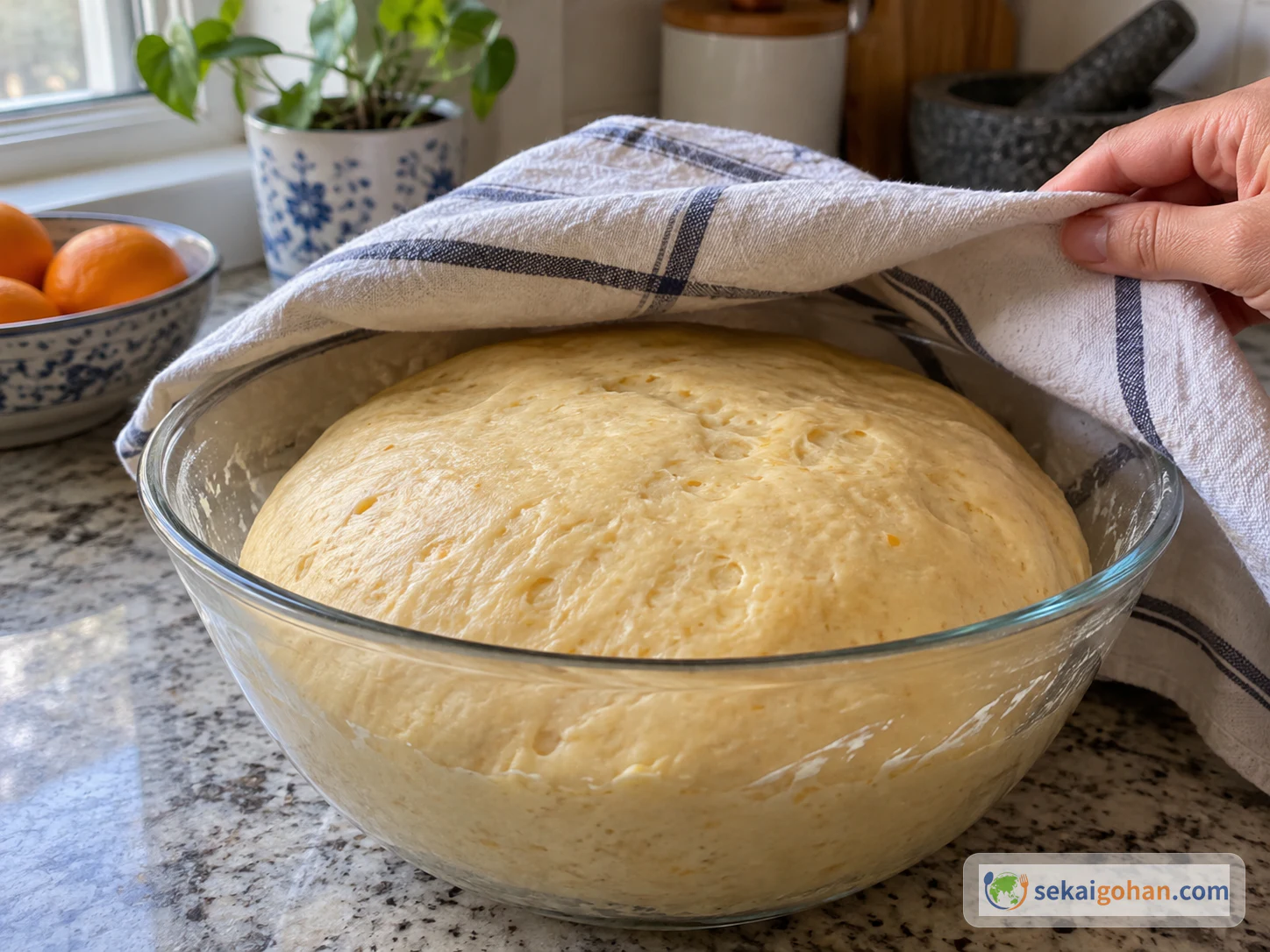
Pan de muerto dough risen to nearly double in a lightly oiled bowl
Judge the first rise by volume: nearly doubled

Shape the dough into a ball and put it in a lightly oiled bowl. Cover and let it rise until nearly doubled, about 1 1/2 to 2 hours. A warm kitchen speeds this up; a cool one slows it down.

STEP55 / 10

Fold and refrigerate

STEP 5

Gently fold the surface of the dough over itself, return it to the bowl and cover. Refrigerate for at least 4 hours or overnight. Don't go straight to shaping.

STEP66 / 10

Bring to room temperature and divide

STEP 6

Take the dough out of the refrigerator and leave it at room temperature for 30–45 minutes.

Cut off about a quarter of the dough, about 10 oz (280g), for the decorations and divide it into two portions. Divide the remaining dough into two pieces of about 15 oz (425g) each. Don't trim or add dough to make them exact.

STEP77 / 10

Shape the loaves and the bones

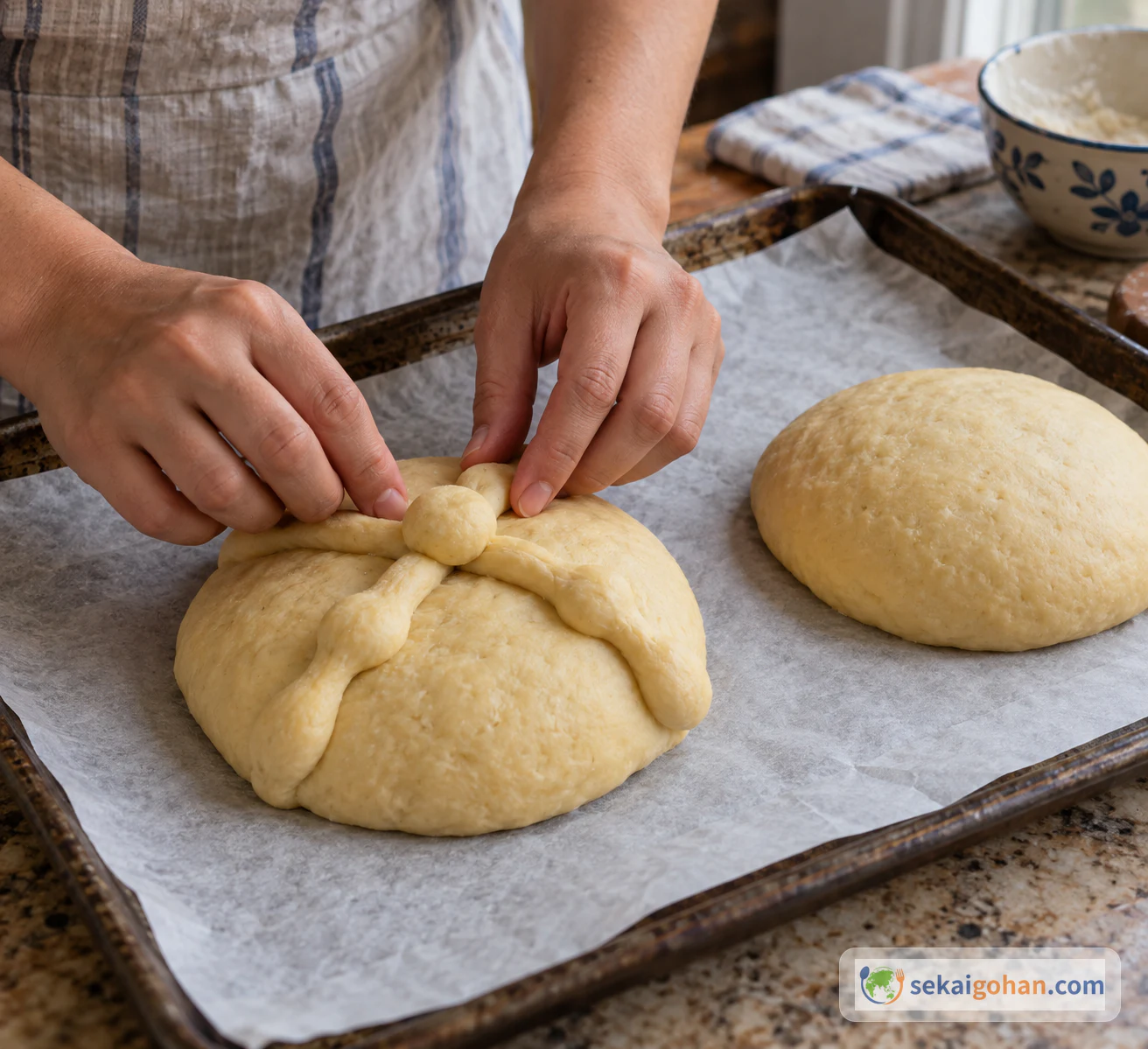
Two bone-shaped ropes crossed on a flattened round of dough, with a small ball pressed onto the center
Press the center ball down firmly so the crossed bones stay attached

Round each 15 oz (425g) piece into a ball, then press it gently into a flat circle about 6 inches across. Place both on the parchment-lined baking sheet.

From the decoration dough, make 2 small balls. Roll the rest into 4 ropes, each 6–7 inches long. Press into each rope at intervals so it looks like a bone.

Lay 2 ropes across each loaf so they cross in the middle. Press a small ball firmly onto the center of each, where the ropes cross, to hold them in place. No egg wash is needed; just press firmly.

STEP88 / 10

Let the loaves rise and preheat the oven

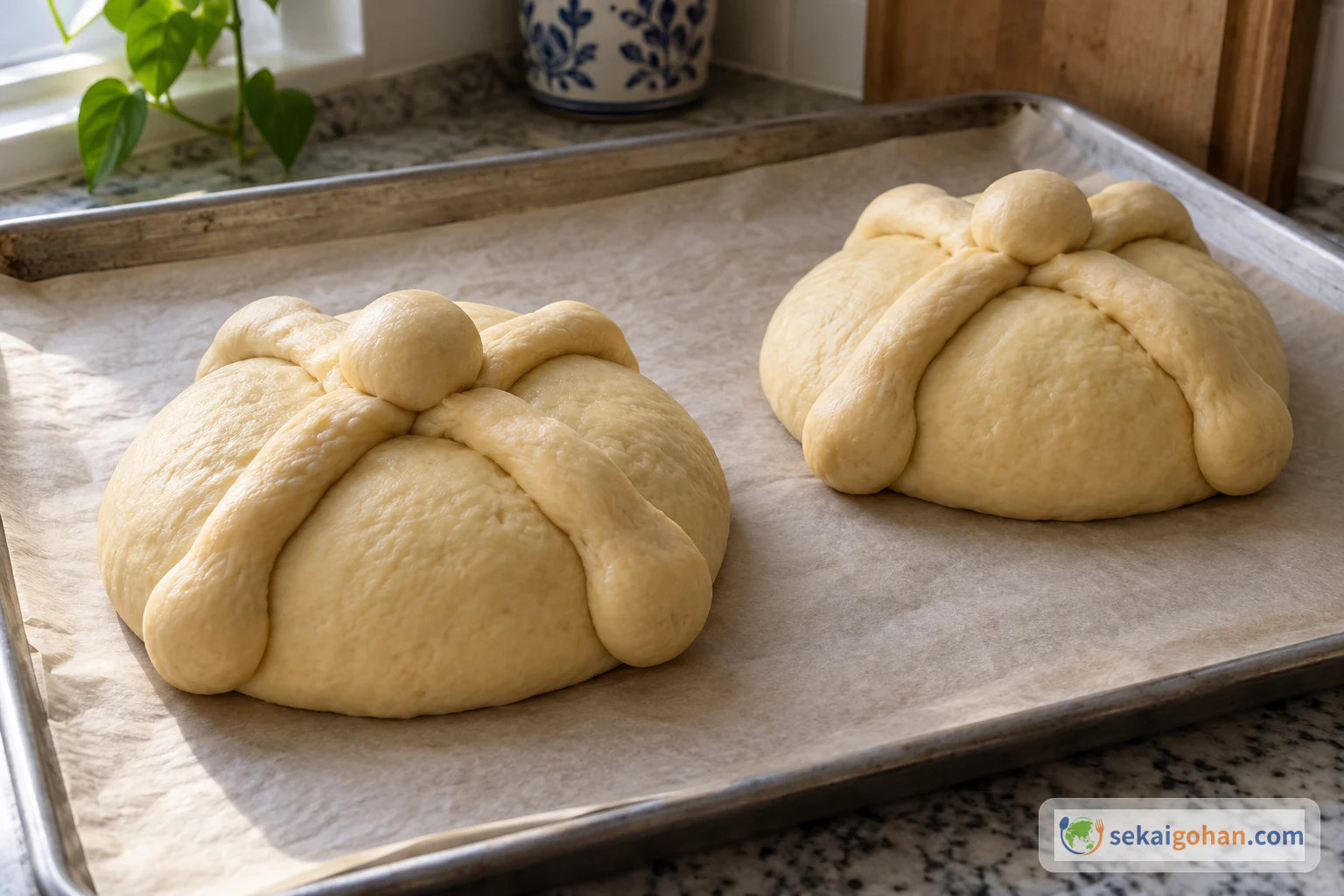
Two risen, unbaked pan de muerto loaves on a baking sheet, each with crossed bones and a center ball
After the second rise, check that the decorations are still firmly attached

Cover the loaves and leave them in a warm place until roughly doubled, 1 to 1 1/2 hours. While they rise, preheat the oven to 350°F.

Before baking, check that the center balls and the crossed bones are still pressed onto the loaves.

STEP99 / 10

Bake, tenting with foil

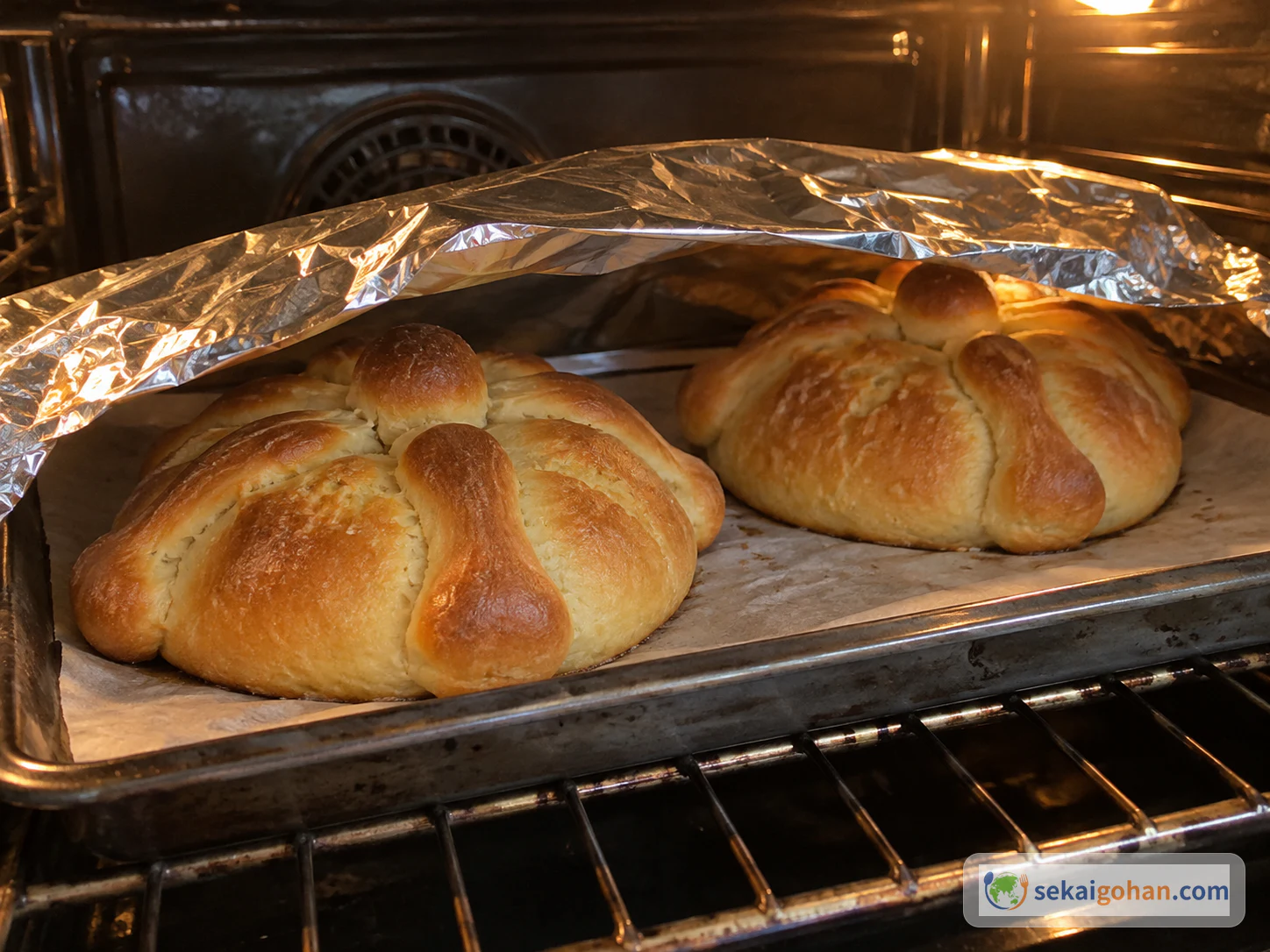
Pan de muerto partway through baking, loosely tented with aluminum foil so the tops don't burn
Tent with foil once the tops are lightly colored

Bake for 20 minutes, until the tops are lightly colored. Then cover the loaves loosely with aluminum foil and bake for another 20–25 minutes, until the tops and bottoms are a deep golden brown and the center of the bread reads 190°F.

STEP1010 / 10

Finish with butter and sugar

Brushing a baked loaf with melted butter and immediately sprinkling it with sugar
Butter one section at a time and sugar it right away, while the surface is still wet

Let the loaves cool on the baking sheet for about 20 minutes. Brush one section of a loaf with the melted 3 oz (85g) of butter and immediately sprinkle sugar from the 2.25 oz (66g) portion over that same section. Repeat, section by section, until the whole loaf is coated, then do the second loaf.

Move the loaves to a cooling rack and let them cool completely.

0 / 0
Ingredients

Ingredients

1 / 1

Ingredients

Ingredient Amount Role
Milk, lukewarm (whole milk preferred) 1/2 cup (113g) For the preferment. Warm, not hot
Instant yeast 1 tbsp For the preferment
Granulated sugar 1 tsp For the preferment, with the yeast
Bread flour 1/2 cup (60g) For the preferment
Orange blossom water (or rose water, or water) 2 tbsp For the dough. Aroma
Orange zest 2 tsp For the dough. Citrus aroma. Grate only the colored skin, not the white pith
Anise seeds 1 1/2 tsp For the dough. Sweet aroma
Bread flour 3 1/2 cups (420g) For the dough. The main body of the bread (480g flour in total with the preferment)
Table salt 1 tsp For the dough. Balances the sweetness
Granulated sugar 1/2 cup (99g) For the dough. Sweetness
Large eggs 4 For the dough. Richness
Unsalted butter, room temperature, cut into 1/2-inch cubes 16 tbsp (226g) For the dough. Added a little at a time
Unsalted butter, melted 6 tbsp (85g) For the finish. Brushed on after baking
Granulated sugar 1/3 cup (66g) For the finish. Sprinkled onto the buttered surface; you may not need all of it
0 / 0

Around November 1 and 2, during Día de Muertos, round sweet breads scented with citrus and anise turn up all over Mexico. Pan de muerto, "bread of the dead," has a soft, rich crumb flavored with orange and anise. Two dough bones cross on top, a small ball holds them in place, and a crust of butter and sugar covers the whole loaf. To get there, let the dough stay slightly sticky and give the long rest the time it needs.

Pan de Muerto on the Ofrenda and Across Mexico

Pan de muerto belongs both to the ofrenda and to the family table. It is set on the ofrenda, the offering prepared to welcome those who have died, and it is also cut and shared at home. This recipe makes the round loaf familiar from central Mexico, and the crossed dough bones on top are its most recognizable feature. The bread carries a range of meanings.

Nobody agrees on where the bread comes from, and several stories compete. There is little historical evidence for the bread under its present name and form, but the modern recipe and shape appear in a 1938 cookbook and in a 1951 painting. Older Mexican sweet-bread recipes share its flavorings and finishing touches. Its history is best read as a mix of influences, not a single pre-Hispanic origin.

The sugar, butter and orange of the central style aren't found everywhere in Mexico. Seasonal breads take many shapes and names, often with local meanings. The Chinantec people of Oaxaca make mermaid-shaped breads, and in Alcozauca, Guerrero, the bread is decorated in red. Some households decorate their loaf with a skull and bones and treat proofing and shaping as a family practice. For more of the country's cooking, see the Mexico country page.

This recipe makes two loaves about 8 inches (about 20 cm) across. It starts with a small yeasted preferment, enriches the dough with eggs and butter, and gives it a long cold rest. Plan on about 11 hours from start to finish: roughly 50 minutes of hands-on work and 40–45 minutes of baking. Most of that time goes to rising and chilling. Kitchens and ovens vary, so trust the signs of readiness in each step along with the clock.

Ingredients for Two Loaves
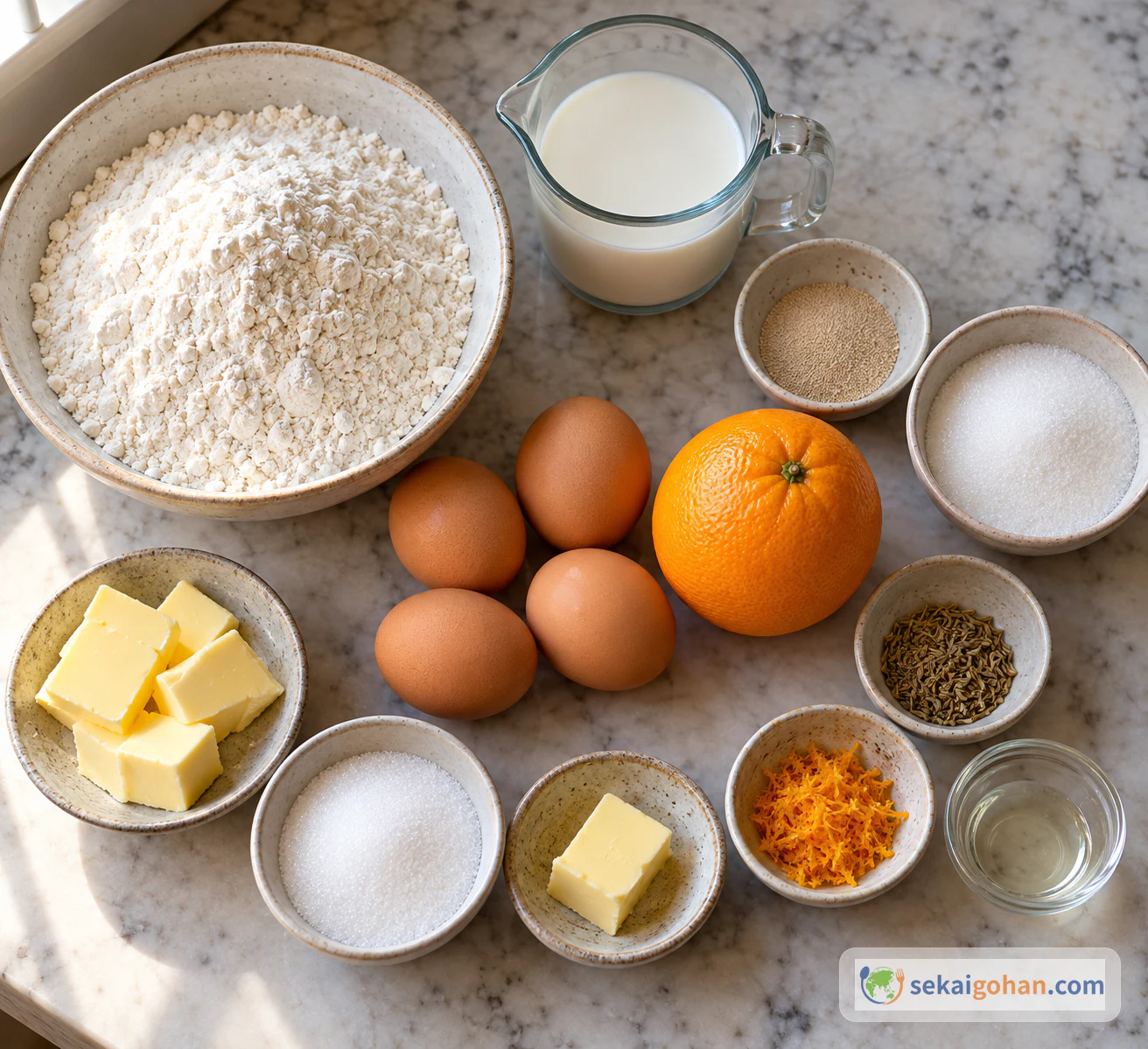
Bread flour, milk, eggs, butter, sugar, an orange and anise seeds for pan de muerto dough and topping
Butter and sugar are measured twice: once for the dough, once for the finish

Butter and sugar each appear twice: one portion goes into the dough and a separate portion is used for the finish. Keep them in separate bowls so they don't get mixed up.

Equipment

  • Stand mixer with a dough hook
  • Kitchen scale
  • Mixing bowl for the preferment, and a larger bowl for rising, lightly oiled
  • Cover for the bowl
  • Bench scraper, for dividing and shaping
  • Baking sheet lined with parchment
  • Aluminum foil, for tenting during baking
  • Digital probe thermometer, for checking the center of the loaves
  • Oven thermometer, for checking the actual oven temperature
  • Pastry brush
  • Cooling rack

Choosing Ingredients for Pan de Muerto

You'll find most of what you need at the supermarket: bread flour, milk, eggs, unsalted butter, oranges and anise seeds. Buy whole anise seeds. Star anise and fennel are different spices and won't give the same flavor.

Orange blossom water can be harder to track down. Try a baking supply shop or order it online. It layers nicely with the orange zest and anise. If you can't find it, use the same 2 tbsp of plain water, and the zest and anise will come through more quietly. Rose water also works, but it pulls the aroma away from citrus and toward something distinctly floral.

Allergens and hygiene

This bread contains wheat, milk and eggs. Check the labels of the products you buy for other allergens and shared-facility statements. The dough contains raw egg, so wash your hands, the mixer bowl and your tools after handling it.

How to Make Pan de Muerto

Plan the timing

The dough rests in the refrigerator for at least 4 hours or overnight before shaping, so it is easiest to mix it one day and shape and bake the next. Rising times depend on how warm your kitchen is; watch the dough as well as the clock.

Oven temperatures

The temperatures here are given in Fahrenheit. If your oven is set in Celsius, convert carefully, and check the real temperature with an oven thermometer, since home ovens often differ from their dial. The 190°F reading in the center and a deep golden color are better signs of doneness than the timer alone.

Pan de Muerto Troubleshooting

Problem Likely cause What to do
No bubbles on the preferment Inactive yeast, or milk that was too hot Check that the yeast is active before making the dough. Warm the milk only to lukewarm
The dough is slow to rise A cool kitchen Go by volume, not the clock: nearly doubled for the first rise, roughly doubled for the second
The dough feels sticky This is the intended texture Don't add flour. Use a bench scraper for handling
The butter won't blend in Too much added at once, or butter too cold Add about 3 tbsp at a time, with the butter at room temperature, and wait for each addition to disappear
The bones lift or the center ball slides off Not pressed on firmly enough Press the ball firmly where the ropes cross when shaping, and check again before baking
The top is browning too fast Oven running hot Tent with foil once the top is lightly colored, and check the oven with a thermometer

Serving and Storing Pan de Muerto

Thick slices of sugar-coated pan de muerto showing a fine, soft crumb
Cut into slices, the sweet crumb shows flecks of orange zest

On the ofrenda, the loaf goes out whole. At the table, cut it into thick slices so every piece gets some of the sugared crust. Once the loaves have cooled completely, wrap them and keep them at room temperature for a few days.

The quantities are set for two loaves. If you want just one, you'll need to rework every ingredient, the decoration dough and the baking together.

Frequently Asked Questions

Can I leave out the anise?

You can, but the aroma will change. If you want a replacement, skip star anise and fennel, which taste different.

Can I skip the refrigerator rest?

No. The dough needs at least 4 hours, or overnight, in the refrigerator before shaping.

Can I knead by hand?

The method is written for a stand mixer with a dough hook, because the dough needs long kneading and stays slightly sticky.

How do I know it's ready?

Watch for the signs in each step: bubbles, volume, color and a center temperature of 190°F.
Sources