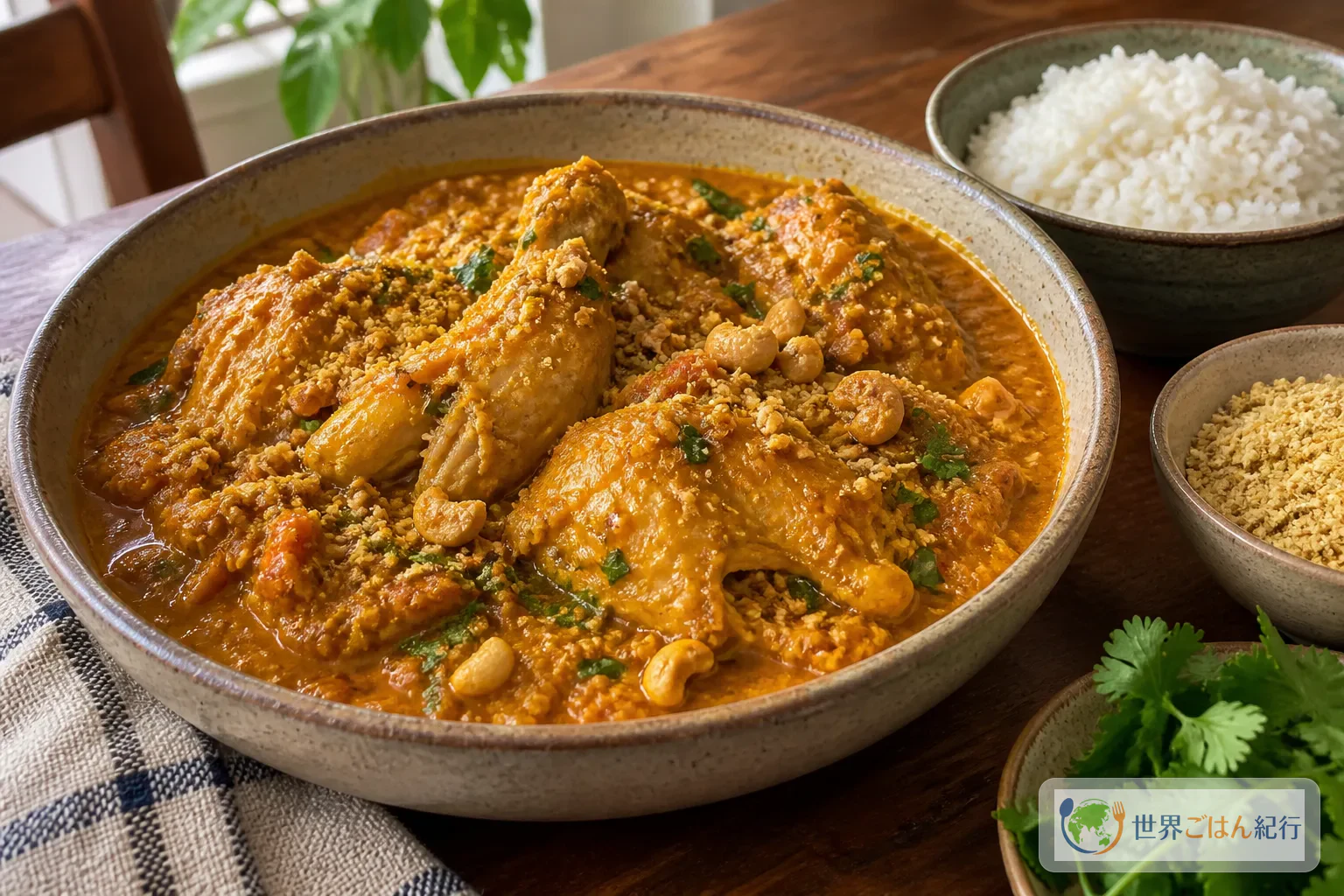
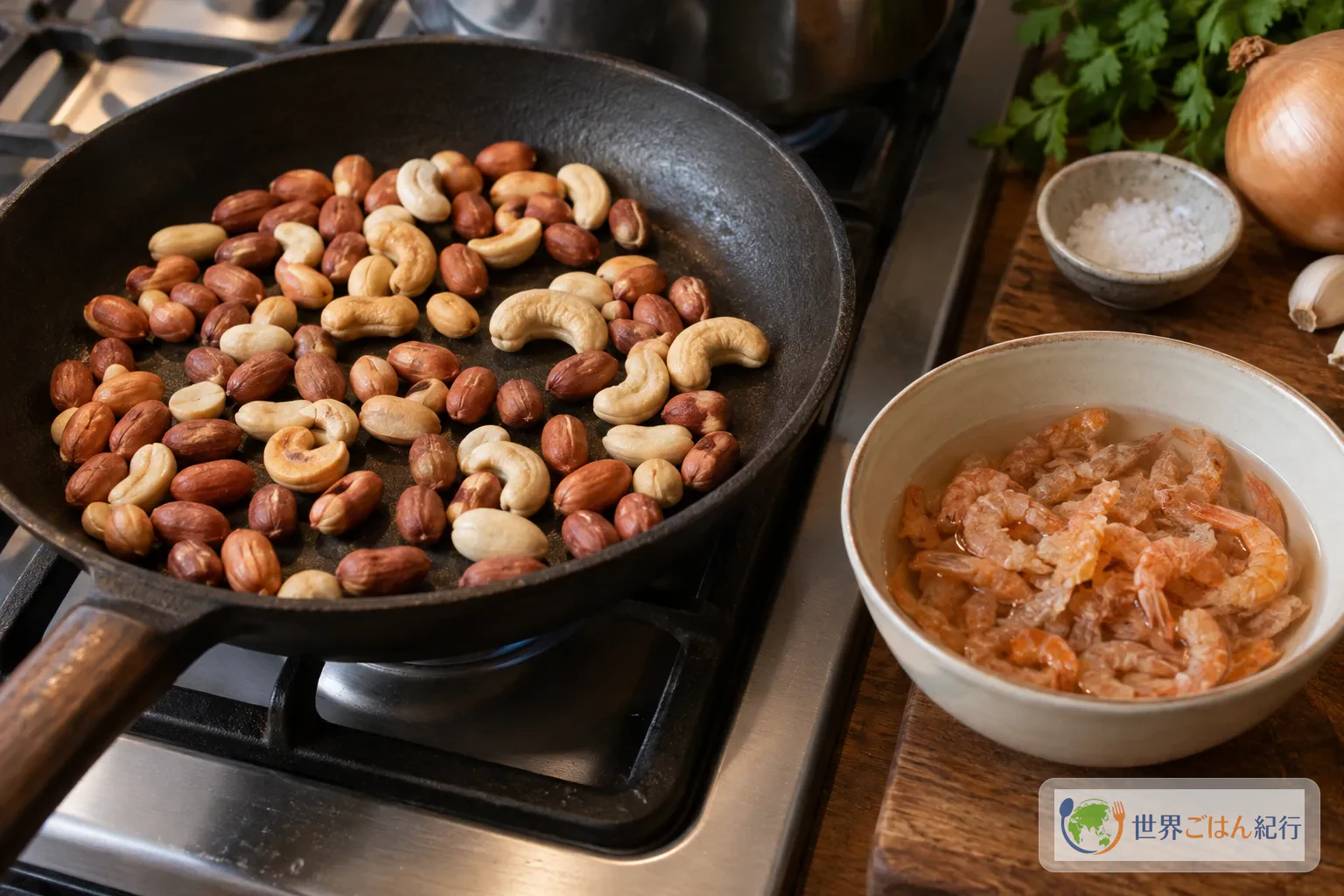
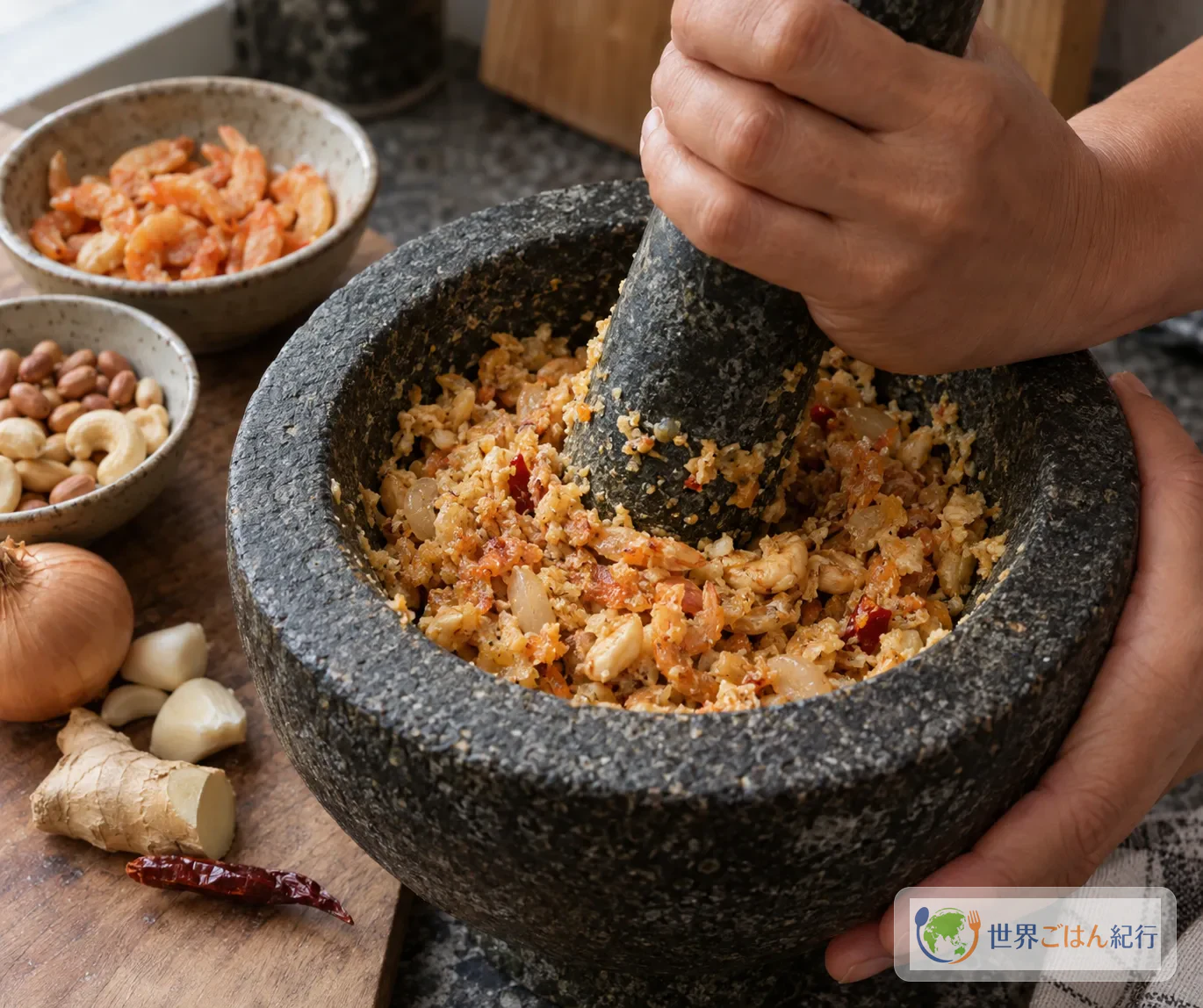
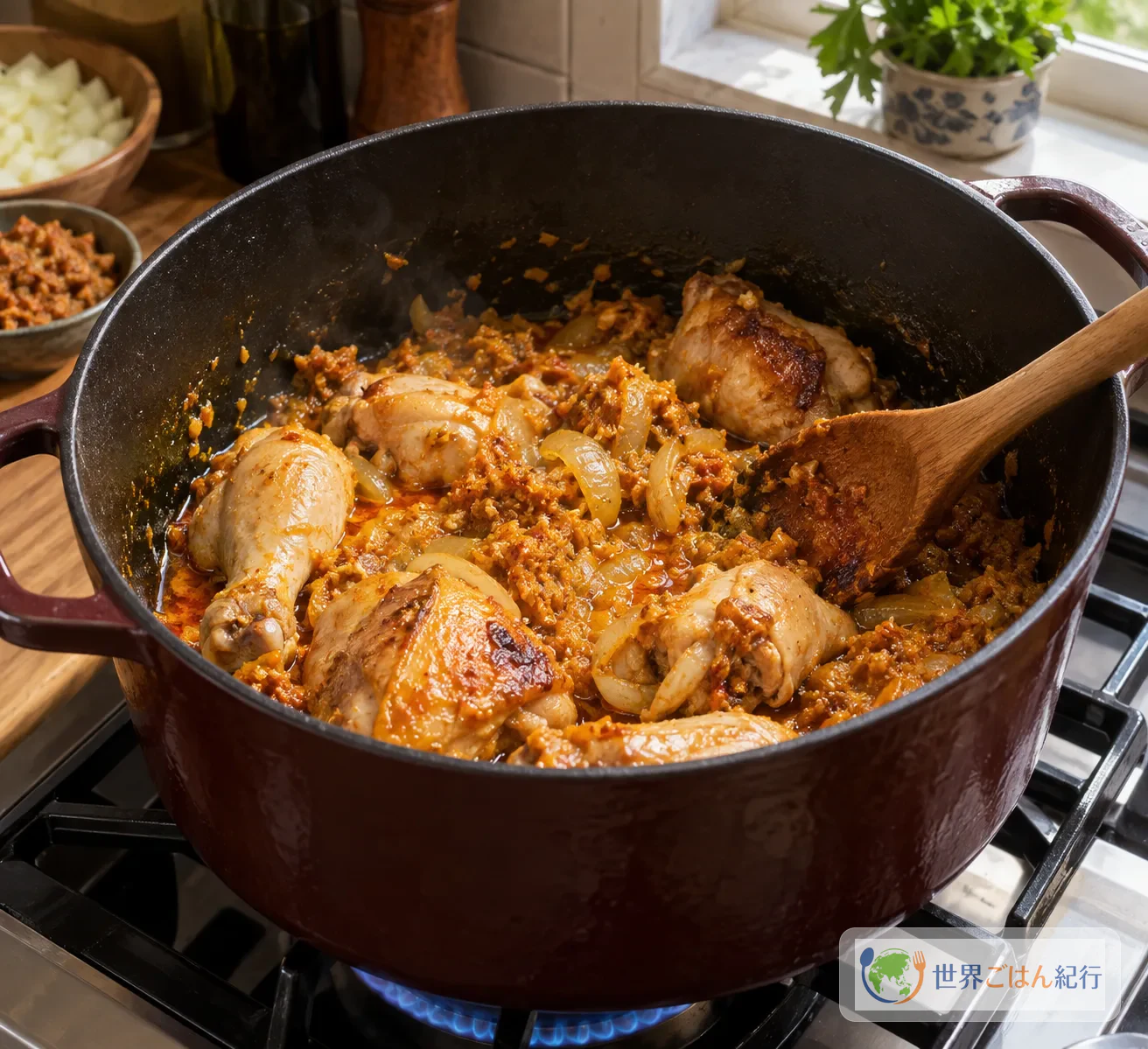
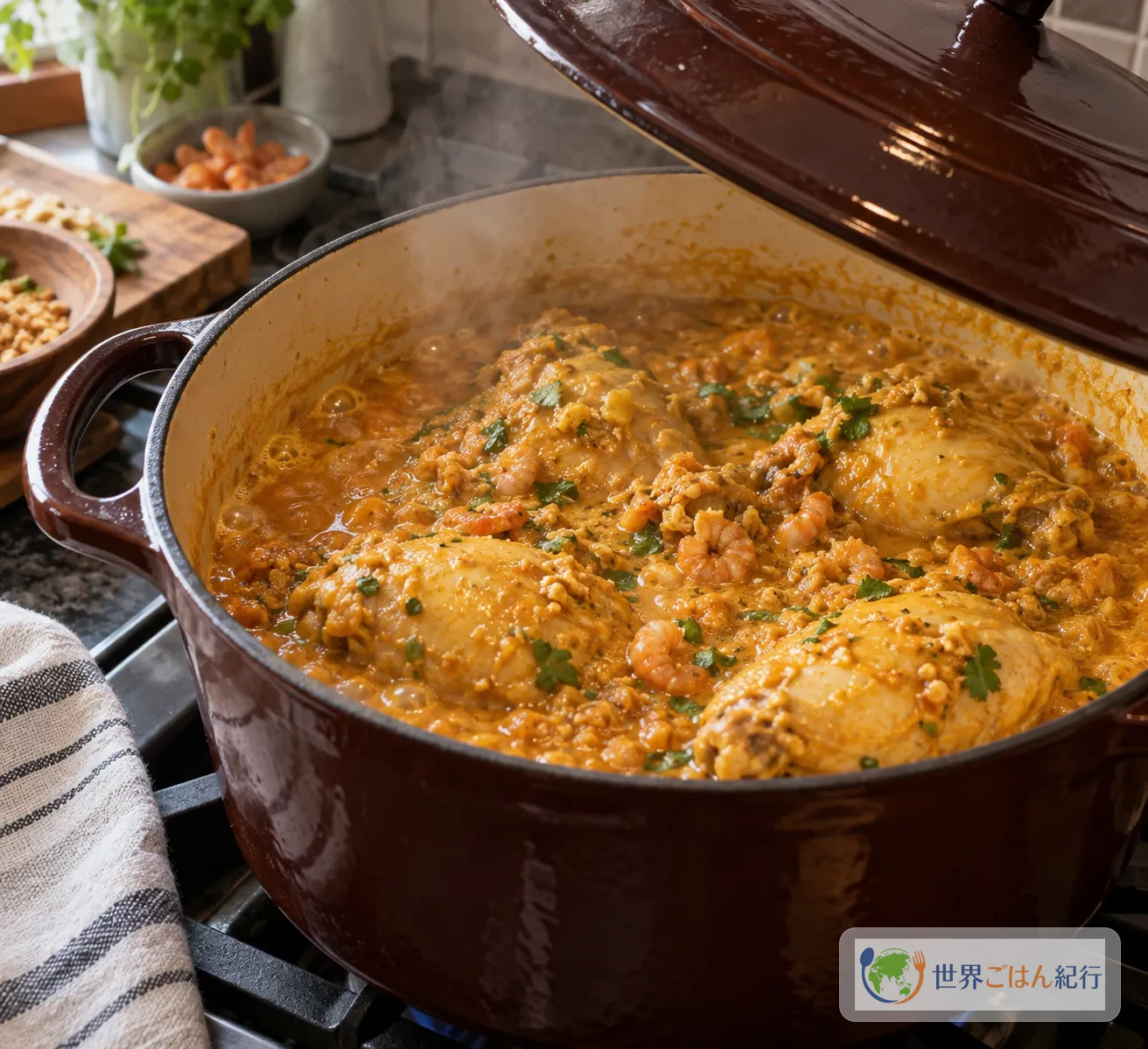
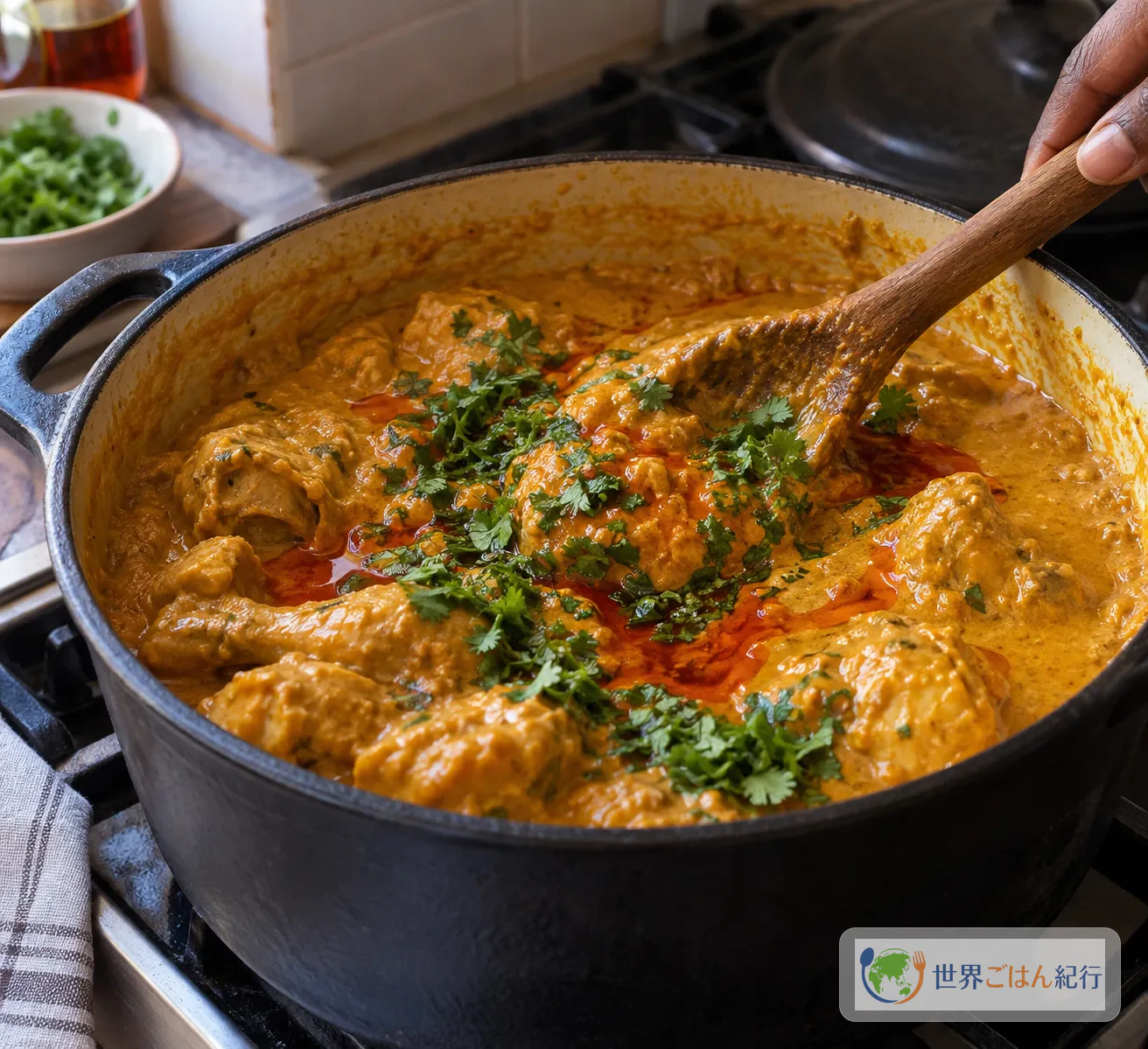
Grind dried shrimp, toasted peanuts and onion together in a mortar, and the dry scent of the sea meets the sweetness of the nuts. Fry that paste slowly in red dendê oil (azeite de dendê), coat the chicken with it, and you're on your way to xinxim de galinha. The stew comes from the state of Bahia in northeastern Brazil (galinha is Portuguese for chicken). Its flavor doesn't come from curry powder or a pile of spices: seafood savoriness, the body of nuts and the aroma of the oil all come together in one pot. Outside Brazil, the tricky parts are how far to rehydrate the dried shrimp, when to add the dendê oil and how thick to leave the sauce. This version serves four, uses bone-in or boneless chicken thighs, and is meant to be spooned over white rice or farofa.
Xinxim de galinha and the Bahian table
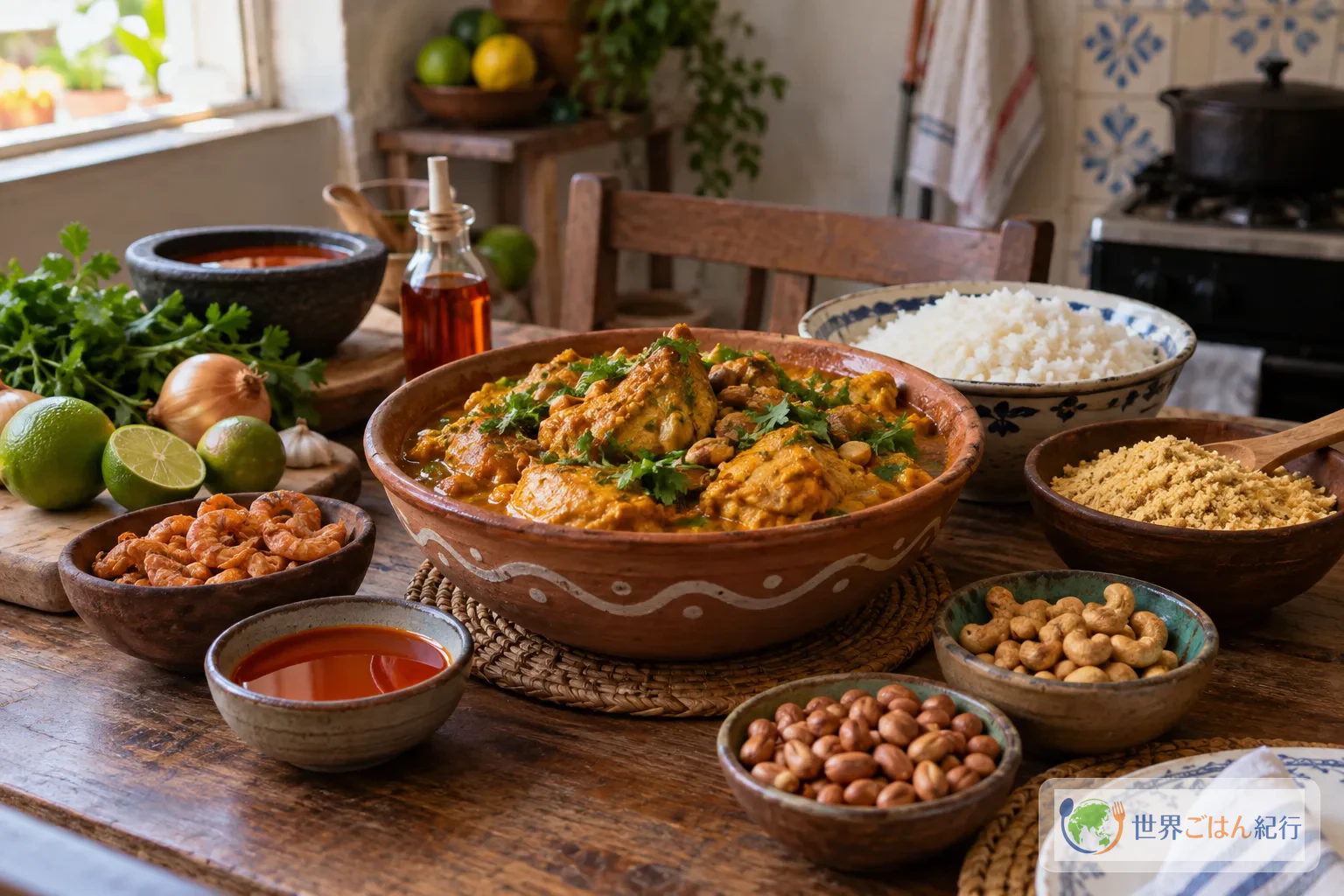
Calling xinxim "spicy Brazilian chicken" misses how the dish is built. Bahian cooking layers African, Indigenous and Portuguese food cultures, and that blending shows up in its food, religion and music. In xinxim, the color of dendê oil, the saltiness of small dried shrimp and a sauce thickened with crushed nuts carry the dish, and none of that has anything to do with heat.
How Bahian versions differ
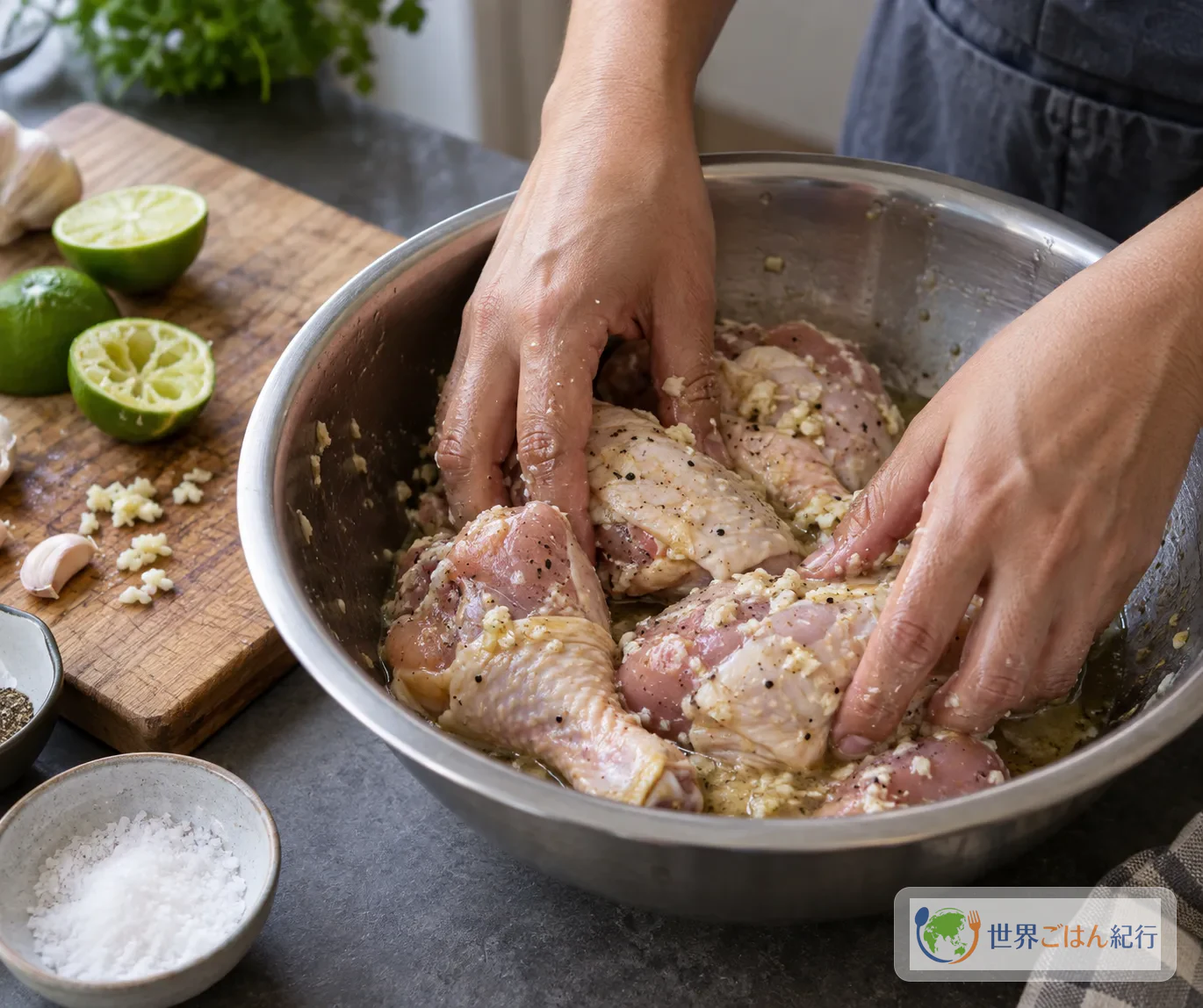
Recipes vary from cook to cook. One version uses a whole chicken, lime, garlic, onion, desalted dried shrimp, toasted peanuts, dendê oil and coriander, and makes a paste of onion, shrimp and peanuts before cooking the chicken. Another combines the chicken with broth and chili, adds the dendê oil at the end, and serves it with white rice and farofa.
A third lists chicken, dried shrimp, onion, garlic, toasted peanuts, egusi (pumpkin or watermelon seeds), dendê oil and cilantro, simmers the chicken gently into a thick sauce, and serves it with white rice, farofa or cassava flour. Other local cooks add cashews or coconut milk. Even under the same name, the pot changes depending on whether the oil goes in generously at the start or is kept as a finishing aroma.
Xinxim in Candomblé
In Candomblé rituals, the dish is tied to Oxum, and a special form made for her uses eggs. The eggs belong to that offering, not to every household pot. The ritual dish, the family table and a cook rebuilding a memory in a modern kitchen are separate settings, and keeping them apart keeps Bahian food culture from being flattened.
Ingredients (serves 4)
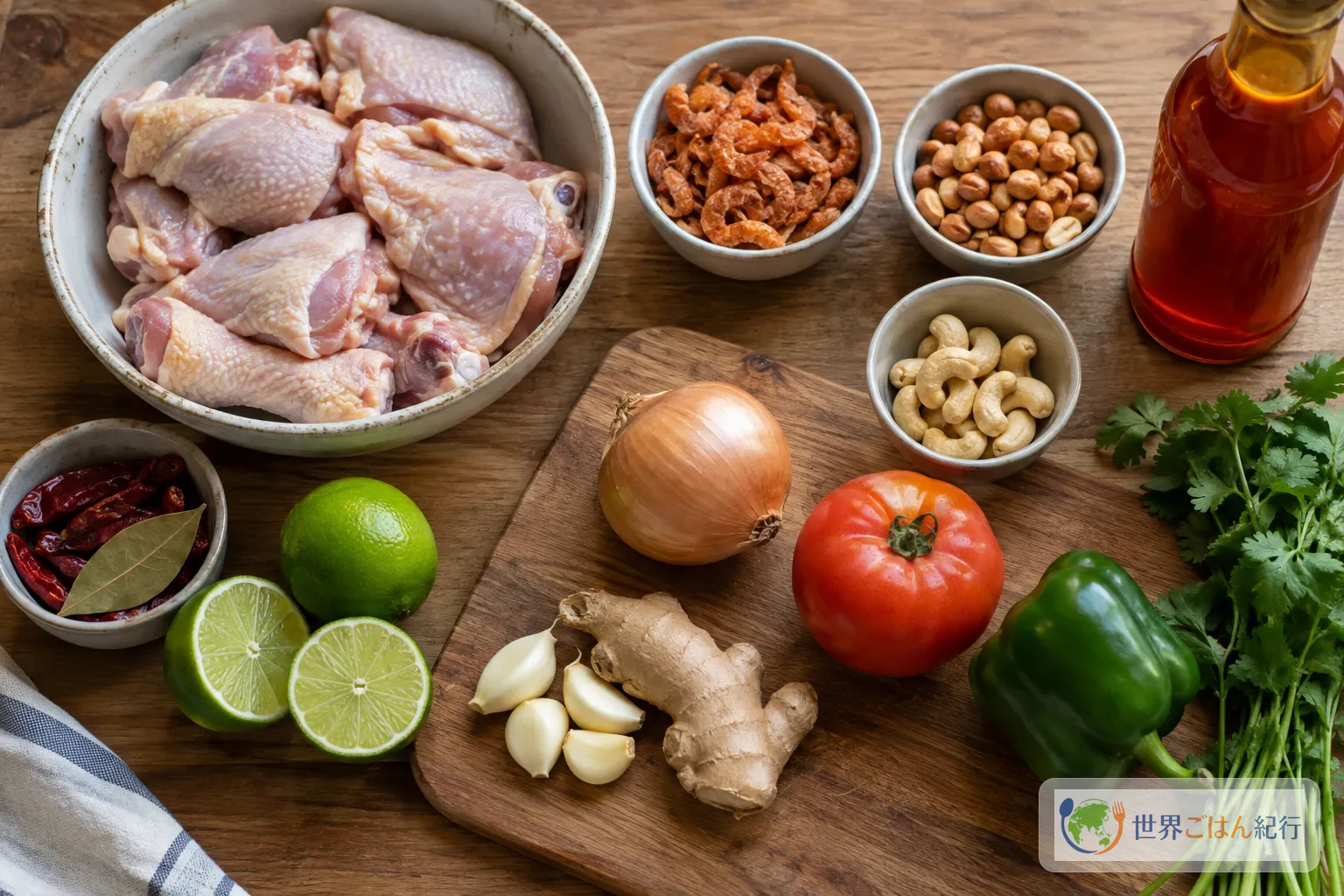
The amounts below are for bone-in chicken thighs. If you make it with boneless meat, use 1.75 lb (800 g) of thigh, shorten the simmer by 5 minutes, and check that the center is cooked through. Dried shrimp, nuts and dendê oil all hit hard at once, making the salt and aroma sharp, so keep to the amounts and adjust at the end.
This recipe contains chicken, shrimp, peanuts and cashews. If you have a shellfish or nut allergy, simply swapping in another ingredient changes not only the flavor but also the safety judgment, so check ingredient labels and whether cookware is shared. Cook the chicken until the center reaches 74°C (165°F). Wash the cutting board and bowls that touched raw chicken before you prepare the sides.
Where to find the key ingredients
Rather than adding rare ingredients you'll use only once, start with the ones that define xinxim and can be used in other dishes. Dendê oil also works in palm-oil stews such as moambe and muamba, and dried shrimp also flavor vatapá and moqueca.
If you buy only one thing for this dish, buy the dendê oil. Look for "red palm oil" or "dendê" on the label, and check the volume and ingredients. Latin American, African and Brazilian grocers and online shops usually stock it. Before you buy, consider whether you have other dishes that will use up a strongly scented oil.
Dried shrimp look alike but differ in saltiness and size. Check the name, net weight, ingredients and salt content on the label, and choose ones where the treatment of heads and shells is clear, so you can plan the prep. Powdered types shorten the mortar time, but if you want to keep the aroma of whole pieces, choose small dried shrimp.
Choosing ingredients and substitutes for xinxim
The sauce comes together in the pan, not just in the mortar. You pass the dried shrimp through water to adjust the saltiness, warm the nuts lightly, and crush them with onion. Fry those three in dendê oil, and the shrimp aroma moves into the oil while the nut particles hold the cooking liquid.
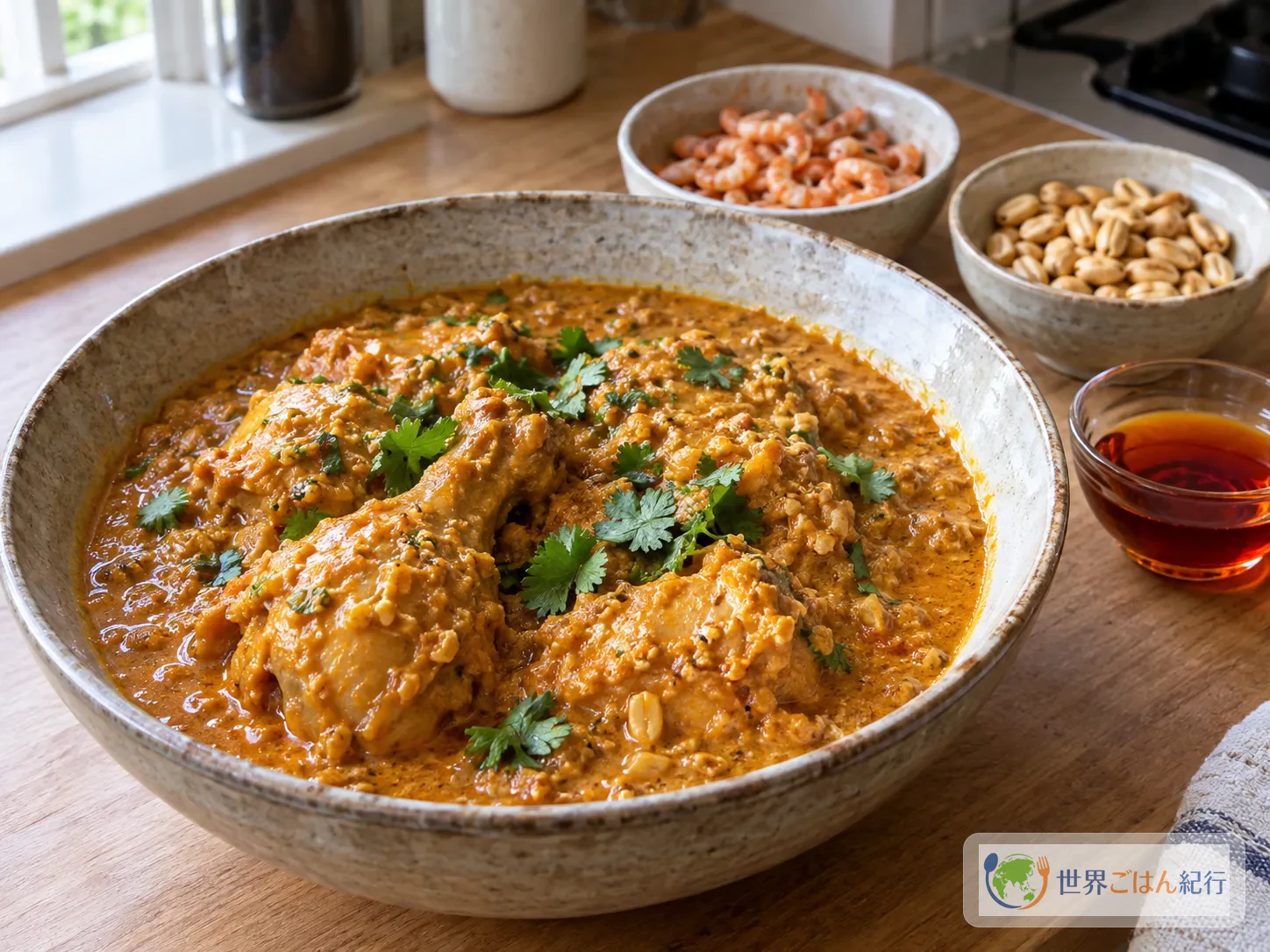
Away from Bahia, think about what a substitute changes, not just whether you can find the ingredient. Substitutes help the dish come together, but they won't match the local flavor exactly.
| Local element | Practical line | What changes and how to use it |
|---|---|---|
| Dendê oil | Red palm oil. If unavailable, 1 tbsp (15 ml) rice bran oil + 2 tbsp (30 ml) olive oil | Color, aroma and mouthfeel change. A full substitute moves it toward a nutty chicken stew |
| Dried shrimp | Small dried shrimp, or unsalted sakura shrimp | Sakura shrimp have a lighter aroma and the salt varies by product. Don't halve the amount; taste and adjust the soaking water |
| Peanuts and cashews | 3.25 oz (90 g) peanuts, or 2.5 oz (70 g) peanuts + 1 oz (30 g) cashews | Peanuts alone give a stronger toasty note, and cashews add a sweet body |
| Malagueta-type chili | Fresh chili, dried red chili, sliced red chili | The difference is more in aroma than heat. Start with half in the pot and serve the rest on the side |
| A whole chicken | 2 lb (900 g) bone-in chicken thighs | Bone-in gives the liquid body. For boneless, drop to 1.75 lb (800 g) and shorten the simmer |
| Egusi (pumpkin or watermelon seeds) | 25 g pumpkin seeds | Brings the texture closer to Bahian versions that use egusi. Replaces 25 g of the peanuts |
Dendê oil
Dendê oil does more than add color. The red-orange oil spreads across the pot and ties the surface of the chicken and the paste together with one aroma. If a strongly scented product worries you, use a neutral oil for part of the amount and keep the last 1 tbsp (15 ml) as dendê. That keeps far more of the dish's character than replacing all of it from the start.
If you can't use dendê oil at all, rice bran or olive oil alone will still cook a good pot, and the crushed dried shrimp, peanuts and cilantro keep the nutty, sea flavor. The color and aroma will be milder, though, and the dish moves away from xinxim. Splitting the oil, 2 tbsp (30 ml) for frying and 1 tbsp (15 ml) for finishing, is a thrifty way to see what it brings. If you plan to make the dish again, look for the oil first. If you'd never use up a jar, there's no need to buy one.
Dried shrimp
Dried shrimp vary a great deal in saltiness and dryness. Rinse them, soak them briefly, squeeze out the water, and leave the soaking liquid behind. Use 10 minutes as the baseline: soak them so long that the smell disappears completely, and the paste loses its sea flavor. If saltiness still dominates when you taste, change the water once more.
Sakura shrimp are easy to find, but they lack the saltiness and the strong, fermented aroma of dried shrimp. Rinse the surface lightly, soak for only 5 minutes, squeeze out the water and crush them with the nuts. If the stew tastes short of salt, add 0.5 g of salt at a time in the later part of the simmer. Fish sauce isn't the first choice here: it makes the liquid saltier and loses the particle texture of the paste.
Nuts and seeds
A coarse paste with particles about 2–3 mm leaves small toasty bits in the sauce, and you can see how thick it is when you spoon it over rice. A food processor works too, as long as you stop well before the paste turns liquid. Peanuts alone make a perfectly good xinxim, and a little cashew adds a soft sweetness.
For a texture closer to Bahian versions with egusi, lightly toast 25 g of pumpkin seeds and crush them in place of 25 g of the peanuts. The aroma is greener and the particles feel a little larger. Store-bought pumpkin seeds won't match the local seeds exactly, so treat them as a substitute.
A mortar or kitchen tools
A mortar lets you stop while watching the particles in the paste, so it suits cooks who want to keep the aroma of dried shrimp and nuts. A heavy granite one gives the most consistent texture; check whether it comes with a pestle, and think about storage space and washing. For a single dish, skipping it is reasonable. Crush the nuts in a thick freezer bag with a rolling pin and chop the onion and dried shrimp finely with a knife. If you crush whole spices, salsa or aromatics several times a month, a heavy mortar earns its place.
Cook all cuts of poultry to a safe minimum internal temperature of 165°F (74°C). Insert a thermometer into the thick part near the bone, without touching the bone. If you don't have a thermometer, make sure the center is not raw: cut into a thick part and check for pink or clear juices.
Fixing common problems with xinxim
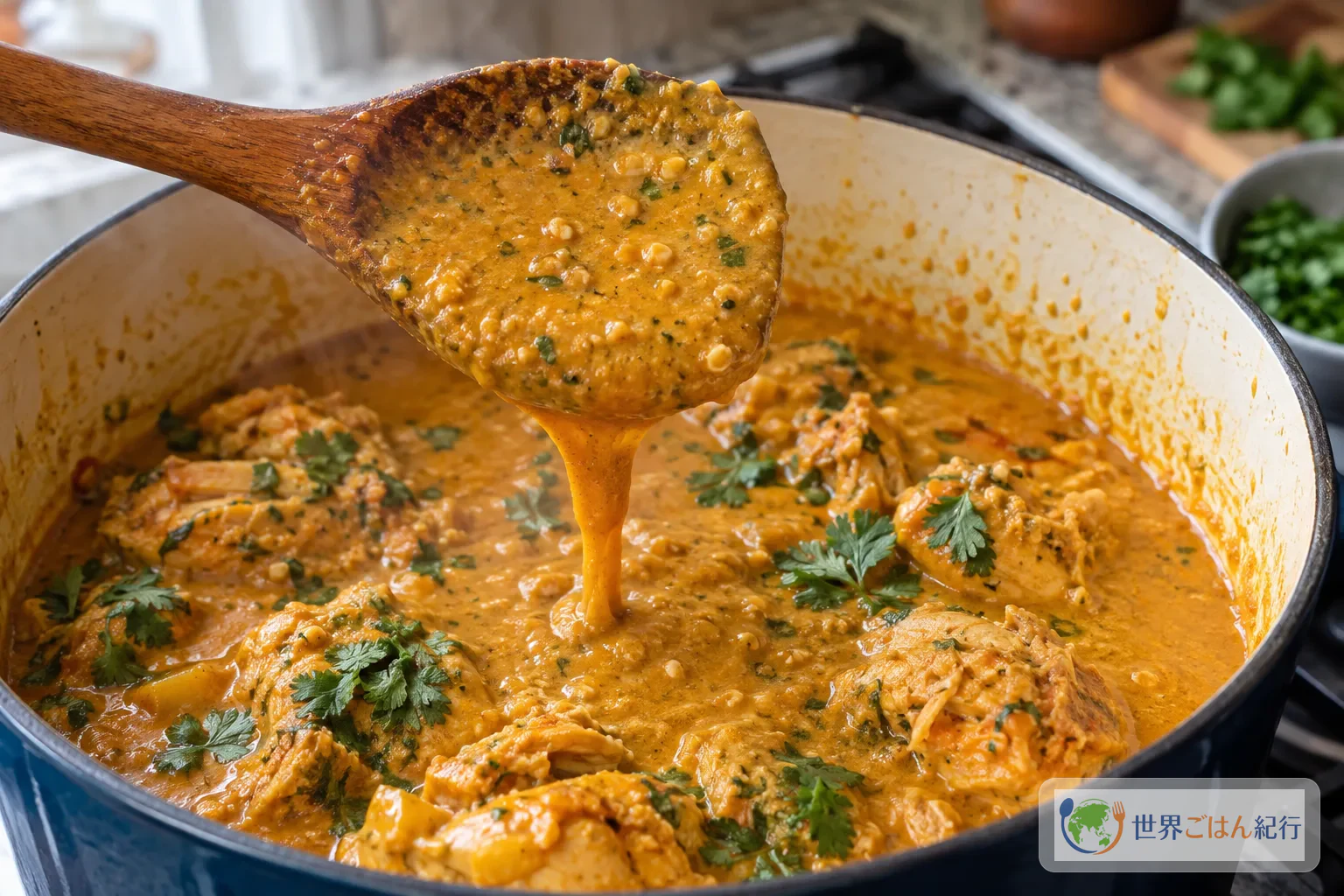
Get everything ready before you light the fire: cut the ingredients, squeeze out the dried shrimp and measure the broth. If you start the chicken simmering and then try to make the paste, the bottom of the pot scorches easily. Going by the clock alone is risky too. The chicken can be cooked while the sauce stays thin, the oil separates, or only the shrimp's saltiness comes through. At the end, judge by the sound of the pot and the thickness of the sauce.
Move only the unburnt part to another pot, add 2 tbsp (30 ml) of unsalted broth, and resume over low heat. Scraping up the black bits with a wooden spoon spreads bitterness through everything, so leave the bottom of the pot alone. If the whole paste smells burnt, take out the chicken and start the paste again with 1.75 oz (50 g) of fresh onion and 1 tsp (5 ml) of oil. That is more reliable than diluting the bitterness.
Push the chicken to the side, take off the lid and reduce over low heat for 3–5 minutes. High heat scorches the nuts on the surface, so keep the bubbles from reaching the middle of the pot in big bursts. If a wooden spoon drawn along the bottom leaves a track for 2 seconds, the sauce is thick enough not to run off the rice.
Eat one piece of dried shrimp to see whether the salt comes from the paste or from the broth. Add 3.5 tbsp (50 ml) of unsalted water or broth, simmer 3 minutes on low, and taste again. If that leaves the sauce loose, take off the lid and reduce for just 2 minutes. Skip the trick of absorbing salt with a potato.
Some floating oil is normal in a dendê stew, but if it has separated completely from the sauce, the heat was probably too high. Turn off the heat, add 2 tbsp (30 ml) of unsalted broth and gently swirl the pot. Once the liquid and paste come back together, warm it on low heat for just 1 minute. Swirling is enough; there's no need to whisk.
Serving and variations for xinxim de galinha
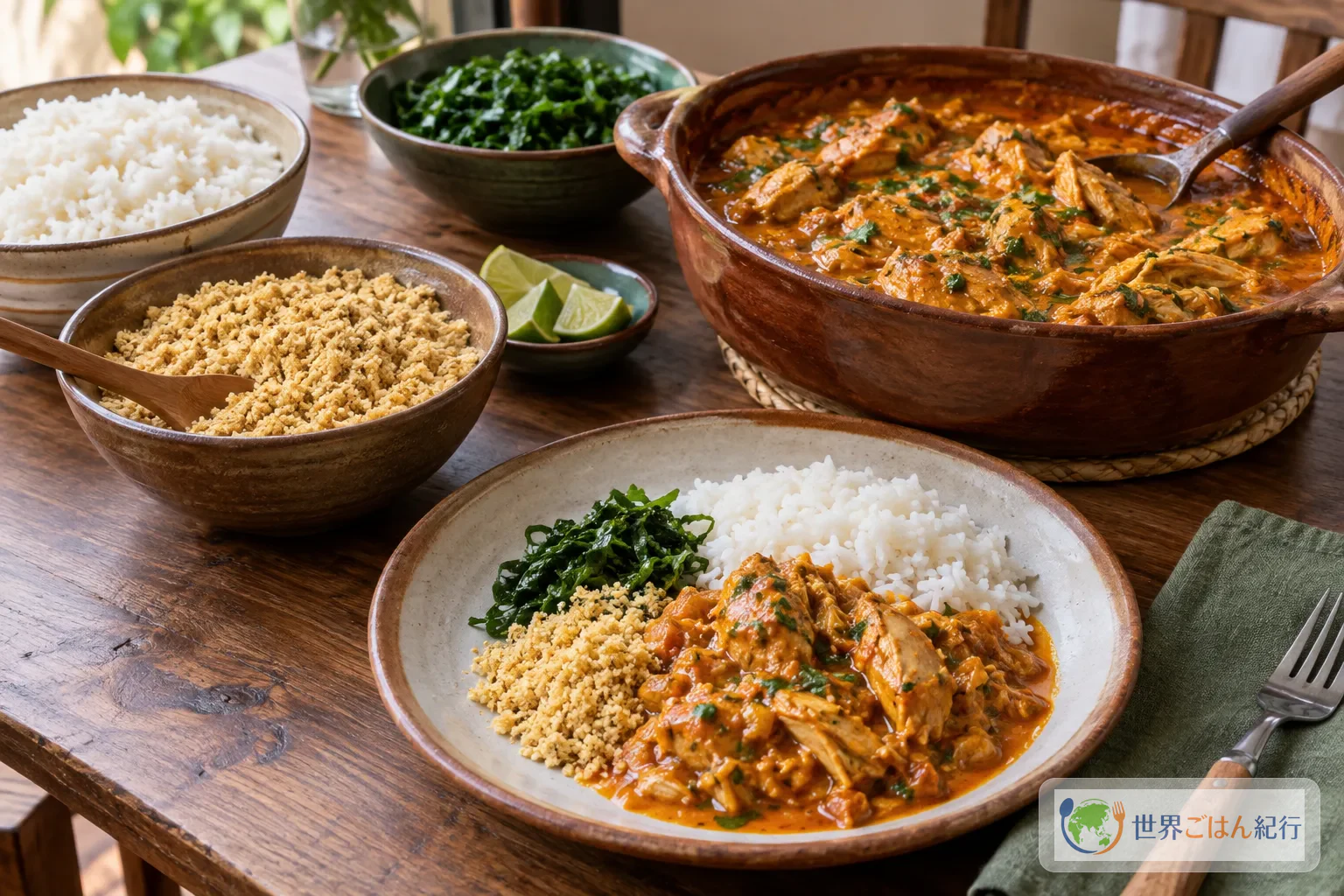
Xinxim needs a staple. White rice or farofa takes on the richness and saltiness of the sauce, and the strength of the dried shrimp and dendê oil settles down. Start with both, then adjust the rest to your household.
Heat at the table
To split the heat for a family, put only half of the chili in the paste and chop the rest finely to serve at the table. Or leave the chili out of the pot entirely and set out cilantro, lime and chopped red chili on the side. The aroma of dried shrimp and dendê oil carries the dish even for people who don't like heat. Removing the seeds lowers the heat but keeps the chili's aroma.
Farofa
Farofa, cassava flour toasted in oil, is a dry base that scoops up the thick sauce, and it makes the texture of the sauce and the grains of dried shrimp easier to notice than rice alone. Some store-bought farofa is seasoned, so judge the overall saltiness after serving them together rather than salting the stew to taste on its own.
With coconut milk
Some Bahian recipes layer coconut milk over the nuts, dried shrimp and dendê oil. Reduce the broth to ½ cup (150 ml), take the chicken out, add ½ cup (100 ml) of coconut milk at the end of the simmer and warm it for 5 minutes, stirring over low heat so it doesn't separate. Return the chicken and let it rest 5 minutes. The sauce turns mellower and the shrimp and dendê are rounded off, which suits people who want less heat or plenty of sauce over rice. Serve lime at the table to keep the coconut's roundness.
With fresh shrimp
For a stronger sea aroma, peel and devein 5.5 oz (150 g) of raw shrimp and add them in the last 5 minutes. They thin the liquid without changing the saltiness, so if the sauce is loose, reduce it for 2 minutes first. If anyone at the table has a shellfish allergy, skip this, including serving a portion separately or cooking it in another pot.
With a whole chicken
To scale up to 6–8 servings, use a whole chicken jointed at the joints for bone savoriness. The meat varies in thickness, so take out the thin parts of the breast first and return the thighs and wings to the liquid to keep them tender. Start with enough broth to come a third of the way up the chicken and add more from there.
Dishes to cook alongside
A wider Bahian table, with more rich sauces taken up by a staple, shows off the differences between them.
- Moqueca baiana: compare the layering of seafood, coconut milk and dendê oil
- Vatapá: a different way of building a paste from dried shrimp and nuts
- Acarajé: see how Bahia's bean dish uses dendê oil
- Farofa: add the texture of cassava flour to take up a rich stew
- Feijoada: compare a Brazilian stew served with a staple
Storage and FAQ
Q. Can I make it ahead?
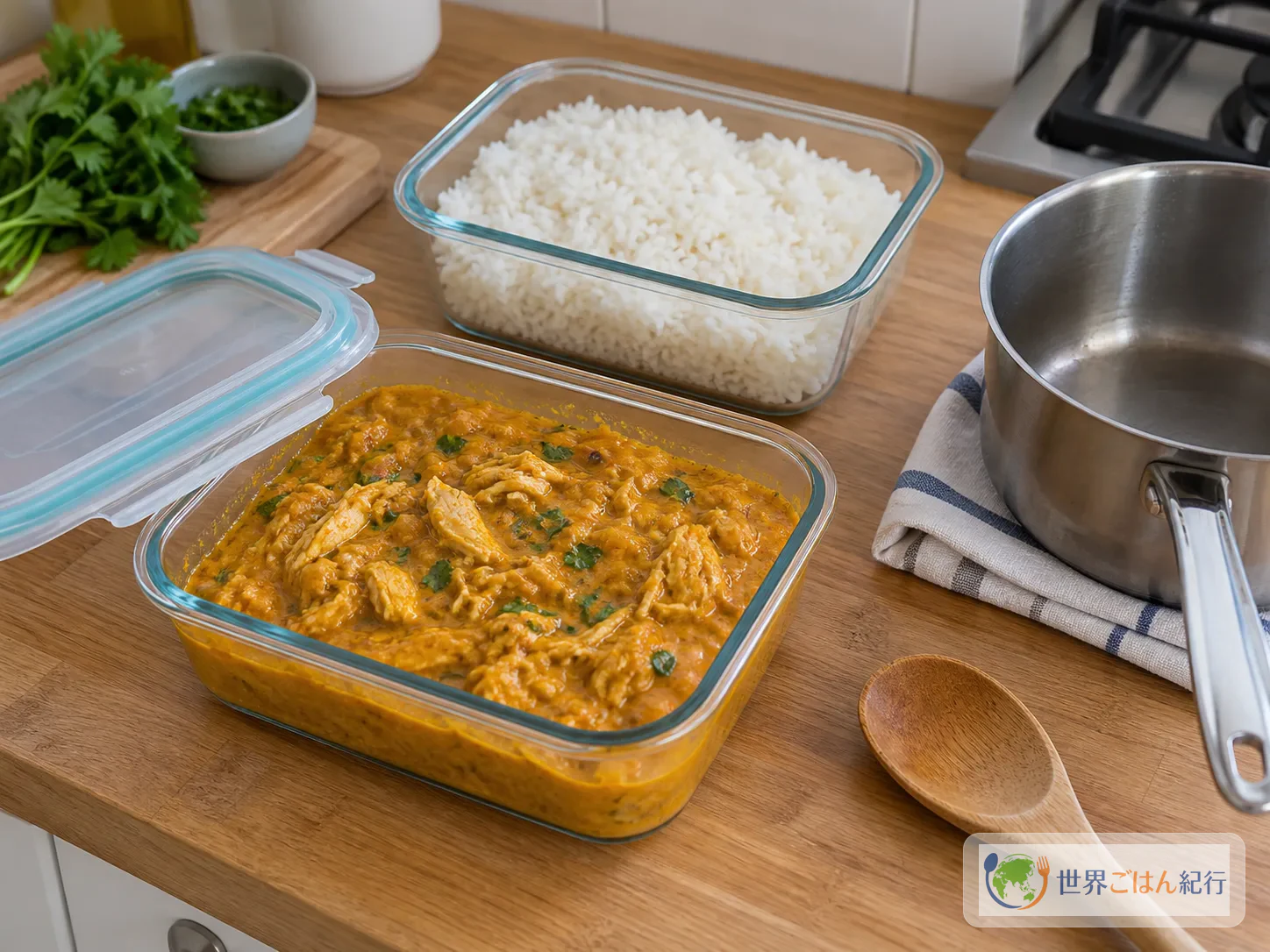
Yes. Cool the chicken and sauce slightly, portion them into shallow containers and refrigerate. Keep white rice and farofa separate and warm only what you'll eat, which helps the sauce keep its thickness. Reheat in a pot over low heat until the center reaches 165°F (74°C), the standard for poultry and leftovers; measure with a thermometer if you have one. Throw out anything that has sat at room temperature for a long time, or that smells or looks off.
Q. The dried shrimp smell is too strong
Rinse and soak for the full 10 minutes, and if it's still strong, reduce to 20 g. Less shrimp also means less savoriness and aroma in the sauce, though. Rather than filling the gap with more nuts, serve white rice, farofa and lime to spread the intensity in your mouth.
Q. Can I replace the cashews with peanuts?
Yes, with 3.25 oz (90 g) of peanuts. The toasty note comes forward and the sweet, soft body fades. Going the other way, all cashews, makes the aroma monotonous, so keep at least a little peanut for depth. Both can trigger nut allergies, so leave them out when that's a concern.
Q. Can I use chicken breast instead of thighs?
You can, but breast dries out if simmered too long. Leave it in large pieces, count 20 minutes on low heat from when the liquid boils, and stop once the center reaches 165°F (74°C). Bone-in thighs take longer, but the meat and liquid come together better, so they're the better choice the first time.
Q. The sauce was firm the next day
The nuts and chicken fat set the sauce as it cools. Add 2–3.5 tbsp (30–50 ml) of water or unsalted broth and warm it slowly over low heat to loosen it. High heat from the start tends to separate the oil, so keep it gentle enough that a wooden spoon can trace the bottom of the pot.