In Ecuadorian homes during Holy Week, bags and bowls of beans line the kitchen table. A grandmother cracks open fava bean pods, a child counts white beans, and someone shucks kernels of corn, while salt cod soaks in water nearby and squash simmers until tender. All of it goes into fanesca (also written fanesca ecuatoriana), a thick soup eaten in the days leading up to Easter. Beans, young grains, squash, and milk share the great pot of Holy Week, so every spoonful has a different texture. And the pot brings together salt cod and young grains, the sea and the field, in a single bowl.
Fanesca: Ecuador's Holy Week Soup
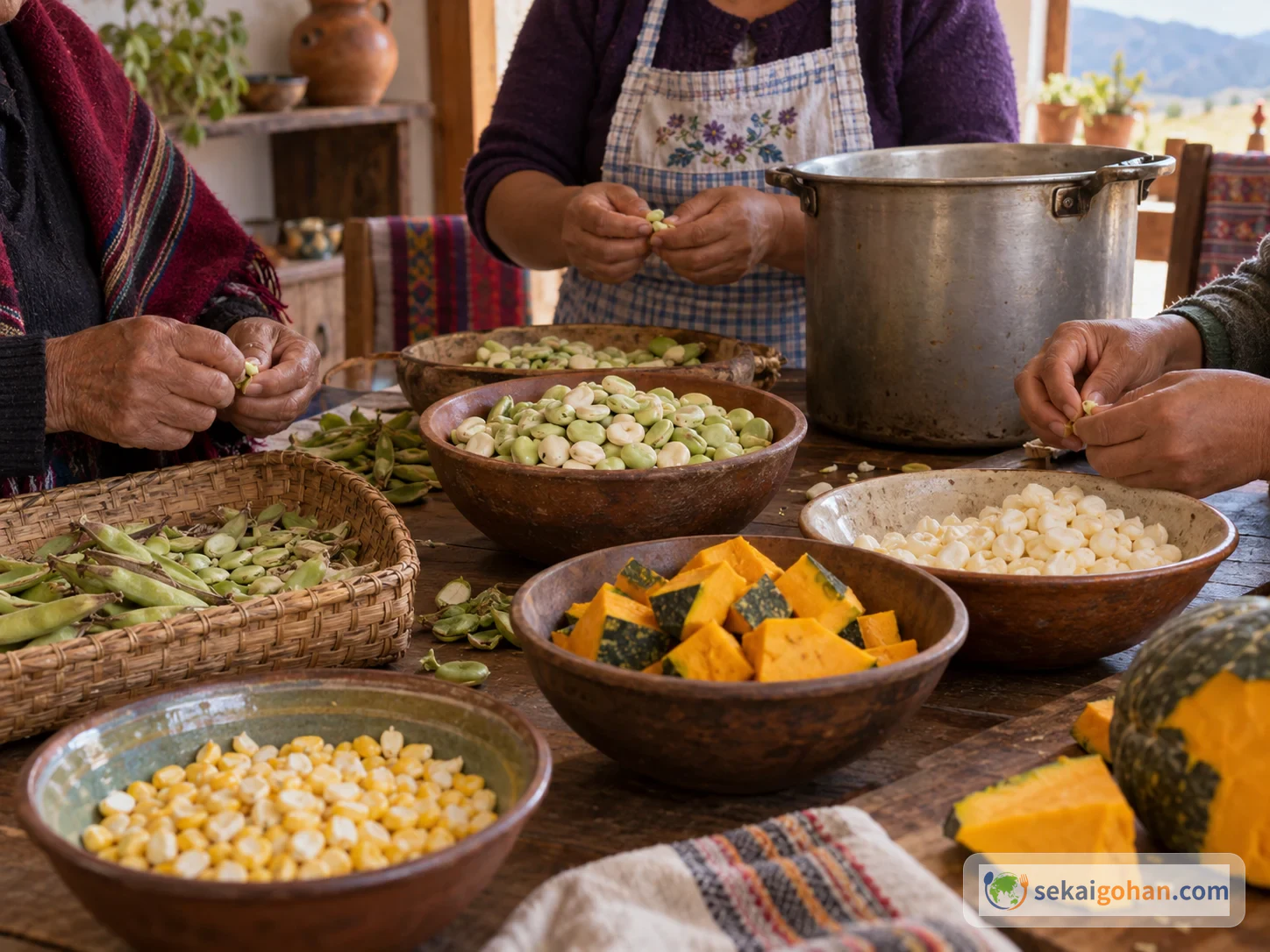
Fanesca is a family project. Year after year, families gather in the kitchen during Holy Week to shell and cook the beans and grains together. Even peeling the grains used to be a shared household job, and all that labor was part of what the dish meant socially. The big pot starts the day before, and the hours spent shelling beans as a family count as cooking too.
Where Fanesca Comes From
The dish started in the Andes as uchucuta, a harvest food made with young grains and chiles. In the colonial period, dairy, fish, and sofrito were layered on top. It also has links to Mushuk Nina and the equinox farming calendar, though not every household keeps the same rituals today. Then came Catholic Holy Week: meat was off the table, so salt cod and milk went in, and the soup took on its modern form. Nobody has settled the origin or the name. There's no known birthplace, inventor, or date.
Twelve Ingredients and Regional Versions
Some recipes use eight kinds of beans and grains, others twelve. The number twelve stands for the apostles, but plenty of good fanescas use fewer. The Andean version is built on corn, fava beans, chochos, mellocos, and squashes. Coastal versions add vegetables the Andean side leaves out, such as achogcha and green beans. Dried or fresh young beans, the choice of fish, and the garnishes all change from family to family, so you won't find one authentic version, just a fanesca for each household.
That holds abroad too. Families who carry the dish to new countries make it at home with whatever beans and fish they can get, and the shape of the celebration survives the swaps.
How to Make It
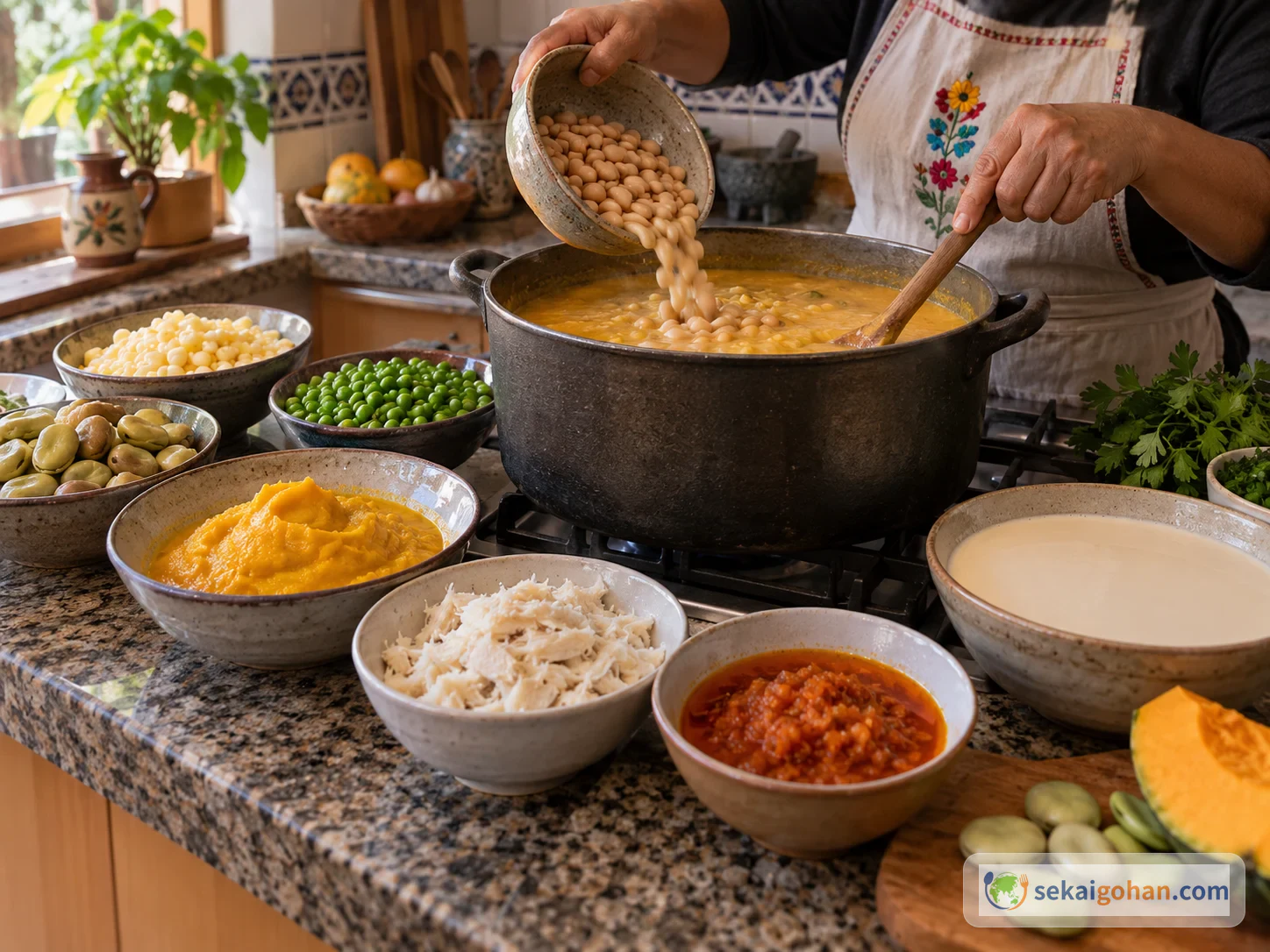
The total time includes 24 hours to desalt the salt cod. The cooking day itself takes about 70 minutes. Cook the beans and grains separately, because they differ in hardness. Then build the soup base, finish the annatto sofrito, make the peanut and milk, and cook the salt cod in turn, and combine them at the end. Salt comes last, after the salt cod and cheese have gone in.
1. Desalt the salt cod and pre-boil the beans the day before
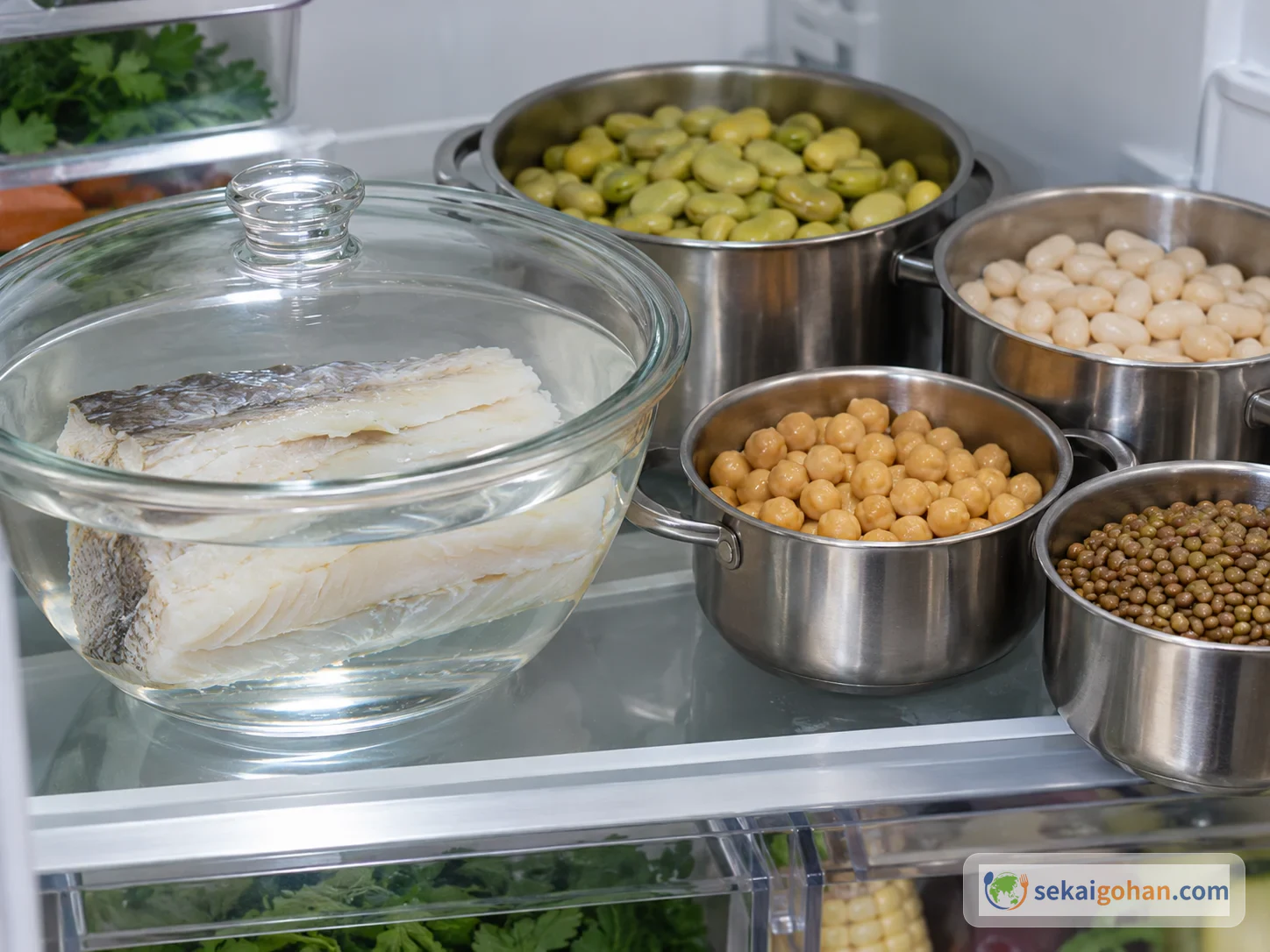
Start with the desalting, which takes the longest. Put 7 oz (200 g) salt cod in plenty of water in the refrigerator, and change the water every 6–8 hours for 24 hours. Then check the saltiness with one piece: cook it and taste it. If it is still too salty, keep changing the water for a few more hours. Thicker fish needs longer.
Boil the beans in separate pots. Soak dried fava beans, white beans, and chickpeas each and boil them until tender, and stop the lentils at the stage where they do not fall apart. If you use canned beans, just rinse and drain them. Do not overcook the green peas and corn.
If you stop the beans when they can be crushed with a finger but still have a slight firmness at the center, they will be just tender in the final big pot. If you simmer lentils or green peas from the start, they dissolve into the soup, so save them for later. Keep the cooking liquid separate for each bean, and if it is not too cloudy, you can use a little of it as soup liquid.
2. Make the core of the soup with squash and rice
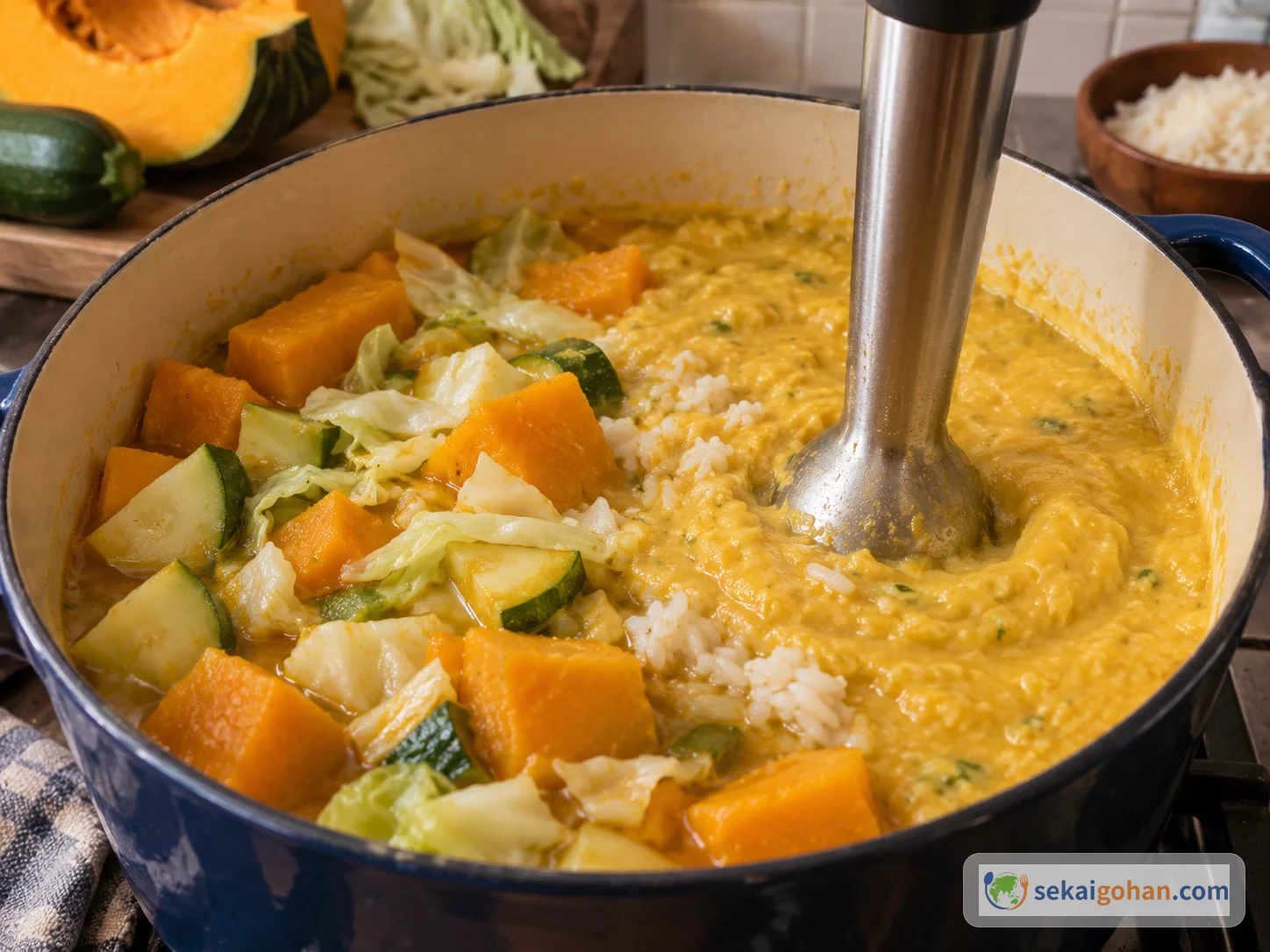
Put 9 oz (250 g) squash, 5.5 oz (150 g) zucchini, 2.75 oz (80 g) cabbage, and 1 cups (250 ml) water in a pot, cover, and simmer over medium-low heat for 15–20 minutes. Turn off the heat when a skewer slides into the center of the squash without resistance, and keep the cooking liquid.
Blend 2/3 of the squash and zucchini, the cabbage, 2.75 oz (80 g) cooked rice, and ½ cup (100 ml) cooking liquid smooth with an immersion blender. The rice binds the soup and gives it a pleasant body. Set aside the remaining 1/3 of the squash and zucchini without mashing it fully, so small pieces stay in the finished soup. Leave some chunks: that is what makes it fun to eat.
For thickness, aim for a soup that falls from a spoon in a thick ribbon. If it is stiff, add cooking liquid 1 tbsp at a time. If it is watery, add the reserved squash and then blend; do not add water just to thin it. Cabbage releases moisture that dilutes the flavor, so hold off on the salt for now.
3. Make the annatto sofrito
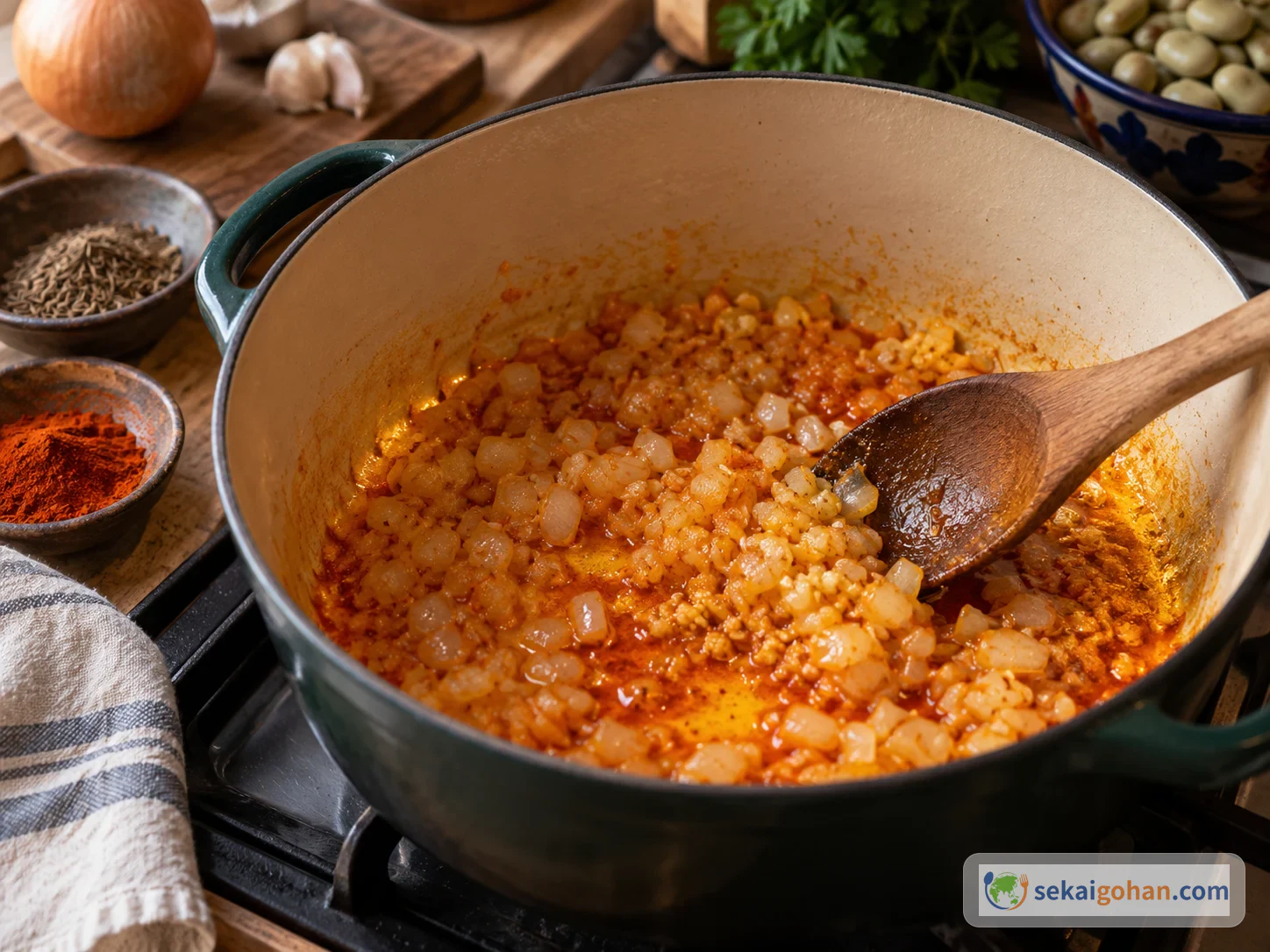
Melt 25 g unsalted butter in a heavy pot and cook 5.5 oz (150 g) onion and 2 cloves garlic over medium-low heat for 5–7 minutes. When the onion is translucent and there is still some moisture left in the bottom of the pot, add 1 tsp annatto, 1 tsp cumin, and 1/2 tsp oregano.
Annatto adds no heat. It gives red color and a mild earthy aroma. Cook it for only 30–60 seconds, just long enough to move the red color into the fat. Stop before the powder turns black on the bottom of the pot, and move on to the next step.
If the pot is drying out, add 1 tbsp cooking liquid or water to lower the temperature. Never turn up the heat after the annatto goes in. If black specks or smoke appear, start over so bitterness does not carry into the soup. Paprika can stand in for the color, but it does not give annatto's aroma.
4. Cook the salt cod in milk and make the peanut milk (cooking step)
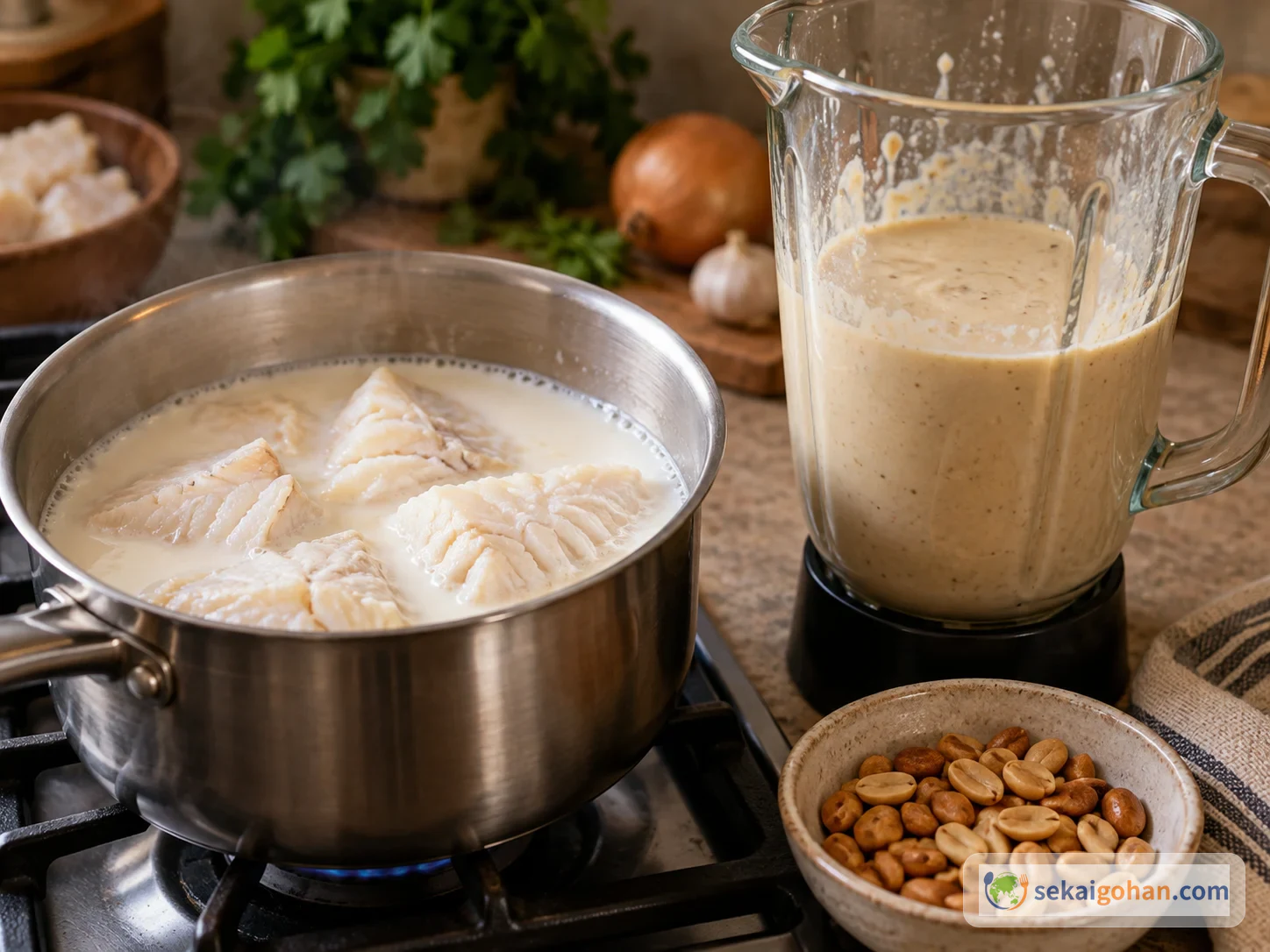
Pat the desalted salt cod dry and gently simmer it in a small pot with 1 cups (250 ml) milk over low heat for 8–10 minutes, until it is white through to the center. Take it out and flake it coarsely, then strain the fish milk and keep it. A hard boil toughens the fish and makes the milk separate.
Blend 1.75 oz (50 g) unsalted roasted peanuts with ¾ cup (200 ml) milk in a blender until the peanuts are smooth. Make sure no large bits remain. Set aside 3.5 tbsp (50 ml) cream and the remaining ½ cup (100 ml) milk for finishing, and adjust how much you use while tasting the saltiness of the salt cod and cheese.
5. Combine in the big pot, return the ingredients, and set the thickness
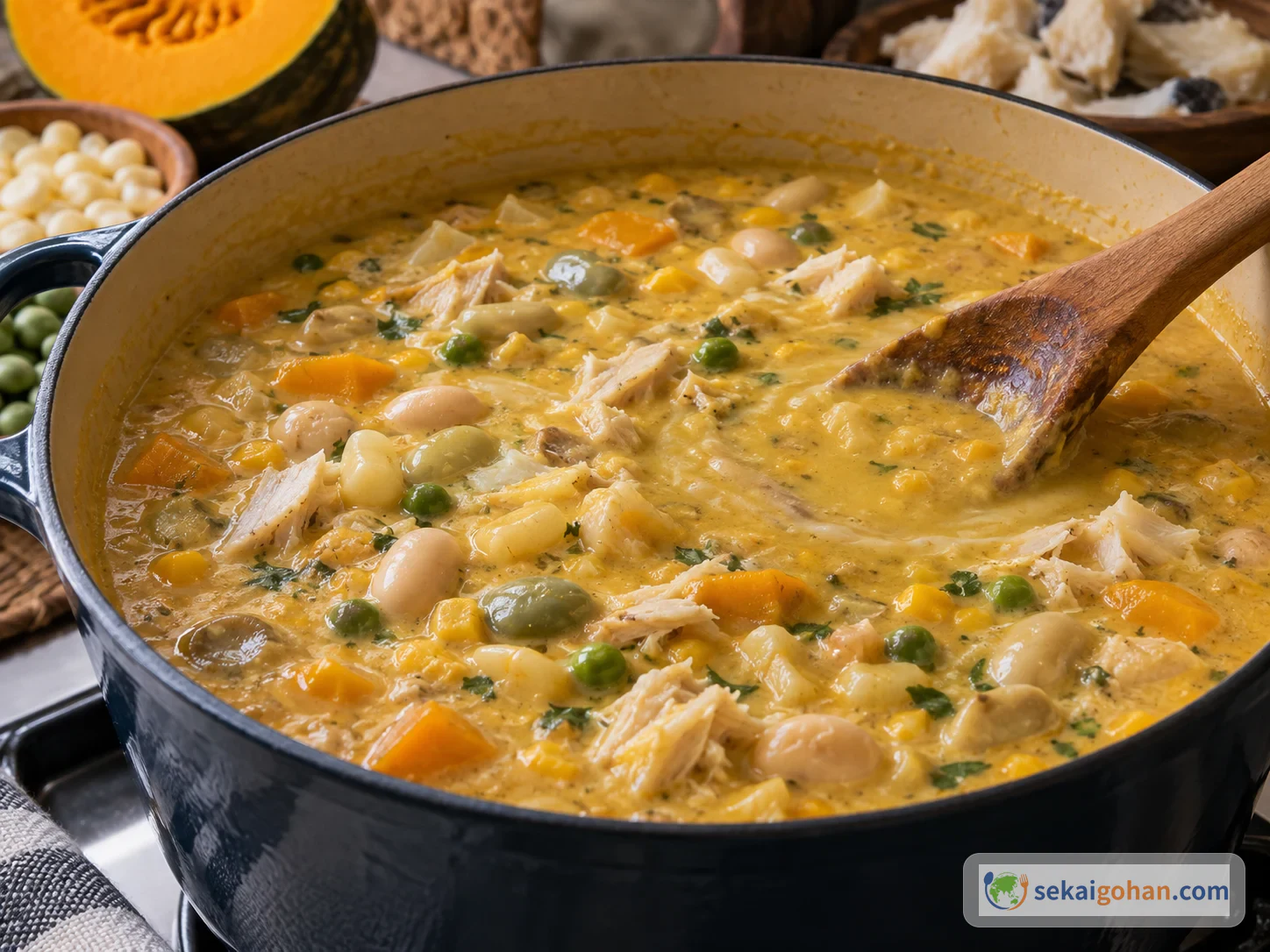
To the sofrito add the squash puree and the reserved squash, 1¼ cups (300 ml) bean cooking liquid or water, and the milk the fish was cooked in, and combine over low heat for 10 minutes. Then add the corn, fava beans, white beans, chickpeas, and chochos, and simmer another 10 minutes over low heat.
Finally add the green peas, lentils, salt cod, the peanut and milk sauce, and the cream, and cook for 5–8 minutes without letting it boil. Just before turning off the heat, melt in the cheese and adjust with salt and black pepper. Because of the salt cod and cheese, decide the salt last.
It is done when the squash and milk base blends smoothly with the ingredients. Drag a wooden spoon along the bottom of the pot: the trail should last 2–3 seconds, and the soup should thinly coat the back of the spoon.
If it is too thick, add 3.5 tbsp (50 ml) milk or unsalted cooking liquid at a time, warming over low heat each time. If it is too thin, remove the lid and simmer over low heat for 5–10 minutes, or mash a little of the reserved squash and add it. Boiling hard to reduce it breaks the beans, separates the milk and peanuts, and leaves only the saltiness.
6. Finish with egg and plantain
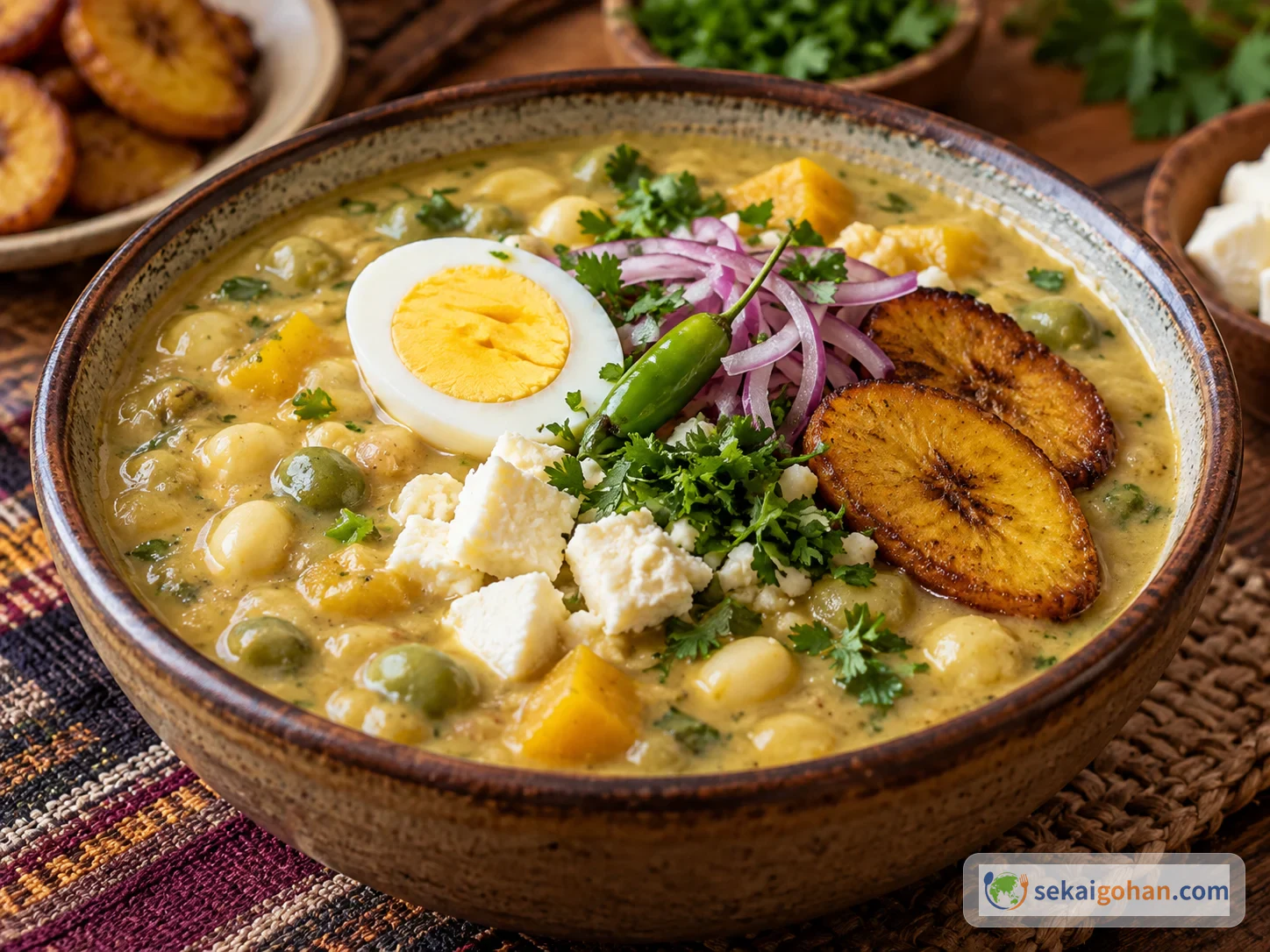
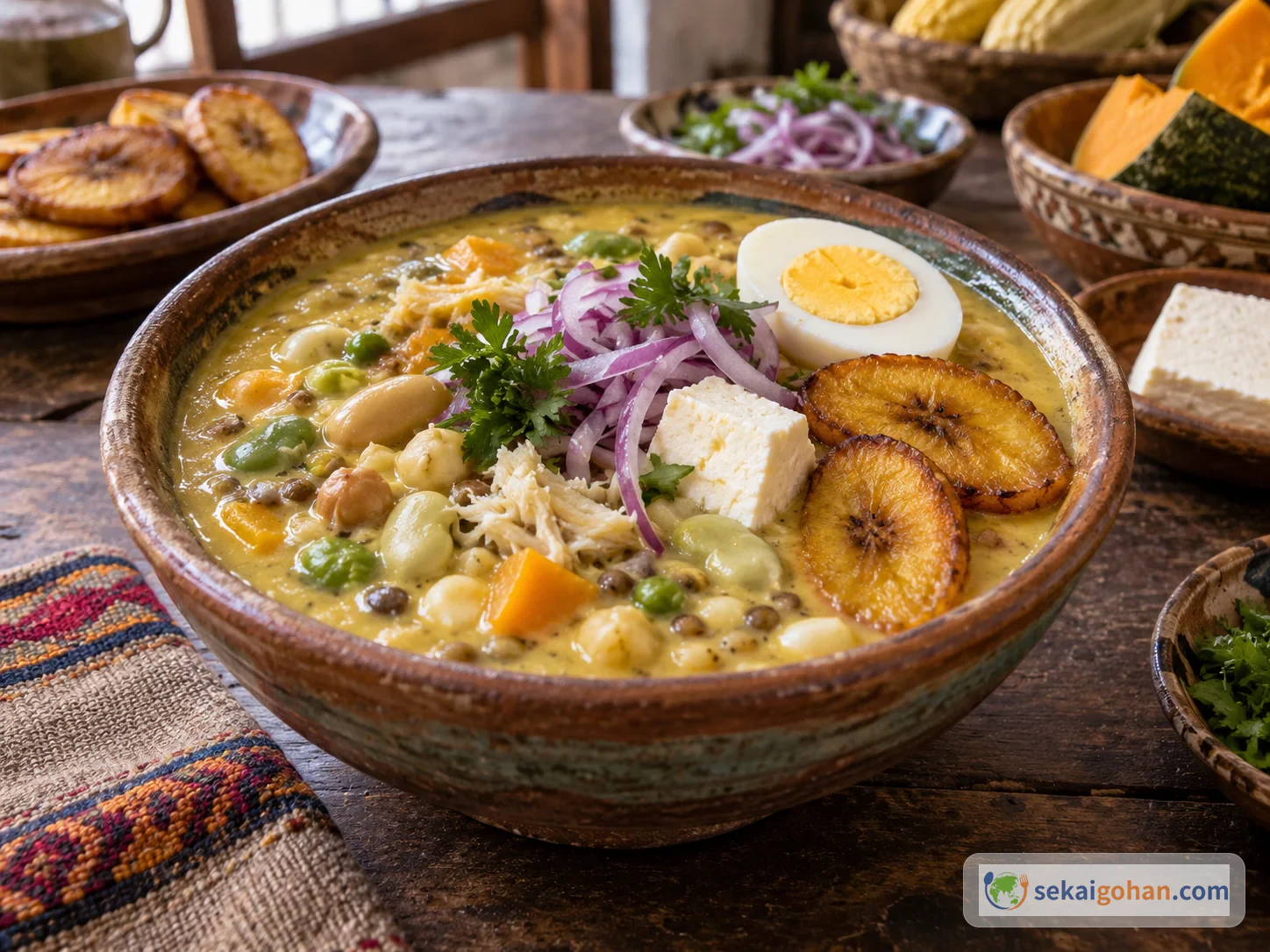
Hard-boil 2 eggs in boiling water and halve them. Slice ripe plantain on the diagonal and, in a skillet over medium-low heat with a little oil, cook both sides until browned to toast the surface. Toss red onion with a little lime juice and salt, and have parsley or cilantro, cheese, and green chile ready too.
Pour the fanesca into deep bowls and top with the egg and plantain, onion, cheese, and herbs. Keep the acidity separate by serving it on a different plate if you like. If everyone adds to taste, they can change each bite with the garnishes, and the rich soup stays enjoyable to the end.
Ingredients (serves 4)
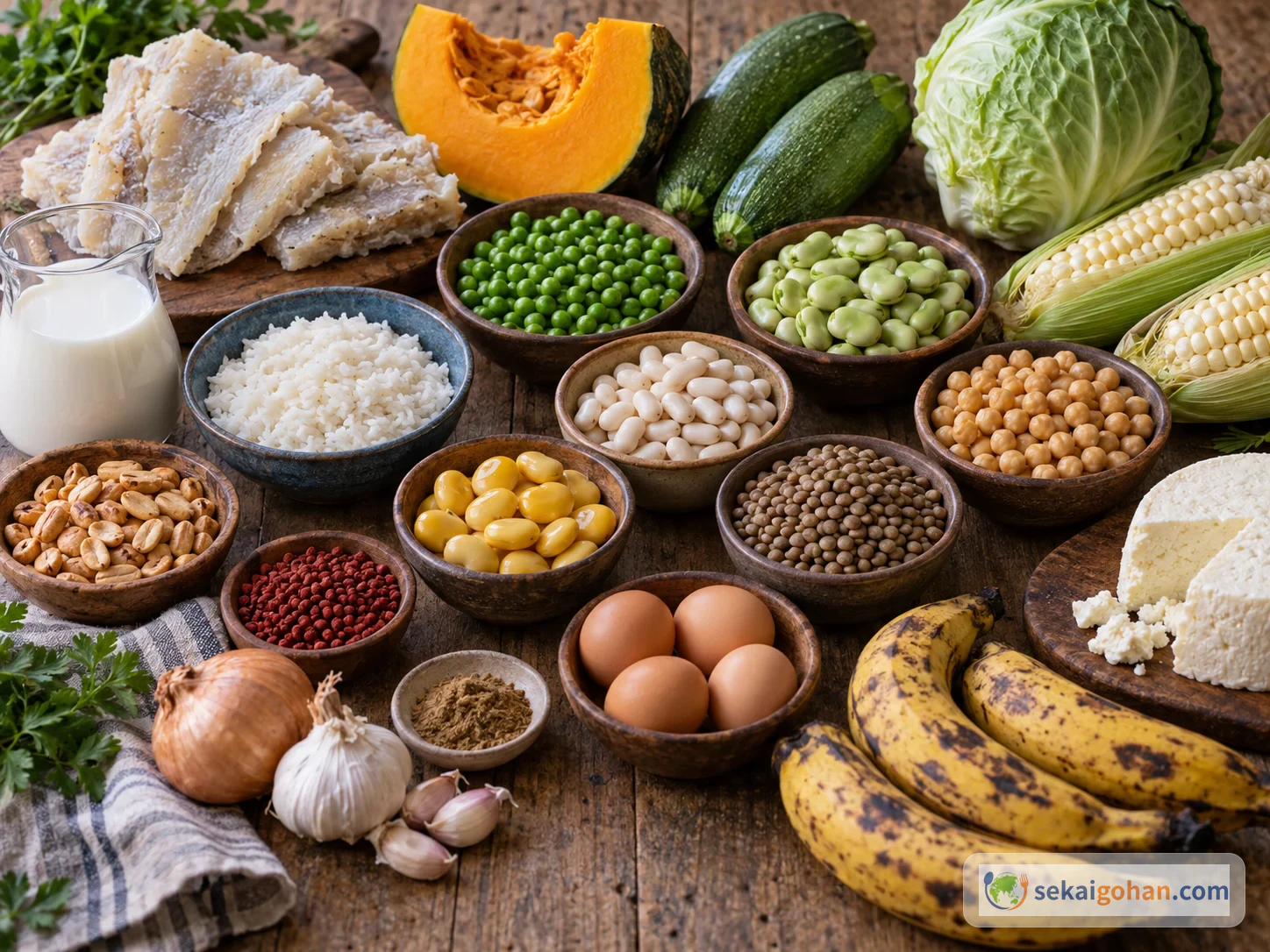
Before you shop, get the overall picture. The eight ingredients are corn, green peas, fava beans, white beans, chickpeas, lentils, chochos, and rice. Chochos are lupini beans; if you can find them already soaked, rinse and use them. If you cannot find them, use the same amount of white beans, though the texture will be a little different.
The other foundation is the squash and zucchini that build the thickness from squash. Squash brings sweetness and body to the core of the soup. If you cannot find zambo, use zucchini in its place. Substitute white beans for chochos rather than hunting for them.
If you prep the salt cod, dried beans, and lentils separately the day before, on the day you only need to line up the eight boiled beans and grains in boxes or bowls. The ones worth looking for first are fava beans, lentils, annatto, and plantain, by their common names. Do not hunt for chochos and zambo; replace their roles of texture and sweetness with white beans and zucchini.
Desalt the salt cod in the refrigerator, changing the water, and do not leave it long at room temperature. Check each diner for allergies to fish, milk and cheese, peanuts, and legumes. Do not reuse the water or milk used for desalting, and cook everything thoroughly to the center after heating.
Choosing Ingredients and Substitutes for Fanesca
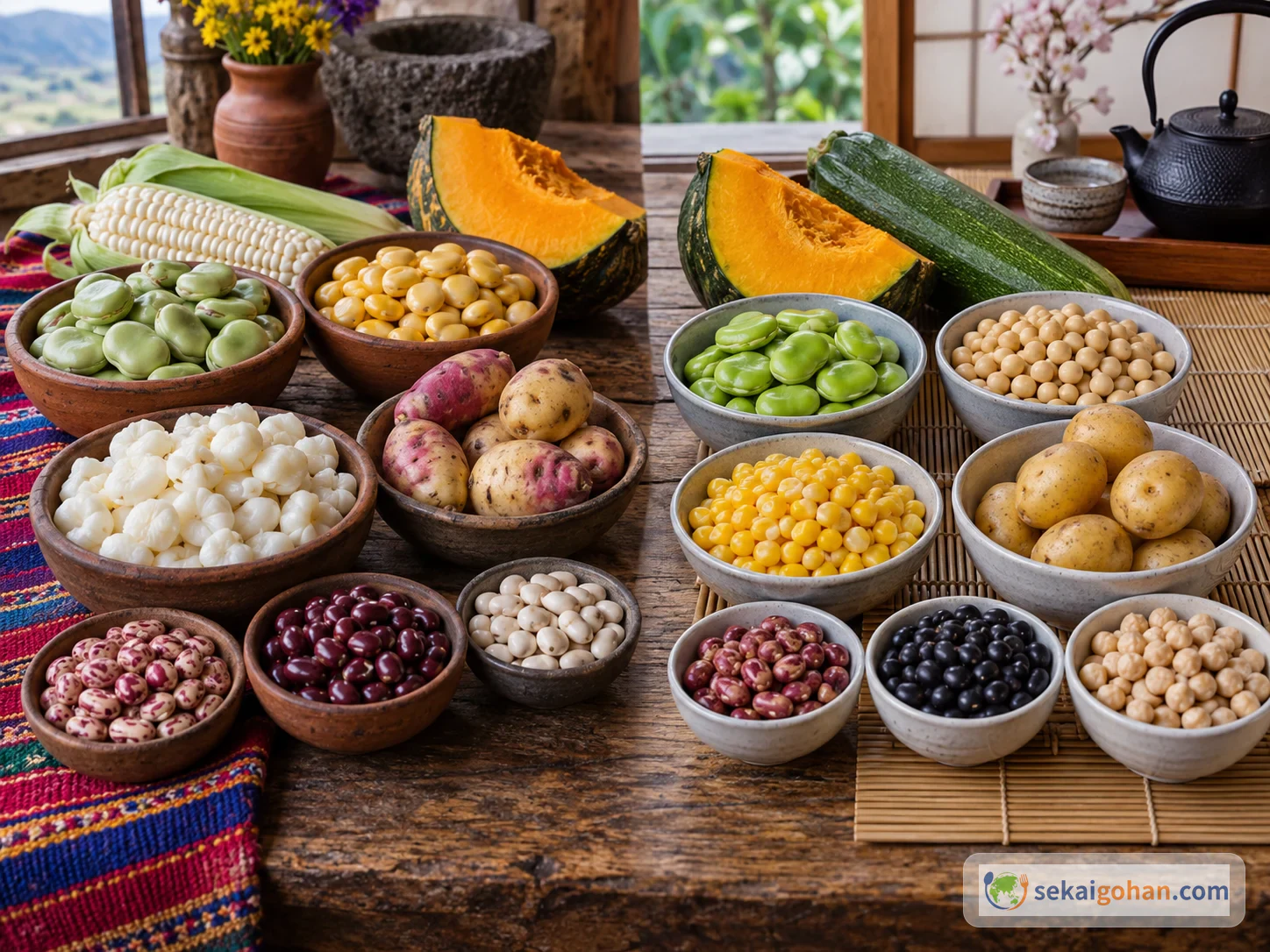
This recipe sticks to eight ingredients so the work is easy to share: corn, green peas, fava beans, white beans, chickpeas, lentils, chochos, and rice. The body comes from milk and squash rather than from piling up more grains. When you cook it at home, protect a few things above all: the savoriness of salt cod, the sweetness of squash, the body of milk and peanuts, a sofrito with annatto, and a mix of beans and grains. Past that, you have room to improvise. White beans can stand in for chochos, zucchini plus extra squash for zambo, and a little potato for mellocos.
Fish and color are harder to fake. If you can't find salt cod and use white fish instead, you'll get less salt and less savoriness, so add the fish at the end rather than cooking it first, and adjust the salt separately. Paprika can stand in for annatto's color, but it won't give you the flavor. Turmeric pushes the soup into another dish entirely, so leave it out.
Shopping online? Search for annatto (achiote), fava beans, lentils, and plantain (cooking banana) by their common names. For chochos and mellocos, don't grab some random product just to keep the count up; use the substitutes in the ingredient table instead.
Fixing Common Fanesca Problems
If it becomes too salty
If the salt cod and cheese have pushed it too far, thin the soup with small amounts of unsalted squash puree, milk, or bean cooking liquid. Pouring in a lot of water at once will break down the thickness from the squash and milk. Hold back on extra cheese, salt, and the salt-cured onion garnish, then taste again.
If it is watery or separated
If it's watery, take off the lid and simmer over low heat for 5–10 minutes, or stir in a little squash and rice puree. If the dairy and peanuts separate, stop the boil, add a little milk, blend one serving until smooth, and return it to the pot. Beans that have fallen apart are just part of the soup now, so don't add more beans; let the garnishes bring the texture back.
Serving and Storing Fanesca
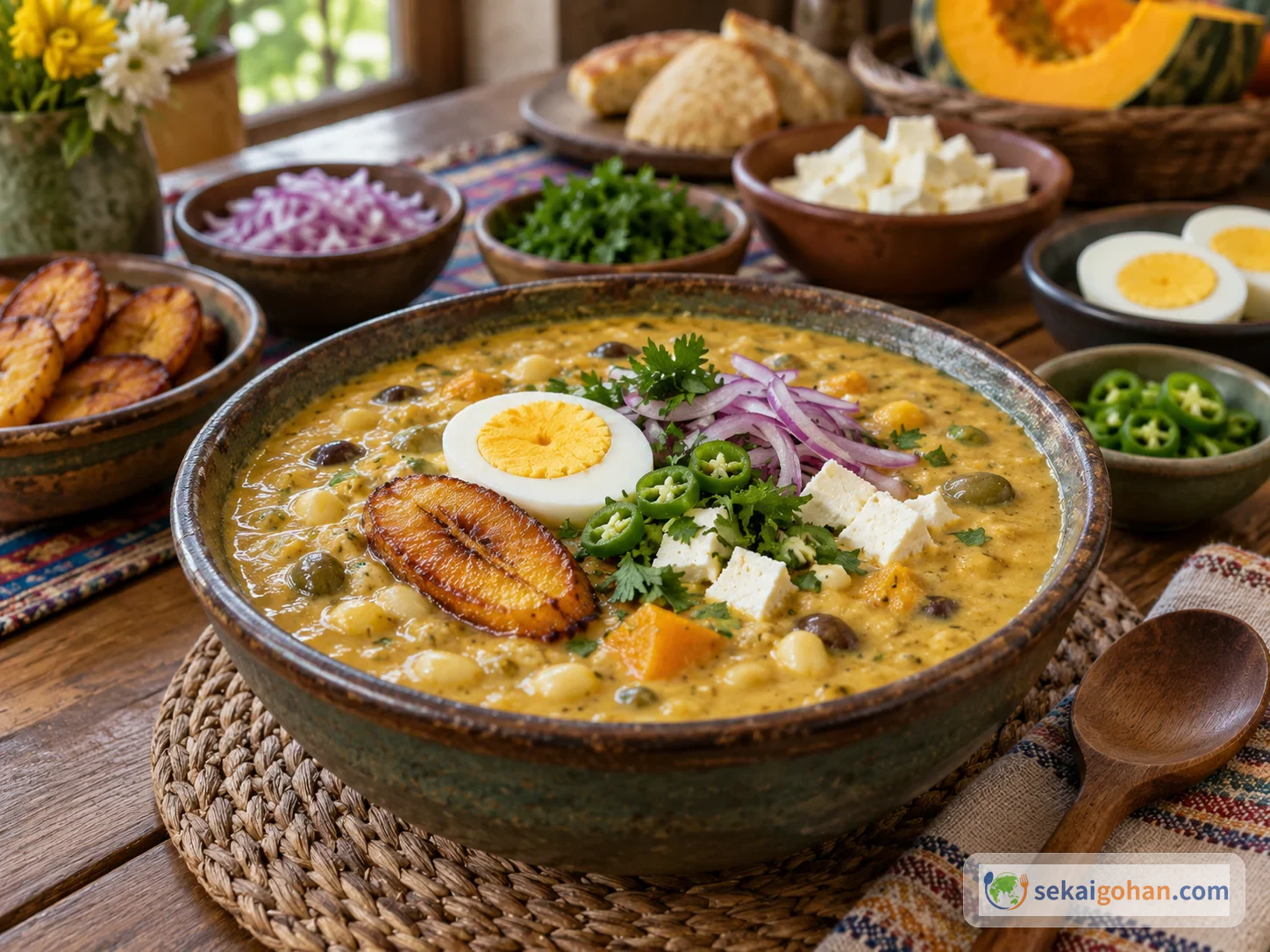
The garnishes are a big part of the meal: hard-boiled egg, fried ripe plantain, cheese, parsley or cilantro, chile, and lime-cured onion. Small fried wheat pastries or empanaditas are a nice extra on a separate plate. Put out the plantain's browned sweetness, the red onion's acidity on a separate plate, and cheese a little at a time. When each one stays separate, even a soup this rich is easy to finish.
Ladle the soup into bowls while it's hot and add the egg and plantain first, then the onion, chile, cheese, and herbs. When everyone adds their own heat and salt, kids and anyone cutting back on salt can keep their bowl mild. Taste the first bowl at full thickness. For seconds, you can loosen it with a little milk or unsalted cooking liquid.
Storing and reheating
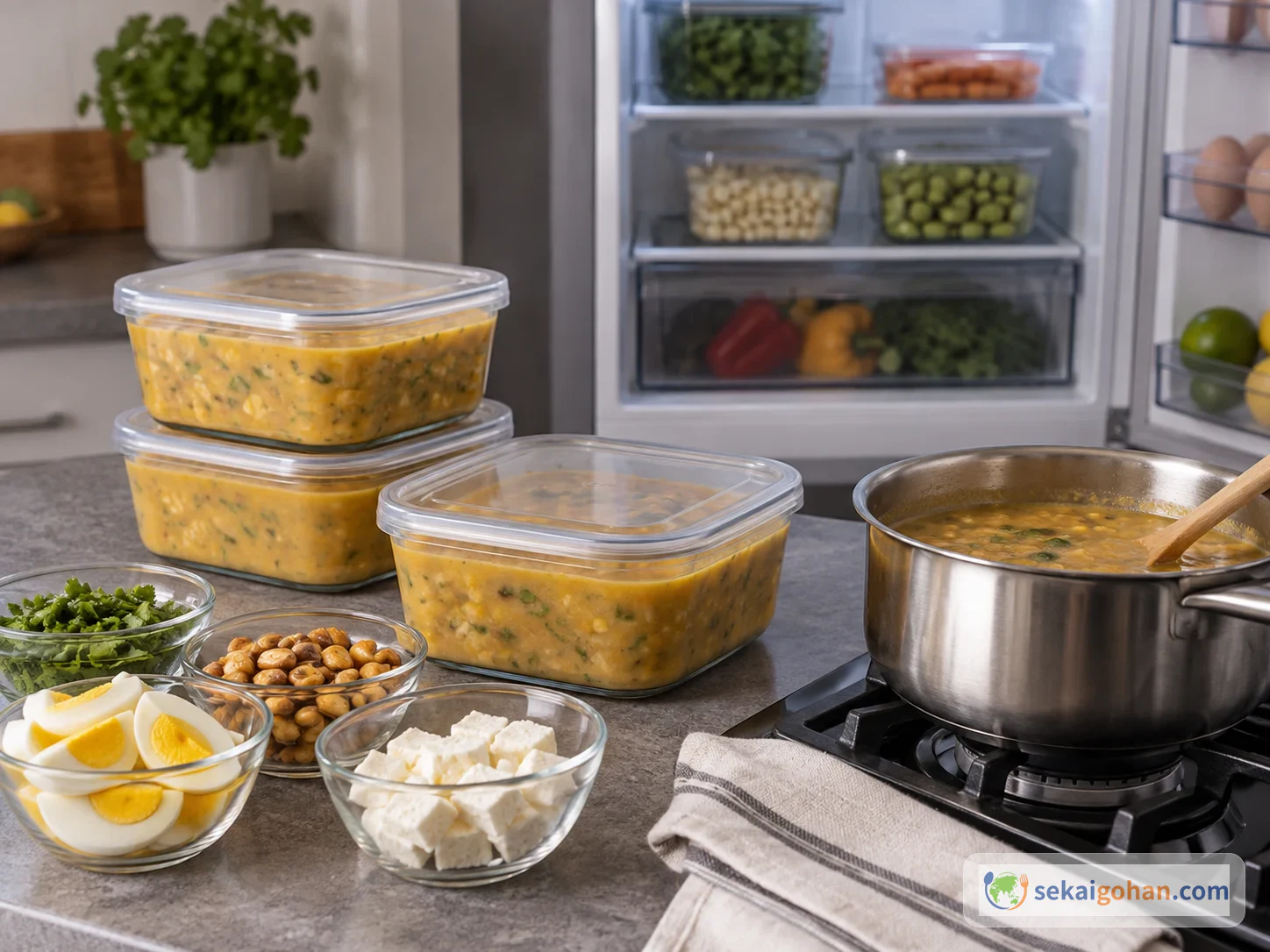
With fish and dairy in the pot, make-ahead fanesca needs care. Cool it quickly, divide it into shallow portions, and refrigerate it in airtight containers instead of leaving it out at room temperature. Eat it within about 2 days, and reheat only what you will eat, warming it in a pot until it's hot at the center.
For freezing, store the garnishes separately. Freezing changes the beans' texture and tends to split the dairy, so use it within about 2 weeks for best quality. If it separates as it reheats, keep it from a hard boil, add a little milk, and whisk it back together slowly.
Do not leave the pot out at room temperature. Cool it quickly, and use containers in the refrigerator that keep the liquid from touching other foods. Do not eat it if it smells sour, is stringy, or the container is bulging. The safe number of days depends on your refrigerator's temperature, the desalting, and the ingredients. Do not rely on the day count alone; check the smell and texture first.
FAQ
Q1. Is 12 hours enough to desalt the salt cod?
One method desalts the fish for 12 hours in milk, and another for 24–48 hours in water. How thick and salty your fish is sets the time. This recipe uses 24 hours, changing the water every 6–8 hours. Rather than going by the clock, cook a piece after desalting and taste it to see whether it needs longer.
Q2. Can I make it without peanuts or milk?
Peanuts and milk give the soup most of its thickness and richness. To leave them out, use more white beans and squash puree and stretch the soup with unsalted fish stock. Soy milk in place of dairy changes the aroma and how the soup separates. If someone has a peanut allergy, steer clear of substitutes that contain peanut butter too. With dietary restrictions, safety matters more than matching the flavor, so check allergen labels.
Q3. The next day it was too thick.
The rice, beans, and squash soak up liquid in the fridge. Add 3.5 tbsp (50 ml) milk or unsalted cooking liquid at a time and warm it over low heat. Once it's hot, check the salt before adding cheese or salt-cured onion. Don't let it boil hard; turn off the heat before the dairy separates.
Related Reading
- Locro de papas: Ecuador's potato and cheese soup: An Andean soup of potatoes and dairy, worth comparing with fanesca's base of squash and milk
- Encebollado: Ecuador's fish soup: A coastal pairing of fish and acidity, different from salt cod
- Llapingachos: Ecuador's cheese-stuffed potato cakes: Potato and cheese side dishes from the Ecuadorian table
Nutrition (per serving, one of four)
These are estimates for four servings, covering the salt cod, beans and grains, milk, peanuts, cheese, and garnishes. The numbers shift with how much salt stays in the fish after desalting, the moisture in the beans, the type of cheese, and the oil used to fry the plantain.
| Nutrient | Amount |
|---|---|
| Energy | 540 kcal |
| Protein | 1 oz (29 g) |
| Fat | 22 g |
| Carbohydrates | 2 oz (54 g) |
| Fiber | 11 g |
| Salt equivalent | 3.7 g |