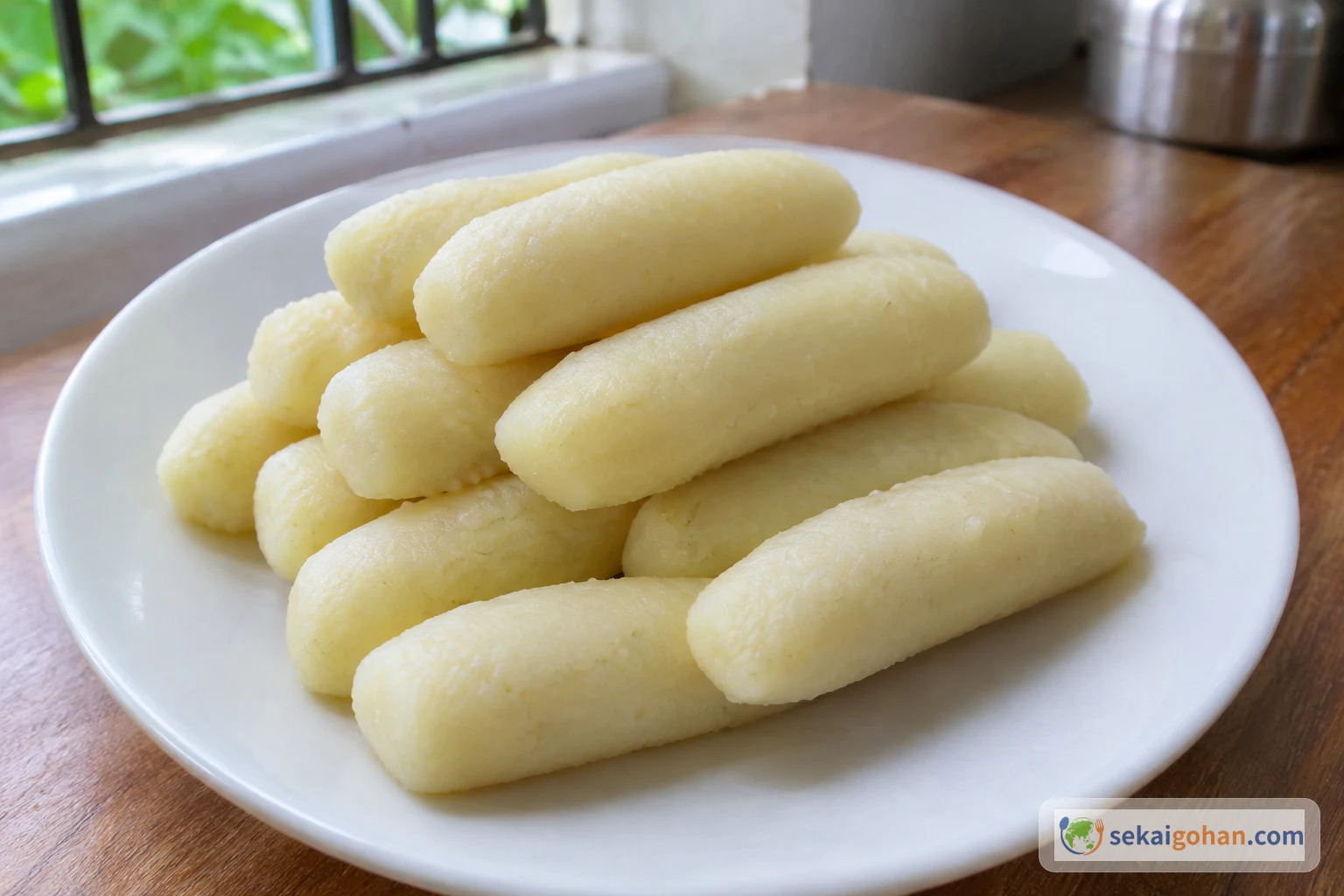
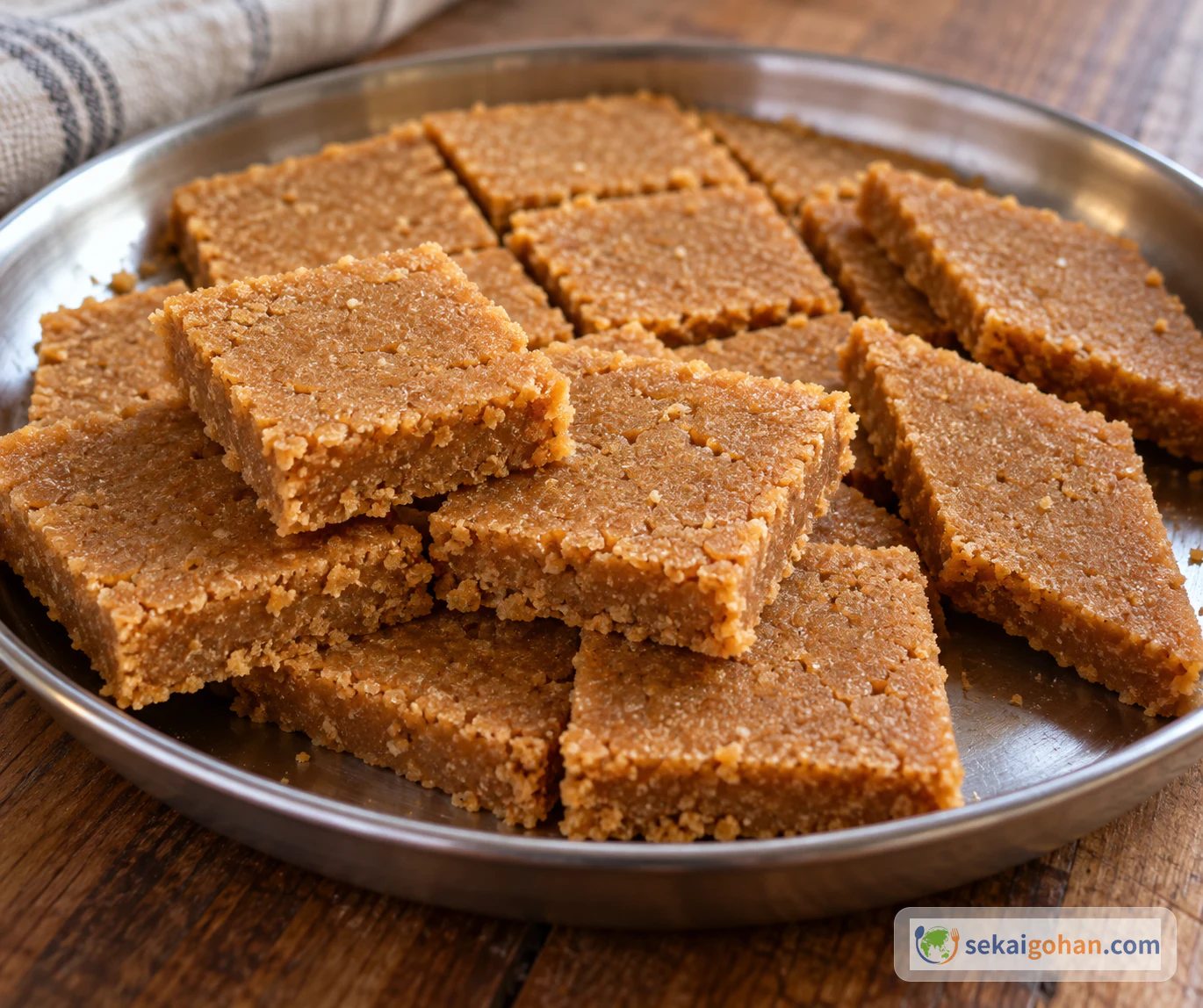
Lift the lid of the steamer and all you see is a small white mound. It has no browning and no garnish. Break one open, though, and coconut and dark jaggery crumble out of the moist rice flour as a sweet scent rises with the steam. Bhapa pitha (ভাপা পিঠা) is Bangladesh's steamed winter sweet, and its flavor comes out the moment you break it. Make it on a cold morning or evening, and eat it straight from the steamer while the air still smells of rice and dark sugar.
What bhapa pitha is
In Bengali, bhapa means steamed. Pitha is a big family of sweets and snacks made from rice, wheat, pulses and more. For this one, you moisten rice flour, pack it loosely into a mold, fill it with coconut and jaggery and steam it. The texture is grainier than a steamed bun and more crumbly than a dumpling, and it suits tea time or a morning snack.
Other rice-flour sweets in the region are quite different. Sri Lanka's aasmi is light from frying and syrup, and the Philippines' sapin-sapin is rich with layers of glutinous rice flour and coconut milk. Bhapa pitha is plainer than either. Its flavor depends on getting the moisture of the flour right.
ভাপা (bhapa) means steamed, and পিঠা (pitha) is read pitha. You will also see Vapa pitha in English. This site uses "bhapa pitha."
Ingredients and how to think about shopping

This makes 6 bhapa pitha about 7 cm across. Small teacups, pudding molds or metal cups all work. What matters is not pressing hard into the mold but piling the moist flour loosely.
This recipe uses rice and coconut. Glutinous rice flour and rice flour can be made on lines that also handle wheat, dairy and nuts, so check the labels if you have allergies. If the steamer boils dry, the pot will scorch. Stay near the pot while steaming.
What matters most for bhapa pitha is the fineness of the flour, a small amount of glutinous rice flour, and a steamer that holds steady steam. Fine desiccated coconut and jaggery are sold at import and Asian grocers.
Choose a non-glutinous rice flour with fine grains that is not gritty after steaming. It is not kneaded like wheat flour but made to hold water like damp sand, so the fineness of the flour shows directly in the result.
Glutinous rice flour is not essential. With only non-glutinous rice flour, the edges tend to crack on the first try, so mix in a little over a tenth of the total as insurance. You are not aiming for mochi, so don't add too much.
The steamer matters even for a small sweet. If strong steam isn't rising from the start, the flour sets while still damp and only the center turns heavy. A two-tier pot makes it easier to keep enough water, and steam circulates even with a cloth laid in.
Choosing rice flour, coconut and jaggery
You won't need any unusual ingredients. When you shop, pay attention to how damp the rice flour is and how fragrant the coconut filling will be. This recipe mixes in a little glutinous rice flour so the cakes crumble less. Without it, the cakes taste more purely of rice flour and break apart crumbly once they cool. Add more and they hold together better, but they drift away from a Bengali steamed rice-flour sweet toward something like mochi. The first time, use just 1.5 oz (40 g). Next time, try rice flour only, and the difference will be easy to see.
Fresh or frozen grated coconut comes closest, if you can find it. Desiccated fine coconut works too, as long as you rehydrate it in boiling water before making the filling. Long-shred coconut is awkward to eat, so chop it with a knife to 0.25 inch (5 mm) or less.
If you can't get jaggery, use dark brown sugar. On its own, 3.25 oz (90 g) of brown sugar has a strong aroma that can drown out the coconut. A split of 2.75 oz (80 g) brown sugar, 10 g raw cane sugar and 0.4 g cardamom goes better with tea.
Instructions: don't press the flour; let the steam bring it together
Bhapa pitha is not a sweet you knead and shape. Flour that has taken up water goes into a mold, and the steam sets it from the surface. Pressing it hard makes the shape look steadier, but after steaming the center turns heavy and does not crumble in the mouth.
Common bhapa pitha problems and fixes

At home, the hard part is moistening the flour, and you won't need special equipment. With so few ingredients, nearly every failure comes down to the moisture in the flour or the steam. Too much water makes the cakes heavy like mochi. Too little leaves them powdery, and they crack after steaming. You can adjust the sweetness of the filling later, but the state of the flour is fixed once it goes into the steamer.
| Condition | Cause | Fix |
|---|---|---|
| Powdery after steaming | Too little water, weak steam | Add water 1 tsp (5 ml) at a time until the flour holds when squeezed. Start steaming over high heat |
| Heavy like a dumpling | Too much water, pressed into the mold | Add 1 tbsp non-glutinous rice flour. Don't press in the mold; only level the surface |
| Filling is hard | Jaggery was boiled down | Stop at 2 minutes over low heat. On a day you use brown sugar, add 1 tsp water to the filling |
| Filling leaks from the side | Filling spread to the edge | Put the filling in the center and leave 0.25 inch (5 mm) of plain flour at the edge |
| Pockmarks from drips on the surface | Condensation dripped from the lid | Wrap a cloth around the lid. If the pot drips a lot, tilt the lid slightly |
How to eat, store and reheat

Bhapa pitha is best warm and freshly made. Break one open while it's hot, before the smell of coconut and jaggery fades. Serve it with unsweetened black tea or strong milk tea rather than a cold dessert. It's also good after the lightly salty aloo bhorta. If you're serving it at a meal of rice and dal, a little sour aam er achar clears the palate before the sweet pitha.
| Storage method | Duration | When eating |
|---|---|---|
| Room temperature | 4 hours | Only in a cool indoor winter room. Cover lightly so it doesn't dry out |
| Refrigerator | 1 day | Steam over medium heat for 5 minutes. Serve as soon as the surface plumps back |
| Freezer | 2 weeks | Wrap one by one. Steam frozen over medium-low heat for 8 minutes |
| Microwave | 20 seconds at 600 W | Dries easily, so sprinkle a few drops of water and cover loosely with plastic wrap |
Can I make it with only rice flour?
Yes. Use 10 oz (280 g) non-glutinous rice flour and start with ½ cup (105 ml) lukewarm water. The cakes crack more easily without glutinous flour, so fill the molds without pressing and keep the 2-minute rest after steaming.
Can I make it without molds?
Small teacups, mugs or pudding cups work fine. A cup about 7 cm across and about 3 cm high steams evenly in 12 minutes. One large cake in a big bowl stays heavy in the center, so make small ones the first time.
Can I substitute if I dislike coconut?
Not really. Without coconut, bhapa pitha loses half its aroma. If you really dislike it, you can make small ones with 20 g ground sesame and 2 oz (60 g) brown sugar, but the result tastes like a different sweet.
Can I make it in the microwave if I have no steamer?
I don't recommend it. In a microwave, the outside of the rice flour sets suddenly while the center tends to stay powdery. You'll get closer with a homemade steamer: a skillet filled with water, a heatproof plate and a lid. Keep the water at a gentle simmer, and don't let it boil dry.