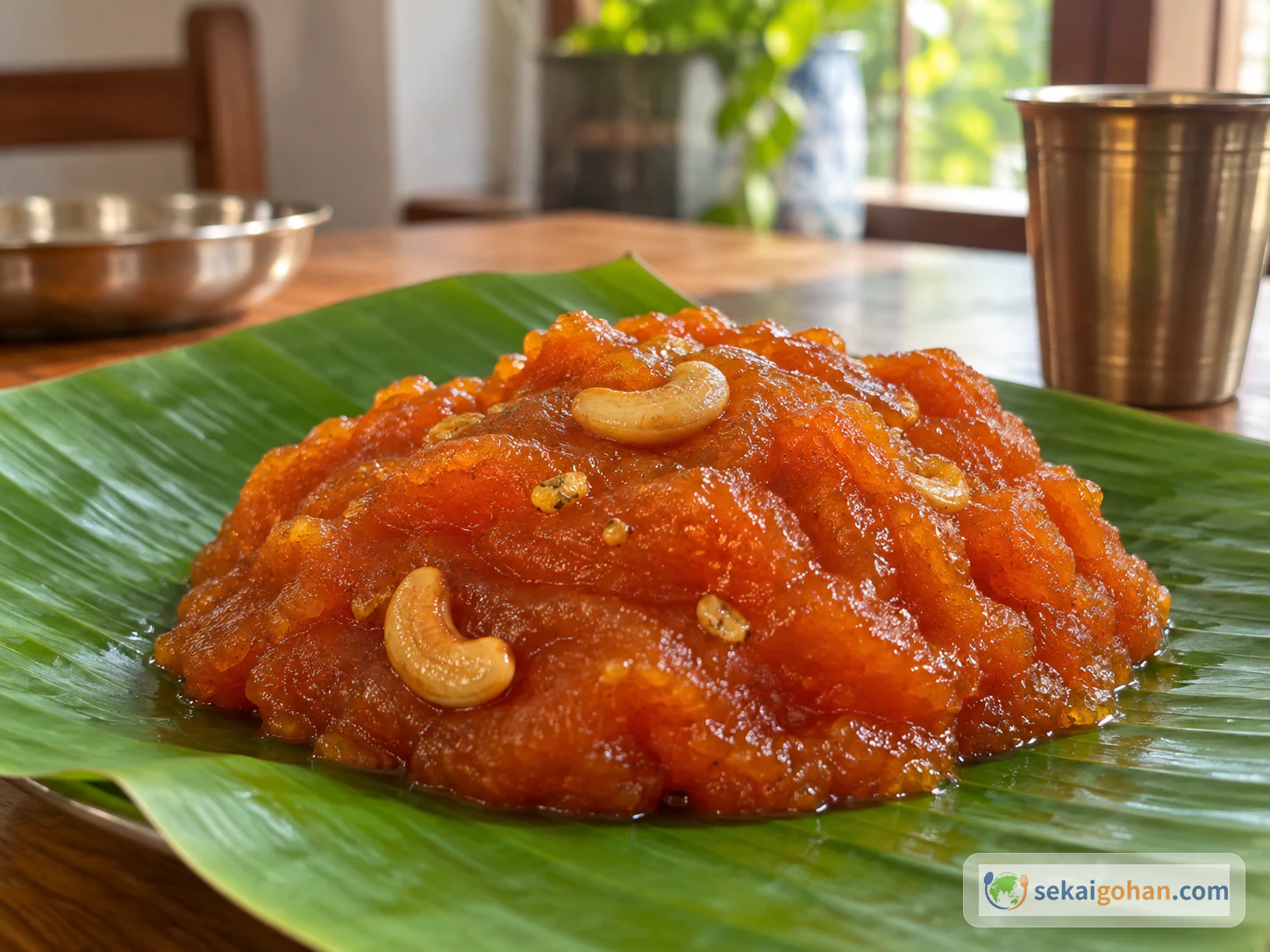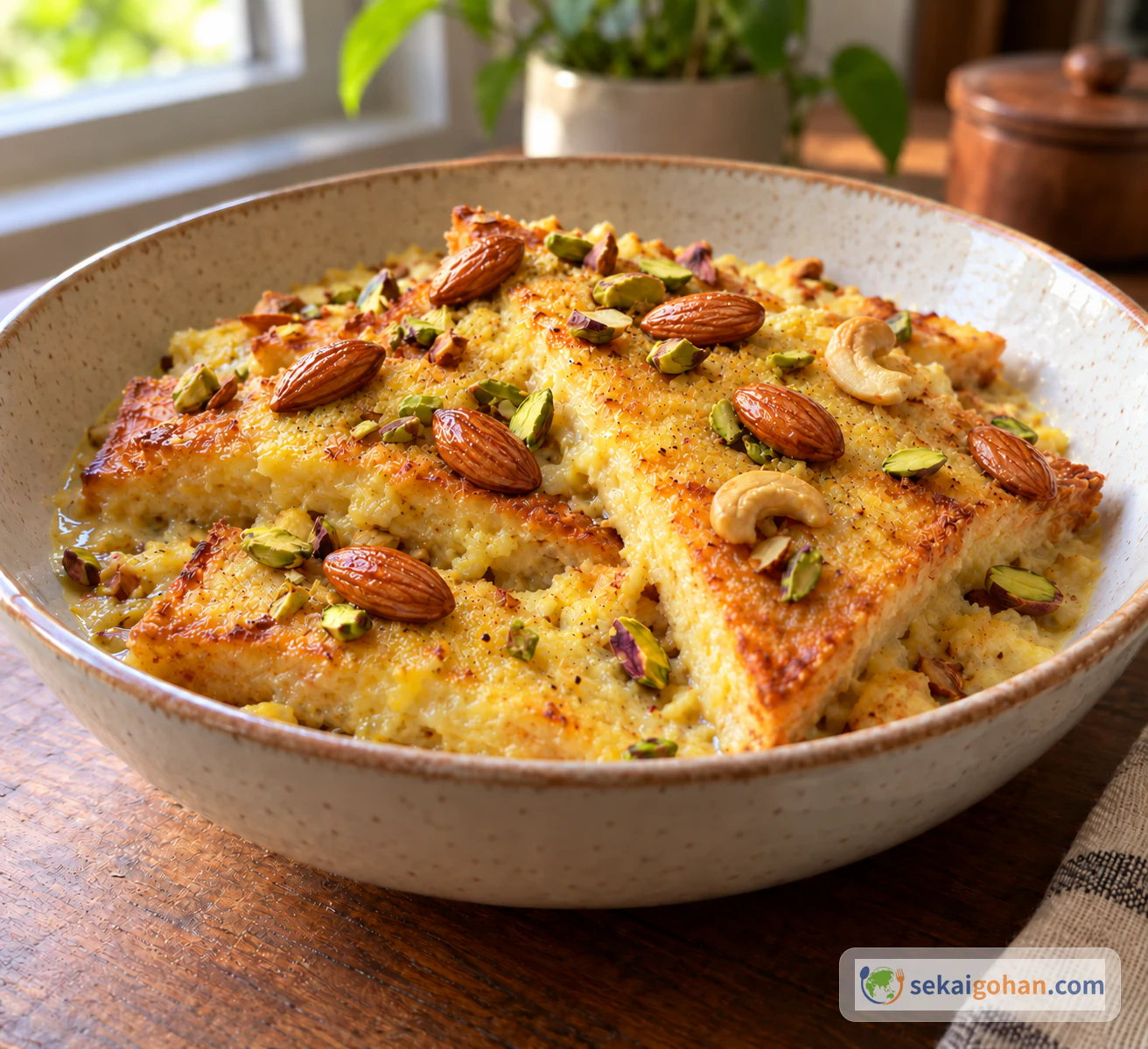
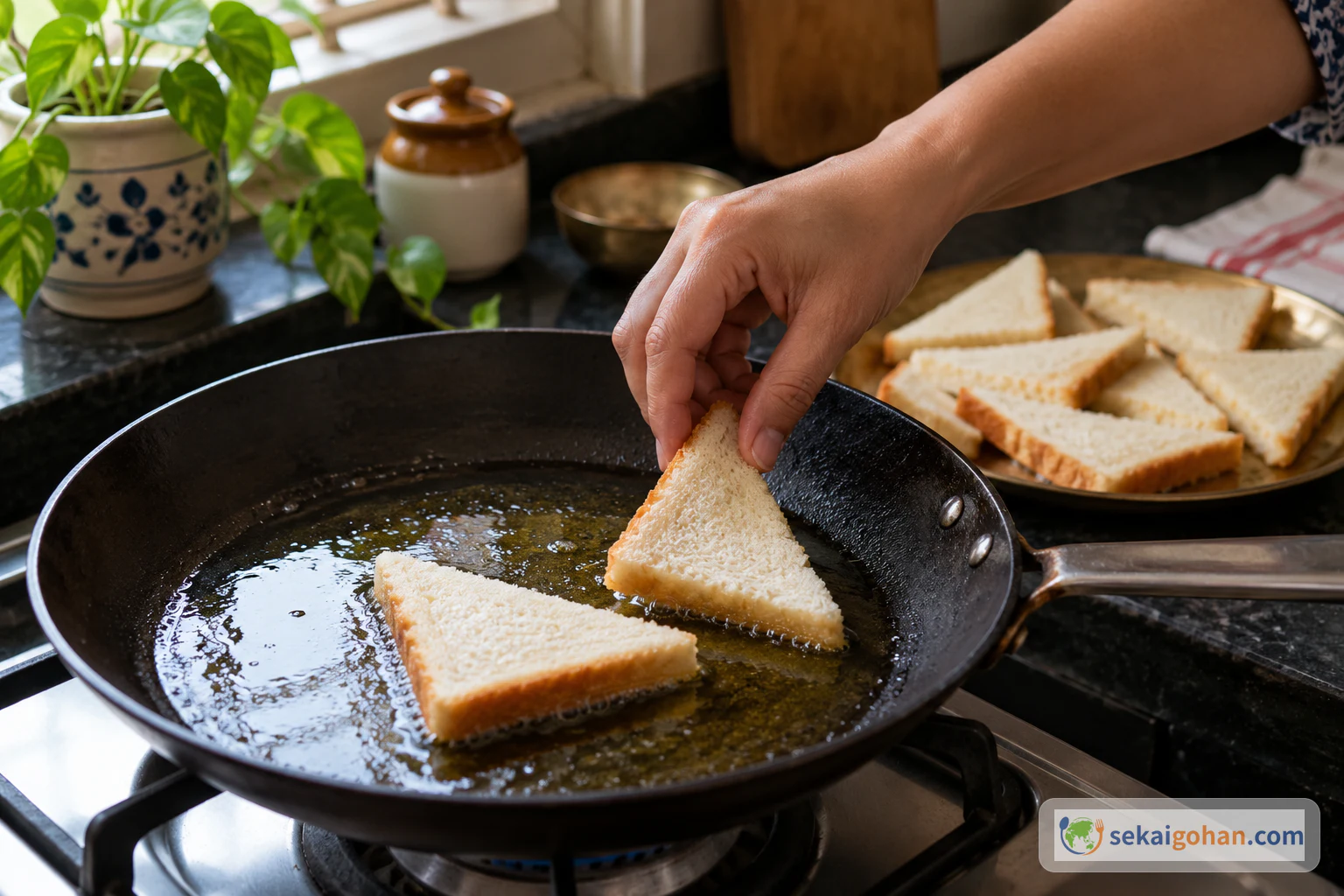
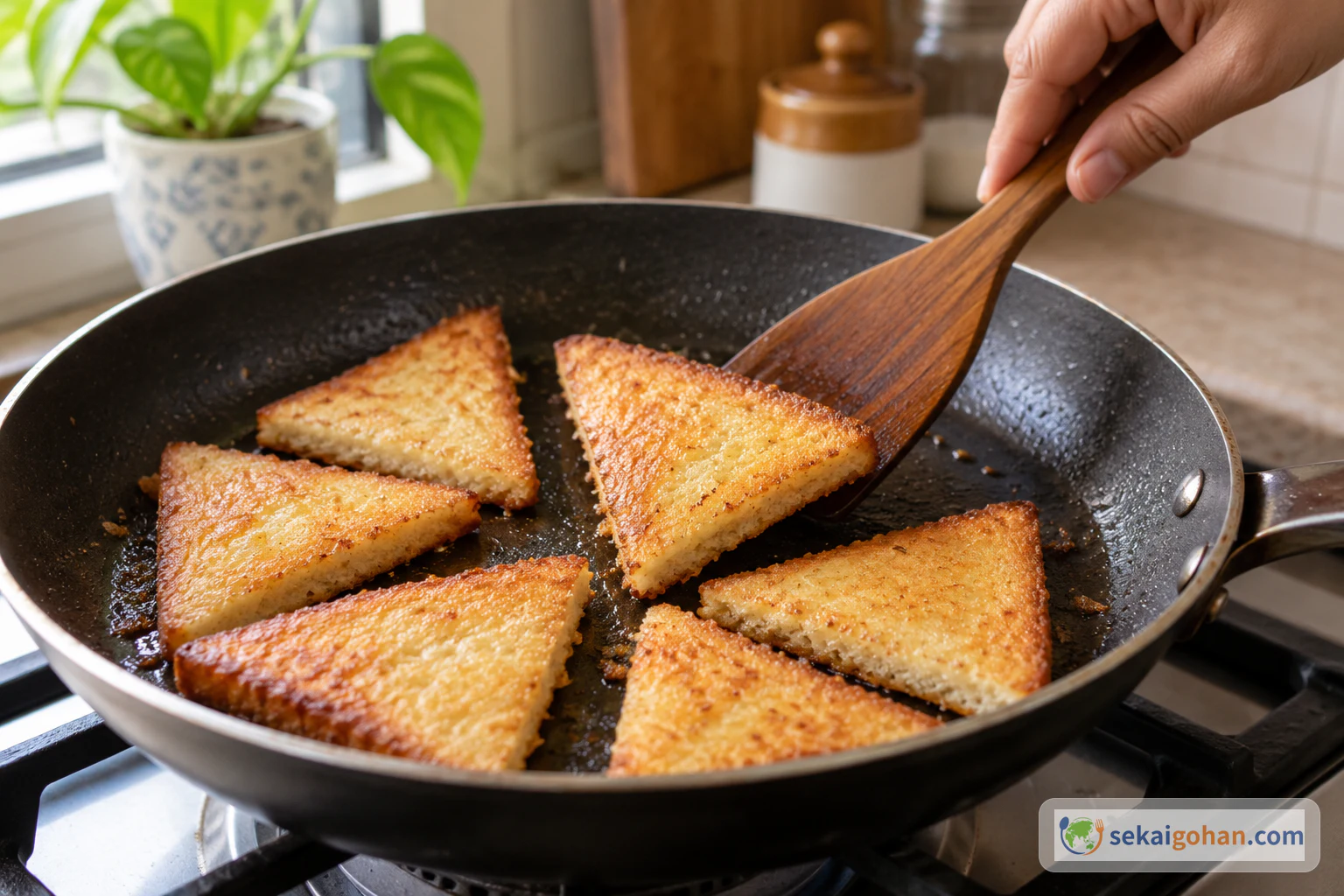
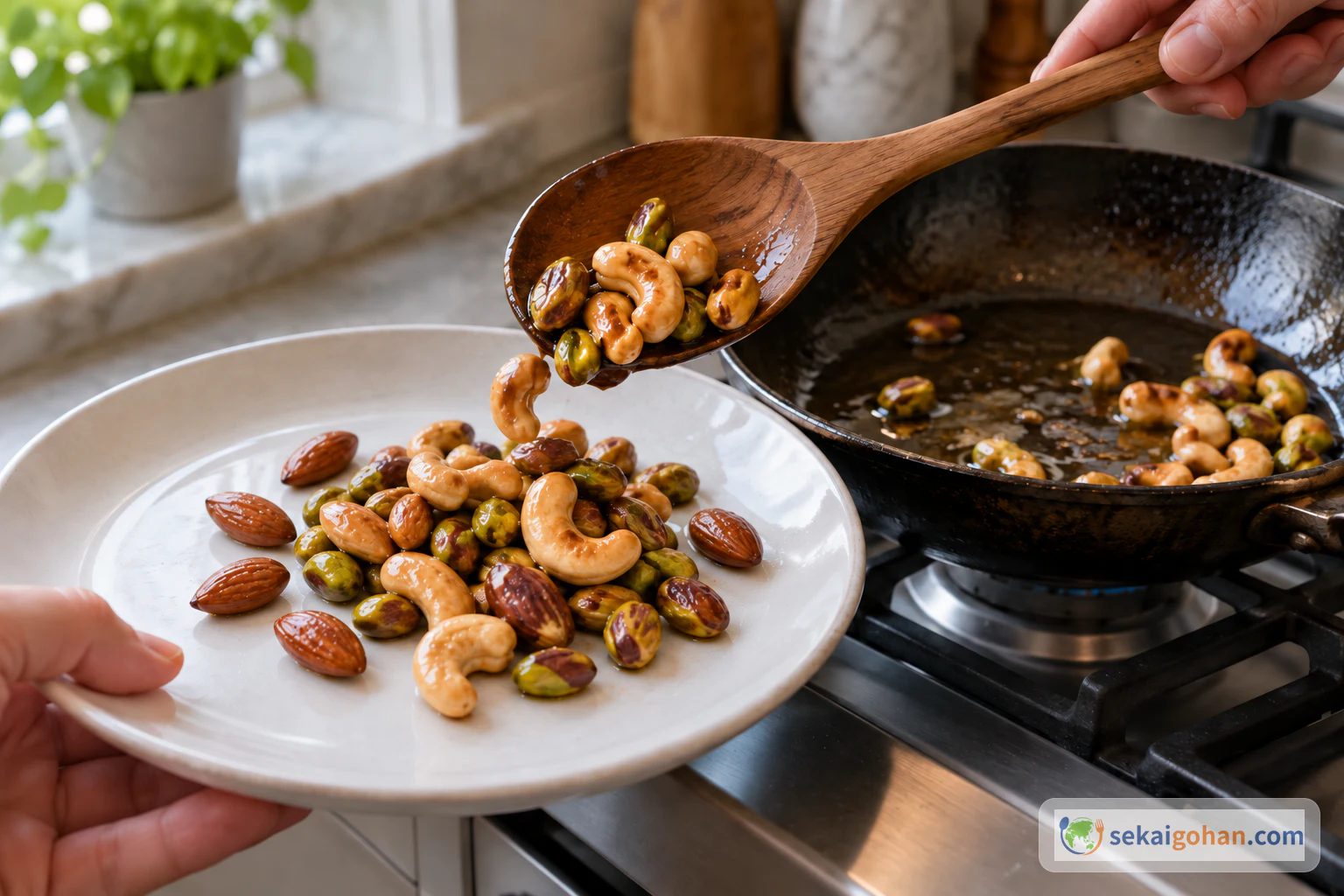
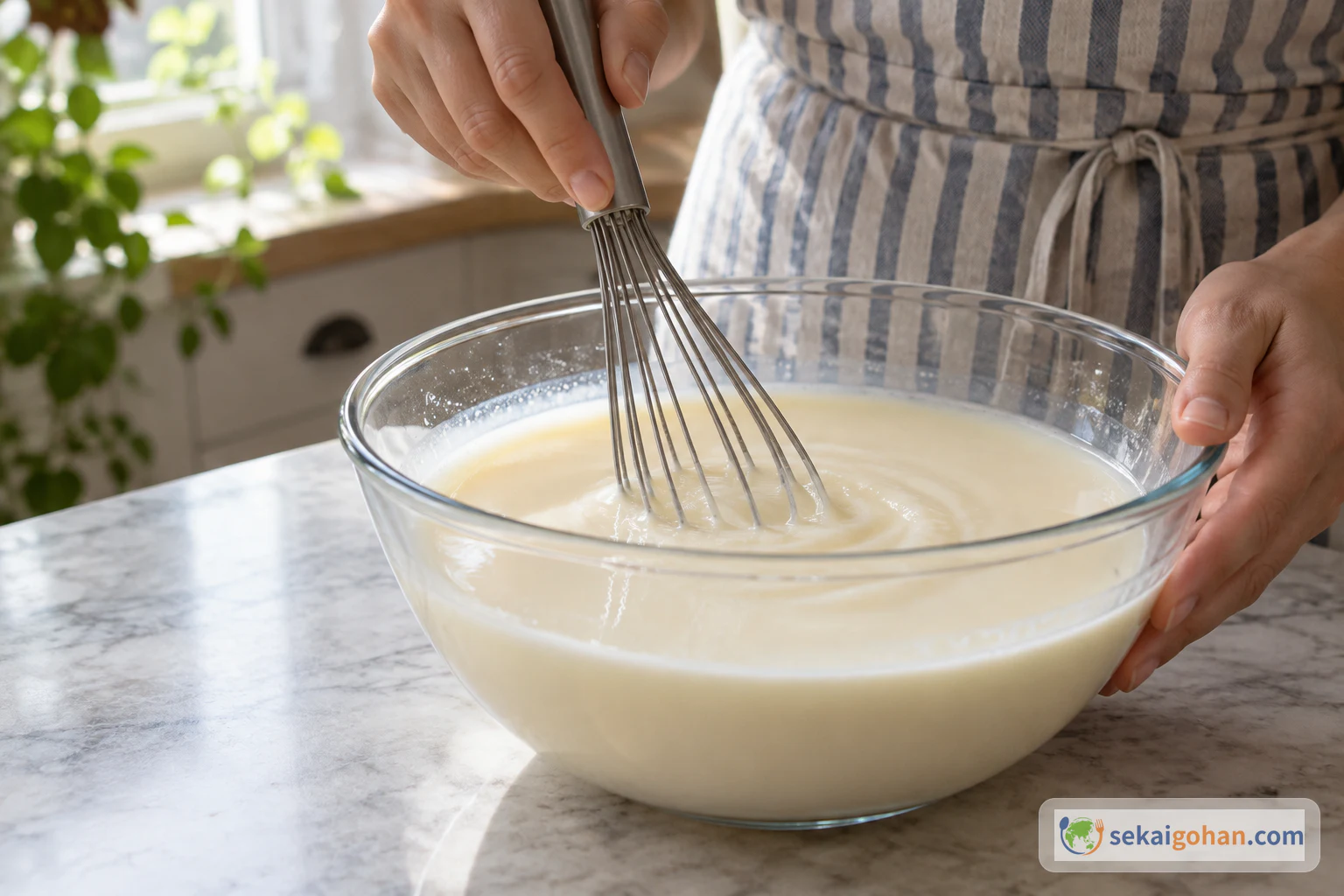
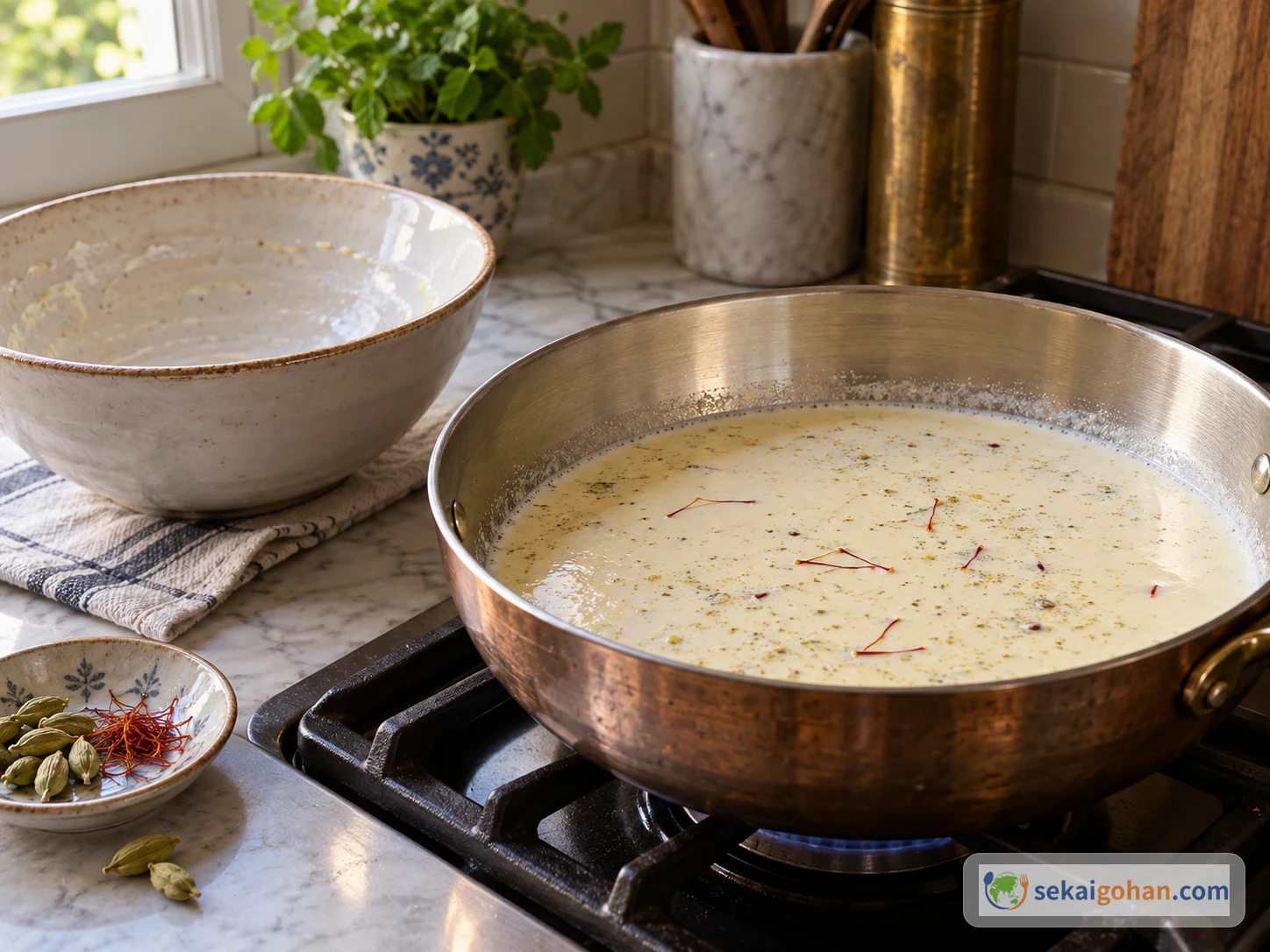
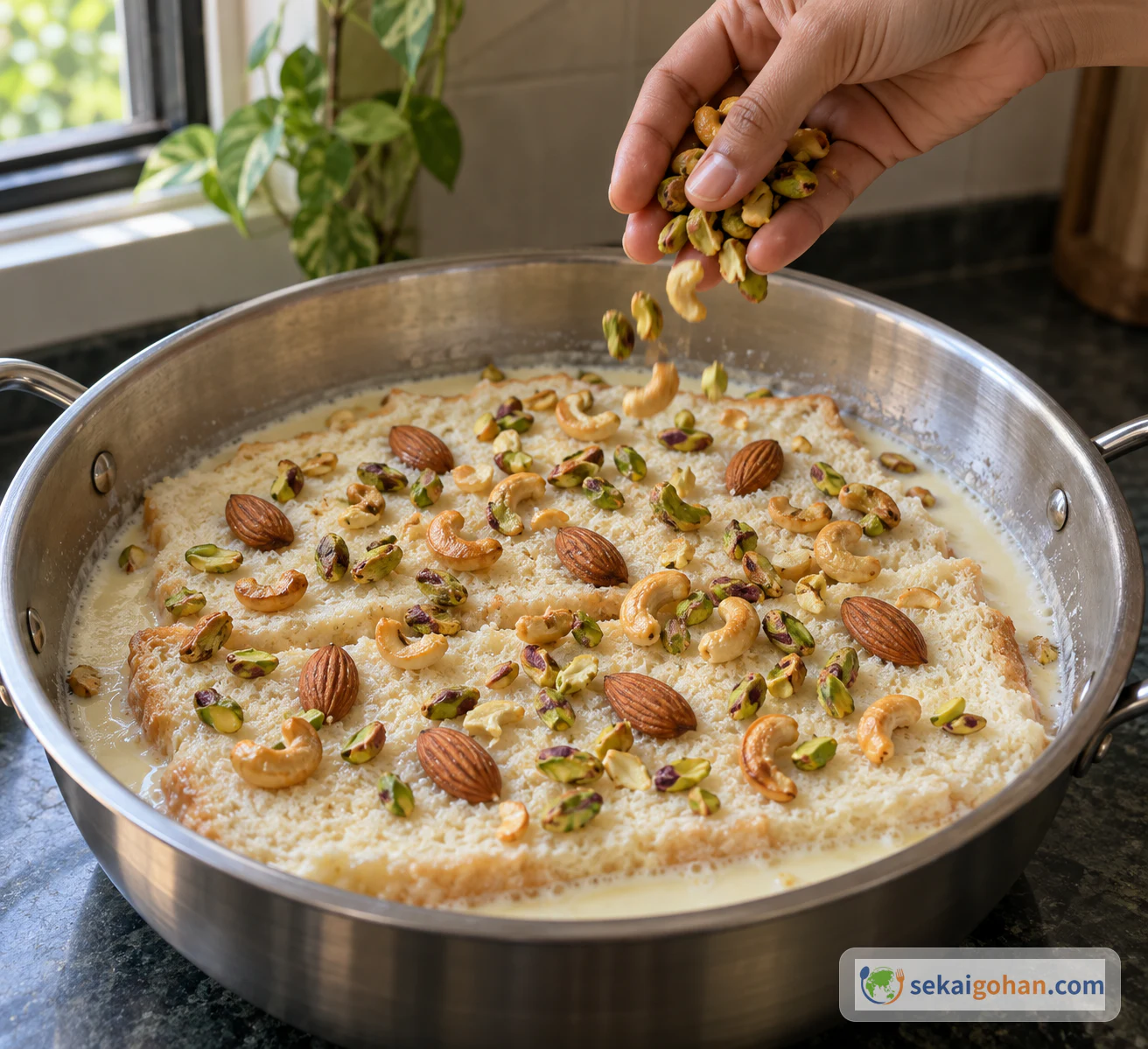
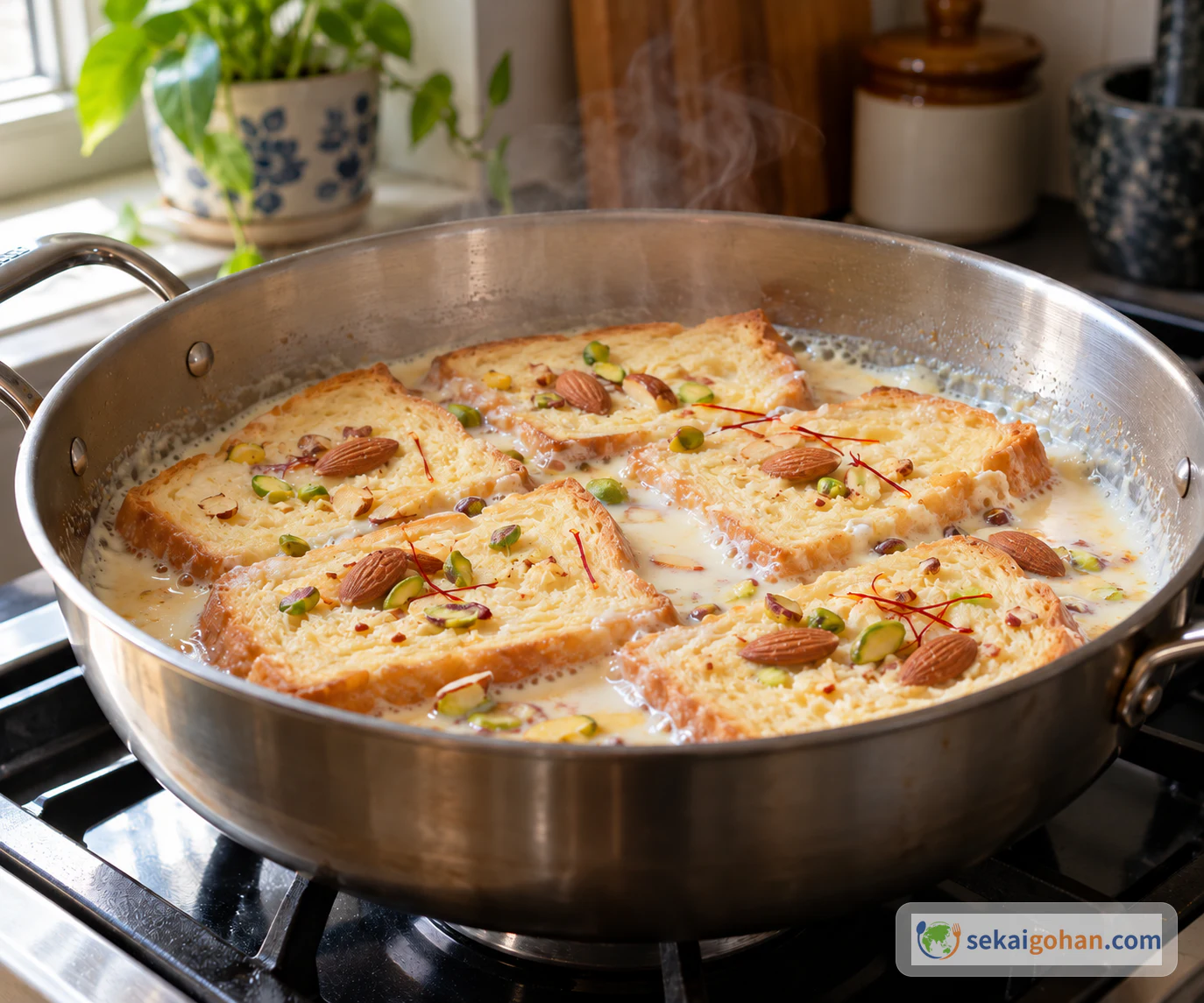
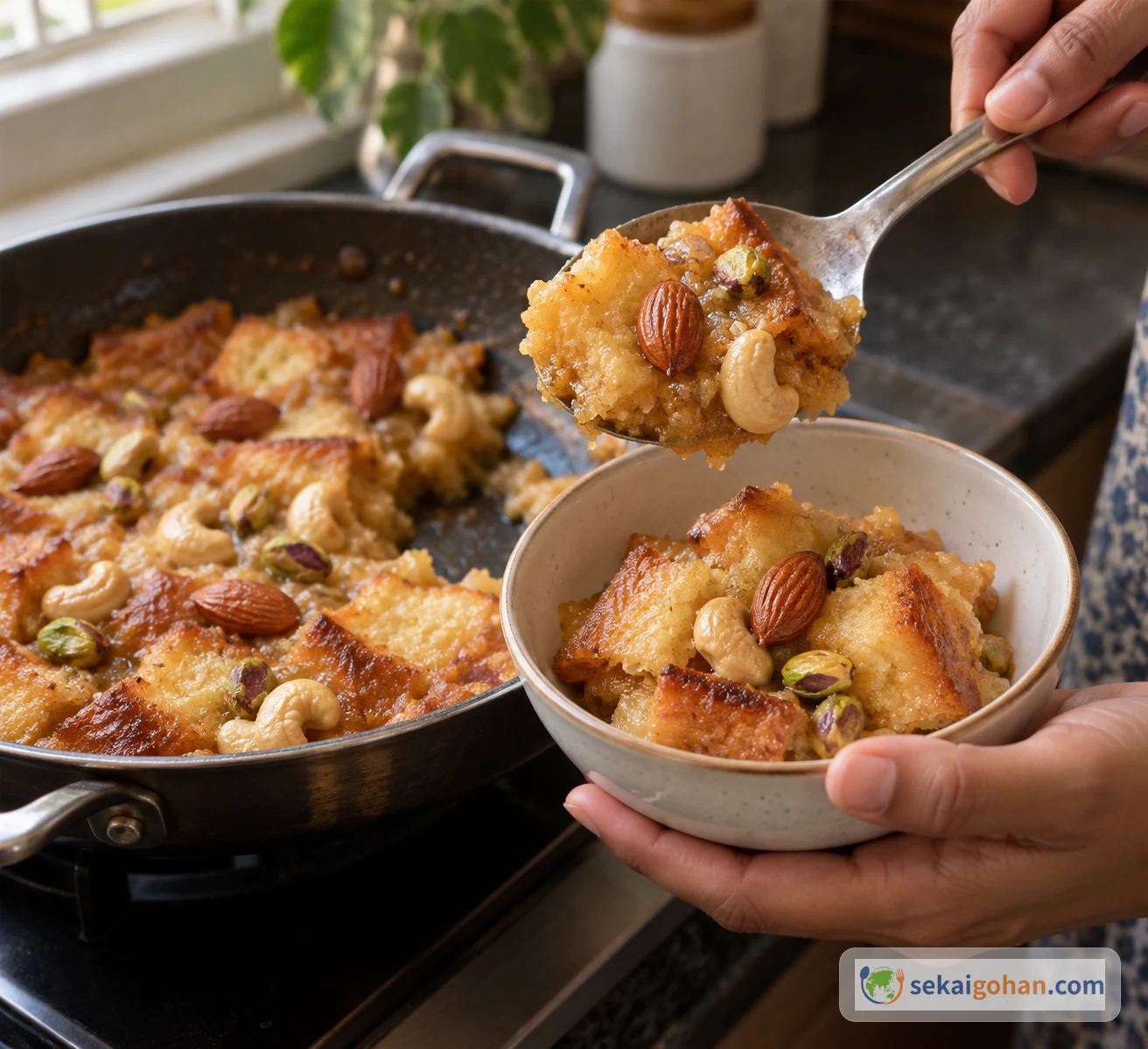
White bread triangles turn golden in a thin layer of ghee, and in the same pan a handful of almonds darkens, followed by cashews and pistachios. Meanwhile, condensed milk and plain milk warm gently in a heavy-bottomed pan, scented with cardamom powder and a pinch of saffron strands. The toasted bread goes into that milk in two layers, the nuts and a spoonful of rose water go on top, and the pan returns to low heat until the bread has drunk up the milk. Double ka meetha is a Hyderabadi bread dessert, and this is a quicker home version of it. It serves 3, with 15 minutes of prep and 15 minutes of cooking.
Double Ka Meetha in Hyderabad
The name
The name is all about bread and sweetness. double-roTii means bread or a loaf of bread, and miiThaa means a sweet taste or a sweetmeat. So double ka meetha is a sweet made from bread, and double roti is the everyday name for Western-style bread.
Where it is eaten
In Hyderabad, double ka meetha is made for Eid gatherings, weddings and parties, and it turns up on Ramadan and Eid menus too. It isn't tied to any one occasion, though. You'll find it on festive and everyday tables alike.
The city's wider food history runs deep. In the 19th century, cookbooks carried courtly cooking knowledge to a wider readership, and after 1857 cooks moved to Hyderabad from Delhi, Lucknow and elsewhere.
Double ka meetha and shahi tukda
Cooks disagree on how the two are related. Some treat them as different dishes and link sugar syrup to shahi tukda. Others see them as close relatives that differ only in the thickness of the bread.
This home version
Traditional recipes reduce milk into rabri, deep-fry the bread, soak it in sugar syrup, or finish it covered on low heat. This version takes a shortcut on each count. Condensed milk stands in for the rabri, the bread is toasted on a tawa instead of fried, and the sugar syrup is left out.
For more dishes from across the country, see our India page.
Ingredients for Double Ka Meetha
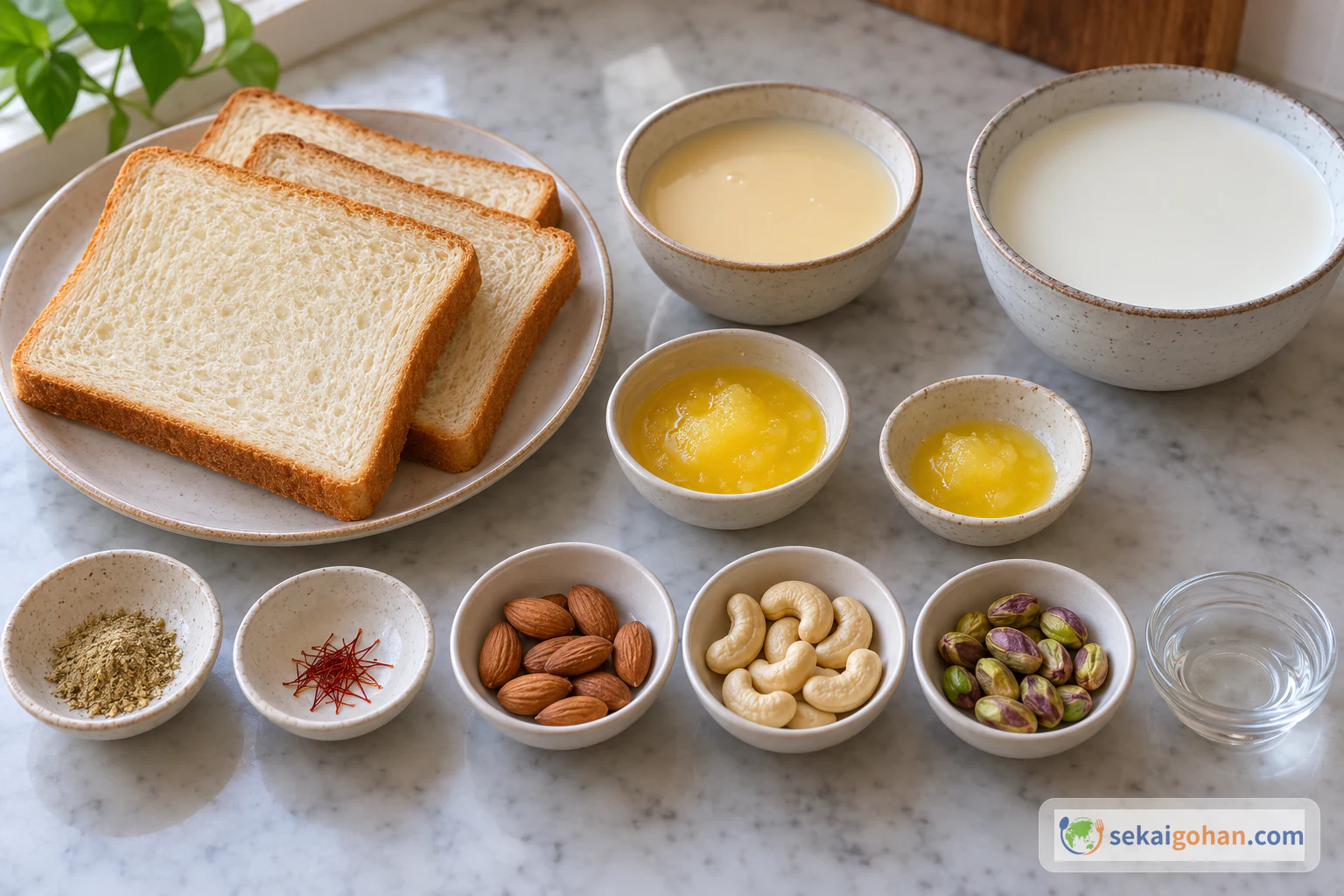
The two portions of ghee are used at different stages. Keep them in separate dishes so the nut ghee is not used up on the bread.
Equipment
- Cutting board and knife
- Tawa or heavy-bottomed frying pan, for toasting the bread and frying the nuts
- Flat spatula
- Plates for the toasted bread and the fried nuts
- Mixing bowl
- Whisk or spoon
- Heavy-bottomed pan, for warming the milk mixture and the final simmer
- Small spoon, for the rose water
- Serving bowls
Choosing Ingredients for Double Ka Meetha
Look for ghee, cardamom powder, saffron strands and rose water by their plain names, plus "kesar" for saffron.
- Bread: Large white sandwich bread, crusts kept on. If your slices are much smaller than standard sandwich bread, use more of them. Go by how many pieces it takes to fill two layers in your pan.
- Ghee: Ghee does double duty here, toasting the bread and frying the nuts, so stick with it.
- Saffron: Use real saffron strands. Yellow food coloring is a different ingredient altogether.
- Cardamom: Use ground cardamom rather than whole pods.
- Rose water: Choose plain culinary rose water, not a rose-flavored drink or syrup. The ingredients list marks it as optional, but the method sprinkles 1 teaspoon over the bread, so use it if you can. Without it the dish still works, but the aroma will be different.
Method: Toast, Fry, Warm, Layer, Absorb
The milk mixture is stirred together cold in a mixing bowl and then poured into a heavy-bottomed pan before heating. Never put an ordinary mixing bowl over direct heat.
Fixing Common Double Ka Meetha Problems
Toast the bread until it is golden and crisp on every side, warm the milk without boiling it, and let the two layers soak on low heat without turning them, so each triangle keeps its shape.
Let the bread and milk guide you at each stage, rather than the clock.
Judge each stage by golden bread, warm (not boiling) milk, and milk absorbed into the bread.
| What you see | What to check | What to do |
|---|---|---|
| Bread is golden in patches but soft elsewhere | Whether every surface has touched the pan | Keep turning the pieces until evenly crisp, adding a little more ghee if the pan is dry |
| Nuts all browning at once, some too dark | Whether everything went in together | Fry the almonds alone first, then the cashews and pistachios, and take each batch out as soon as it is ready |
| Milk mixture starts to bubble hard | The heat under the pan | Keep it on low and take it off as soon as it is warm; it should not boil |
| Milk catching on the bottom during the final simmer | The pan | Use a heavy-bottomed pan and keep the heat low |
| Bread triangles breaking apart | Whether they were turned or stirred in the milk | Leave the layers still while the milk is absorbed |
Serving and Variations
Serve double ka meetha warm, or chill it and serve it cold.
Swaps to try
You can use multigrain, whole wheat or brown bread instead of white, cut rectangles instead of triangles, or trim the crusts. The bread can be deep-fried, shallow-fried or brushed with ghee instead of pan-toasted, and it can even be baked or microwaved. Some cooks put khoya (mawa) in the milk and add sugar or sugar syrup. Raisins can go in once the dessert is done, and if you don't mind softer edges, you can turn the bread gently during the final simmer.
Other versions
A richer version reduces milk into rabri, fries the bread and the nuts (raisins included), soaks the bread in sugar syrup, and finishes the whole dish covered on low heat (dum). Another layers fried bread with sugar syrup, saffron milk and nuts. A branded version uses Milkmaid condensed milk and deep-fries the bread before simmering it in the condensed-milk mixture. Its quantities are tied to the product pack. Each of these has its own proportions, so pick one and follow it rather than mixing amounts.
Frequently Asked Questions
Do I need to make rabri?
No. Here, sweetened condensed milk mixed with milk takes the place of rabri. Rabri-based versions use a different method.
Should the bread be fried?
Pan-toast it in ghee until golden and crisp. Deep-frying or shallow-frying also works, but this recipe doesn't use either.
How long does it keep?
Keep it in the refrigerator and eat it within a couple of days.