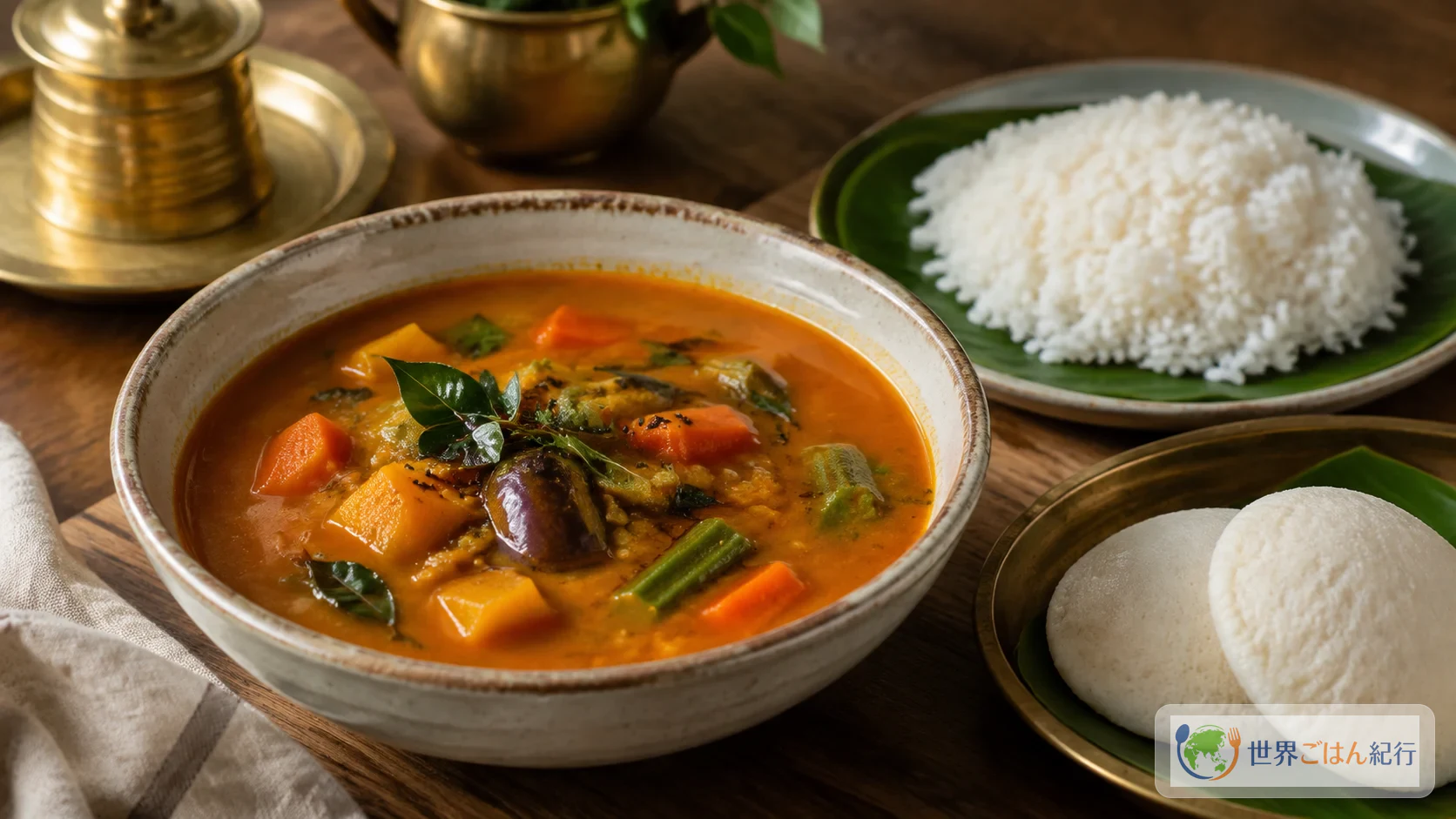
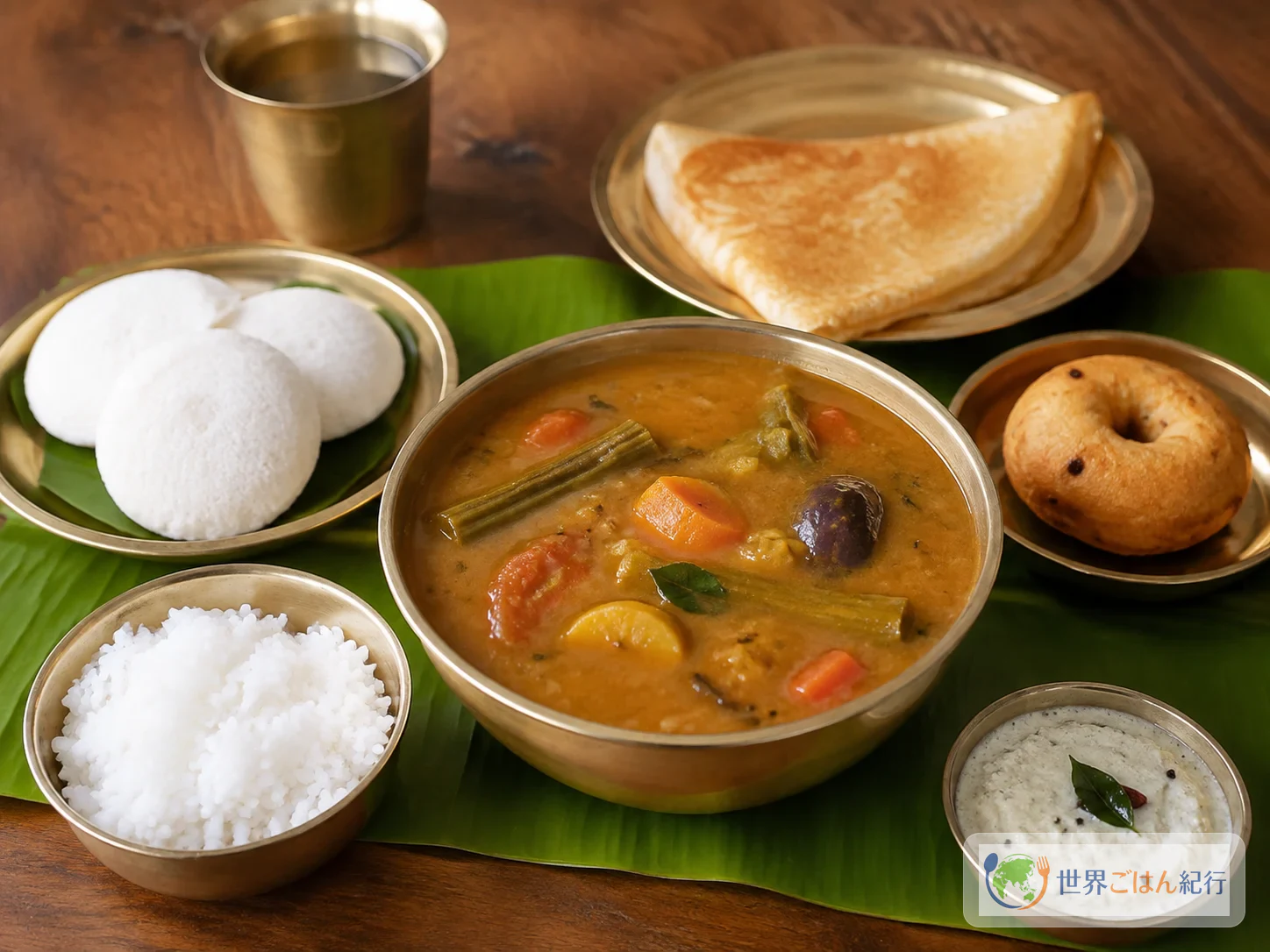
Mustard seeds crackle softly, and the curry leaves give one big spit as they hit the oil. Kill the heat before the dried red chiles and cumin darken, pour the hot oil over the pot of dal and vegetables, and reddish-brown streaks spread across the surface. Sambar (சாம்பார்) is South India's everyday stew of toor dal (split pigeon peas), vegetables, tamarind and spices. The carrots keep some bite, the squash holds its edges, and the dal is soft enough to bind the broth, while the deep sourness of tamarind, the toastiness of dry-roasted spices and the green scent of fresh leaves all layer in one pot. Spooned over rice, the broth soaks into every grain. With idli or dosa it turns into a sauce that picks up the gentle sweetness of the batter.
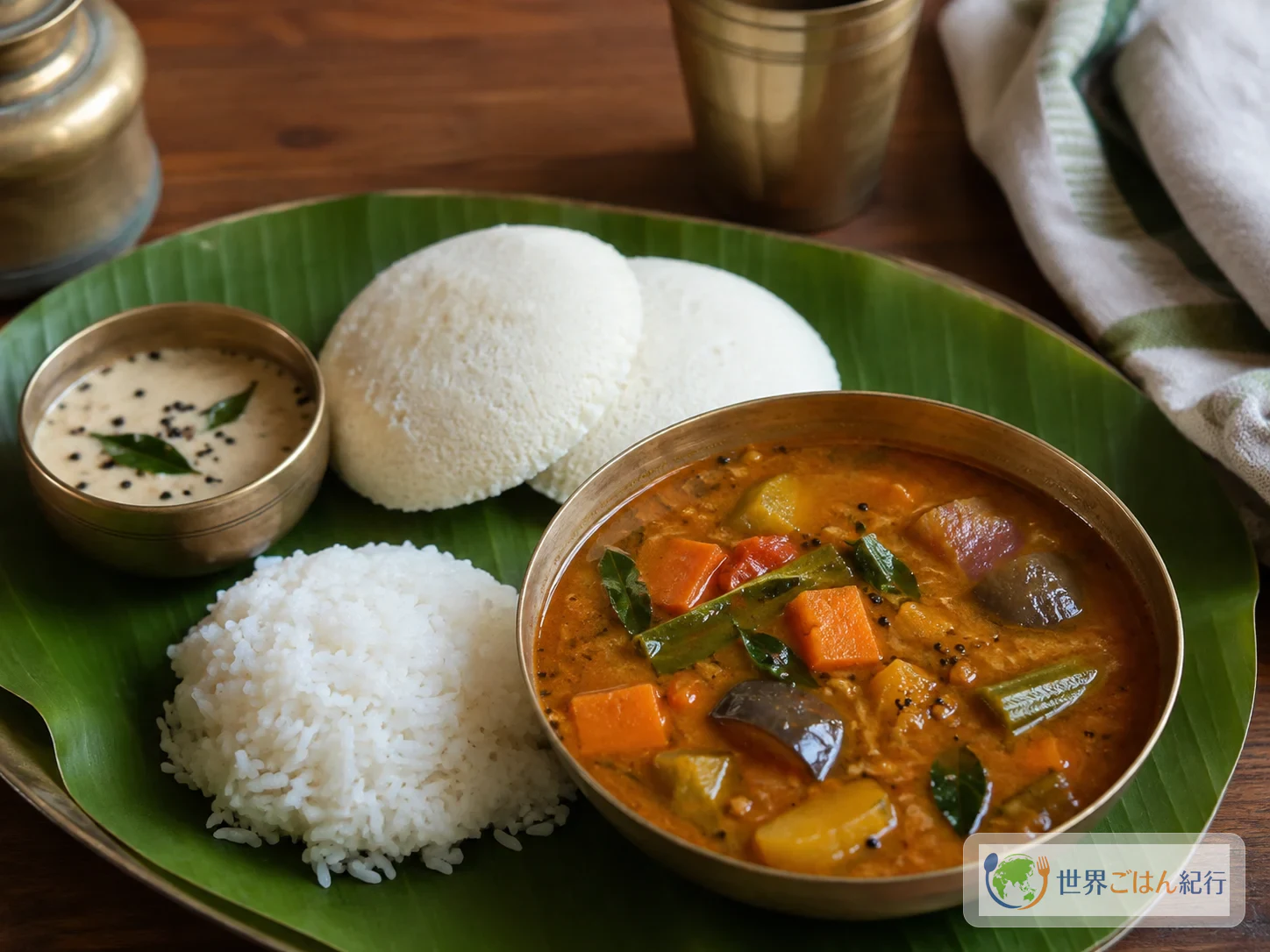
Sambar across South India
Sambar is served with rice, idli, dosa and vada. Because it's an everyday pot, every region puts the sourness somewhere a little different. Its origin is unclear. One popular story places its birth in the Maratha rulers' kitchen in Thanjavur, Tamil Nadu, but similar sour lentil dishes appear in earlier records. What's more interesting than who owns the "authentic" version is how the dish changed its ingredients and its name as it traveled.
The regional differences show up in how the pot is built. Versions that lean Tamil Nadu are built around tamarind's sourness, toor dal, dry-roasted sambar powder and the aroma of sesame oil. Udupi sambar is sweet and mildly spiced, made with coconut and jaggery (unrefined cane or palm sugar). Udupi cooking draws on locally grown grains, legumes, greens and vegetables, and pumpkin and gourds go into the pot.
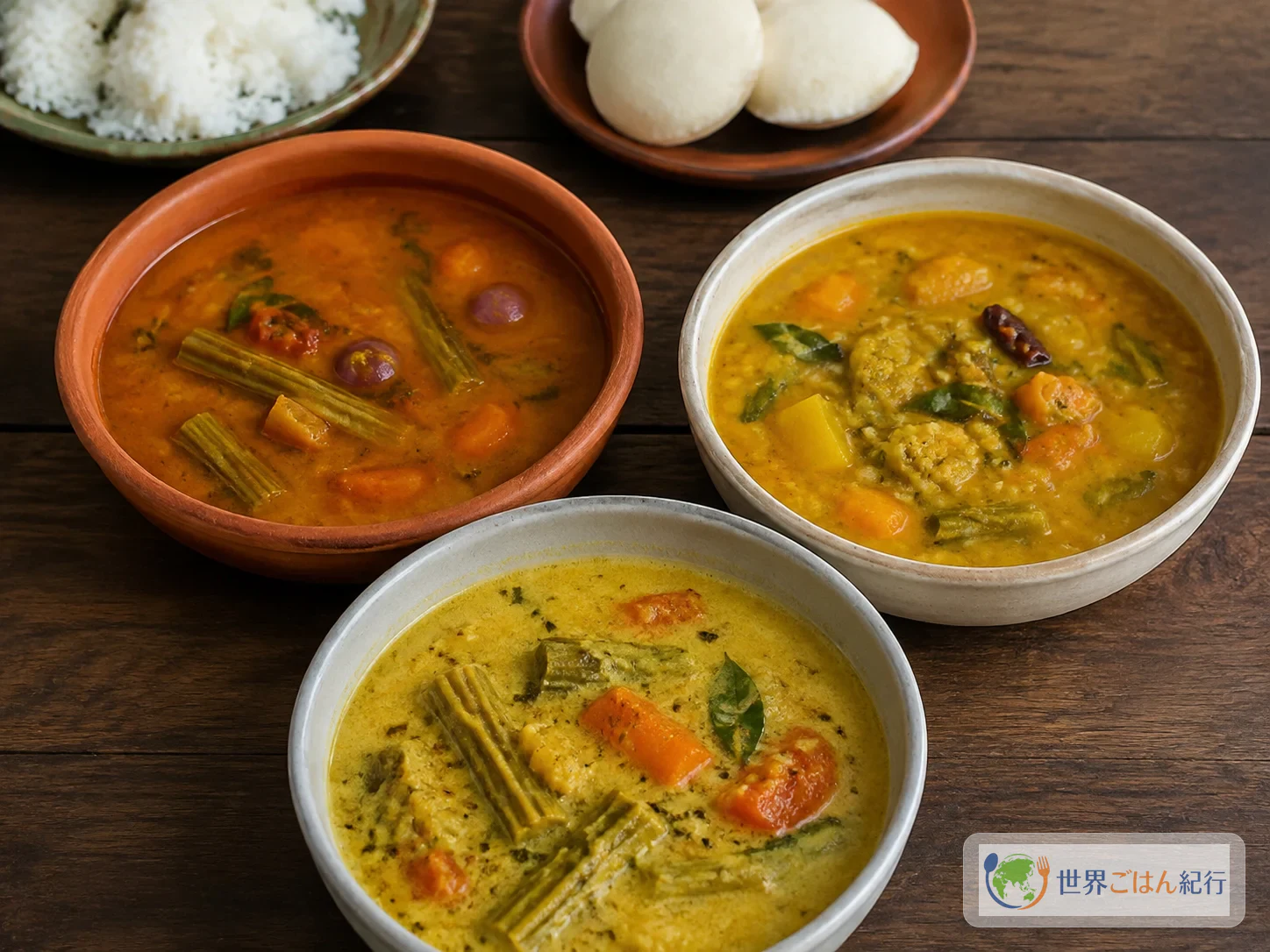
In Kerala, sambar is a home-table lentil dish served with rice, idli and dosa. Versions made with coconut oil or coconut paste shift toward the rounder aroma of the coast. Even with the same vegetables, more tamarind makes it better with rice, and more jaggery and coconut make it easier to pair with idli or dosa.
Ingredients (serves 4): decide the dal, vegetables and sourness separately
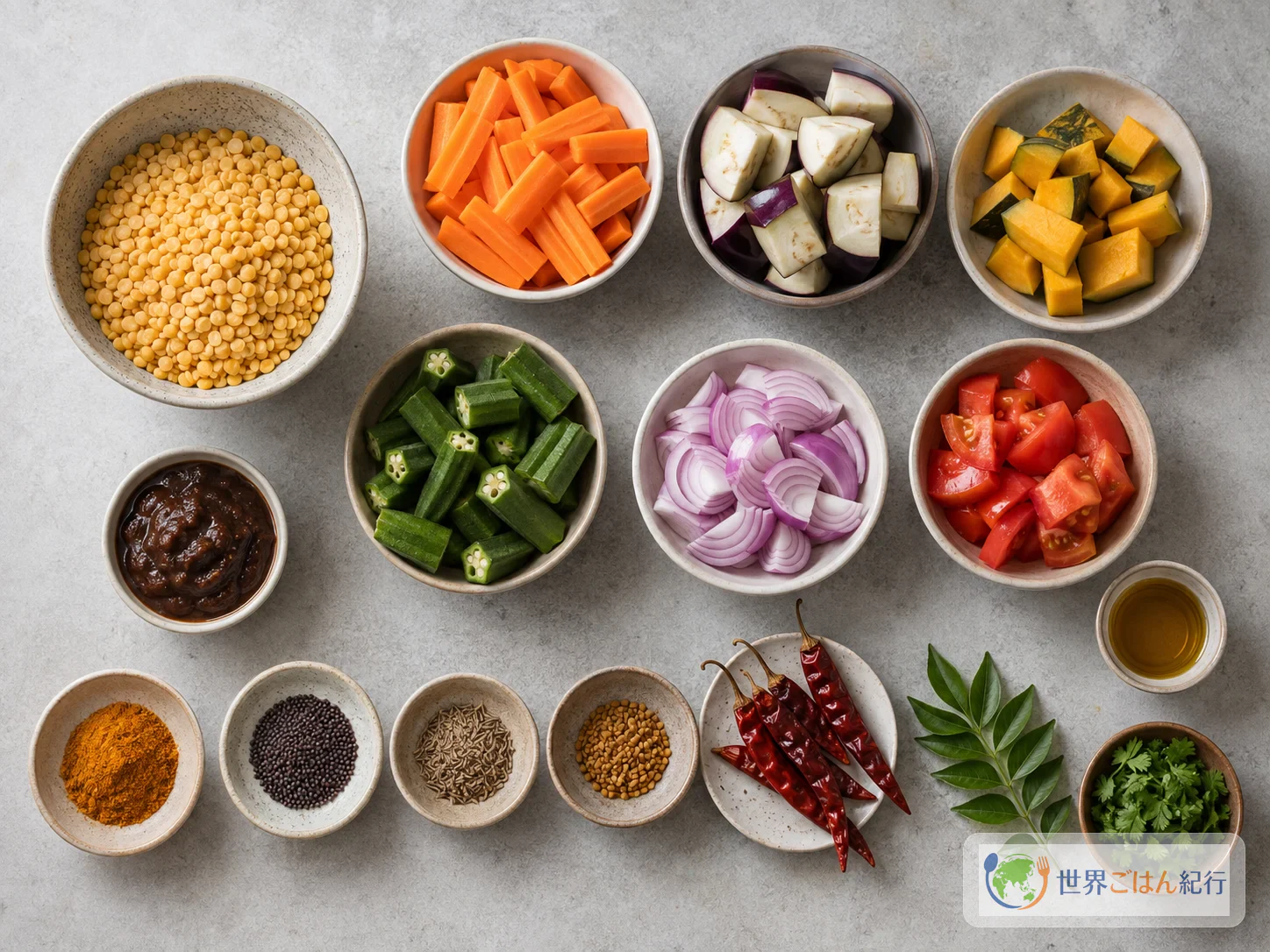
Enough for 4 bowls of rice, or to go with idli or dosa for 4 people. It makes about 1.2 L (5 cups), but adjust the liquid at the end depending on whether it's poured over the staple or used for dipping. Toor dal is easiest to find at Indian grocery stores or online; if you can't get it, the substitutes are listed below.
| Ingredient | Amount | Substitutes & notes |
|---|---|---|
| Toor dal (split pigeon peas) | 180 g | About 1 cup. Hulled yellow split peas also work, but break down differently |
| Water (for the dal) | 650 ml | If the dal is old, add 50–100 ml more boiling water |
| Ground turmeric | 1.5 g | Rounds out the dal's flavor. Too much turns it bitter |
| Salt (for the dal) | 2 g | Keep separate from the finishing salt; go light at first |
Vegetables and sour element
| Ingredient | Amount | Substitutes & notes |
|---|---|---|
| Onion or small shallot-type onions | 4 oz (120 g) | Halve small onions; cut a large onion into 0.5 inches (1 cm) wide pieces |
| Tomato | 6.5 oz (180 g) | Supports the sourness. If canned, use the same amount of unsalted diced tomatoes |
| Carrot | 3.5 oz (100 g) | 0.5 inches (1.5 cm) dice. Daikon or sweet potato also work |
| Eggplant | 5.5 oz (150 g) | 1 inches (2 cm) dice. Don't soak too long in water, so it doesn't fall apart |
| Kabocha squash | 5.5 oz (150 g) | 1 inches (2 cm) dice. With a very sweet variety, leave out the jaggery |
| Okra | 2.75 oz (80 g) | 1 inches (2.5 cm) lengths. Green beans also work |
| Water (for the vegetables) | 2½ cups (600 ml) | Start with enough to half cover the vegetables and adjust at the end |
| Tamarind paste | 25 g | If using lemon juice instead, add 1.5 tbsp (20–25 ml) after turning off the heat |
Sambar seasoning
| Ingredient | Amount | Substitutes & notes |
|---|---|---|
| Sambar powder | 24 g | Store-bought is fine. Check the label for added salt |
| Jaggery or dark brown sugar | 4 g | Takes the edge off the sourness. Leave out if you don't want sweetness |
| Salt (for finishing) | About 7 g | Adjust for the powder's salt and the vegetables' moisture |
Tempering and serving
| Ingredient | Amount | Substitutes & notes |
|---|---|---|
| Sesame oil (untoasted Indian gingelly or a fragrant cold-pressed type, not plain refined) | 2 tbsp (30 ml) | Coconut oil or rice bran oil also work |
| Mustard seeds | 3 g | Use whole. Heat until they pop |
| Cumin seeds | 1.5 g | Whole seeds, not ground, carry aroma into the oil |
| Fenugreek seeds | 0.5 g (5–6 seeds) | Turn bitter easily, so don't add more |
| Dried red chiles | 2 | Seed them for less heat |
| Curry leaves | 10–12 leaves | Frozen is fine. Leave out if unavailable |
| Cilantro | 10 g | For garnish. Leave out if you dislike it |
| White rice, or idli / dosa | 4 servings | Match the sambar's thickness to the staple |
Tamarind gives a rounder sourness than lemon juice, with a slight astringency. The first time, thin the paste with ½ cup (100 ml) water and decide whether to use all 25 g based on how strong your product is. With dried tamarind, soak 1.25 oz (35 g) in ½ cup (100 ml) boiling water for 20 minutes, squeeze it well by hand and strain. If you add a type with seeds or fibers straight to the pot, it's hard to judge both the texture and how sour it will be.
If you're not using tamarind, start with 1.5 tbsp (20 ml) lemon juice, turn off the heat, wait 3 minutes and taste. Lemon has a brighter aroma and doesn't give tamarind's depth, but the dish still works as a lentil and vegetable stew.
Choosing sambar ingredients and substitutes
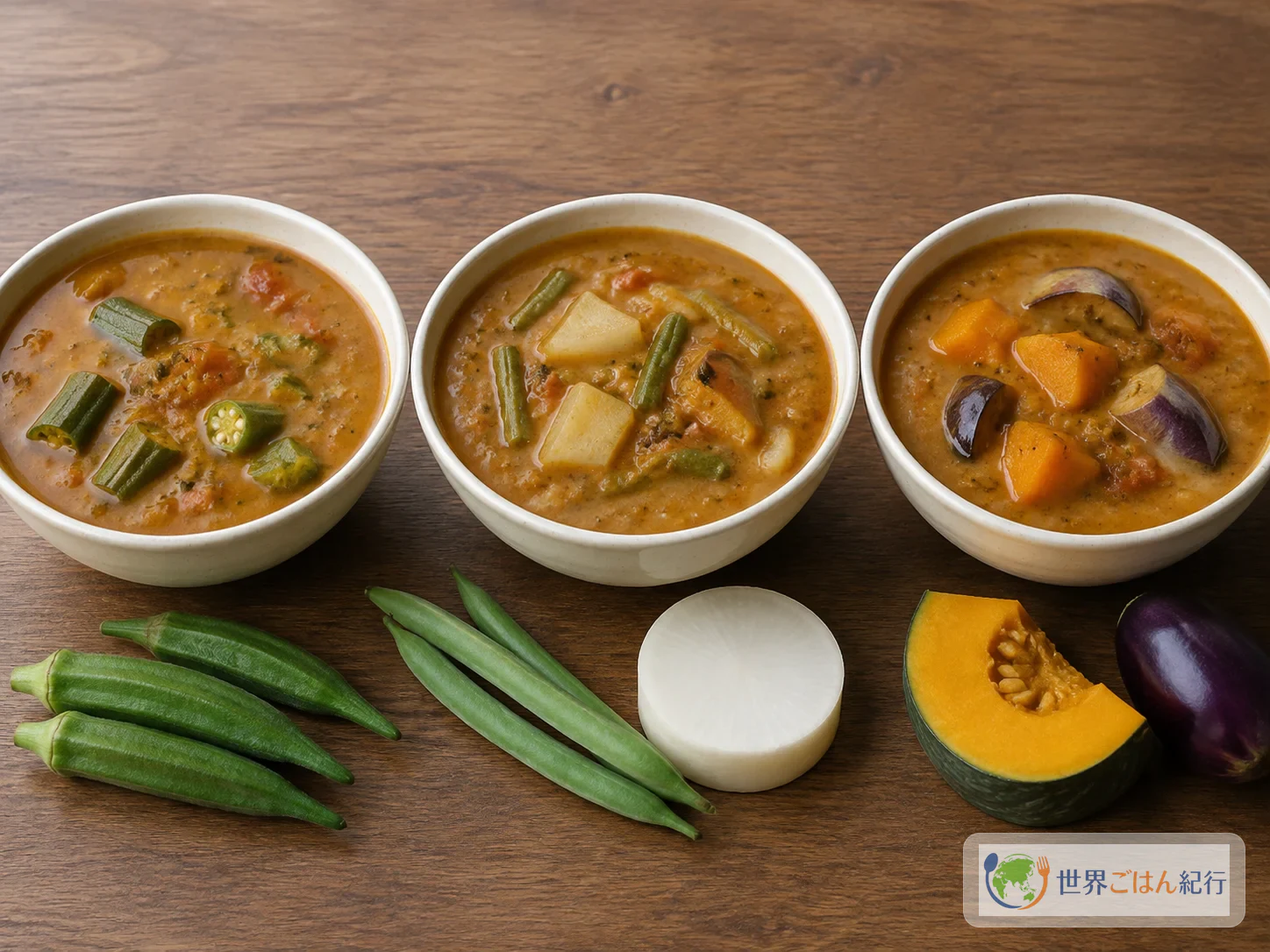
Swapping South Indian vegetables for what's available locally changes two things: the sweetness that balances the sourness, and the order in which things break down. So choose a substitute for the role you want to keep, not for whether it will taste the same. If you can't find drumsticks (moringa pods), cut the vegetables into even pieces and add the firmest ones first, so the simmer keeps its rhythm.
| Ingredient common in South India | Easier substitute | What changes |
|---|---|---|
| Drumsticks (moringa pods) | Okra, green beans, daikon | The texture of scraping the flesh off the pod is hard to reproduce. Okra adds body; daikon gives a lighter broth |
| Small onions (sambar onions) | Regular onions | You lose the sweet little whole onions, so cut regular onions thicker |
| South Indian pumpkin | Kabocha squash | Kabocha is very sweet, so leaving out the jaggery keeps the sourness sharp |
| Curry leaves | Leave out, or use frozen | Bay leaves or shiso won't give the same aroma. Don't force a substitute |
| Toor dal | Yellow split peas, red lentils | Red lentils cook fast and make the dal's sweetness and thickness lighter. Check softness before adding the sourness |
| Fragrant sesame oil | Rice bran oil, coconut oil | Rice bran oil is milder; coconut oil gives a rounder, coastal aroma |
Fenugreek and sambar powder
Mustard seeds, fenugreek and curry leaves all go into the same tempering, but each does a different job. Fenugreek changes in aroma and bitterness depending on whether you use the leaves (kasuri methi), the powder or the seeds. This pot takes only 5–6 seeds, so if you're making it once, leaving them out won't change much. If your store-bought sambar powder already contains fenugreek, skip the extra seeds. Even if you like the bitterness, you'll get a cleaner aroma by keeping the dry-roast and the tempering from burning than by adding more.
Homemade sambar powder lets you tune the sweetness of coriander, the earthiness of cumin and the heat of the chiles separately. Store-bought powder only needs measuring, which makes it more reliable on a first try. How often you cook is what decides it. If you make sambar, rasam, dal and similar dishes at least once a month, a small spice grinder earns its place, because it lets you grind just the amount you need while the dry-roasted seeds are still fragrant. For a one-off, a mortar and pestle works, or put the roasted spices in a bag and crush them coarsely with a rolling pin.
Method: soften the dal first, add the sourness later
Rather than finishing the dal, vegetables, spices and tempering oil all at once, these steps bring together ingredients that cook at different speeds in order. Times vary with pot size and how fresh the dal is, so check the state of things with a wooden spoon or skewer as well as the clock.
1. Rinse and soak the toor dal
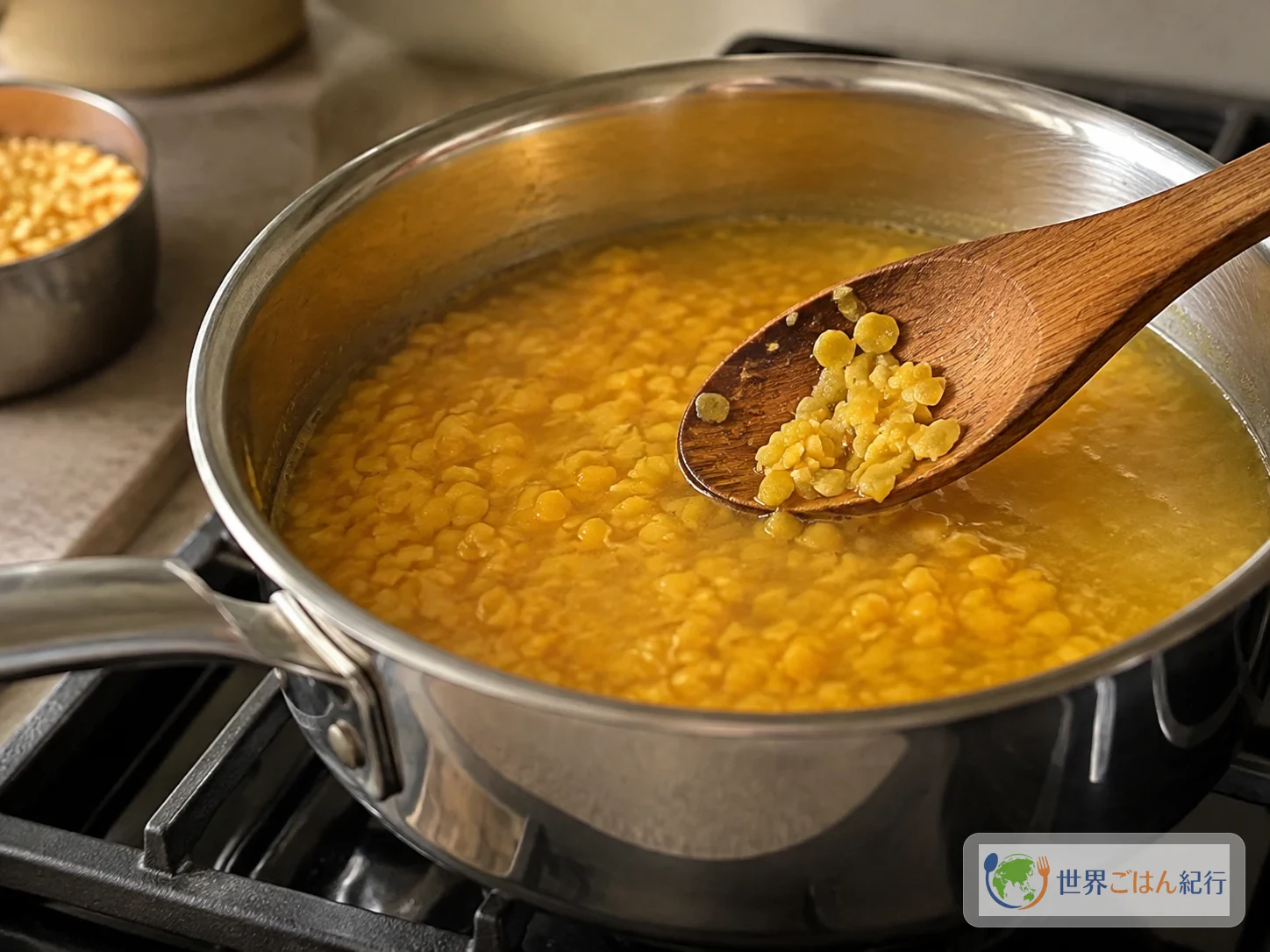
Rinse 6.5 oz (180 g) toor dal under running water 2–3 times, and once the water runs fairly clear, soak it in water for 20 minutes. Drain, transfer to a pot, add 2¾ cups (650 ml) water, 1.5 g turmeric and 2 g salt and bring to a boil over high heat. Once it boils, turn the heat to low and simmer with the lid slightly ajar for 30–35 minutes. Old dal can take 40 minutes or more, so if the water gets low, add boiling water 3.5 tbsp (50 ml) at a time. Turn off the heat when a grain has no hard center when lightly pressed with your fingers, and a wooden spoon dragged across the bottom leaves a trail that fills in right away. If you move on while the dal is still hard, it's difficult to fix once the acid goes in.
2. Cut the vegetables according to how fast they cook
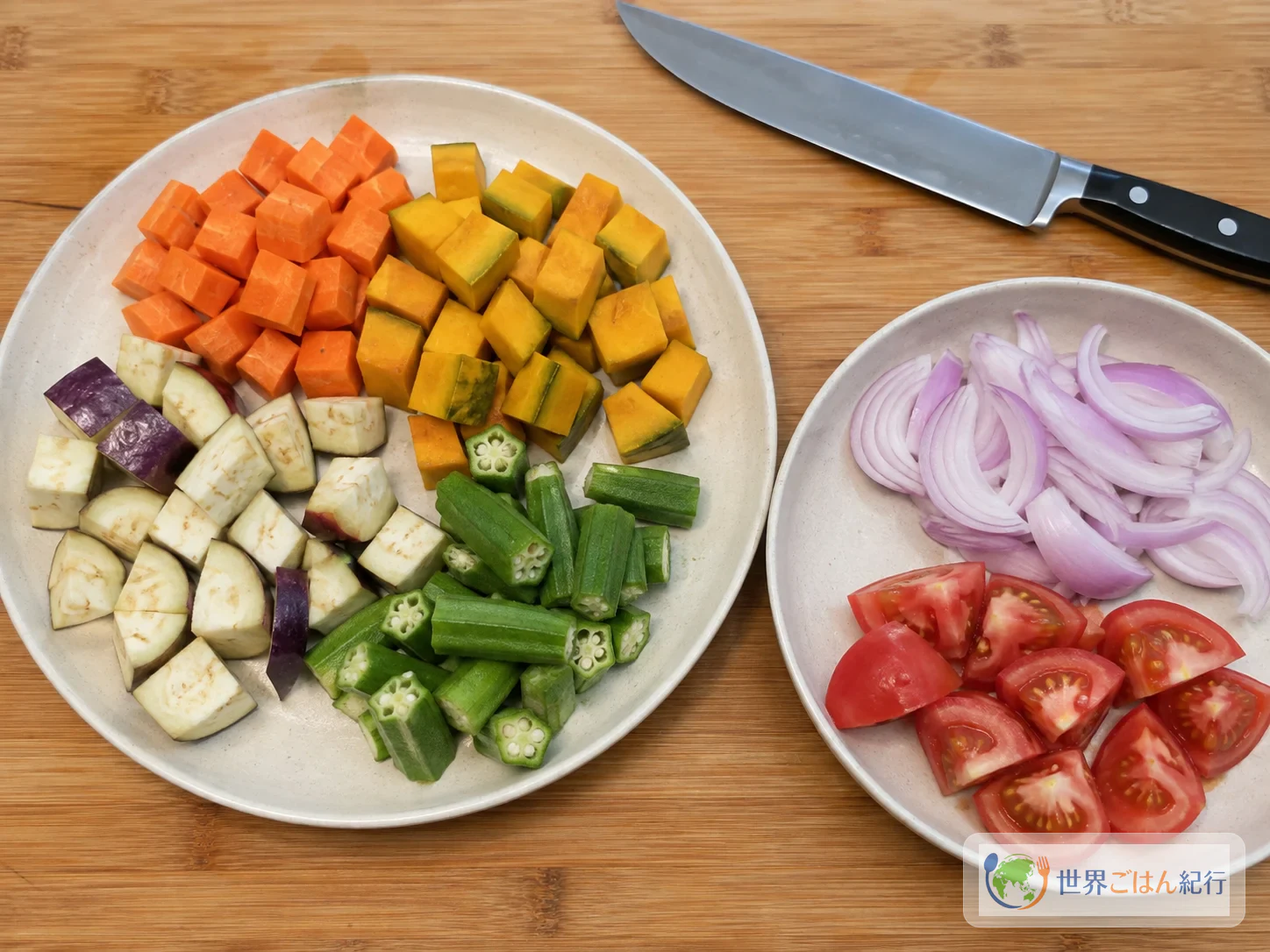
Cut the onion into 0.5 inches (1 cm) wide pieces, the carrot into 0.5 inches (1.5 cm) dice, the squash and eggplant into 1 inches (2 cm) dice, and the okra into 1 inches (2.5 cm) lengths. Cut the tomato into 1 inches (2 cm) pieces, leaving some seeds in if you don't want it to collapse. Allow about 10 minutes for cutting. Rather than making every piece exactly the same, cutting the hard carrot a little smaller and the soft squash a little bigger makes it easier to finish them together in one pot. Put the onion, tomato and okra on one plate, and the root vegetables, eggplant and squash on another.
3. Use sambar powder, or build the aroma yourself
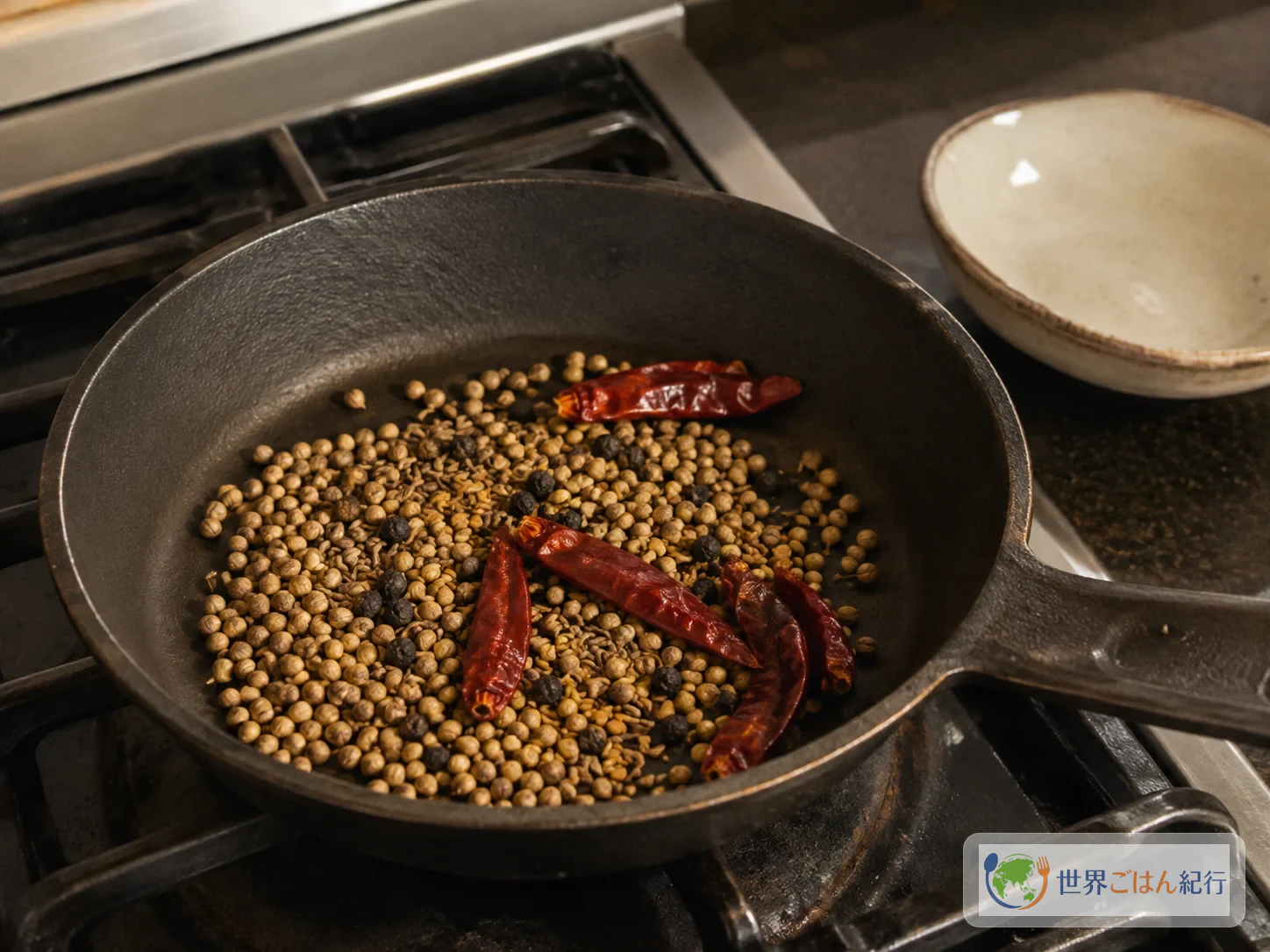
If using store-bought sambar powder, skip this step and measure out 24 g. To make your own, dry-roast 10 g coriander seeds, 4 g cumin seeds, 2 dried red chiles, 1 g black peppercorns and 0.5 g fenugreek seeds over medium-low heat for 2–3 minutes. Turn off the heat before it smokes, spread the spices on a plate and let cool for 5 minutes. Grind the cooled spices to a coarse powder. It's ready when a pinch still has a few grains in it and there's no raw smell. Blackened fenugreek gives a strong bitterness, so if it burns, don't force it; just make the spices again.
4. Cook the firm vegetables first and keep their shape
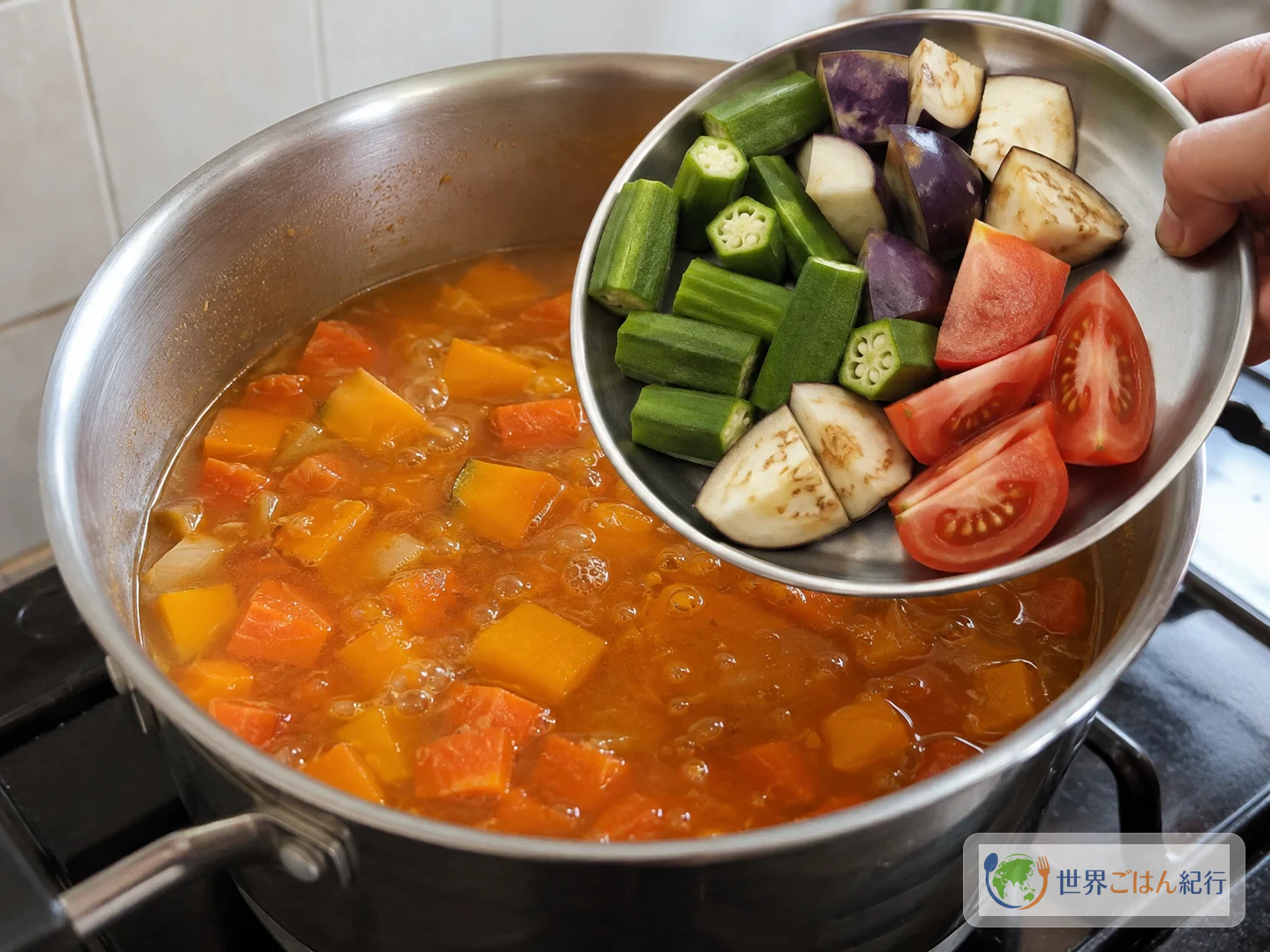
In a separate pot, put 2½ cups (600 ml) water, the onion, carrot and squash and cook over medium heat for 8 minutes. Once it's simmering, add the eggplant, tomato and okra, lower the heat to medium-low and cook for another 7–8 minutes. Turn off the heat when a skewer goes into the carrot, the squash's edges are slightly rounded, the eggplant sinks when pressed with chopsticks, and the cut ends of the okra haven't broken down. The vegetables don't need to be completely soft. Don't add the tamarind yet. If the acid goes in at this stage, the flavor gets fixed before you've checked the vegetables' tenderness, and it becomes harder to stop them falling apart later.
5. Add the tamarind and sambar powder to the broth
Thin 25 g tamarind paste with ½ cup (100 ml) water and add it to the vegetable pot. Add the 24 g sambar powder, 4 g jaggery and 5 g of the 7 g salt, and cook over medium-low heat for 8 minutes. Move on when the surface bubbles quietly, the raw, green sourness of the tamarind has gone, and a thin film of reddish-brown spice shows at the edge of the pot. You're looking for the powder to be evenly blended into the broth and a light coating clinging to the tip of the wooden spoon. Boiling hard the whole time only reduces the water and makes the sourness sharp. If your tamarind is very sour, start with 20 g and add the last 5 g at the end.
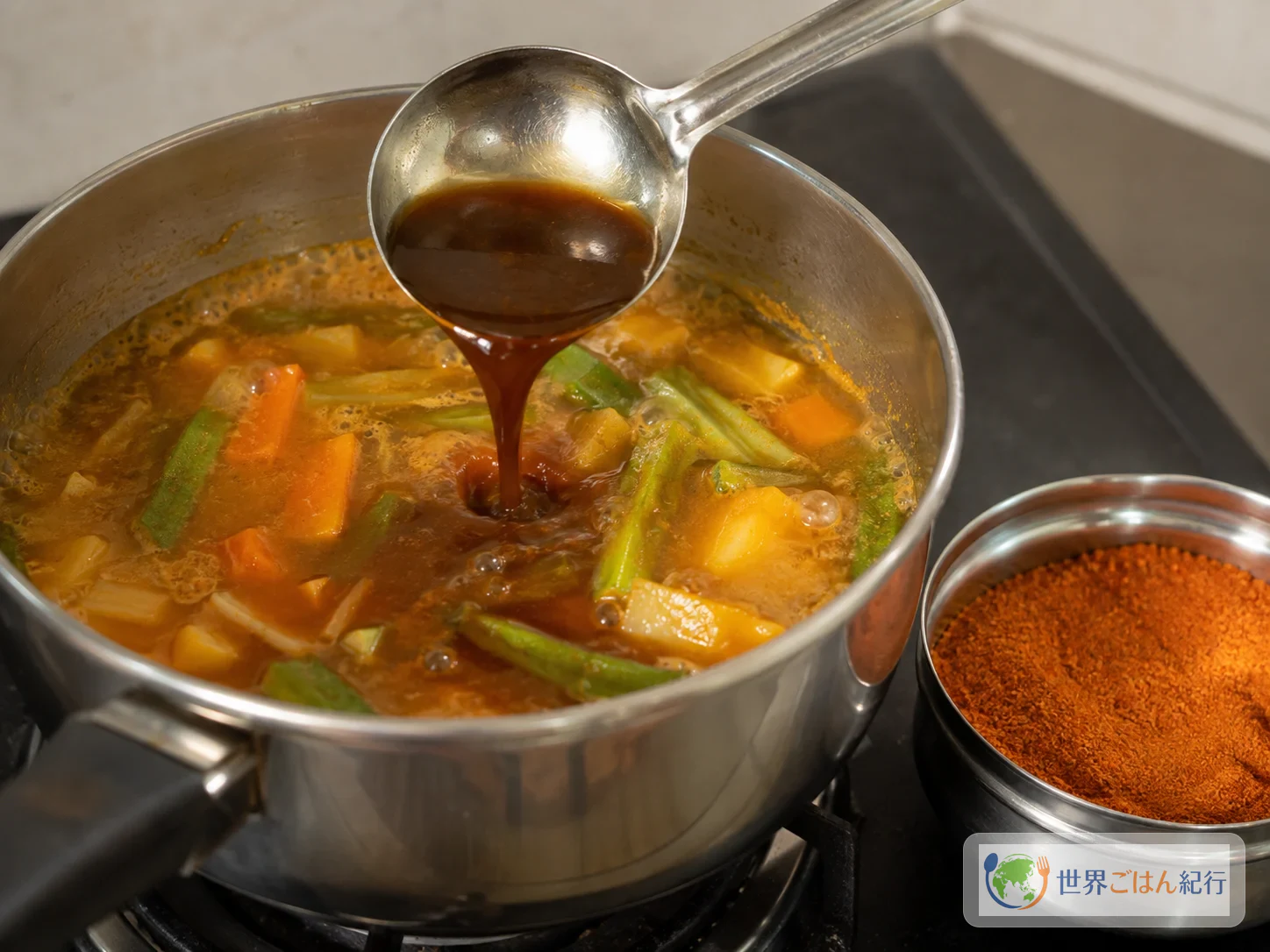
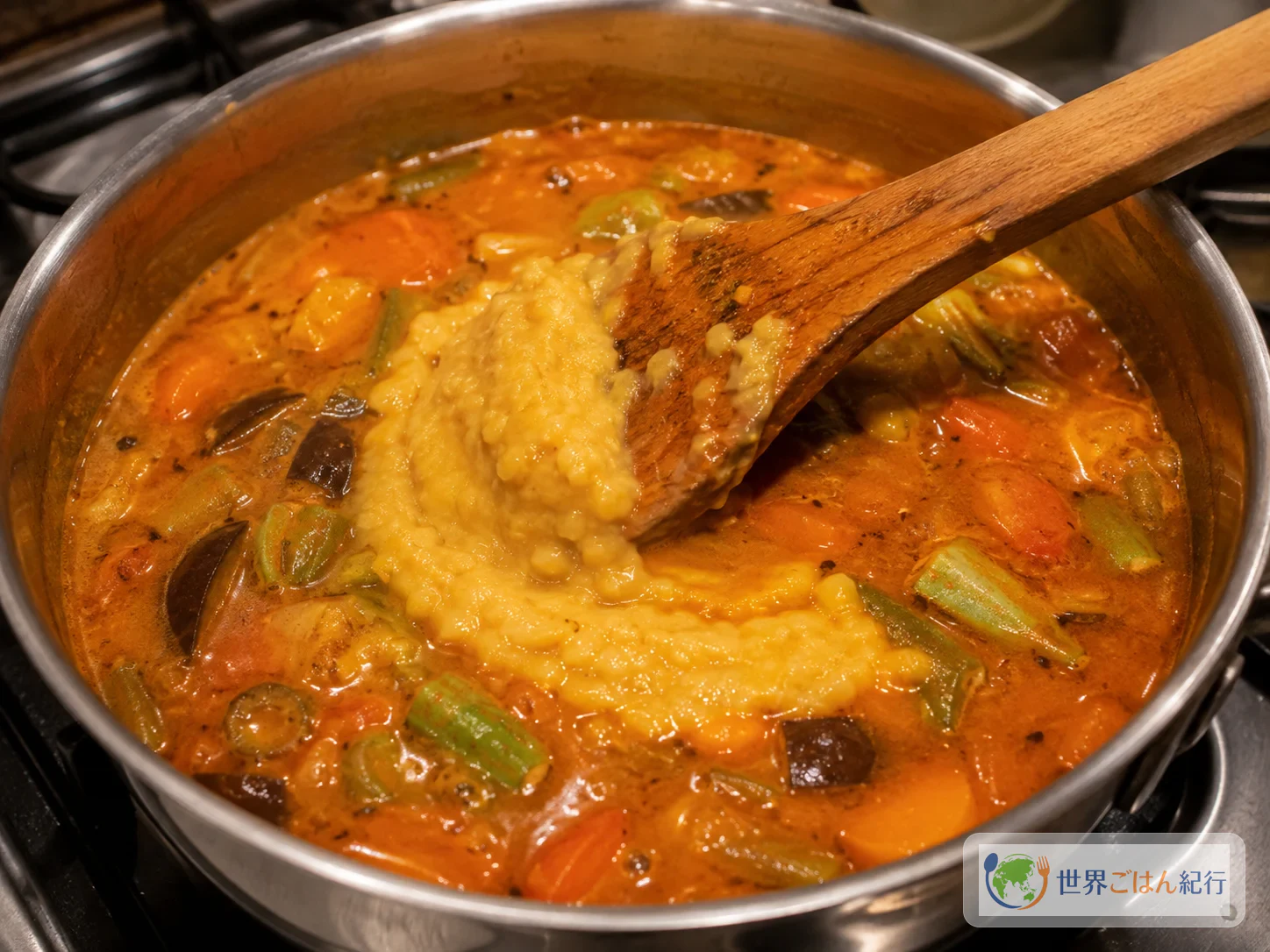
Just adding water gives you a thin, sour broth. Add 2–3 tbsp mashed dal, simmer over low heat for 3 minutes, then recheck the salt; this fixes both the sharp edge and the thickness at once.
6. Add the soft dal and set the thickness
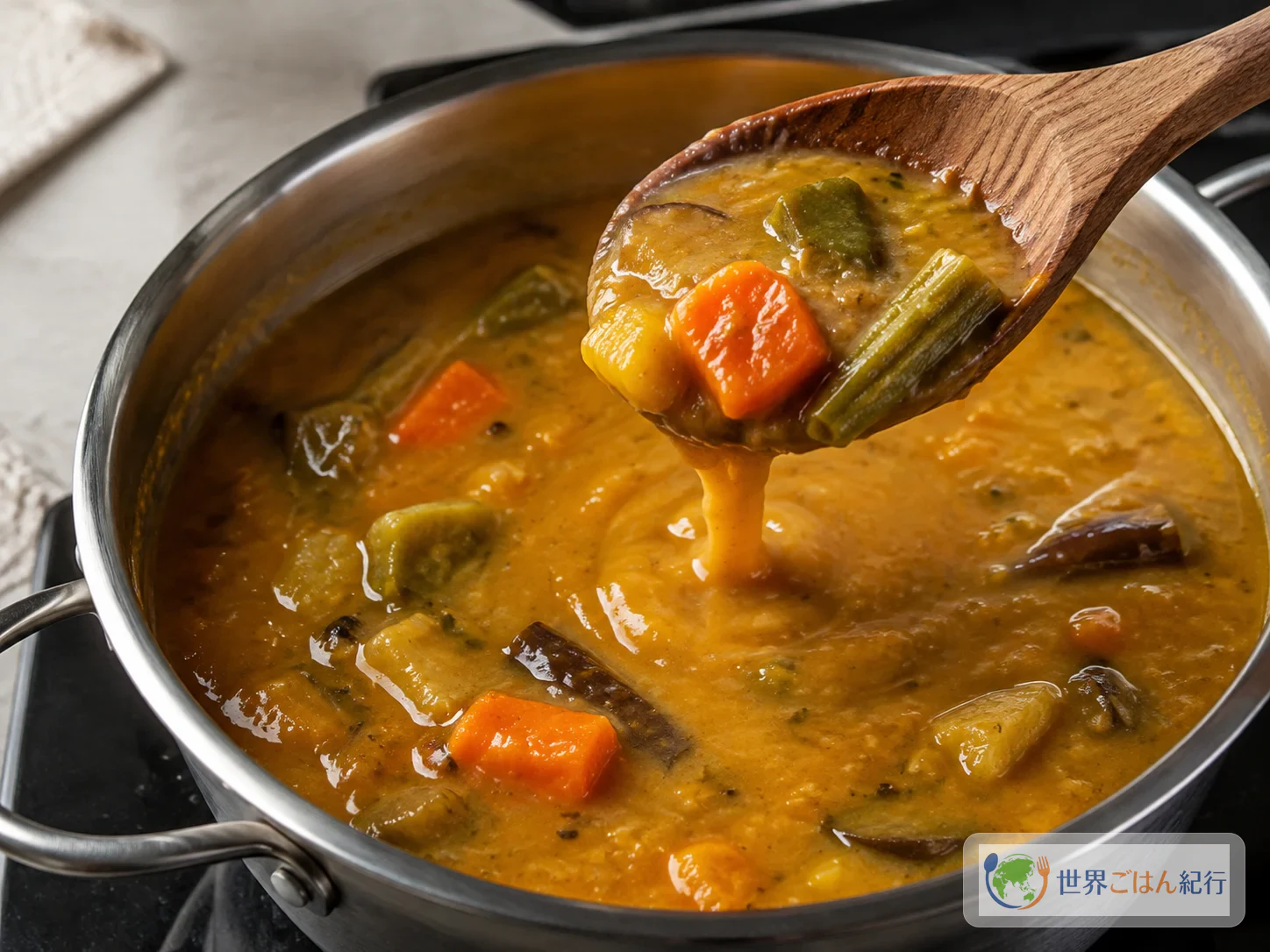
Lightly mash the cooked dal with a wooden spoon and add it to the vegetable pot. Fold it in from the bottom in big strokes and cook uncovered over medium-low heat for 8–10 minutes. When the grains of dal are almost invisible, a spoonful tipped off the spoon falls in a thick ribbon, and the ribbon stays on the surface for about 3 seconds, it's the right thickness for rice. To serve with idli or dosa, add 3.5 tbsp–½ cup (50–100 ml) boiling water and loosen it until the mark on the surface disappears in about 1 second. Adding the water 3.5 tbsp (50 ml) at a time rather than all at once lets you adjust without breaking up the vegetables.
7. Make the tempering and pour in the hot oil
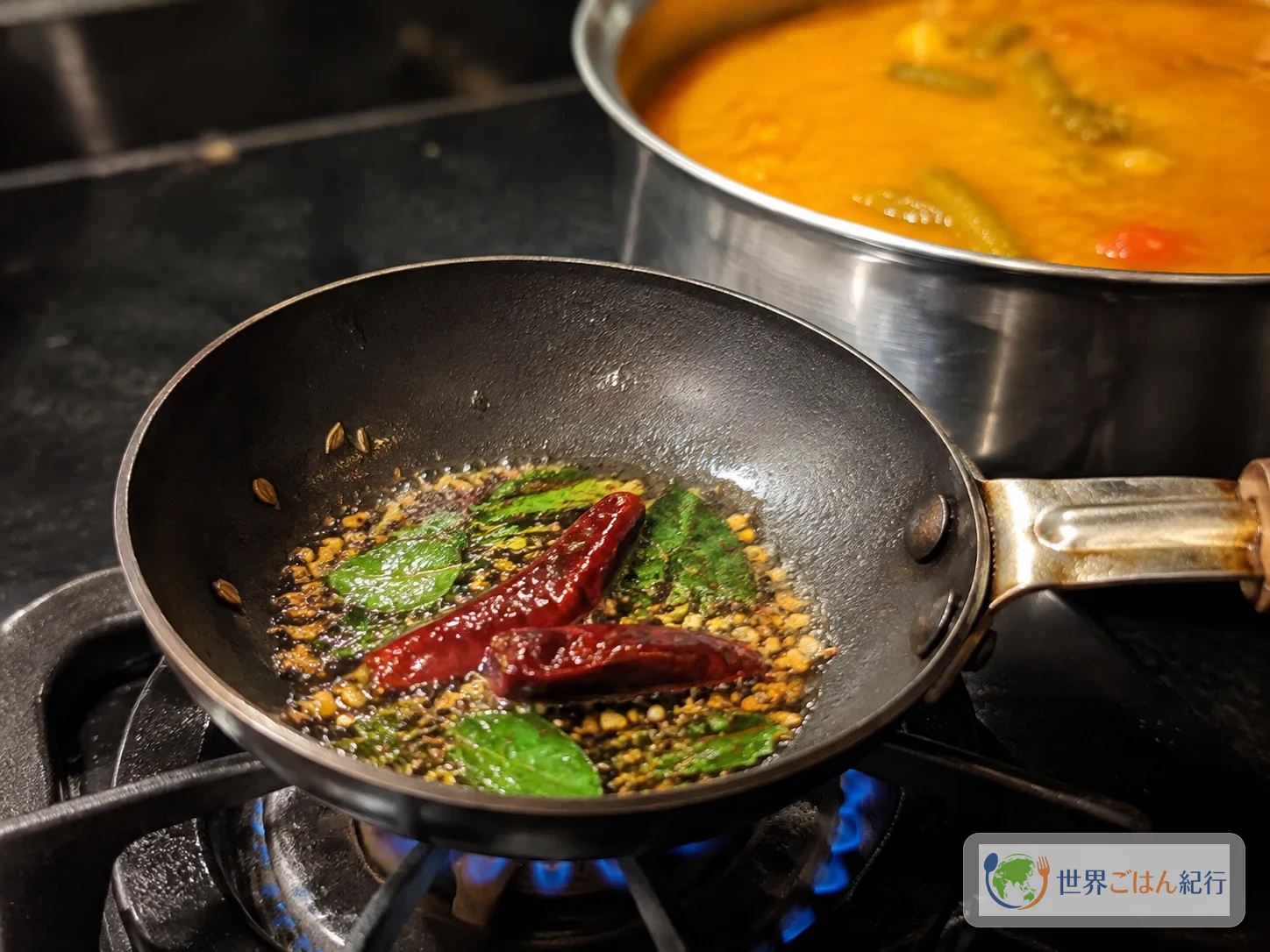
Put 2 tbsp (30 ml) sesame oil in a small skillet and warm it over medium heat for 1 minute. Add 3 g mustard seeds, and when they start to pop, add 1.5 g cumin, 5–6 fenugreek seeds and the 2 dried red chiles. When the cumin smells fragrant after 20–30 seconds, add 10–12 curry leaves, cook 10 seconds more and turn off the heat. The leaves spatter, so keep your face back and stir with a long-handled utensil. The moment to stop is before the spices blacken, when the oil has taken on the color of the red chiles. Pour the hot oil into the sambar, cover and leave for 2 minutes.
8. Rest it and match it to the staple
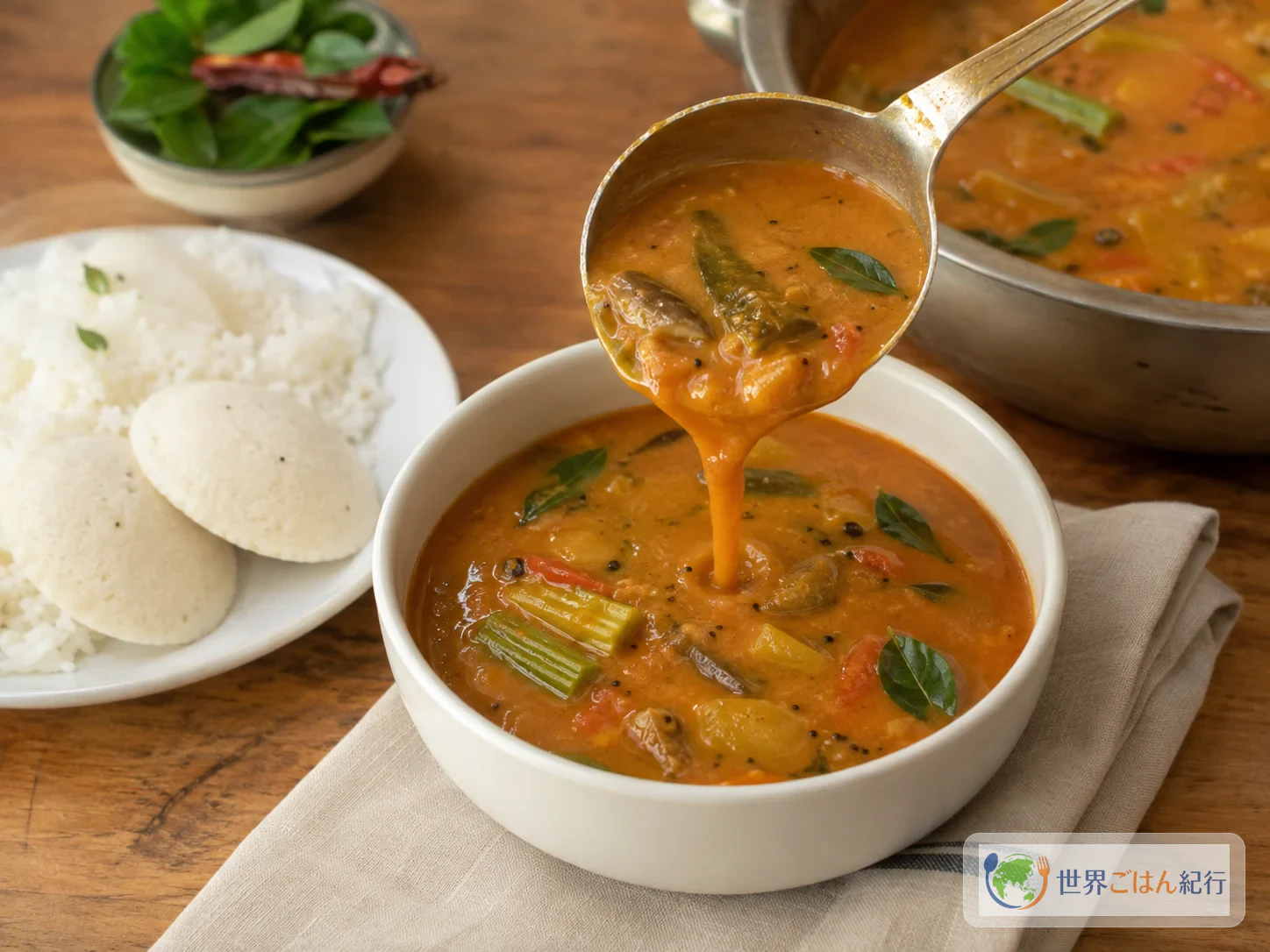
Take the sambar off the heat and let it rest, covered, for 5 minutes. Add the remaining salt little by little; if it's not sour enough, add 5 g tamarind, and if it needs sweetness, add jaggery 1 g at a time. When seasoning, don't taste straight from the pot; take a spoonful onto a small plate and let it cool slightly first. When it's hot, it's harder to taste the salt and sourness properly. Scatter with cilantro and serve with rice, idli, dosa or vada. It's done when the broth spooned from the pot thinly coats the vegetables and the dal doesn't feel too gritty on your tongue.
Common sambar problems and fixes
The main thing is not to add the sourness too early. Cook the dal until soft before any acid goes in, take the vegetables off the heat separately while they still hold their shape, and only then bring the tamarind, spices and dal together. That way you can tackle the two classic failures one at a time: dal that turns sour while still hard at the center, and vegetables that dissolve completely.
Even so, the dal, the vegetables, the sourness or the oil will often get ahead of the others. Diluting everything with water washes out the flavor, so fix the problem with the ingredient closest to its cause.
| Problem | Likely cause | How to fix it |
|---|---|---|
| Dal still hard at the center | Not soaked enough, old dal, acid added too early | Add ½ cup (150 ml) boiling water, cover and cook over low heat in 10-minute rounds. You can also soften just the dal in a separate pot before adding the sourness |
| Vegetables falling apart | Firm and soft vegetables cooked for the same time | If you can lift the pieces out without crushing them, move them to a plate and adjust just the broth with dal. Next time, add the okra and tomato later |
| Sourness too sharp | All the tamarind added at once | Add 3.5 oz (100 g) unsalted mashed dal or squash and cook 3 minutes over low heat. Add jaggery 1 g at a time |
| Too bitter | Fenugreek or tempering burned | Burnt oil can't be removed, so make just the tempering again. If the whole pot is bitter, diluting it with unsalted dal won't remove the burnt taste |
| Watery | Watery vegetables, too much boiling water added | Uncover and cook over medium-low heat for 5–10 minutes. Stop when a wooden spoon leaves a trail for 2–3 seconds |
| Flat flavor | Not enough salt, weak oil aroma, not enough sourness | Check the salt 1 g at a time and add a little tempering made in a separate pan. Add tamarind 5 g at a time |
If you only add more tamarind to make it more sour, it masks the sweetness of the dal. Adjust the salt first, loosen the thickness a little with boiling water, then add tamarind 5 g at a time; it's much easier to control.
If the dal has no hard center, the vegetables keep slight edges, and the broth dropped from a spoon leaves a trail for just a moment, it's at a baseline thickness that works with both rice and idli.
Serving, variations and storage
Serving sambar
The same sambar eats very differently depending on what you serve it with. Over white rice, the thick dal holds the broth and you pick up the vegetables bit by bit. Poured over idli, it brings sourness and oil to the mild steamed rice and lentils. With dosa, it plays off the toasty, browned surface. Vada soaks up broth through its crust, so keep the pot a little looser and it won't feel heavy by the end.
Set the thickness by who's eating and what's on the table. For a dinner built around rice, cook it down until a wooden spoon leaves a trail that lingers for a moment, and put cilantro and raw onion on the side as a contrast to the soft dal. For breakfast, serve the sambar in a deep bowl, put idli or dosa on a separate plate, and add a little coconut chutney. Fermented batters already bring salt and tang, and very thick sambar makes the whole meal feel heavy. So add about ½ cup (100 ml) boiling water to the rice-thickness pot until it pours into the bowl in one continuous stream and slowly levels out. When serving it with ready-made idli or dosa, add the water while you reheat.
If you want more heat, leave the pot alone and spoon a little tempering of dried red chiles warmed in oil over individual bowls. That way children and anyone who likes it milder can eat from the same pot.
Udupi-style sambar
Transfer half the sambar to another pot. Soften 20 g desiccated coconut in 2 tbsp (30 ml) hot water, grind it to a paste, and add it to the pot with 8 g jaggery. Warm over low heat for 5 minutes, using 5 g less tamarind than the original amount. It tastes sweet first, and the heat comes afterward.
Coastal-style sambar with coconut
Swap the tempering oil for coconut oil and add 15 g desiccated coconut at the end. The aroma gets stronger, so cut the dried red chiles to 1 and add the tamarind little by little at the end. Coconut's sweet aroma fades with long simmering, so stir it in just before you turn off the heat.
Sambar sadam
Leftovers make a one-dish meal. Warm the sambar, add an equal amount of cooked white rice, and stir over low heat for 3–5 minutes, until the rice absorbs the broth and the mixture falls slowly from a spoon. It's close to rice, dal and vegetable dishes like Karnataka's bisi bele bath. If you're planning this for the next day, don't overcook the sambar the first time, and don't overmix once the rice goes in.
Storing and reheating sambar
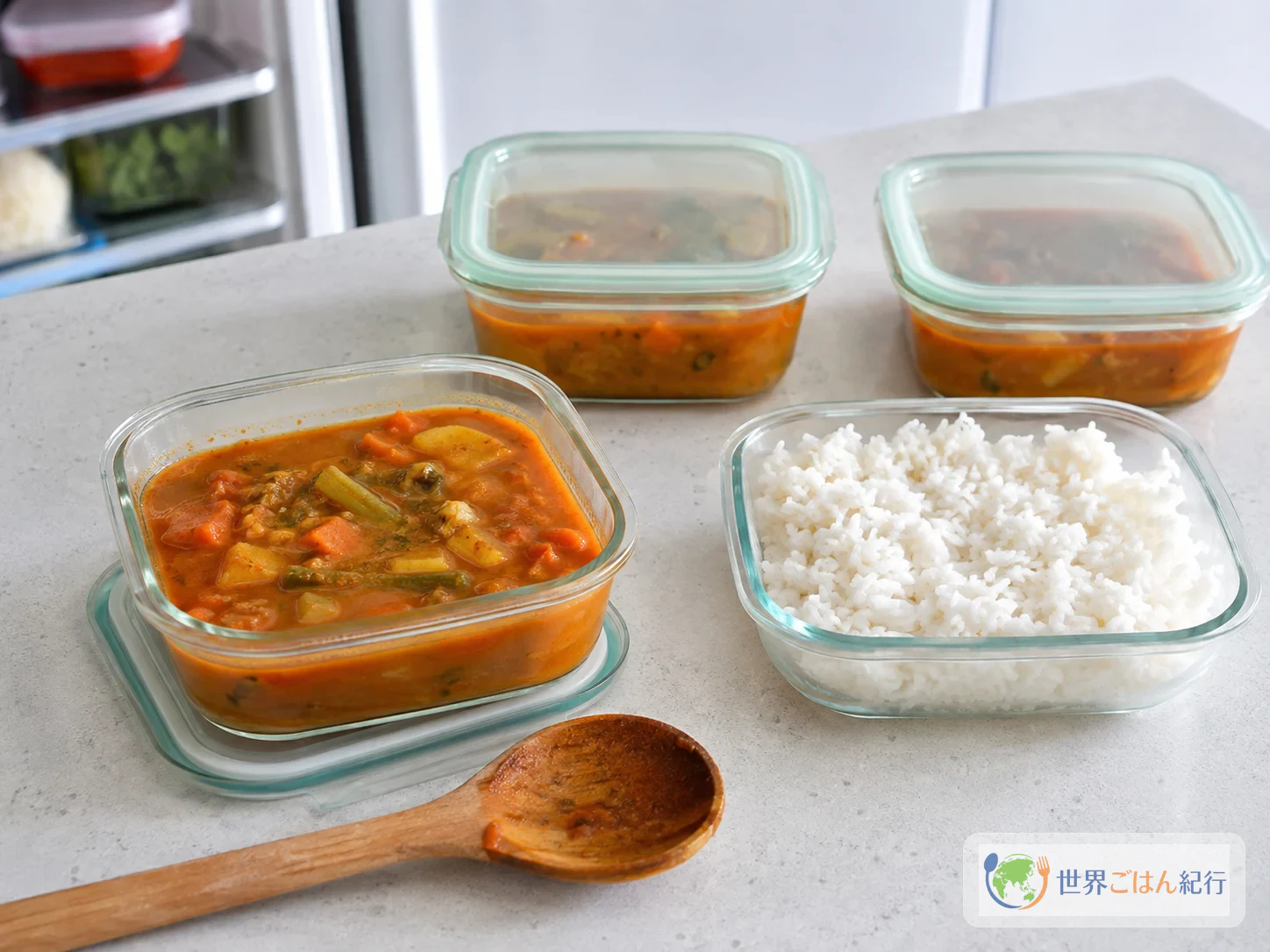
Don't leave sambar sitting in the pot at room temperature. Divide large batches into shallow containers, refrigerate within 2 hours of cooking, and use the leftovers within 3–4 days. It's fine to put it in the fridge while it's still hot. The center of a big pot is slow to cool, though, so split it into shallow single portions, and cool the rice in a separate container. The dal sets as it cools, so if you know you'll serve the pot the next day, finish it a little looser.
To reheat, add 20–50 ml boiling water to a single portion and heat over low heat until it bubbles throughout and the center reaches 74°C (165°F). The dal settles to the bottom, so stir while scraping the base of the pan, and taste for sourness and salt before serving. Take out only what you'll eat rather than reheating the whole batch over and over. Throw out anything past its fridge life or with an off smell or an odd surface, and don't taste it to decide.
FAQ
Q1. Is sambar a curry or a soup?
It's a lentil stew, or a dal-based curry. It's thickened with dal and served with rice or idli rather than eaten for the broth alone. In Japanese it gets called a soup, a stew and a curry. What matters more than the name is matching the thickness to the staple.
Q2. Do I really need tamarind paste?
Tamarind gives sambar its South Indian sourness, but for a one-off you can use lemon juice instead. Add the lemon after turning off the heat so it keeps its aroma. Tamarind strength varies by product, so start with 20 g and increase 5 g at a time.
Q3. I can't find toor dal.
Use the same amount of yellow split peas and allow a longer cooking time. Red lentils soften quickly: start by cooking 5.5 oz (160 g) in 2½ cups (600 ml) water, and make up any lack of thickness with dal afterward. Either way, get them soft enough to crush between your fingers before adding the sourness.
Q4. Is it still South Indian without curry leaves?
Yes. Mustard seeds, cumin, the sourness and the thickness of the dal carry the dish's character. If you can find frozen curry leaves, add them to the tempering straight from the freezer.
Q5. Can I use a pressure cooker?
The easiest approach is to soften only the dal in the pressure cooker and finish the vegetables and sourness in a separate pot. Pressure time varies with the freshness of the dal and with your appliance, so follow the manufacturer's instructions and open the lid only once the pressure has dropped. Make sure the dal is fully soft before it goes into the vegetable pot.
Q6. Some family members can't eat spicy sambar.
Seed the dried red chiles and start with just 16 g sambar powder. If the milder pot feels flat, put extra chile in the finishing tempering and spoon it only onto the bowls of those who like it hot. Diluting with water also weakens the sourness and salt, so cut back on the spicy ingredients instead.
Q7. I can't tell whether my sambar powder contains salt.
If you can't check the ingredient list, use half the finishing salt during cooking and taste after turning off the heat. Store-bought powders vary in their proportions of chile, coriander, fenugreek and salt, so treat the 24 g in this recipe as a starting point.