Dumpling day always makes a bit of a mess: a bowl of kneaded dough, chopped onion, the smell of ginger, a small dish of water at your elbow. You might use the same ingredients for pan-fried potstickers. Roll the wrappers thin and line them up in a steamer, though, and you end up somewhere else entirely, with Nepali momo (मम). These are thin wheat-flour wrappers around a meat or vegetable filling, steamed and eaten with a spicy tomato-based achar. If dal bhat is Nepal's everyday meal, momo are what you make when people get together.

In English it is written momo, and in Nepali मम. As a dish name, people rarely fuss over singular and plural and simply say "momo."
Momo in Nepal
Momo are Nepal's national snack. On the streets of Kathmandu they're everywhere, from tiny eateries to dedicated momo shops. At home they're a sociable dish: someone folds, someone steams, someone makes the achar, and the roles sort themselves out.
Origin and flavor

Momo are hard to trace to a single origin. They are widely believed to have taken root in Nepal through trade with Tibet. Other accounts involve Newar merchants (the Indigenous people of the Kathmandu Valley) and migration across the Himalayan region.
Wherever they started, momo picked up new aromas in Nepal. Tibetan-style momo tend toward a plain, ginger-forward flavor. Nepali momo bring in garlic, onion, cumin, coriander, timur (Nepali Sichuan pepper) and cilantro, and they come with plenty of tomato or sesame achar.
Styles of momo
Around Kathmandu you'll commonly see white steamed momo, kothey momo browned on one side, jhol momo in a thin spicy broth, and fried momo. Buff momo, made with water buffalo, are a classic too. Buffalo meat is hard to find for most home cooks, though, so ground chicken or ground pork is the realistic choice.
| Type | Its place in Nepal | Making it at home |
|---|---|---|
| Steamed momo | The most basic. Steamed and served with achar | The one to make first. Least likely to go wrong |
| Buff momo | Filled with water buffalo. Popular in Kathmandu | Get close with a beef-pork mix or ground pork |
| Chicken momo | Easy to handle at home and in Nepali restaurants abroad | Ground chicken thigh is the easiest |
| Veg momo | Cabbage, mushrooms, tofu, cheese and more | Use pressed tofu and mushrooms to make up for the lack of meat juices |
| Jhol momo | Served under a thin, spicy broth | Make it by thinning the achar with water |
| Kothey momo | Browned on one side, then steamed | A good match for store-bought dumpling wrappers |
Momo vs. potstickers
What sets momo apart from Japanese or Chinese-style potstickers is the steam and the sauce, not a crisp bottom. Potstickers get a crunchy base and a dip in soy-vinegar or chili oil. Momo are steamed until the wrapper turns soft and springy, and you eat them for the aromas of tomato, sesame, chili, garlic and timur. Hold on to that, and the same flour and ground meat become a very different dish.
Ingredients (serves 4, about 28 momo): plan the juices and the achar first

For 4 people, plan on about 28 momo for a light meal. To make it a full dinner, add a simple dal and stir-fried greens from dal bhat, so the meal isn't just meat and flour.
This recipe contains wheat, chicken and sesame. If you use store-bought dumpling wrappers, some brands contain soy, egg or dairy. For veg momo, check the labels on both the wrappers and the seasonings as well.
Ingredients and tools for this dish
Timur gives momo a distinctly Nepali lift, but there's no need to buy a big bag at the start. If you can't find it, use a small amount of Sichuan pepper and keep the numbing effect in check. Look for timur at South Asian or Nepali grocery stores, or online.
A bamboo steamer keeps the surface of the wrappers from turning sticky, and you can bring it straight to the table. A metal steamer works too; line it with a cloth or parchment paper so the momo don't stick.
If you are making the achar, toast the white sesame seeds and grind them coarsely in a mortar to bring out their aroma. A food processor is fine, but a slightly grainy texture clings to the momo better than a perfectly smooth one.
Choosing ingredients for momo

If you already make dumplings, momo are easy to pick up. Just watch that you don't slide back into your usual dumpling habits, or you'll end up with potstickers that never got fried. Large store-bought wrappers are fine for your first batch. For a truer momo texture, make your own wrappers a little thicker than you would for potstickers.
| Ingredient in question | Closer to Nepal | Realistic at home | Verdict |
|---|---|---|---|
| Wrapper | Handmade from flour and water | Large store-bought dumpling wrappers | Store-bought is fine the first time |
| Meat | Water buffalo, chicken, pork | Ground chicken thigh, ground pork | Chicken breast alone dries out easily |
| Aroma | Timur, mustard oil | A little Sichuan pepper; rice bran oil + hot mustard | Too much turns it into a different dish |
| Sauce | Roasted tomato, sesame, chili | Tomato, white sesame, lemon | Avoid a plain soy-vinegar dip |
| Vegetables | Onion, scallion, cilantro | Cabbage, onion, scallion | Squeeze out the water |
| How to eat | With plenty of achar | Adjust the heat on the plate | Serve the chili separately for family meals |
The one thing that's close to irreplaceable is the tomato-sesame achar. The wrapper and the meat give you lots of room, but switch the sauce to soy and vinegar and the dish never leaves potsticker territory. The sweet-tart roasted tomato, the body of sesame, and the aroma of garlic and chili are what pull the plate toward Nepal.
For the meat, ground pork has more fat than chicken, so it comes out juicier, and a beef-pork mix gets you close to buff momo. Timur and mustard oil can be skipped. Timur is more citrusy than Sichuan pepper, but a tiny amount of Sichuan pepper and a little extra black pepper point you in the right direction. Go easy, because too much makes the flavor lean Chinese. Mustard oil has a strong aroma, and for a first batch, rice bran oil with a little prepared hot mustard mixed in is plenty.
Method: don't overfill, and let the steaming time do the cooking
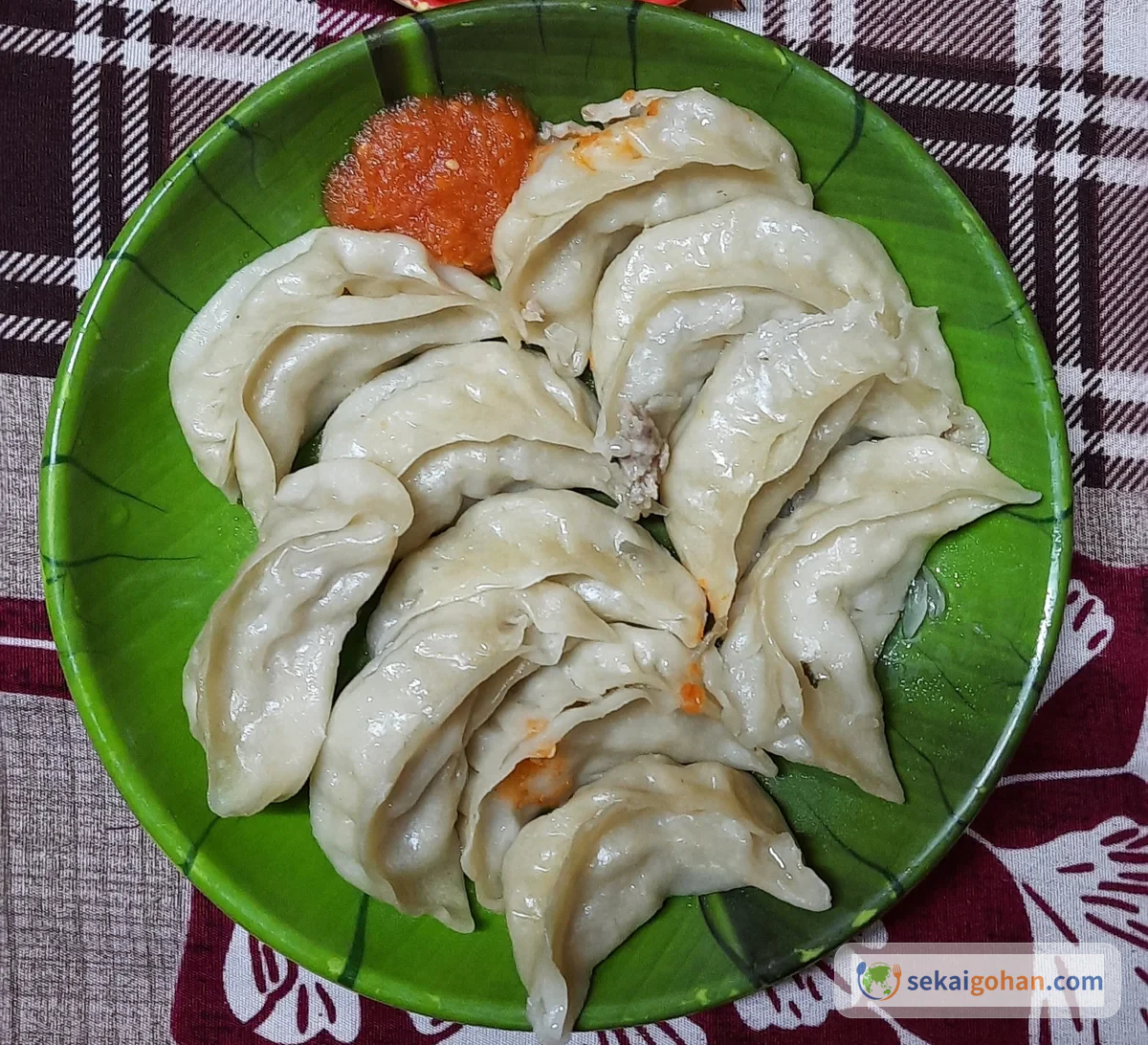
Momo look difficult, but most failures come down to three things: overfilling, dried-out wrappers and sticking to the steamer. Getting the moisture of the wrapper and the amount of filling right matters more than perfecting the fold.
Choose large, thick wrappers, and steam rather than pan-fry. Overfilling small wrappers keeps the pleats from closing and they will tear. Store-bought wrappers dry out quickly, so cover them with a damp cloth as soon as they come out of the package.
Fixing torn, tough or dry momo
Momo go wrong in ways that look like potsticker problems but aren't quite the same. Because they're steamed, wrappers that soak up too much moisture tear. And a filling short on fat or moisture seizes up inside the wrapper like a meatball.
| Problem | Cause | Fix |
|---|---|---|
| Wrappers tear | Wrapper too thin, too much filling, loose seal | Leave the center thicker and use a heaping teaspoon of filling |
| Wrappers are tough | Too little water in the dough, not rested enough | Add a bit more lukewarm water and rest for 30 minutes or more |
| Filling is dry | Only chicken breast, too little oil and moisture | Use ground chicken thigh and work in 2 tbsp water |
| Sticks to the steamer | No oil, momo packed too close | Use oil, napa cabbage leaves or perforated parchment |
| Tastes like potstickers | Eaten with soy-vinegar, too much garlic and sesame oil | Go back to the tomato-sesame achar |
| Undercooked | Not steamed long enough, filling too big | Steam 12–15 minutes and chop the vegetables finely |
Unlike a burger mix, momo need a certain amount of stickiness. Without it, the juices separate during steaming and pool at the bottom of the wrapper. After adding the salt, mix for 2–3 minutes, until your hand starts to feel a little heavy.
If you make your own wrappers, go light on the dusting flour, because extra flour keeps the seams from sticking. Lay the rolled wrappers out side by side instead of stacking them, and cover them with a damp cloth if they start to dry.
Momo variations, serving and storage
Once you've got steamed momo down, the same folding opens up a lot of options. The easiest at home are jhol momo, made by thinning the sauce; kothey momo, browned on one side; and meatless veg momo.
Choosing a variation
Let the meal decide. If you can serve them straight from the steamer, make basic steamed momo. When frozen momo are becoming dinner, go for jhol momo, and on store-bought wrapper days, kothey momo. Veg momo are good on meat-free days, and a small side batch next to meat momo makes a nice change of flavor.
| Variation | Best for | What to add | Watch out for |
|---|---|---|---|
| Steamed momo | First try, guests, serving in the steamer | A thicker achar | The wrappers firm up as they cool |
| Jhol momo | Cold days, reheating frozen momo | Water or chicken stock, lemon | Thin it too much and the flavor goes flat |
| Kothey momo | Store-bought wrappers, when you want a browned side | Oil, water, a skillet with a lid | Add the steaming water before it burns |
| Veg momo | Meat-free menus, a light side | Mushrooms, tofu, cabbage | Dries out unless you add some fat |
Decide before you shop, and you won't overbuy spices. For jhol momo, buy one extra tomato and make sure you have lemon or lime. For kothey momo, choose thick store-bought wrappers that resist tearing, and check that your skillet has a lid. For veg momo, leave time to press the tofu first.
Jhol momo
Jhol means a thin broth or sauce. Add water or chicken stock to the tomato-sesame achar and adjust with salt and lemon, using about 4 tbsp achar to ½ cup (150 ml) warm water. Put the steamed momo in a bowl and pour the jhol over them. On a cold day, you'll want to drink the broth once the momo are gone.
Kothey momo
Lightly oil a skillet and brown one side of the momo over medium heat for 2 minutes. Once they're browned, add ¼ cup (80 ml) water, cover and steam-fry for 7–8 minutes. Kothey momo hide the weaknesses of store-bought wrappers, and they go over well with anyone used to pan-fried dumplings.
Veg momo
Sauté 5.5 oz (150 g) pressed firm tofu, 5.5 oz (150 g) chopped mushrooms and 5.5 oz (150 g) cabbage, then season with garlic, ginger, cumin, coriander and salt. Vegetable fillings have no meat fat and dry out easily, so add 1 tbsp butter or oil.
Eating nothing but a big pile of momo leans heavily on flour and meat. Add stir-fried greens, a cucumber achar or a simple dal to balance the table. For a South Asian feel, the raita and tangy onions from tandoori chicken side dishes work here as well.
For another dish built on many of the same regional ingredients and aromas, try dal puri.
Storing and making momo ahead
If you're making momo ahead, freeze them before steaming. Line a tray with parchment paper, arrange the filled momo so they don't touch, and freeze. Once they're frozen, move them to a freezer bag and use within about 2–3 weeks.
Steam frozen momo straight from the freezer, adding 3–5 minutes to the usual steaming time. Don't thaw them first, because thawed momo absorb moisture and tear more easily.
Steamed momo keep in the refrigerator until the next day. Re-steaming reheats them better than the microwave. If you do use the microwave, arrange them on a plate, sprinkle with 1 tsp water and cover loosely with plastic wrap. Browning leftovers kothey style also hides wrappers that have dried out.
Keep the achar in a clean container in the refrigerator for about 3 days. The sesame loses its aroma quickly, so it doesn't store well for long. Any extra makes a good sauce for steamed chicken, roasted eggplant or samosas.
Frequently asked questions
Q1. Do store-bought dumpling wrappers make them less authentic?
A little, but they're fine for a first try. Choose large, thick wrappers and don't let them dry out before steaming. Once you're comfortable, making the wrappers from flour gets you closer to that soft, springy texture.
Q2. What if I don't have a bamboo steamer?
Set a small plate in a deep pot, place a perforated metal plate or heatproof plate on top, cover and steam. Oil the bottom of the momo or line the plate with napa cabbage or cabbage leaves to keep them from sticking.
Q3. How do I adjust the heat for kids?
Leave the chili out of the filling and go light on the chili in the achar. Adults can add chili oil or chilies on their own plates. Once the heat is mixed into the filling, you can't take it out.