Walk the street corners of India and, from somewhere, you catch the sound of oil crackling and the smell of cumin scorching. At the stall, triangular pastries are frying golden in an enormous iron pan. This is the samosa (समोसा / Samosa), a signature street food of Indian cuisine: a crisp crust wrapped around a spiced potato filling. When you bite through the triangle, the aroma of spices spills out from inside. You won't get that moment at a restaurant. You get it at home, with the samosas fresh from the oil, and once you've had it, you won't go back to frozen ones.
The Samosa: Origins and Street Culture
From Central Asia to India
The samosa's history goes back much further than India. Its prototype is "sanbusaj" (sanbūsaj), a triangular fried pie recorded in a 10th-century Persian text. That text is considered the oldest written record of the samosa. Nomads of Central Asia also made triangular fried pies as portable food, and in the 11th century meat-filled sanbusa was served at the court of the Ghaznavids (in present-day Afghanistan).
The samosa reached India in the 13th century, during the Delhi Sultanate. At that court in the 13th and 14th centuries, sanbūsah filled with meat, ghee, and onion was served to royalty, and made with mutton and goat, it was a high-class dish. Over time it evolved into vegetarian samosas, with spiced fillings in place of meat.
Under the Mughal Empire in the 16th century the samosa spread across all of India. Vegetarian culture shaped it, and the filling of potato and spices became mainstream. The potato itself only arrived with Portuguese merchants in the 17th century, so samosa and potato are a relatively recent pairing.
The Samosa's Relatives Around the World
The idea of a filled pie folded into a triangle or a half-moon traveled across Eurasia along the Silk Road and the sea trade routes. Its relatives include the Middle Eastern "sambusak," North Africa's "brik," South America's empanada, and Eastern Europe's burek and pierogi.
In East Africa (Kenya, Tanzania, Uganda), Indian immigrants brought the samosa with them, and it developed on its own path as "sambusa." There, meat and cheese fillings are mainstream.
Samosa Culture Today

In India today the samosa is an everyday food, bought at street stalls. You'll find stalls at railway stations, at bus terminals, and in office districts at lunchtime. The samosa turns up in every setting: with the morning chai, as an afternoon snack, as a party appetizer, even at wedding receptions. Chai and samosa together are "India's coffee and doughnuts."
Ingredients (makes about 12 pieces, serves 4)

The reason samosa dough turns crisp like pie crust lies in the step of "rubbing" oil into the flour. This technique, called "rubbing in" in English, partly inhibits gluten formation and creates a layered texture. The principle is the same as for pie crust and biscuits. Too little oil gives a hard crust, and too much makes the dough hard to bring together. 3 tbsp is the golden ratio.
Amchur is an important spice that adds acidity and depth to the samosa filling. You can find it at Indian grocery stores or online by searching for "amchur powder." If you cannot get it, 1 tbsp lemon juice can substitute, but the fruity acidity peculiar to amchur cannot be reproduced.
Nutrition (approximate for 3 of the 12)
| Nutrient | Per 3 pieces |
|---|---|
| Calories | 380 kcal |
| Protein | 8 g |
| Fat | 18 g |
| Carbohydrate | 1.75 oz (48 g) |
| Dietary fiber | 5 g |
| Sodium | 620 mg |
This dish contains wheat flour. For gluten-free, make the dough from 5.5 oz (150 g) rice flour and 1.75 oz (50 g) potato starch, but the texture will differ. There is no dairy in this recipe. Swapping the oil for ghee adds dairy. This is a vegan recipe.
Choosing Samosa Ingredients

Ajwain (carom seeds) is the key to the flavor. It isn't very familiar in some places, but it's a spice with a distinctive flavor similar to thyme. Added to the dough, it gives off a soft aroma as the samosas fry and brings them closer to the authentic taste. Look for it at Indian grocery stores and online, or use cumin seeds instead.
Method
Making samosas divides into four stages: "dough," "filling," "shaping," and "frying." What matters most is rubbing oil into the dough and managing the frying temperature. Indian street cooks feel the temperature of the oil with their fingertips.
How to Make Tamarind Chutney (the Other Classic Sauce)
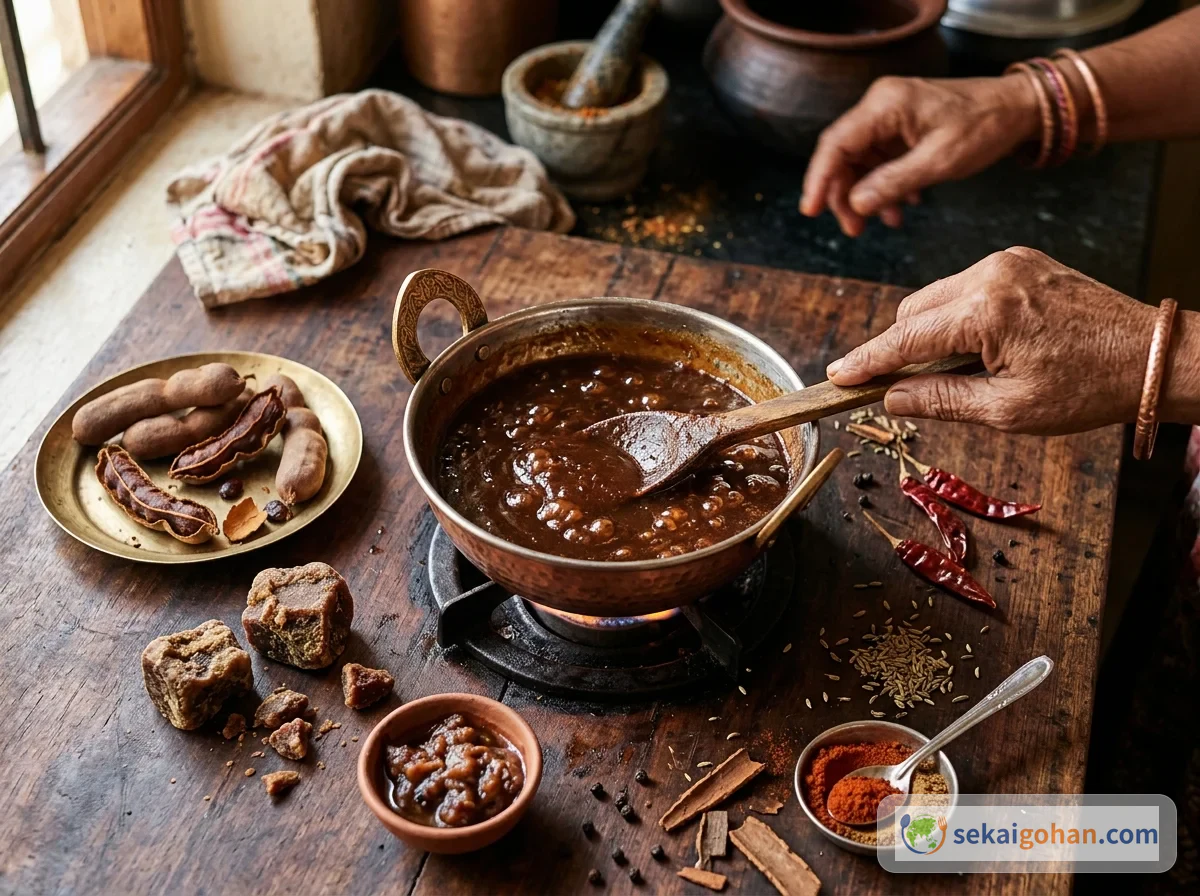
When you eat samosas in India, two kinds of chutney always come alongside: the green mint chutney (above) and the brown tamarind chutney.
| Ingredient | Amount | Substitutes and notes |
|---|---|---|
| Tamarind paste | 2 tbsp | Available at Indian grocery stores and online |
| Water | ½ cup (100 ml) | — |
| Jaggery (unrefined sugar) | 2 tbsp | Dark brown sugar can substitute |
| Ground cumin | 1/2 tsp | — |
| Chili powder | 1/4 tsp | — |
| Salt | 1/4 tsp | — |
Put the tamarind paste, water, and jaggery in a small pot and simmer over low heat for 5 minutes. Add the ground cumin, chili powder, and salt, mix, and let cool. It keeps for 1 week in the refrigerator.
Samosa Tips and Fixes

Make samosa dough much stiffer than bread or pizza dough. If you catch yourself thinking, "Isn't this a little too stiff?" it's just right. A sticky dough with too much water won't fry up crisp.
Mash the potatoes only coarsely. Fully mashed filling is smooth but monotonous, so most Indian street-stall samosas keep lumps about 0.5 inches (1 cm) across. You want that fluffy texture mixing with the spices as you bite. The filling of empanadas is kept coarse for a similar reason.
Serving and Storing Samosas
In India, samosas almost always come with chai (spiced milk tea). The milk and sweetness of the chai soften the heat of the spices and refresh your mouth. Lassi (a yogurt drink) is another classic pairing, and samosas are great with beer too, since the hop bitterness of an IPA works with the spices. For a meal, set a South Asian table with dal bhat or ema datshi. For more Indian cooking, try biryani, khichdi, or pav bhaji, a flour-based street food served with a vegetable curry.
Samosas are best freshly fried. If they've gone cold, 3 to 4 minutes in a toaster oven brings the crispness back. Skip the microwave, which turns the dough soft.
Samosa Variations

Keema samosa (ground meat version)
Saute 7 oz (200 g) ground chicken (or mixed ground meat) in oil with half a chopped onion and season with spices. Use this keema in place of the potatoes and you have the meat samosa eaten in Pakistan and Afghanistan. Add 1/4 tsp cinnamon powder to the 1 tsp garam masala for a more Central Asian flavor. Like nihari, a Pakistani beef shank stew, this version owes a lot to the food culture of the Islamic world.
Paneer samosa (cheese version)
Cut 5.5 oz (150 g) paneer (Indian fresh cheese) into 0.5 inches (1 cm) cubes and mix with 7 oz (200 g) potatoes for the filling. Drained firm tofu works if you can't get paneer. The richness of the cheese goes beautifully with the spices, and this version is especially loved in the Punjab region of northern India.
Sweet potato samosa
Use 14 oz (400 g) sweet potato in place of the potatoes. Its sweetness plays against the heat of the spices. Add 1 tsp chaat masala (a tangy spice mix) and you get sweet, spicy, and sour all at once. A squeeze of lime instead of lemon adds a refreshing acidity, much like ceviche, and makes it taste even more like street food.
Oven-baked samosa
Brush the shaped samosas thinly with vegetable oil, arrange them on a baking sheet, and bake in an oven preheated to 200 degrees C for 25 to 30 minutes. They won't be as crisp as freshly fried ones, but they use far less oil. Spraying the surface with oil gives a more even color.
Spring roll wrapper samosa (time-saving version)
Skip the dough and use store-bought spring roll wrappers. Cut each wrapper lengthwise into 3 equal strips, put filling at one end, and fold it into a triangle the way you'd fold a flag. Fry for just 3 to 4 minutes at 170 degrees C. The texture isn't the same as the real thing, but it's handy when you need a lot of samosas for a party.
Frequently Asked Questions

The samosa dough is stiff and hard to roll. May I add water?
You can add water 1 tsp at a time, up to ½ cup (90 ml) in total. If the dough is still stiff after that, it needs more oil, so next time increase the oil to 3.5 tbsp. Resting the dough for 30 minutes also relaxes the gluten and makes it easier to roll. If you cut the rest short, the dough shrinks.
The seams open while frying
The cause is either too little water on the seam or too much filling. Brush the seam with a "glue" of 1 tsp flour and 2 tsp water, then press firmly with the back of a fork to seal it. Leave the samosas alone for the first 5 minutes in the oil, because moving them with chopsticks before the dough sets pulls the seams open.
Can I make them the day before?
Yes. Shaped samosas keep in the refrigerator overnight. Moisture from the filling can soften the dough, so set them on a tray, cover with plastic wrap, and take them out just before frying. You can also freeze them for up to 1 month. To fry them straight from frozen, start at a low temperature (120 degrees C) and fry 5 minutes longer than usual.
Can I make them in an air fryer?
Yes. Brush the shaped samosas thinly with vegetable oil and cook at 180 degrees C for 12 to 15 minutes, turning them once halfway through. They won't be quite as crisp as oil-fried samosas, but they're crisp enough, and they use far less oil, which suits anyone watching their fat intake.
Sources
The history of the samosa is drawn from the following English-language books as primary sources.
Books:
- Sen, Colleen Taylor. Food Culture in India. Greenwood Press, 2004 (https://www.bloomsbury.com/us/food-culture-in-india-9780313324871/) accessed 2026. An academic overview covering Indian food culture in general. Details the samosa's arrival from Central Asia.
- Achaya, K.T. Indian Food: A Historical Companion. Oxford University Press, 1994 (https://global.oup.com/academic/product/indian-food-9780195628456) accessed 2026. The definitive history of Indian food culture. On the changes of the samosa in the Mughal period.