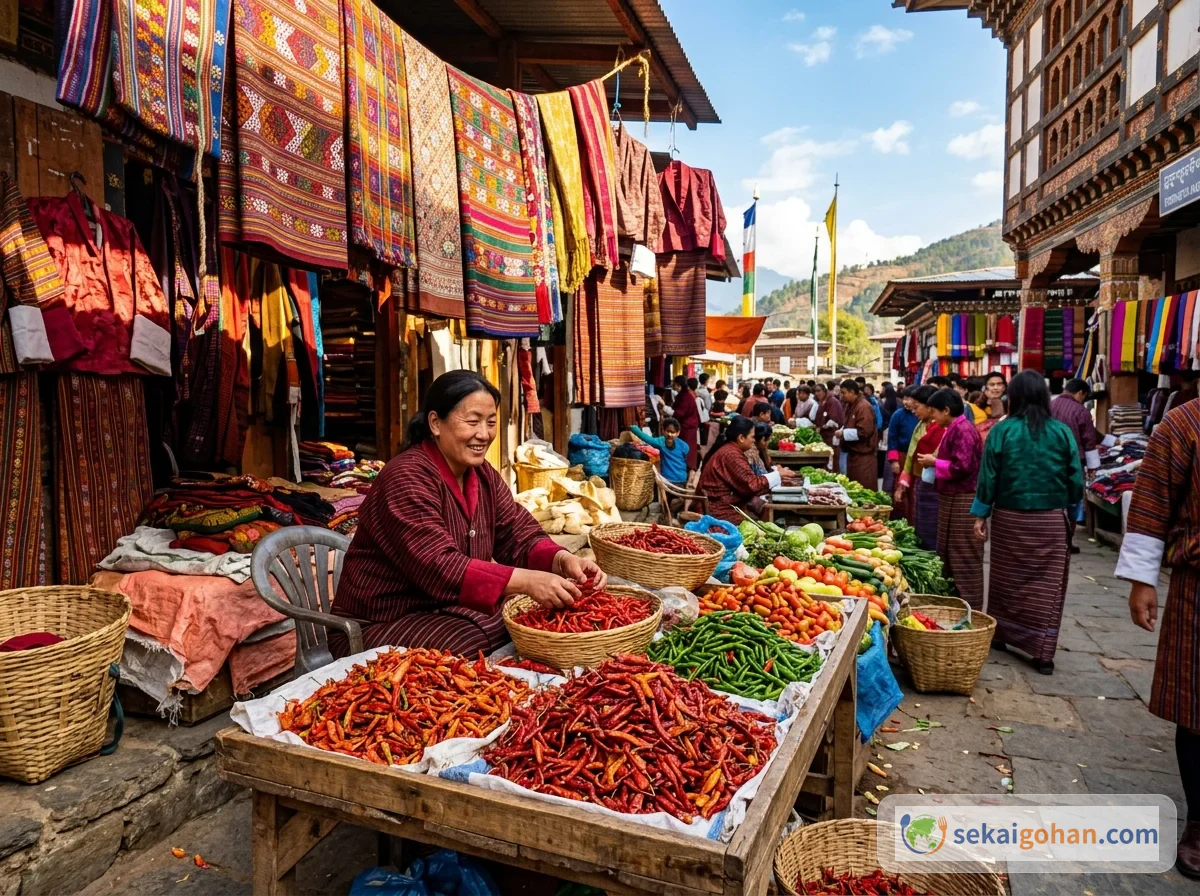
A morning market in Thimphu. In the cold Himalayan air, chilies are piled high in green, red and yellow, and shoppers carry them home by the kilo. If you're used to buying a pinch at a time, the amount is hard to believe. In Bhutan, chilies are a vegetable, not a seasoning. Ema datshi, Bhutan's national dish, simmers them with cheese. In Dzongkha, Bhutan's national language, "ema" means chili and "datshi" means cheese, so the name literally means chilies in cheese. Bhutan belongs to the South Asian food sphere, but no other dish there treats chilies as the main vegetable.
Ema datshi in Bhutan
Some Bhutanese people say flatly that a meal without chilies is "not a meal," and ema datshi sits at the top of that chili culture. It's eaten every day across the country with red rice, and it plays the role miso soup plays in Japan. The variations are countless, depending on the type of chili, how it's cut and which cheese goes in.
Ema datshi at every meal
Bhutanese people eat ema datshi at literally every meal: alongside breakfast, as the main dish at lunch, as a side at dinner. The day's batch gets talked about ("The chilies were fresh today," "Yesterday's was too salty"), the way people in Japan talk about their daily miso soup.
At tsechu, Bhutan's festivals, large quantities are served. Masked dancers perform in temple courtyards, and between the performances people eat red rice and ema datshi. On festival days cooks pay attention to the quality of the chilies and use fresh local ones.

In autumn, red chilies cover farmhouse roofs to dry in the sun. It's a seasonal sight and a favorite of tourist photographers. Those dried chilies go into ema datshi all winter. Fresh and dried chilies taste different, and Bhutanese cooks choose between them by season.
Toning down the heat for a guest is considered rude in Bhutan, because it assumes the guest can't handle spice. Real hospitality means a properly spicy ema datshi, although restaurants for foreign tourists do adjust the heat. Ema datshi is also on school lunch menus, and children start getting used to it at about age three or four. Its heat is on a different level from other spicy South Asian dishes such as Sri Lanka's stir-fried kottu roti.
How chilies reached Bhutan
Chilies come from Central and South America. Columbus brought them back to Europe at the end of the 15th century, and in the 16th century the Portuguese carried them to India. From there they crossed the Himalayas northward into Bhutan.

Climate and geography explain why they spread so fast. At 2,000 to 4,000 m the cold is never far away, and the capsaicin in chilies warms the body. Chilies also grow well on Bhutan's limited farmland and keep well when dried, so they naturally took root as a vegetable.
Bhutan was closed to the outside world for a long time. Foreigners were allowed in from 1974, and television and the internet both arrived in 1999. During those years of seclusion, ema datshi developed with little foreign influence, and the pairing of chilies and cheese was perfected. Bhutan became a constitutional monarchy in 2008 and modernized quickly. Indian and Chinese restaurants have opened in Thimphu and Paro, but ema datshi is still the center of the Bhutanese table. Since Bhutan opened to tourism, travelers have spread the word on blogs and social media, and it's now counted among the world's spiciest national dishes.
Bhutan has adopted Gross National Happiness (GNH) as a guiding principle, placing the well-being of its people ahead of economic growth alone. Preserving and promoting culture is one of the pillars of GNH, and passing on traditional dishes such as ema datshi fits within that outlook.
Ingredients (serves 4)

Choosing the cheese
| Cheese | Suitability | Notes |
|---|---|---|
| Feta + mozzarella | Best | Feta's saltiness and mozzarella's stretch come closest to the real thing |
| Cottage cheese + sliced cheese | Good | Budget-friendly. The sliced cheese provides the thickness |
| Cream cheese | Acceptable | High in fat, so reduce the butter |
| Processed cheese (baby-cheese style) | Acceptable | Convenient, but the flavor differs from the original |
Datshi, Bhutan's traditional cheese, is hard to find outside Bhutan. Mixing feta (salty, crumbly) and mozzarella (melting) at 7:3 gives the closest taste. Cream cheese alone is too rich and strays from the plain character of Bhutanese cooking.
This dish contains dairy (cheese and butter). People with a milk allergy should not eat it. Eggs are not used. Check the ingredient label of any commercial cheese for egg.
Choosing ingredients for ema datshi

You can find almost everything for ema datshi at an ordinary supermarket. The hard part is the cheese: Bhutan's datshi is difficult to get elsewhere. The closest substitute is 5 oz (140 g) feta plus 2 oz (60 g) mozzarella. Feta's saltiness and crumbly texture resemble datshi, and mozzarella's stretch gives the sauce body. Feta alone leaves the sauce too thin, and mozzarella alone makes it bland.
| Ingredient | Where to buy | Notes |
|---|---|---|
| Green chilies | Supermarket, greengrocer | Choose firm, glossy ones |
| Shishito peppers | Supermarket | Also sold as mild green peppers |
| Feta cheese | Supermarket, specialty grocer, online | Buy in a block |
| Mozzarella | Supermarket | Block or shredded |
| Ingredient | Substitute | Difference in result |
|---|---|---|
| Datshi (traditional cheese) | Feta + mozzarella (7:3) | The closest taste and texture |
| Green chilies | Shishito + chili flakes | Bulk is there, but the heat is weaker |
| Red rice | Brown rice | Similar texture. The color differs |
| Traditional butter | Regular butter | Slightly different flavor, but good enough |
Method
Cooking ema datshi
Ema datshi is remarkably simple. You put the ingredients in a pot and simmer them. Yet Bhutan's food wisdom is packed into that simplicity.
In Bhutan the staple is red rice rather than white. If you can find it at a specialty grocer or online, cook the red rice and ladle plenty of ema datshi over it. White rice is delicious too, but the plain flavor of red rice with the cheese sauce is the real taste. If you can't get red rice, brown rice gives a similar texture.
Ema datshi cooking tips

Cut the chilies lengthwise
Chilies cut into rings release their heat all at once and make the whole sauce fiercely hot. Cut them in half lengthwise instead. They keep their shape, and the heat blooms in your mouth as you bite, which is how it's eaten in Bhutan. Leave the seeds in: Bhutanese people say an ema datshi without seeds isn't ema datshi.
Be generous with butter
Bhutanese cooking uses a lot of butter, because high, cold places call for a high-calorie diet. Skimp on it and the sauce loses its richness. The 2 tbsp in this recipe is the minimum. Fat matters just as much in other highland cooking, like Nepal's lentil curry set meal, dal bhat.
Go easy on the water
Too much water makes the cheese watery, and you lose the thick, creamy body. The chilies release their own moisture, so start small and add a little more only if it runs dry while simmering. You're aiming for something a little looser than cream stew.
Let the cheese melt on its own
Stirring a lot after the cheese goes in makes it stick to the bottom of the pot or turn rubbery. Turn the heat to low, swirl the pot now and then, and let the cheese melt into the sauce on its own. Unlike nihari, Pakistan's long-simmered stew, ema datshi is done as soon as the cheese melts.
Ema datshi variations
Bhutanese tables hold many dishes called "something datshi." Cooking in cheese is a basic Bhutanese technique, and it works with much more than chilies.

| Name | Main ingredient | Character |
|---|---|---|
| Ema datshi | Chilies | The national dish |
| Shamu datshi | Mushrooms | Mushrooms in cheese. A luxurious version in matsutake season |
| Kewa datshi | Potatoes | Potatoes in cheese. Popular with children |
| Gondo datshi | Eggs | Eggs in cheese. A breakfast staple |
Every datshi is built the same way: butter + cheese + a little chili + the main ingredient. Even the mushroom and potato versions get a little chili, because in Bhutan chili is a base seasoning in every dish. Among everyday vegetables, zucchini, eggplant and broccoli also pair well with cheese. If you're calling it ema datshi, though, it needs chilies.
Simply replace the chilies in ema datshi with 7 oz (200 g) shimeji mushrooms to make shamu datshi (mushrooms in cheese). Adding 3 shishito peppers brings a Bhutanese-style heat. Common cultivated mushrooms such as shimeji, enoki or king oyster differ from Bhutan's mushrooms but pair wonderfully with cheese. The umami of the mushrooms and the richness of the cheese make a gentle flavor that suits most palates.
Frequently asked questions

Q1. Is it really that spicy?
The ema datshi Bhutanese people eat is several times hotter than a "very hot" curry in Japan. This recipe is adjusted for home cooks. Using more shishito peppers makes it milder, and the fat in the cheese softens the heat, so it's easier to eat than you might expect.
Q2. Can children eat it?
Yes, if you use only shishito peppers and leave out the green chilies. Kids tend to like a stew of cheese and mild peppers. In Bhutan, too, children are often served kewa datshi (potatoes in cheese) with the heat toned down.
Q3. Does it taste better the next day?
No. Ema datshi is best freshly made. The cheese firms up over time and can turn rubbery when reheated, so try to finish it the day you make it. If you do have leftovers, reheat them over low heat with a little water.
Q4. Where can I buy red rice?
Look at specialty grocers or online. Red rice from other countries, or whole-grain "ancient rice" varieties, also work. For the Bhutanese look, cook ordinary white rice with 10 to 20 percent red rice mixed in. If you cook red rice alone, use 1.2 times the usual water and soak it for 30 minutes first.
Q5. What drinks go well with ema datshi?
In Bhutan the classic pairing is butter tea (suja). It's unfamiliar in many places, but you can make a simple version by melting salted butter into black tea. To tame the heat, try lassi (a yogurt drink). Bhutan's beer is Druk lager, which is hard to find abroad, so any light lager makes a fine substitute.
Q6. What other Bhutanese dishes should I know?
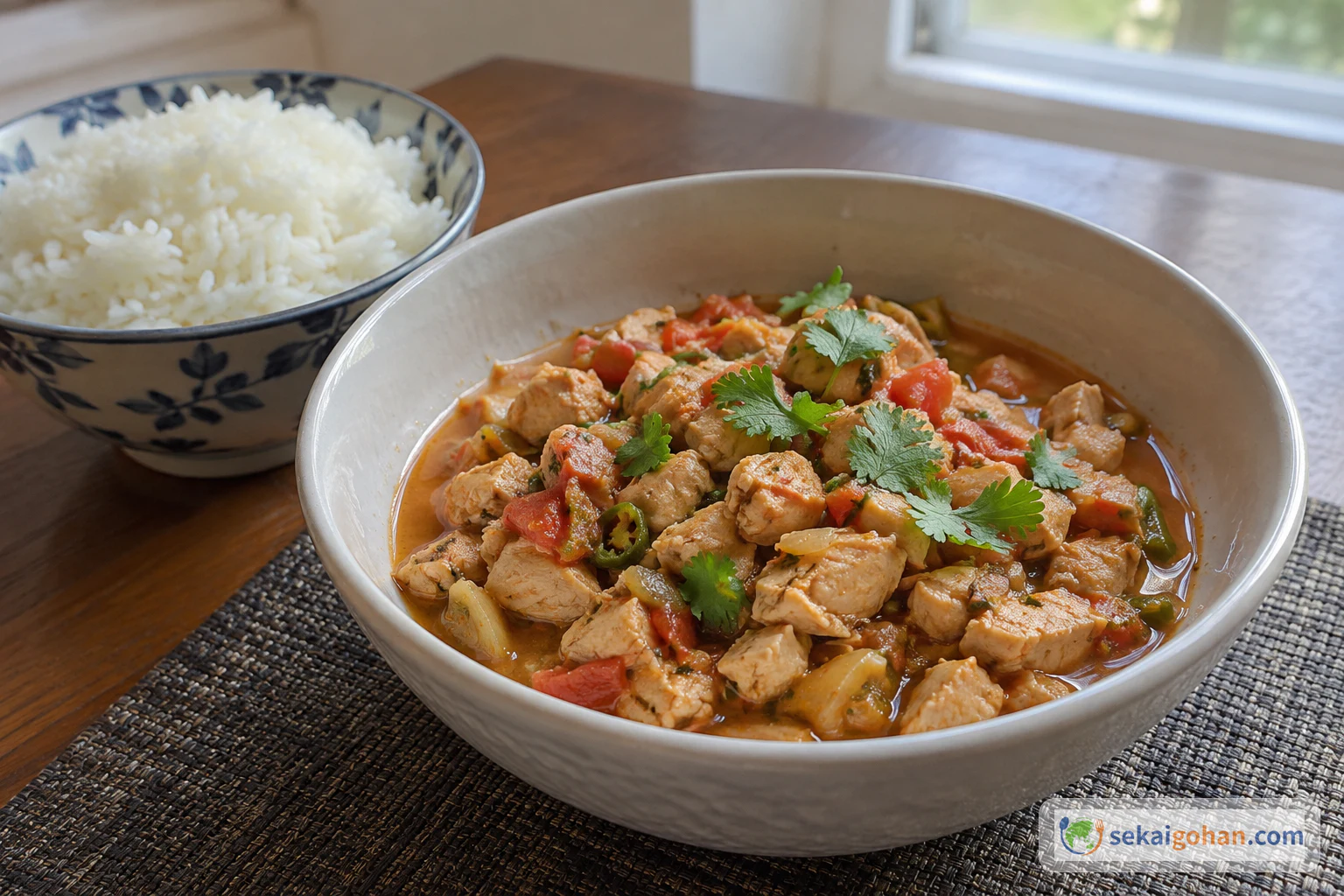
Besides the datshi family, try phaksha paa (pork stir-fried with chilies) and jasha maroo (chicken and chili stew). Elsewhere in South Asia, dal bhat (Nepal), nihari (Pakistan; in Japanese) and khichdi (India; in Japanese) are national dishes with rich food cultures of their own.
Sources
The following English-language references were mainly consulted.
- Ema datshi - Wikipedia (English) — a comprehensive explanation of the history, variations and cultural background of ema datshi
- Bhutanese Ema Datshi Recipe - Serious Eats — a recipe explained with cooking science
- The National Dish of Bhutan - Atlas Obscura — reportage on Bhutanese food culture
Related articles: spicy dishes of South Asia
National dishes of South Asia: Dal bhat is Nepal's lentil curry set meal, a dish from the same Himalayan cultural sphere as ema datshi. Nihari is a Pakistani spiced beef stew in which the spices melt in over several hours. Khichdi is India's lentil-and-rice porridge, a gentle South Asian home dish.
Spicy dishes of the world: Kottu roti is Sri Lanka's griddle stir-fry with a punchy chili kick. Gapao is Thailand's basil stir-fry, which uses chilies differently from ema datshi. Som tam is Thailand's green papaya salad, whose extra-hot version rivals ema datshi in heat.
Dishes of the world made with cheese: Khachapuri is Georgia's cheese bread. Plăcintă is Romania's cheese pie. In both, cheese is the star, but pairing it with chilies is an idea particular to Bhutan.
Conclusion: the simplest national dish
Ema datshi is simply chilies simmered in cheese. The recipe has four steps and takes 30 minutes. It needs no special technique and no complicated spice blend. Yet this simple idea of cooking chilies in cheese is hard to find in other food cultures.
In the cold Himalayan highlands, warming the body with cheese and chilies has sustained the Bhutanese table for generations. At the center of the table in the "land of happiness" is no luxury ingredient or elaborate technique, just chilies and cheese. The dish you can make in one pot in 30 minutes holds a taste of Bhutan.