Lamprais Recipe: How to Make Sri Lankan Rice and Curry Baked in Banana Leaf

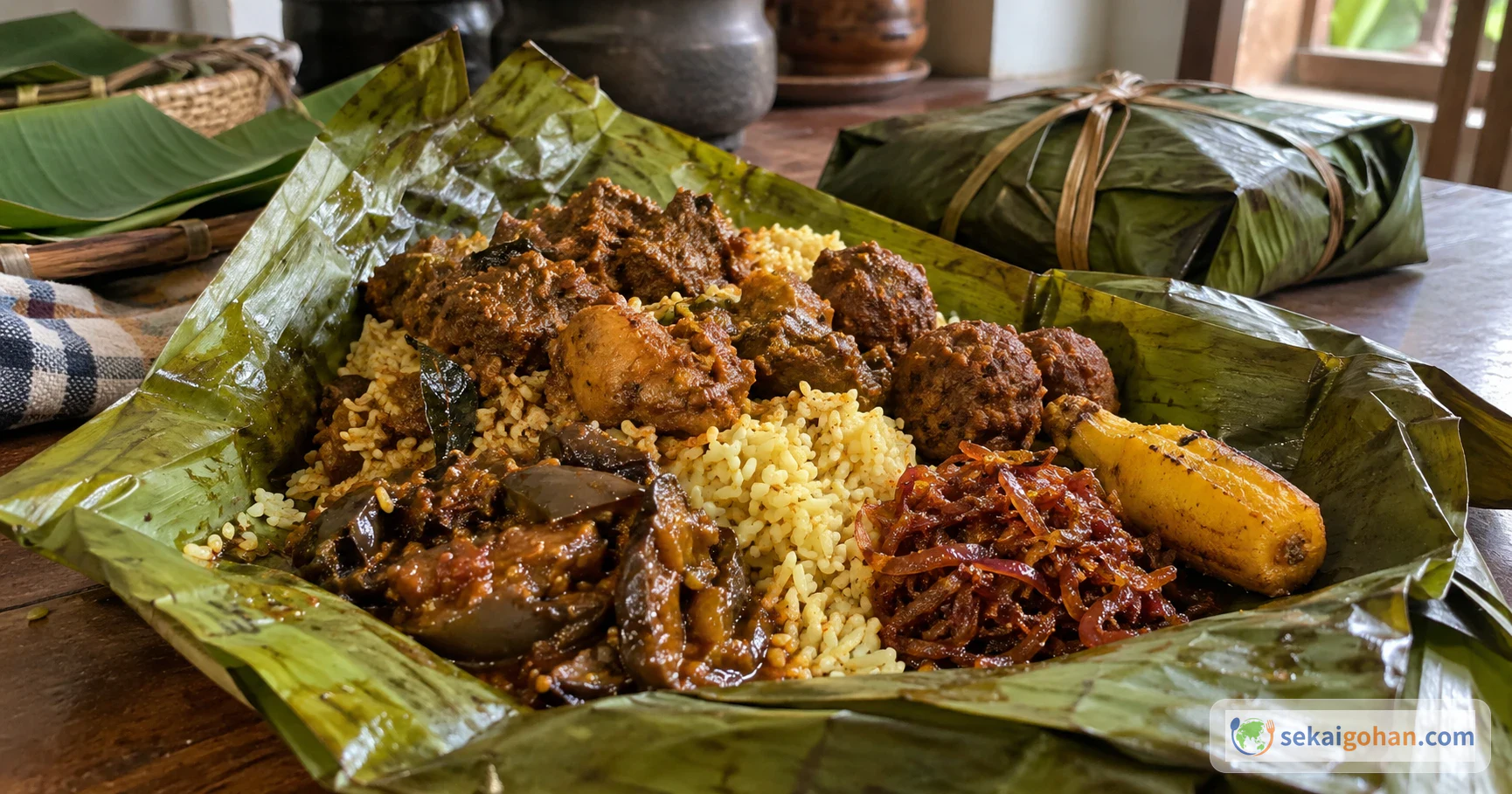
An opened banana-leaf packet of Sri Lankan lamprais with yellow rice, meat curry, eggplant and seeni sambol
Prep
1 hr 20 min
Cook
1 hr 30 min
Total
2 hr 50 min
Serves
4 servings (4 packets)
Level
Advanced
Cuisine
Sri Lankan

Lamprais is a Sri Lankan Dutch Burgher dish of rice, three-meat curry, eggplant and seeni sambol, wrapped in banana leaf and baked. With substitutes, storage.

Cooking flow

Cooking steps

STEP11 / 6

Simmer the three meats and make the stock for the rice

15 min prep + 45–50 min on low heat

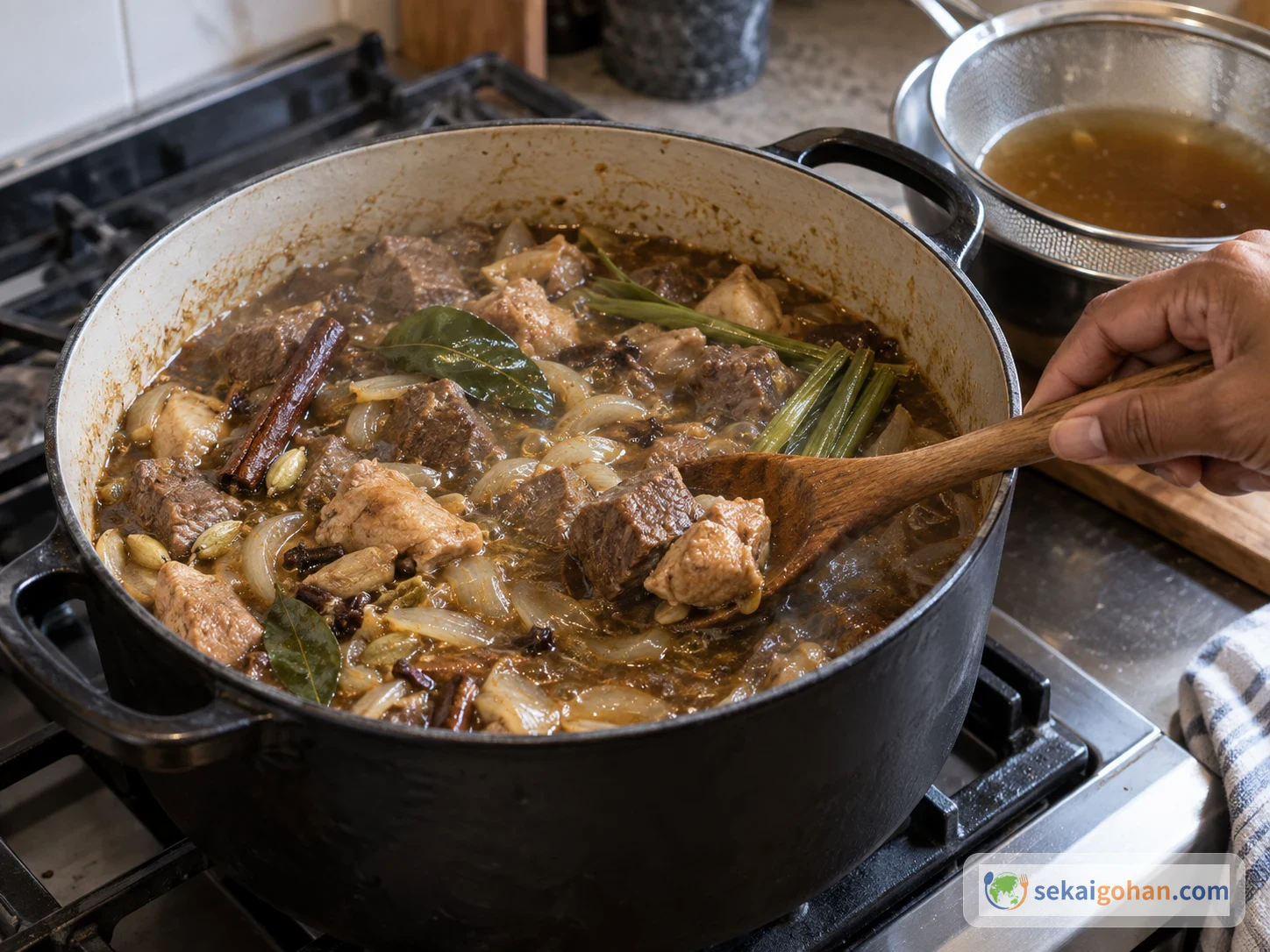
Beef, pork, chicken and aromatics simmering in spiced stock
Simmer the three meats to make the stock that underpins both the rice and the curry
  • Cut the beef chuck, pork shoulder and chicken thighs into 1 inches (2 cm) cubes, and put 5.5 oz (150 g) onion, 20 g garlic, 20 g ginger, 1.25 oz (35 g) ghee or butter and the whole spices in a pot.
  • Over medium heat, sauté the spices and aromatics for 2–3 minutes, then stir the meat for about 5 minutes until the surface turns opaque.
  • Add 3¾ cups (900 ml) water, the curry leaves, pandan leaf, bruised lemongrass and 5 g salt. Bring to a boil, then simmer on low heat for 45–50 minutes.
  • When a bamboo skewer slides into the beef and pork without resistance and the liquid has reduced slightly, lift out the meat. If it's still tough, add boiling water and extend the low simmer by 10–15 minutes.
  • Strain through a fine-mesh sieve and measure out 2¼ cups (520 ml) of warm stock for the rice. You're done when the meat is tender and the stock has no burnt bitterness.
STEP22 / 6

Cook the rice in the meat stock and let the grains rest

30 min soaking + 15–18 min cooking + 10 min steaming

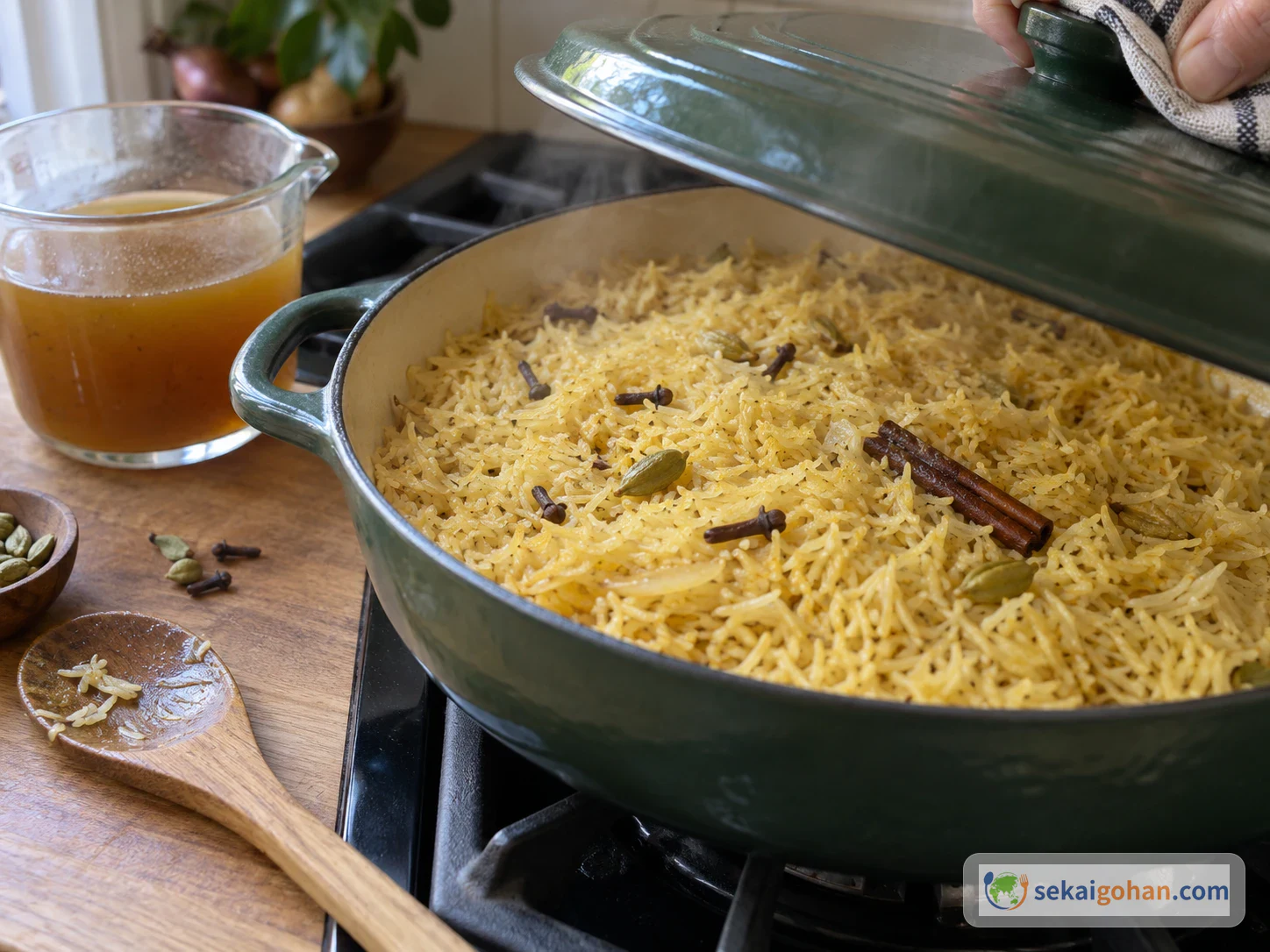
Rice absorbing the meat stock in a pot with cinnamon and cardamom
Let the rice absorb the meat stock and steam it with a slight bite left in the center
  • Rinse 11.5 oz (320 g) basmati or long-grain rice, soak for 30 minutes and drain.
  • Warm 20 g ghee or butter with the cinnamon, cardamom and cloves in a pot over medium-low heat for 1 minute. Add the rice and stir for 2 minutes, until the grains look lightly glossy with fat.
  • Add 2¼ cups (520 ml) warm meat stock and 4 g salt. Once it boils, reduce to low, cover and cook for 15–18 minutes.
  • When no liquid is visible and the center of the grains still has a slight bite, turn off the heat, and steam with the lid on for 10 minutes.
  • If the grains are still hard in the center, add 2–3 tbsp hot stock, cover and rest for 5 minutes. It's done when the grains are separate and not sticky.
STEP33 / 6

Thicken the meat curry, and finish the eggplant and bananas separately

15 min curry + 20 min eggplant + 15 min bananas

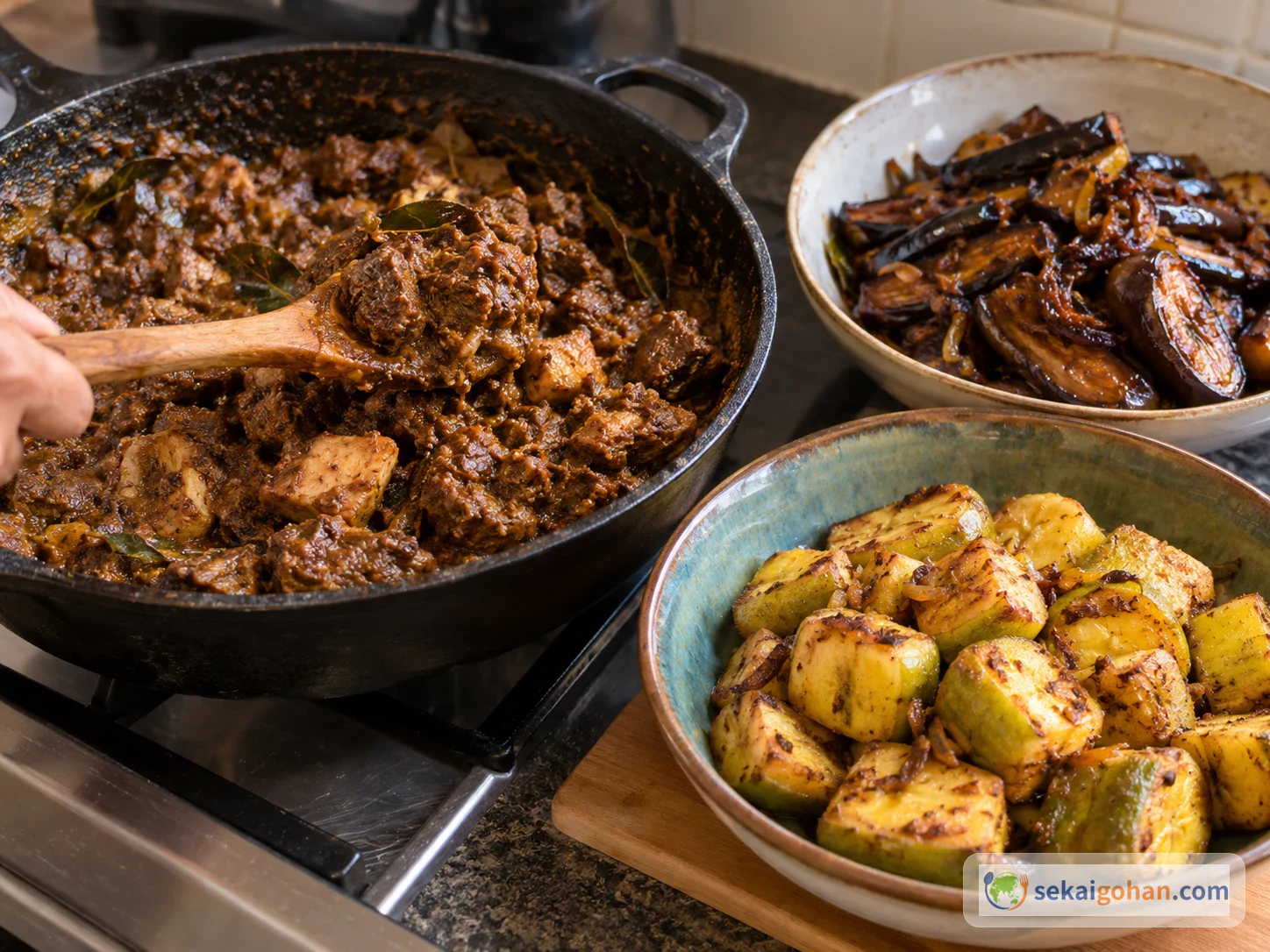
Meat curry, tamarind eggplant and fried cooking bananas finished in separate dishes
Before wrapping, bring the curry and sides, each with a different moisture level, to the right consistency separately
  • Add 20 g roasted curry powder, the turmeric, chili powder, remaining spices and ½ cup (150 ml) strained cooking liquid to the meat. Bring to a boil over medium heat, then simmer on low for 10–15 minutes.
  • Stop when a line drawn across the bottom of the pot with a wooden spoon stays for 2 seconds and the sauce clings to the meat. If it's loose, lift out the meat and reduce over medium heat for 3–5 minutes.
  • Cut 10.5 oz (300 g) eggplant into 0.5 inches (1.5 cm) wide pieces and fry in oil over medium heat for 5–7 minutes until browned. Add 20 g tamarind, 1 tbsp (15 ml) vinegar, 18 g dark sugar, the mustard seeds, 3 g salt and 3.5 tbsp (50 ml) hot water, and simmer on low for 5 minutes.
  • Cut 14 oz (400 g) green cooking bananas into 0.5 inches (1.5 cm) thick slices and fry in oil over medium heat for 5 minutes. Add a little curry powder, turmeric, salt and 3.5 tbsp (50 ml) water, cover, and cook on low for 5–7 minutes until a skewer goes through.
  • Don't let the eggplant liquid and the banana juices run onto the same plate; keep them apart until wrapping.
STEP44 / 6

Make the seeni sambol and frikkadels

20 min seeni sambol + 15 min meatballs

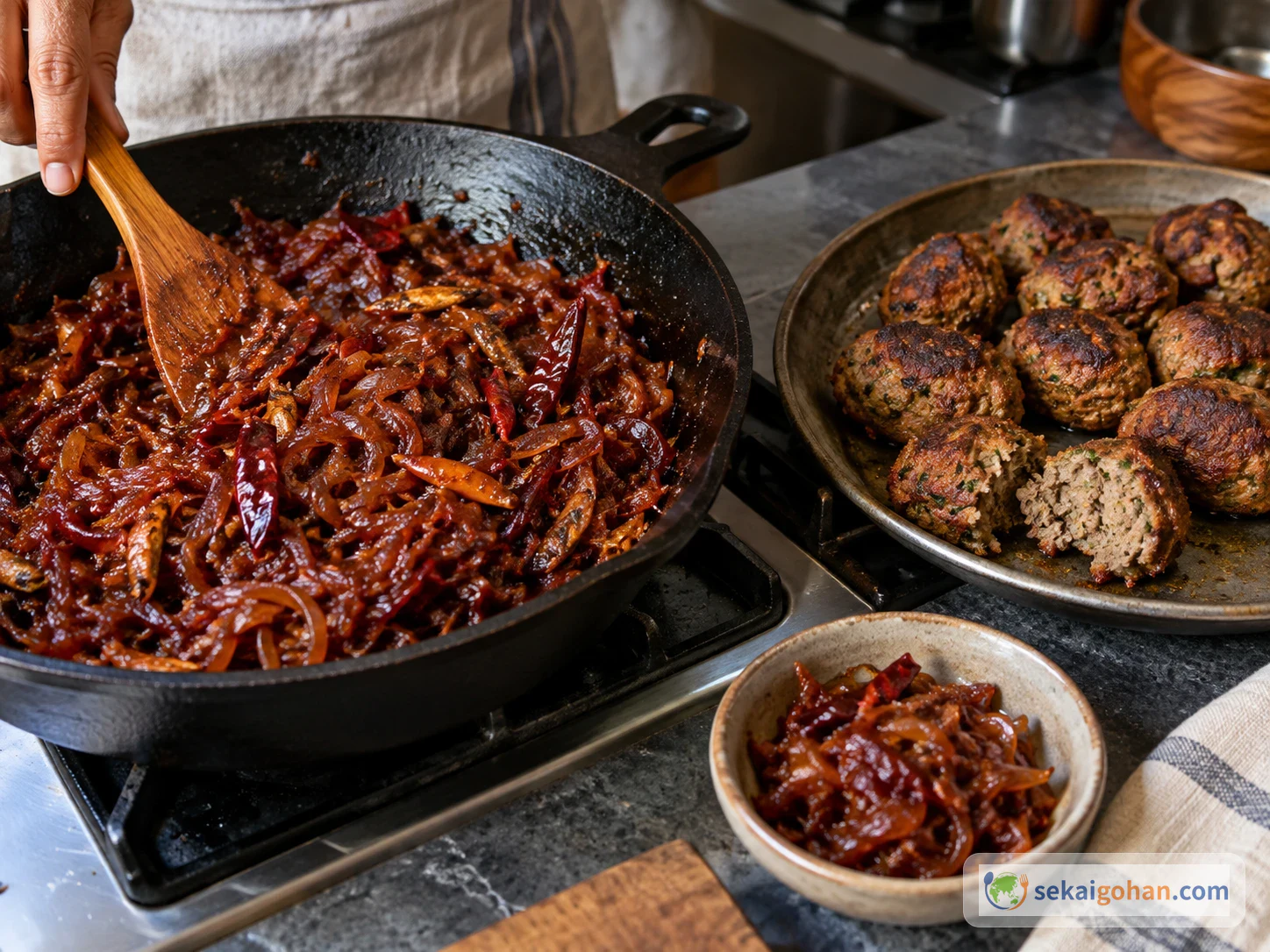
Amber seeni sambol and spiced frikkadels finished separately
Finish the sweet-spicy onions and the meatballs before they go into the leaf parcels
  • For the seeni sambol, use 9 oz (250 g) red onions, 8 g dried red chilies, 10 g ginger, 10 g garlic, 20 g brown sugar, 10 g Maldive fish, 1 tbsp (15 ml) lime juice and 2 g salt.
  • Fry the onions in oil over medium-low heat for 15–18 minutes, until they turn from translucent to light amber and a line drawn with a spatula doesn't close up easily.
  • Add the chilies, ginger, garlic, Maldive fish and sugar and cook on low for 3 minutes. Turn off the heat and stir in the lime juice. Don't let it scorch and turn bitter.
  • Mix 7 oz (200 g) ground beef, the egg, 25 g breadcrumbs, 50 g onion, 5 g garlic, the cinnamon, fennel, black pepper and 3 g salt, and shape into 8 ovals about 1 inches (3 cm) across.
  • Fry the meatballs in oil over medium heat, rolling them, for 8–10 minutes, until browned all over and no pink remains in the center when you cut one open. If the mixture holds together evenly and isn't too sticky, it's easy to shape.
STEP55 / 6

Warm the leaves and fill 4 packets evenly

15–20 min

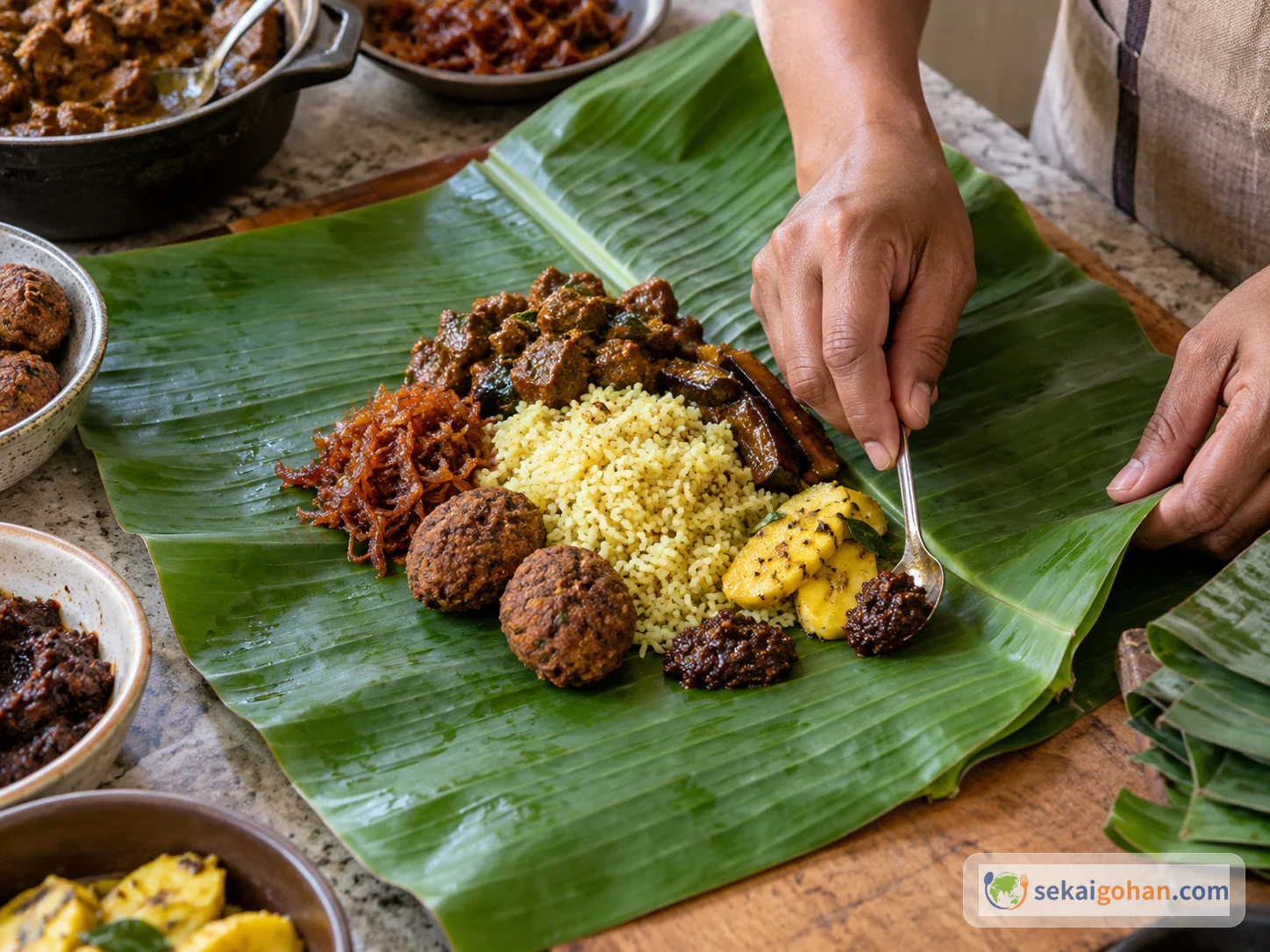
Placing rice, meat curry, eggplant, seeni sambol and meatballs in the center of a warmed banana leaf
Leave a margin on all four sides and arrange the components without piling them on top of one another
  • Wash the banana leaves, pat them dry, and pass them over a low open flame or above boiling water for a few seconds at a time, until they turn pliable and glossy. Don't scorch holes in them.
  • In the center of each leaf, place about 6.5 oz (180 g) rice. Around it, arrange about 4 oz (120 g) meat curry, about 2 oz (60 g) eggplant, about 50 g banana, about 25 g seeni sambol, 2 frikkadels, 1 tsp blachan and, if using, 1/2 egg.
  • Don't put the wet curry near the edges of the leaf, and don't spread it too far over the rice in the center. Leave at least 2 inches (5 cm) of margin on all four sides.
  • Fold the long sides of the leaf to the center, then tuck the short sides underneath to make a rectangle. Place the seam side down, and double up any torn leaves.
  • The packet is done when the leaf is pliable and untorn, nothing spills from the edges, and the seam is closed.
STEP66 / 6

Bake the packets at 350°F (180°C) and rest before opening

10 min preheating + 20–25 min baking + 8 min resting

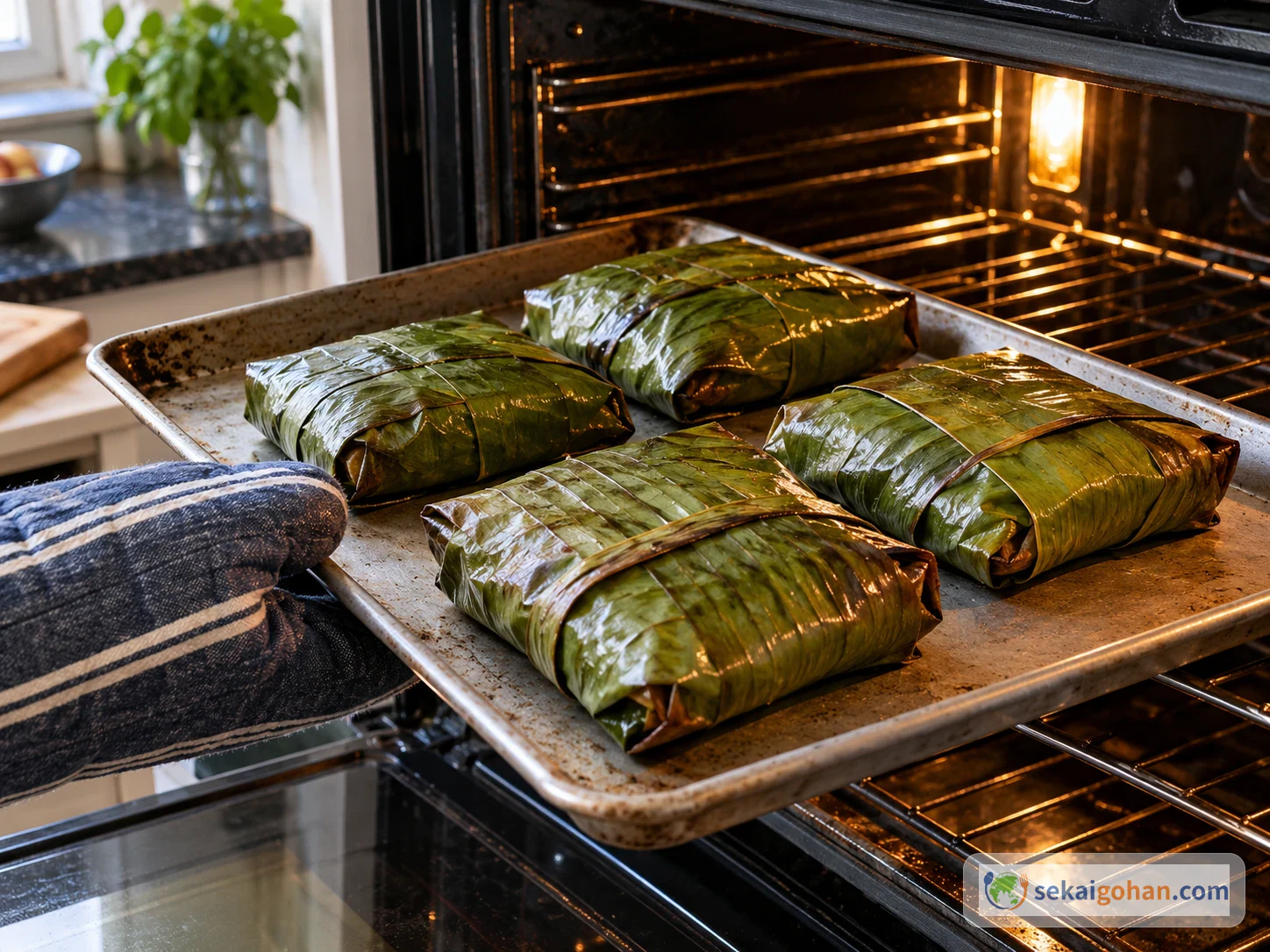
Banana-leaf packets seam side down on a baking sheet, baking
Bake the packets at 180°C and judge doneness by the color of the leaf edges and the heat at the center
  • Preheat the oven to 180°C (350°F) and place the packets seam side down on a baking sheet.
  • Bake at 180°C for 20–25 minutes. Success looks like leaf edges turned deep olive, packets hot all the way to the center, and no liquid leaking onto the sheet.
  • Don't extend the baking time and over-scorch the leaves. If the rice comes out dry, next time adjust with the curry's cooking liquid, a teaspoon at a time, before wrapping.
  • After baking, rest for 8 minutes. When opening the leaf, keep your face away to avoid steam burns.
  • It's done when the leaf smells fragrant, the packet is warm to the center and the rice isn't sticky.
  • Take the packets off the sheet when each holds a rectangle of about 15 cm, the corners haven't opened, and only the leaf edges have darkened.
0 / 0
Ingredients

Ingredients

1 / 4

Meat curry and meat stock

Ingredient Amount Substitutes & notes
Beef chuck 200 g 2 cm (3/4 in) cubes. A lean stewing cut. If using more pork instead, keep the total at 600 g
Pork shoulder 200 g 2 cm cubes. To avoid pork, use chicken instead, which makes it a two-meat version
Boneless chicken thighs 200 g 2 cm cubes. Remove the skin if you like
Water 900 ml For the meat stock (about 3 3/4 cups). If it reduces too much, add boiling water
Onion 150 g Thinly sliced. Red onion works too
Garlic 20 g Finely chopped
Ginger 20 g Finely chopped
Ghee or unsalted butter 35 g Butter is the base. Ghee gives a stronger aroma
Cinnamon 5 g 1 stick, broken
Cardamom 4 pods Lightly crush the pods
Cloves 4 Don't let them burn
Cumin seeds 4 g Whole. If ground, start with 2 g
Black peppercorns 3 g Coarsely crushed
Coriander seeds 8 g Coarsely crushed
Fennel seeds 3 g Optional, but the sweet aroma will be lighter
Turmeric 3 g Ground
Chili powder 2 g Halve for less heat
Roasted curry powder 20 g + a little 20 g for the meat curry, a little for the bananas. Sri Lankan roasted curry powder; if unavailable, dry-toast regular curry powder
Curry leaves 8 Frozen are fine. Omit if unavailable
Pandan leaf 10 cm Brings the aroma closer to the original, but optional
Lemongrass 1 stalk Bruise the base before using
Salt 8 g Roughly 5 g for the stock and 3 g for the curry
2 / 4

Rice cooked in stock

Ingredient Amount Substitutes & notes
Basmati or other long-grain rice 11.5 oz (320 g) Rinse, soak 30 minutes and drain. For Japanese short-grain rice, start with 2 cups (450 ml) liquid and adjust
Reserved meat stock 2¼ cups (520 ml) Bring to a boil before using. If short, top up with unsalted hot water
Ghee or unsalted butter 20 g For toasting the rice
Cinnamon 3 g 1/2 stick
Cardamom 3 pods Crush the pods
Cloves 2 For the rice
Pandan leaf 2 inches (5 cm) Can be omitted if you used it in the stock
Salt 4 g Reduce depending on how salty the stock is
3 / 4

Eggplant, cooking bananas and seeni sambol

Ingredient Amount Substitutes & notes
Eggplant 10.5 oz (300 g) Cut into 0.5 inches (1.5 cm) wide batons. Less watery eggplants are easier to handle
Green cooking bananas 14 oz (400 g) 2. If unavailable, use 12.5 oz (350 g) of waxy potatoes; the texture will differ
Tamarind paste 20 g If you have goraka, use 10 g instead and adjust for sourness
Rice vinegar 1 tbsp (15 ml) For the sweet-sour eggplant. Lemon juice also works
Brown sugar or dark muscovado sugar 1.25 oz (38 g) 18 g for the eggplant, 20 g for the seeni sambol
Red onions 9 oz (250 g) Thinly sliced, for the seeni sambol
Dried red chilies 8 g Remove some seeds for less heat
Maldive fish flakes 10 g 8 g of katsuobushi (dried bonito flakes) can stand in, but the seafood aroma changes
Lime juice 1 tbsp (15 ml) For the seeni sambol. Lemon juice also works
Ginger and garlic 10 g each For the seeni sambol, finely chopped
Mustard seeds 2 g For the eggplant. Optional
Vegetable oil 3.5 tbsp (50 ml) For frying the eggplant, bananas and seeni sambol. Don't use too much
Salt 7 g Roughly 3 g eggplant, 2 g bananas, 2 g seeni sambol
4 / 4

Frikkadels, blachan and wrapping

Ingredient Amount Substitutes & notes
Ground beef 7 oz (200 g) Ground pork also works. For the meatballs
Egg 1 Binder for the meatballs. To avoid egg, use 1 tbsp water and more breadcrumbs
Breadcrumbs 25 g Rice-flour breadcrumbs avoid wheat
Onion 50 g Finely chopped, for the meatballs
Garlic 5 g Finely chopped, for the meatballs
Cinnamon, fennel, black pepper 1 g each For the meatballs, finely crushed
Salt 3 g For the meatballs
Dried shrimp paste or blachan 10 g Omit if allergic to shrimp. Katsuobushi alone won't give the same flavor
Banana leaves 4 sheets, 12 inches (30 cm) square + spares Wash and pat dry. If unavailable, use parchment paper plus foil
Eggs (optional) 2 Hard-boil and halve; 1/2 egg per packet
0 / 0

On Sunday mornings around Colombo, banana-leaf parcels pile up at shop counters. Some shops take orders that morning and sell out before noon. At home you warm the closed parcel and open the leaf on your plate, and under the rising steam you find rice cooked in meat stock, ringed by a spread of side dishes. Lamprais is a Sri Lankan dish from the Burgher kitchens of Colombo. The trick is that the rice and the sides are cooked separately. Expect a lot of pots. Your reward is bringing everything together in one parcel at the end.
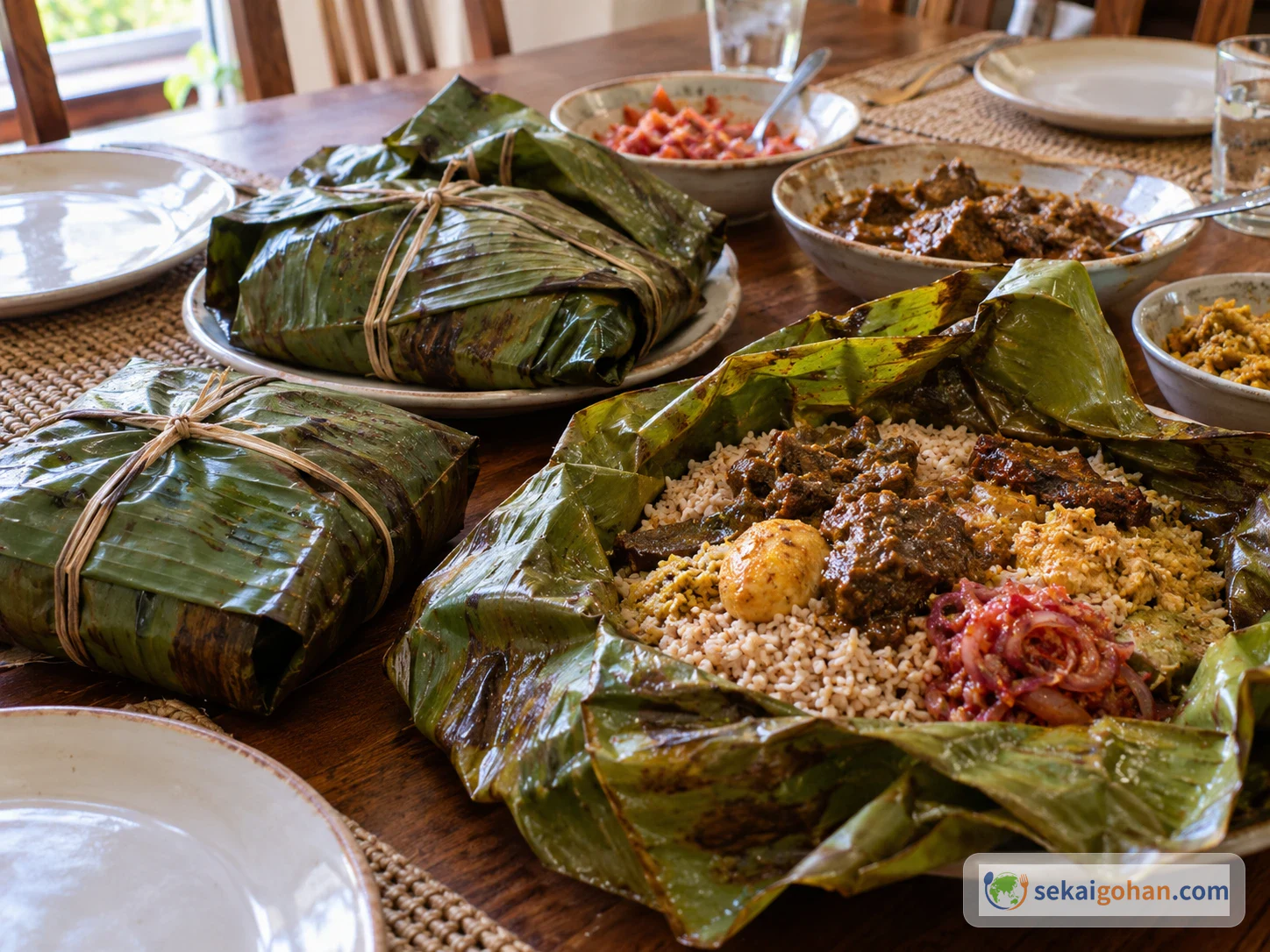
Lamprais parcels on the table, one opened to show the rice and sides
Inside the opened leaf: rice, curry and sides packed into one parcel

What lamprais is and where it comes from

Lamprais is rice and accompaniments baked in a plantain leaf, and it has ties to Dutch heritage. At its center is rice cooked in meat stock, served with several accompaniments such as meat curry, meatballs, ash plantain, seeni sambol and blachan.

The curry, the eggplant and the rice are each finished on their own before wrapping, so their textures and aromas stay distinct in every mouthful. Stir it all into the rice and every bite would taste the same. The final heating inside the leaf then gently ties the components together.

Burgher food culture in Colombo
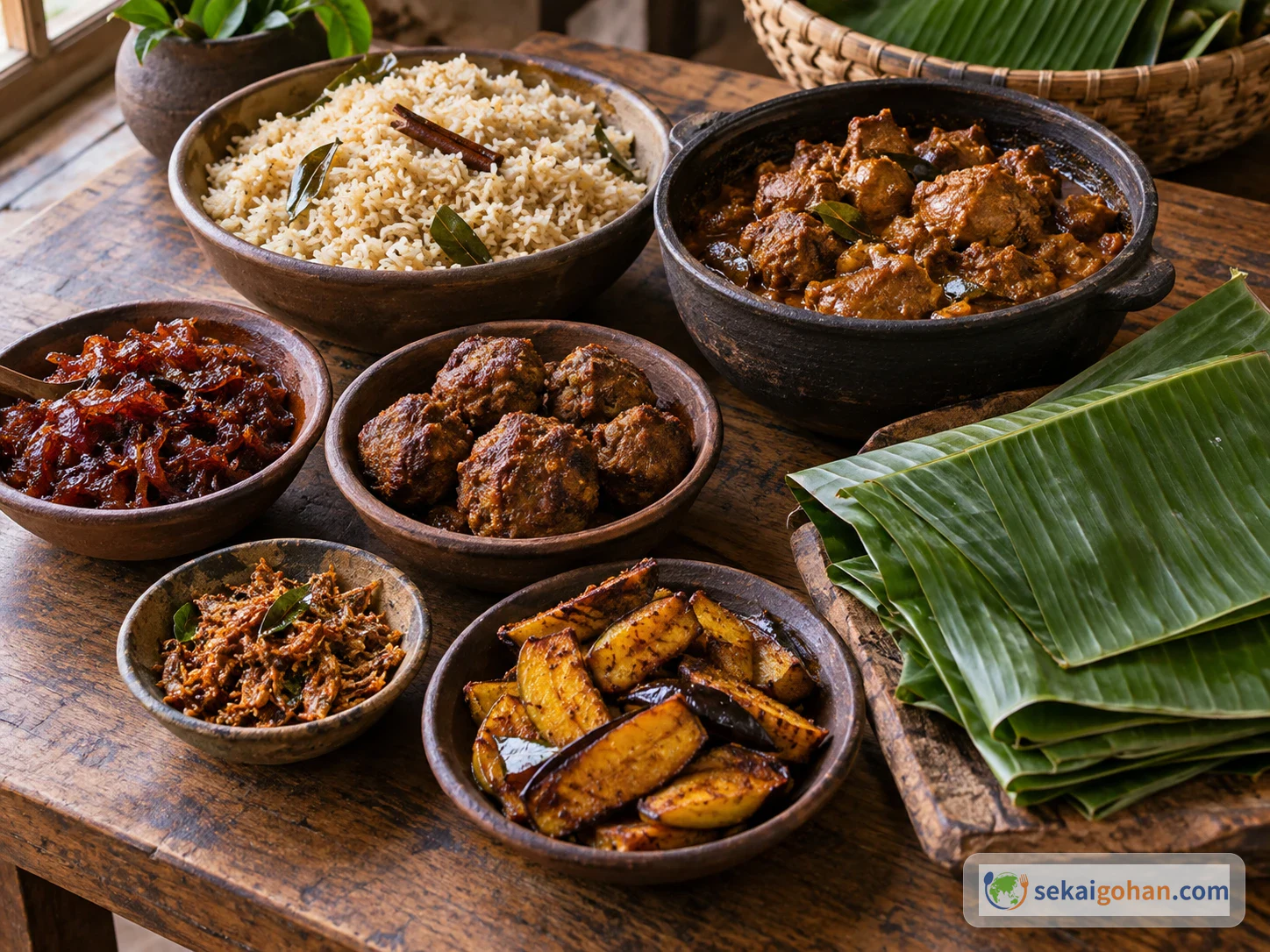
Rice, three meats, red onions, banana leaves and spices in separate bowls
Lamprais, where several cultures and ingredients come together in one wrapped dish

The dish is tied to Burgher women cooks around Colombo. The Burghers are descendants of Dutch traders and local Sinhalese women. Lamprais draws on knowledge of rice, meat, spices and leaf handling from several food cultures that overlapped within Burgher food culture around Colombo, until different dishes became one parcel. Gathering so many labor-intensive dishes into one parcel puts lamprais somewhere between everyday meals and food for celebrations and gatherings.

The name is spelled lamprais, lumprice or lump rice, and it doesn't trace back to a single Dutch word. The dish also has links to two other wrapped rice dishes, Indonesian lempur and Sinhala buth-mula. What they share is rice wrapped in leaves so it can be carried. With the varied spellings and the overlapping wrapped dishes, there's no single origin to point to.

Shop and home versions

The contents change from shop to shop and from home to home. Some shops use chicken instead of mixed meats, some leave out the egg or the blachan, and parcels come in different sizes. The classic parcel holds rice in meat stock, a beef, pork and chicken curry, meatballs, ash plantain, seeni sambol and blachan. This home-kitchen version keeps the three meats as its base and treats the egg and blachan as optional branches: the egg can be left out, and the seafood-based blachan can be swapped.


Ingredients (serves 4, makes 4 packets)
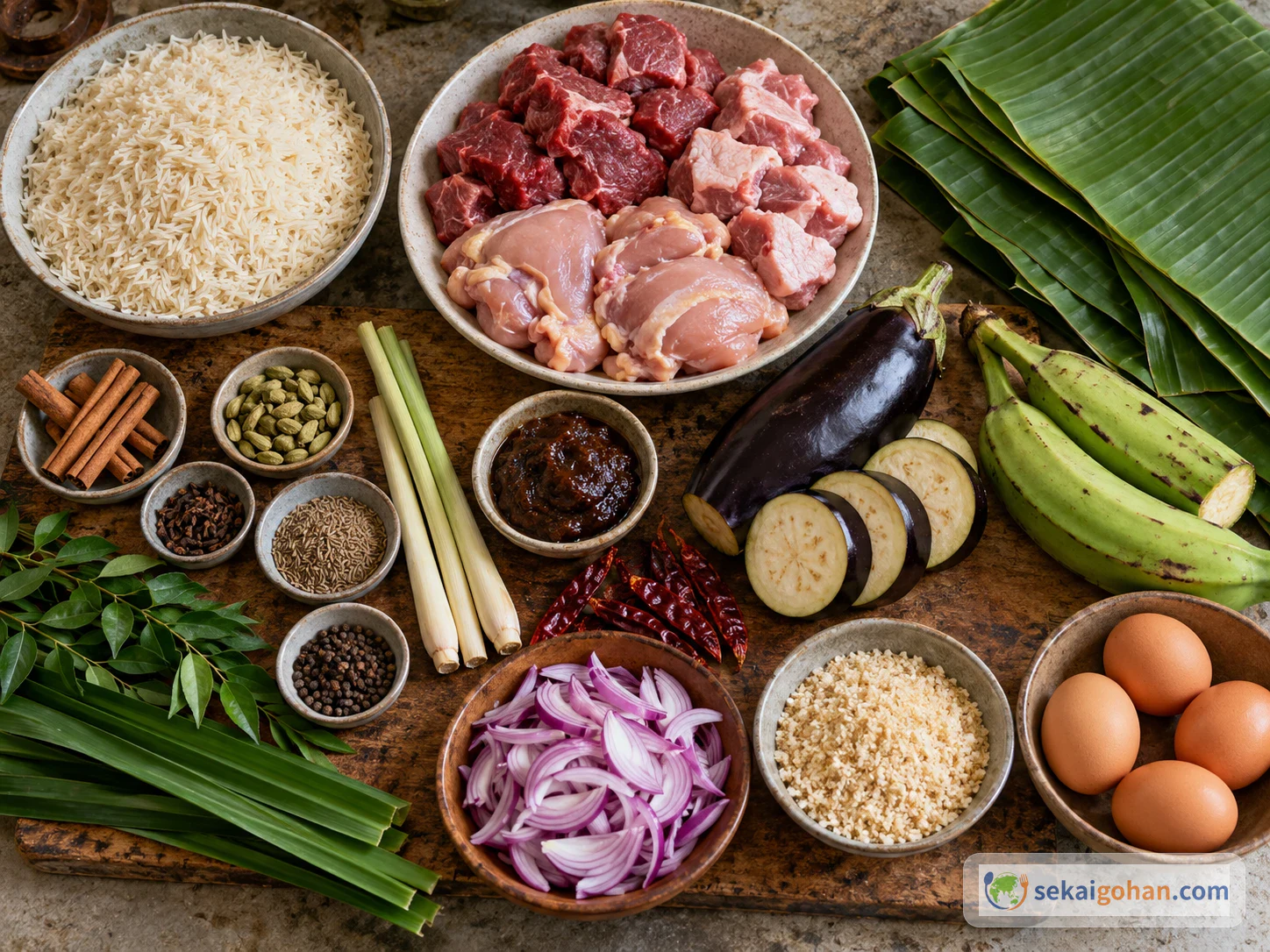
Beef, pork, chicken, rice, whole spices, tamarind, eggplant, cooking bananas, red onions and banana leaves for lamprais
For lamprais, prepare the ingredients for each component separately first

These amounts make 4 servings, or 4 packets. You need 11.5 oz (320 g) of rice and, for the meat curry, three meats: 7 oz (200 g) each of beef, pork and chicken. The meat is simmered in 3¾ cups (900 ml) of water; about 2¼ cups (520 ml) of that stock goes to the rice and the rest is used to adjust the curry's consistency. This meat stock is the backbone shared by the rice and the curry. Buy extra banana leaves for wrapping. The tables below list each ingredient, split by role, with substitutes.

Tip

You don't need to gather every original ingredient. Tamarind gives the sweet-sour eggplant a rounded, fruity sourness and is the main substitute here if you don't have goraka. Banana leaves carry aroma and hold the parcel, but parchment paper and foil keep in the steam if you can't find them. Maldive fish and blachan are seafood-based, and substitutes won't reproduce their flavor exactly; here it's fine to prioritize what you can get. If you're making this just once, you could buy only tamarind and use the substitutes in the table for the rest.

Using tamarind paste in the eggplant adds a fruity note to the sourness that vinegar or lemon alone don't give, and changes how it balances against the sweetness. If you plan to use it in other South Asian dishes, it's worth buying. If you're making this only once, are happy shifting the sourness with lemon juice and vinegar, or already have it at home, you can skip it.

Allergy notes

Blachan and Maldive fish contain shrimp and fish. If you have an allergy, leave them out and check the ingredient labels of any substitutes too. The frikkadels use egg and breadcrumbs, so switch to rice-flour breadcrumbs to avoid wheat. Without the seafood, the dish keeps its structure but loses the savory depth and aroma of the sea. If you use the same knife and cutting board, wash them before cutting other ingredients.

Choosing ingredients and substitutes for lamprais
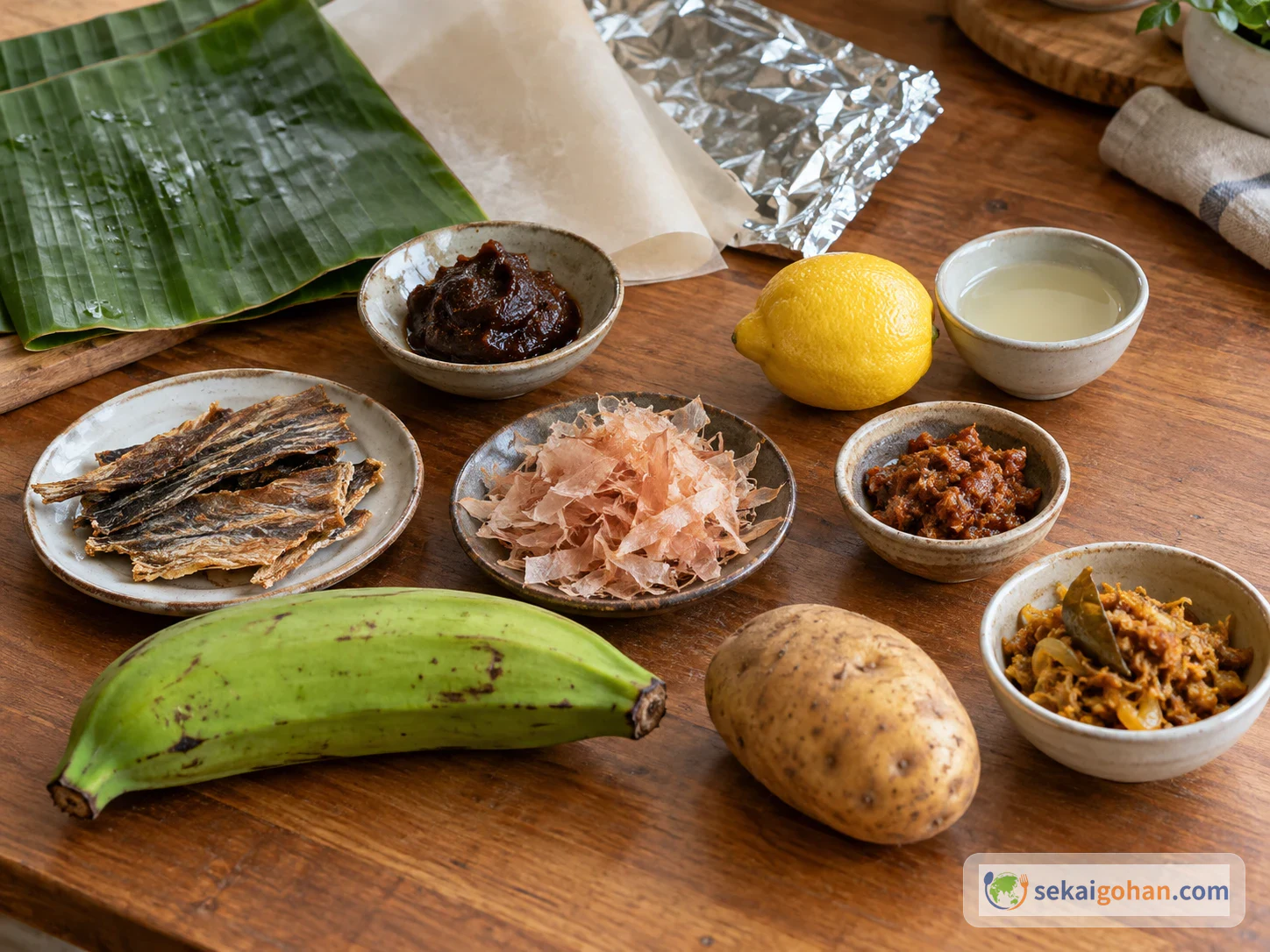
Banana leaves, parchment and foil, tamarind, katsuobushi and dried shrimp compared as substitutes
Even when availability comes first, separate the flavor backbone you keep from the aromas that change

You can keep the basic structure of lamprais without every original ingredient, but it helps to know what each swap changes. Banana leaves preserve the aroma: they hold the parcel together and scent it. Parchment paper and foil hold the steam and the shape, but they can't give you that leaf aroma.

Katsuobushi in place of Maldive fish gives a similar savoriness, though its aroma is different. Dried shrimp paste is a seafood substitute for blachan with a similar fermented aroma. If allergies or ingredient labels are a concern, leave it out. Green cooking bananas can be replaced with waxy potatoes, but potatoes change the texture: you lose the sweetness and the fibrous bite.

Chicken instead of three meats

You can replace the 7 oz (200 g) each of beef, pork and chicken with 1.25 lb (600 g) chicken thighs. The stock and the texture of the meat will change, so you end up with a different home version rather than a lighter take on the classic. Chicken falls apart if it's overcooked, so add it in the second half of making the stock.

Lamprais without blachan or seafood

Without blachan and Maldive fish, you still have the rice, meat curry, eggplant, seeni sambol, meatballs and the leaf parcel. Katsuobushi or dried shrimp won't reproduce the original exactly, but they add savory depth. If you need to avoid seafood entirely, check the ingredient and production-line labels on any substitute.

Method: finish the stock, rice and sides separately
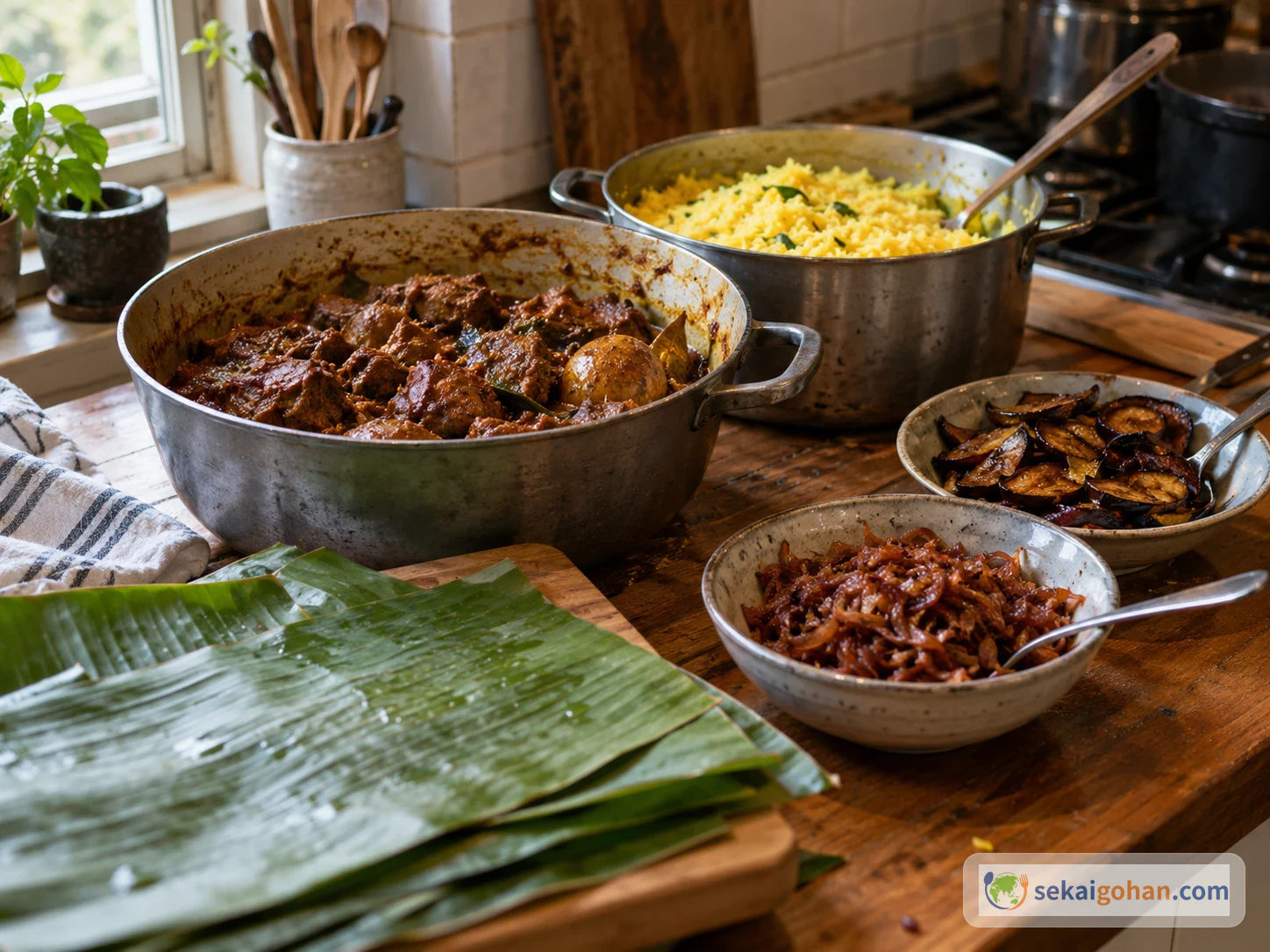
A pot of three meats, rice cooked in stock, and small dishes of eggplant and seeni sambol
Finish each component separately, then pack them into banana leaves at the end

The process is long, so it helps to keep the order in mind: meat and stock, rice, curry and sides, frikkadels, warming the leaves and wrapping, and finally baking at 180°C (350°F). There are three key points: strain the stock, keep the rice grains separate, and reduce the cooking liquid before wrapping. Don't mix the rice and sides together in the liquid, and adjust the consistency of the wetter components before wrapping.

Tip

If, just before wrapping, liquid keeps running off a spoonful of curry, lift out the meat and reduce the sauce. If a packet's seam won't stay closed, double the leaf or switch to parchment paper and foil. Baking at 350°F (180°C) for 20–25 minutes isn't just reheating; it's the time for the aromas of each component to merge inside the leaf. But if you packed the components cold, always check that the packet is hot all the way to the center.

Tools for crushing spices

Whole spices for the stock and rice release more aroma when coarsely crushed. A small spice grinder makes it easy to crush small amounts to an even size, which helps if you'll do this often. A mortar and pestle or a chef's knife work too, so there's no need to buy one for a single attempt.

Common lamprais problems and fixes
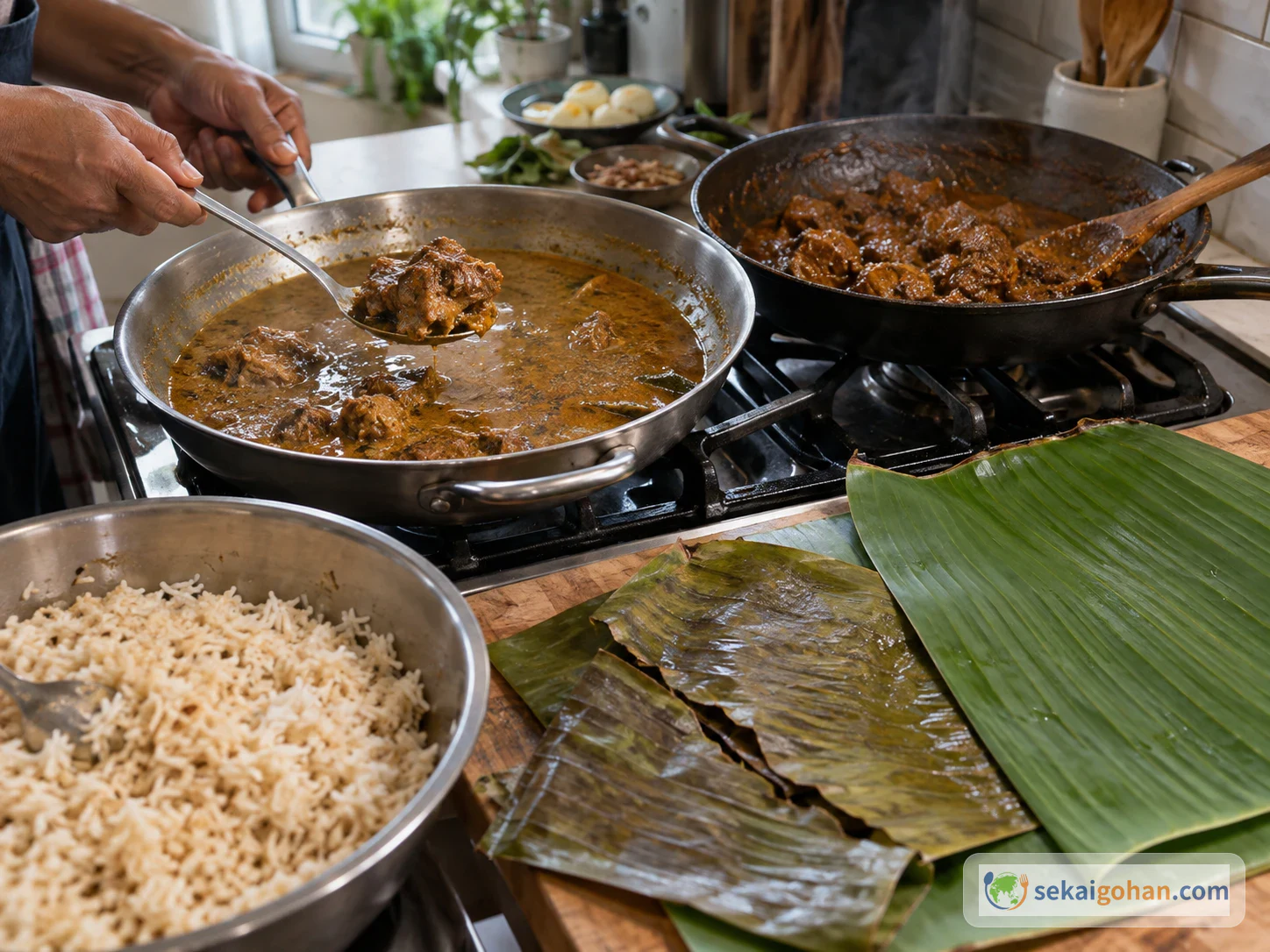
A counter with lamprais curry, rice, eggplant and seeni sambol back in separate dishes for adjusting
Before wrapping, you can still fix the moisture and saltiness component by component

Once a parcel is wrapped, fixing it rarely works, so go back to the component that caused the problem. The rule is fix moisture before wrapping. If the curry is watery, lift out the meat, reduce the sauce over medium heat for 3–5 minutes, then return the meat. Reduce it inside the leaf and the rice turns mushy.

If the rice is hard, revive it with hot stock. Before wrapping, add 2–3 tbsp hot stock, cover and steam for 5 minutes, and resist adding water all at once. If the meat is tough, add unsalted boiling water or stock and keep it at a low simmer for another 10–15 minutes, until tender.

If the seeni sambol burns, don't stir in the burnt part. Leave the scorched bottom in the pan and move only the top to another dish. Sugar usually won't cover the bitterness.

If the leaf tears

Warm stiff leaves a few seconds longer, but take them off the flame before they blacken. Wrap small tears with a second leaf and turn the seam underneath. For large tears, wrap the inside in parchment paper and the outside in foil before baking. You lose the leaf aroma, but the rice and sides stay intact.

If it's too salty

Blachan, Maldive fish and the meat stock all bring salt, and when all three pile up, the parcel turns too salty. Go easy on them together. If the curry gets salty, add unsalted stock a little at a time, and add more eggplant or rice to spread the salt across the parcel. Lemon or vinegar only adds sourness, which clashes with the seeni sambol and eggplant.

Serving lamprais
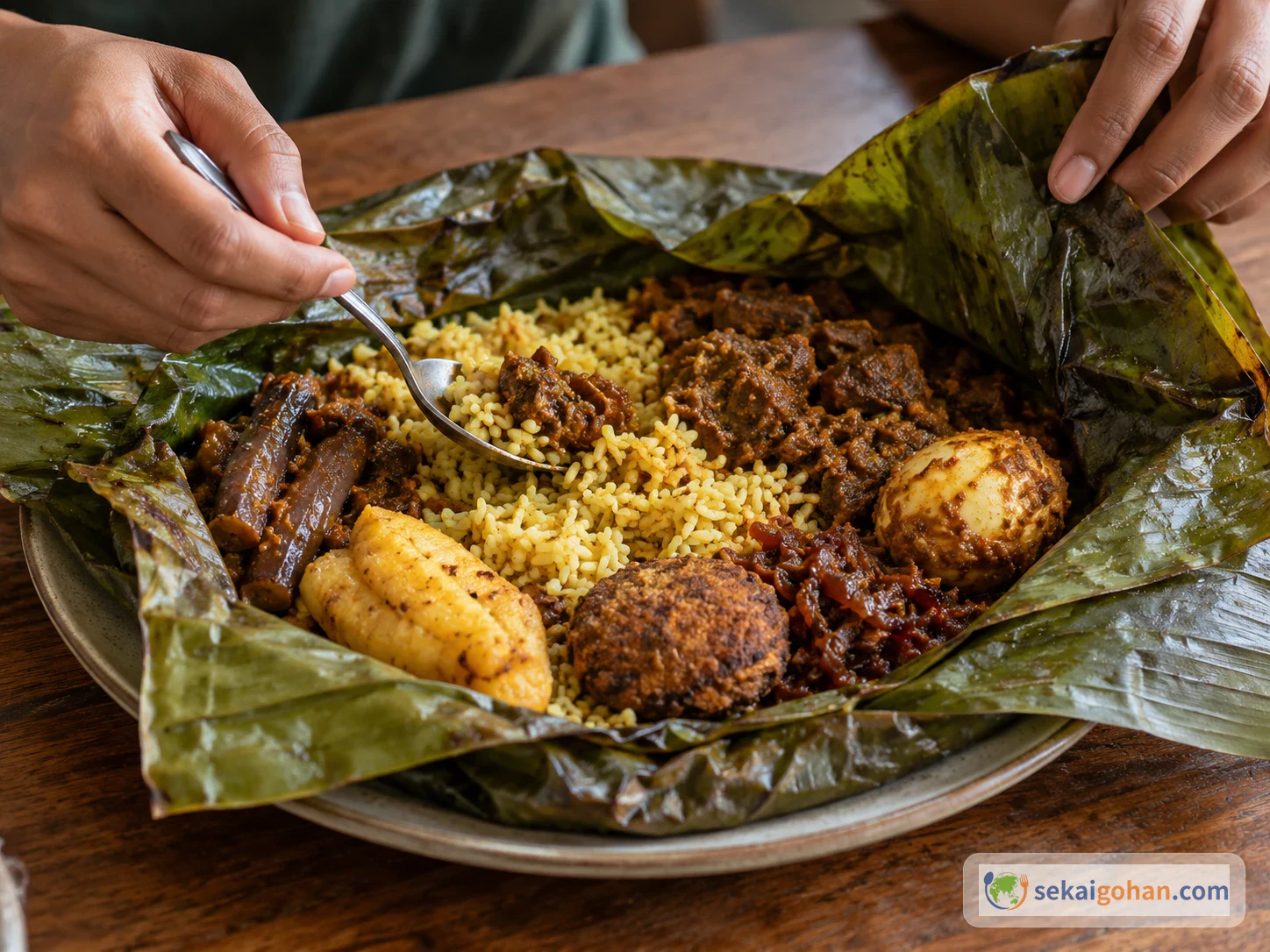
Opened lamprais at the table, showing yellow rice, meat curry, eggplant and meatballs
Open the closed packet and combine the rice with the sides a little at a time as you eat

After resting, open the leaf on your plate. The rice, meat curry, eggplant, banana, seeni sambol and meatballs each sit in their own spot. It would be a shame to eat them one at a time. Put a little curry on the rice and add a spoonful of the sweet-sour eggplant or the spicy onions, and you get the pleasure of recombining the flavors with each bite. Look past the leaf aroma for the richness of the meat stock, the sourness, the sweet heat and the savory seafood notes.

More Sri Lankan dishes
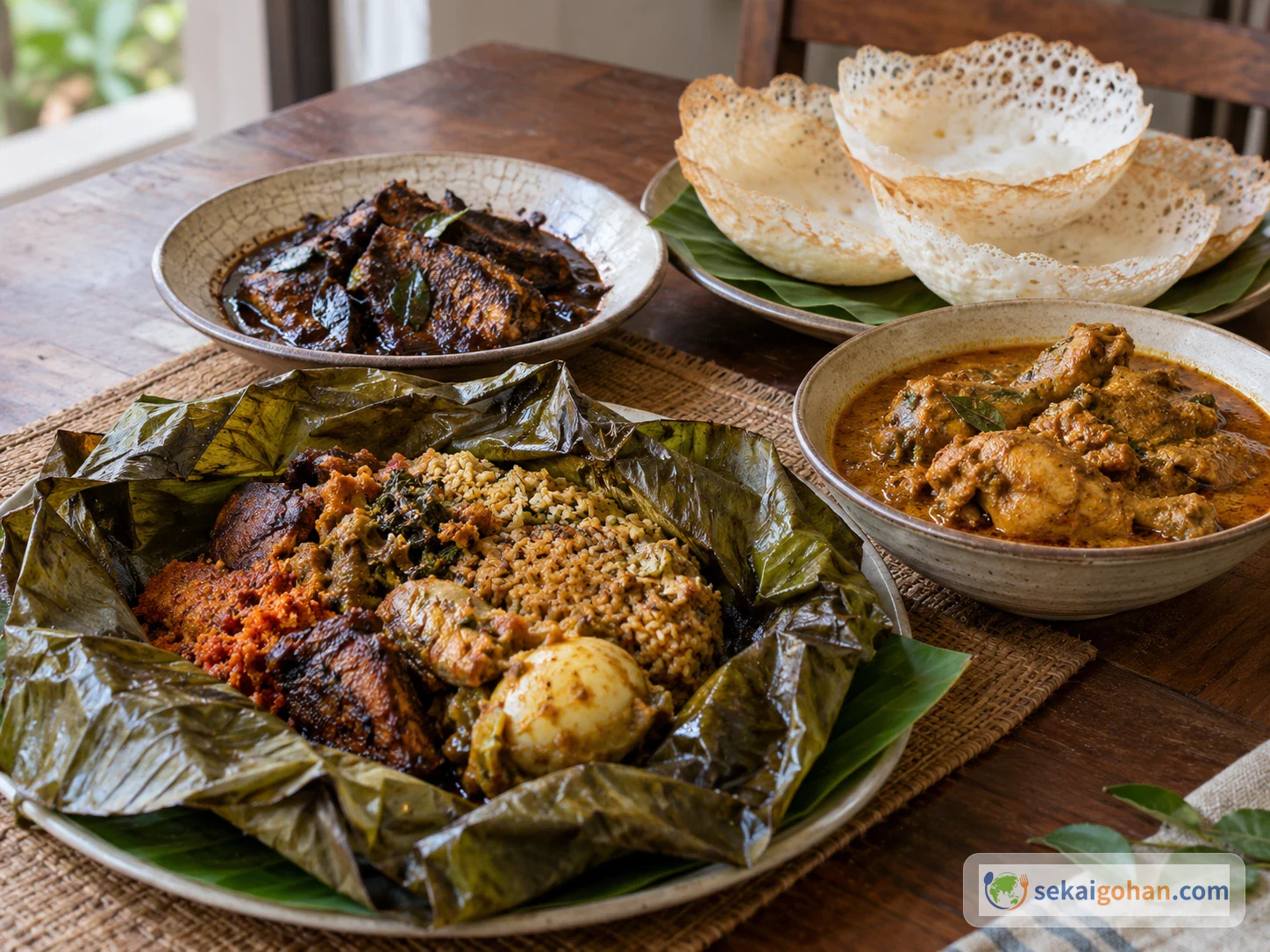
Ambul thiyal, kukul mas curry and hoppers next to lamprais
From sourness to meat curry to rice staples, the Sri Lankan table spreads out
  • Ambul thiyal: fish simmered down with the sourness of goraka or tamarind.
  • Kottu, pol sambol and kiribath: more Sri Lankan dishes on this site.
  • Kukul mas curry: a Sri Lankan chicken curry on its own, for digging deeper into meat-curry spices.
  • Hoppers: a breakfast of rice and coconut, a different kind of meal from a wrapped dish.

Frequently asked questions
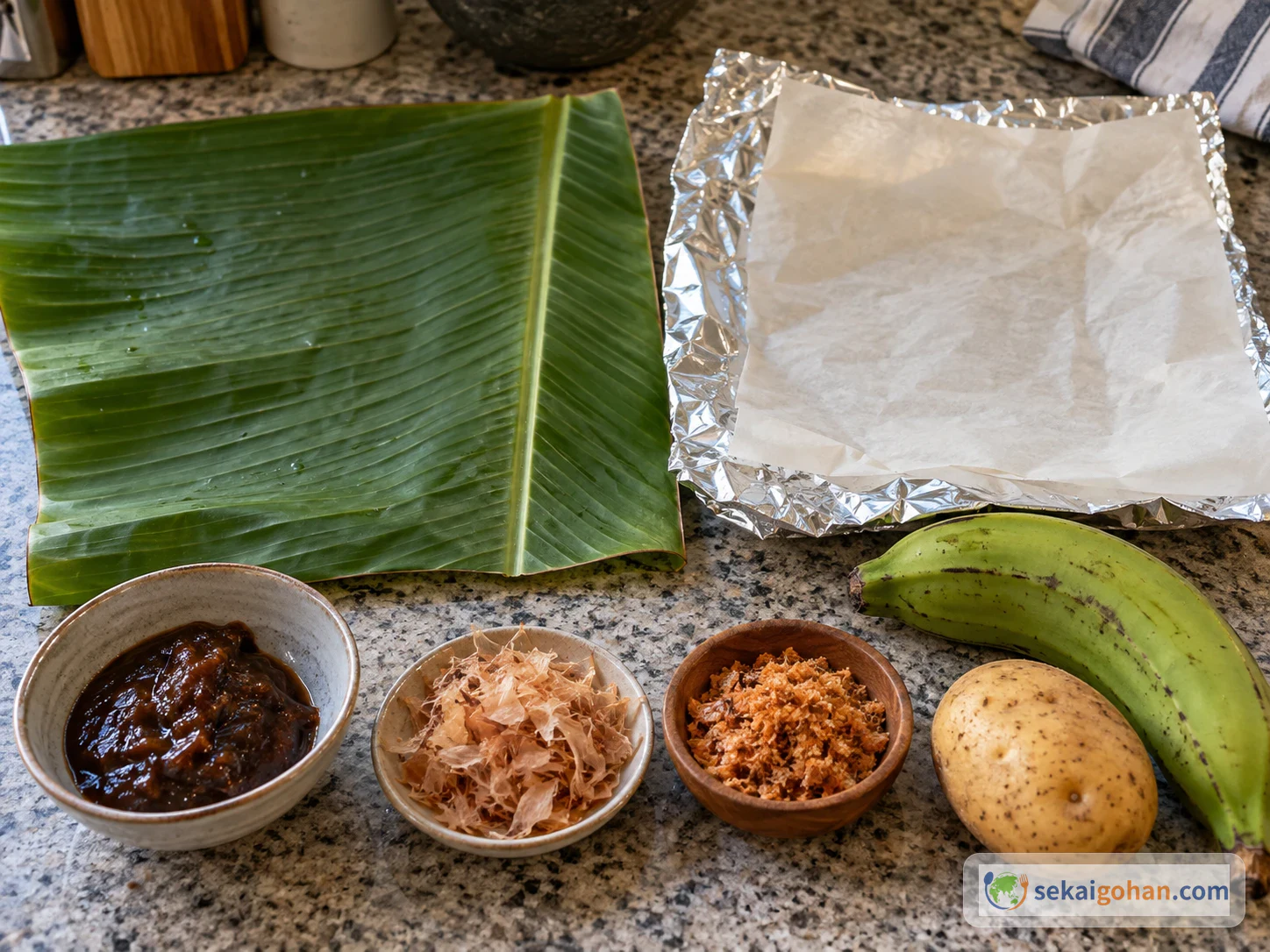
A closed lamprais packet, an opened one and substitute ingredients in small dishes
Lamprais questions about ingredients and wrapping, answered component by component

What is lamprais, and how do you spell it?

Lamprais is a Sri Lankan dish from the Burgher kitchens of Colombo: rice cooked in meat stock, served with accompaniments such as meat curry, meatballs, eggplant, seeni sambol and blachan, all wrapped in a leaf and baked. You will also see it spelled lumprice or lump rice. The leaf is a plantain (banana) leaf.

Is lamprais Sri Lankan or Dutch?

It is a Sri Lankan dish with Dutch heritage. The Burghers who made it are descendants of Dutch traders and local Sinhalese women, and the dish draws on several food cultures around Colombo. It does not trace back to a single Dutch word or one origin.

Can I make it without banana leaves?

Yes. Wrap the packets in parchment paper and secure the outside with foil to hold the steam and the shape. Don't wrap in foil alone, so the food doesn't touch the metal.

Can katsuobushi replace Maldive fish?

8 g of katsuobushi adds the seafood savoriness. Its aroma, saltiness and cut are different, though, so it isn't the same as blachan or Maldive fish. If you have a fish allergy, avoid katsuobushi too and skip the extra savoriness.

Can I eat it the next day?

Yes. After cooking, move both the components and the finished packets to shallow containers, cool them quickly and refrigerate. To eat, set the packets on a baking sheet so the leaves don't tear, and reheat until hot to the center. Throw out anything that has sat at room temperature for a long time or that smells or looks off.

Where should I cut back to make it less spicy?

Start by halving the dried red chilies and the chili powder, and keep the cinnamon, cardamom, cumin and black pepper. Use fewer chilies in the seeni sambol too and let the onions and sugar carry a sweet heat, so nobody has to add spice at the table. With less heat, you still taste the sourness, the savory seafood notes and the leaf aroma.

Sources
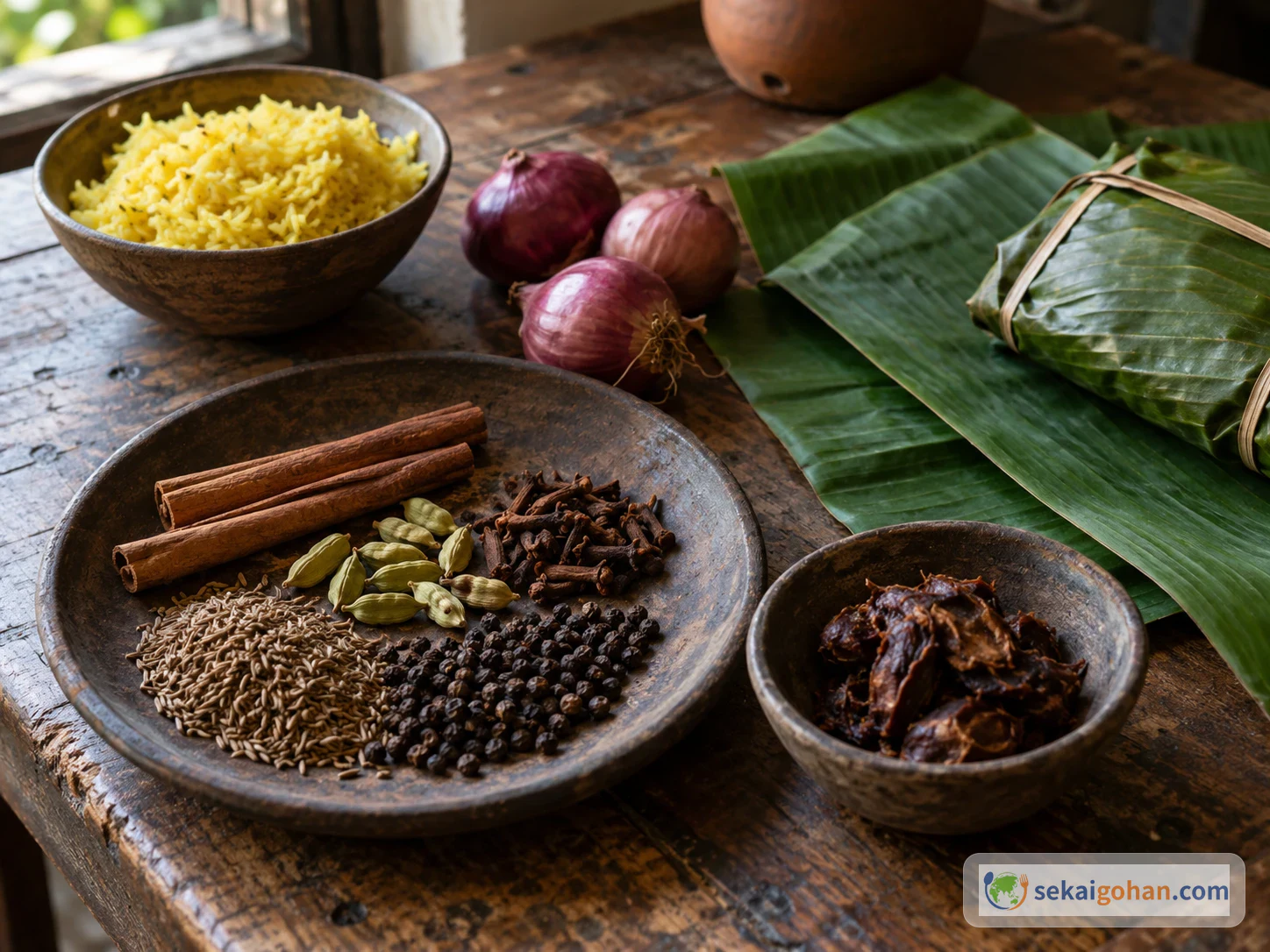
Whole spices, tamarind, red onions and banana leaves arranged by dish
The ingredients and sources behind the structure of lamprais