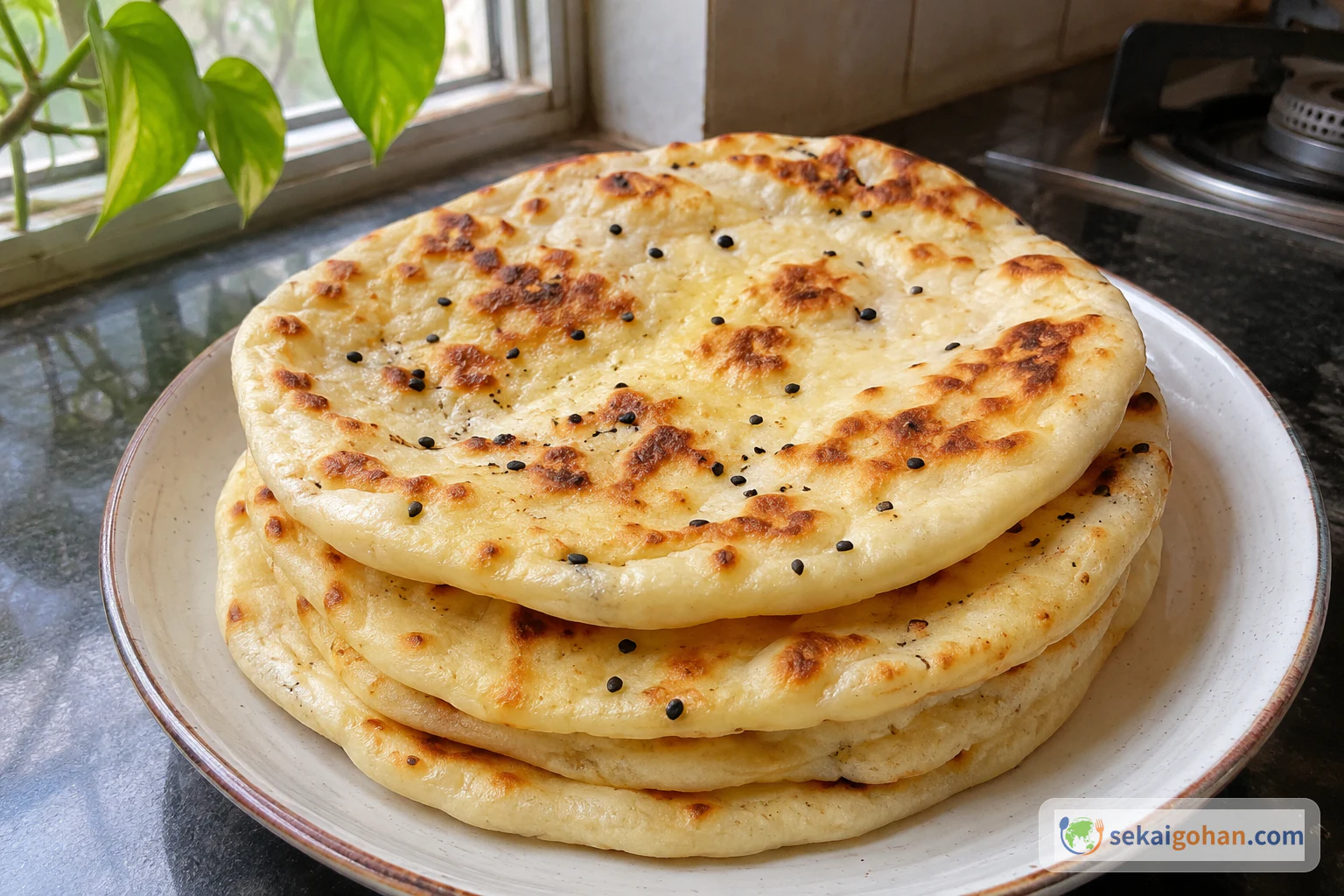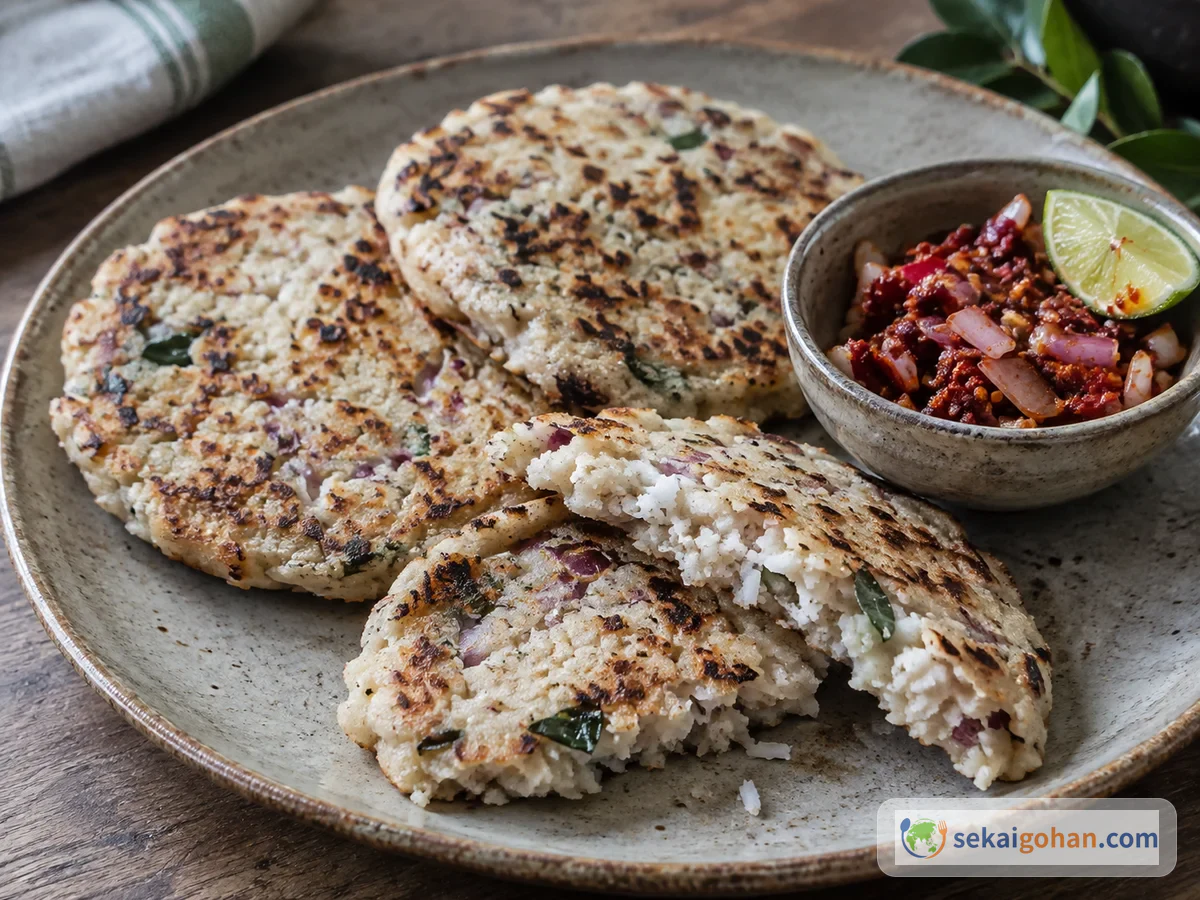
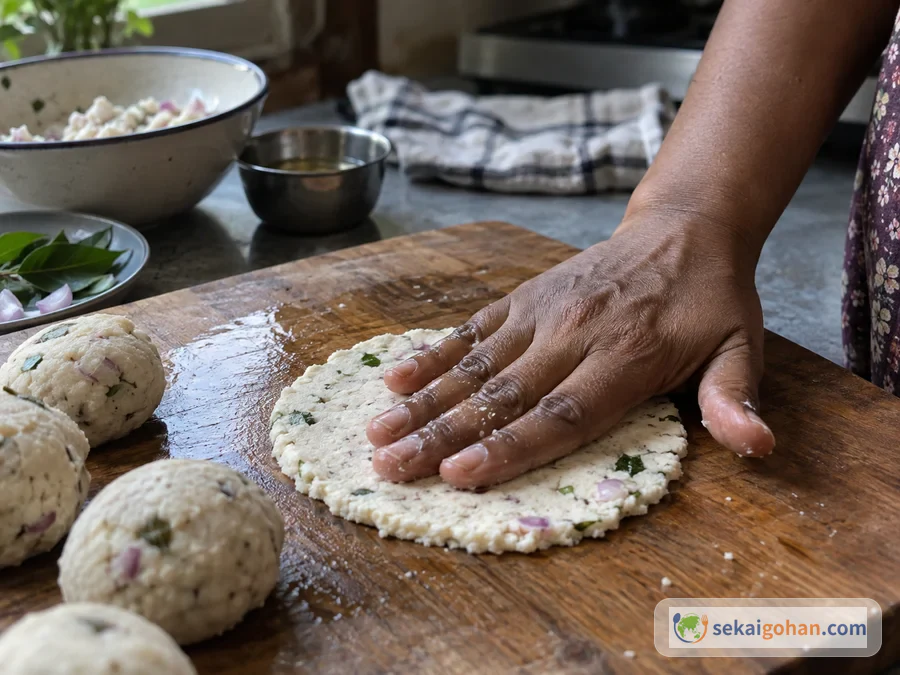
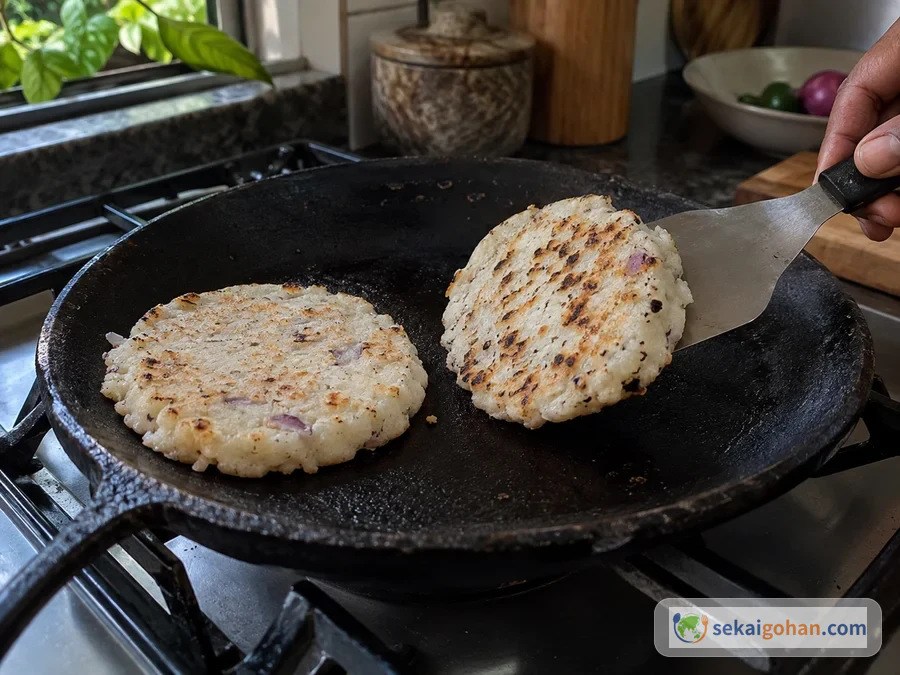
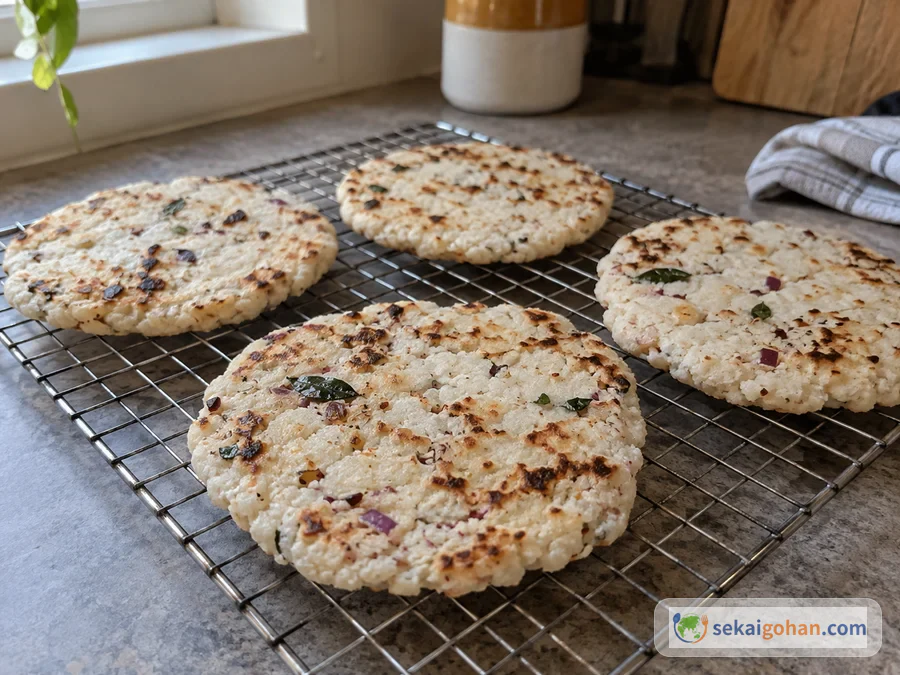
Tear off a piece of a small round bread with browned spots, dab on a little red lunu miris, and eat it. You'll see this at Sri Lankan breakfast tables all the time. The bread is pol roti, an unleavened flatbread made from wheat flour and grated coconut. Break one open and you'll see white flecks of coconut inside, while the outside has toasty browned spots. It needs no fermentation and no oven, so flour and a frying pan are all you need.
Pol Roti on Sri Lankan Tables
In Sri Lanka, pol roti is eaten at breakfast, at dinner and at tea time. It's sold as street food too, and it's everyday food rather than a festival dish. It shows up at both breakfast and dinner because it's made from things every kitchen has: wheat flour and coconut.
What sets it apart is the coconut flesh worked right into the dough. Kiribath is rice cooked in coconut milk, and hoppers are a fermented rice-flour batter cooked in a pan, so each uses coconut and grain in its own way. Among the many large flatbreads called roti, pol roti stands out for its coconut flecks and its thickness.
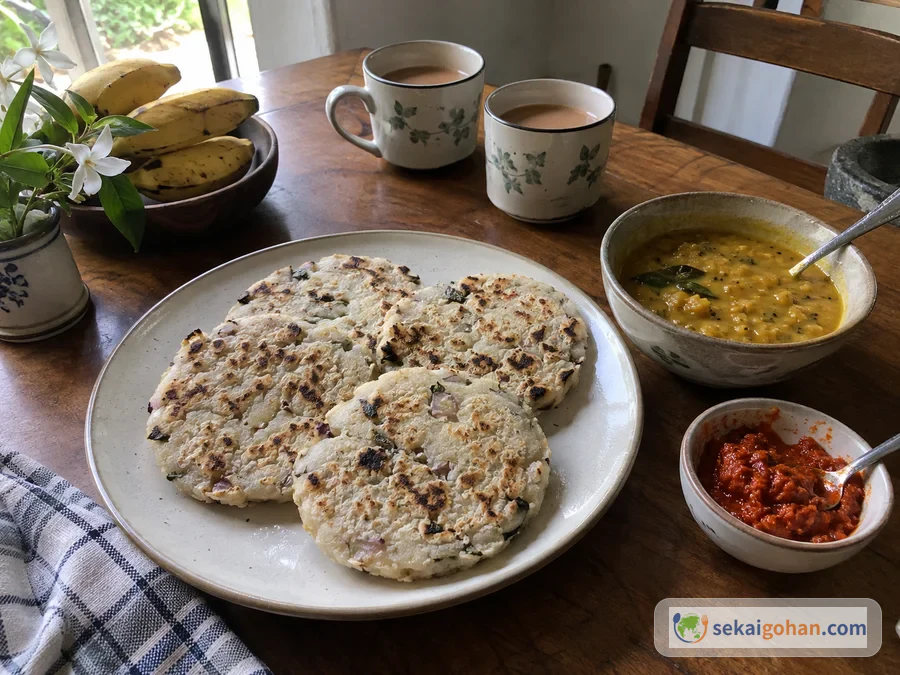
You can serve it with both spicy and sweet accompaniments. On the spicy side there's lunu miris (a seasoning of onion, chili and lime), sambol and curry. On the sweet side there's jam, jaggery and banana. The bread itself has no sugar in it, so on sweet days the sweetness comes from what you put on it.
The firm bread is good torn bit by bit and dipped in curry, and it doesn't have to be eaten piping hot. It's also food to carry: you can sandwich lunu miris between two rotis, though you won't find that at every stall in the country. At home it often comes with bean curry, fish curry and the like. The same bread pairs differently depending on whether the aromatics are in the dough or in what's served beside it.
Flour and Aromatics by Household
There's no single home recipe. Some households add onion and green chili, some add curry leaves, and some add no aromatics at all. Some use oil and some don't. Some local cooks use about 1 part coconut to 1 part flour by volume, and one uses 2 cups of flour to 1 cup of coconut. These volume measures show how much households differ. They don't convert to the weights in the ingredient table.
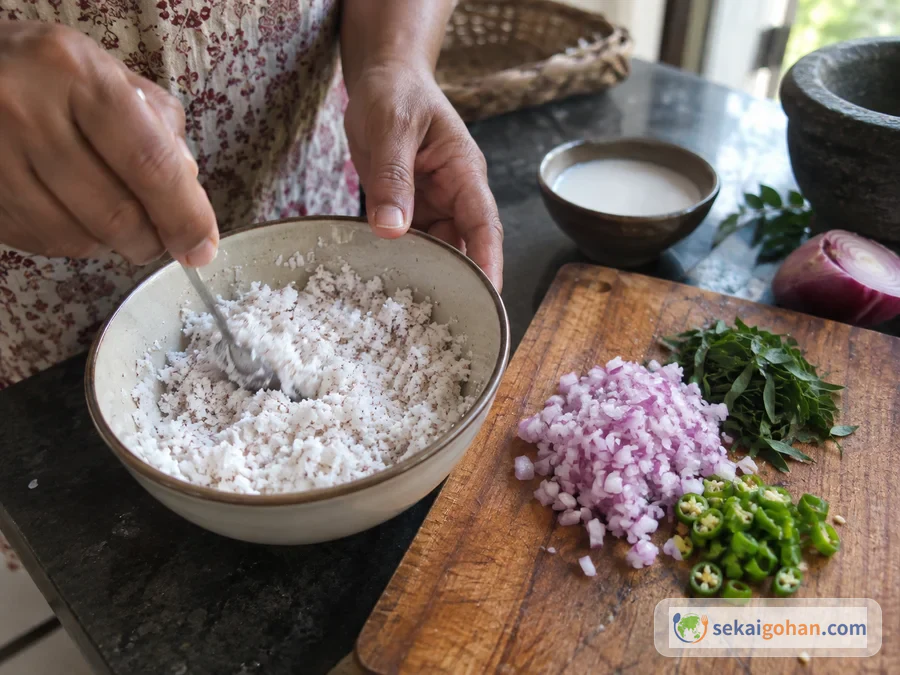
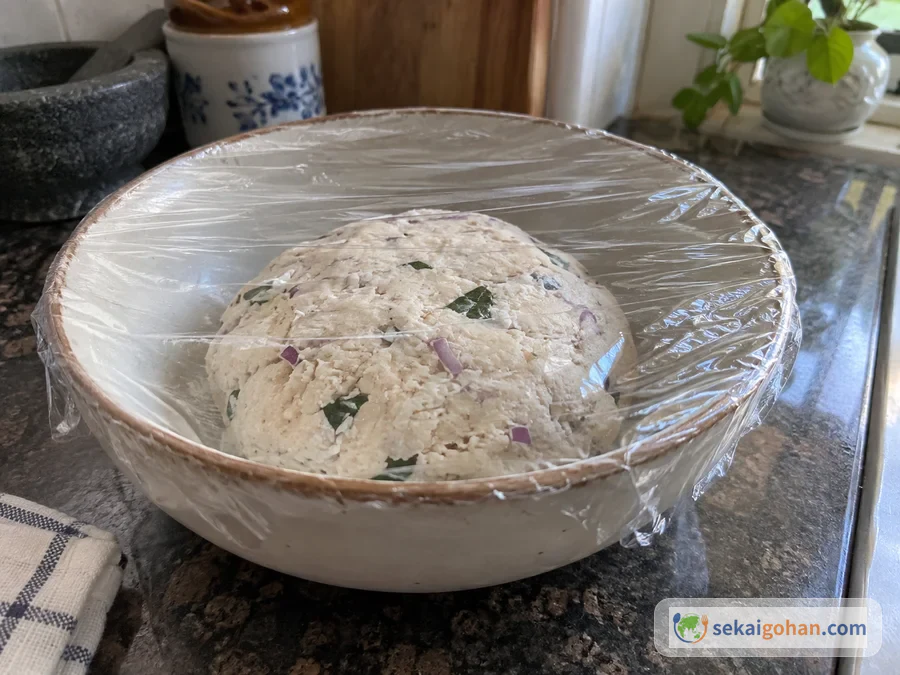
This version is adjusted for a home kitchen. The dried coconut is first moistened with unsweetened coconut milk, and the recipe makes 8 rounds (4 servings), each about 4.5 inches (12 cm) across and 0.25 inch (5 mm) thick, cooked two at a time in a frying pan. It takes about 80 minutes in all, but you aren't waiting for anything to ferment. That time goes to the coconut soaking up liquid and the dough resting for 30 minutes.
Not every roti is made from wheat. Kurakkan is finger millet, and kurakkan roti is made from finger millet flour, brown rice flour and coconut. The bread changes with the grain and with the household.
Ingredients (serves 4, makes 8 rounds)
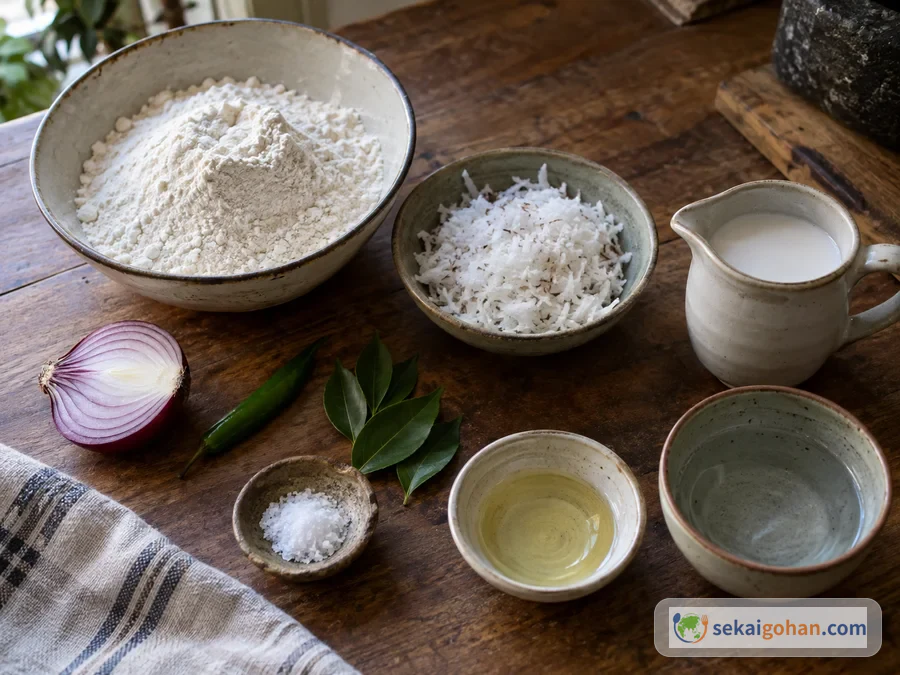
The basic version makes 8 rounds with onion and curry leaves, for a meal. At 2 per person, it is a staple amount, and you prepare the accompaniments separately. Use unsweetened, fine desiccated coconut. Measure out ½ cup (100 ml) water, and start by adding ¼ cup (80 ml). This water is separate from the ½ cup (100 ml) coconut milk that rehydrates the dried coconut. Adjust the rest while watching the state of the flour and coconut.
| Ingredient | Amount | Substitutes & notes |
|---|---|---|
| All-purpose flour | 9 oz (250 g) | A mix of 4.5 oz (125 g) cake flour and 4.5 oz (125 g) bread flour also works |
| Desiccated coconut (unsweetened) | 2 oz (60 g) | Finely grated dried coconut. Different from coconut flour |
| Coconut milk (unsweetened) | ½ cup (100 ml) | Moistens the dried coconut. Mix the liquid in the container evenly before use |
| Water | ½ cup (100 ml) | Start with ¼ cup (80 ml) and adjust the remaining 1.5 tbsp (20 ml) 1 tsp (5 ml) at a time |
| Red onion | 1.75 oz (50 g) | 1.75 oz (50 g) ordinary onion also works. 2–3 mm dice |
| Green chili | 1 (about 5 g) | Omit entirely for less heat. Remove seeds and pith and chop fine |
| Curry leaves (fresh or frozen) | 8 leaves | Chop fine. If dried, crumble 4 leaves finely. Omit if unavailable |
| Salt | 5 g | Mixed through the dough |
| Vegetable oil | 12 g | 10 g for the dough, 2 g for the shaping surface. No oil for cooking |
Curry leaves are a leaf ingredient, not curry powder. Choose fresh or frozen if you can. Dried leaves differ in aroma strength, so the flavor will not be the same. If you cannot get them, leave them out. It still works as a coconut bread. Curry powder tastes different, so do not use it in place of the leaves. You cook this dough in an ordinary frying pan, so no special equipment is needed.
This uses wheat and coconut. If you serve it with accompaniments containing dairy, check for dairy too. Read the ingredient labels, and people who cannot eat wheat or coconut should avoid it. Also, do not taste raw flour or raw dough. After touching the dough, wash your hands, the bowl and the counter, and do not put cooked bread back on a plate that touched the dough.
Choosing Coconut, Flour and a Pan for Pol Roti
Fresh and dried coconut hold different amounts of water. Fresh or frozen grated coconut is moist, so 2 oz (60 g) dried coconut and 3.5 oz (100 g) fresh coconut can't be swapped by weight alone. Treat them as two separate formulas.
If you're using fresh coconut, leave out the 2 oz (60 g) desiccated coconut and the ½ cup (100 ml) coconut milk and use 3.5 oz (100 g) grated coconut instead. Everything else stays the same, but start the water at ¼ cup (80 ml), because how much you need depends on the coconut. Either way, use fine, unsweetened flesh. Keeping the flecks of coconut flesh is what gives this bread its character.
The all-purpose flour in local recipes doesn't quite match the cake flour and bread flour sold in Japan. In Japan, use all-purpose flour or a mix of 4.5 oz (125 g) cake flour and 4.5 oz (125 g) bread flour. Bread flour on its own tends to make the dough springy, and cake flour on its own tends to make it crumble. There's no need for long kneading in a machine. Water, thickness and heat matter as much as the flour, so if you switch flours, go by how the dough feels rather than by the clock, and add water a little at a time.
For equipment you need an ordinary frying pan, a bowl, a spatula and a scale. A flat chapati pan works but isn't essential, and you press the rounds out by hand, so you won't need a rolling pin. With a nonstick pan, follow the maker's instructions and don't heat it empty at high temperature. With an iron pan, pick a well-seasoned one and cook dry. The 2 g of oil is for shaping and keeps the dough from sticking. It isn't for frying.
Method
Look first at how the work is spread out. Prep takes 55 minutes: 10 minutes for the coconut to absorb liquid and for chopping, 5 minutes to mix the dough, 30 minutes to rest it and 10 minutes to shape 8 rounds. Cooking and plating take about 25 minutes, depending on the number of rounds and the size of the pan. Aim for an even 0.25 inch (5 mm) thickness, and check the heat with the first round before cooking the rest. Do not call a round done just because the surface is scorched.
Strongly aromatic flecks and onion color first on the surface. Do not keep the heat high to get more scorched spots. If a round has a thick center, press it again before cooking. If it is undercooked, cook it further over low heat. Do not treat blackened patches as a sign of good flavor.
Leave cooked bread on a rack without stacking. A cloth laid lightly over it keeps it soft, but do not seal it, or the bread will steam. Cover the dough you are working on so it does not dry out, and let the cooked bread release steam. Handle dryness and moisture separately at each stage of the work.
When Pol Roti Dough Cracks or Cooks Hard
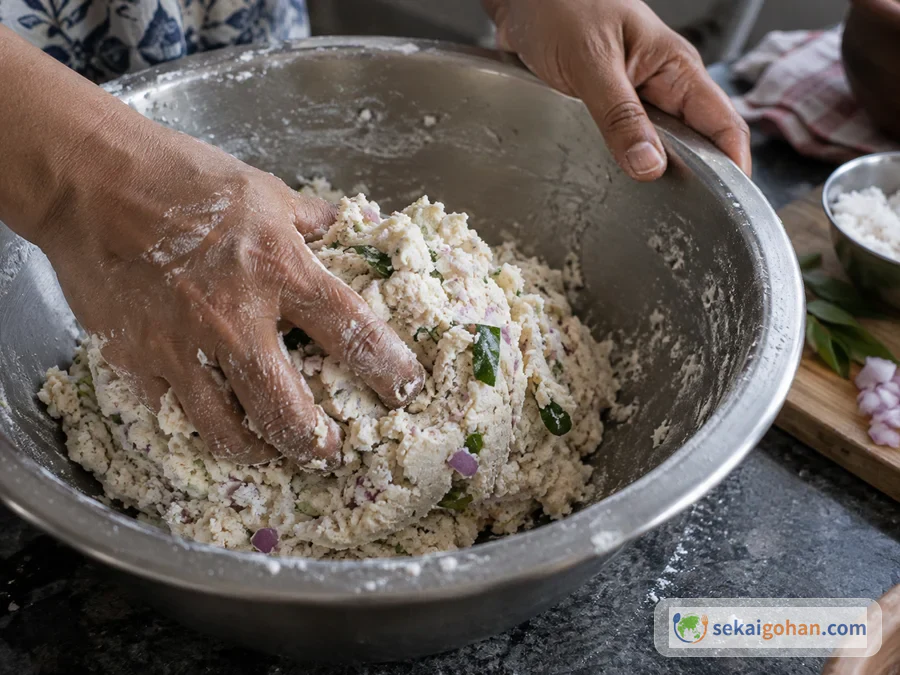
Most dough problems come down to water. Small cracks at the edge close up with a wet finger. If the dough falls apart every time you press it, it hasn't taken in enough water: mix in 1 tsp (5 ml) water at a time and reshape. If it's sticky and won't lift, there's too much water, or the onion has let out moisture. Add flour 5 g at a time until it comes together. Adding a lot at once throws off the amount of coconut.
| Problem | Likely cause | How to fix |
|---|---|---|
| Crumbles when pressed | Not enough water, coconut too coarse | Add water 1 tsp (5 ml) at a time and bring flour and coconut together again |
| Sticks to hands and counter | Added too much water at once | Add flour 5 g at a time and use oil thinly |
| Dark outside but raw center | Heat too high, center too thick | Lower the heat and flip each minute to cook further |
| Hard and dry throughout | Too thin, overcooked, too little water | Make the next dough an even 0.25 inch (5 mm) and review cooking time and water |
| Stacked bread is damp | Stacked hot and sealed | Spread on a rack and reheat in a frying pan just before eating |
Once a round is cooked, there's little you can do to fix it, so get it right on the pan. Aim for 0.25 inch (5 mm) thickness and medium to medium-low heat, and judge doneness by the center, not by how many dark spots there are. Match the heat with the first round: break it open and check the center. A round that came out hard still softens nicely when dipped in curry, and you can correct the water and thickness in the rest of the dough.
Serving and Storing Pol Roti
Pairings
The same bread makes a very different meal depending on what goes with it: curry, a chili seasoning or something sweet. For a sweet breakfast, leave the onion, green chili and curry leaves out when you mix. Add water according to how the dough feels, and don't automatically pour in the full amount. On sweet days, leave out the aromatics. That's all it takes for the dough to suit jam or banana.
| How to eat | Dough and accompaniment | Change in flavor |
|---|---|---|
| A meal with bean curry | Basic dough with hot bean curry | Mellowness of beans and toasty browned spots |
| Staple with chicken curry | Tear the basic dough and dip in chicken curry | Coconut-flecked bread takes up a rich sauce |
| A little spice at a time | Basic dough with a small amount of lunu miris | Adjust the kick of chili and lime by quantity |
| Jam breakfast | Aromatics-free dough with jam | Fruit's sweet-sour with coconut |
| Banana and a sweet snack | Aromatics-free dough with banana and a little brown sugar | Brown sugar used instead of jaggery |
The simplest place to start is tearing it and dipping it in curry. When you want to cook more around it:
- To make a companion for the meal, kukul mas curry
- For a rice staple using coconut milk, kiribath
- To learn a fermented rice-flour bread too, hoppers
Storage and Reheating
Set the cooked bread on a rack for a short time to let the steam escape, then wrap each cooked bread individually and put them in an airtight container. Once it has cooled, put it in the refrigerator at 39°F (4°C) or below, where it keeps until the next day. Don't leave it at room temperature for long.
To keep it longer, freeze the individually wrapped rounds. The flavor holds for about one week. Freezing doesn't kill all bacteria, so thaw the bread in the refrigerator or with the microwave's defrost setting, heat it right away after microwave thawing, and never leave it to thaw at room temperature for long. To reheat, warm both sides in a frying pan over low to medium-low heat until the center reaches 165°F (74°C). Turn the heat down if it starts to scorch, and don't judge safety by texture alone.
Refrigerate or freeze within 2 hours of cooking. If the outside temperature is above about 90°F (32°C), do it within 1 hour. Do not extend this time because the bread is still steaming. Do not eat anything with an off smell or mold, or anything whose storage history you do not know. A lack of smell does not mean it is safe. Store any curry you served in a separate container, and handle it according to its ingredients.
Frequently Asked Questions
Can I make it with coconut milk alone?
No. The coconut flesh in the dough is what makes pol roti. With milk alone you lose the flecked texture and change the amount of liquid. In this recipe, the milk is there to rehydrate the dried coconut. Milk alone cannot reproduce the flecks, so keep the coconut in.
What if I do not have curry leaves?
If curry leaves are the only thing you're missing, make it without them. Local home recipes include a plain bread of wheat flour, coconut flesh, salt and water. Don't use the same amount of curry powder in their place. If you also leave out the green chili, the dough turns mild, and you can bring the heat with the accompaniments.
Do I need yeast or baking powder?
Neither. The 30-minute rest gives the flour time to take up moisture, and the dough isn't meant to rise. Don't crank the heat trying to make it puff like a thin flatbread. What matters is a thickness and heat that cook the center through.
Can I make the dough the day before?
Local cooks do cover and refrigerate dough, but this dried-coconut formula is meant to be made and cooked the same day. If you do make it the day before, refrigerate it at 39°F (4°C) or below as soon as it's mixed and cook it the next day. Never leave it out overnight, and don't stretch leftover dough over more days. If the cold dough cracks, let it soften until you can work it by hand before shaping.
Can I replace the wheat flour with rice flour?
Not at the same amount. Rice flour binds differently from wheat, so the shape and texture change, and a full switch to coconut flour would need its own formula too. Treat a full swap to rice flour as a separate formula. This recipe isn't suitable for anyone with a wheat allergy.
Do the nutrition numbers include the accompaniments?
No. The figures are per person (2 rounds), the basic formula from the ingredient table divided by 4, without accompaniments: about 380 kcal, 7 g protein, 18 g fat, 1.75 oz (52 g) carbohydrate and 500 mg sodium. They're estimates calculated from each ingredient's composition values, counting ½ cup (100 ml) of milk as 3.5 oz (100 g) and leaving out the small amounts of leaves and chili. The fat in your coconut milk, any extra flour or water, and how much oil stays on the bread will all shift them. They aren't measured values, so don't use them for therapeutic diet calculations.