Undhiyu: Gujarat's Winter Vegetable Medley with Methi Muthia

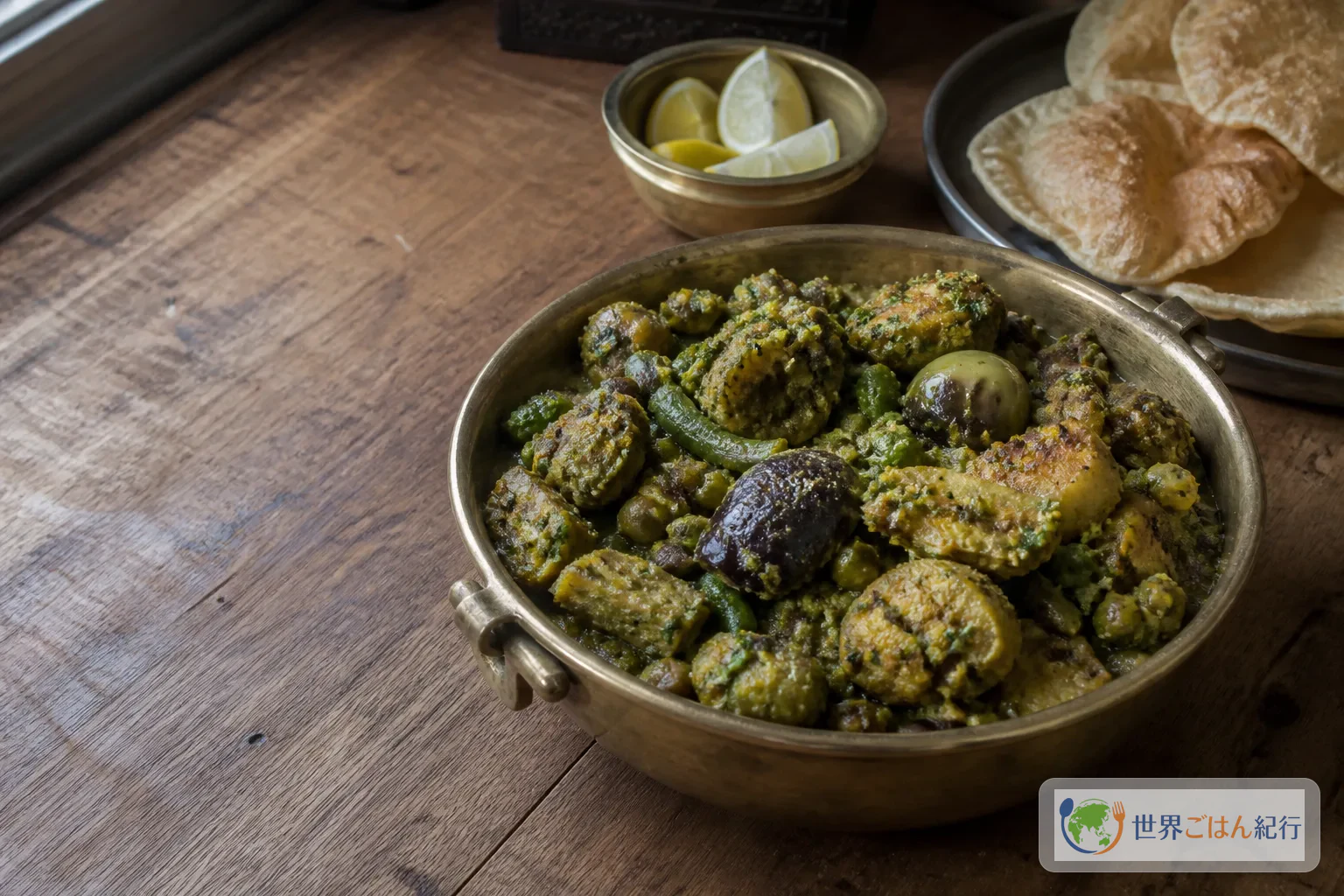
Gujarati undhiyu served in a brass bowl with puri and lemon on the table
Prep
50 min
Cook
45 min
Total
1 hr 35 min
Serves
4 servings
Level
Intermediate
Cuisine
Indian (Gujarati)

Undhiyu is a Gujarati winter dish of layered seasonal vegetables and fried fenugreek muthia, simmered in a green coconut masala. Surti-style ingredients, regional differences, substitutes, heat control, storage and serving, in home-sized amounts, with fixes for green garlic substitutes and hard muthia.

Cooking flow

Cooking steps

STEP11 / 8

Cut the vegetables and drain the methi

15 min

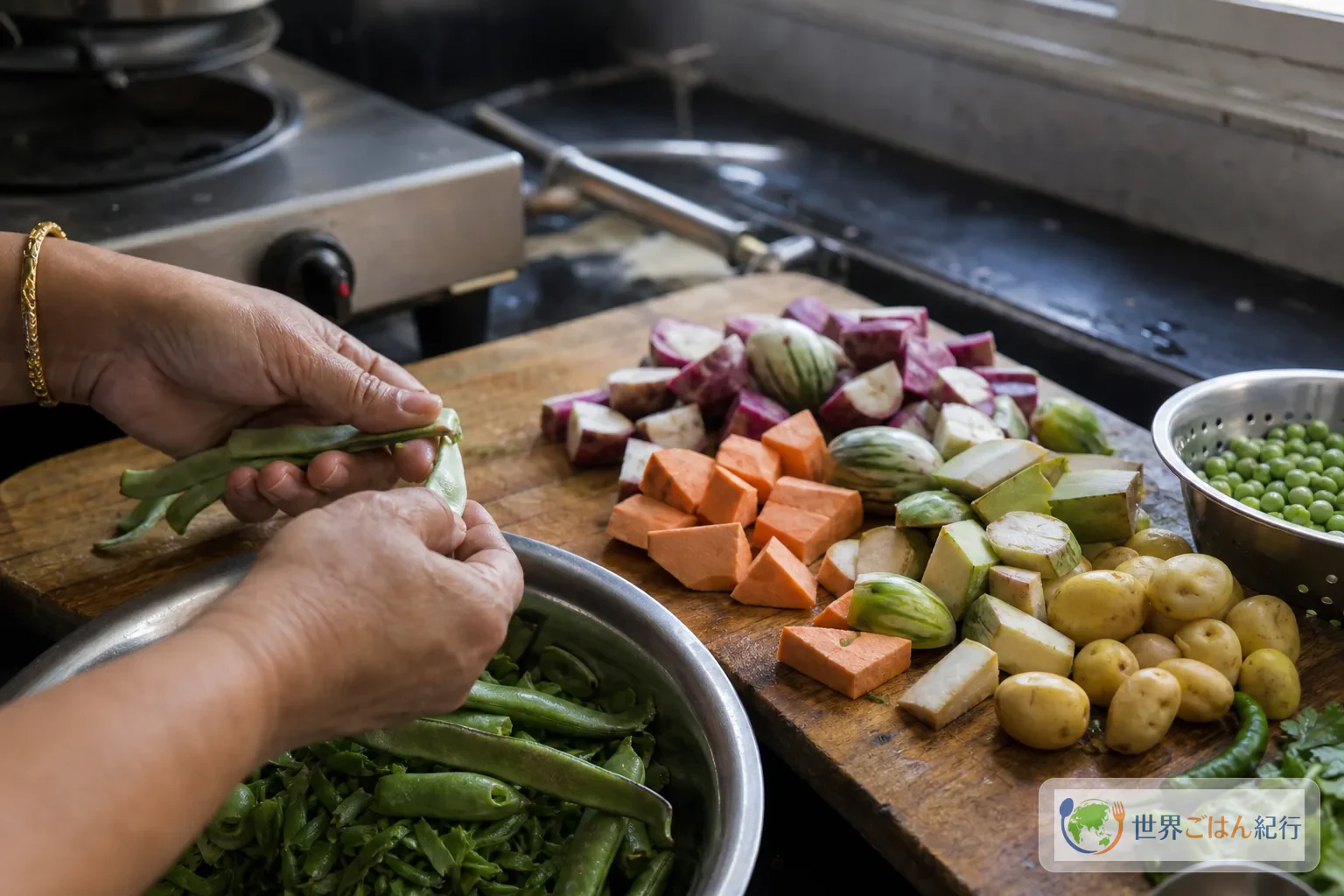
Cutting flat green beans and root vegetables for undhiyu
Cut the hard root vegetables into 3 cm cubes and the beans into 4 cm pieces, and pat the methi dry

Remove the ends and strings from 9 oz (250 g) flat green beans and cut into 1.5 inches (4 cm) pieces. Make a cross-shaped lengthwise cut in 5.5 oz (160 g) baby eggplant and 7 oz (200 g) baby potatoes, leaving the stem, but do not cut all the way through to the bottom. Peel 8 oz (220 g) sweet potato and 7 oz (200 g) purple yam and cut into 1 inch (3 cm) cubes; peel 7 oz (200 g) green banana thickly and cut into 1.5 inches (4 cm) pieces. If the juice of purple yam makes your hands itch, use gloves, and do not soak the cut pieces in water for long; pat them dry with a cloth. Thaw 5.5 oz (150 g) frozen green peas and drain. If you can get toor lilva (fresh green pigeon peas), use the same amount, but in this home version, which layers them without blanching, they will cook too slowly if the skins are tough. Wash 2.75 oz (80 g) fresh methi leaves, remove the thick stems, chop into 2–3 mm widths, and pat dry with a cloth. No heat is used in this prep stage. The prep is done when the cut surfaces have not dried out and the width of the beans and the corners of the root vegetables are uniform.

STEP22 / 8

Make the green coconut masala

10 min

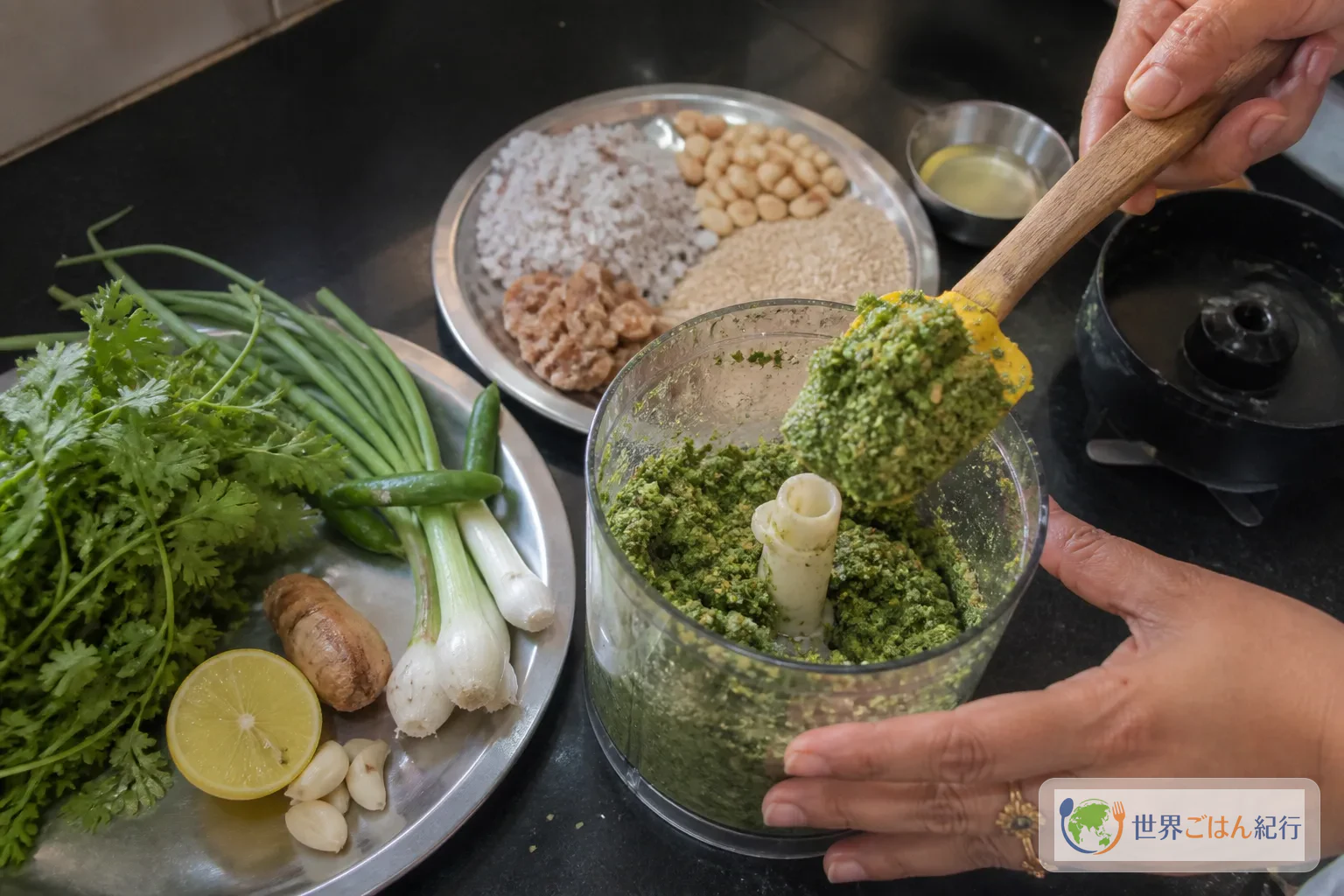
Coarsely processing a green masala of coconut and cilantro in a small food processor
Don't add too much water; a moist masala with some grains left is easier to stuff

Put 2.5 oz (70 g) cilantro, 1.75 oz (50 g) green garlic or garlic scapes, 15 g ginger, 15 g garlic, 10 g green chili, 2.75 oz (80 g) desiccated coconut, 1.25 oz (35 g) unsalted peanuts, 15 g white sesame, 18 g raw cane sugar or jaggery, 1.5 tbsp (20 ml) lemon juice, 5 g coriander-cumin powder and 5 g salt in a food processor. Pulse at first, and stop when the whole has become a moist, coarse crumble. If you add water and make it a smooth paste, it flows out of the eggplant cuts and pools at the bottom of the pot. Only when the blade won't turn, add water 1 tsp (5 ml) at a time, keeping the total within 1 tbsp (15 ml). The sign is that it holds together when pinched in your fingers and grains of about 1–3 mm remain. Divide the masala, two-thirds for stuffing and one-third for the layers in the pot.

STEP33 / 8

Make the methi muthia dough

10 min

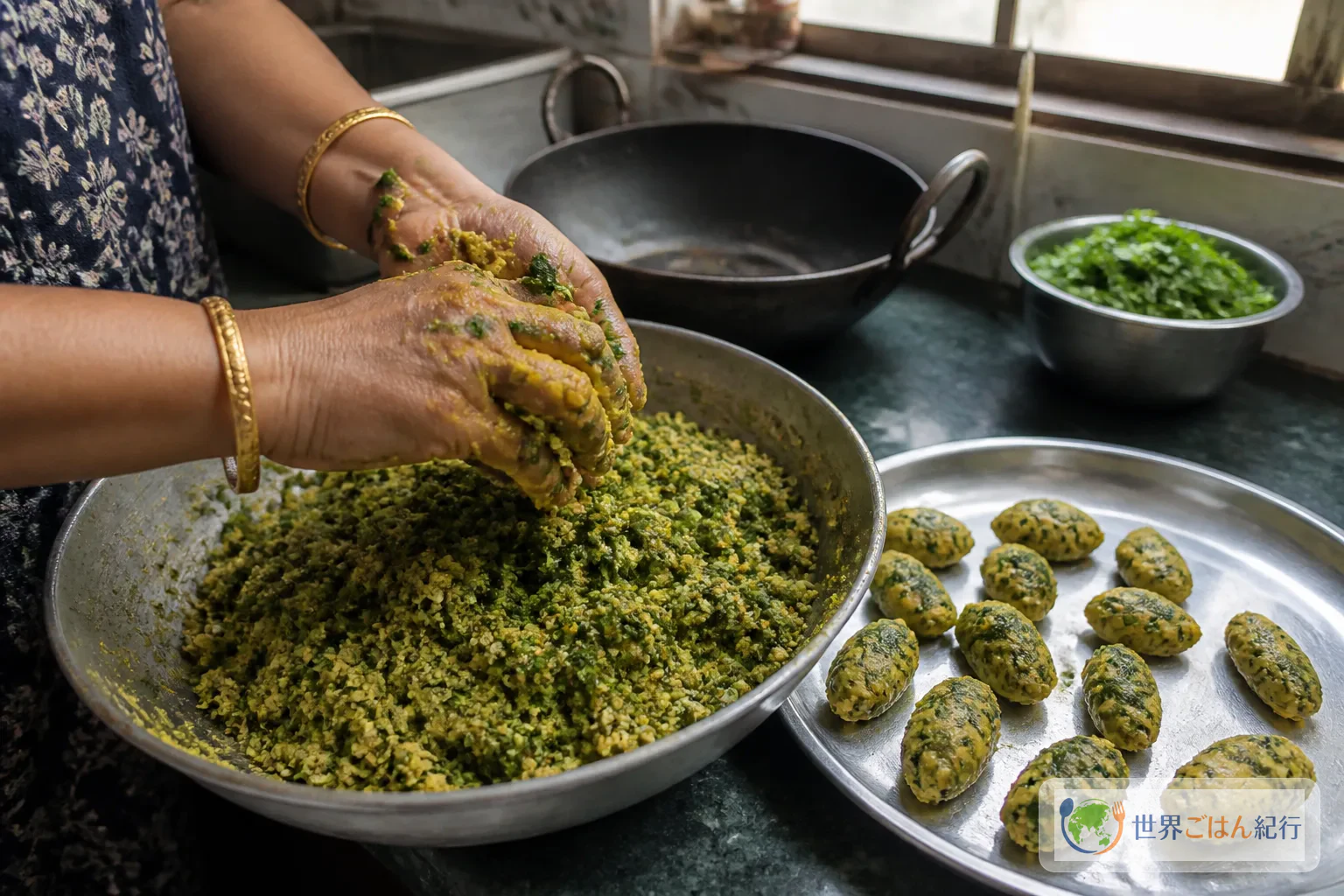
Shaping a dough of methi, besan and whole wheat into small ovals
Don't make the dough stiff; shape it into small ovals about 4 cm long

In a bowl, put 2.75 oz (80 g) chopped methi, 2 oz (60 g) besan (chickpea flour), 2.75 oz (80 g) whole wheat flour or atta, 1.5 g ajwain, 1 g turmeric, 1 g chili powder, 3 g salt and 1 g baking soda. Add 1 tbsp (15 ml) oil and 2 tsp (10 ml) lemon juice and mix with your fingertips so the flour coats the leaves. Add water starting at 1.5 tbsp (20 ml), and if it is not enough add 1 tsp (5 ml) at a time, stopping when no dry flour remains. There is no need to keep kneading the dough hard. It is enough if it holds together when pressed in your palm and the cracks don't open wide when you lift it. Divide into 12 and shape into small ovals about 1.5 inches (4 cm) long and 0.5 inches (1.5 cm) in diameter. If they crack, add 1 tsp (5 ml) water; if sticky, add 5 g besan.

STEP44 / 8

Fry the muthia, leaving the centers tender

10 min

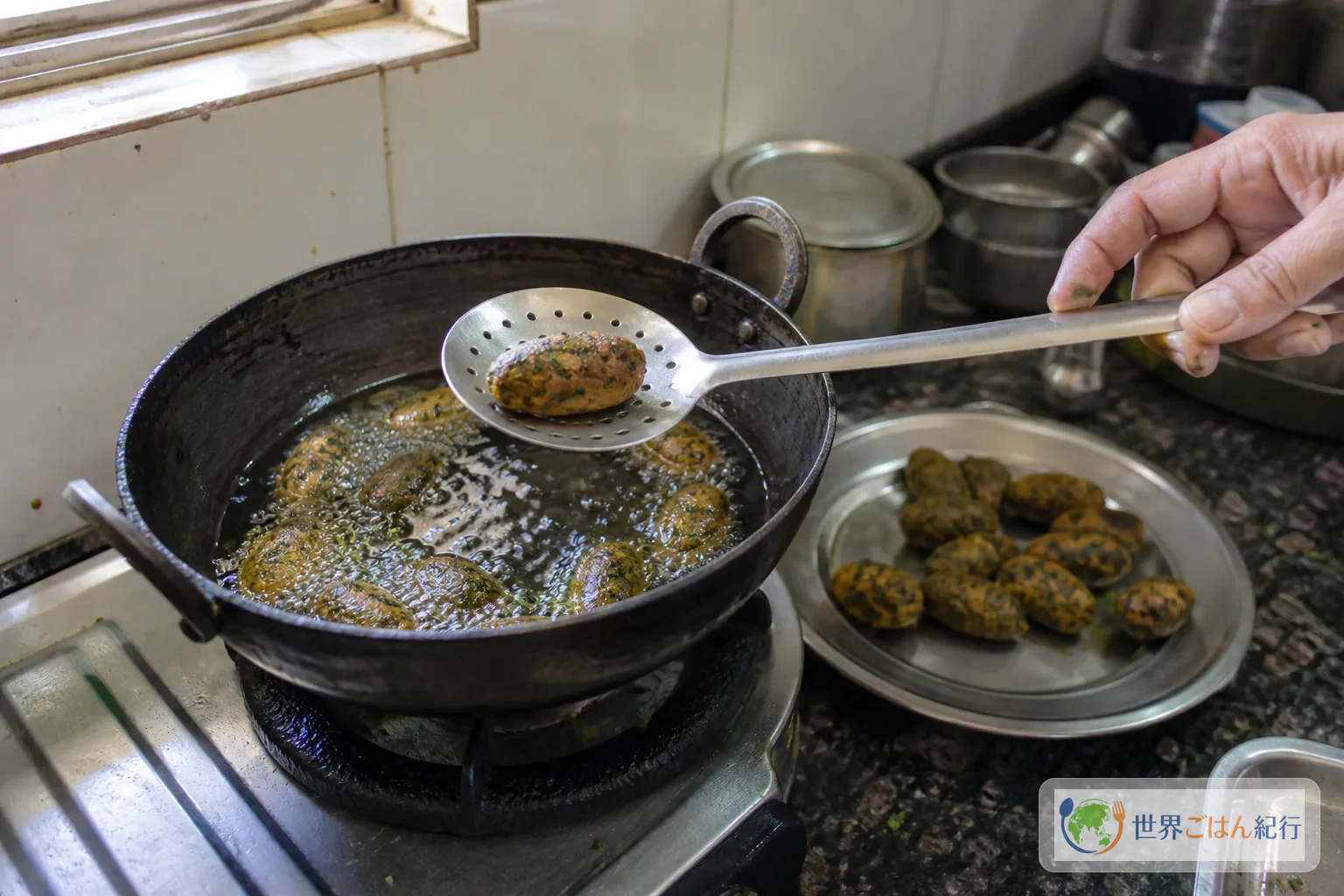
Frying methi muthia in oil and lifting one golden piece with a slotted spoon
Lift them out of the oil when the surface is a pale golden color and springs back slightly when pressed

Put 1¼ cups (300 ml) frying oil in a small deep pot and bring to 165–170°C over medium heat. Without a thermometer, drop in a small piece of dough and watch for it to float in about 3 seconds with fine bubbles around it. If it browns deeply right away, the heat is too high. Don't crowd the muthia; fry 4–5 at a time for 4–5 minutes. Take them out when the surface is a pale golden color and they spring back slightly when pressed with chopsticks. If you fry the outside to dark brown, the centers won't soften again in the later steaming and they become hard dumplings. Drain on a rack to remove the oil, and keep at room temperature until needed.

STEP55 / 8

Stuff the eggplant and potatoes with masala

8 min

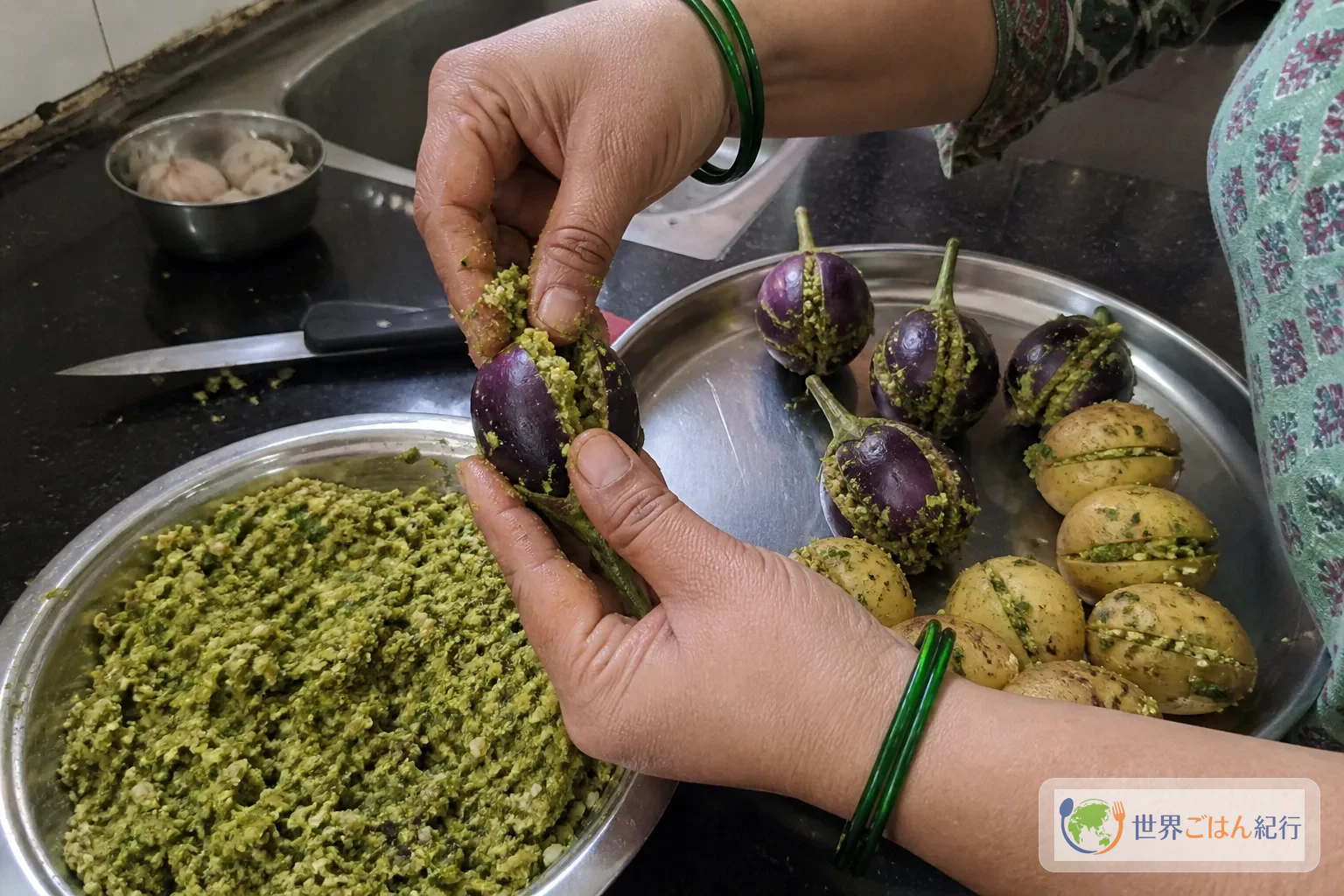
Stuffing masala into cross-cut baby eggplant
Don't open the cuts too wide; pressing the masala deep helps it hold together in the braise

Open the cross cuts in the baby eggplant and baby potatoes slightly with your fingers and press in about 2 tsp masala per piece. Keep the eggplant cuts about 0.25 inch (5 mm) wide, and the potato cuts to within 0.5 inches (1 cm) of the center, so that the skin stays connected like a ring. Press the filling deep in, but not so much that the skin splits. The leftover masala is for the vegetable layers, so don't try to use it all up. Because eggplant flesh slides out of the skin once cooked, keeping the cuts only as wide as they can hold the filling, rather than opening them fully, keeps the shape in the pot. If a potato is large, cut the cross deeper to make a path for the heat to reach the center.

STEP66 / 8

Heat the oil and build the layers

10 min

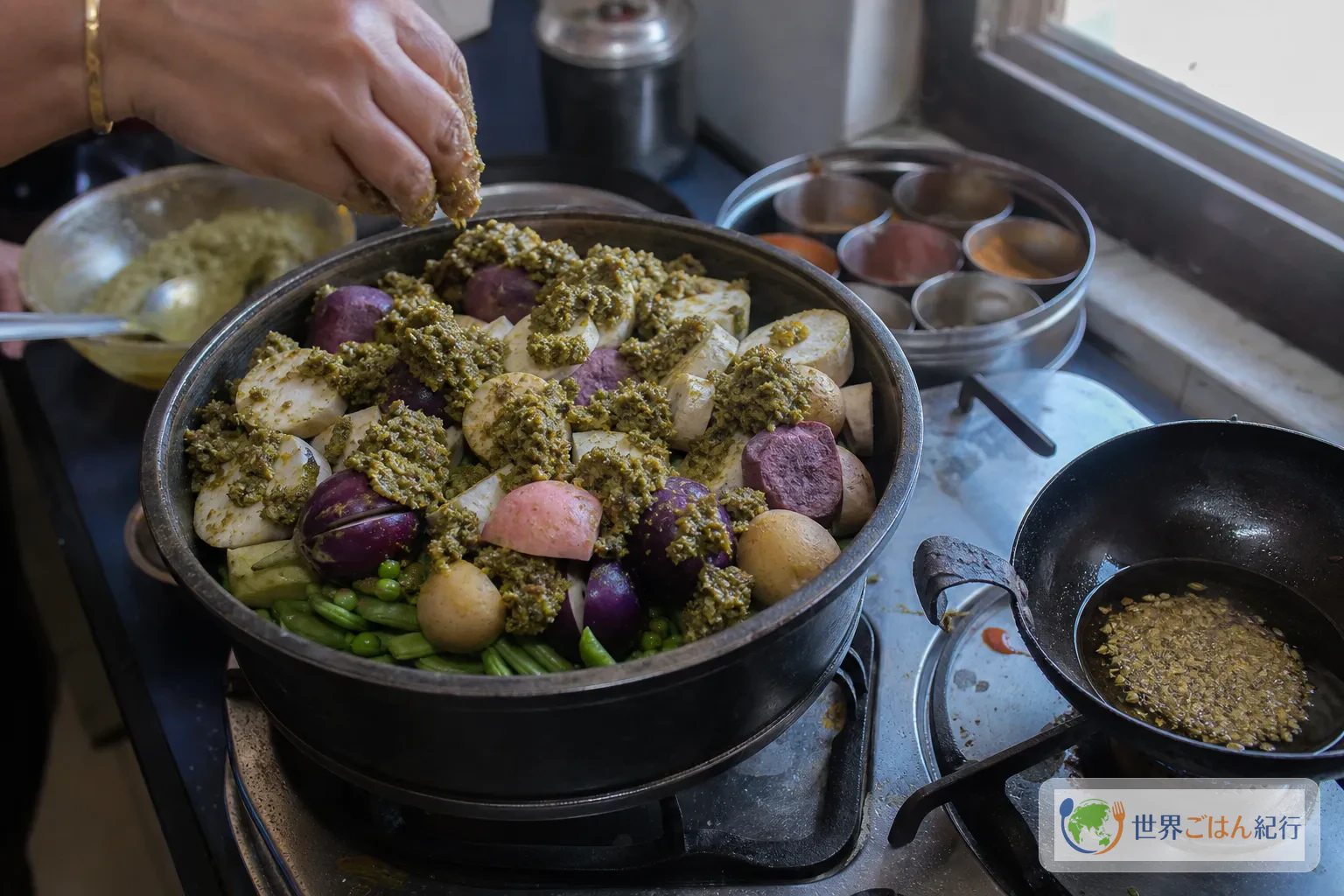
Layering beans on the bottom, with stuffed eggplant and root vegetables on top, and tempering spices in a separate pot
Hard beans and root vegetables on the bottom, with masala and water divided between the layers

Put 2 tbsp (30 ml) peanut oil or rice bran oil in a heavy covered pot and set over medium heat. Add 3 g mustard seeds, 3 g cumin seeds and 1 g fenugreek seeds, and when they pop, add 0.5 g asafoetida. Fenugreek turns very bitter if it burns, so move on as soon as the aroma comes out. Spread the beans and peas on the bottom of the pot and scatter one-third of the remaining masala over them. On top place the sweet potato, purple yam, and the stuffed eggplant and potatoes, and scatter more masala. Do not add the green banana and muthia yet. Pour ½ cup (150 ml) water in from the edge of the pot, taking care not to pour it directly over the ingredients.

STEP77 / 8

Cover and steam-simmer the vegetables on low heat

25 min

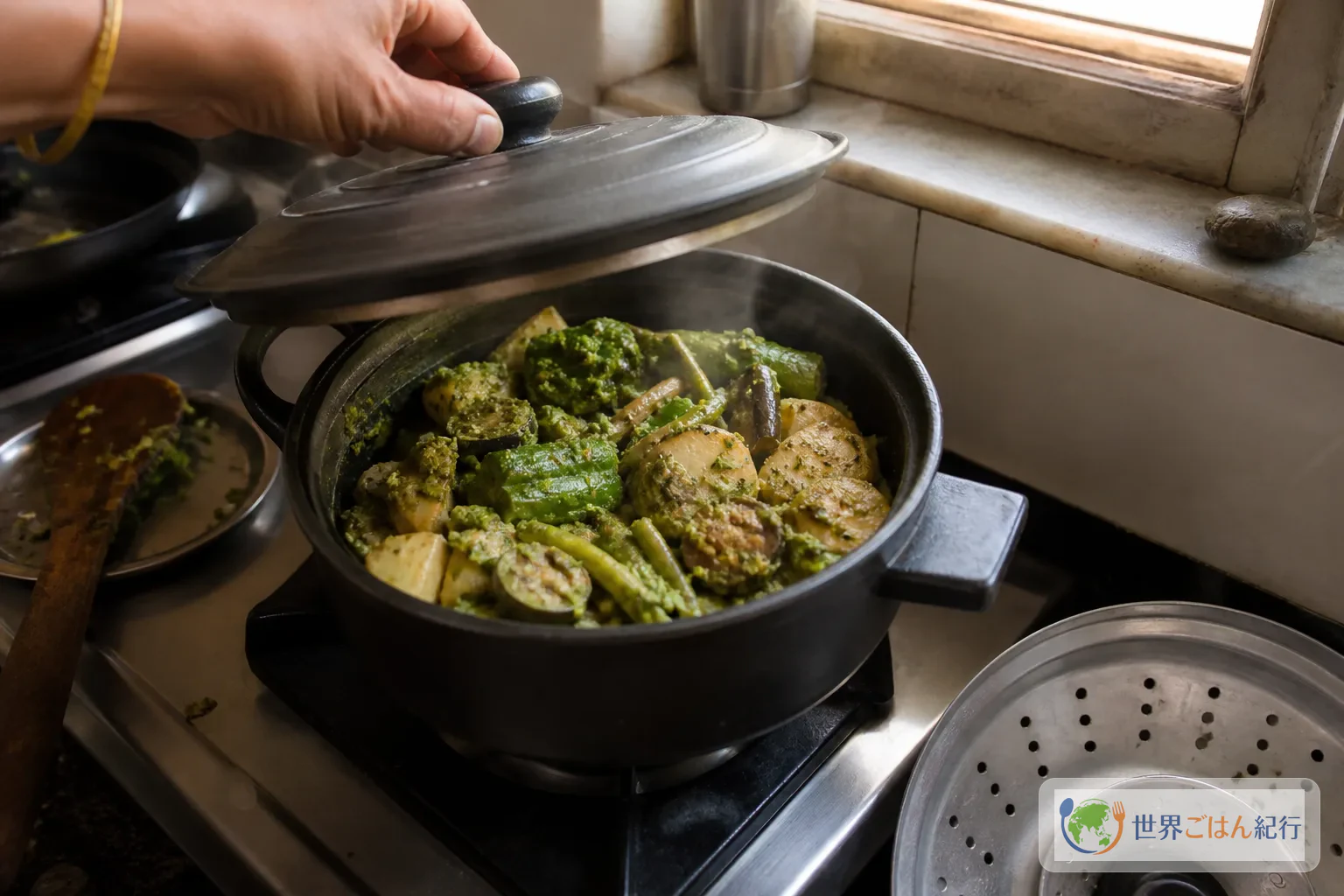
Lifting the lid slightly to check how the steaming undhiyu vegetables are cooking
After 20 minutes on low heat, push a skewer in just once, and add boiling water only when the bottom is dry

Close the lid tightly, lower to low heat and cook for 20 minutes. You want small bubbles continuing to rise from the bottom of the pot; if steam jets out strongly from the gap at the lid, the heat is too high. If you stir along the way, the eggplant and purple yam fall apart and the masala dissolves into the water. After 20 minutes, open the lid just once and push a bamboo skewer into the center of a potato. If it is still hard, put the lid back and add 5 minutes. If the bottom of the pot is dry and there is a smell of burning oil, add 1.5–2 tbsp (20–30 ml) boiling water from the edge. If water has come out of the vegetables, don't add any. The sign is that a skewer goes into the sweet potato and purple yam, and the beans break when pressed with a finger but their fibers have not completely disappeared.

STEP88 / 8

Add the muthia and green banana to finish

12 min

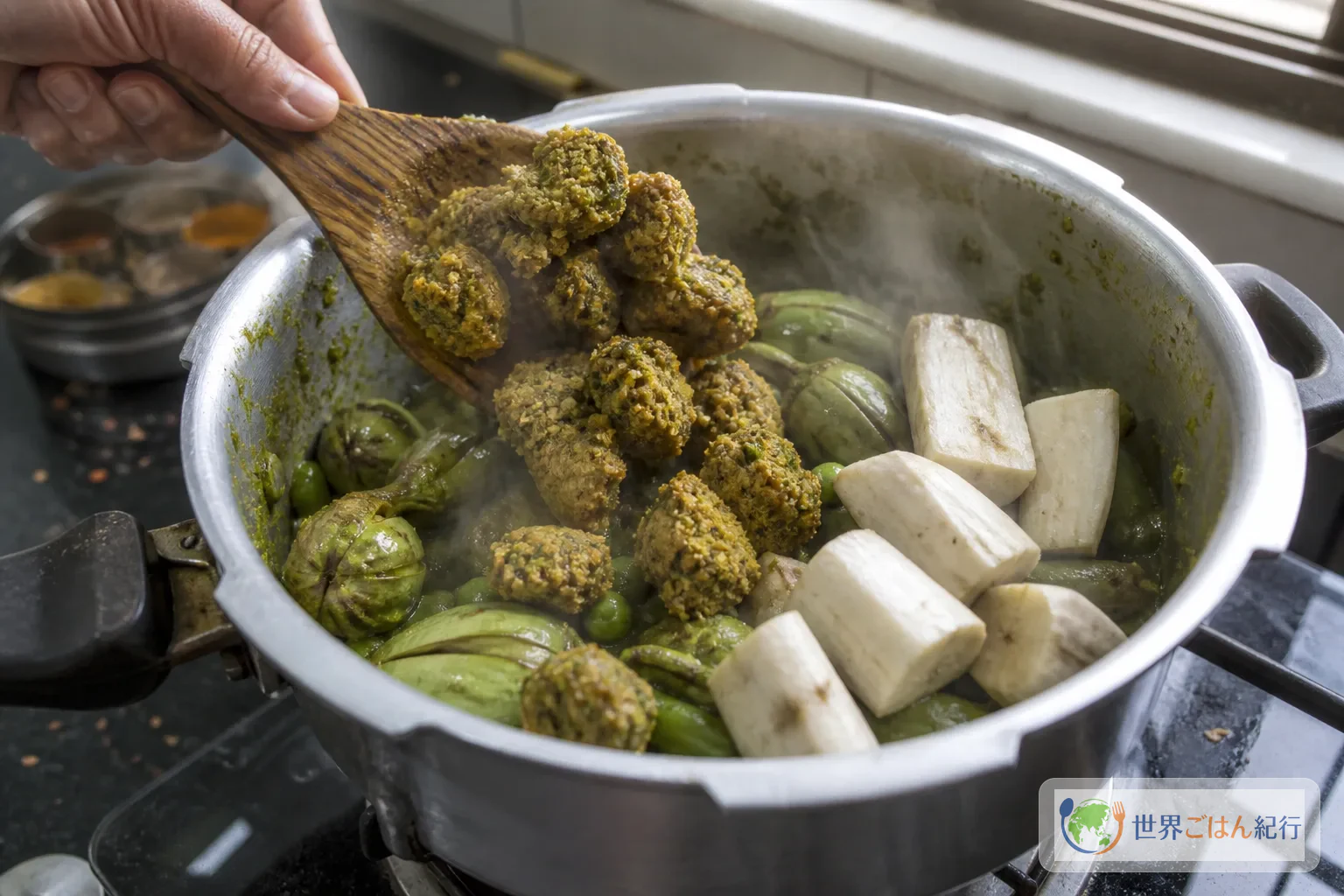
Adding golden muthia to the steamed pot and finishing the green banana and vegetables
Add the muthia and green banana when the vegetables are about 90% done, and finish them for only 8–10 minutes

When the vegetables are about 90% tender, place the 12 fried muthia and the green banana on top. If any masala remains, spread it thinly over the muthia. Cover again and simmer on low heat for 8–10 minutes. Turn off the heat when a skewer goes into the green banana and a muthia broken open with chopsticks shows no white of raw flour at the center. Finally add 2 tsp (10 ml) lemon juice and 10 g chopped cilantro, and shake the pot to move everything once. After resting 5 minutes, the masala at the bottom settles a little and the flavor reaches the surface of the muthia too.

0 / 0
Ingredients

Ingredients

1 / 3

Vegetables

Ingredient Amount Substitutes & notes
Flat green beans (in place of Surti papdi) 9 oz (250 g) Choose thick pods. Ordinary green beans work, but the bean sweetness is lighter
Green peas 5.5 oz (150 g) Use the same amount of toor lilva (fresh green pigeon peas) if you have them. Thaw frozen and drain
Baby eggplant 5.5 oz (160 g) (4–5) With ordinary eggplant, cut into 1 inch (2 cm) rounds and place on the top layer without stuffing
Baby potatoes 7 oz (200 g) Cut large ones into 1 inch (3 cm) cubes. Make cross cuts
Sweet potato 8 oz (220 g) 1 inch (3 cm) cubes. Not a replacement for purple yam, but it matches the sweetness
Purple yam (kand) 7 oz (200 g) If unavailable, taro can substitute. Color and stickiness change
Green banana 7 oz (200 g) net (1) If unavailable, replace with 5.5 oz (150 g) lotus root and add in the final 10 minutes
Fresh methi leaves 2.75 oz (80 g) Substitute 2 oz (60 g) spinach plus 3 g dried kasuri methi. The muthia aroma is weaker
Cilantro 2.75 oz (80 g) 2.5 oz (70 g) for the masala, 10 g for finishing. If you dislike it, omit only the finishing portion
Green garlic or garlic scapes 1.75 oz (50 g) 1.5 oz (40 g) garlic scapes plus 5 g garlic. Garlic alone doesn't give the green aroma
2 / 3

Methi muthia

Ingredient Amount Substitutes & notes
Besan (chickpea flour) 2 oz (60 g) Using only wheat flour changes the toasty outside and the cohesion
Whole wheat flour or atta 2.75 oz (80 g) Cake or all-purpose flour tends to make the dough loose. If you have none, mix in half bread flour
Ajwain 1.5 g 1/3 tsp. If you have none, increase cumin by 1 g
Turmeric 1 g 1/3 tsp. For color; don't overdo it
Chili powder 1 g 0.5 g if reducing heat
Baking soda 1 g 1/5 tsp. Too much brings bitterness
Salt 3 g For the dough
Lemon juice 2 tsp (10 ml) Doesn't tighten the dough; balances the green bitterness of the methi
Vegetable oil 1 tbsp (15 ml) For the dough. Separate from the frying oil
Frying oil 1¼ cups (300 ml) Don't let the muthia absorb all of it. Don't strain and reuse the rest; judge its condition and dispose
3 / 3

Green masala and seasoning for the pot

Ingredient Amount Substitutes & notes
Desiccated coconut or freshly grated 2.75 oz (80 g) Unsweetened. Coconut milk adds too much liquid
Unsalted peanuts 1.25 oz (35 g) Coarsely crushed. If avoiding nuts, replace with 20 g besan
White sesame 15 g If avoiding sesame, omit and increase peanuts by 10 g
Ginger 15 g Grated
Garlic 15 g Minced. Used separately from the green garlic
Green chili 10 g 1–2. Removing the seeds lowers the heat
Jaggery or raw cane sugar 18 g Not to sweeten the dish, but an amount to round out the green bitterness
Coriander-cumin powder 5 g If you have none, 2 g cumin and 3 g coriander
Lemon juice 2 tbsp (30 ml) 1.5 tbsp (20 ml) for the masala, 2 tsp (10 ml) for finishing. Adjust acidity at the end
Salt 8 g Split roughly 5 g for the masala and 3 g for the pot
Peanut oil or rice bran oil 2 tbsp (30 ml) For the pot. Separate from the frying oil
Mustard seeds 3 g For tempering
Cumin seeds 3 g For tempering
Fenugreek seeds 1 g They turn bitter easily, so about 1/4 tsp
Asafoetida 0.5 g Omit if you have none
Water ½ cup (150 ml) Added from the edge of the pot. Add 1.5–2 tbsp (20–30 ml) more only if it dries out
0 / 0

Before the lid comes off, the smell rises from the pot: a green masala of coconut and green chili, fried methi dumplings, and a whole market's worth of winter vegetables layered together. Undhiyu is the winter vegetable dish of Gujarat, in western India. You get the green aroma of the Surti style, root vegetables that turn fluffy, and fenugreek muthia that are fragrant outside and tender inside, all from one pot. At home, a heavy covered pot stands in for the traditional clay one. Three things matter most: cut the vegetables to the same size, add the fragile muthia and green banana later, and don't stir much while it simmers.

Undhiyu and the upside-down pot
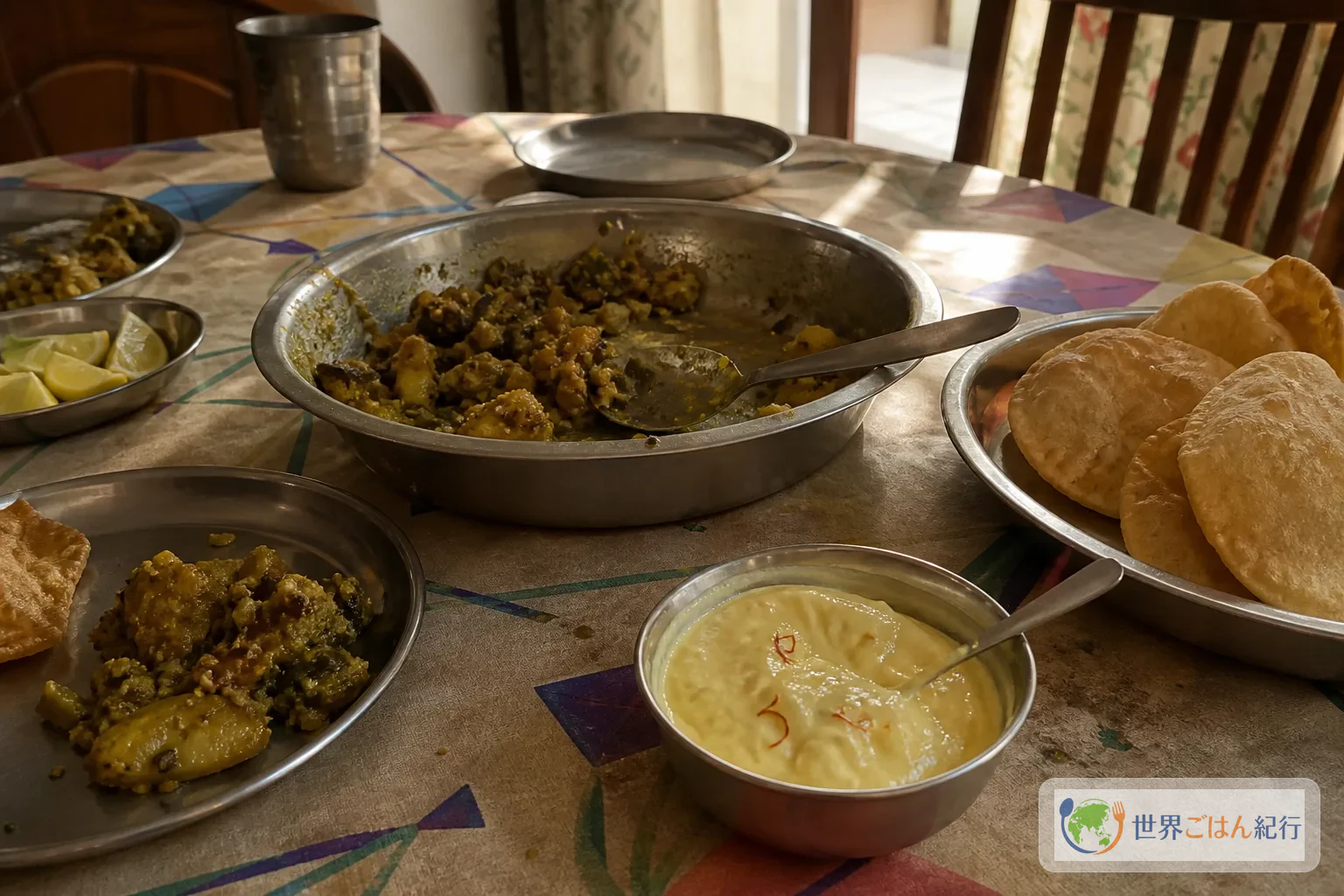
A Gujarati winter table gathered around undhiyu, puri and shrikhand
Undhiyu is a dish for winter gatherings, set beside puri and sweet shrikhand

Undhiyu was traditionally made in an earthen pot called a matlu. Beans, green banana, purple yam, muthia and more were layered inside, then the pot was sealed, turned upside down and set over the fire. The word undhu in the name means "upside down," so the old method of heating the pot from above and below survives in the dish's name. Because the layers cook slowly and stay intact, it's a different thing from a stew you stir up from the bottom. These days most homes and shops use ordinary stoves and heavy pots, but the idea is the same: keep the layers whole and seal in the moisture over low heat.

A note on spelling

The Gujarati dish name is spelled Undhiyu, and other spellings exist in other languages. You may also see Undhiyo in searches.

Surti, Kathiyawadi and matla undhiyu

Surti style comes from around Surat in southern Gujarat. It brings together a green masala, green garlic, coconut, seasonal beans and fried methi muthia, so you get sweetness and acidity with no sharp edges. If you're substituting ingredients outside India, use garlic scapes along with cilantro to hold on to that green aroma.

Kathiyawadi home recipes are built on a red gravy of tomato and red chili, and they run hotter. Some versions fry the vegetables first and combine them afterward. So undhiyu can be a green braise or a deep red one, and each leaves a very different impression. "Matla" is less a regional name than a way of describing the inverted clay-pot method. To tell the styles apart, look at which vegetables go in and which aroma leads.

Type Flavor and cooking axis Judgment at home
Surti style Green coconut masala, green aromatics, fried muthia This recipe. Don't increase the heat too much, to keep the vegetables' sweetness
Kathiyawadi style Deep gravy of red chili and tomato, strong heat, fried vegetables Make it as a separate dish. Don't just add tomato to the Surti masala
Matla undhiyu Clay pot inverted, heat applied above and below At home, keep the idea with a heavy pot and lid, low heat and little liquid

A winter dish for Uttarayan

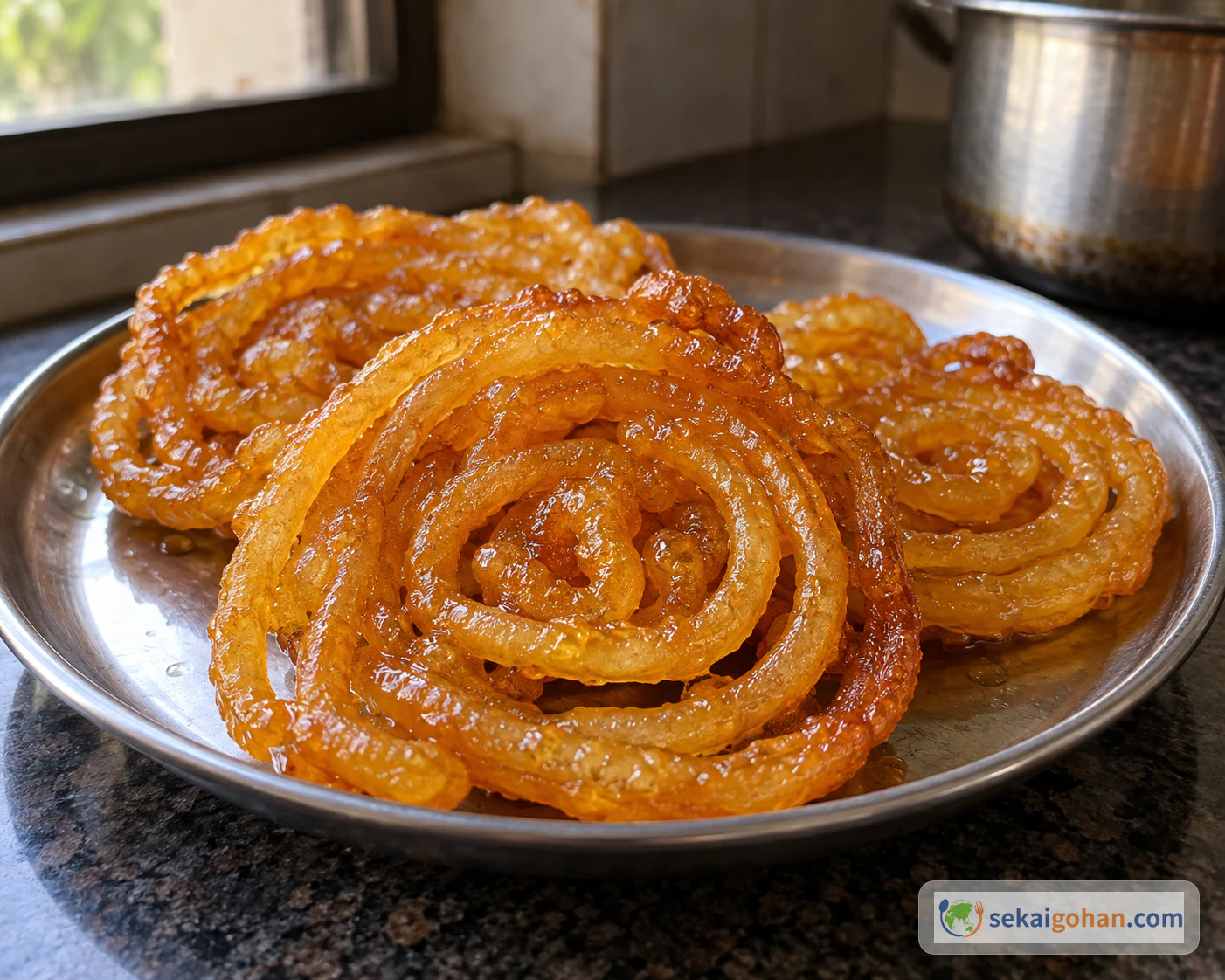
Undhiyu belongs to winter for two reasons: that's when its ingredients come to market, and that's when the occasions for eating it come around. Surti papdi, green pigeon peas, purple yam, green banana and green garlic fill the winter markets and decide what goes into the pot. Around Gujarat's kite festival, Uttarayan, and Makar Sankranti, it's heaped on large platters with puri, alongside sweet shrikhand and jalebi.

Method: hard vegetables on the bottom, fragile ones later

If you put all the cut vegetables in at once, by the time the beans are soft the green banana and muthia will have fallen apart. Place the slow-to-cook ingredients at the bottom and those you want to keep their shape on top, and add the muthia last.

How to recover if something goes wrong

If the vegetables are hard but there is too much liquid, don't stir; set the lid slightly ajar and reduce the liquid over medium-low heat for 5–8 minutes. If a burnt smell appears, move only the top ingredients to another pot and don't scrape the burnt bottom. Add 3.5 tbsp (50 ml) boiling water and the leftover masala to a separate pot and reheat, which keeps the bitter burnt flavor from spreading through the whole dish. Hard muthia means they were over-fried or the dough lacked moisture. If they are not in the pot yet, spoon 2 tbsp of hot masala over them, cover and steam for 10 minutes on low heat. If they hardened in the pot, push them to the side without breaking up the vegetables, add 2 tbsp boiling water and cook 5 more minutes. Muthia that have broken are not a failure; they can be eaten as is, as pieces that add body and a toasty flavor to the masala.

Ingredients (serves 4): prepare the winter vegetables and the green masala separately
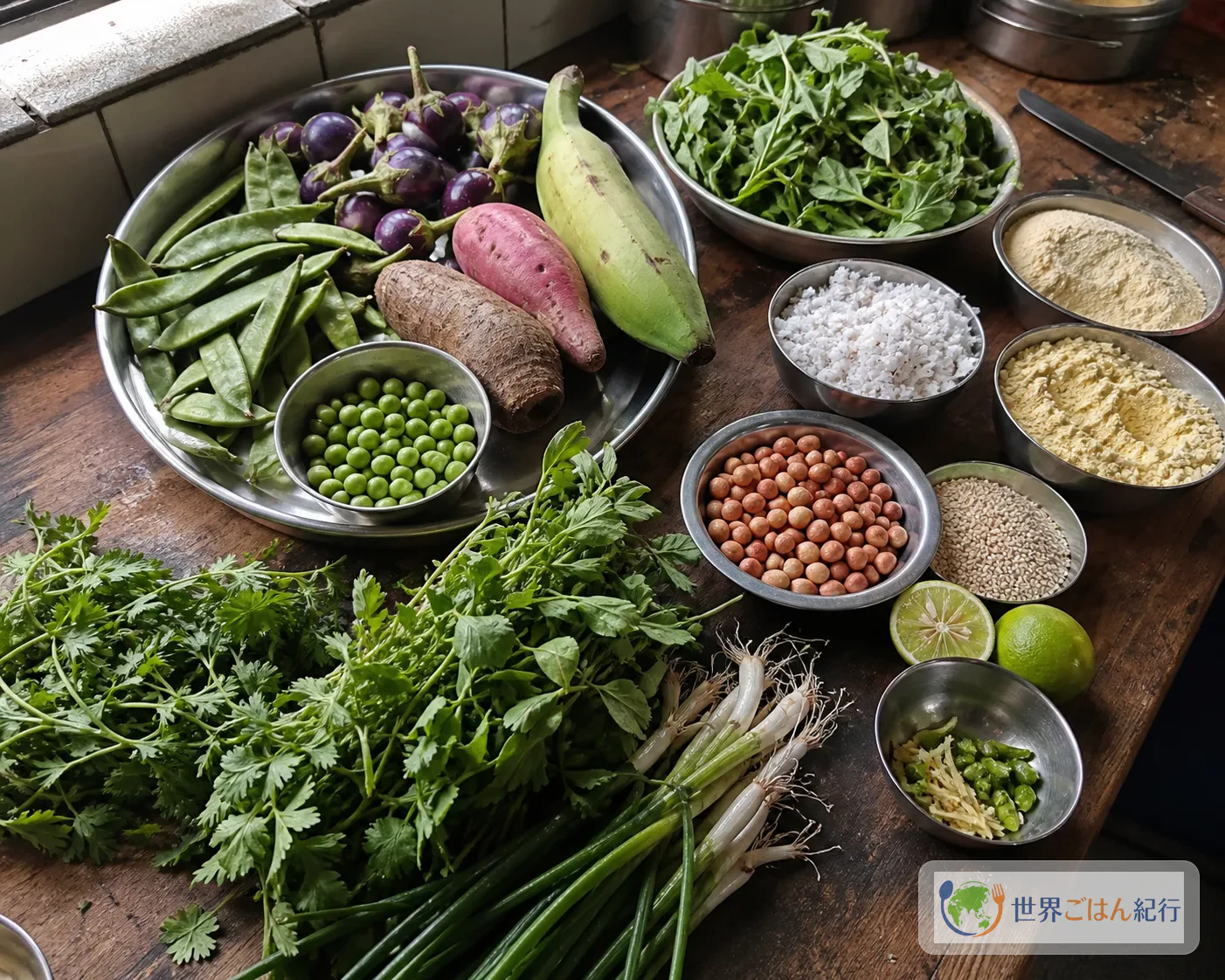
Winter vegetables, methi, coconut, beans and flours for undhiyu laid out in the kitchen
Prepare the flat green beans, root vegetables, methi, coconut and peanuts separately

This serves 4 as a main. With puri or roti, the undhiyu alone is enough for 3 people to share. The ingredients follow the Surti-style combination used locally. Easy-to-find substitutes are noted.

What you can swap, and what to keep

You don't need to hunt down every hard-to-find ingredient. But if you think separately about three roles, green aroma, fluffy root vegetables and the texture of muthia, the outline of the dish holds even with substitutes.

Role Closer to local Practical substitute What changes
Bean sweetness and skins Surti papdi, toor lilva Flat green beans, green peas The bean aroma is lighter, but the sweetness of the layers remains
Green aroma Green garlic Garlic scapes plus a little garlic The pungency comes slightly forward
Sticky tubers Purple yam (kand) Taro, or sweet potato Color and stickiness change. Watch for falling apart and add later
Springy green banana Green banana Lotus root No acidity, with a stronger crunch
Bitterness of methi Fresh methi Spinach plus dried kasuri methi Aroma is subtler, but the green color of the muthia holds
Smoky aroma of clay pot Matla set over a fire Heavy covered pot on low heat No smoky aroma. Prioritize not scorching and keeping the layers

Because it uses wheat and chickpea flour, the basic recipe is not gluten-free. If you are allergic to peanuts, sesame, chickpeas, wheat or coconut, check the labels of the substitutes too. If you fry in oil shared with other foods, remember that coating residue and bits from those foods can remain in it.

Adjusting oil and heat

The Surti flavor is built not by adding more chili but by the lineup of coconut, green aromatics, lemon and jaggery. When reducing heat, halve the green chili, and do not increase the sugar to balance it out.

Shopping for undhiyu: fenugreek seeds vs. methi leaves
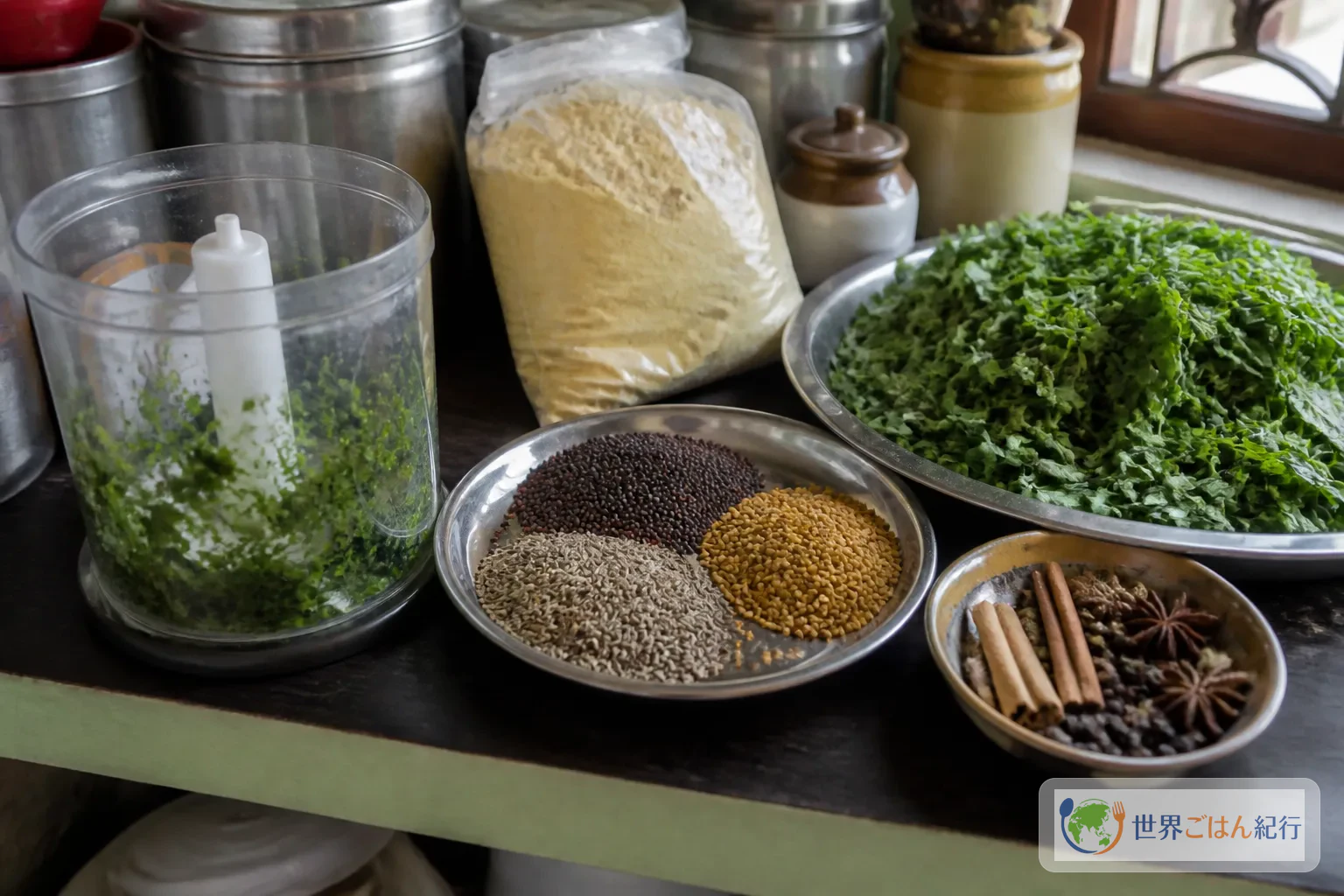
Choosing fenugreek seeds, methi, besan and a small food processor in a kitchen
Fenugreek seeds worth looking for in undhiyu, and a small food processor for the green masala

Fresh methi leaves are the star of the muthia. Buy them fresh if a shop near you carries them, and on days you can't find them, spinach plus dried methi is the practical choice. Fenugreek seed is a different ingredient from the methi leaf. Here only 1 g of seed goes into the tempering, where it pops in the oil and adds a toasty flavor and a light bitterness. Buy whole seed, not powder, and check the package size. Leftover seeds are good in chana masala, where they help build aroma in a bean stew.

The things worth ordering online are the whole spices that are hard to find locally and a tool that grinds the green masala coarse and even. If you make a big batch of masala, a small food processor keeps the coconut and peanuts from settling unground at the bottom. When you shop for one, check that it has a chopping blade, and look at the bowl size and how many parts you'll have to wash. It's worth buying if you'll use it beyond undhiyu, for avial and chutneys too.

Choosing not to buy a tool

You can also make it by finely chopping cilantro and garlic with a knife and crushing the peanuts in a mortar. The more grains remain in the masala, the closer it gets to the rustic local texture. A food processor is for people who meet these conditions: make undhiyu every year, also make chutneys and avial, and find it hard to keep up the chopping by hand.

Serving and varying undhiyu

Undhiyu tastes best the day it's made, when the beans are still crisp, the root vegetables fluffy and the muthia toasty on the outside. Frying puri at the same time makes for a lot of work, so the first time, serve it with store-bought naan or thin roti and keep your attention on the vegetables and the muthia texture. On a day when you have time, make the masala and muthia the day before, then cut the vegetables and finish the pot on the day, and you can gather around a big pot like a festival lunch. Serve it next to thepla, a flatbread from the same Gujarati table with methi leaves worked into the dough, and you can taste side by side what a winter vegetable braise and a flatbread each bring.

Variation Ingredients and steps What changes
Make the beans more Japan-friendly Use green beans and green peas The green bean aroma is lighter, but the layers of winter vegetables are still possible
Change the methi 2 oz (60 g) spinach and 3 g dried kasuri methi The bitterness of the muthia becomes gentler
Change the green banana Add 5.5 oz (150 g) lotus root at the end Crunch stands out more than sweetness
Steam the muthia Steam after shaping, then add to the pot The surface is softer, and oil is reduced
Move toward Kathiyawadi style Simmer tomato, red chili and tamarind in a separate pot to serve alongside A red heat different from Surti style
Lighten the table Replace puri with roti Cut down the fried food and let the vegetable braise be the star

Storage and FAQ

Let leftovers cool a little, then divide them into shallow airtight containers and refrigerate. Don't leave them out at room temperature for long. Cooked leftovers keep 3–4 days in the refrigerator, but the green banana and muthia lose their texture quickly, so for the best flavor aim for 3 days. Don't freeze it, because the eggplant, potato and muthia turn watery after thawing. To reheat, warm it in a pot over medium-low heat until hot in the center, adding boiling water 1 tbsp at a time if it looks dry. If you notice a sour smell, sliminess or anything else off when you open the container, throw it out without tasting.

Is it still undhiyu without green garlic?

It changes the character, but you can make it with 1.5 oz (40 g) garlic scapes and 5 g garlic. The green aroma will be weaker. Don't make up for it with more cilantro. Instead, go easy on the green chili and add the lemon at the end to sharpen the finish.

Can I substitute yellow bananas for green bananas?

No. Ripe yellow bananas fall apart when cooked, and their sweetness takes over. If you have no green banana, cut 5.5 oz (150 g) lotus root into 1.5 inches (4 cm) pieces and add it in the last 8–10 minutes. It won't taste like green banana, but it adds a crunch the other root vegetables don't have.

Can I make the muthia without frying?

Yes. Steam them for 12–15 minutes, then add them to the pot. The surface won't be as toasty as fried, but it's a good option when you want less oil. Shape them into the same 1.5 inches (4 cm) ovals you would for frying, since larger pieces won't cook through in the center.

The dish came out too hot. What can I do?

Instead of adding a lot of sugar, soften the heat with 3.5 oz (100 g) separately steamed potato or 3.5 oz (100 g) boiled chickpeas. Water alone thins out the masala's aroma, so add it a little at a time, then adjust at the end with lemon juice 2–3 ml at a time.
Sources