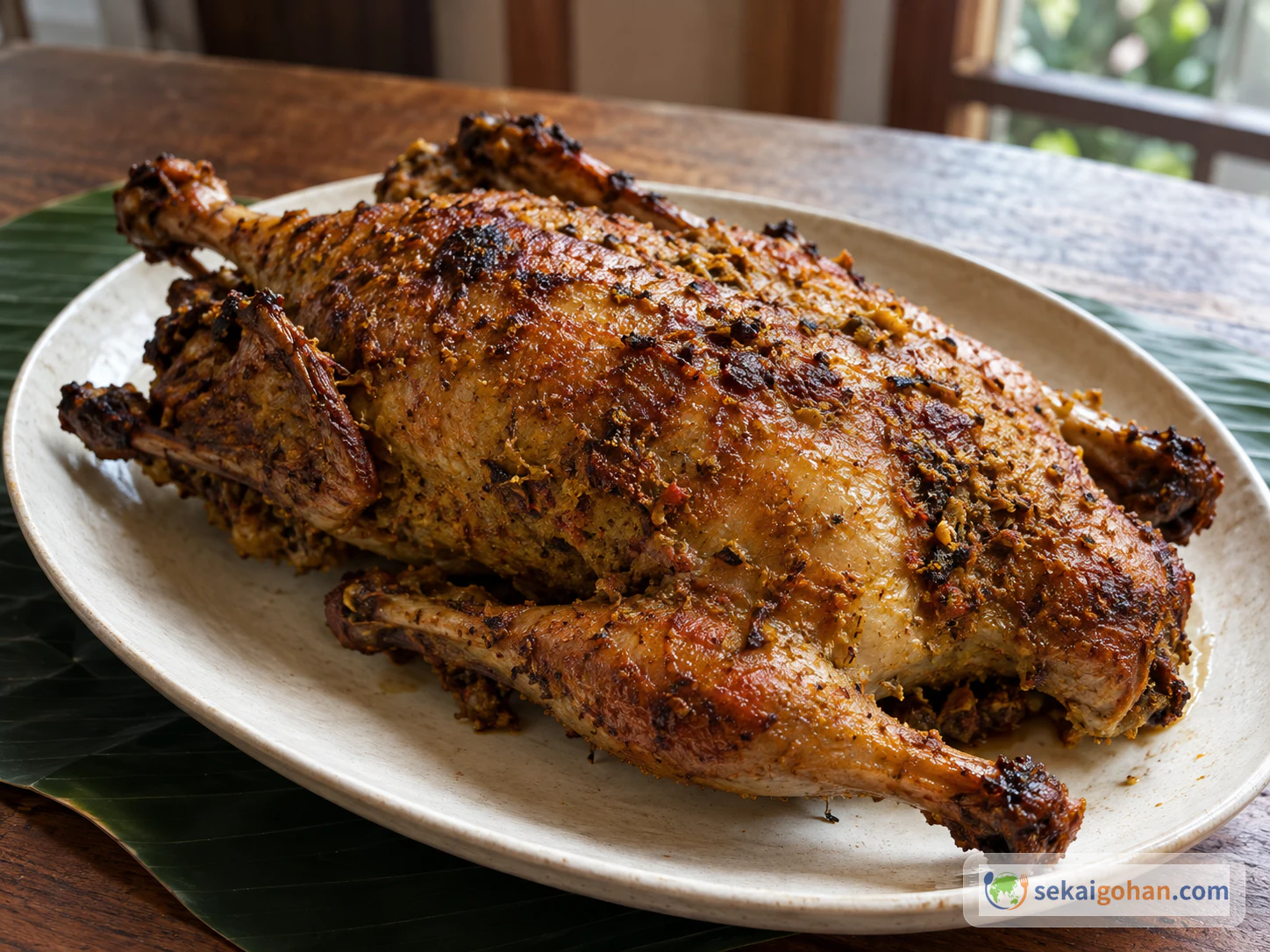
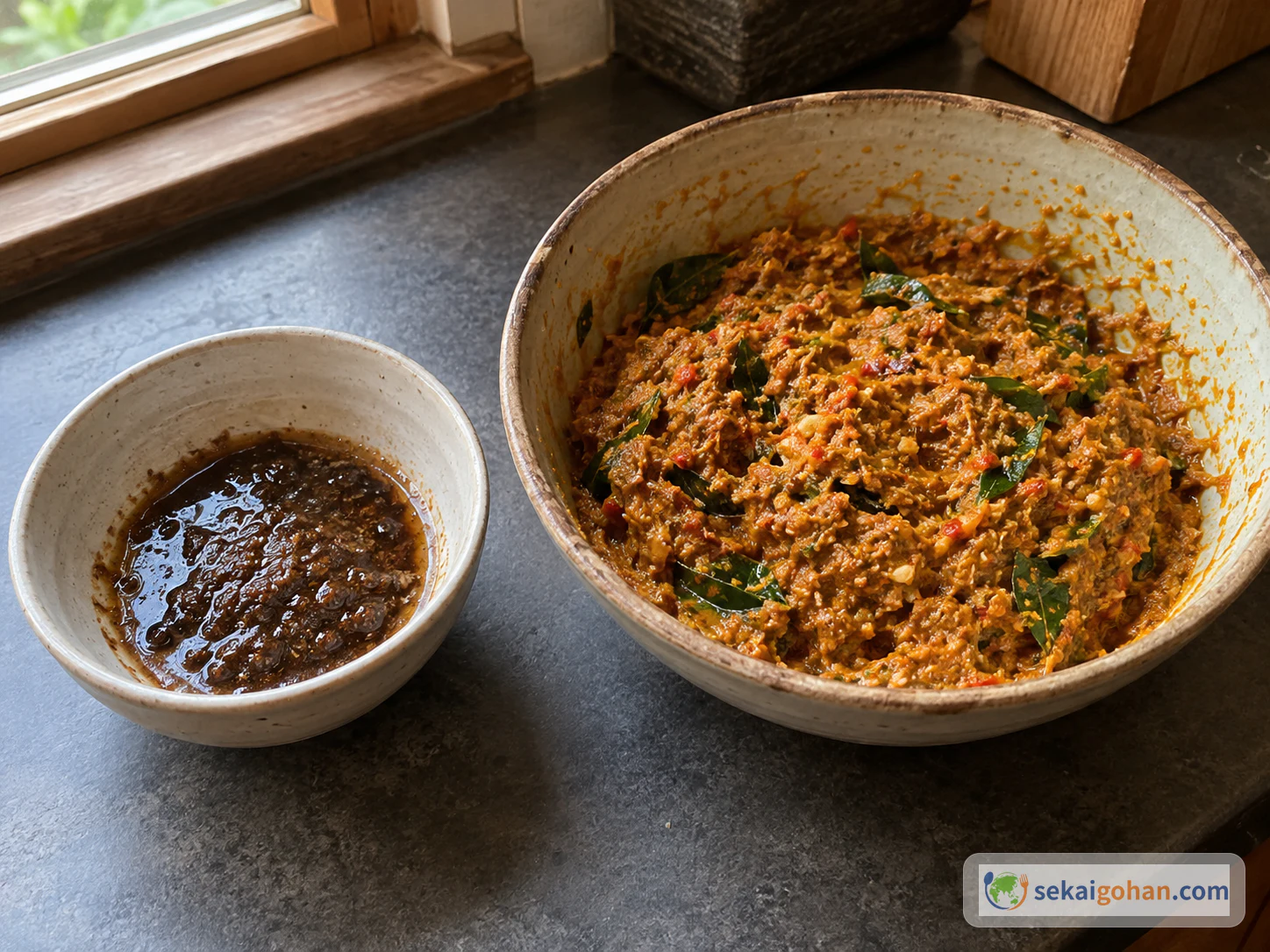
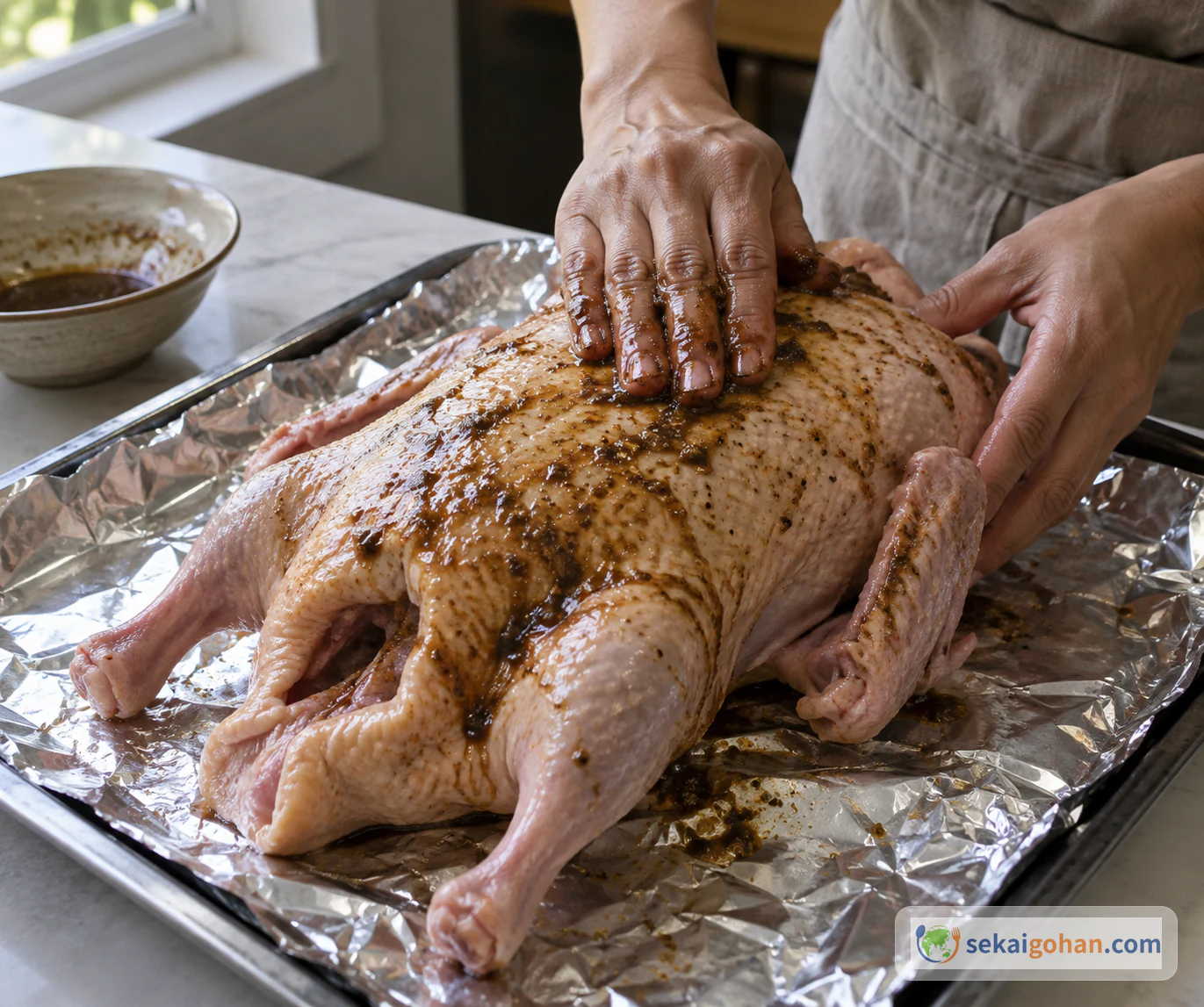
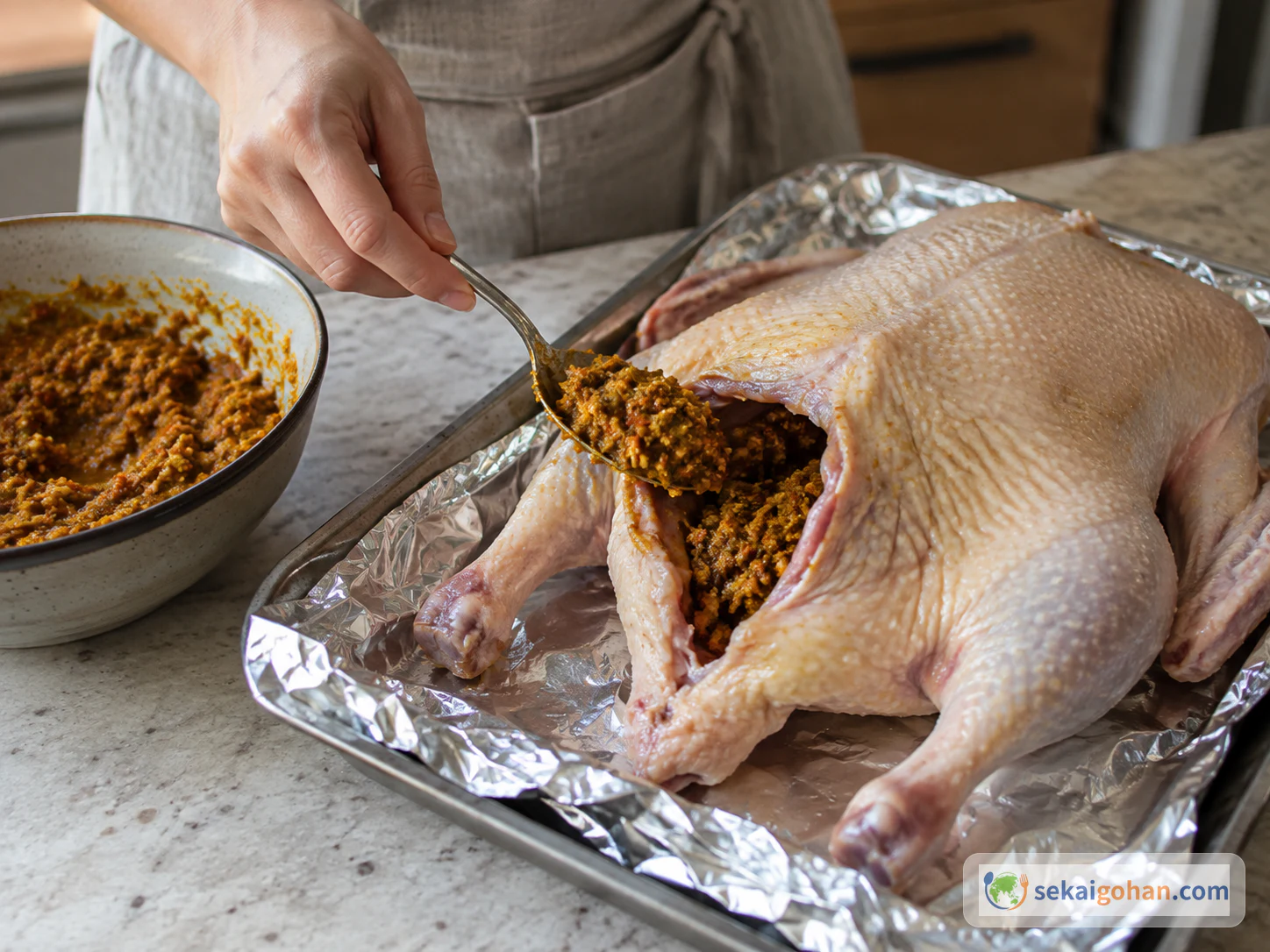
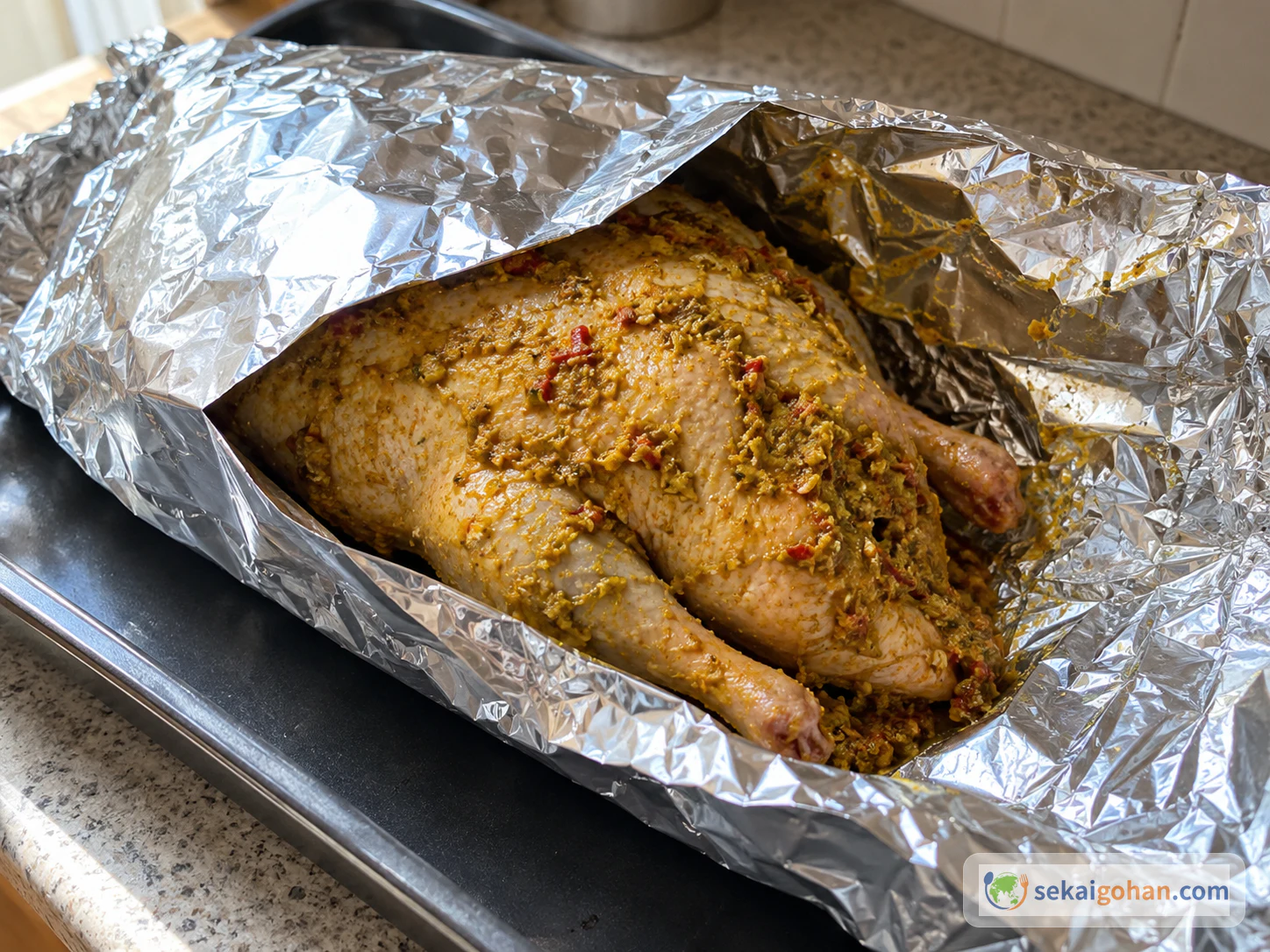
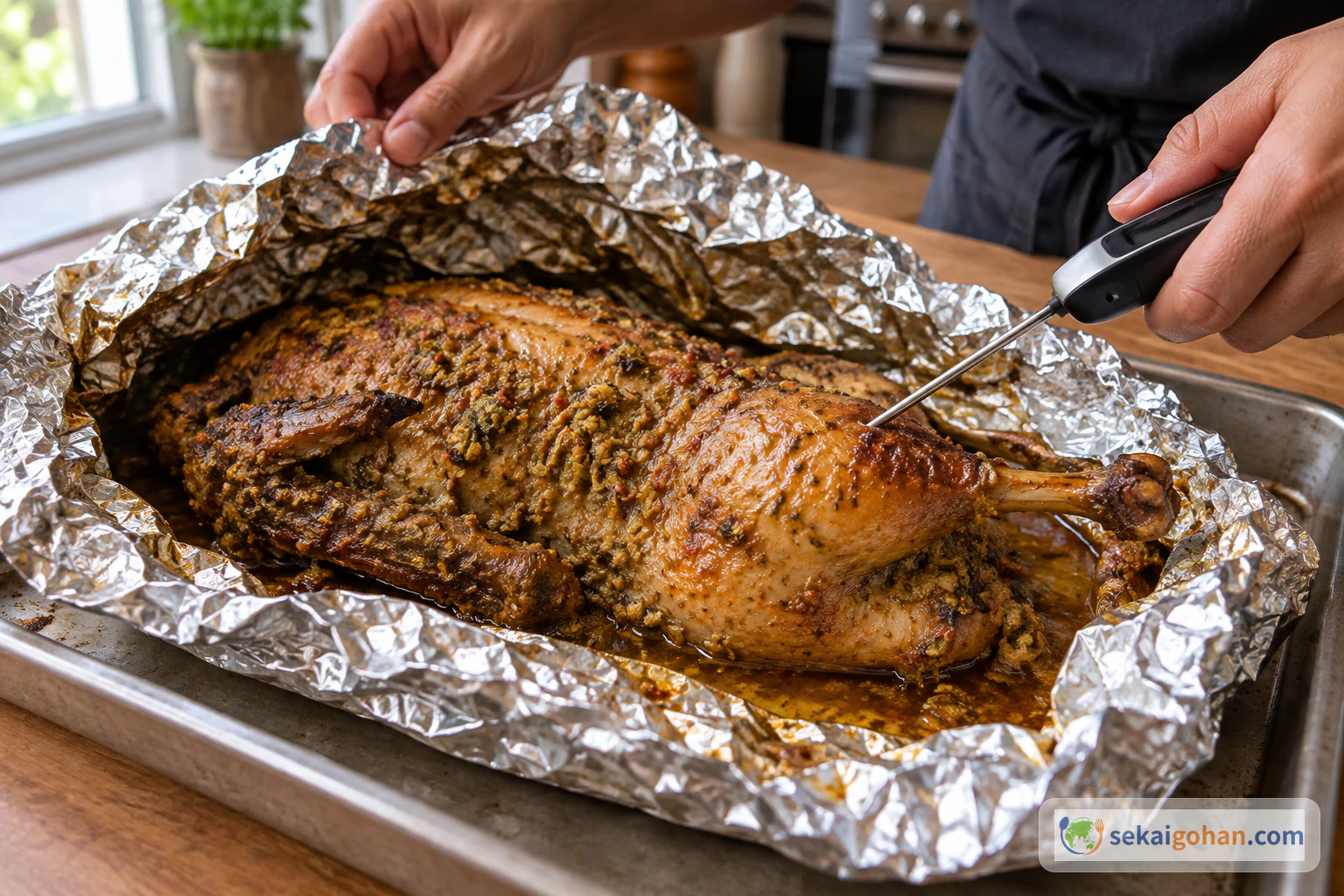
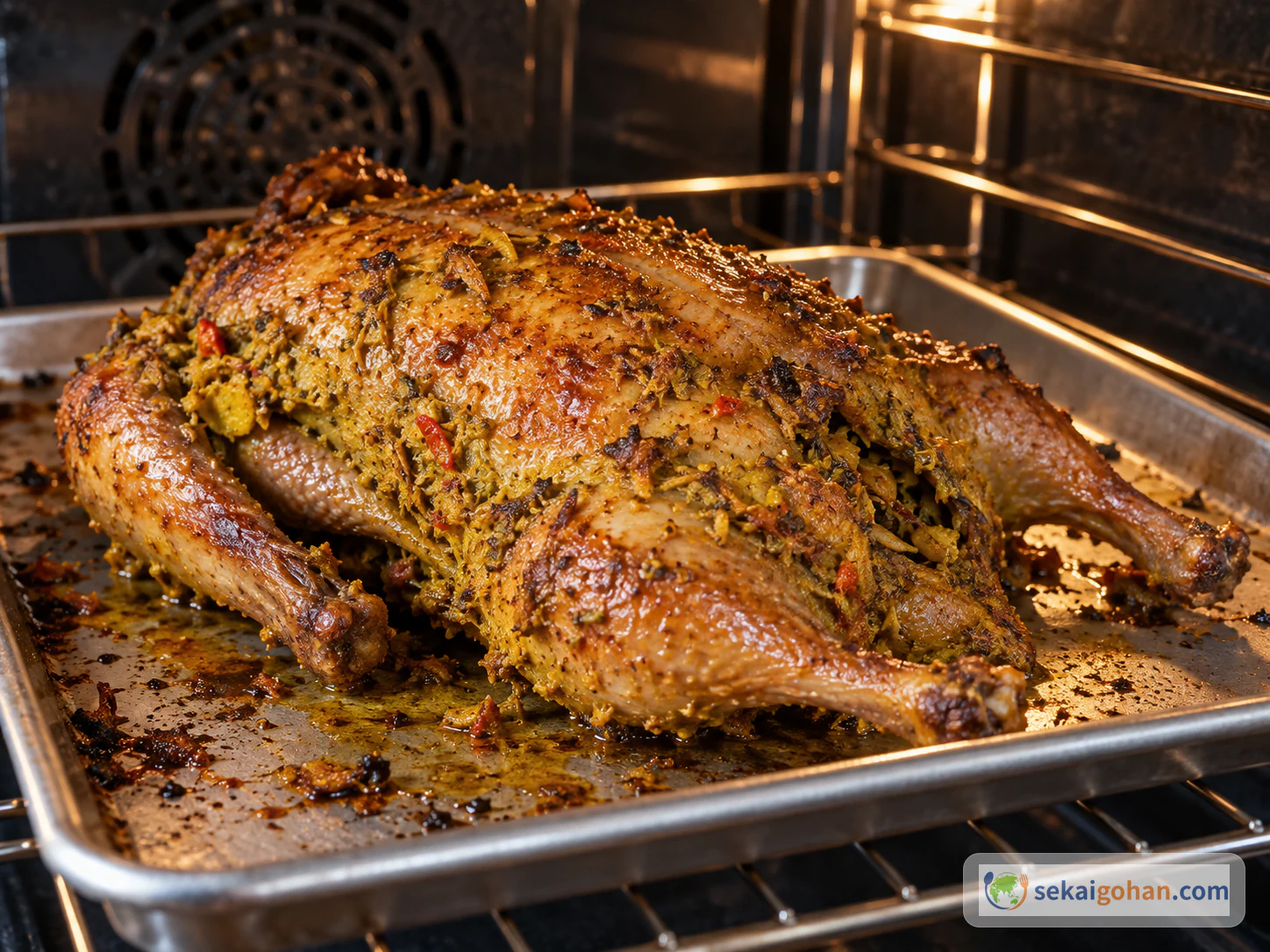
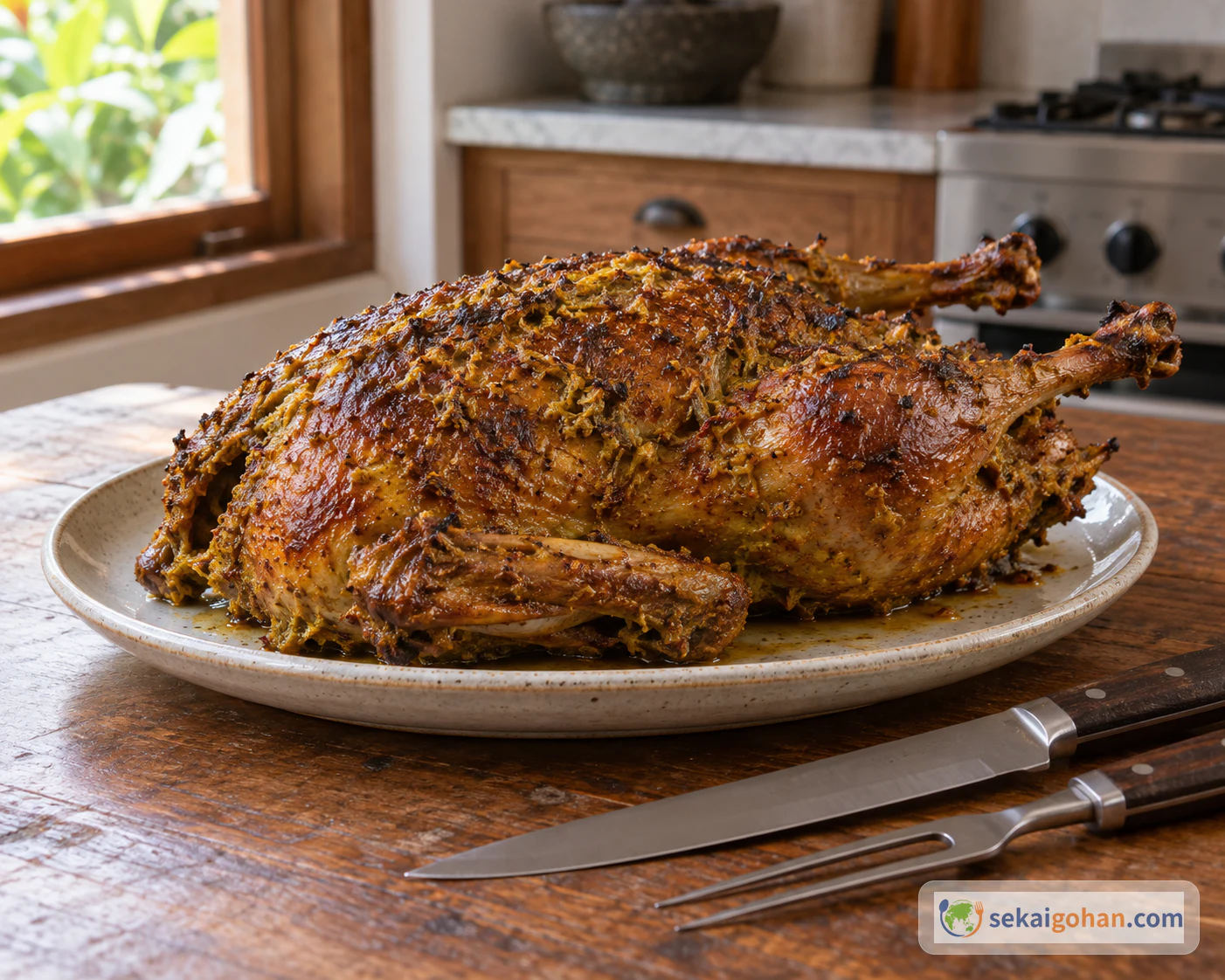
The foil folds back and steam rises, carrying the smell of shallot, garlic, galangal, turmeric and shrimp paste. The duck underneath is still pale and moist under its paste. It goes back into a much hotter oven, uncovered, and comes out with browned skin and a crust of spices. That's bebek betutu, a Balinese whole duck seasoned inside and out with a fragrant spice paste and cooked slowly. Here it's sealed in foil and cooked in a home oven.
About Bebek Betutu
Bebek betutu is from Bali, where it's served at customary events, ceremonies and celebrations, or as a special dish. Every version starts the same way. A whole duck is seasoned with shallot, garlic, turmeric, ginger and candlenut, wrapped in leaves and cooked over slow heat. The wrapping is usually banana or areca-palm leaf.
The methods vary a lot. Some cooks wrap the duck in cassava leaves and banana leaves, and coconut bark and steam-roasting are part of the tradition too. Some recipes steam the duck before baking it, and others roast or steam it slowly the whole way through.
This version is made for a home oven, with a double layer of foil instead of leaves. You won't get the smoke or coconut-shell aroma of pit cooking. What you do get is meat kept moist by the sealed foil and skin browned by a final uncovered roast. Betutu is also made with chicken, as ayam betutu. For that dish and others from the country, start at our Indonesian recipes.
Rely on a food thermometer, not the clock.
Use a duck of about 2 kg (about 4.5 lb), gutted.
Toast the candlenuts before blending, and measure the center of the paste inside the bird.
Ingredients for One Whole Duck
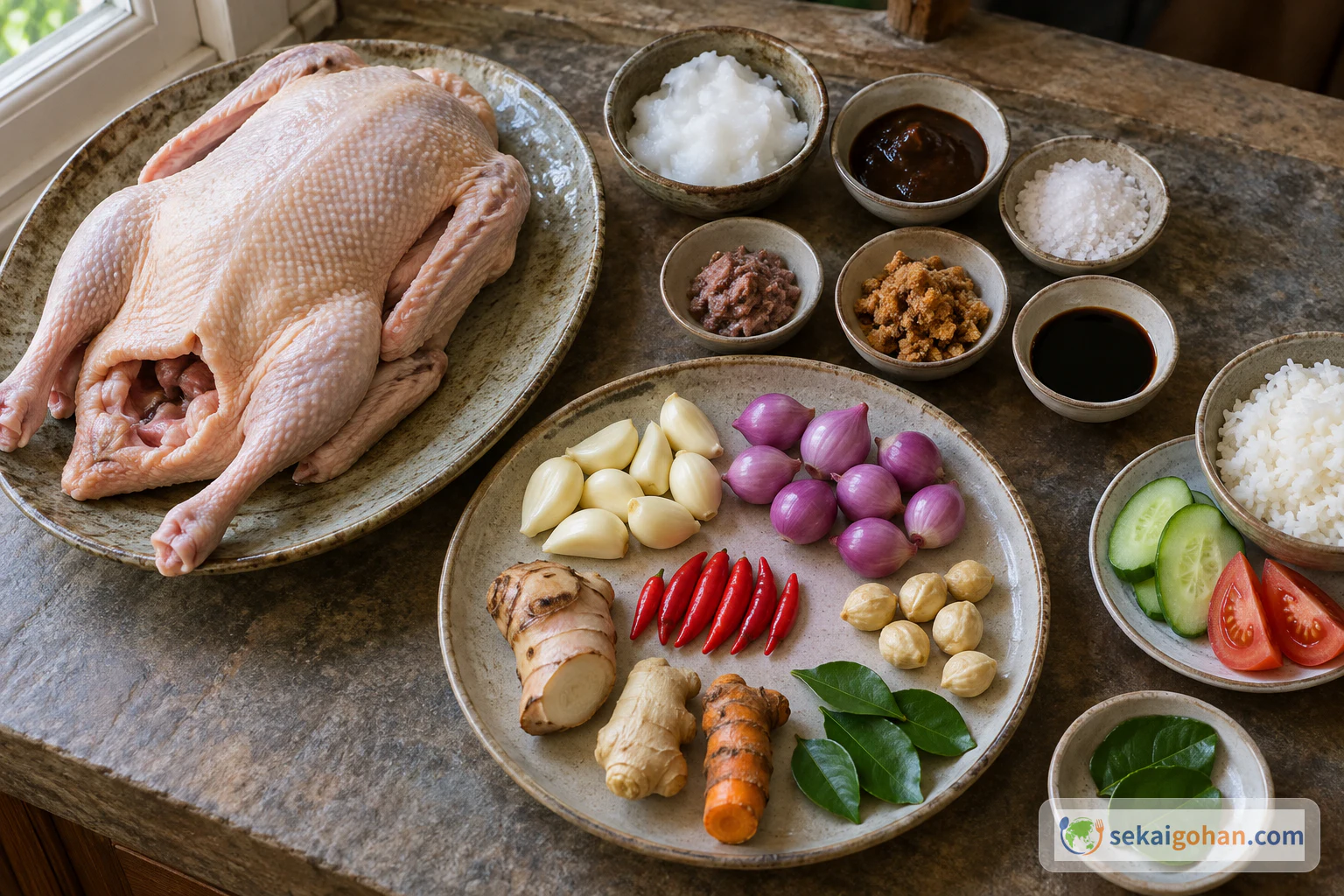
Serves 4–6. The coconut oil and tamarind are each divided between the rub and the paste.
This dish contains duck, shrimp paste (crustacean) and tree nuts. Thaw a frozen duck in the refrigerator or microwave. Keep the knife, cutting board and containers used for raw duck separate from other foods, wash and sanitize them after use, and wash your hands after touching the bird. Use a different knife and board for the cucumber, tomatoes and lime leaves.
Choosing Ingredients for Bebek Betutu
Every swap below changes the dish a little, so choose with that in mind.
- Duck: Most domestic ducks in the US are White Pekin, and Long Island is a trade name. A retail whole duck is sold at 4.5 lb (2,041 g), the size this recipe is built around. In Japan, gutted whole aigamo duck is sold at about 2.1–2.4 kg (up to 5.25 lb) and works here. If your duck isn't about 4.5 lb (2 kg), keep the spice amounts as they are and judge doneness by temperature.
- Salt: A tablespoon of salt weighs very different amounts: 8 g for Diamond Crystal kosher, 16 g for Morton's kosher, 18 g for table salt. A spoonful of fine salt can easily be too much, which is why fine salt is measured by weight.
- Candlenuts: Unsalted macadamia nuts are the most common substitute. Keep in mind they're still tree nuts.
- Galangal: Ginger can stand in, but you lose galangal's sharp citrus and pine-like note, and the warm ginger aroma takes over.
- Palm sugar: Unrefined cane sugar works, with a different flavor.
- Kecap manis: This is a sweet soy sauce, so ordinary soy sauce isn't a match.
- Shrimp paste: Products sold as shrimp paste or terasi vary by brand.
- Curry leaves and lime leaves: These are two different leaves. Curry leaves go into the paste, and kaffir lime leaves are only an optional garnish.
Equipment
- Aluminum foil, enough for a double layer that wraps the whole duck
- Baking sheet or roasting tray
- Food processor or mortar and pestle
- Instant-read food thermometer
- Pan for toasting the candlenuts
- Separate knife and cutting board for raw duck
- Small bowl for the rub and a bowl for the paste
- Platter, carving knife and fork
- Shallow containers for leftovers
Method: From Sealed Foil to Browned Skin
The times below are for a duck of about 4.5 lb (2 kg). Bird size and oven settings vary, so measure the temperature at both points in step 5 before moving on.
Bebek Betutu Doneness and Troubleshooting
The temperatures in step 5 do two different jobs. The 175°F (about 79°C) at the leg is a guide to the texture of the meat, not a safety rule. For safety, the minimum for whole poultry and for the center of any stuffing is 165°F (about 74°C). In Japan, the standard is 75°C at the center for at least 1 minute. That standard was set for chicken, and we apply it to duck here.
Use the 167°F (75°C) line at both measuring points: the leg and the center of the paste. The dense paste inside the bird is exactly the part you can't judge from the outside of the duck, and color and elapsed time can't confirm either point.
| Problem | Likely cause | What to do |
|---|---|---|
| The leg or paste center is under temperature | The duck is larger or the oven runs differently | Wrap it again, keep roasting, and measure both points again |
| The meat has tightened and dried | The foil was not fully sealed, so moisture escaped | Check for gaps before it goes in the oven next time |
| The aroma is uneven | The paste was too coarse | Blend or pound until smooth before filling |
| The skin is browning too fast | The final roast runs hot | Go by color rather than the full 25–30 minutes, and do not let it burn |
| The rub tastes too salty | Fine salt was measured by the spoon | Next time, weigh fine salt and start at 8 g |
| The meat tastes underseasoned | The paste was lightly salted, as intended | Add salt at the table after carving, never by tasting the paste |
Serving, Storing and Varying Bebek Betutu
Serving
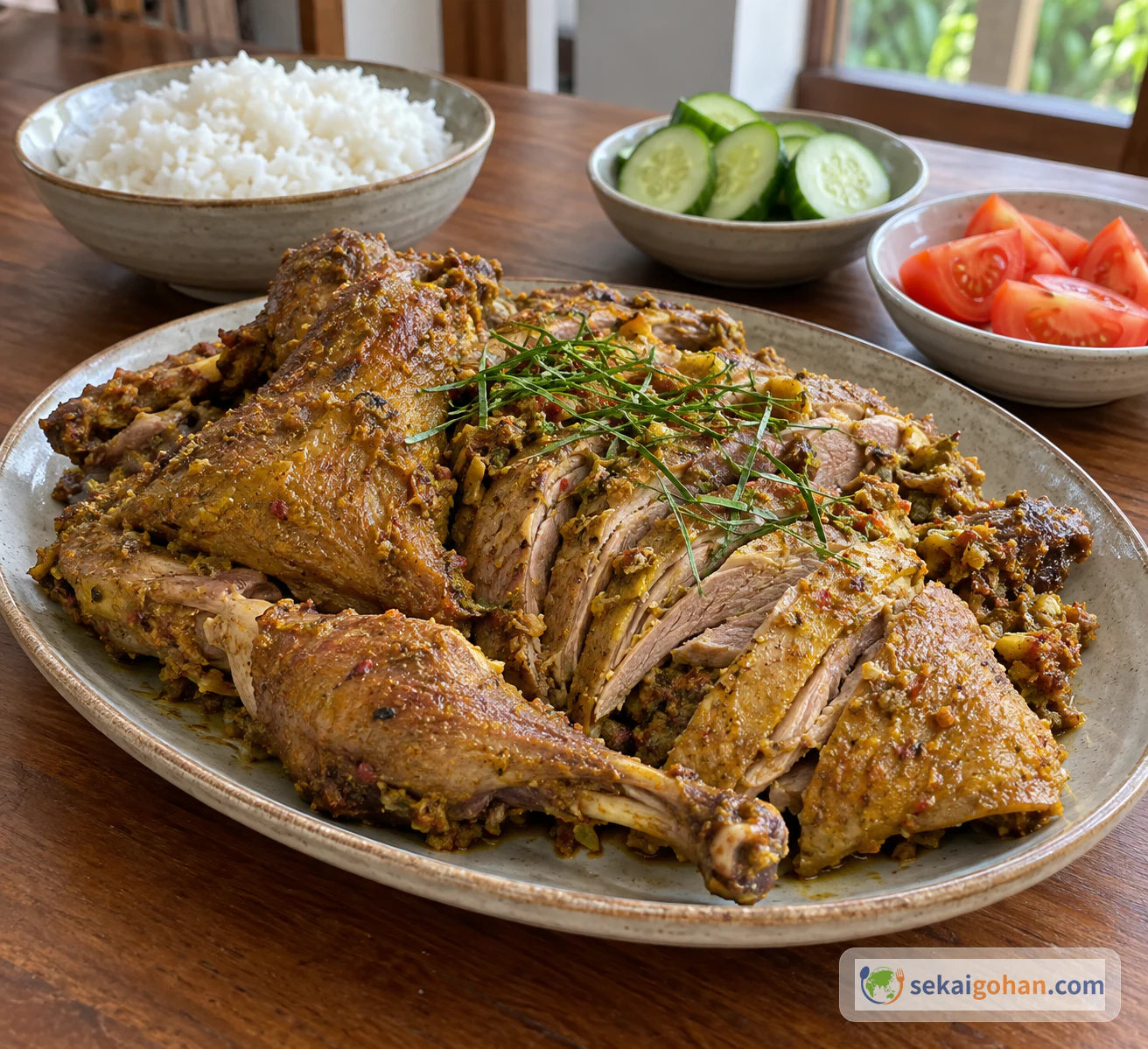
Bebek betutu is commonly paired with rice, lawar and sambal matah. For a simple table, white rice with optional cucumber and tomatoes is all you need. Add lawar and sambal matah if you want a fuller Balinese spread.
Leftovers
Treat the cooked paste the same way as the duck. Divide leftovers into shallow containers and refrigerate them within 2 hours, or within 1 hour if the room is above 32°C (90°F). Keep the refrigerator at 10°C or below, eat within 3 to 4 days, and reheat to 165°F (about 74°C).
Variations
- Less heat: Use fewer chiles. The heat drops, and the balance of the aromatics shifts with it.
- Fresh or ground turmeric: Use either the fresh piece or 2 tsp ground, but never both.
- Leaf-wrapped or steamed betutu: These methods have their own proportions and timings. The times here apply only to the foil method.
Frequently Asked Questions
What is the difference between bebek betutu and ayam betutu?
Bebek betutu is made with duck, and ayam betutu with chicken. This recipe is for the duck.
Can I make it without banana leaves?
Yes. This version uses a double layer of foil throughout, which makes it a home-oven method rather than a traditional leaf wrapping or pit.
Why can't I taste the paste?
Raw candlenuts are slightly toxic and can cause digestive distress. Toast them before blending, and don't taste the paste until it's fully cooked.
How much salt goes in the paste?
The rub uses 1 tbsp. Since you can't taste the paste, add only a very small amount of salt to it, if any, and adjust at the table after carving.
Should I prick the duck's skin?
Pricking or scoring the skin helps render the fat. This method doesn't include that step.
When should I carve it?
Let it rest for 20 minutes, and keep the paste in the cavity until then.