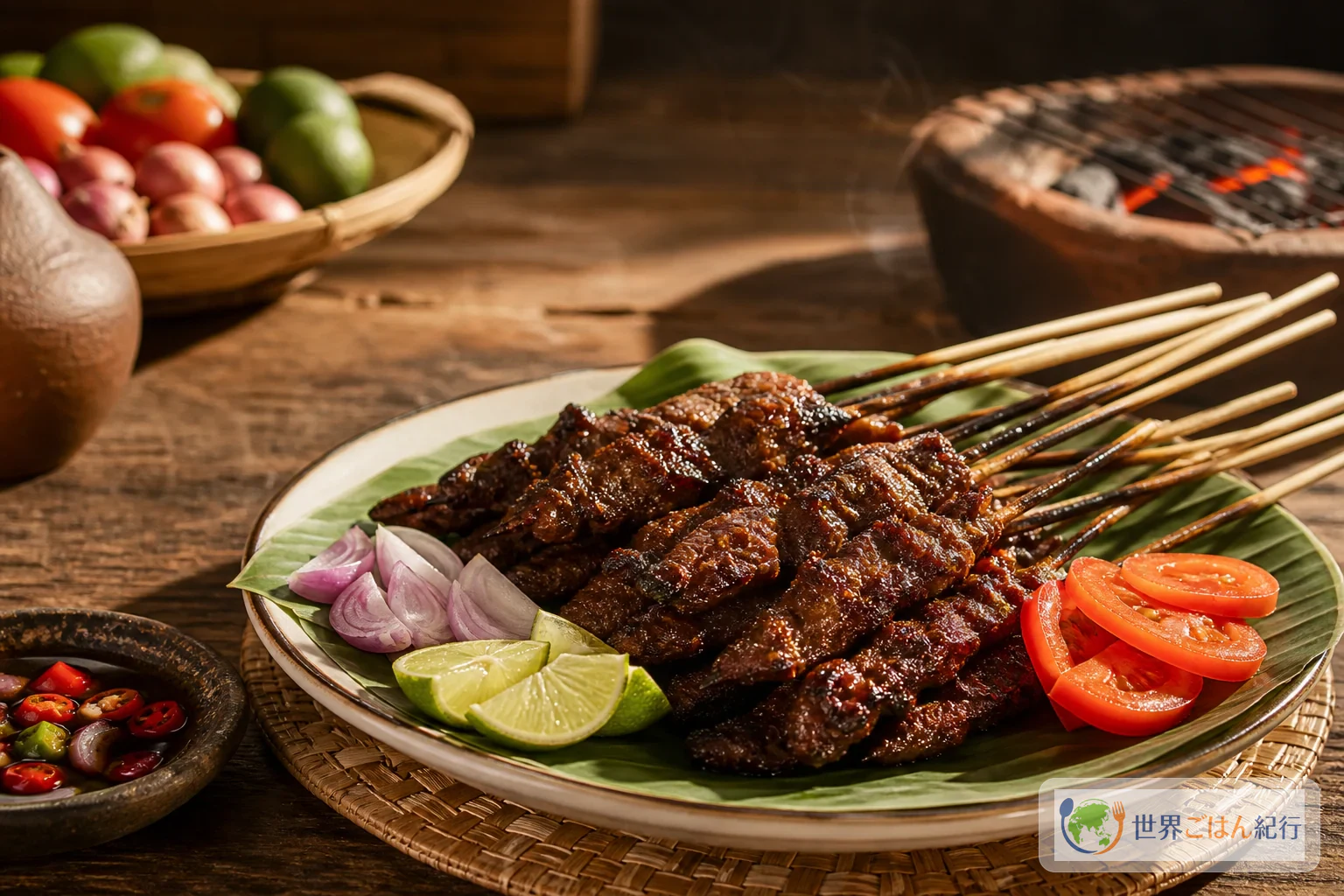
The smell of caramelizing sugar comes first, and the richness of peanuts follows close behind. Small pieces of chicken, tossed in a dark brown marinade of garlic, coriander and kecap manis, are threaded onto bamboo skewers, grilled over charcoal and eaten with peanut sauce or a sweet soy glaze. This is sate ayam, Indonesia's chicken skewer. It tastes a little like soy sauce, only much sweeter, and it arrives with shallots, chiles and lime on the same plate.

Sate ayam and Indonesian satay
Sate ayam and yakitori
The setup looks a lot like Japanese yakitori, but the flavor is built on a very different axis. Yakitori lets the meat itself shine with salt or a simple tare. Sate ayam depends on four things: the sweetness of charred kecap manis, the raw bite of shallots, the tartness of lime and the smoke of charcoal. English-language recipes often call it simply "chicken skewers with peanut sauce," but peanuts alone don't make it Indonesian. Without those four, it drifts toward yakitori with peanut sauce.
nasi goreng and mie goreng are the better-known first tastes of Indonesian food. But if you want the feel of an Indonesian street stall, satay is hard to beat. Smoke rises while it grills, you hold the end of the skewer to drag it through the sauce, and you eat it with cucumber and lontong. Set next to the rice dishes, it brings a sense of fun, of picking and sharing.
In Indonesian it is written sate ayam. In English it is also called chicken satay or satay chicken. Sate ayam keeps the sound of the original.
Satay across Indonesia

Satay is one of Indonesia's most famous dishes and is eaten all across the country, from Java and Madura to Padang and Bali. Small pieces of meat threaded on skewers and grilled is the shared structure, but the meat and especially the sauce change a great deal from place to place. The usual account is that satay spread as street food in Java around the 19th century, influenced by the grilled skewers (kebabs) brought by Indian and Arab traders. Reliable records are scarce, though, so its origins remain unclear.
The version here is the Madura-style sate ayam you often see at street stalls: chicken cut small, grilled with sweet soy and served with peanut sauce, chopped shallots, chiles and lime. The sauce is rich, but with cucumber and lontong alongside, it never feels too heavy.
| Region / name | Meat and shape | What the sauce is like | Making it at home |
|---|---|---|---|
| Sate Ayam Madura | Small chicken skewers | Peanut sauce, kecap manis, shallots | Easy with chicken thighs and peanuts |
| Sate Padang | Beef or offal | Yellow spice sauce thickened with rice flour | Hard for a first try. Strongly aromatic |
| Sate Lilit | Minced fish or chicken wrapped around a stick | Coconut, aromatics, lemongrass | Close to tsukune meatballs |
| Sate Kambing | Goat | Sweet soy sauce, chiles, tomato | Lamb is an easy stand-in |
Ingredients (serves 4) — decide on the chicken thighs and sweet soy first

This makes about 16 to 20 short skewers. As a main course it serves 4; if you also serve nasi goreng or mie goreng, it is enough for 6 to share. You can use chicken breast, but for your first time, thighs are the better choice. Because the meat is cut small and grilled, lean breast meat with little fat and moisture dries out easily.
This dish contains chicken and peanuts. Check the ingredient labels on your soy sauce and kecap manis for soy and wheat. If anyone has a peanut allergy, skip the peanut sauce and switch to a sweet-savory sauce of kecap manis and lime.
A substitute for kecap manis
In a small saucepan, combine 4 tbsp regular soy sauce, 3 tbsp dark brown sugar or raw cane sugar and 1 tbsp water, and simmer over low heat for 3 minutes. Turn off the heat once it thickens slightly. It thickens further as it cools. Some recipes add star anise or cinnamon, but in sate ayam those aromas tend to take over, so you can leave them out the first time.
Ingredients and tools for this dish
If you want to get closer to the real flavor in one step, start with kecap manis. You can also use it for nasi goreng, mie goreng and sambal stir-fries.
Unsalted roasted peanuts are the easiest to work with. Sweetened peanut butter makes it hard to control the sweetness.
On days when you want everyone to set their own heat level, put sambal at the edge of the plate. If you make a batch of the sambal substitute (in Japanese), you can use it for both nasi goreng and satay.
Shorter bamboo skewers fit more easily under a home broiler or in a skillet. Soak them in water before using so they don't burn.
Choosing ingredients for sate ayam

Kecap manis, shallots, tamarind, lontong, chiles: the list looks unfamiliar, and it causes more hesitation than the charcoal. In a home kitchen, it's more realistic to decide which parts of the flavor to keep than to chase perfect street-stall conditions. What really matters is cutting the chicken small, grilling it quickly and finishing it with a thick peanut sauce.
| Ingredient or tool | Close to the original | Practical home solution | Verdict |
|---|---|---|---|
| Chicken | Small pieces of chicken on skewers | Chicken thighs cut in 1 inch (2.5 cm) cubes | Breast dries out easily; use thighs the first time |
| Kecap manis | Bango, ABC and similar brands | Regular soy sauce + dark brown sugar | The heart of the dish. Don't skip it entirely |
| Shallots | bawang merah | Red onion, yellow onion | Tame the bite of any served raw |
| Tamarind | Tartness and fruitiness | Lemon juice, a little rice vinegar | The acidity changes, but it substitutes fine |
| Peanuts | Coarsely crushed peanuts | Unsweetened peanut butter | Loses some texture, but saves time |
| Charcoal | Street-stall smoke and indirect heat | Broiler, skillet | Avoid charcoal indoors |
| Lontong | Rice wrapped in banana leaves | Slightly firm white rice | White rice is plenty the first time |
The one thing that is close to irreplaceable is the glaze of sweet soy. Grill with plain soy sauce alone and you get something close to Japanese yakitori. If you can't find kecap manis, add dark brown sugar or raw cane sugar to regular soy sauce and simmer it down a little; that gives you the charred sweetness the dish depends on.
Tamarind is easier to let go of. The tartness loses some depth, but lemon and a little vinegar work perfectly well. Lontong, rice packed into banana leaves or similar wrappers and cooked until firm, takes real effort at home, so firmly cooked plain rice is plenty to start with. And while the peanut sauce feels more like a street stall with some texture, unsweetened peanut butter seasoned with garlic, kecap manis and lemon still works on busy days.
How to make it — thread small pieces and build a glaze without overcharring
Sate ayam depends more on careful prep than on grilling time. If you cut the chicken large, the outside blackens before the center is cooked. Cut it too small and it dries out. Aim for 1 inch (2.5 cm) cubes. Don't pack the skewers too tightly; leave a little space for the heat to get through.
A broiler gives the most fragrant result. In a skillet, brown the skewers first, then briefly char just the surface with a kitchen torch or under the broiler to get closer to the street-stall aroma. Burning charcoal indoors is dangerous; use it only outdoors or in a dedicated, well-ventilated setup.
Grilling sate ayam and fixing common mistakes
Stop at fragrant, before it burns
Sate ayam uses the aroma you get just before something burns. Kecap manis is high in sugar, so if you brush it on over high heat from the start, the meat turns black before it cooks through. You don't need charcoal for this: a broiler, a skillet or a toaster oven all do the job.
First brown the surface of the chicken. Turn it partway through. At the end, brush on a thin coat of the sweet finishing glaze. Following this order makes it easier to avoid both burning and undercooking.
If a 1 inch (2 cm) piece and a 1.5 inches (4 cm) piece share a skewer, the small one dries out while the large one stays undercooked. Just keeping the size even cuts down on failures, even without a thermometer.

Peanut sauce is easiest to eat when it drops slowly from a spoon. If it's watery, it won't cling to the skewers and just runs to the bottom of the plate. If it's too thick, add a little hot water rather than cold; the aroma comes through better.
Sweet browned spots can make the chicken look done while the center is still raw. Cut open the thickest part of one skewer and check that the center is white and the juices run clear. If you have a probe thermometer, aim for 75°C (167°F) in the center.
Common mistakes

With sate ayam, mistakes show right away: blackened skewers, tough meat, heavy sauce, chalky peanuts. Most of them have a simple cause.
| Problem | Main cause | Fix |
|---|---|---|
| Only the outside is black | Glaze brushed on too early, heat too high | Brush thinly only in the last 2–3 minutes |
| Center seems raw | Pieces too large, skewer packed too tightly | Cut 1 inch (2.5 cm) cubes and leave a little space |
| Meat is dry | Breast meat, overcooking, no rest | Use thighs and rest 2 minutes after grilling |
| Sauce feels heavy | Too many peanuts, not enough acidity | Add a little lemon or tamarind |
| Chalky texture | Peanuts not simmered long enough | Simmer over low heat for 8–10 minutes so the oil blends in |
| Tastes like yakitori | Sweet soy and peanut too weak | Serve extra kecap manis and sauce on the side |
Light charring is flavor, so not every dark spot is a problem. Bitter, charcoal-black burns are another story, and even peanut sauce can't rescue them. If the heat feels too strong, move the skewers off it for a moment and lower it before brushing on the glaze.
A sauce that's too thick makes it feel like you're eating sauce more than meat. Squeeze lime over just before eating and serve plenty of cucumber and red onion to cut the richness. It's the same trick that keeps rich dishes like rendang enjoyable to the last bite.
Serving, storing and varying sate ayam
Serving

At Indonesian street stalls and small eateries, sate ayam is sometimes served with lontong or ketupat, compressed rice cakes. At home, slightly firm white rice is plenty. The sweet peanut sauce goes so well with rice that a plate of skewers with rice and vegetables is far more satisfying than a few skewers on their own.
To build out an Indonesian menu, pair it with nasi goreng for a rice dish, mie goreng for noodles and soto ayam for a chicken soup, and the table starts to feel like a street-stall spread. On a day with a rich meat dish like rendang, make fewer skewers and add more cucumber and lime.

If you keep cooking Indonesian food, nasi goreng uses the same kecap manis, and the sambal substitute (in Japanese) brings the heat. For a rich meat dish, rendang is the natural next step; for a light soup alongside, soto ayam.
Storage

Keep the skewers and sauce separate. Slide the grilled satay off the skewers into a clean container, refrigerate it and eat it by the next day. The microwave alone tends to dry it out, so cover it loosely, warm it for 30 seconds, then briefly sear the surface in a skillet to bring the aroma back.
The peanut sauce keeps for 2 to 3 days in the refrigerator. It firms up when cold, so loosen it with a little hot water and always reheat it before serving. Cut the vegetables and lime just before eating rather than storing them with it.
Marinated raw chicken keeps for about half a day in the refrigerator. To freeze it, skewer it, freeze it marinated and laid flat, and use it within 2 weeks. Thaw it slowly in the refrigerator and never leave it out at room temperature.
Variations

Once you're comfortable with sate ayam, try changing the sauce and the meat a little; adjusting within the same framework shows you what actually moves the flavor. For a milder version, leave the red chile out of the peanut sauce and serve sambal on a separate plate. When kids are eating, make the sauce a little sweeter and squeeze lime only over the adults' portions. For a more grown-up version, serve a little sambal kecap, a mix of chopped red chile, red onion and kecap manis.
If you're using chicken breast, first massage the cut meat with 1 tsp sugar, 1/3 tsp salt and 1 tbsp water and let it sit for 10 minutes before marinating. Grill it for less time and take it off as soon as the center is cooked through.
Made with lamb, it leans toward sate kambing. Add a bit more garlic and serve it with a sauce of kecap manis, lime, red onion and chile instead of peanut sauce; the sweet soy aroma pairs well with the richness of the meat. Pork is also delicious, but it moves away from the context of Indonesia's Muslim street stalls.
For a vegetarian-leaning version, use atsuage (thick fried tofu) and king oyster mushrooms. Pour boiling water over the atsuage to remove excess oil, pat it dry, and cut the mushrooms into fairly large pieces. Peanut sauce and fried tofu go very well together, and it's a good stepping stone toward Indonesian vegetable dishes like gado-gado.
Frequently asked questions

Can I make sate ayam in just a skillet?
Yes. Lightly oil a skillet and cook over medium heat for 3 to 4 minutes per side. At the end, brush on a thin coat of the kecap manis finishing glaze and sear for about 30 seconds. You won't get charcoal smoke, but the sweet glaze and peanut sauce are plenty to make it taste like sate ayam.
Can I use peanut butter instead?
Yes, if it's unsweetened. Thin 4 oz (120 g) peanut butter with ¾ cup (200 ml) water, 2 tbsp kecap manis, 2 tsp lemon juice, a little garlic and salt. If all you have is sweetened peanut butter, leave out the brown sugar and adjust to taste.
How do I keep the bamboo skewers from burning?
Soak them in water for about 30 minutes before using. Under a broiler, wrap the handles loosely in aluminum foil if they sit close to the heat. Wrap only the handles, though; meat covered with foil won't brown.
Sources
To check regional differences, kecap manis and safe cooking temperatures for chicken, we consulted English-language food resources alongside Japanese public health information.
- Wikipedia, "Satay" https://en.wikipedia.org/wiki/Satay (accessed 2026-10-22)
- Indonesia Travel, "Delicious Satay, Indonesia's Most Famous Dish" https://www.indonesia.travel/id/id/travel-ideas/gastronomy/delicious-satay-indonesia-s-most-famous-dish/ (accessed 2026-05-09)
- Recipes Indonesia, "Chicken Satay with Peanut Sauce" https://recipesindonesia.com/indonesian-chicken-recipes/chicken-satay-with-peanut-sauce/ (accessed 2026-05-09)
- Kikkoman Home Cooks, "Chicken Satay with Kecap Manis & Peanut Sauce" https://kikkomanusa.com/homecooks/recipes/chicken-satay-with-kecap-manis-peanut-sauce/ (accessed 2026-05-09)
- 厚生労働省, "カンピロバクター食中毒予防について" https://www.mhlw.go.jp/stf/seisakunitsuite/bunya/0000126281.html (accessed 2026-05-09)