
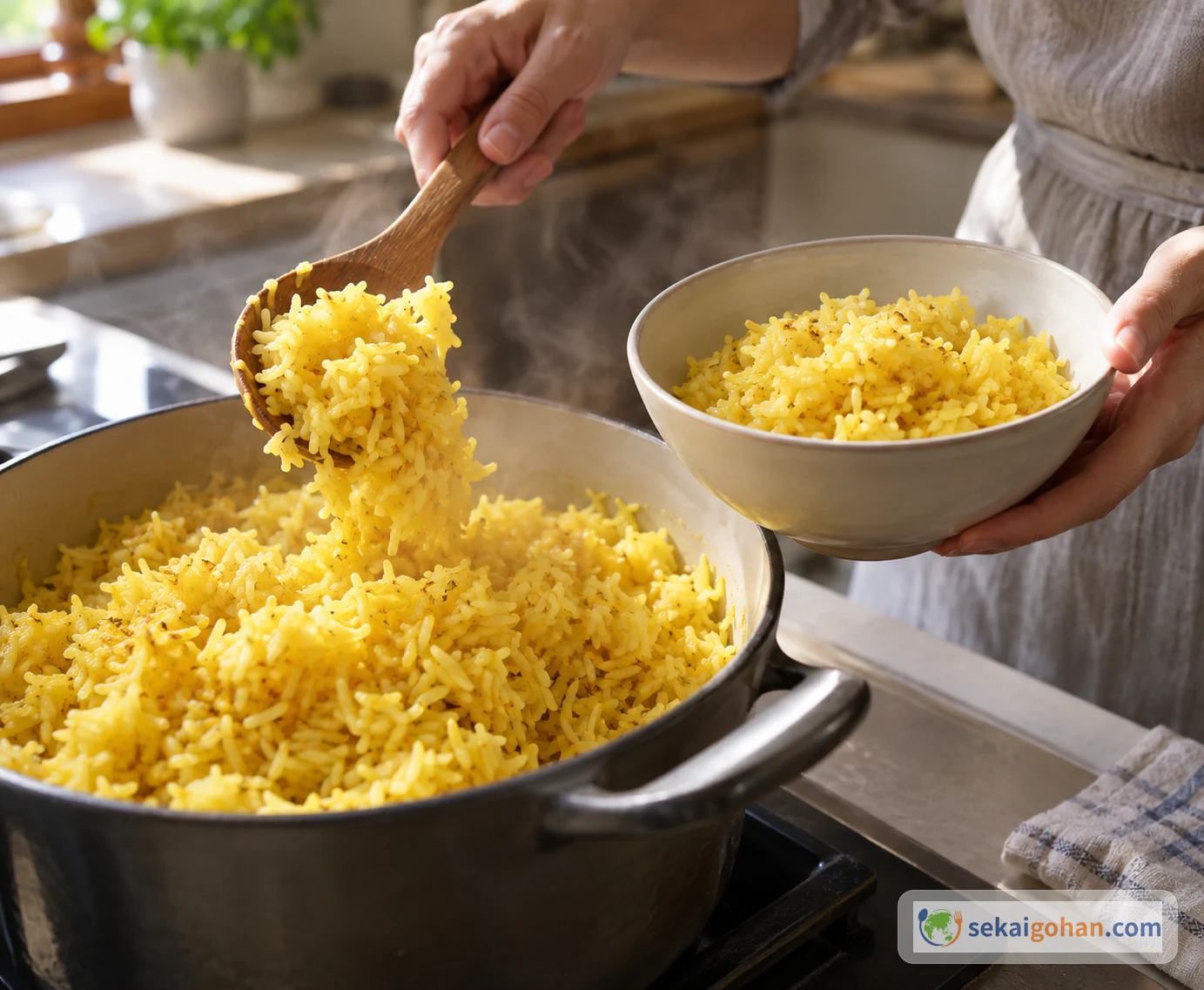
Nasi Kuning: Balinese Yellow Rice Steamed with Coconut Milk and Aromatics

Yellow nasi kuning steamed following a Balinese cookbook recipe
Serves
About 2 kg cooked rice (as stated in the source)
Cuisine
Indonesian (Balinese)

How to make nasi kuning following one recipe from a Balinese cookbook: turmeric water blended from fresh turmeric, coconut milk with garlic, lemongrass and galangal, and a two-stage steaming method. Also covers how nasi kuning differs from the cone-shaped tumpeng, how to choose ingredients, and how to avoid mixing up the different waters.

Cooking flow

Cooking steps

STEP11 / 6

Make the turmeric water and measure out ½ cup (100ml)

Fresh turmeric blended with water, strained, and a portion measured out
Strain the turmeric water and set aside only the measured portion for the rice

Put the fresh turmeric and the 2 cups (500ml) of water in a blender and blend for about 2 minutes until fine. Strain the liquid. From the strained turmeric water, measure out ½ cup (100ml) for the rice. That ½ cup (100ml) is all the rice needs.

STEP22 / 6

Wash, soak and give the rice its first steam

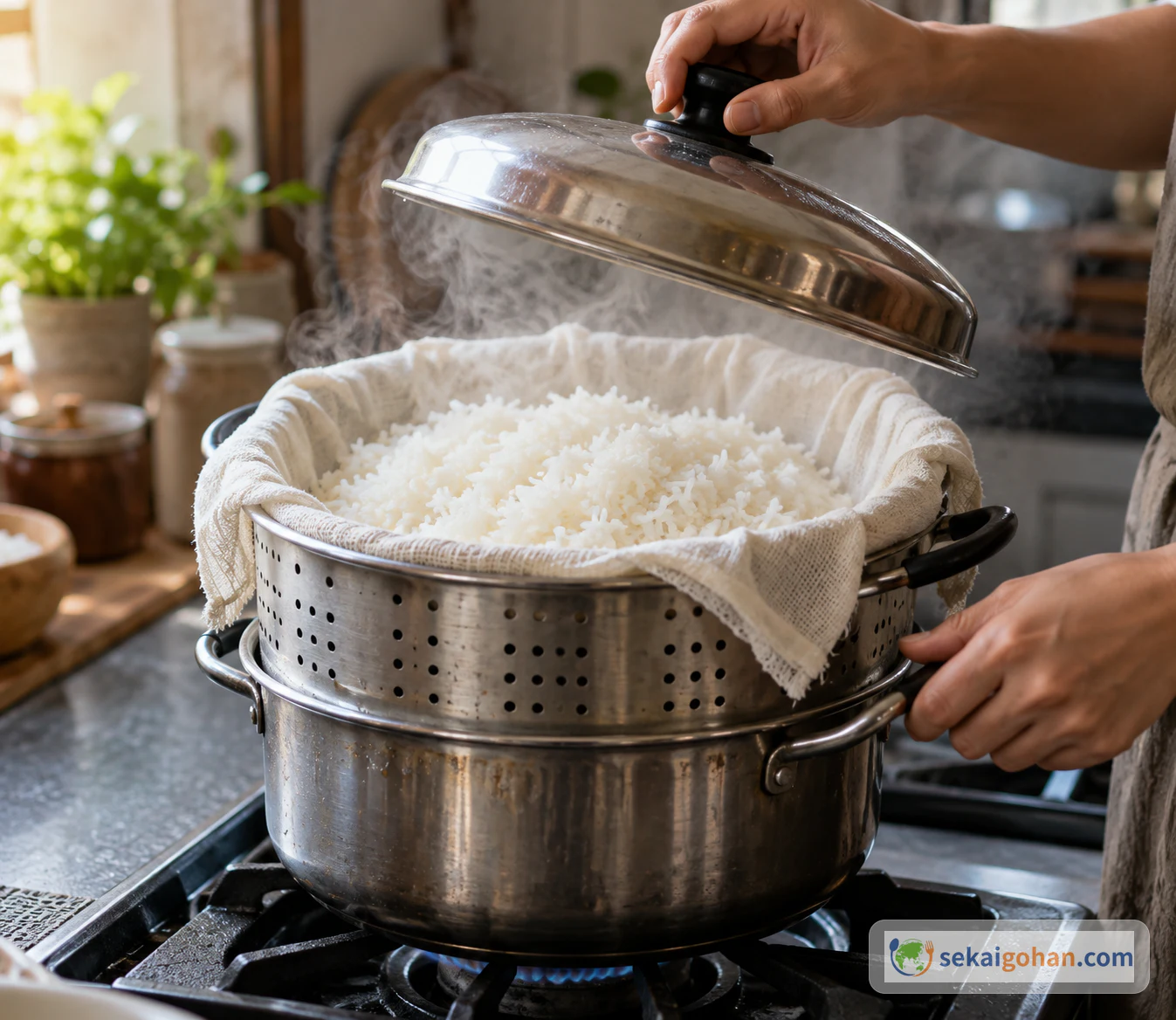
Soaked and drained rice in its first steaming
The rice is still white at the first steaming

Wash the rice, then soak it in water for 15 minutes. Drain it, put it in the steamer basket over boiling water, cover, and steam for 15 minutes. The water should sit about 1 inches (2.5cm) below the basket.

STEP33 / 6

Bring the cooking liquid to a boil

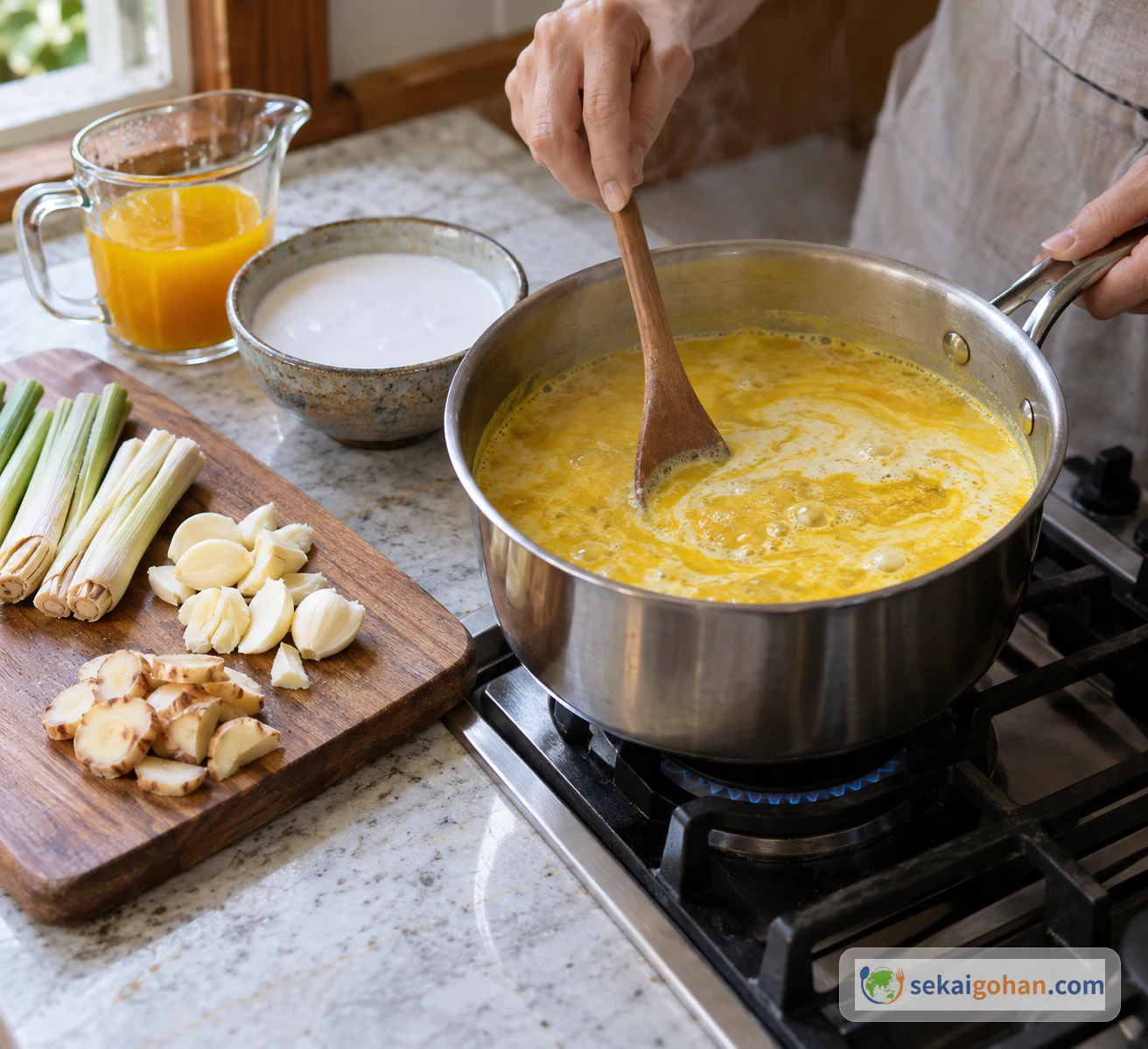
Turmeric water, water and coconut milk coming to a boil
Bring the yellow liquid to a boil with the aromatics ready nearby

In a saucepan, combine the 3¼ cups (800ml) of water, the ½ cup (100ml) of turmeric water and the ½ cup (150ml) of coconut milk, and bring to a boil. Have the garlic, lemongrass, galangal and salt ready to use in the next step.

STEP44 / 6

Combine the rice with the hot liquid and let it absorb

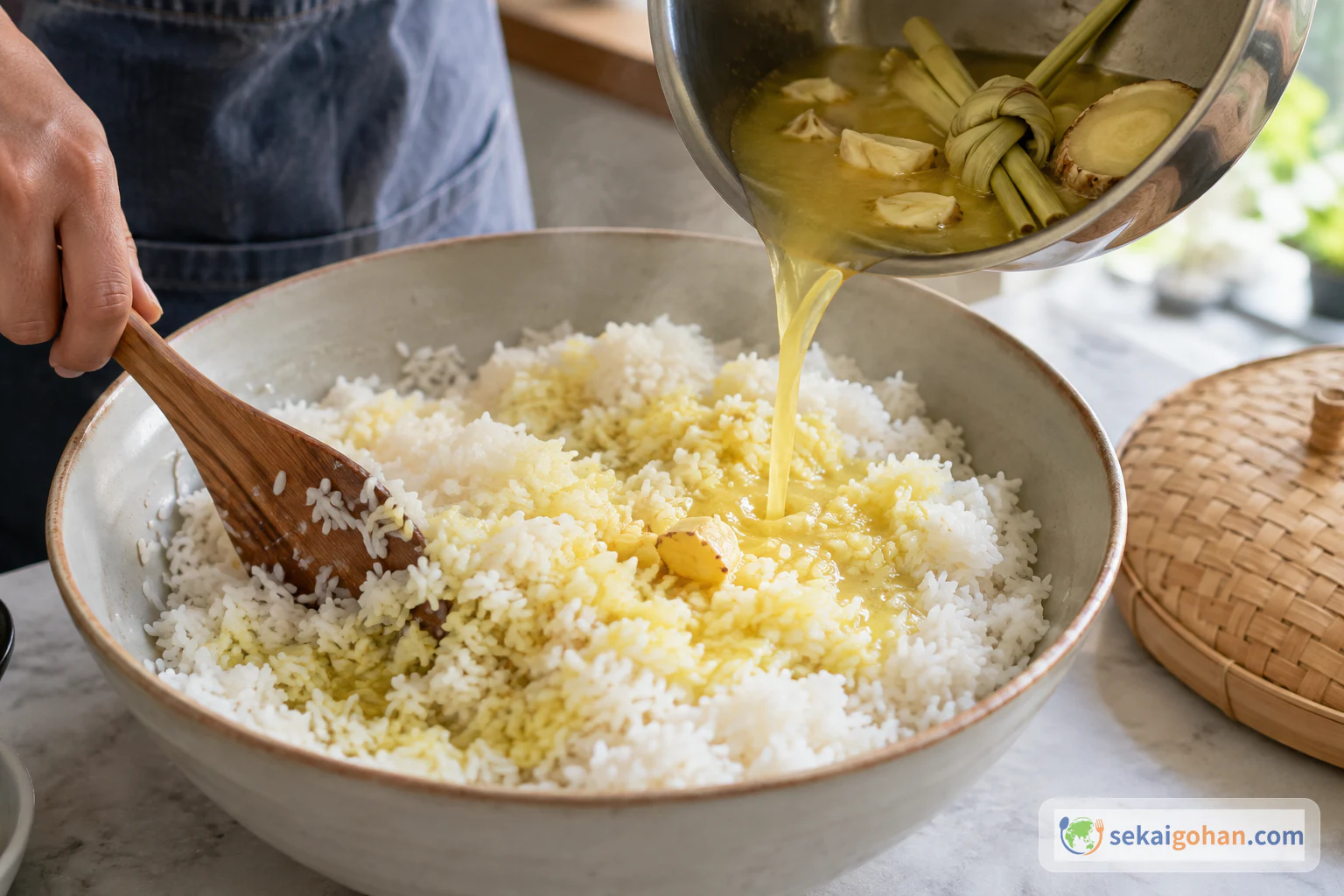
Steamed rice mixed with the hot liquid and aromatics before absorbing
Mix gently, then cover so the rice can soak up the liquid

Transfer the steamed rice to a large bowl. Add the hot liquid along with the garlic, lemongrass, galangal and salt, and mix. Cover and leave for about 20 minutes, until the rice has absorbed the liquid.

STEP55 / 6

Return the rice to the steamer for a second steam

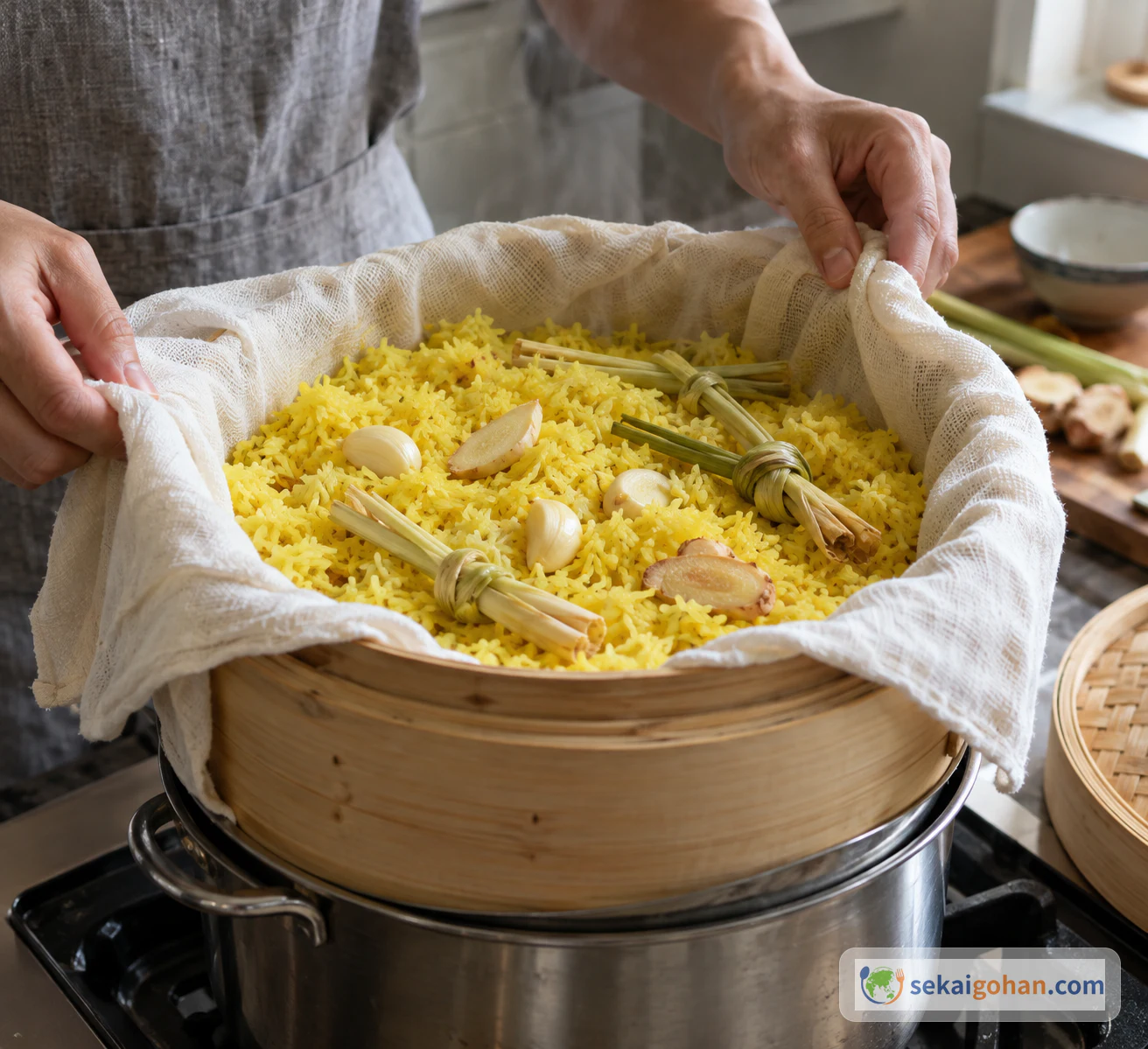
Yellow rice back in the steamer for the second steaming
The second steaming finishes cooking the rice

Loosen the rice, then return it to the steamer over boiling water. Steam for about another 20 minutes, until the rice is cooked through.

STEP66 / 6

Fluff and serve

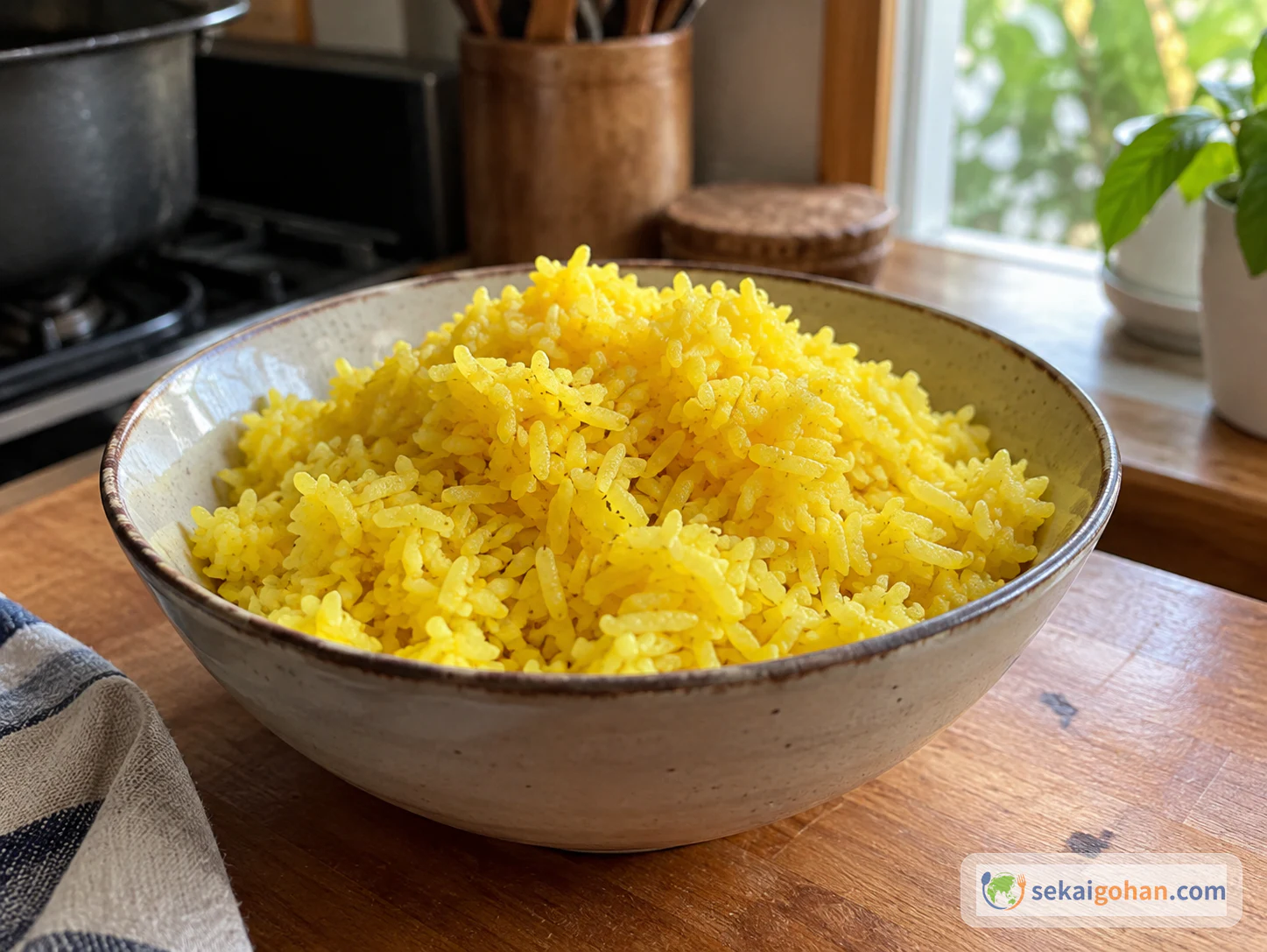
Freshly steamed yellow rice being fluffed and served
Fluff the rice gently as you serve it

When the rice is fragrant, yellow and cooked through, fluff it gently and serve it.

0 / 0
Ingredients

Ingredients

1 / 3

For the turmeric water (air kunyit)

Ingredient Amount Notes
Fresh turmeric 5 inches (12.5cm) piece Measured by length
Water 2 cups (500ml) For making the turmeric water only. Not the rice's cooking liquid
2 / 3

For the rice

Ingredient Amount Notes
White rice 2.25 lb (1kg) Washed and soaked before steaming
Water for soaking and for the steamer As needed Separate from the waters above and below
3 / 3

For the hot liquid and aromatics

Ingredient Amount Notes
Water 3¼ cups (800ml) The rice's cooking liquid
Turmeric water (from above) ½ cup (100ml) Use only this amount of what you made
Coconut milk ½ cup (150ml)
Garlic 4 cloves Crushed
Lemongrass 2 stalks Bruised and tied in a knot
Fresh galangal 0.5 inches (1cm) piece Thickly sliced and bruised
Sea salt 2 tsp
0 / 0

Fresh turmeric root gives this rice its sunny color, and coconut milk, garlic, lemongrass and galangal give it its fragrance. Nasi kuning means "yellow rice," and in Bali that yellow carries meaning of its own. The rice is steamed plain first, then left to soak up a hot liquid tinted with turmeric and enriched with coconut milk, the aromatics and sea salt, and finally steamed a second time until tender. The recipe starts with 2.25 lb (1kg) of rice and yields about 4.5 lb (2kg), and it works best at full size, so make the whole batch. Plan on about 20 minutes of preparation and 55 minutes of cooking, but steamers and stovetops differ, so trust the state of the rice more than the clock.

Nasi Kuning and Tumpeng

Nasi kuning is a way of cooking rice. Tumpeng is a way of presenting it: rice shaped into a cone and surrounded by side dishes, served mainly at selamatan gatherings in Java, Sunda, Madura and Bali. Yellow rice is a common choice for tumpeng, but white rice and nasi uduk are used too, so a tumpeng is not always yellow, and nasi kuning is often simply served in a bowl.

The color has drawn plenty of interpretation. Nasi tumpeng kuning has been linked to Hindu beliefs, Mount Meru and wider symbolism, and there are accounts of what the colors mean in Bali specifically. These are readings rather than a settled history of the dish, and they belong to Bali rather than to all of Indonesia. Nasi kuning is also everyday food as well as celebration food; how you shape it and what you serve alongside are up to you.

Ingredients for the Full 2.25 lb (1kg) Batch
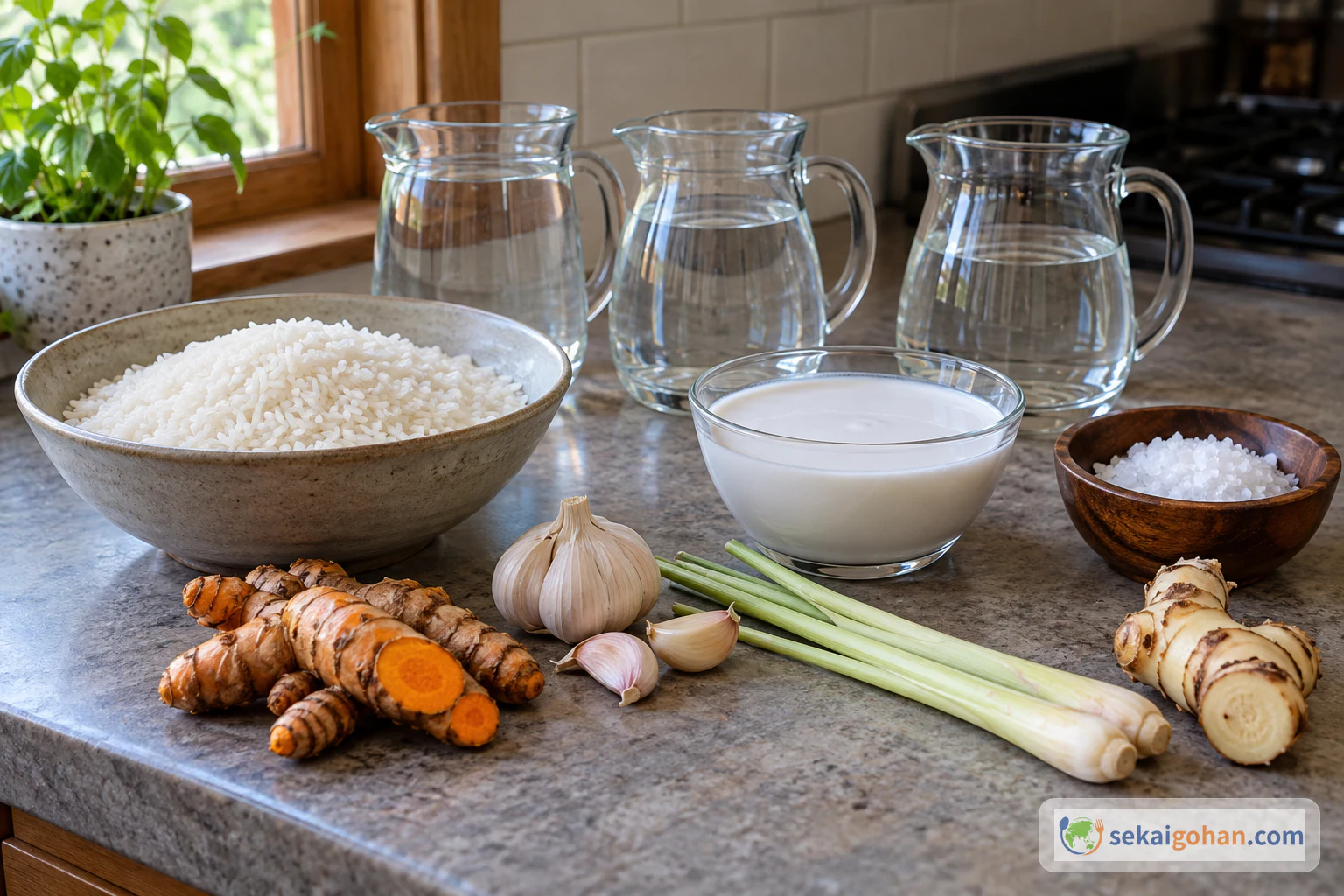
White rice, fresh turmeric, coconut milk, aromatics and separate jugs of water for each use
Keep the water for turmeric, cooking liquid and soaking in separate jugs

Equipment

  • Blender
  • Fine strainer
  • Measuring jug
  • Steamer with a basket and lid
  • Saucepan
  • Large bowl and a cover for it

Choosing Ingredients for Nasi Kuning

Fresh turmeric. Use fresh turmeric, measured by length rather than weight. Asian and Indian grocers are the best places to find the root.

Galangal and lemongrass. Both are part of the flavor of this rice. Ginger in place of galangal, or lemon juice in place of lemongrass, gives you a variation with a different taste.

Rice. Use white rice. Short-grain rice such as Japanese rice works, but it cooks up stickier, so expect a softer, clingier texture.

Coconut milk. Products vary, so check the label for ingredients and allergen information.

Three different waters

This recipe uses water for three separate jobs: 2 cups (500ml) to make the turmeric water, 3¼ cups (800ml) as the cooking liquid for the rice, and additional water for soaking the rice and filling the steamer. Of the strained turmeric water you make, use only ½ cup (100ml). Do not pour all of it into the rice, and do not confuse it with the 3¼ cups (800ml) of cooking liquid.

Method: Turmeric Water, First Steam, Absorbing, Second Steam

Read before you start

Get the steamer water ready before you steam. Keep the water level about 1 inches (2.5cm) below the steamer basket, so the boiling water does not touch the rice, and do not let the steamer boil dry. All times are guides; check how the rice is cooking as you go.

Troubleshooting Nasi Kuning

What happened Likely cause What to do
The rice is too wet or the color too strong All the turmeric water went in, or the waters were mixed up Next time, use only ½ cup (100ml) of turmeric water and keep the 3¼ cups (800ml) cooking liquid and the soaking and steamer water separate
The bottom of the rice is soggy The steamer water was touching the basket Keep the water level about 1 inches (2.5cm) below the basket
The steamer ran dry Not enough water for the full steaming time Check the water level during each steaming and add hot water before it runs low
Liquid is still pooling in the bowl after about 20 minutes The rice has not finished absorbing Leave it covered until the liquid is absorbed before the second steam
The rice is still firm after the second steam Steamers and heat differ Keep steaming and check again until the rice is cooked through
The aroma is weak Aromatics were not crushed or bruised Crush the garlic, and bruise the lemongrass and galangal before adding them

Serving, Variations and Storage

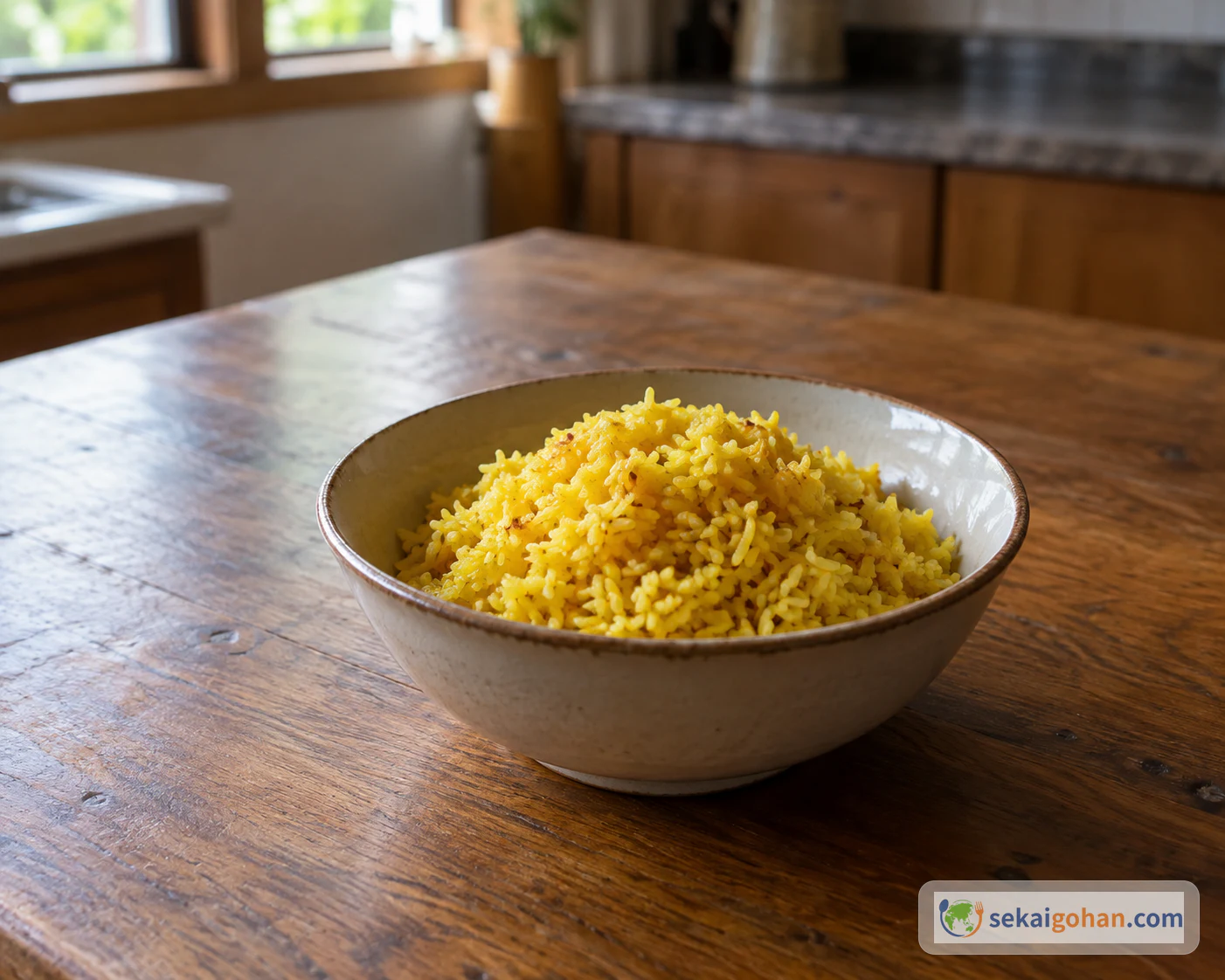
A bowl of plain nasi kuning on a home table
Nasi kuning can be brought to the table on its own

A plain bowl of yellow rice is all this recipe makes, and it's lovely just like that. Eggs, fried shallots and other side dishes are separate dishes you can add if you want to build a fuller meal or a tumpeng.

Other cooks make it differently. One version uses long-grain rice and a dressing of shallot, garlic, chicken stock, coconut milk, lemongrass, salam leaf, pandan and turmeric water, also steamed in two stages. It's a good dish in its own right, with a different character from this one.

Handling cooked rice

Heat food until the center reaches 167°F (75°C) for at least 1 minute. Use separate utensils for raw and cooked foods. Put leftover nasi kuning in shallow containers, cool it quickly and refrigerate it. Reheat thoroughly before eating.

Frequently Asked Questions

Does nasi kuning have to be shaped into a cone?

No. The cone is tumpeng, a way of presenting rice and side dishes. Tumpeng is often made with yellow rice, but white rice and nasi uduk are also used, and nasi kuning can be served simply in a bowl.

Can I use ground turmeric instead of fresh?

This recipe is written for fresh turmeric root, so the color and the amounts are based on fresh.

Do I use all 2 cups (500ml) of the turmeric water?

No. The 2 cups (500ml) of water is for making the turmeric water. Of the strained liquid, use only ½ cup (100ml) in the rice, together with the separate 3¼ cups (800ml) of cooking water and ½ cup (150ml) of coconut milk.

For more dishes from the same country, see Indonesian recipes.

Sources

  • Tjok Maya Kerthyasa and I Wayan Kresna Yasa, Paon: Real Balinese Cooking (Hardie Grant), "Nasi kuning (yellow rice)," published by SBS Food. The recipe followed here: ingredients, preparation and use of turmeric water, soaking, two-stage steaming and absorption, the finished amount of about 2kg, the preparation and cooking time guides, the note against making a smaller quantity, and the Balinese meaning of the color. https://www.sbs.com.au/food/recipe/nasi-kuning-yellow-rice/a1mfmil4h
  • BPSMP Sangiran, Indonesian Ministry of Education and Culture portal, "Filosofi Tumpeng di BPSMP Sangiran." Tumpeng as rice and side dishes presented in a cone; yellow rice as common but white rice and nasi uduk also used; the selamatan context in Java, Sunda, Madura and Bali; and the page's interpretation of the cone's symbolism. https://kebudayaan.kemdikbud.go.id/bpsmpsangiran/filosofi-tumpeng-di-bpsmp-sangiran/
  • "Indonesian food culture mapping: a starter contribution to promote Indonesian culinary tourism," Journal of Ethnic Foods (Springer Nature). The paper's discussion of nasi tumpeng kuning in relation to Hindu beliefs, Meru and symbolism. https://link.springer.com/article/10.1186/s42779-019-0009-3
  • The Culinary Institute of America, World Culinary Arts: Indonesia and Malaysia (2014), "Yellow Rice / Nasi Kuning." A different published recipe with long-grain rice and a dressing, steamed in two stages, and the document's own statement on color symbolism in Bali. https://ciaprochef.com/wp-content/uploads/2024/04/WCA_IndonesiaMalaysia_Recipes.pdf
  • Ministry of Health, Labour and Welfare (Japan), "家庭でできる食中毒予防の6つのポイント" (Six points for preventing food poisoning at home). General home guidance on heating to 75°C at the center for at least 1 minute, separating utensils, cooling in shallow containers and reheating. https://www.mhlw.go.jp/stf/seisakunitsuite/bunya/kenkou_iryou/shokuhin/syokuchu/01_00006.html