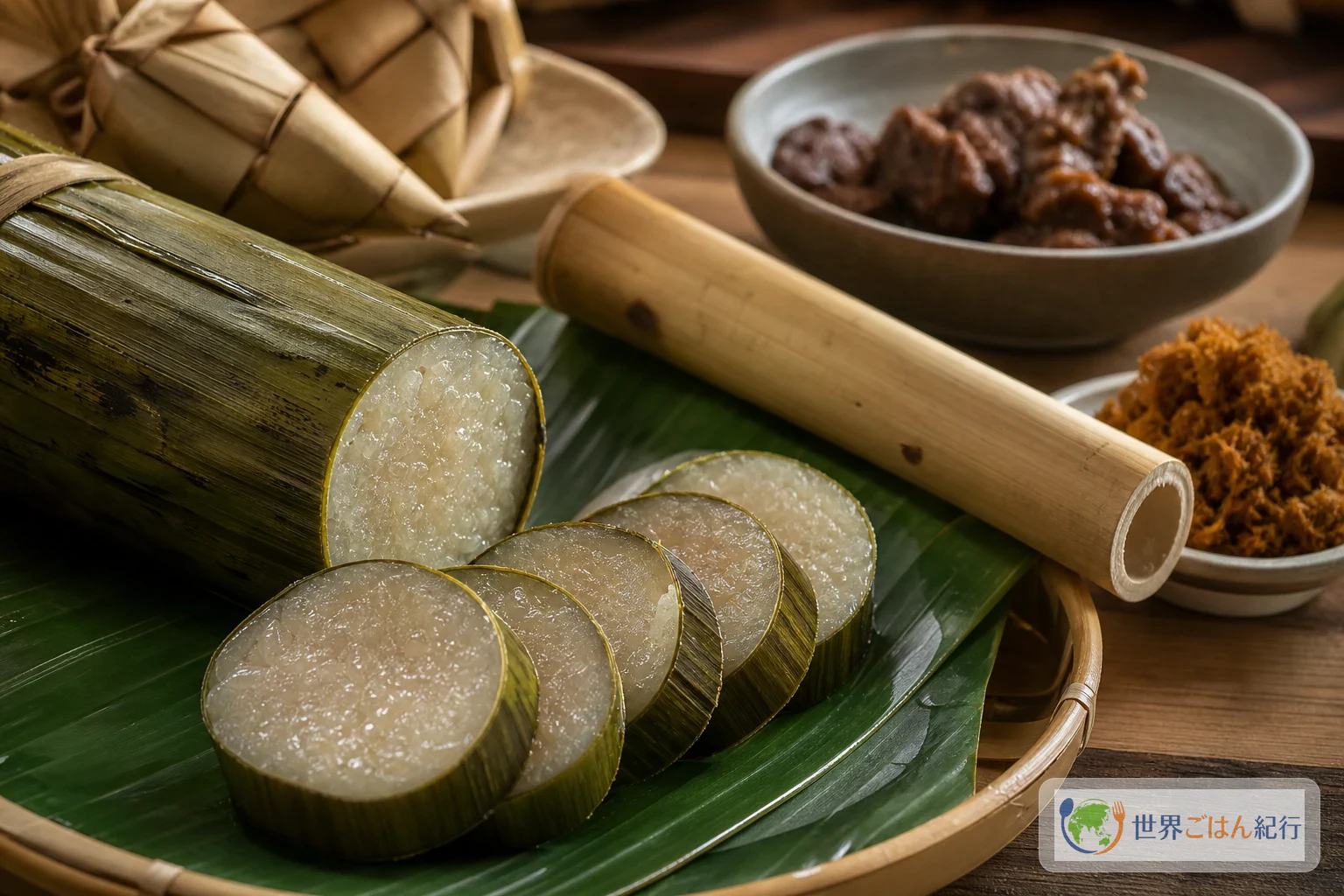
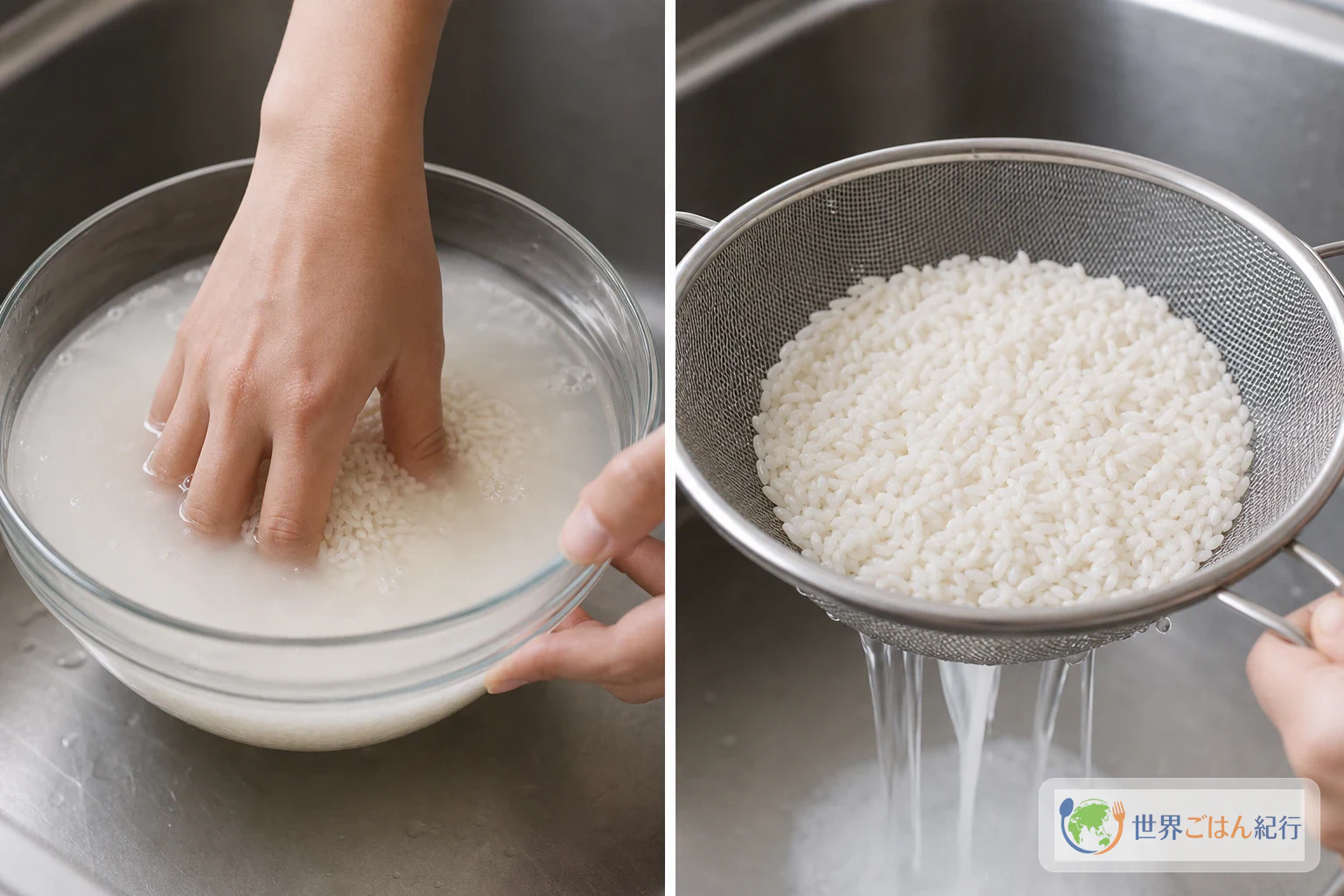
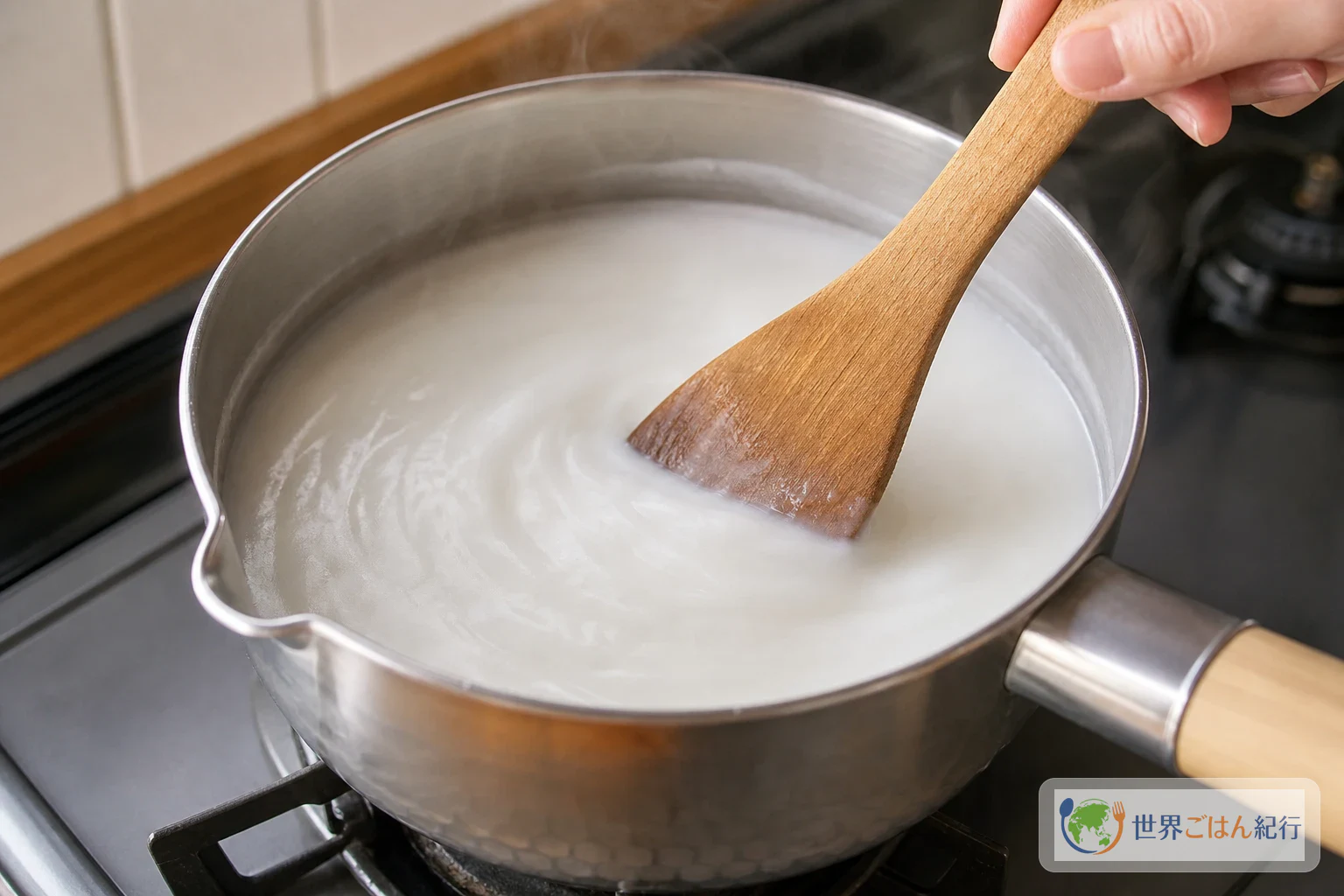
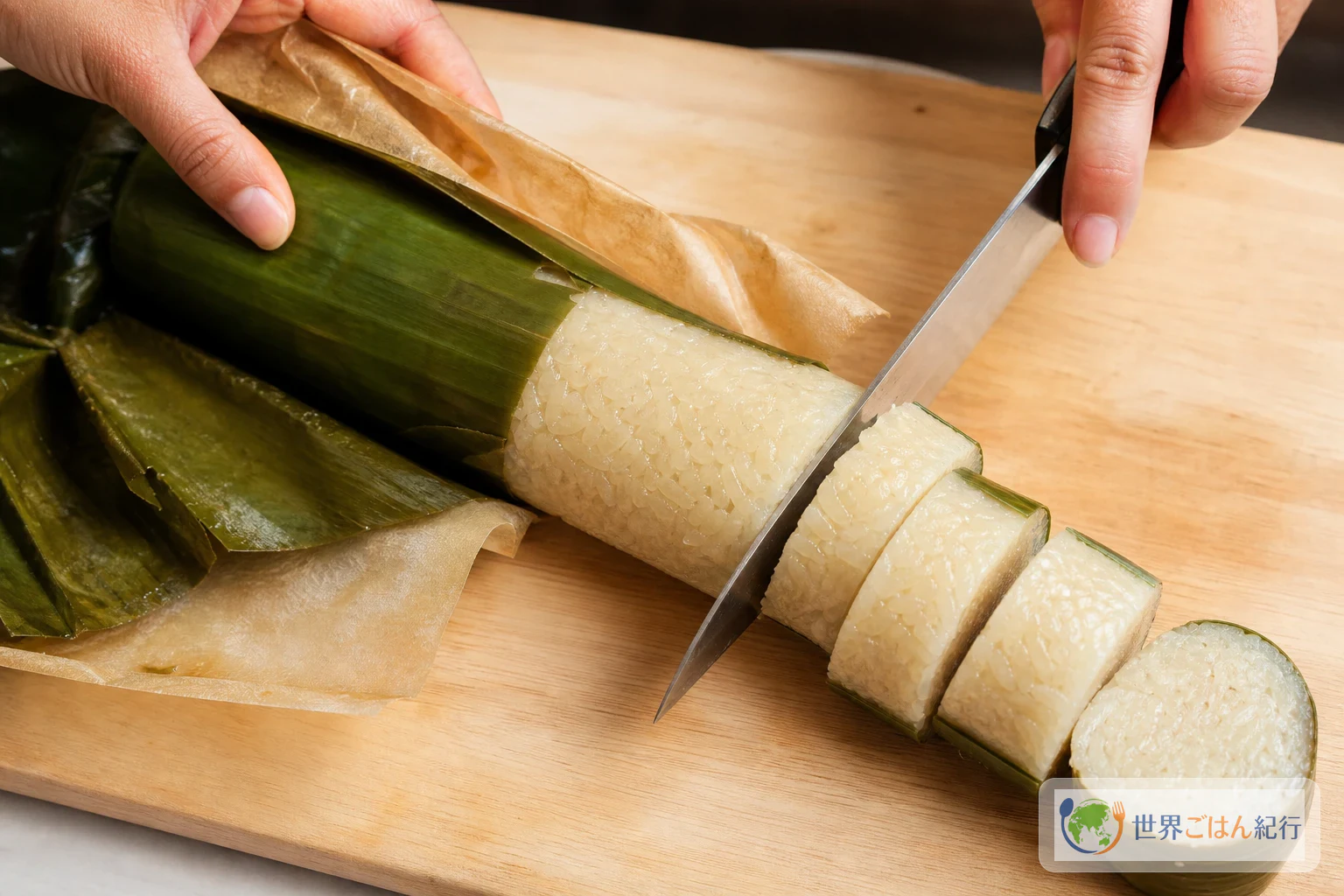
When you wash glutinous rice for lemang, the water in the bowl turns milky white. A few hours later, that same rice has become a log you can slice with a knife. Lemang is glutinous rice and coconut milk cooked together, traditionally in bamboo, and on Malaysian festive tables it is the salty rice that goes alongside strongly flavored dishes such as rendang and sambal. The ingredients are few. The flavor comes from steaming the rice inside the bamboo tube, turning it again and again near the fire.
Lemang across Malaysia and maritime Southeast Asia
Lemang is eaten across maritime Southeast Asia, in Brunei, Indonesia, Malaysia, and Singapore. In Malaysia it is served for Hari Raya Aidilfitri and Aidiladha, when it takes the place of white rice next to rendang and sambal. It comes to the table in the tube and is cut just before eating, so it is easy to share however many people turn up.
A white slice of lemang is not rice you finish by adding flavor. It is a base that soaks up the juices of strong side dishes and calms the mouth for a moment. If you have made nasi lemak, you will recognize the coconut aroma, but lemang is closer to a cut-and-keep preserved food than to "cooked rice."
Regional differences
Regional differences show more in when lemang is eaten than in the main ingredient. In the northern states of Kelantan and Terengganu, you find lemang at stalls and Malay restaurants. In Negeri Sembilan, "lemang tepung" is a sweet version made with wheat flour, coconut milk, and red sugar instead of glutinous rice. It is cooled and eaten as a sweet, while lemang proper pairs with salty dishes.
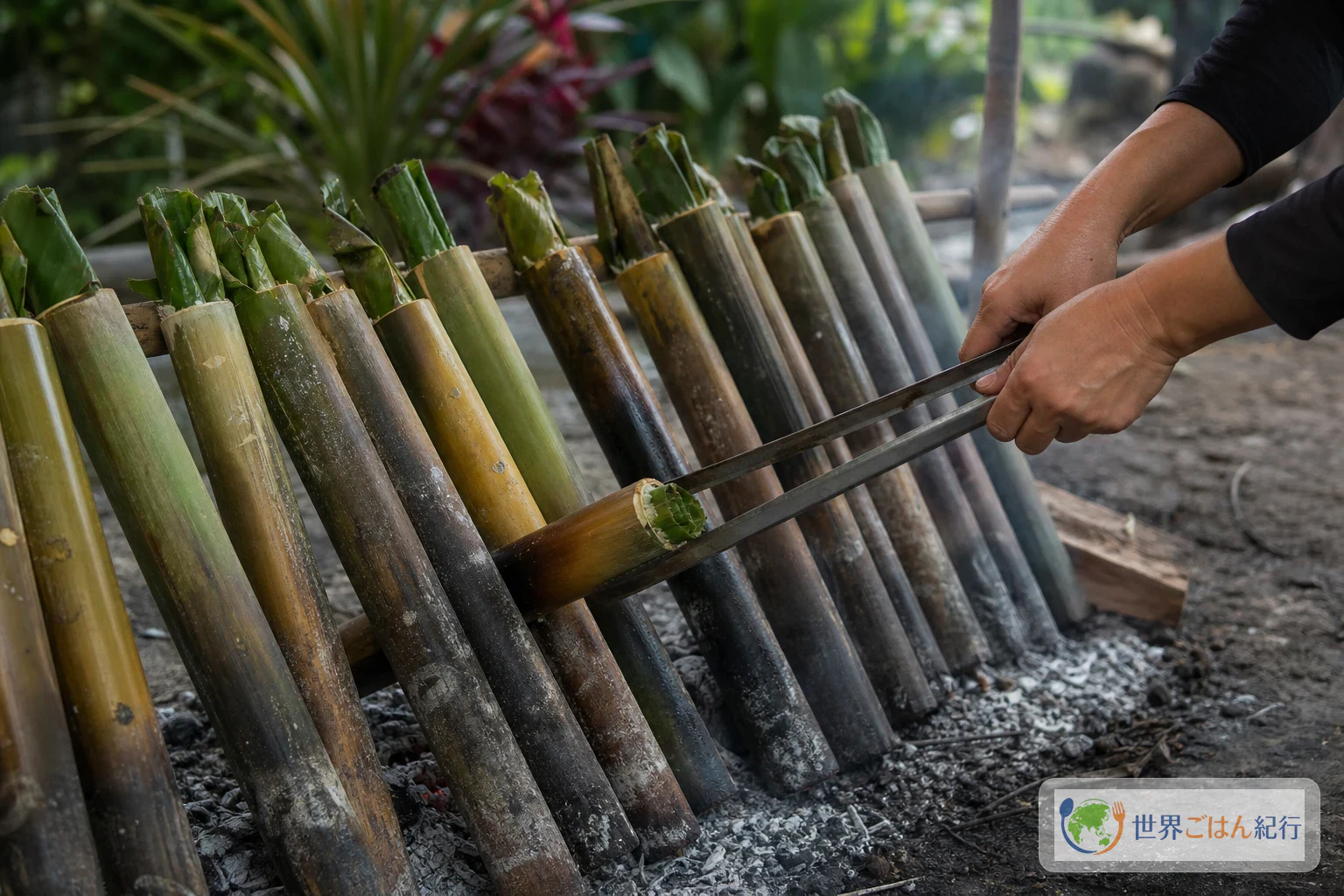
The Negeri Sembilan dialect also has a word, "langgai," for the crosspiece that holds the bamboo tube beside the fire. Even the spot where the tube is set has its own name. That one short word shows that lemang was made by several people around a fire, not by one person at a rice cooker.
Lemang in a home kitchen
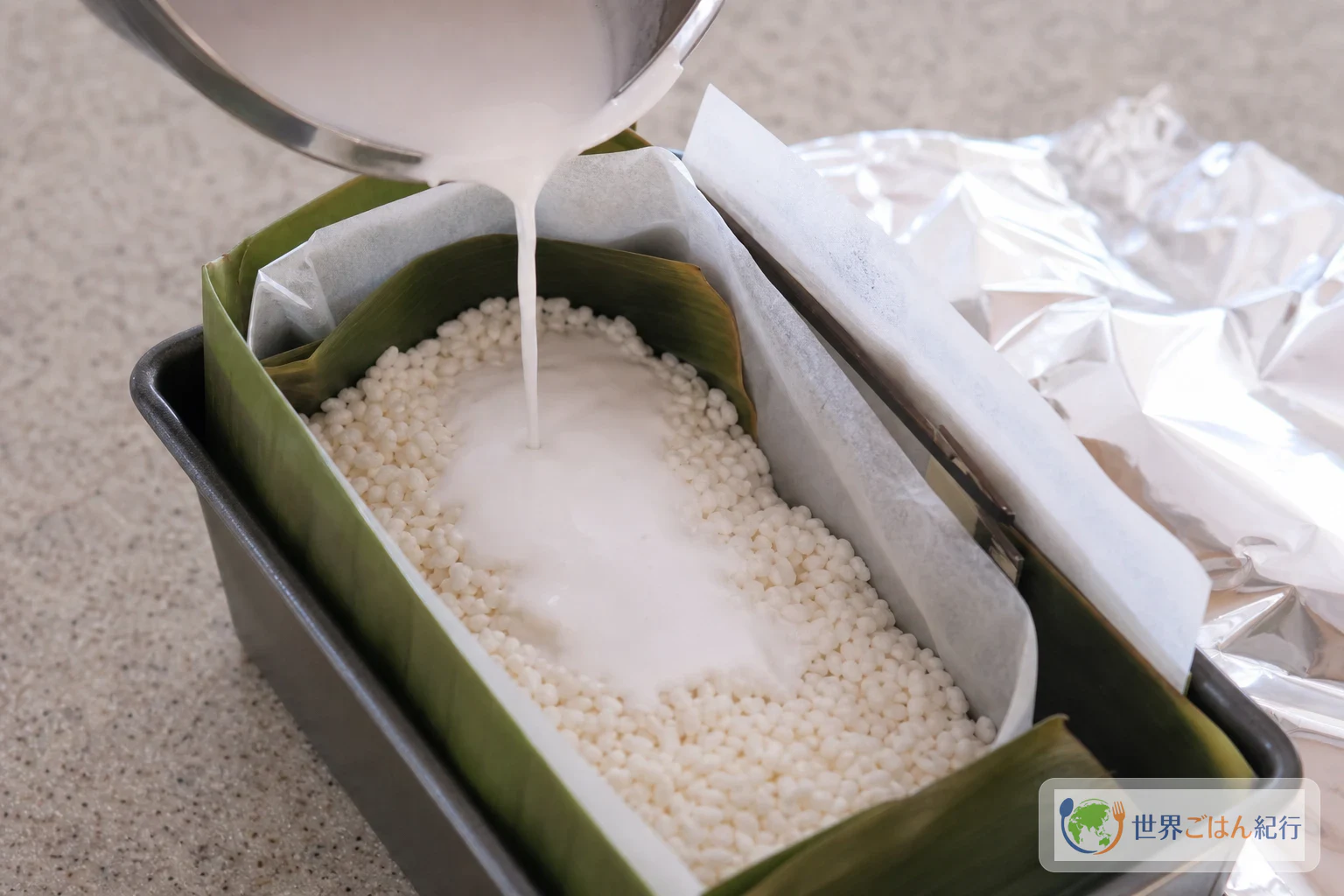
Cooking in bamboo over an open fire gives very different results depending on the thickness of the tube, the overlap of the leaves, and the distance from the fire. The home version cooks the rice through with steam, rewraps it in leaves, and finishes it with a brief browning in the oven. Don't copy the bamboo tube exactly. Keep to an order in which the center of the rice sets evenly and the scent of the leaves remains. What you are after is a slice with the stickiness of glutinous rice, the round, fatty aroma of coconut, and a green note of leaf after the salt. It should be ready to soak up rendang sauce.
Ingredients and equipment
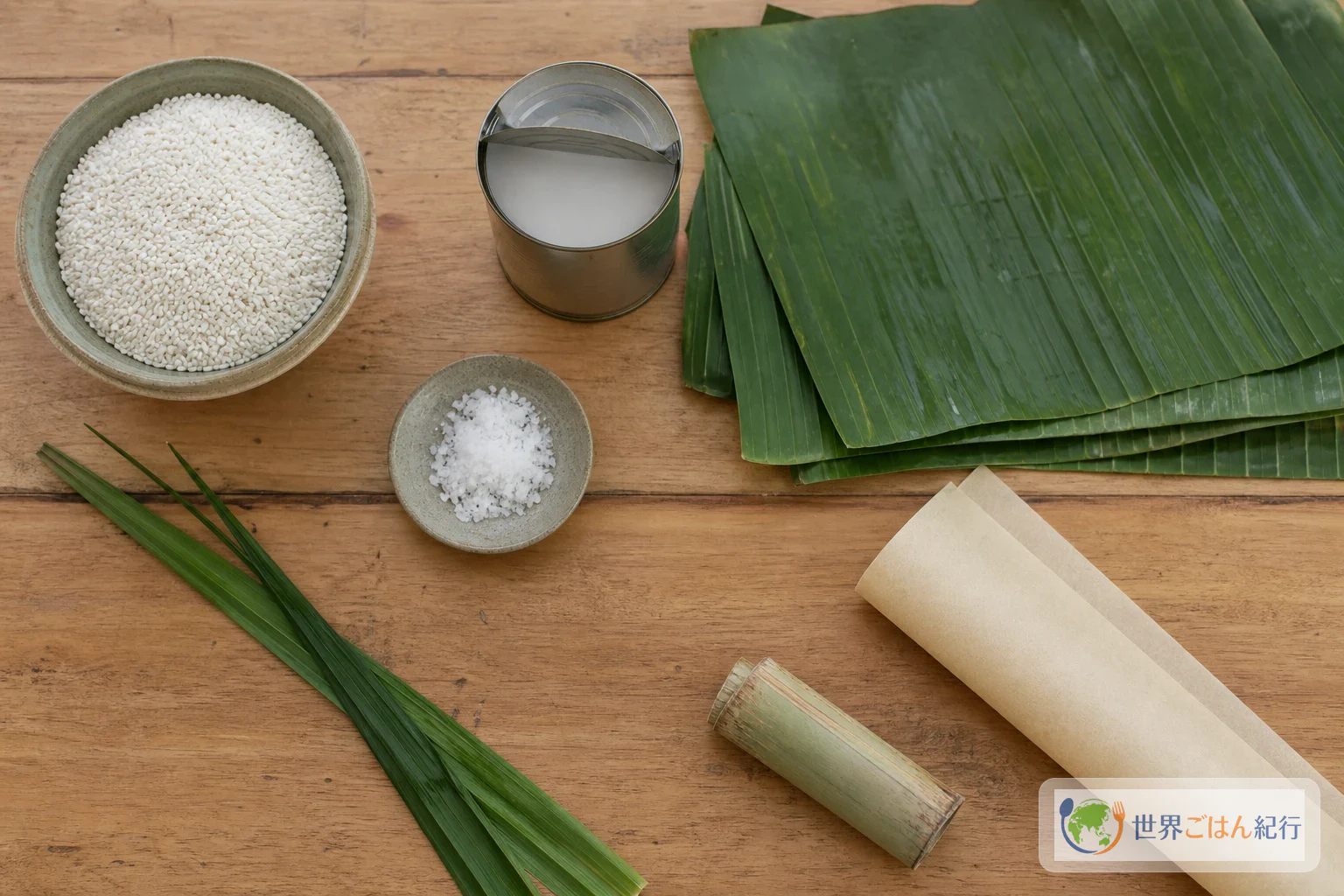
Ingredients (serves 4)
Don't use ordinary rice. Without the stickiness of glutinous rice, it won't hold together when you slice it into rounds after cooling. If you buy it, check that the product name says "glutinous rice" and that the only ingredient is rice. If you already have locally grown glutinous rice, use that. If you buy Thai rice, look for "glutinous rice" on the package, not the milling date, and check the quantity.
Equipment
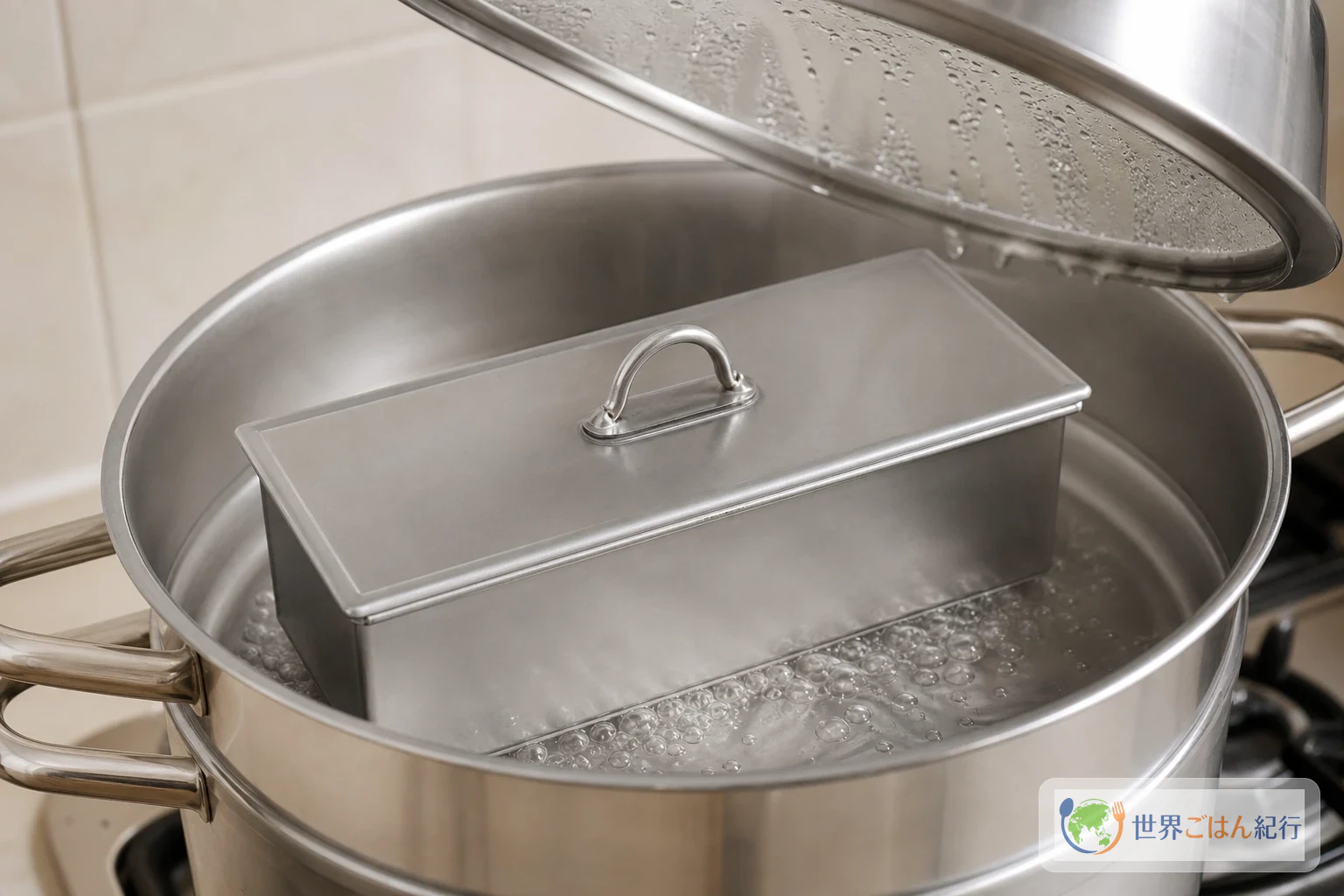
You will use a metal loaf pan of about 8 inches (20 cm) × 3 inches (8 cm) × 3 inches (7 cm), parchment paper, aluminum foil, a steamer, oven mitts, and a knife. For the pan, choose a shallow one that fits in the steamer with its cover on, not the inner pot of a rice cooker. If you stand banana leaves up to line it, you can lift the cooked rice out and re-wrap it.
Choosing a steamer and coconut milk for lemang
Whether to buy a steamer depends less on steam strength than on how the pan fits. A steamer basket of about 9.5 inches (24 cm) that sits on a pot you already own works well, as long as it does not touch the pan when the lid is closed, and you can use it for rice dishes and dim sum too. A deep pot, a steaming rack, and a lid will also do the job if you can set the pan level. If you are shopping online, check the outside diameter, whether it has two tiers, whether a lid is included, and whether it fits your pot.
When you open the can, if a thick layer of solids floats on top, increase the 3.5 tbsp (50 ml) of hot water to 60 to 70 ml. If it is a watery carton type, reduce the hot water to 2 tbsp (30 ml). Make sure it is unsweetened coconut milk for cooking, not a coconut drink or a sweetened product.
You only need 1 cup (250 ml). The rest of a 1¾ cups (400 ml) can goes well in rendang or soup, or look for a small-portion product of matching volume.
Common lemang failures and fixes
Most problems with lemang come from three places: rice that was not soaked long enough, steam droplets falling on the rice, and slicing too soon.
Soak for 4 hours in room-temperature water so the water reaches the center of the rice. Even in a hurry, do not stop at 2 hours; soaking overnight is more reliable. If the grains are still hard after soaking, more steaming time only makes the outside collapse first.
The double layer of aluminum foil keeps steam droplets out, but pressing it on hard traps air inside. If droplets fall on the rice, only the bottom turns soft, and it tends to split when you rewrap it.
Lemang is softest right after steaming and looks unfinished, and slices cut while it is hot get crushed. Leave it wrapped for 20 minutes. If it still sticks to the knife, wait 10 more minutes, until the rice clings only a little to your fingers. Skipping the cooling time makes it fail on shape, not on doneness. Remember this so you don't panic halfway through.
If it comes out sticky and won't slice, cool it another 10 to 20 minutes first. If liquid still seeps out, next time reduce the water by 1.5 tbsp (20 ml) to suit how thick your coconut milk is, and don't pack the rice to the top of the pan. Stickiness is most likely when you cut it right after steaming, leave the droplets on the foil, and eyeball the liquid instead of measuring.
Serving, storing, and varying lemang
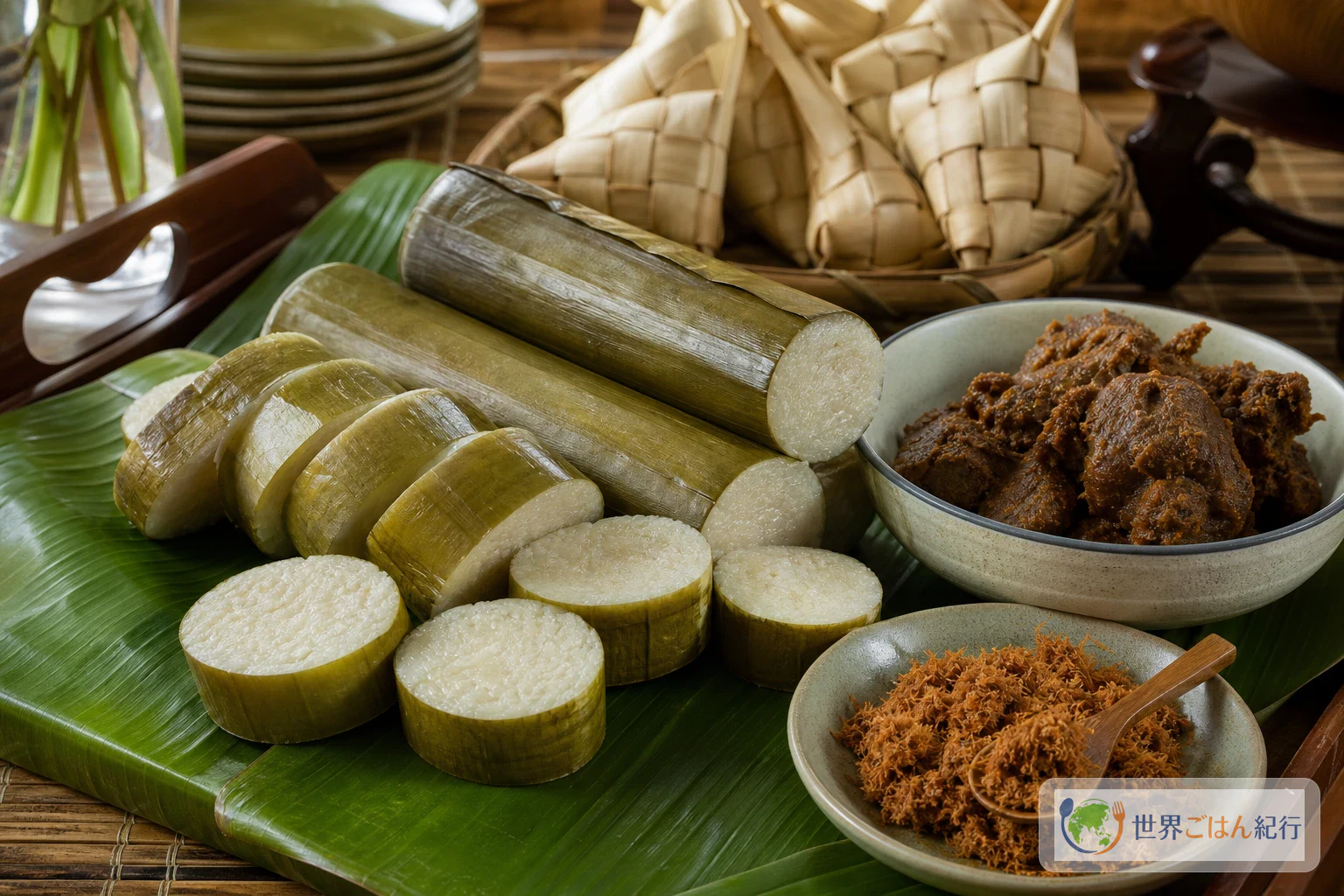
Serve lemang in rounds with rendang or the shredded-meat serunding, where the coconut fat and the spice aromas layer together. Once it is cool, you can wrap and refrigerate it slice by slice and eat it the next day.
Don't leave steamed lemang at room temperature for long. Once it's off the heat, move it to a shallow container and refrigerate. At home, eat it within about 2 days. Steam only the portion you will eat, or microwave it until hot in the center. Cool leftovers quickly before storing, and reheat them thoroughly, until the center reaches 167°F (75°C) or above. If you react to coconut, choose a different dish without coconut milk. For processed products, check the ingredients and allergen labels every time you buy.
| Variation | What changes | Suited to |
|---|---|---|
| Pandan scent | Add pandan leaf when warming | When you want to add one more aroma |
| Double leaves | Banana leaves both inside and outside | When you want the leaf aroma to be clear |
| Easy version | Omit the leaf and steam in parchment only | When you first want to check the texture |
| Black glutinous rice flecks | Replace 20 percent of the glutinous rice with black glutinous rice | When you want to change the look. Extend the soaking to 6 hours |
| Sweet serving | Serve a little gula Melaka or jam on the side | As a light snack without side dishes |
The first time you change things, keep the rice, coconut milk, and salt the same and change only the leaf or the side dishes. That way you can tell where the flavor changed.
Frequently asked questions
Can it be called lemang without a bamboo tube?
The home version is not the traditional bamboo method, but steaming and then rewrapping in leaf gets you close to the flavor and the sliceable shape. If you do use bamboo tubes, make sure they are clean and food-safe, and follow the seller's conditions of use. Never repurpose decorative bamboo.
Can I make it with locally grown glutinous rice?
Yes. Locally grown glutinous rice has round grains and tends to steam up softer, so keep the liquid as written and begin checking the steaming time at 55 minutes. Ordinary non-glutinous rice won't hold its shape when you cut it after cooling.
What can I substitute for banana leaf?
Parchment paper works, though you lose the green scent of banana leaf and the moment of unwrapping at the table. If you can get frozen banana leaf, thaw it and pass it through boiling water so it softens enough not to tear.
How do I reheat leftover lemang?
Steam again only what you will eat; this brings back the aroma of the leaf. In a microwave, cover it with a damp paper towel and heat it a little at a time. Throw out anything left at room temperature for a long time, or anything with an odd smell or surface.