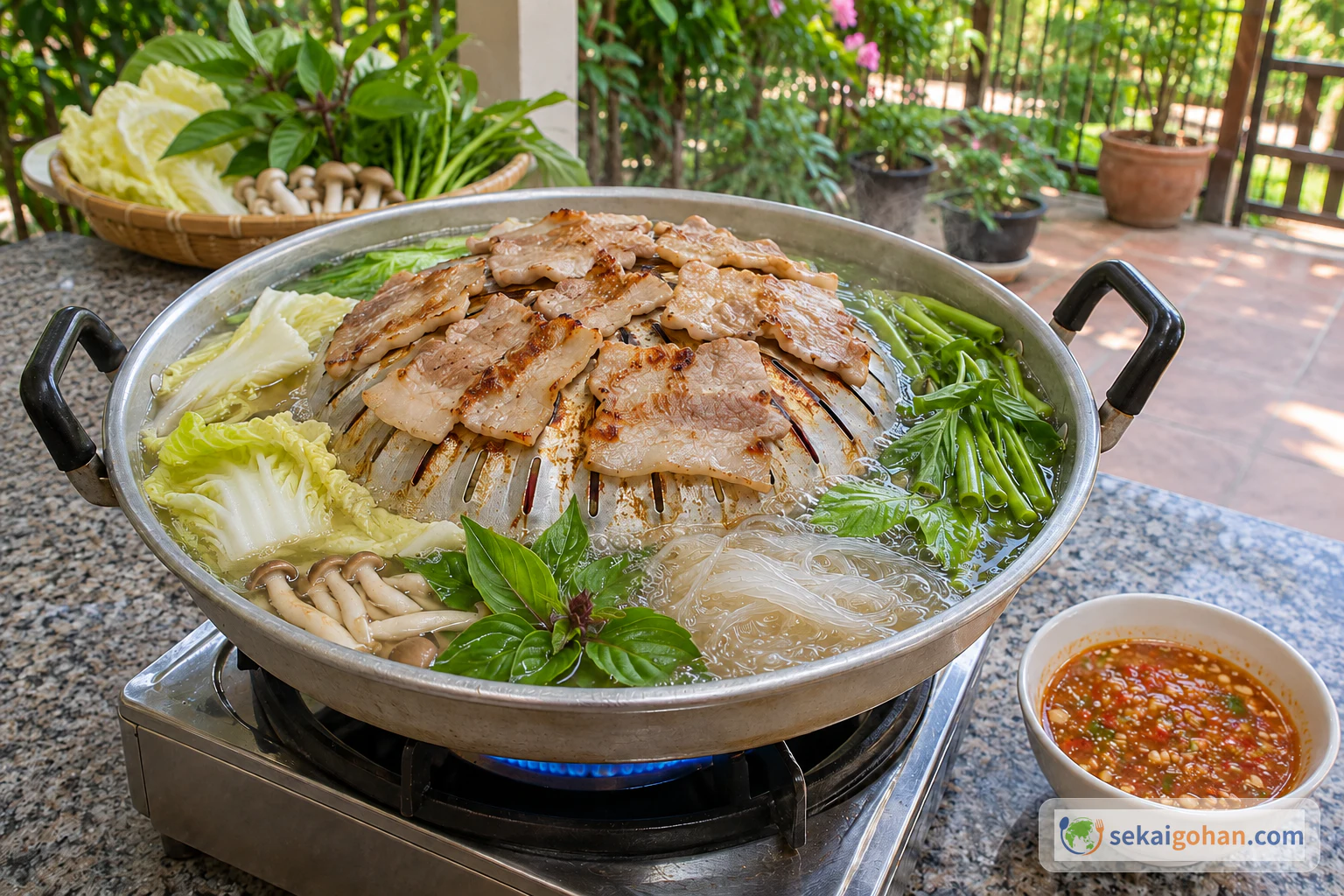
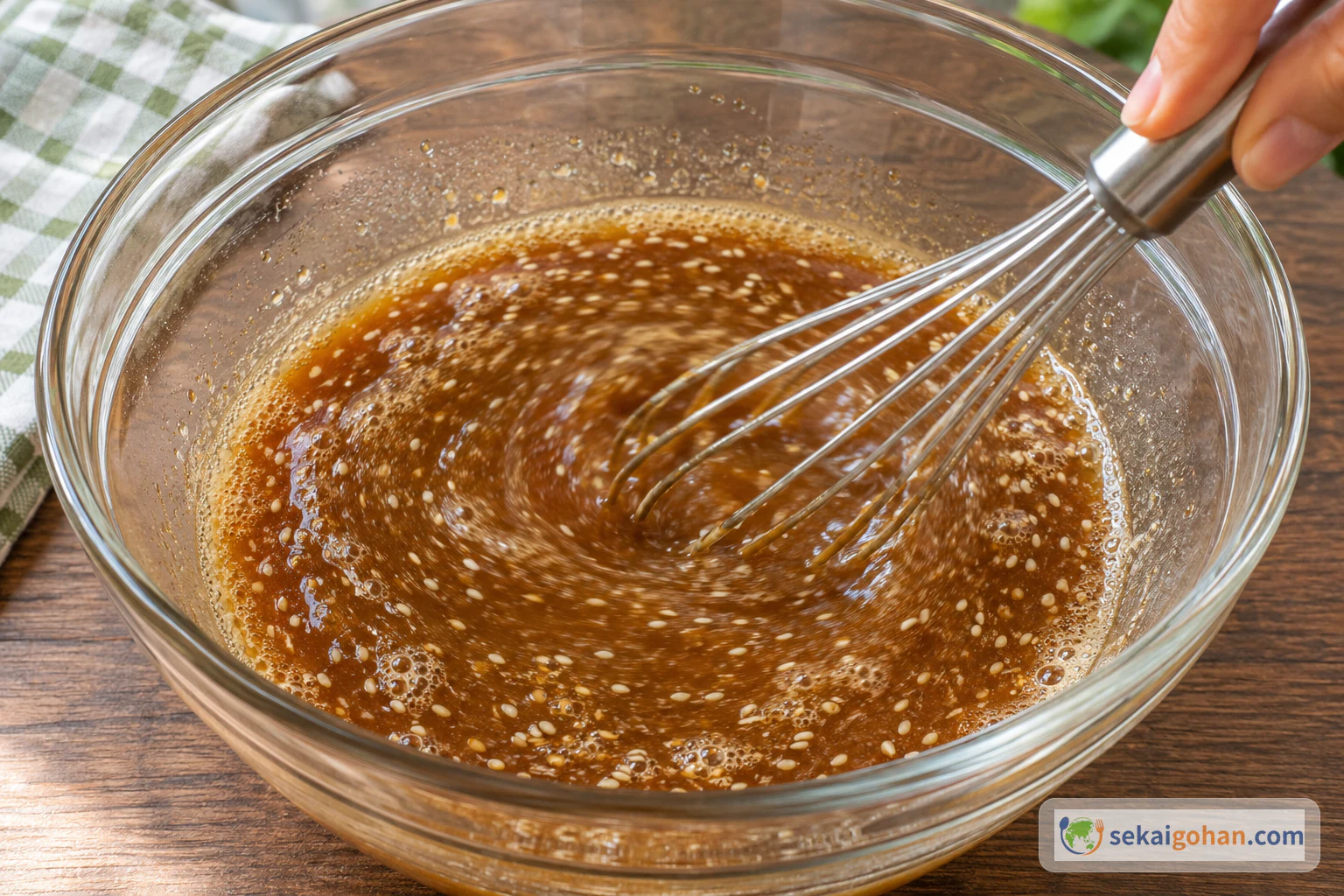
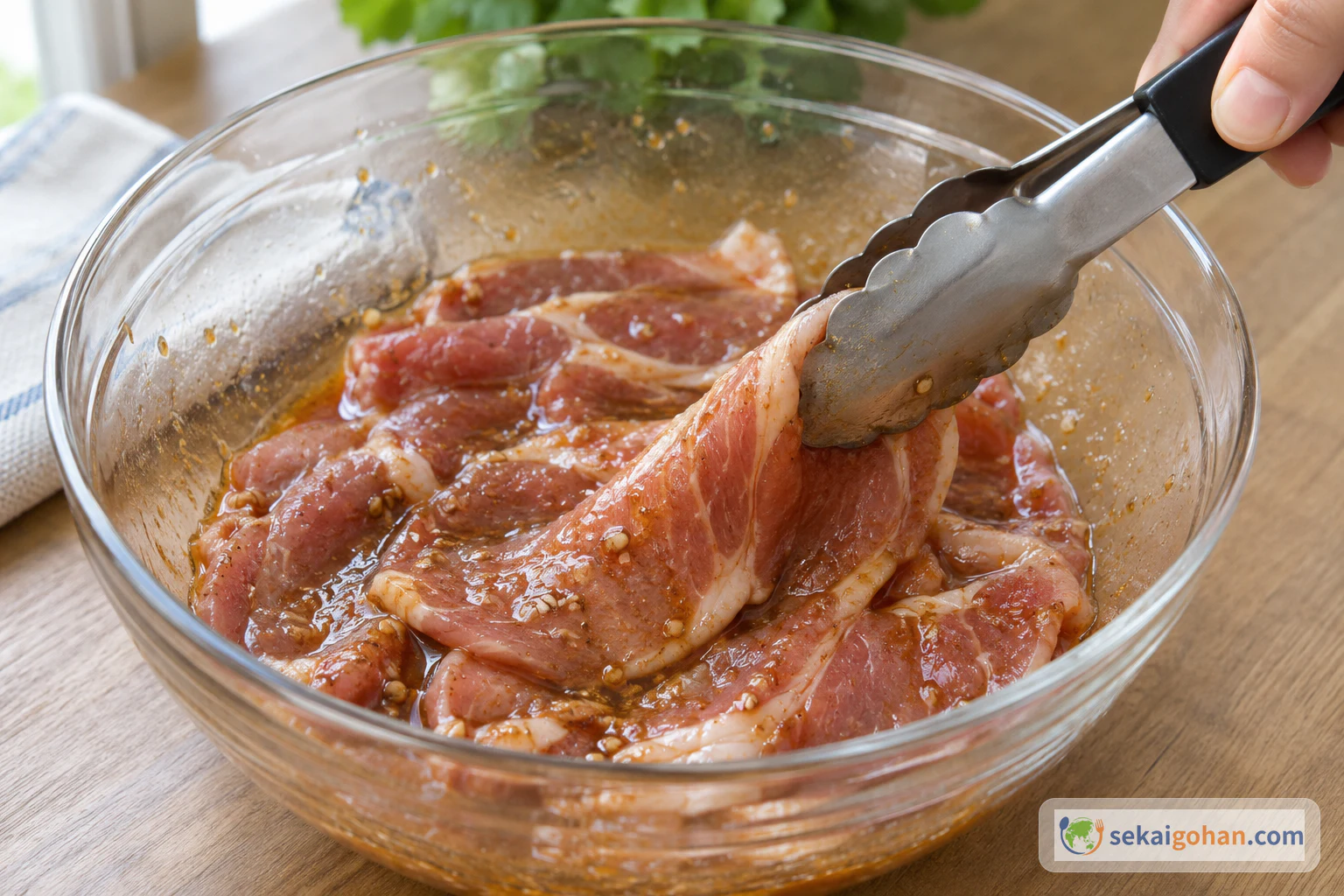
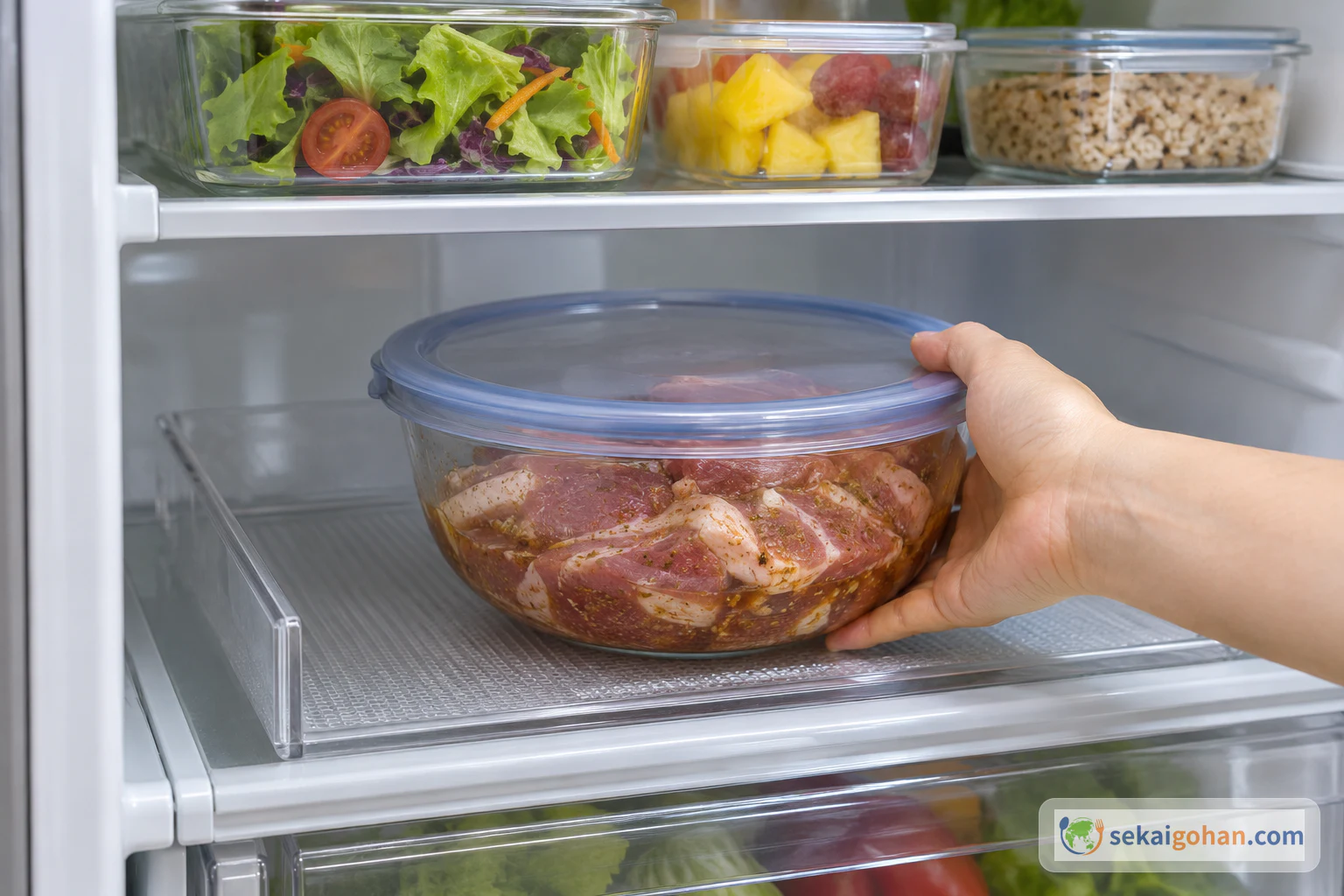
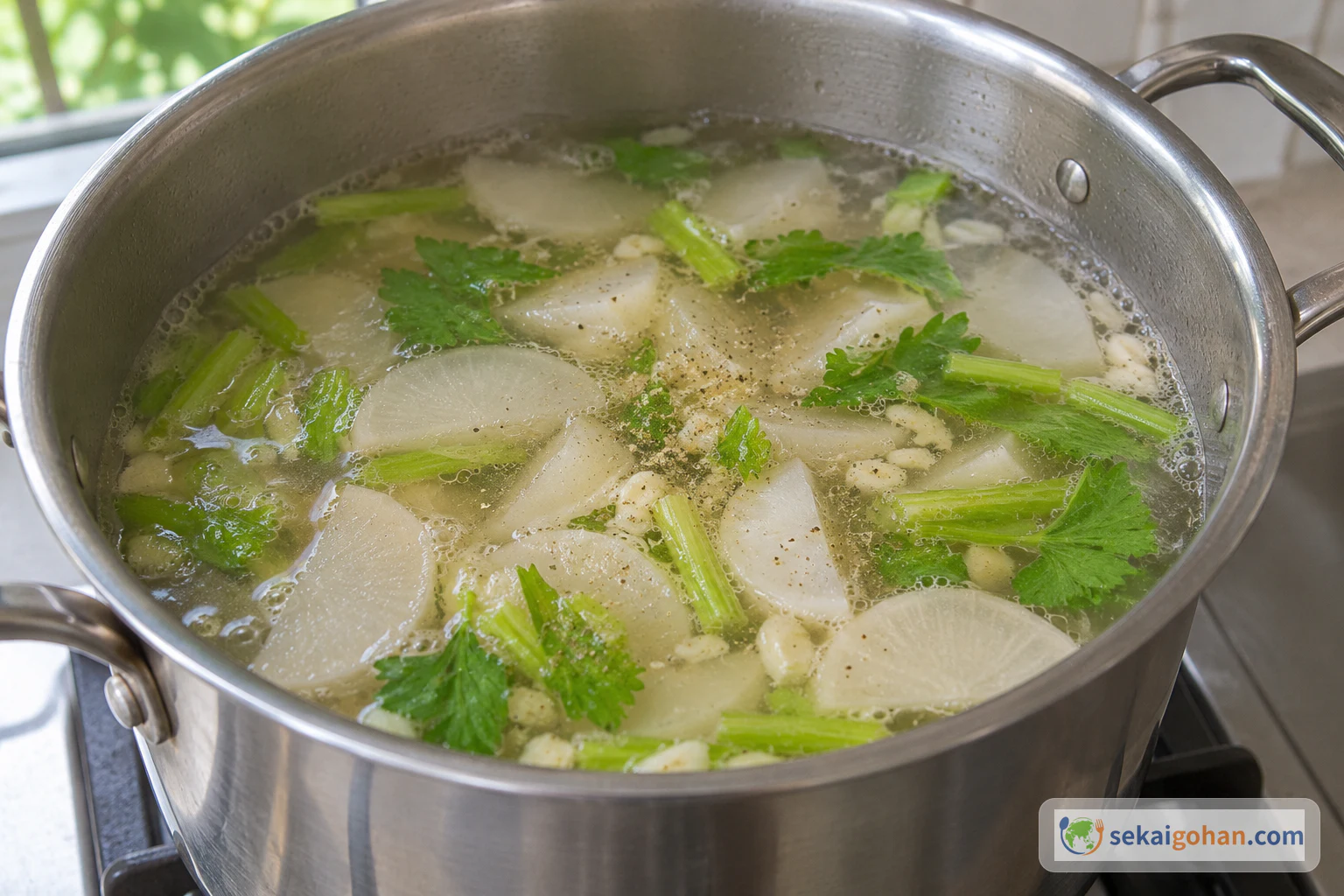
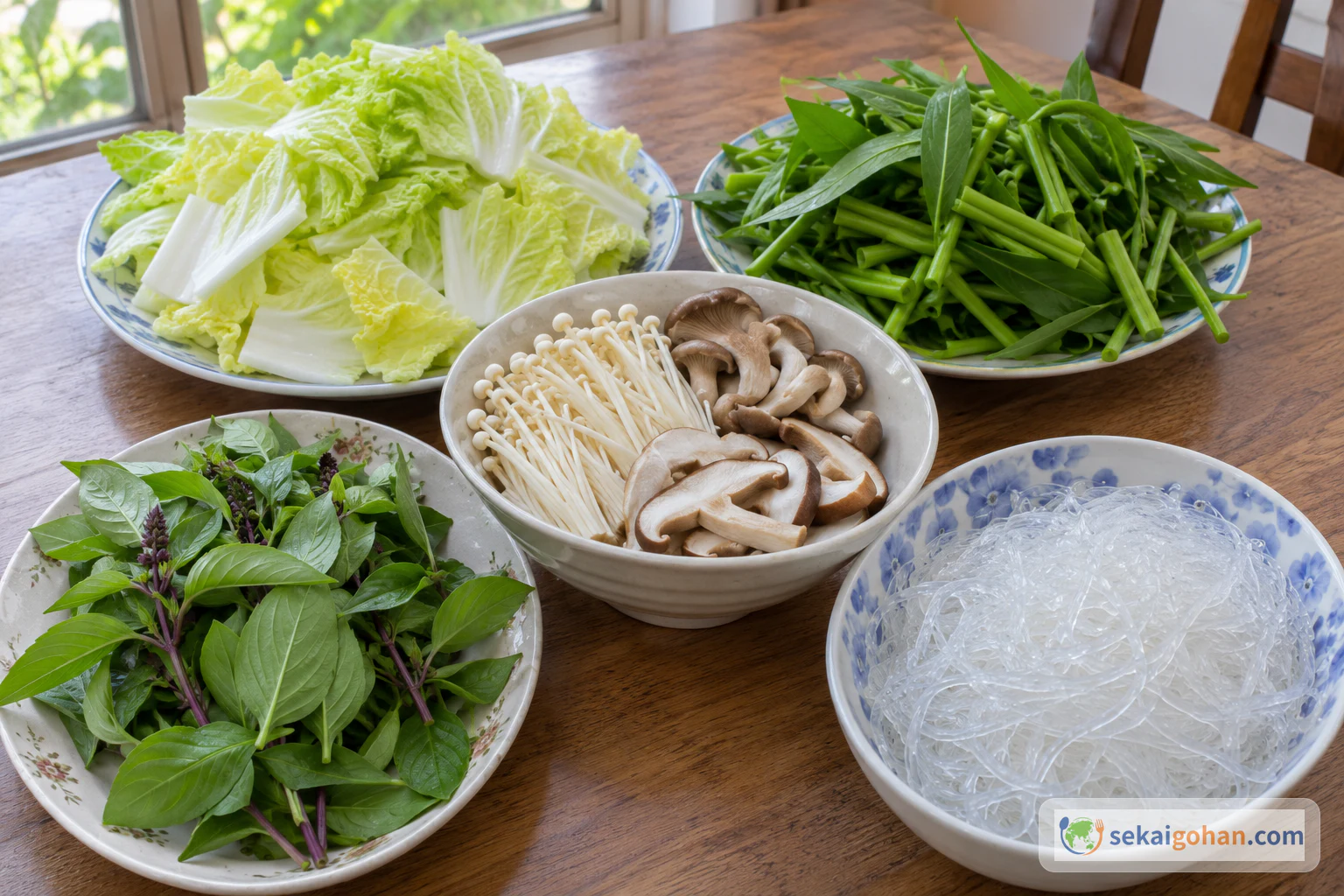
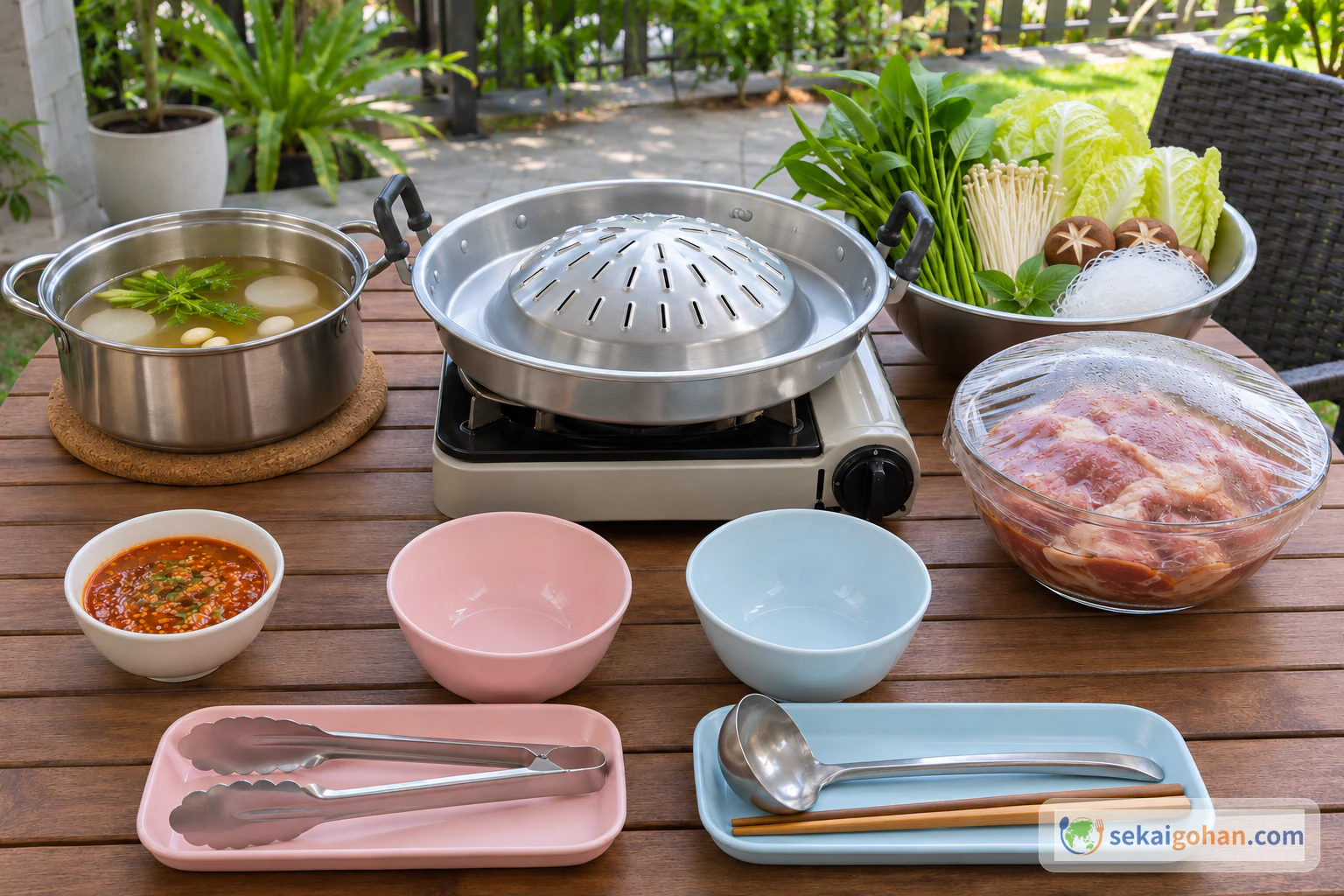
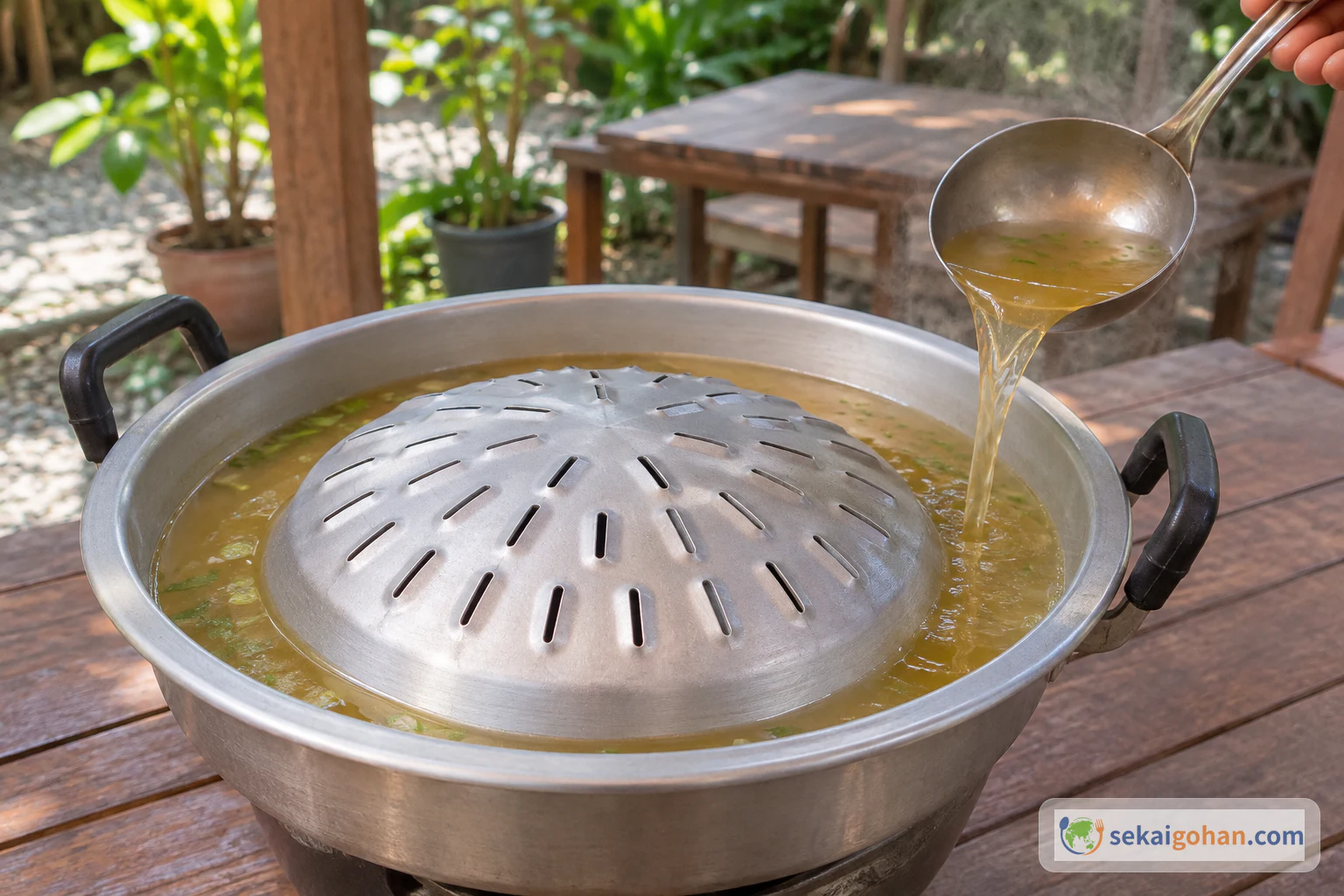
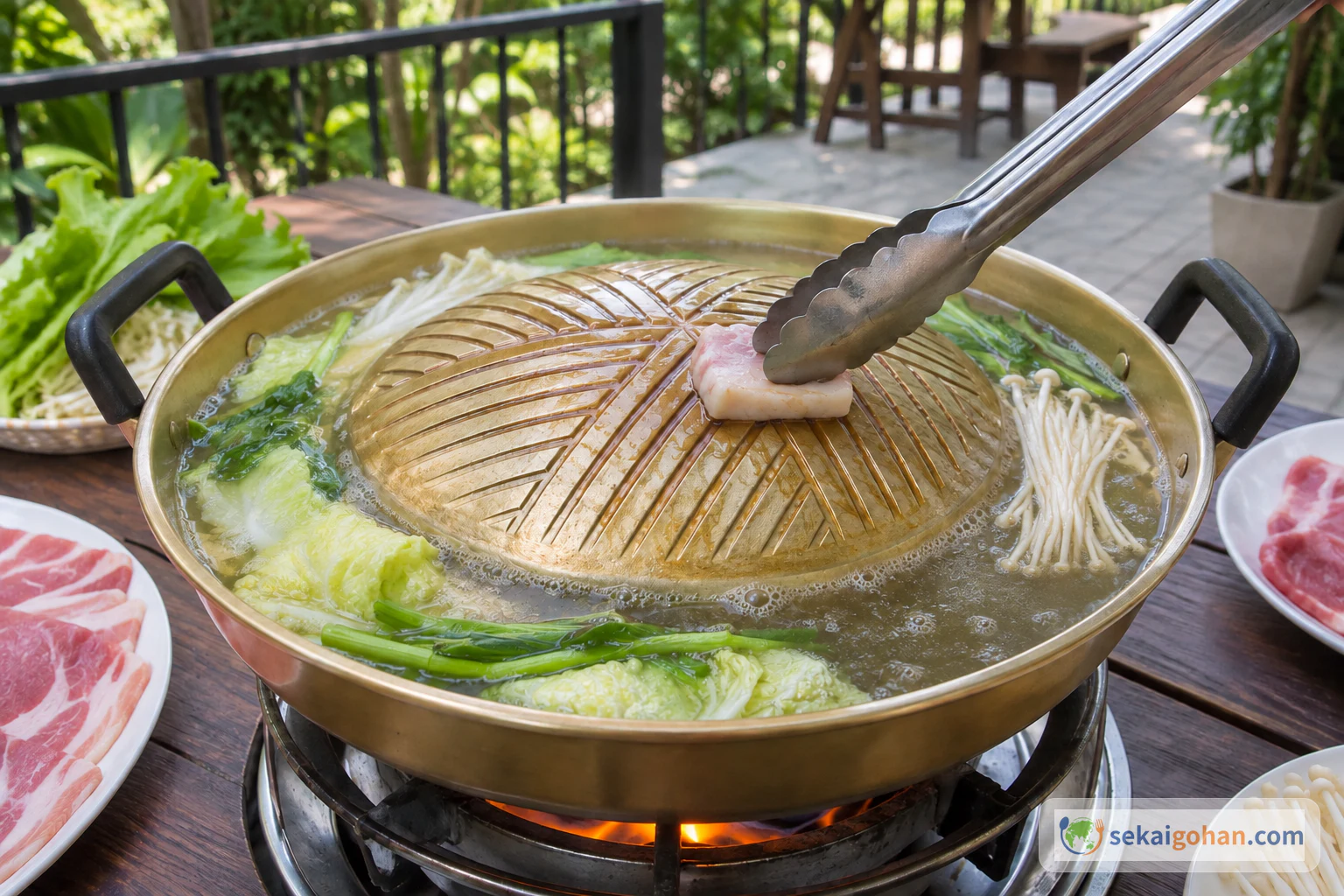
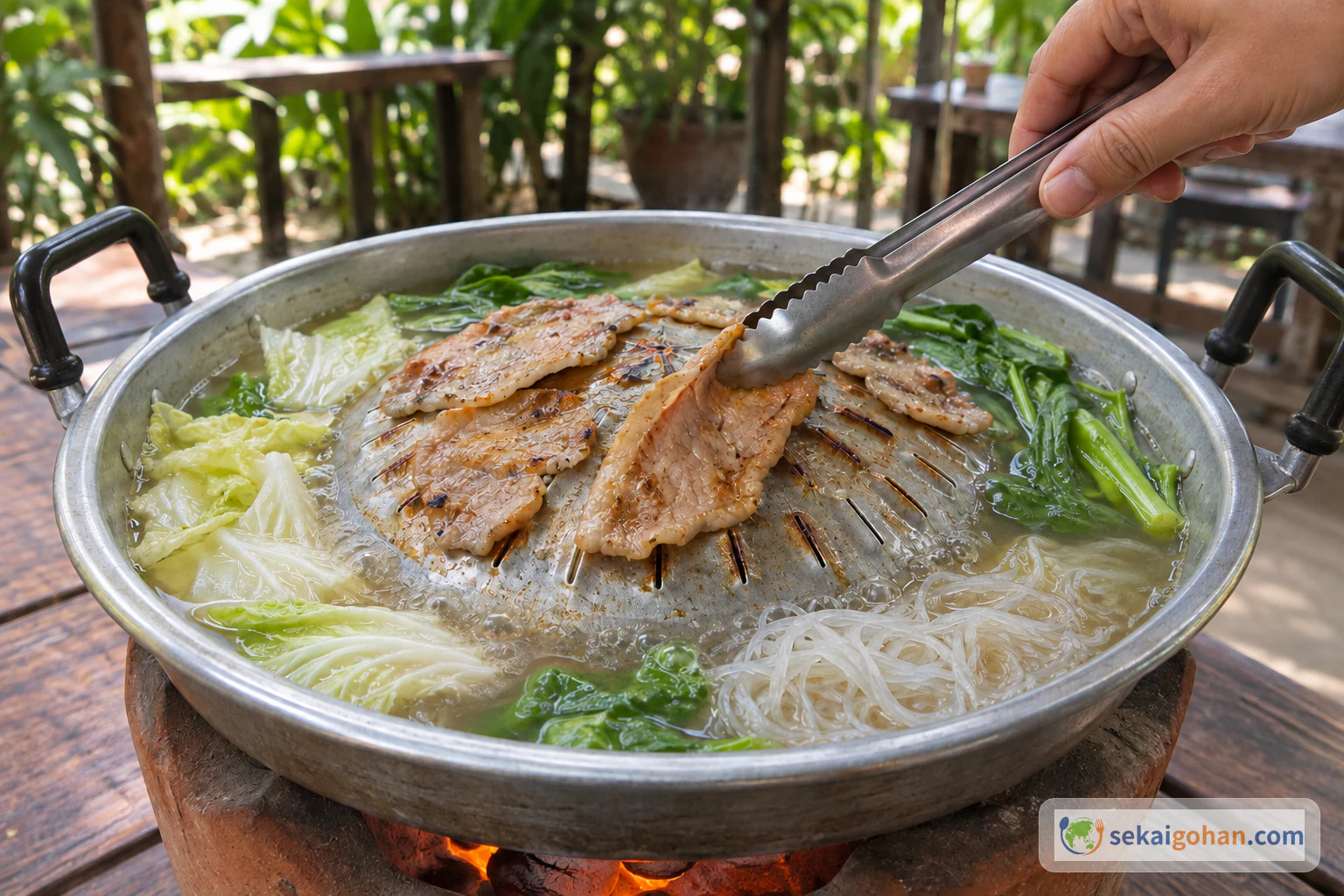
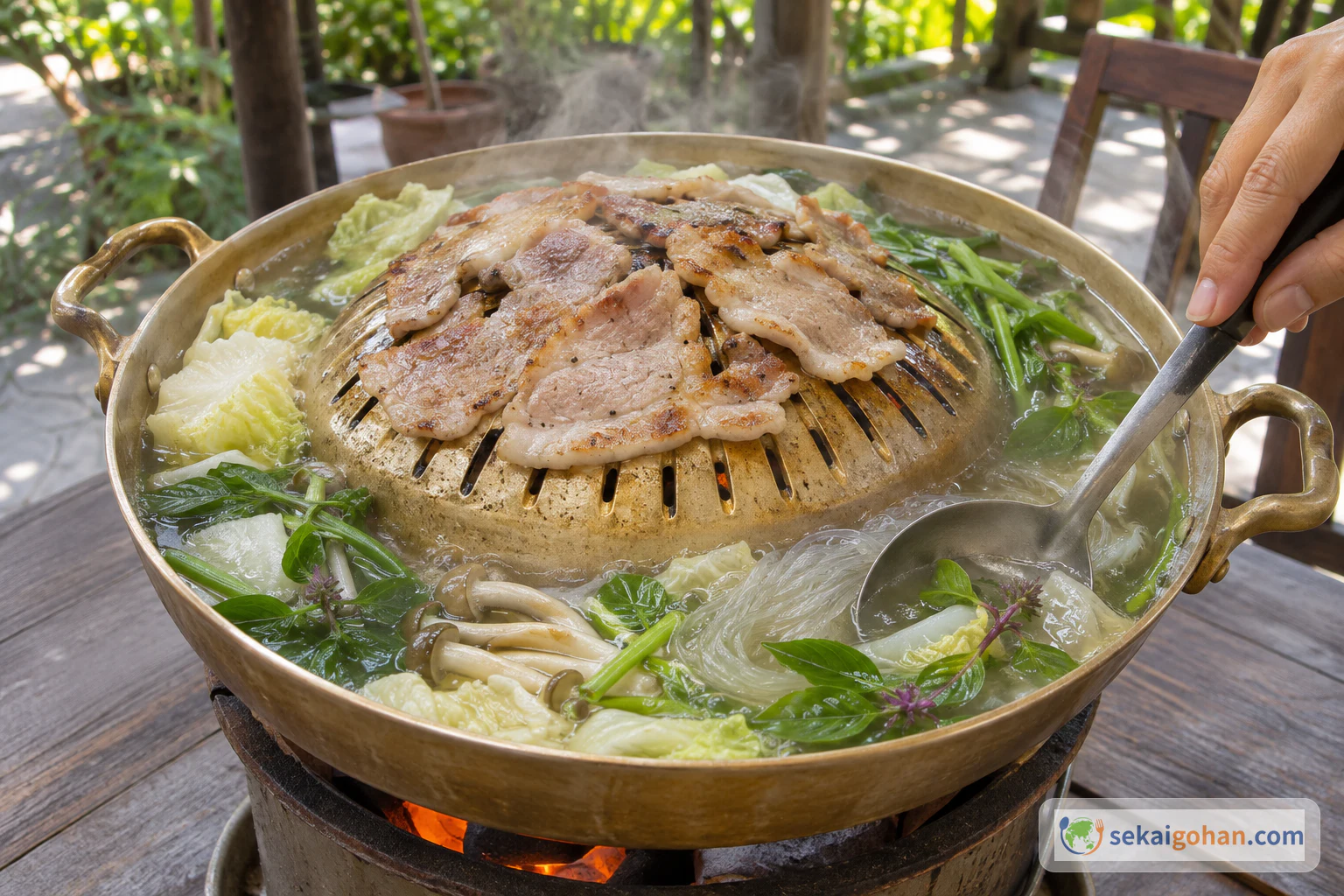
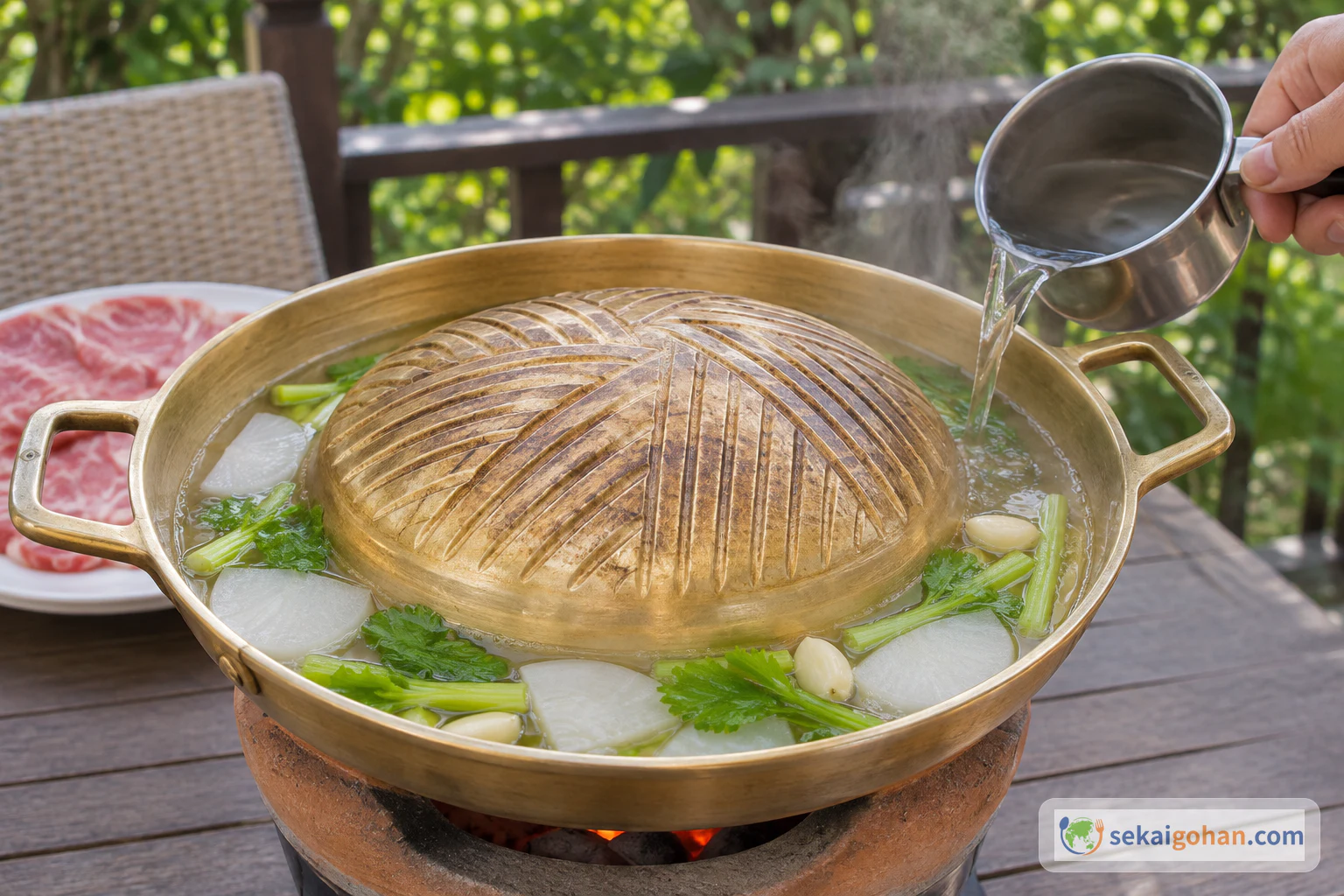
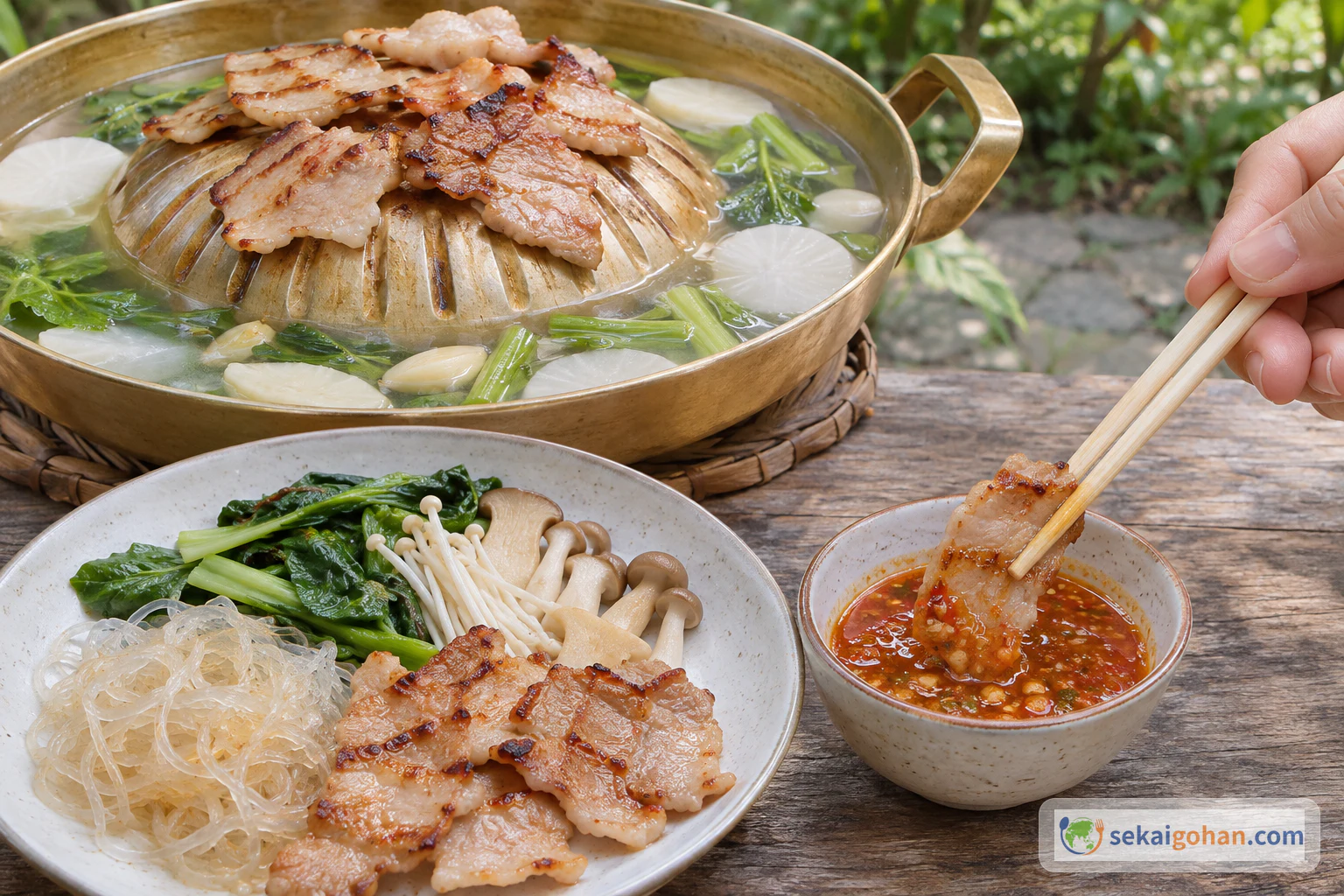
A domed pan sits in the middle of the table. Slices of marinated pork go onto the hot raised center, and as they cook, their juices run down into the ring of broth below, where cabbage, morning glory, mushrooms and glass noodles are softening. Everyone grills and fishes out food at the same time. That's mu kratha, often written mookata in English (หมูกระทะ in Thai): a Thai tabletop grill and hotpot in a single pan. This version serves five, with pork in a savory-sweet marinade of oyster sauce, Golden Mountain sauce, sesame and palm sugar, and a light broth fragrant with white radish, Chinese celery and garlic. The marinade needs at least 6 hours in the refrigerator, so start the day before or in the morning.
For more dishes from the same country, see the Thailand page. If you like grilled Thai meat, try kai yang or the noodle dish pad see ew.
What Mu Kratha Is
Mookata (หมูกระทะ, mu kratha) is a Thai tabletop barbecue and hotpot in one: marinated pork is grilled on a raised dome while vegetables and glass noodles simmer in the broth moat around it. The name means roughly "pork on a pan." You will also see it spelled moo kata, moo ka ta, mu kratha or mookata, and it is usually eaten in a group, with a spicy-sour dipping sauce.
Mookata is a Thai barbecue built around a domed grill with a moat of broth. The center is for grilling, and the outer channel is for simmering. Pork is the classic choice, and what goes into the pan varies from household to household. Some cooks grease the pan with pork fat.
Most of the work happens before anyone sits down. You marinate the pork ahead, simmer the broth in advance, and prep the vegetables and noodles. At the table, the job is simply to keep the dome greased, the pork turning, and the moat topped up.
Two heat zones on one pan: thin marinated pork grills on the raised center, while vegetables and glass noodles cook in broth in the moat around it. Keep the raw pork and its egg marinade cold and separate, and cook everything through before it reaches anyone's plate.
Ingredients (5 servings)
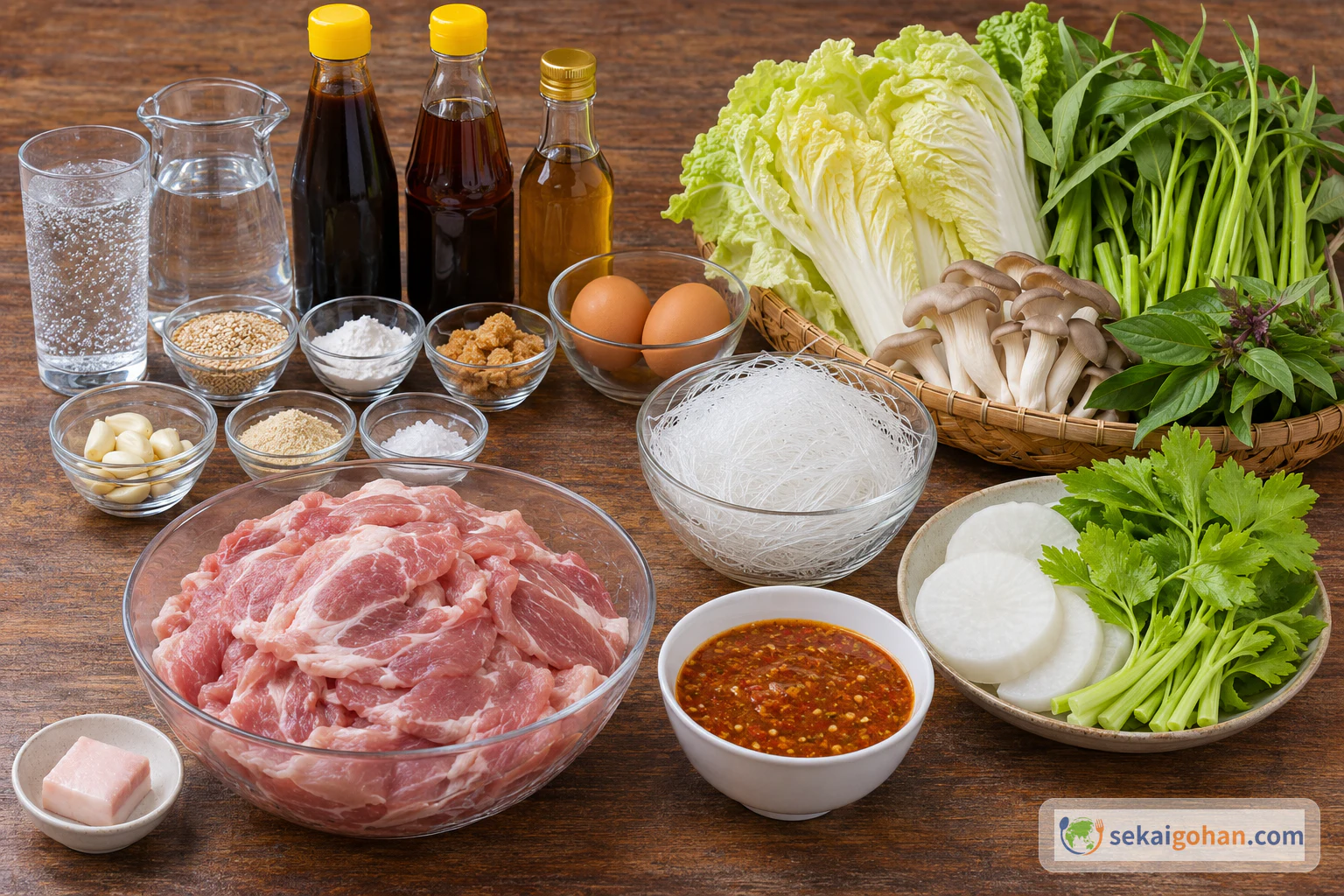
Split the 1 lb (500g) of vegetables however you like among cabbage, morning glory, mushrooms, Thai basil and similar greens.
This recipe contains egg, sesame and oyster sauce (made from shellfish). Seasoning sauces and seasoning powders can contain wheat or soy, so check the labels of the products you buy, including the dipping sauce. The marinade contains raw egg and has held raw pork. Keep it refrigerated, and never use it as a dipping sauce.
Equipment
- Thai domed mookata grill with a broth moat, and a heat source suitable for it
- Mixing bowl with a cover, and a whisk
- Stockpot for the broth
- Ladle
- Small heat-safe vessel or kettle for hot water
- Food thermometer
- Tongs used only for raw pork
- Separate clean tongs, chopsticks and plates for cooked food
- Small bowls for the dipping sauce
Choosing Ingredients for Mu Kratha
No mookata grill? Use a tabletop grill that has a channel around its edge, or a tabletop grill with a separate pot of broth beside it. Either way, keep the two roles apart: grill in one zone, simmer in the other.
Golden Mountain sauce → soy sauce. This swap works, though the flavor changes. Golden Mountain is a Thai seasoning sauce with its own character.
Rosdee → Knorr bouillon powder. This also works. Products differ in flavor and saltiness, so taste the broth before adding all the salt.
Baking powder stays baking powder. Baking soda is not a substitute.
Thai basil and Chinese celery. Other basils and ordinary celery are different herbs. If you can't find Thai basil, leave it out rather than substituting; the broth will just smell different.
The dipping sauce. Mookata sauce can be made at home, but a store-bought one keeps the table simple. Nam jim talay is the sauce for seafood, and sweet chili sauce is a separate option; neither stands in for the mookata dip.
Specialty items. Look for Golden Mountain sauce, Rosdee seasoning powder, Thai basil, Chinese celery and morning glory at an Asian grocery.
Method: Prep Ahead, Then Cook Together at the Table
Steps 1 to 5 happen in the kitchen ahead of time. Steps 6 to 12 happen at the table. If you use charcoal, the table must be outdoors in the open air.
Mu Kratha Troubleshooting at the Table
| Problem | Likely reason | What to do |
|---|---|---|
| Pork sticks to the dome | The dome was not greased, or the fat has burned off | Rub the fatty piece of pork over the hot dome again with the raw-meat tongs |
| Pork looks done but you are not sure | Slices overlapped, or the heat is uneven | Keep cooking until the center holds 167°F (75°C) for at least 1 minute. Color is not a reliable guide |
| The moat is running low | The broth reduces as it cooks | Add hot water a little at a time, staying below the rim |
| The moat is close to overflowing | Too much broth, or too much food added at once | Ladle some broth out and add food in smaller batches |
| Someone used the raw-meat tongs to serve cooked food | Utensils got mixed up | Swap in clean utensils, and keep the raw-meat tongs at the pork platter only |
| The broth tastes too salty | Seasoning powders differ in saltiness | Next time, taste after adding the seasoning powder and before adding all the salt |
Mu Kratha Variations
The vegetables are the easiest place to make the table your own. Keep the total at 1 lb (500g) and choose among cabbage, morning glory, mushrooms, Thai basil and similar greens.
The base version is pork only. If you add 1 lb (500g) of seafood, serve it on a separate plate with its own sauce, nam jim talay.
Frequently Asked Questions
What does mookata mean, and how do you say it?
Mookata is the common English spelling of the Thai หมูกระทะ (mu kratha). It is said roughly "moo-ga-ta." Moo is pork and kratha is a pan, so the name describes the dish: pork cooked on a pan. Other spellings you may meet are moo kata, moo ka ta and mu kratha, and all of them mean the same dish.
How is mookata different from Korean barbecue or shabu-shabu?
Mookata combines the two ideas on one dome: meat is grilled on top and the broth in the moat cooks the vegetables and noodles. Korean pork belly barbecue such as samgyeopsal is grilled and wrapped, while shabu-shabu is a simmered broth with thin meat swished through it. Mookata does both at once.
Can I use a charcoal grill indoors?
No. Burning charcoal indoors can cause carbon monoxide poisoning, so use charcoal only outdoors, in the open air. For any heat source, follow the appliance's instructions.
How do I know the pork is safe to eat?
Cook pork thoroughly and never eat it raw. Use a thermometer: the center should hold 167°F (75°C) for at least 1 minute, because browning and steam don't prove the pork is done. Keep raw-meat utensils separate from those used for ready-to-eat food, or wash them before reusing them.
Can I use the leftover marinade as a dip?
No. It contains raw egg and has held raw pork. Keep it refrigerated, never serve it as a sauce, and use the store-bought mookata dipping sauce instead.
Can I marinate for less than 6 hours?
This marinade needs at least 6 hours in the refrigerator, or overnight. Quick 30-minute marinades exist, but they use different ingredients.
Should the glass noodles be weighed dry or soaked?
Weigh them dry: 5 oz (140g), then prepare them according to the package.
Should the broth go in before or after heating the grill?
Fill the moat first, then start the heat. Always follow your grill's instructions.