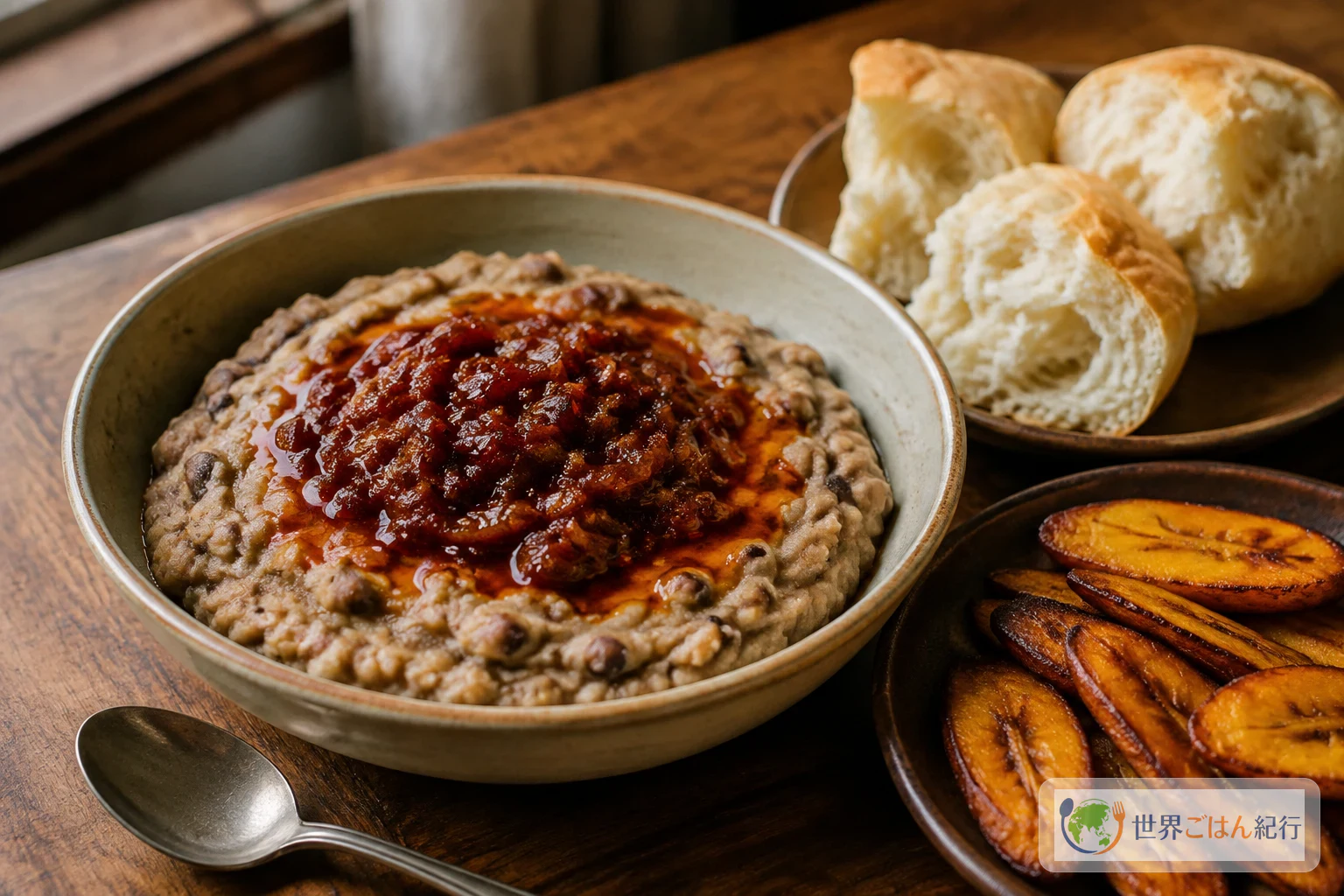
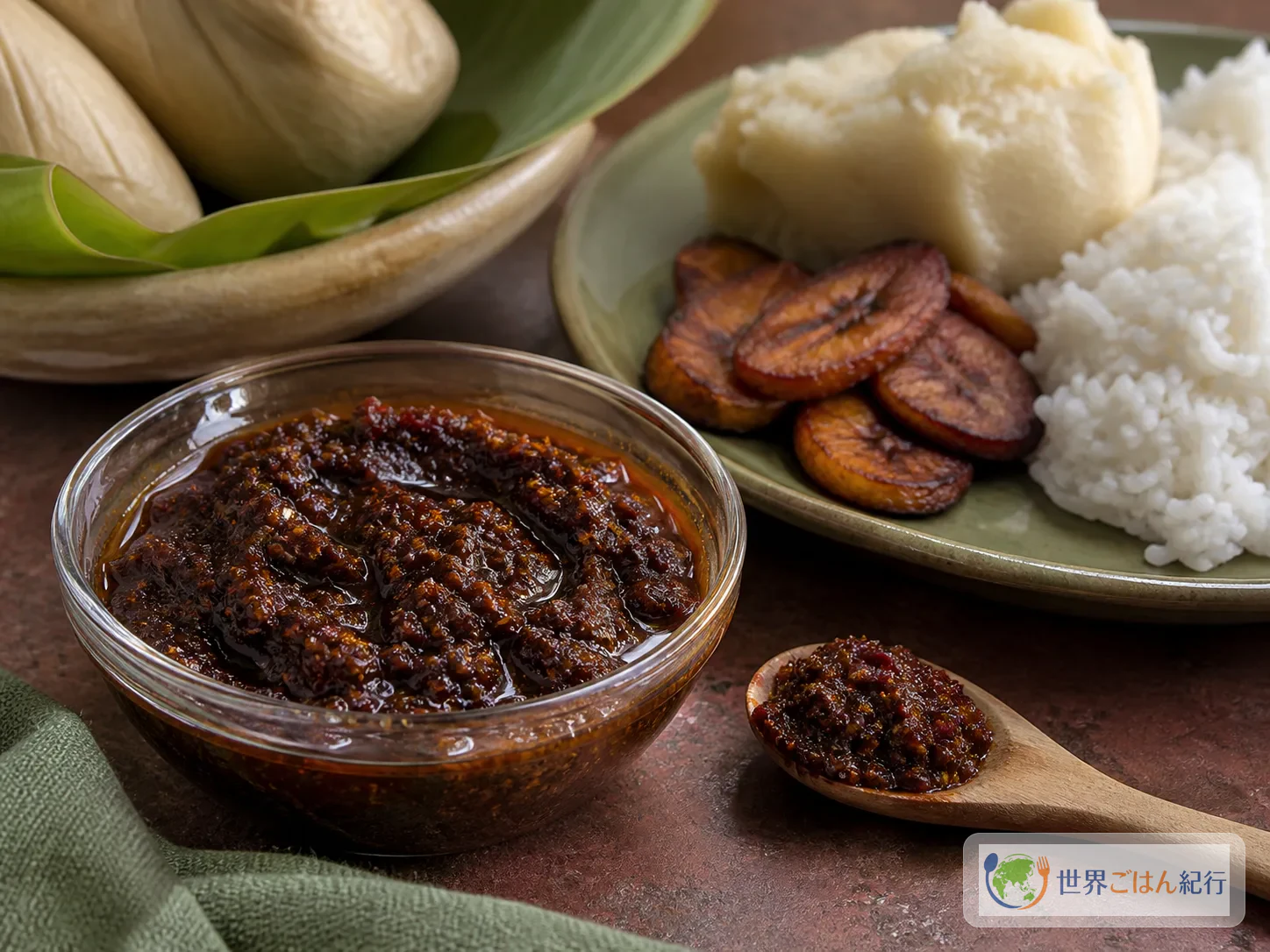
Rub soaked black-eyed peas between your palms in a bowl of water, and the thin skins drift up to the surface. Scoop out the beans, now pale and white, and those dry little seeds are already on their way to becoming a steamed batter. From here on, moin moin is a fun dish to make.
Ground with chiles and onion and steamed until set, those skinned beans become moin moin (also spelled Moi Moi or Moyin-Moyin), a Nigerian favorite. It looks a bit like a rustic savory custard, but at its core it is all bean. The sweetness of red bell pepper, the aroma of onion and the earthy scent of red palm oil come together in the steam. Aim for a moin moin that holds its shape without being dry and quietly gives way when you slide a spoon in. This version has no add-ins, so you can taste the beans and aromatics clearly.

Moin moin in Nigerian cooking
Moin moin is a dish of the Yoruba-speaking region. In Nigeria it shows up at family meals and at parties and weddings as well, eaten alongside jollof rice, fried plantains, pap and more.
It also has a close relative. The same black-eyed peas become akara when fried and moin moin when steamed. The steps up to lightening the skinned beans are the same, so one bag of beans can take you to two dishes.

There is no single fixed way to wrap moin moin. Leaves, aluminum foil and dedicated containers all turn up, as this overview shows. In these step-by-step photos, the beans are washed by hand, the skins floated off, and banana leaves folded into funnels to receive the batter. The leaves add aroma and keep the batter out of the water while it steams.

Cooks also steam it in empty cans and muffin tins. Cowpea processing notes describe it simply as a savory steamed black-eyed pea pudding. Small heatproof cups at home are a practical variation, not a compromise.
Ingredients (serves 4)

This makes 6 heatproof cups of about 200 ml each (about 1 liter of batter in total). If you wrap it in banana leaves, use the same amount of batter.
Black-eyed peas are the star of the batter. Switching to chickpeas or red kidney beans changes how the skins come off and how it steams. The first time, it's worth seeking out black-eyed peas so you can appreciate why the skinning step matters. Canned black-eyed peas hold a lot of water and throw off the batter guidelines, so this recipe doesn't use them.
Black-eyed peas are legumes. Anyone who reacts to soybeans, peanuts or other legumes should check the ingredients and any shared equipment. Smoked fish and eggs are optional; if you add them, use only cooked ones. On days you use fish, keep separate cups and utensils for fish-free portions. Chiles are potent even in small amounts, so when cooking for a family, leave them out and serve them on the side.
Choosing red palm oil, and substitutes
You only use 1.5 tbsp (20 ml) of red palm oil, but its orange color and earthy aroma are what make moin moin taste like moin moin. It also works for Nigerian fried bean dishes and West African stews. If you first want to try just the texture of the beans, you can replace the 1.5 tbsp (20 ml) of red palm oil with 1.5 tbsp (20 ml) of rice bran oil and it will still steam up well.
Red palm oil and palm nut cream are different products, so when shopping, check the label to make sure it says "red palm oil."
Choosing beans and containers for moin moin
Start with dried black-eyed peas. Pre-skinned beans save work, but they absorb water differently, so begin with less water and adjust as you go. Red kidney beans or chickpeas will change the texture.
For steaming, banana leaves bring the most aroma and are easy to wrap with. Heatproof cups give less of that leafy fragrance, but they make moisture and doneness much easier to judge. Learn the right batter consistency in cups first, then try leaves and taste the difference the wrapping makes.
Muffin tins and empty cans work too. If you use cans, choose ones with a food-grade lining and no scratches or rust. If you're unsure, use heatproof cups.
How to make it
Set up the steamer first
Place a steaming rack in a pot at a height where the bottoms of the cups won't touch the water. Use about 3 cm (1 1/4 in) of water below the rack. Choose a pot where the cups stand upright with a little space above them when the lid is on. Keep hot water ready in a kettle so you can top up the pot without interrupting the cooking.
Opening the lid repeatedly while steaming drops the temperature and makes the batter less likely to set. Check the water level only once, after 30 minutes, and gently pour boiling water in below the rack.
Tools for a smooth bean batter

This dish needs a thick paste, not liquefied beans. A blender will work, but the most common mistake is adding too much water when it won't turn. A food processor can keep a thick batter turning without extra water. When using a blender, process small amounts at a time, and if it stalls, reduce the load rather than adding water.
With the amounts in this recipe, don't pack it all in at once; working in 2 batches keeps the blade turning more easily and makes the batter's moisture easier to read.
Moin moin texture cues and fixes
Skins
A few stray skins are still edible, but too many make the batter gritty on the tongue. Wash until at least 80 percent of the beans look white, and that's plenty for homemade moin moin. Rather than picking off skins one by one, be thorough about pouring off the ones floating on the surface.
Adding the water
How much water you need depends on how much the beans absorb and how juicy the pepper is. Start blending with ½ cup (150 ml), then add the rest 2 tsp (10 ml) at a time. If the batter runs off a spoon like a thin liquid, there's too much water; if it falls in a lump that won't flow, there's too little. A thick ribbon that holds its trail for 2 seconds is the easiest consistency to steam.

If the beans won't turn in the blender, resist pouring in a lot of water at once. Blend small amounts, stopping to scrape down the sides.
Whisking in air
Whisking the batter before steaming lightens it, the same idea behind the ekuru method of skinning black-eyed peas and whisking the batter. For moin moin, whisk until fine bubbles are spread throughout, rather than whipping up big ones.
Steaming heat
A boil that's too vigorous makes the cups rattle and sends drips from the lid into the batter. Keep it on medium heat, with a thin stream of steam escaping from the edge of the pot and the water moving gently. Running dry leads to both scorching and undercooking, so check the water level at least once during the 45 minutes.
Troubleshooting moin moin

| Problem | Likely cause | Fix |
|---|---|---|
| Center is liquid | Cups too large, water not boiling vigorously enough, not steamed long enough | Replace the lid and steam over medium heat in 5-minute increments |
| Firm outside, heavy inside | Batter too thick, not enough air | Next time, add 2 tsp (10 ml) more water and whisk 2 minutes longer |
| Watery surface | Drips from the lid, steam too strong | Wrap the lid in a towel and bring the water back to a gentle simmer |
| Gritty bits of bean | Skins left on, not blended enough | Next time, rinse off the skins once more and blend in small batches for longer |
| Red palm oil too strong | Too much oil, or you're not used to the aroma | Next time, cut it to 2 tsp (10 ml) and replace the rest with rice bran oil |
Serving, storing and varying moin moin
Egg, fish and other fillings

You'll see versions with egg, fish and shrimp. Make it plain the first time, then serve hard-boiled egg or smoked fish on the side once you've seen how it steams; that makes the batter's moisture and flavor easier to judge. If you do add fillings, place a small amount of cooked filling in the center, and keep the cups modest in size so everything cooks through evenly.
White ekuru
Leave out the red bell pepper and red palm oil, steam the batter with just salt and onion, and serve it with a hot sauce, and you move toward ekuru, known in southwestern Nigeria as white moin moin and paired with spicy ata din din. It's another face of the same batter rather than a stand-in for the red version.
Storage
Once the steamed moin moin has cooled a little, wrap each one individually, refrigerate and eat within about 2 days. To freeze, unmold them, wrap each one individually and use within about 2 weeks. To serve, reheat in a steamer for 8–10 minutes and eat the same day once they're hot all the way to the center. Avoid refreezing and leaving them at room temperature for long periods.

FAQ
Can I make it without heat?
Yes. Leave out the chile and keep the sweetness of the red bell pepper and the aroma of the onion. Anyone who wants heat can add sauce at the table, which is easier for the whole family than putting a lot into the batter from the start.
What if I add too much water in the blender?
If the batter turns liquid, add a small amount more skinned black-eyed peas to bring the consistency back. Only add beans that have been fully soaked in advance.
What can I do with leftover black-eyed peas or aromatics?
Make akara, where the black-eyed peas are fried and you use the skinning and aerating steps again. For a rice dish, pair it with jollof rice; for a bean stew, try Ghana's red red. Even within West Africa, each takes a different role at the table.
Sources
Moin moin may look like nothing more than steamed beans, but the sequence of skins, water, air and steam translates directly into its texture. If you love the aroma of red palm oil, carry it on to your next West African dish. If you just want to learn the texture first, it's fine to make it with rice bran oil. Once you've learned the sound of skins washing away and the steam rising from the lid, try adding leaves or fillings one at a time.