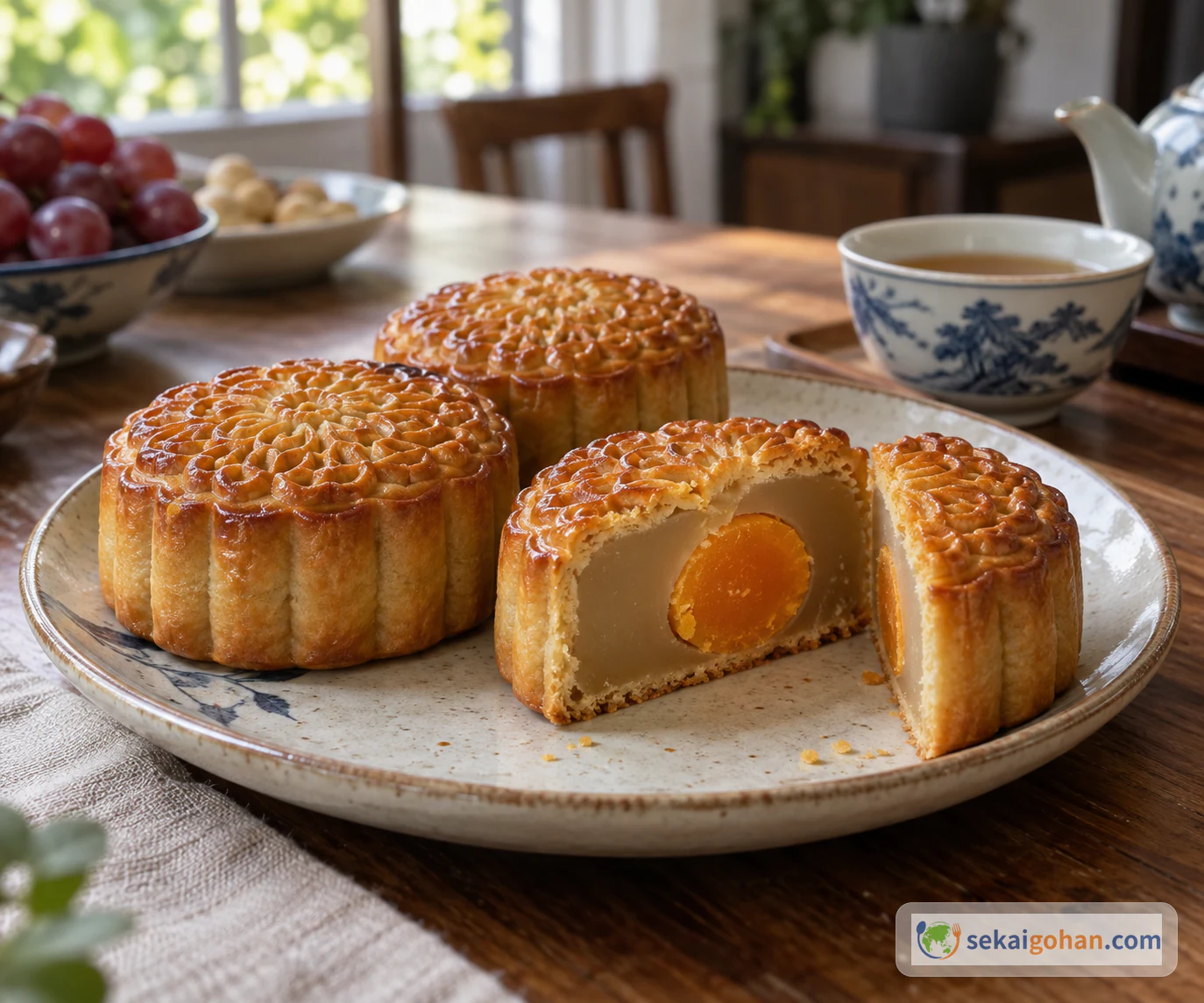
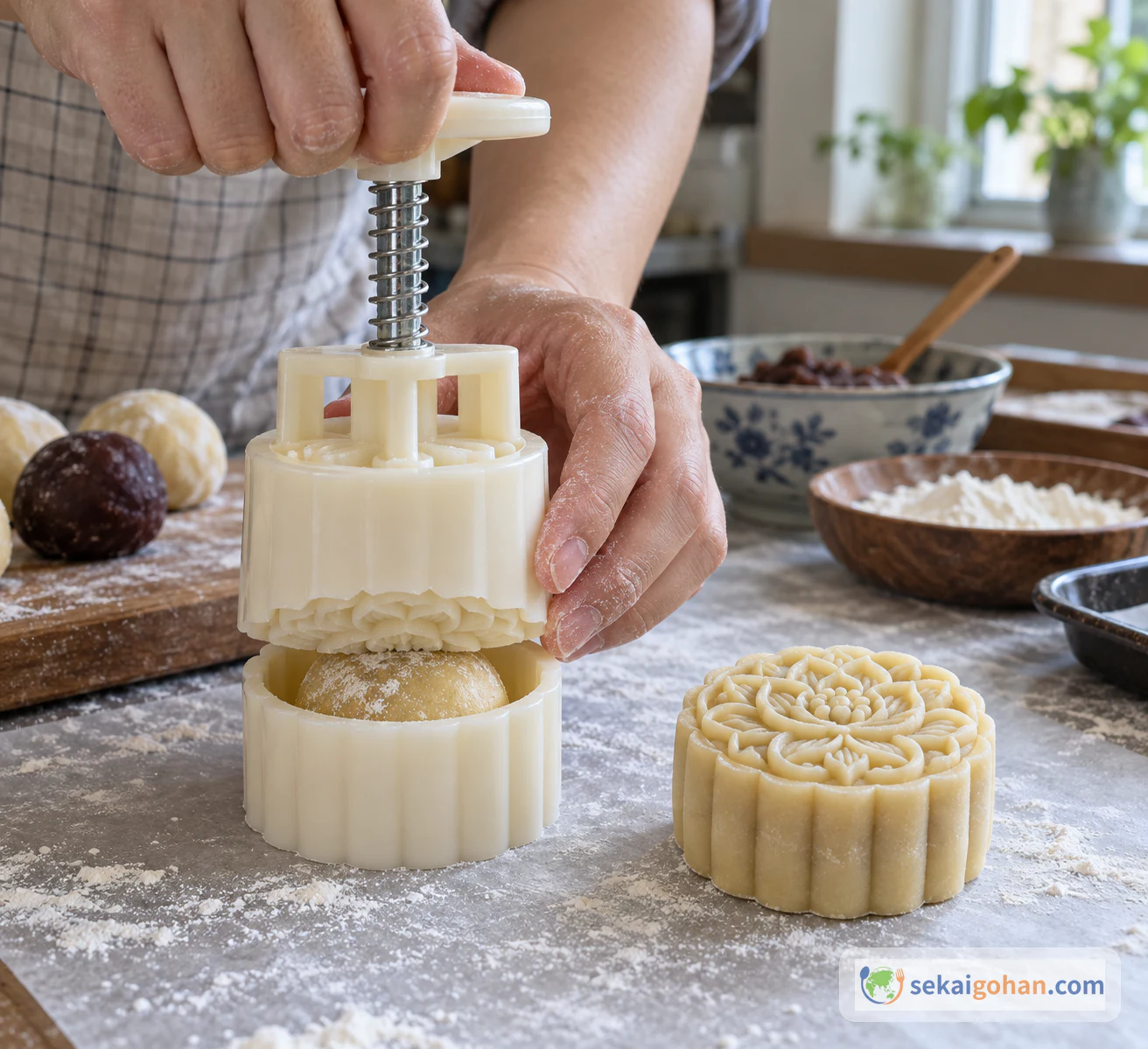
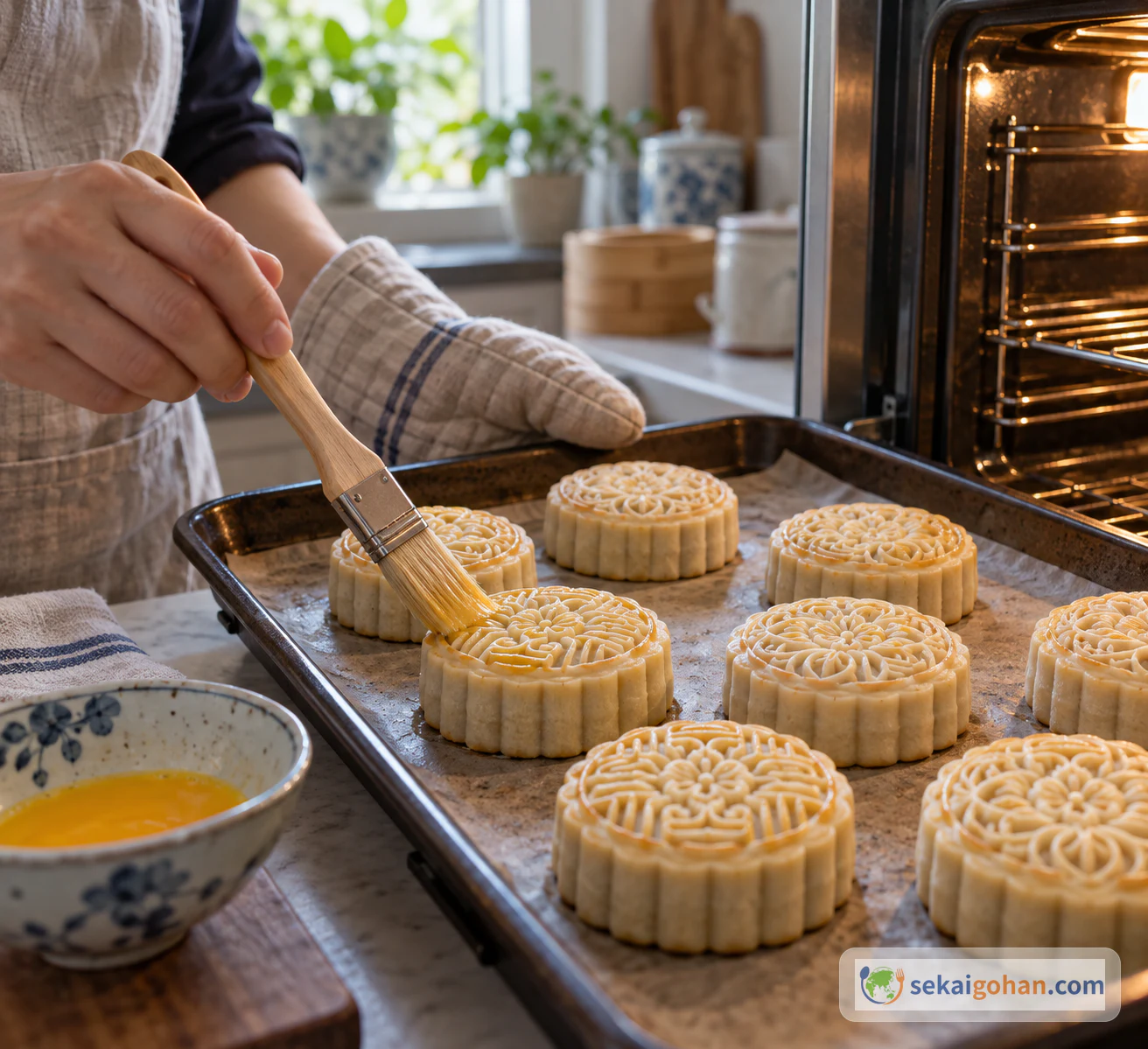
On a Mid-Autumn Festival night in Beijing, families set out mooncakes as offerings to the moon, then gather to look up at it with tea and the cakes. That custom belongs to Beijing in particular, not to all of China. These mooncakes are Cantonese style: a thin baked skin wrapped around sweet, smooth lotus seed paste, with a salty, crumbly salted duck egg yolk hidden at the center of most of them. They are pressed into a patterned mold. They look a little dry when they come out of the oven, and they need a day or two of rest before the crust turns glossy.
Cantonese Mooncakes and Their Regional Cousins
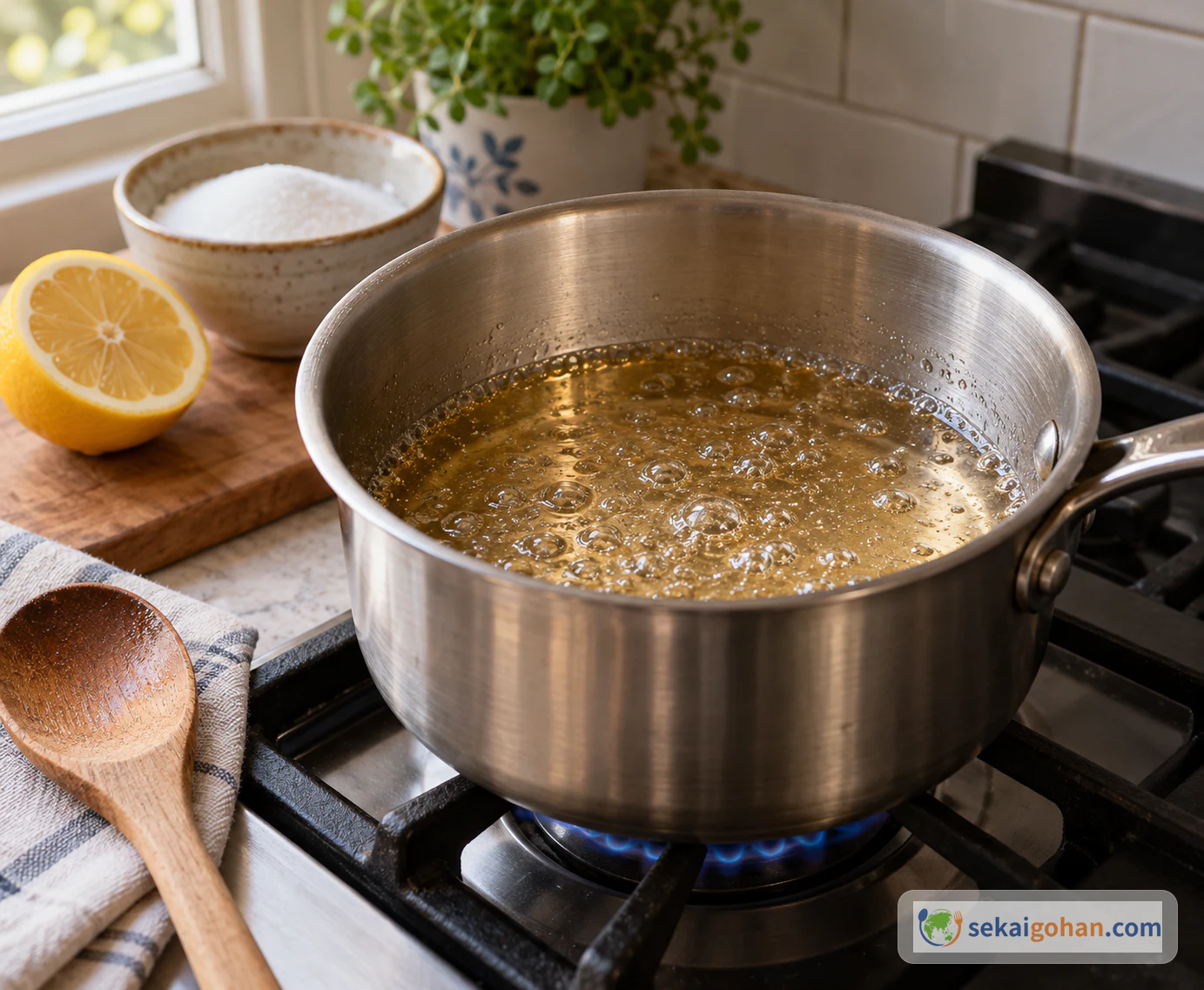
"Mooncake" is an umbrella name, not one fixed recipe. Skins and fillings vary from place to place. Old Beijing has its own red mooncakes, white mooncakes and tuanyuan bing (團圓餅, "reunion cakes"), all different from the Cantonese style. The cakes here belong to the Cantonese baked type: a thin skin made with golden syrup, a molded pattern and a two-stage bake.
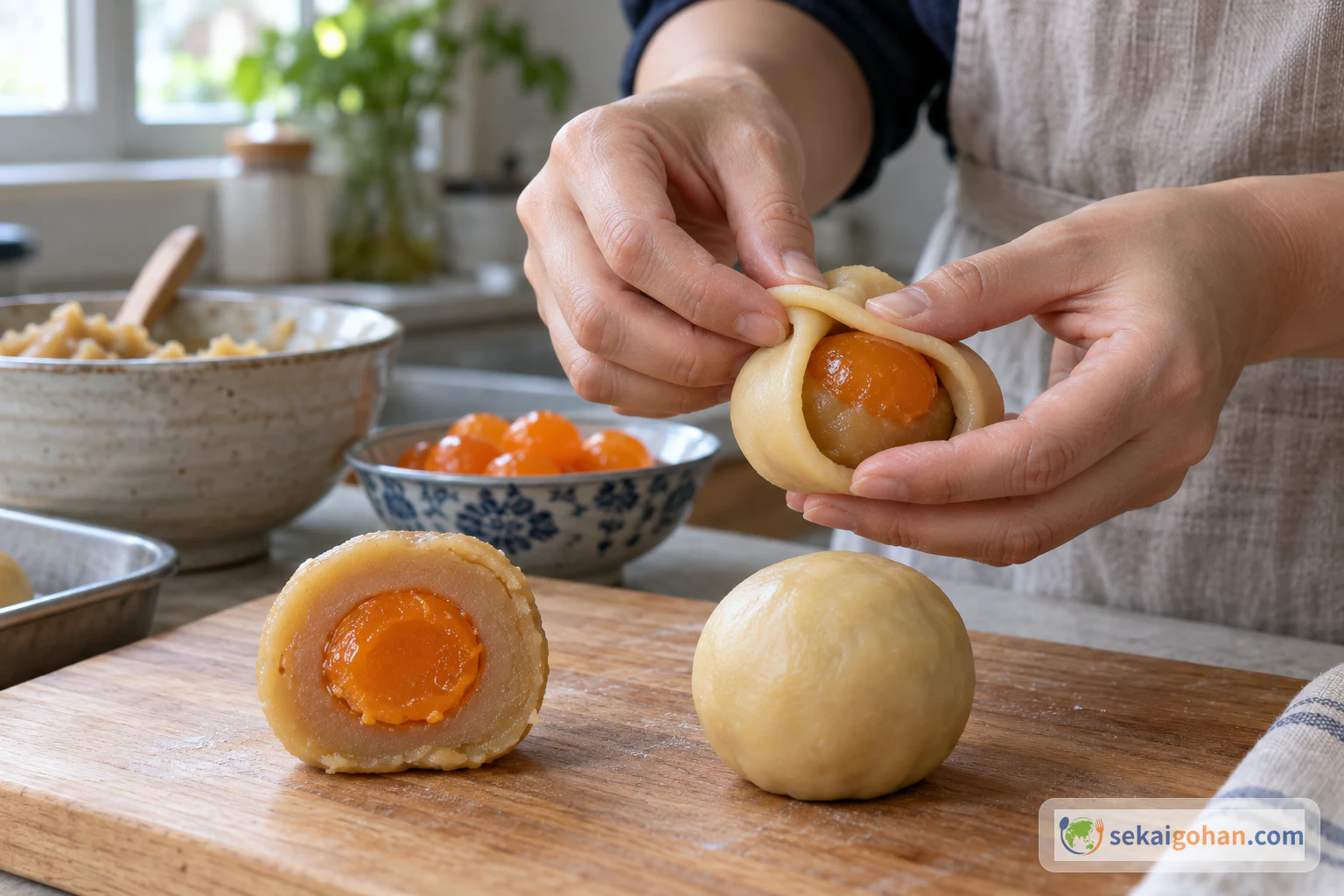
Even Cantonese home recipes vary. One well-known version fills the cakes with red bean paste and salted egg yolk. Its skin uses low-gluten flour, inverted syrup, corn oil and lye water, and its amounts, baking and number of cakes all differ from this recipe. This batch uses lotus seed paste (lianrong). It makes 18 cakes: 12 with a salted yolk and 6 with lotus paste only, so you get a pure lotus version from the same batch.
Mooncake is 月饼 in simplified Chinese and 月餅 in traditional Chinese, read yuèbǐng in Mandarin pinyin.
Planning the Two Days
The work spans two days, and it starts the night before, when the lotus seeds go into water. Make the golden syrup and cook the lotus paste ahead so both can cool completely. On baking day, prepare the yolks, make and rest the dough, then divide, wrap, press and bake. Counting the overnight soak, it comes to about 14 hours.
The patterned cakes need a 100g mooncake mold. The "100g" describes the mold's size, not the finished weight of each cake. Without a mold, shape the cakes by hand into discs about 3 inches across and about 1 inch high. They won't carry a pattern, so they'll look different from the photos.
Ingredients for 18 Mooncakes (12 with Yolk, 6 Without)
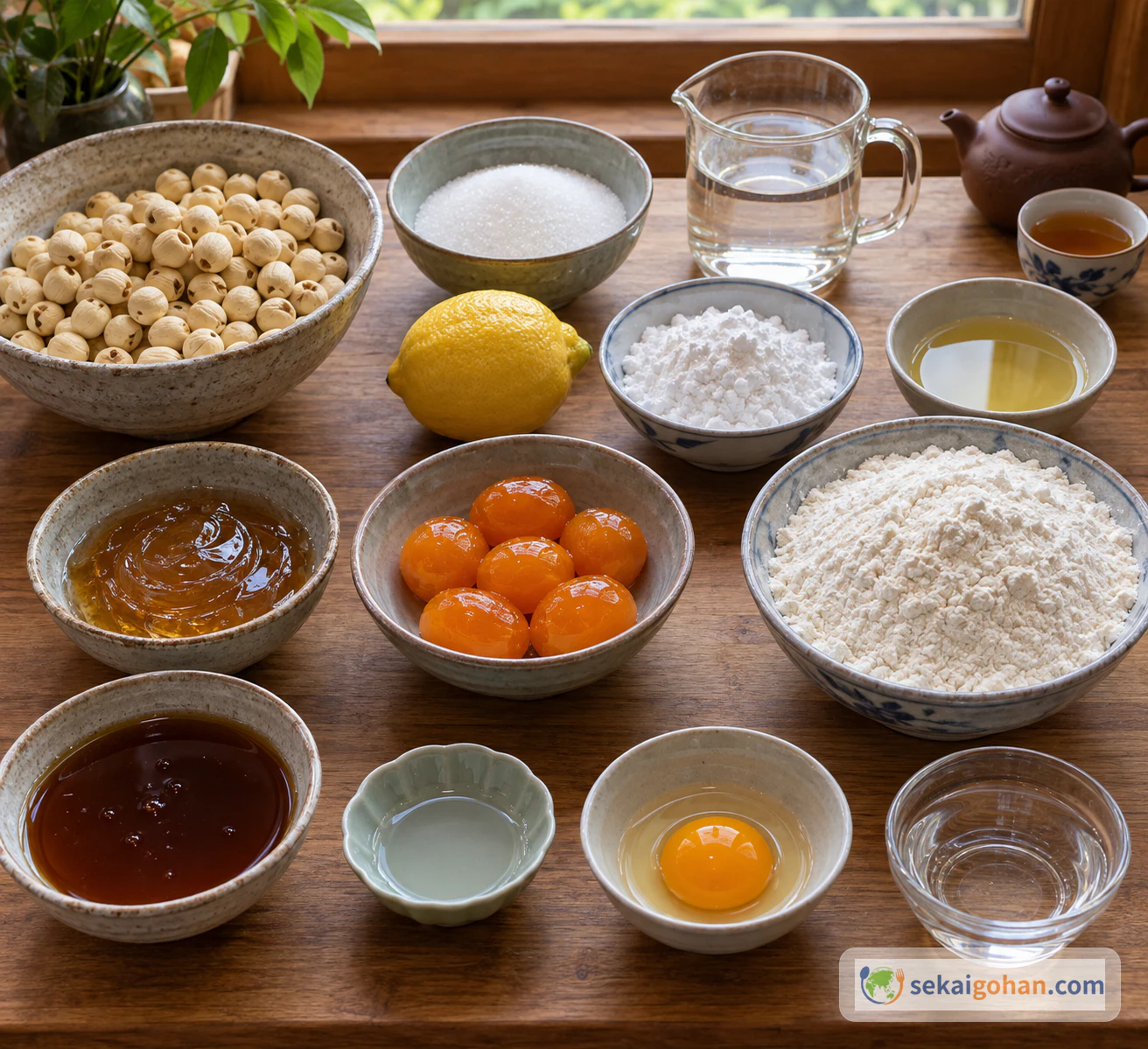
The main recipe contains no salt, and none is added here.
Equipment
- Saucepan for the syrup
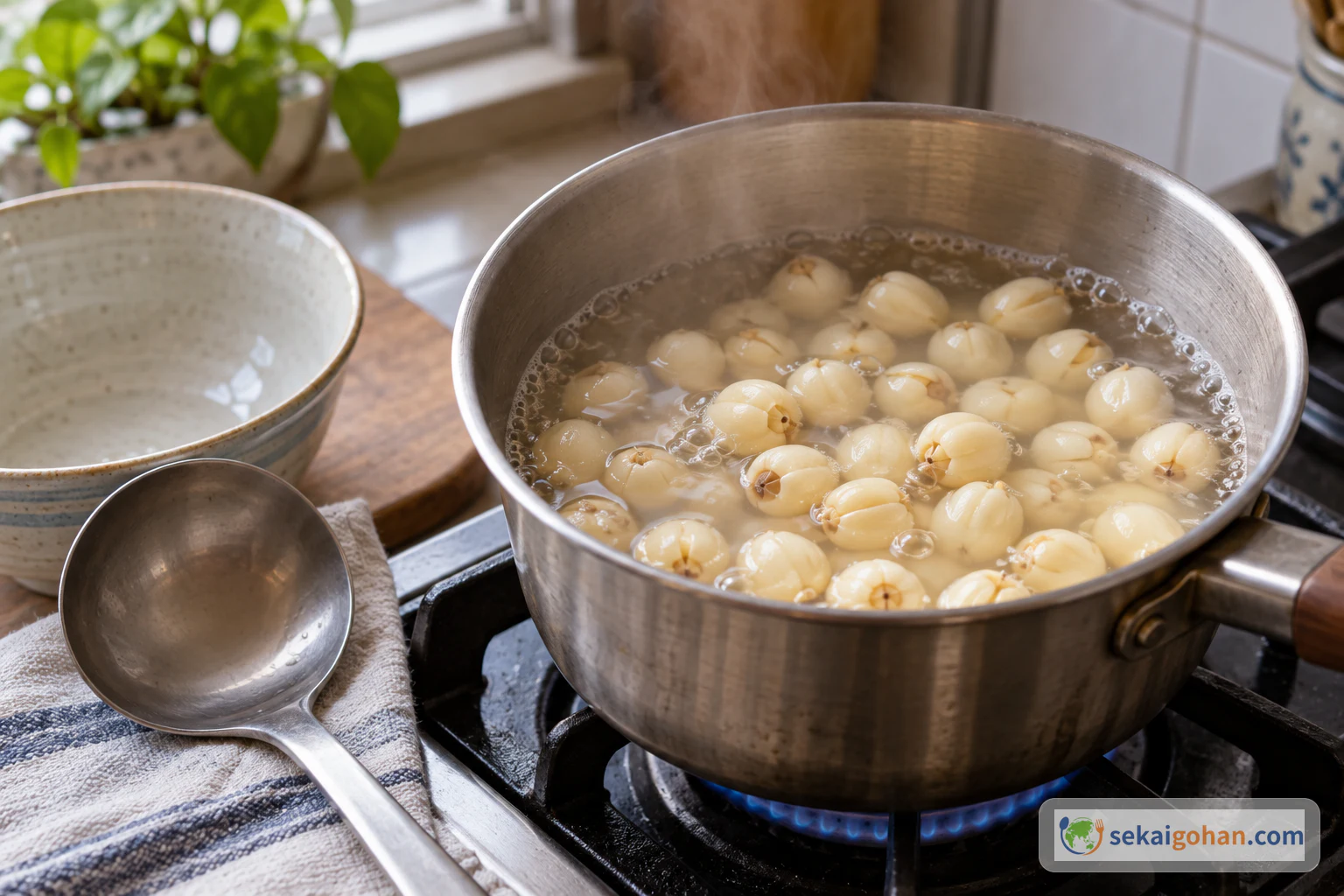
- Pot for boiling the lotus seeds, plus a bowl to reserve the cooking liquid
- Food processor, for puréeing the lotus seeds smoothly
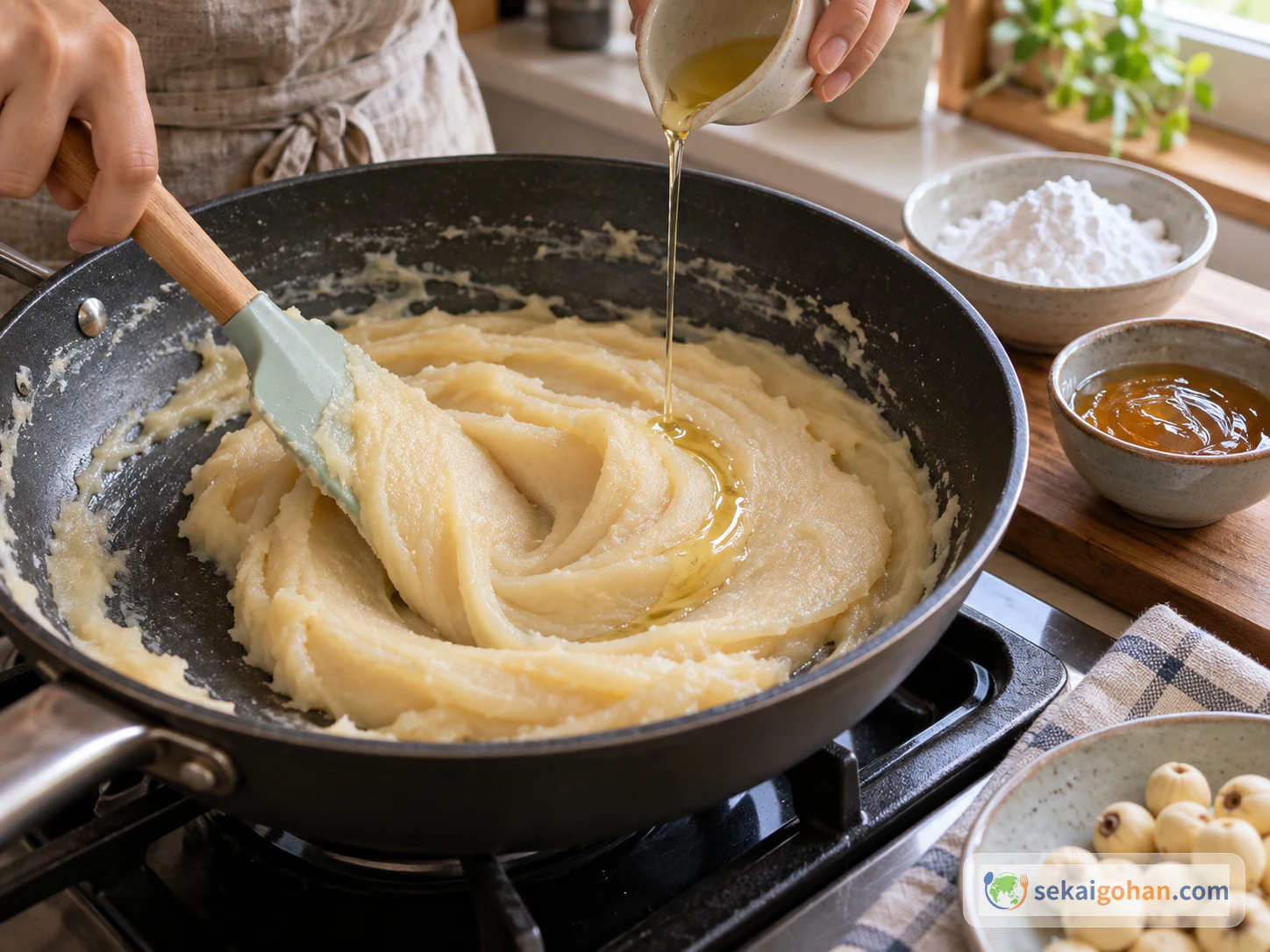
- Wide pan and a silicone spatula, for turning the paste constantly from the bottom
- Digital scale, for dividing 25g, 2 oz (58g) and 2.5 oz (70g) portions
- Mixing bowl and rubber spatula for the dough
- 3.5 oz (100g) mooncake mold (or shape by hand as described above)
- Spray bottle for misting, or just your fingertips
- Pastry brush for the egg wash (a natural-bristle brush works well)
- Baking tray and oven mitts
- Oven thermometer, to check your oven against its dial
Choosing Mooncake Ingredients and Substitutes
Flour and water. Measure the dough flour as 1 3/4 cups rather than 1 2/3 cups (about 250g), and stay with the cup measure instead of converting to grams. For the lotus seeds, start with 4 cups of water (up to 4 1/2 cups) and keep the seeds below the surface.
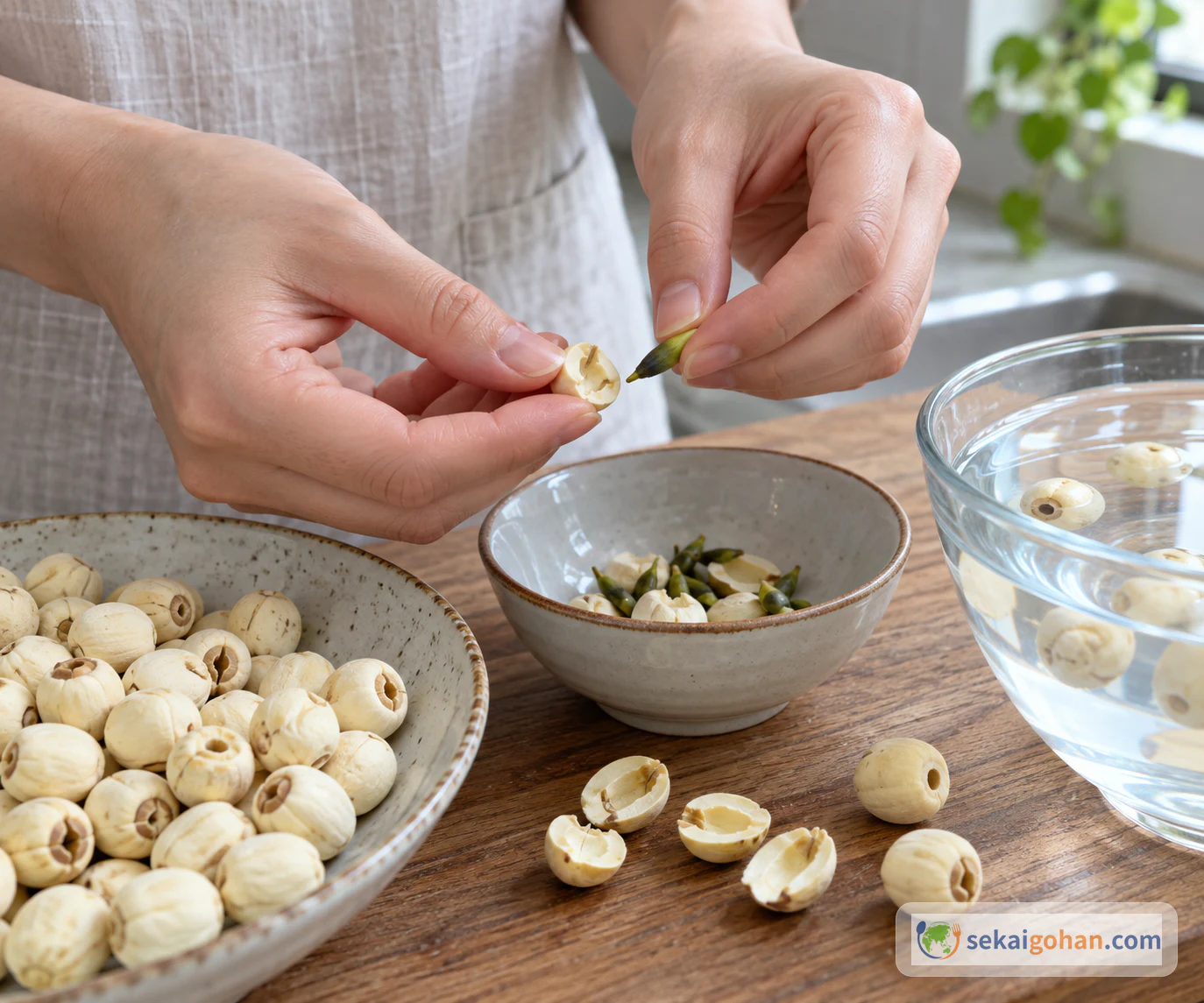
- Lotus seeds: dried lotus seeds are sold at Chinese grocers and online. Split seeds with the germ already removed shorten the prep. White or red beans make a different paste without the lotus aroma, so the result is no longer lianrong.
- Powdered sugar: use powdered sugar for the paste. Granulated sugar has a different grain.
- Oil: peanut oil or corn oil. Corn oil avoids peanut and works in both the paste and the dough. A neutral vegetable oil can stand in at the same volume, though the aroma will differ.
- Maltose: sold as maltose at Chinese grocers. Other thick glucose syrups behave differently, and the paste may set softer or firmer.
- Lye water: buy a product labeled as food-grade alkaline water (kansui / lye water) and use only the small amount given. Baking soda dissolved in water is not an equal substitute.
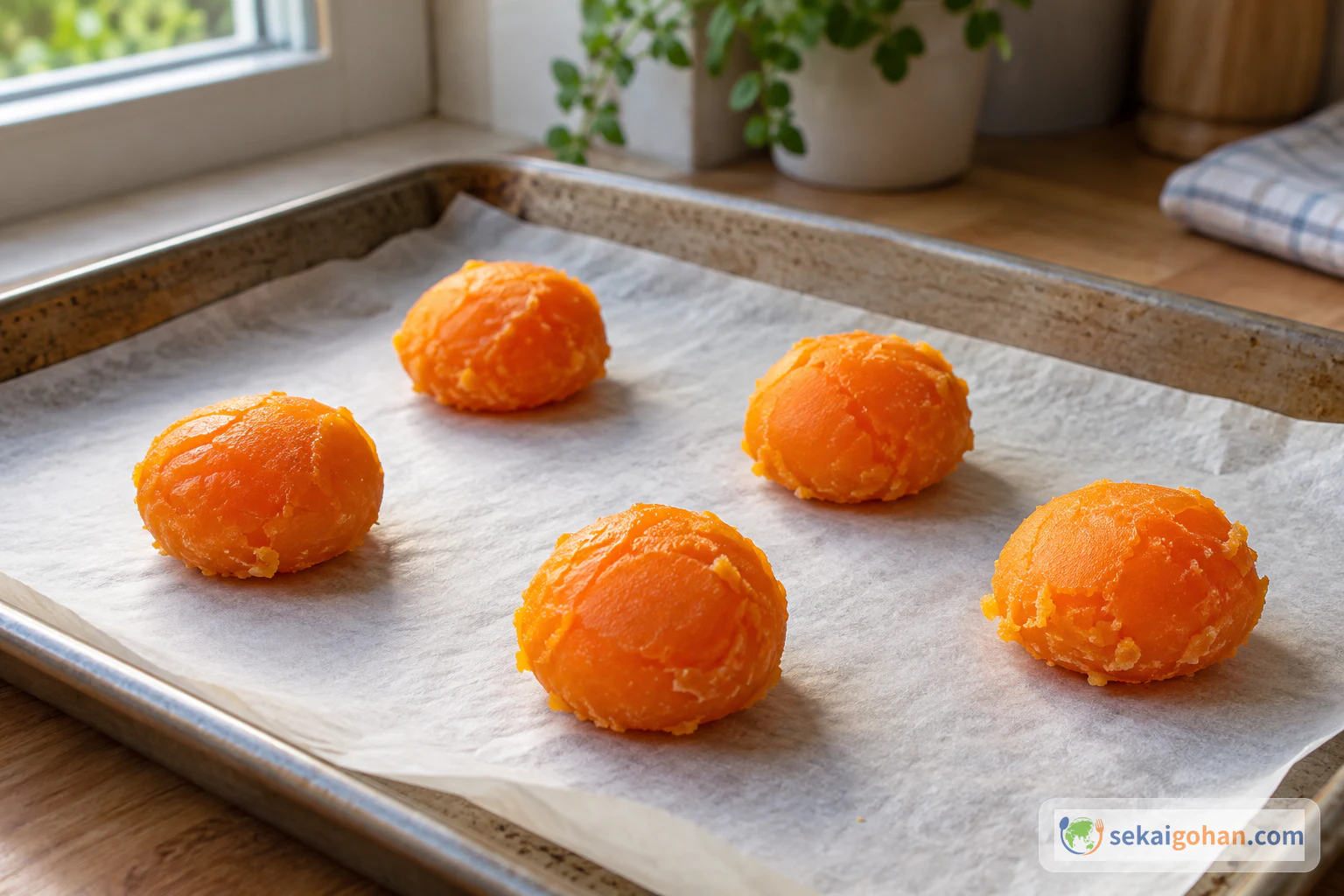
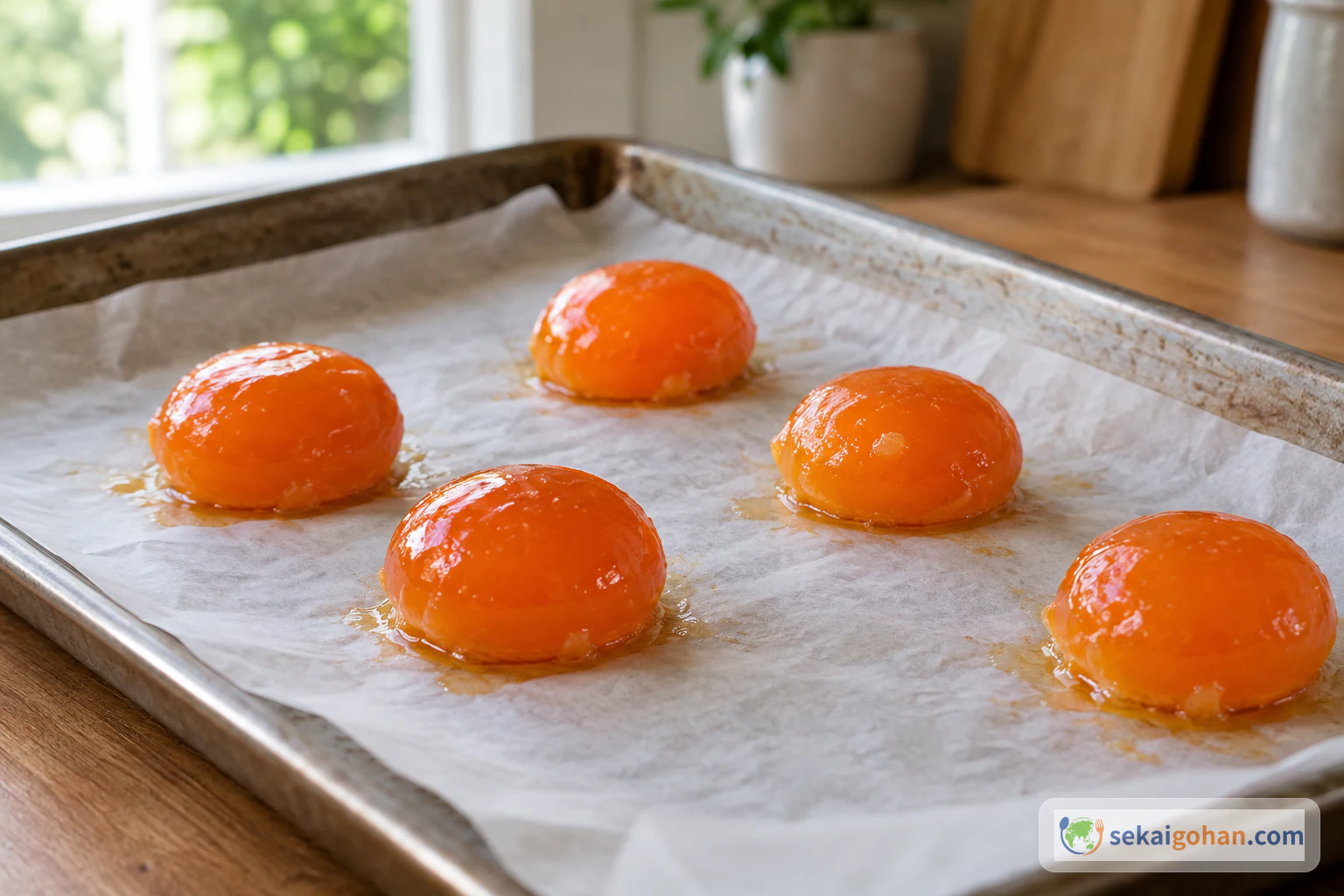
- Salted duck egg yolks: check whether the product is raw or cooked before you buy, and treat a product of unknown status as raw. The main method uses cooked individual yolks. Yolks from whole salted eggs that are already fully cooked need no further baking. For yolks from uncooked salted duck eggs, rinse off the egg white, optionally coat the yolks lightly with baijiu (Chinese spirit), bake them at 350°F (175°C) for 8–10 minutes and cool them completely. The baijiu adds aroma only. It is not a food-safety step.
This recipe contains wheat and egg (chicken egg in the wash, duck egg in the salted yolks), and peanut if you choose peanut oil. Corn oil is an alternative. Check product labels on lye water, maltose, salted yolks and any prepared items for allergens and shared-facility statements, and watch for cross-contact on shared equipment.
Method: From Golden Syrup to the Rested Crust
Steps 1 to 3 can be done the day before so the syrup and paste are fully cool. Steps 4 to 9 happen on baking day.
Mooncake Troubleshooting
| Problem | What to look at | What to do |
|---|---|---|
| The paste sticks to your hands | It wasn't cooked long enough to hold its shape | Return it to the pan and keep turning it until it holds its shape. Judge by texture, not the 30-minute guide; drying time depends on your heat |
| The skin tears or the filling shows | Uneven dough thickness, or trapped air | Spread the dough evenly around the filling and press out the air as you seal. Patch small tears with extra dough |
| The pattern is blurry or the cake won't release | Not enough flour in the mold, or dough stuck in the details | Dust the mold every time and tap off the excess. Clean the details before pressing again |
| The surface cracks while baking | The cakes went in dry | Mist with water before the first bake, as in step 8. Keep to the given temperature |
| The baked cakes look dull | They are freshly baked | Cool completely, refrigerate in an airtight container and allow 1–2 days for the sheen to develop |
Serving and Storing Mooncakes
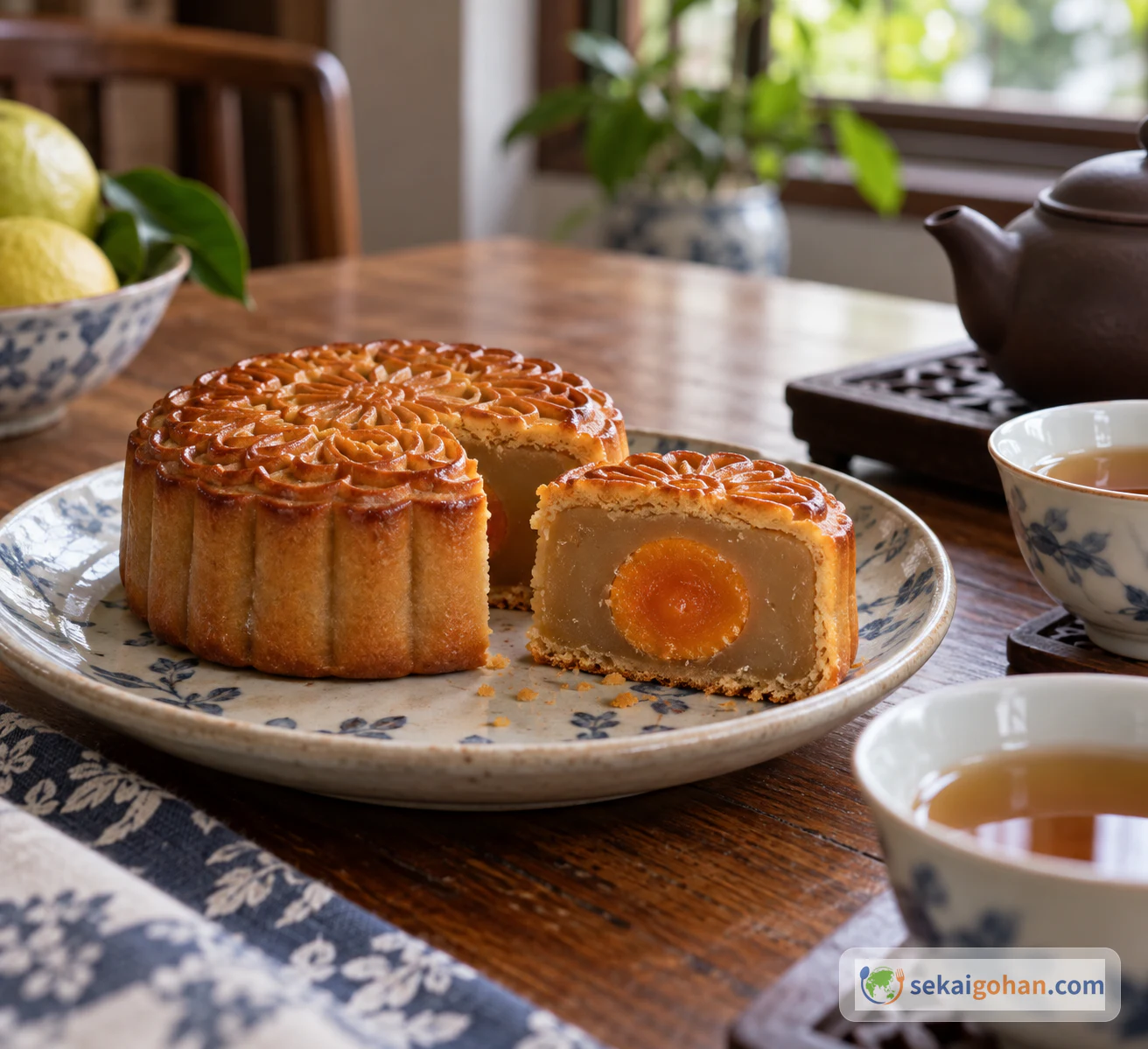
Once the baked cakes have cooled completely, refrigerate them in an airtight container and let them rest for one to two days. The crust that looked dry from the oven settles and takes on its sheen, framing the smooth lotus paste and the salty yolk at the center. So make them one day and share them another. The wait really is part of the recipe.
In Beijing, mooncakes go with moon viewing and tea. At home, slice them into wedges, pass them around and pour the tea.
Frequently Asked Questions
Can I replace the lotus seeds with store-bought lotus paste?
Not one-for-one. Store-bought paste usually already contains sugar and oil, so it can't simply replace the 12 oz of dried lotus seeds, and its sweetness and firmness depend on the product. Check the label to see how much of it is lotus seed, and adjust the sugar and oil separately.
Can I leave out the salted yolk?
Yes. The batch already includes six cakes without yolk, each with 2.5 oz (70g) of lotus paste instead of 2 oz (58g). If you want more plain cakes, the yolk/no-yolk split no longer works as written, so you'll need to re-divide the paste.
Why do the baked mooncakes look dry?
That is normal straight from the oven. The crust regains its sheen after a 1–2-day rest. After cooling completely, keep the cakes refrigerated in an airtight container, as in step 9.