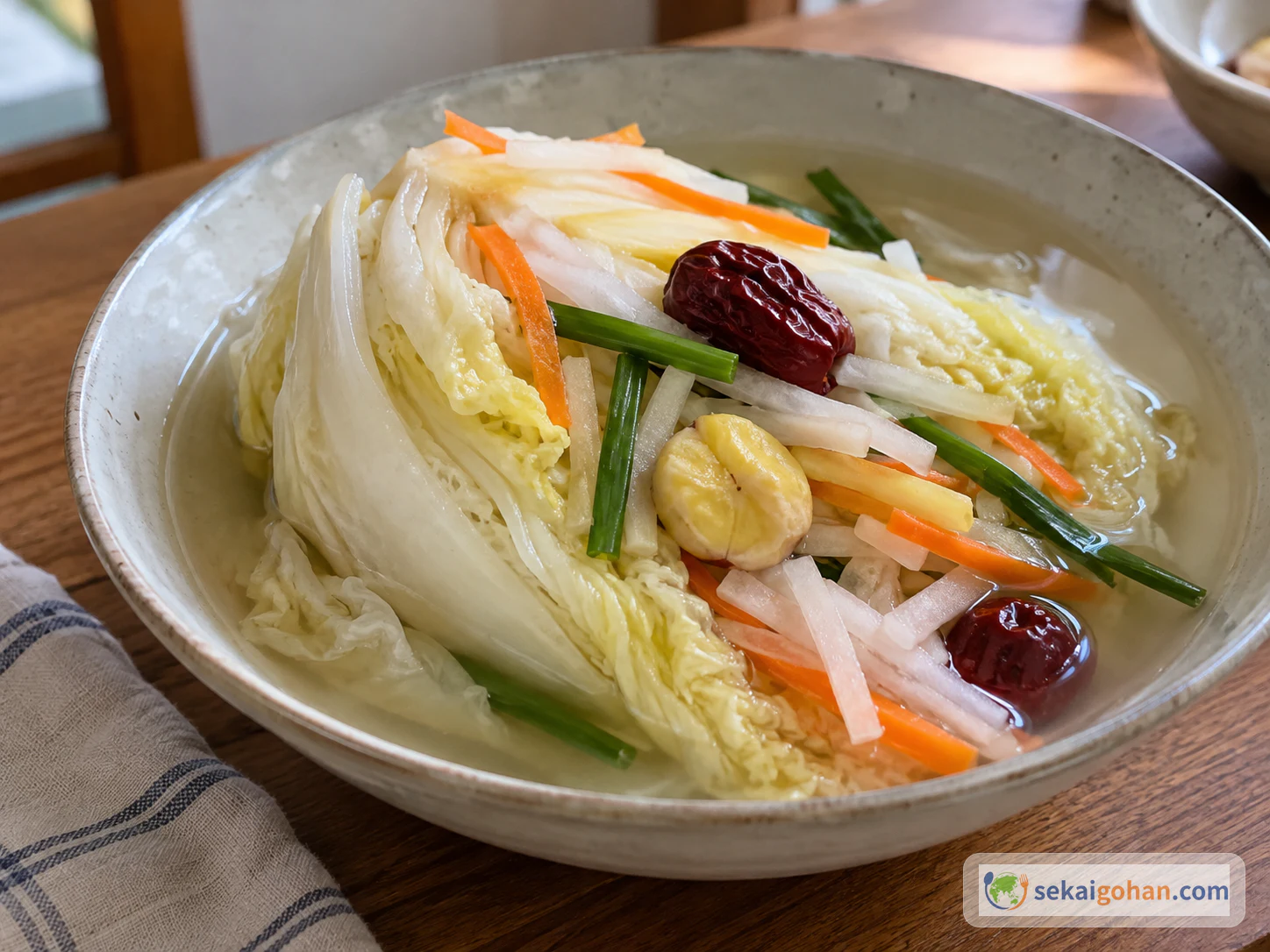
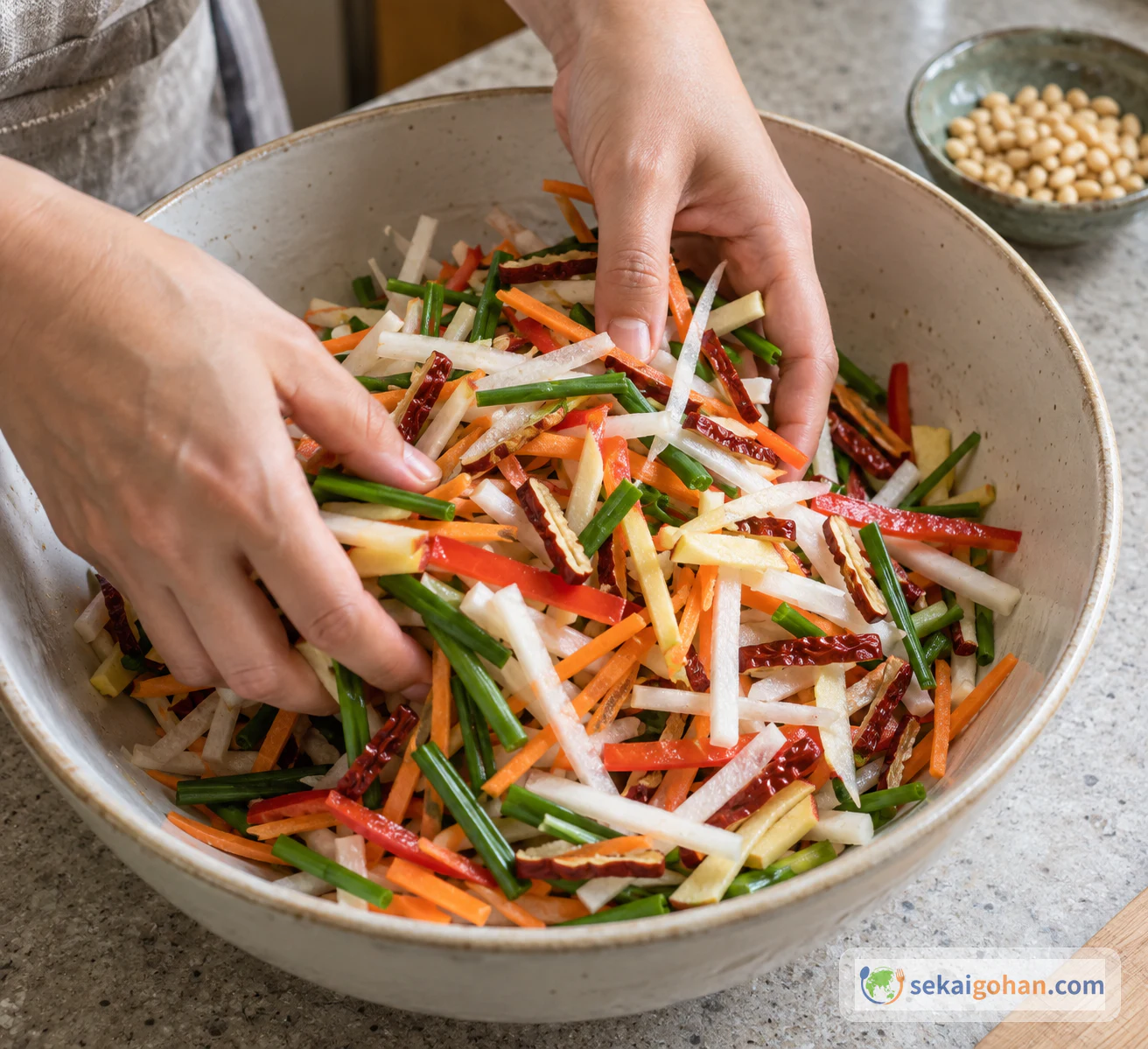
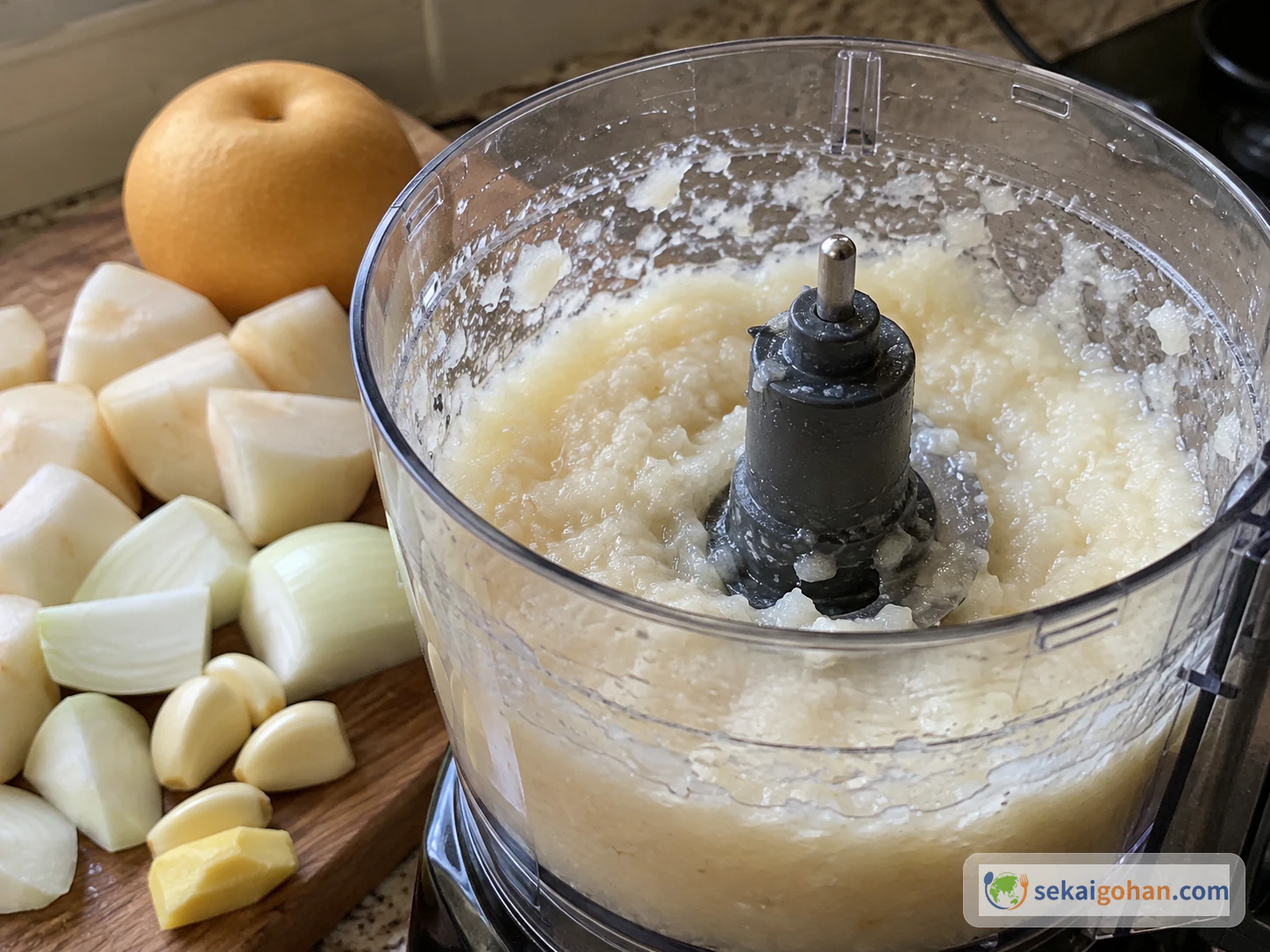
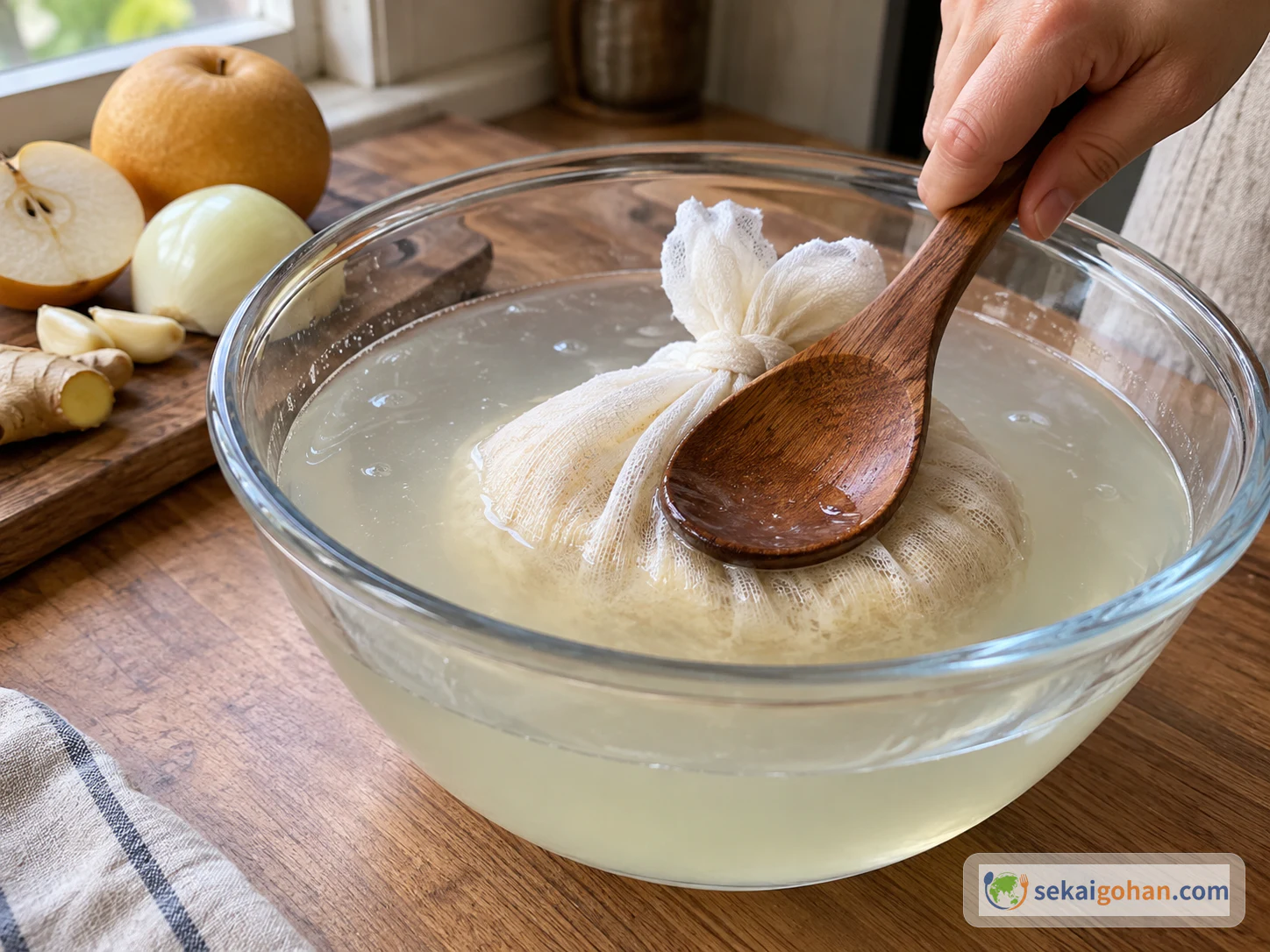
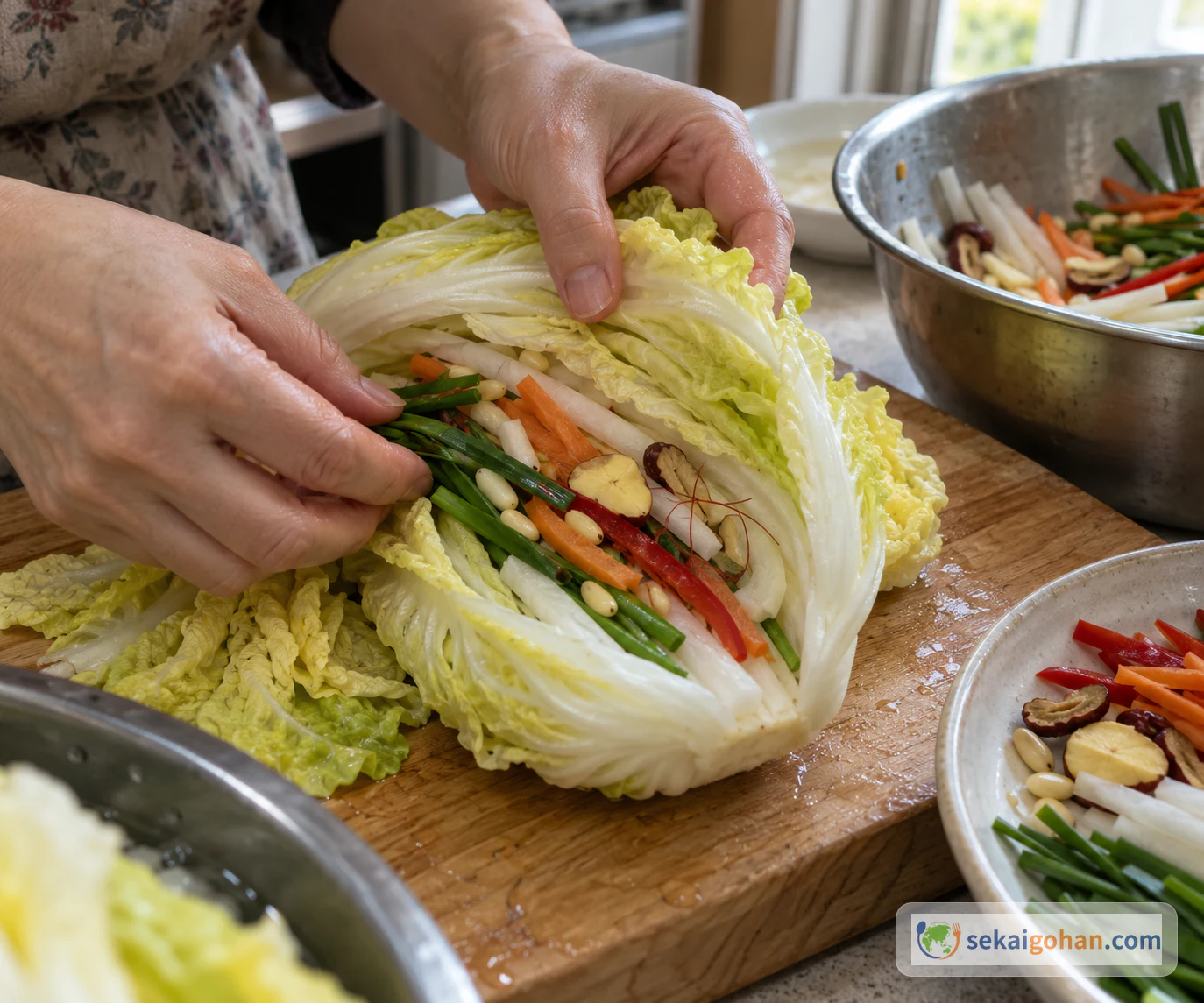
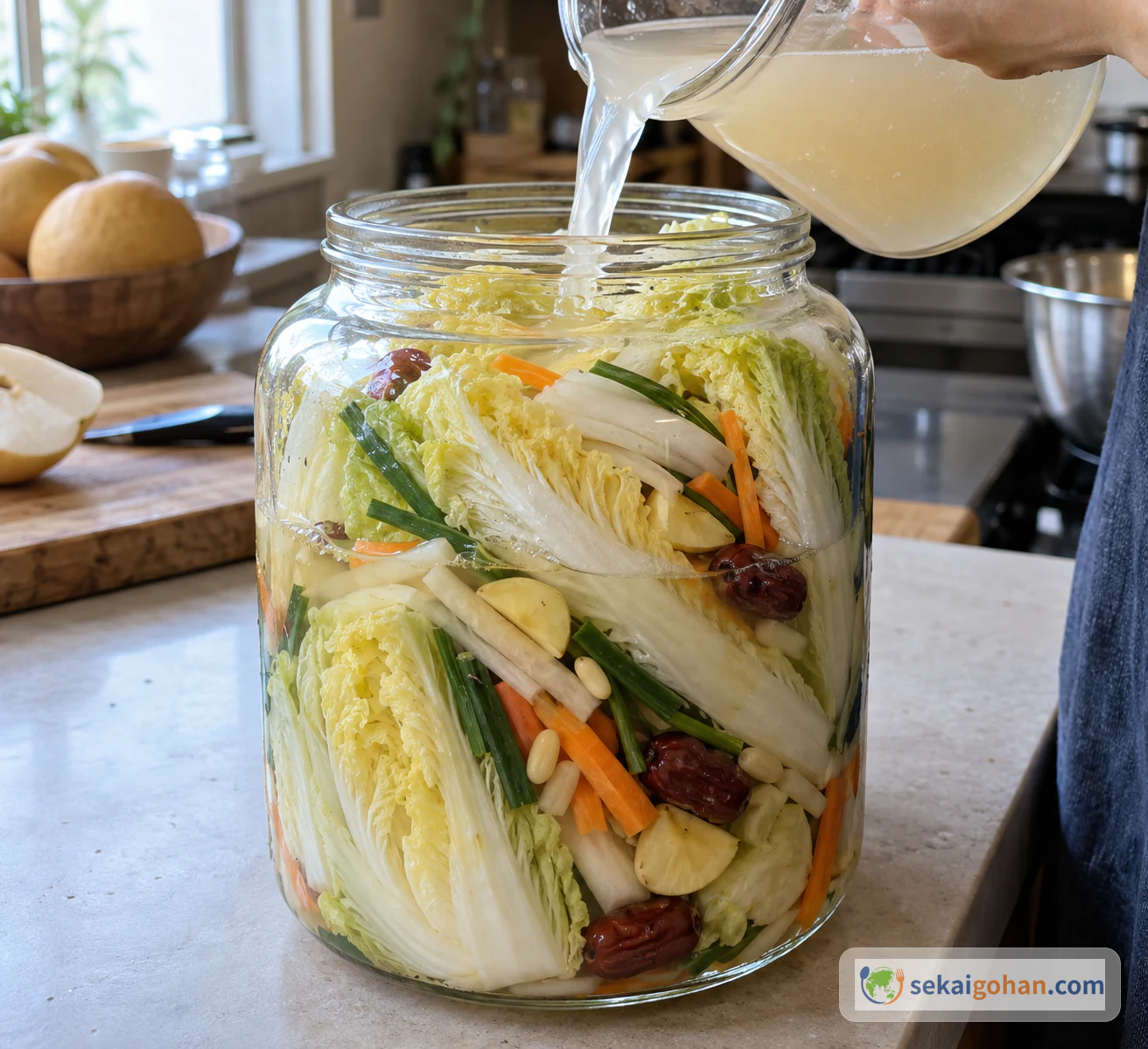
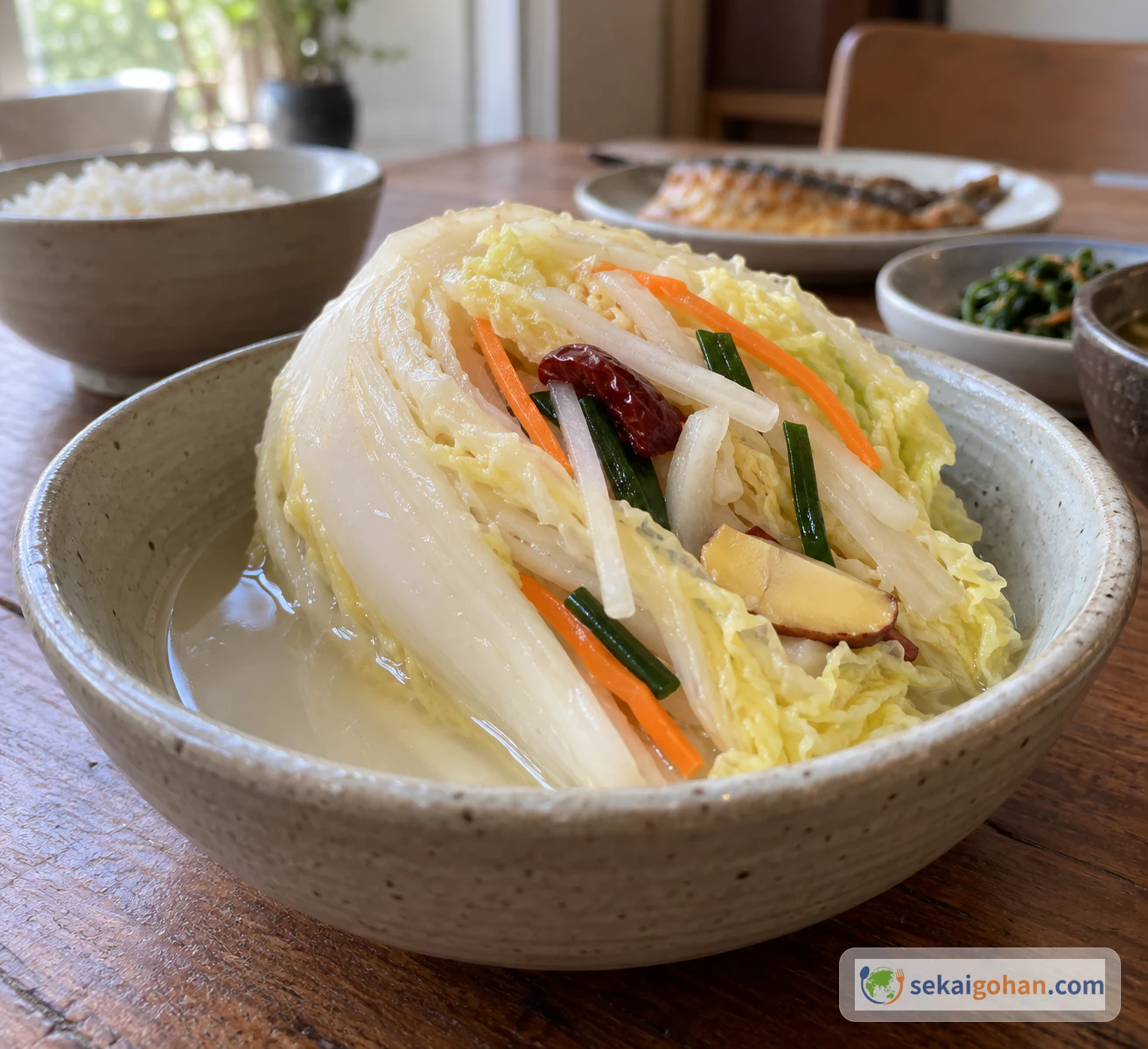
Pale cabbage leaves lie folded around matchsticks of radish and carrot, threads of red bell pepper, and strips of jujube and chestnut, all under a clear brine scented with pear. This is baek-kimchi (백김치), Korean white kimchi, and once it has fermented it is eaten cold. It is mild but full of flavor: the brine draws on pear, garlic, onion and ginger, and the filling tucks a little sweetness and crunch into every leaf.
Baek-kimchi on the Korean Table
The "white" in the name comes from leaving out gochugaru, the Korean chili powder that gives everyday red baechu-kimchi its color. That doesn't make the jar colorless. The red bell pepper and the optional silgochu threads add color; what's missing is the red chili-powder seasoning. In its place is a brine built on pear and aromatics.
Baek-kimchi is easy to lump in with other mild kimchi, but it is its own dish, distinct from mul-kimchi (water kimchi) in general, dongchimi and kkakdugi. It is made from whole-leaf napa cabbage, a vegetable filling and a pear-flavored brine. It is suited to special occasions, served cold as a side dish once it has fermented, and it goes well alongside rich dishes. You'll find more from the Korean table on our Korea page.
Kimjang, the annual making and storing of kimchi for winter, is the wider tradition behind kimchi as a whole, but this small batch can be made any time of year. A single large cabbage is a manageable amount for a home kitchen.
The salt level in this recipe has not been verified. Do not reduce the salt or convert it to weight. Treat a pH reading of 4.6 or below as the final check before eating. Sourness and bubbles do not prove it is safe.
Ingredients: Cabbage, Filling and Pear Brine
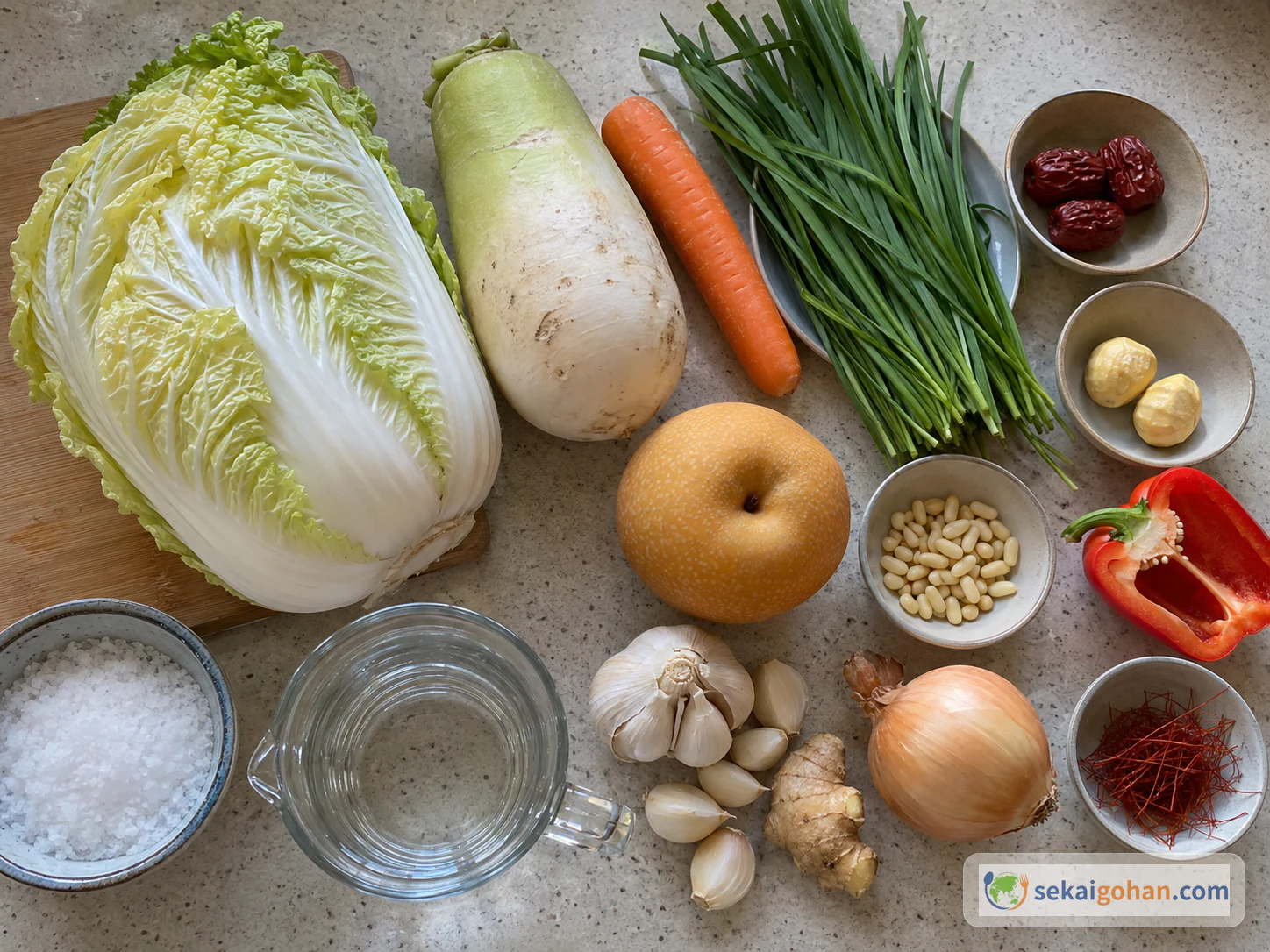
This recipe contains pine nuts, a tree nut. If you add any processed product, check its label.
Choosing Ingredients and Substitutes for Baek-kimchi
Napa cabbage, carrot, onion, garlic and ginger are everyday supermarket items. For buchu, silgochu, jujubes, Korean radish, fresh chestnuts and pine nuts, you'll need a Korean or Asian grocer. Some swaps change the character of the jar, so it helps to know what each one does.
| Item | What you can do | What changes |
|---|---|---|
| Korean radish | Use daikon | Moisture and sharpness differ |
| Buchu | Use Japanese nira | A different vegetable; aroma and leaf width differ |
| Korean pear | Use a Japanese pear, still measuring 2 cups | Aroma and moisture vary by variety |
| Silgochu | Leave it out | Only the garnish is lost; the recipe stays free of chili powder |
| Fresh chestnuts | Avoid swapping in sweet roasted chestnuts | Moisture and processing are different |
| Jujubes | Keep them in the recipe | They are part of the sweet aroma and the filling |
| Kosher salt | Measure by volume; keep it as a volume measure | Brands differ in weight per volume, so a conversion can change the saltiness |
Equipment
- Large basin, wide enough to work salt between the leaves
- Knife and cutting board
- Colander
- Food processor or blender
- Cheesecloth or a fine cloth bag
- Spoon for pressing the bag
- Clean lidded glass container that lets the brine cover the cabbage
- pH test strips or a pH meter
Baek-kimchi Troubleshooting
Most problems with this kimchi are safety decisions rather than flavor fixes, and the answer is usually to wait or to discard.
| What you notice | What to do |
|---|---|
| The cabbage sits above the brine | Use a container in which the brine covers all of the cabbage |
| The room is above 85°F (about 29°C) | Shorten the room-temperature stage and refrigerate sooner |
| About 48 hours have passed and it barely tastes sour | Refrigerate anyway; keep the room-temperature time as it is |
| It tastes sour or has bubbles, but you have not tested it | Wait to eat it; neither sign shows it is safe |
| The pH reading is above 4.6 | Do not eat it. Keep it refrigerated and test again |
| You have no way to measure pH | Wait to eat it until you can confirm 4.6 or below |
| There is mold, an odor other than a fermented aroma, or an unusual texture | Discard it |
| The brine seems too salty for your taste | Keep the salt as written in this recipe |
Storing Baek-kimchi and Tasting Over Time
Baek-kimchi keeps about one month in the refrigerator at 41°F (about 5°C) or below. Discard it if you see mold, smell anything other than a fermented aroma, or notice an unusual texture.
Once a batch has reached a pH of 4.6 or below, it's worth tasting it on different days to see how the flavor changes. That's purely for enjoyment, not a safety check.
Other versions of baek-kimchi use a long 10-to-12-hour salting and add fish sauce, salted seafood and sugar. That makes a different kimchi, so keep its ingredients and salting time separate from this one.
Frequently Asked Questions
Is white kimchi spicy?
This version contains no chili powder, though that isn't a promise of zero heat. It can include silgochu threads as a garnish; leave them out if you prefer.
Why is the room-temperature time shorter?
Some recipes give 1½ to 3 days at room temperature, depending on the heat, and treat a sour taste in the liquid as a sign that fermentation has started. That's a cook's guide, not a safety standard. Limit room temperature to about the first 48 hours, keep the room at 85°F or below, then refrigerate at 41°F or below.
Why do I need to test the pH?
Because the salt level in this recipe is not verified, the pH measurement is the final check. At the end of fermentation, confirm a pH of 4.6 or below with test strips or a meter; kimchi takes about two weeks to get below 4.6. If you cannot confirm the reading, do not eat the kimchi.
Do I need fish sauce or salted shrimp?
No. This is the vegetarian version and uses neither. Salted shrimp (saeujeot) is an optional addition, but adding it, or fish sauce and salted seafood, makes a different recipe that is no longer vegetarian.