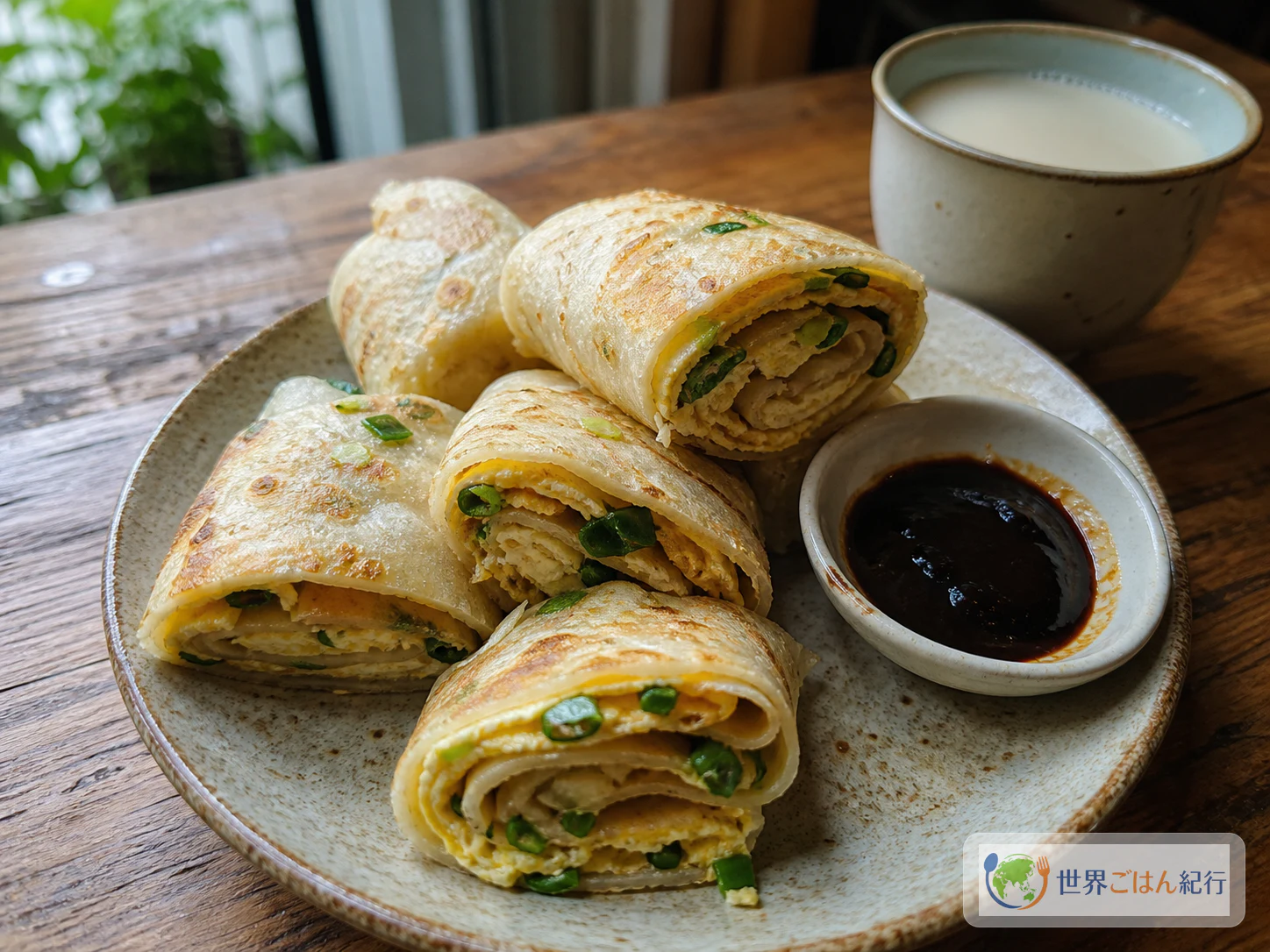
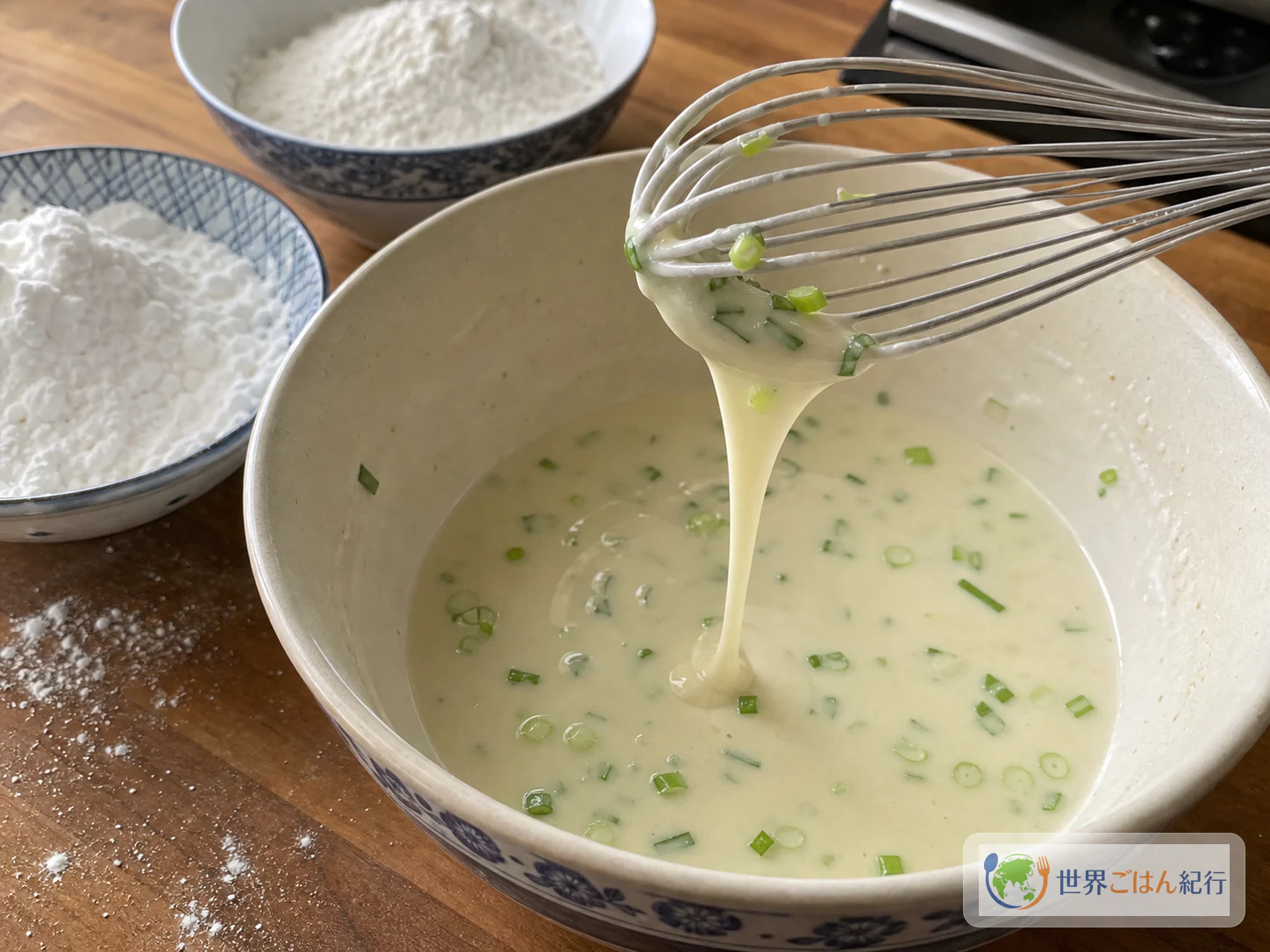
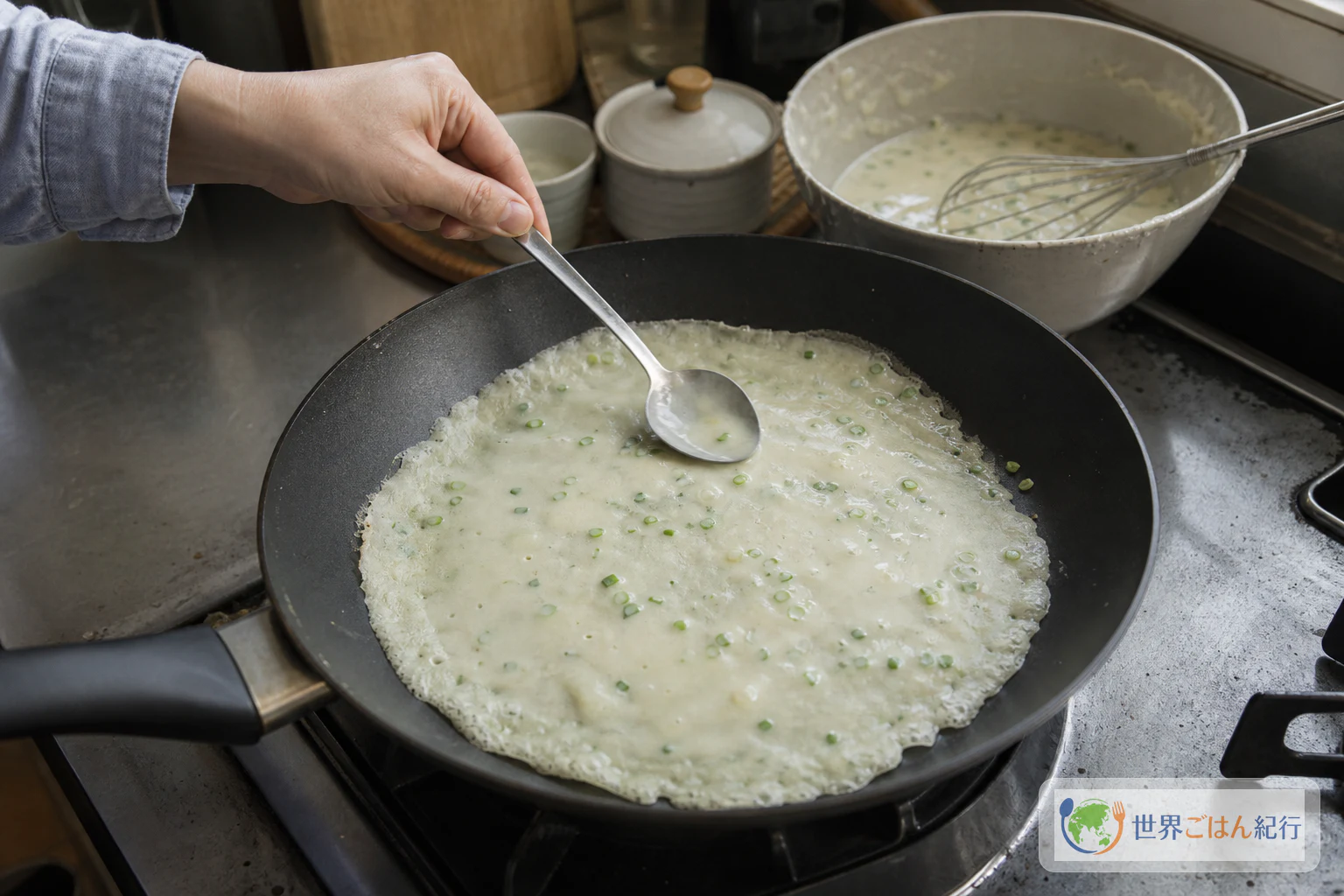
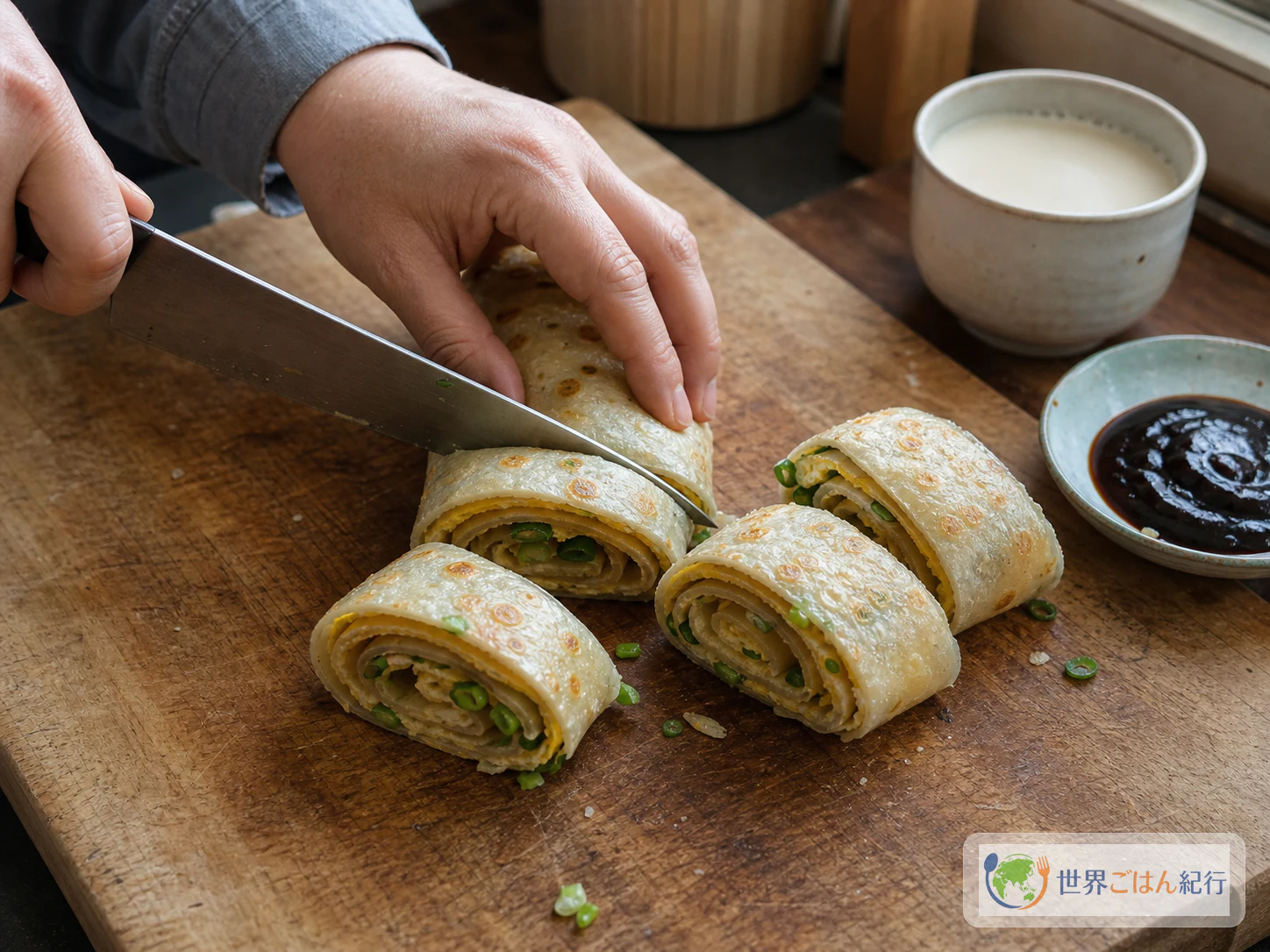
Stir flour into water on a quiet morning, and the batter could still become almost anything. Drop in scallions and spread it thin in a skillet. The moment the edge dries and small bubbles appear, it suddenly looks like a Taiwanese breakfast shop. That's danbing (蛋餅, dàn bǐng): a thin flour crepe with an egg fused onto one side, rolled up, cut, and dipped in a sweet-salty sauce. It's light and slightly chewy, with browned spots where the crepe met the pan.
Danbing in Taiwanese breakfast shops
You'll see danbing at breakfast shops, stalls and snack shops all over Taiwan. The name means "egg bing," and bing here is the Chinese word for a flat flour-based cake, not the Japanese mochi rice cake. Think of it as a rolled egg crepe. It goes naturally with morning soy milk, black tea or mijiang (rice milk).
Taiwan has more than one form. Some shops follow the old style and fuse the egg onto a freshly cooked flour crepe. Others use frozen or ready-made wrappers for speed, and many offer cheese, corn, tuna or pork floss as fillings.
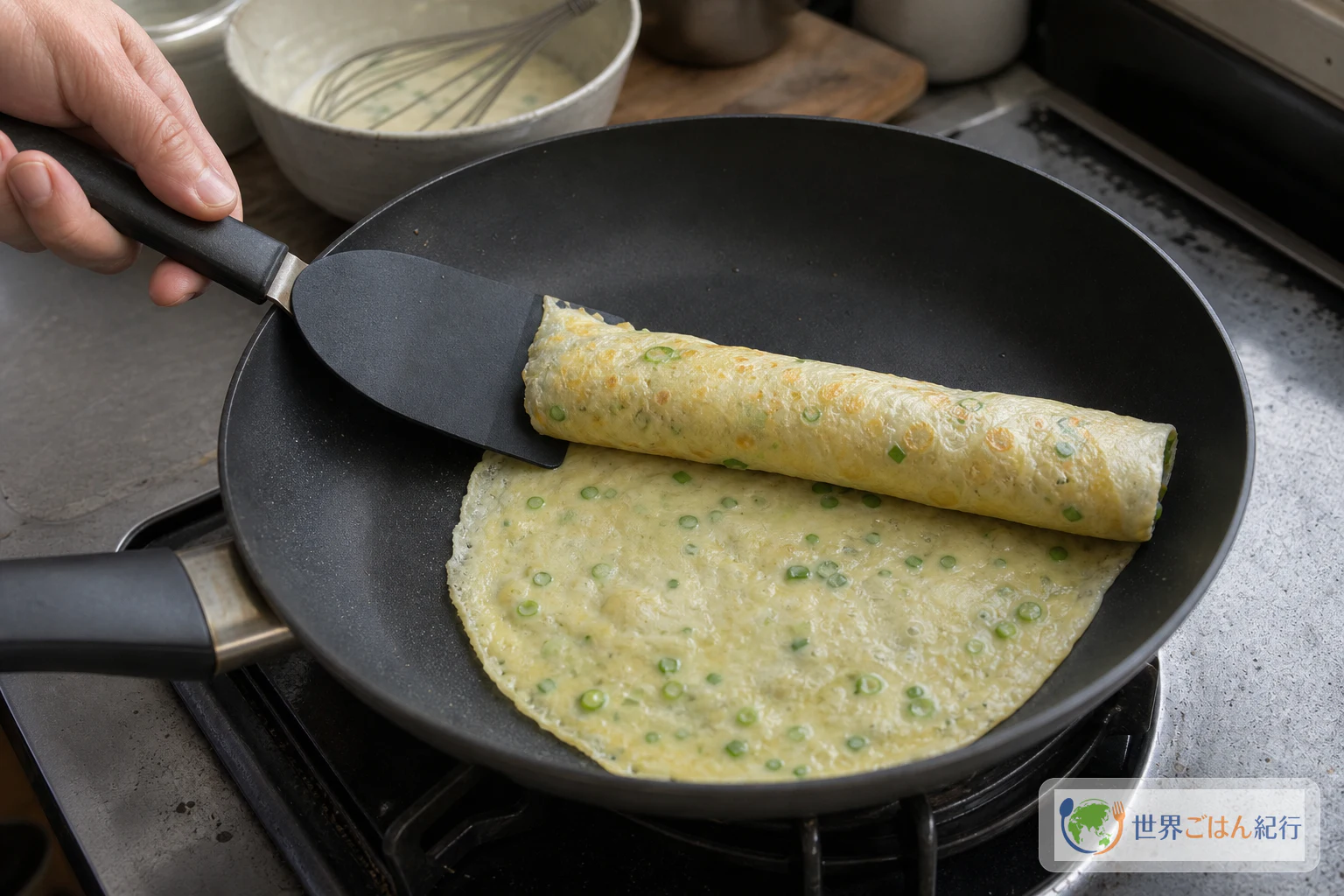
A breakfast-shop danbing is rarely a perfect round. Expect a few browned spots, uneven edges and visible layers of egg and crepe. What matters at home is a crepe that isn't too thick and an egg that stays put until you roll it.
Danbing sits at the opposite end of the Taiwanese table from barrel chicken. That whole-bird roast is a big dinner dish, while danbing is a light morning dish you eat with one hand. With Chinese flour-based dishes such as chow mein and biangbiang noodles, the flavor depends on how the dough is handled. Danbing is different because nothing is kneaded. The batter is simply poured thin.
Ingredients: cake flour for the crepe, tapioca starch for chew
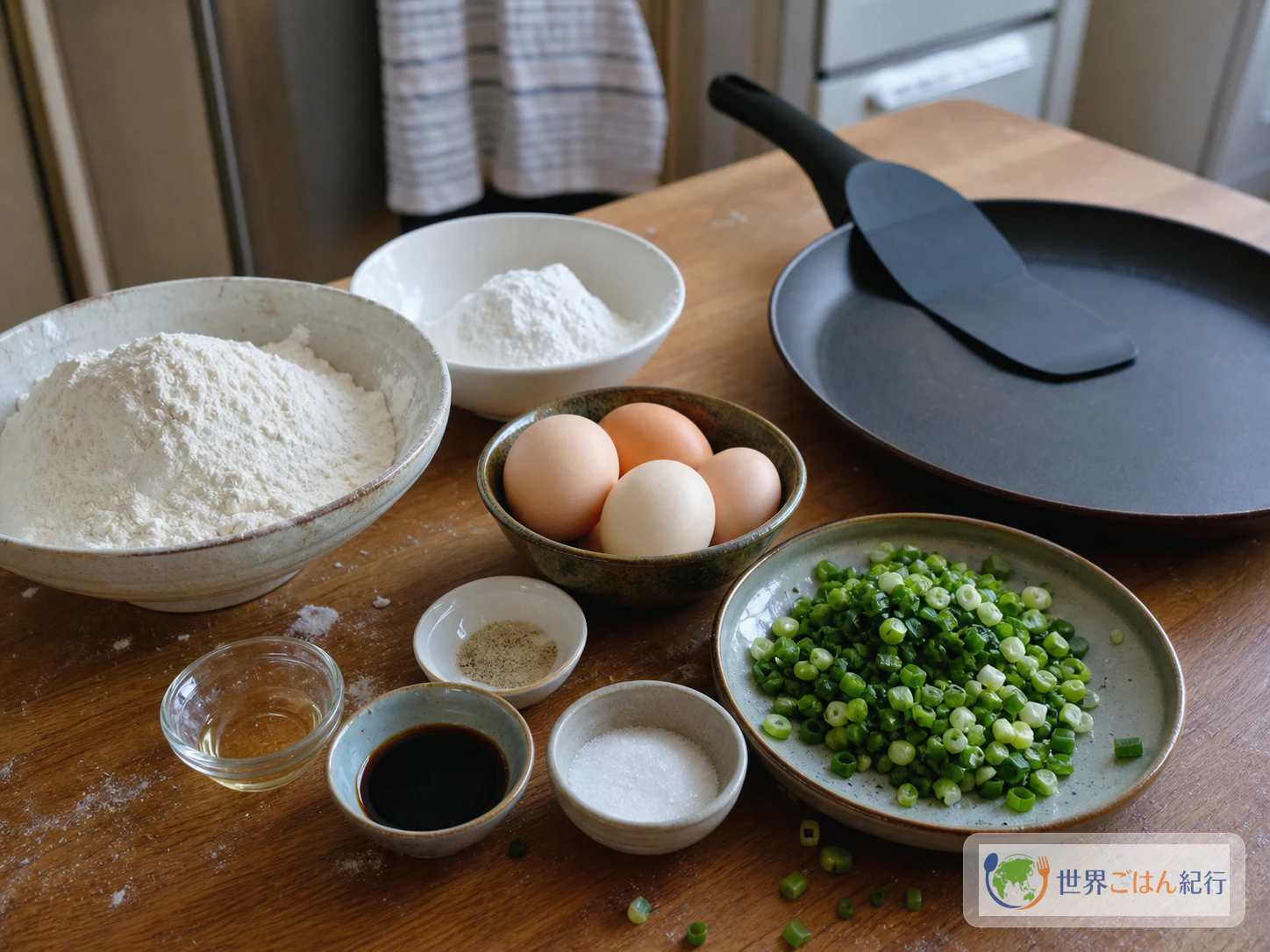
This makes four danbing, each 9.5 inches (22 to 24 cm) across, for 4 servings. One each makes a breakfast; for a light lunch, add soy milk, cucumber and fruit. The crepe tightens as it cools, so it's easiest to eat when rolled and cut fresh off the pan.
This recipe contains egg, wheat, soy and sesame. Some soy sauce, dark soy sauce and tapioca starch are made on lines that also handle wheat or soy, so if you have allergies, check the package labels. Don't leave the egg runny: cook until the surface is set and has bonded with the crepe.
Choosing flour, sauce and pan for danbing
The ingredients are easy to find. The real challenge is a crepe that's thin but doesn't tear. All-purpose flour alone turns heavy, and too much potato starch makes it stiff, like a rice cake. That's why this version adds a little tapioca starch to cake or low-protein flour. Eggs, scallions, cake flour, cucumber and soy milk are everyday groceries. The items that bring the result closer to Taiwan are the tapioca starch, the dark soy sauce and the cooking surface.
Tapioca starch gives the crepe enough elasticity to fold without tearing. Keep it under 20% of the total flour, or the texture turns heavy and dumpling-like.
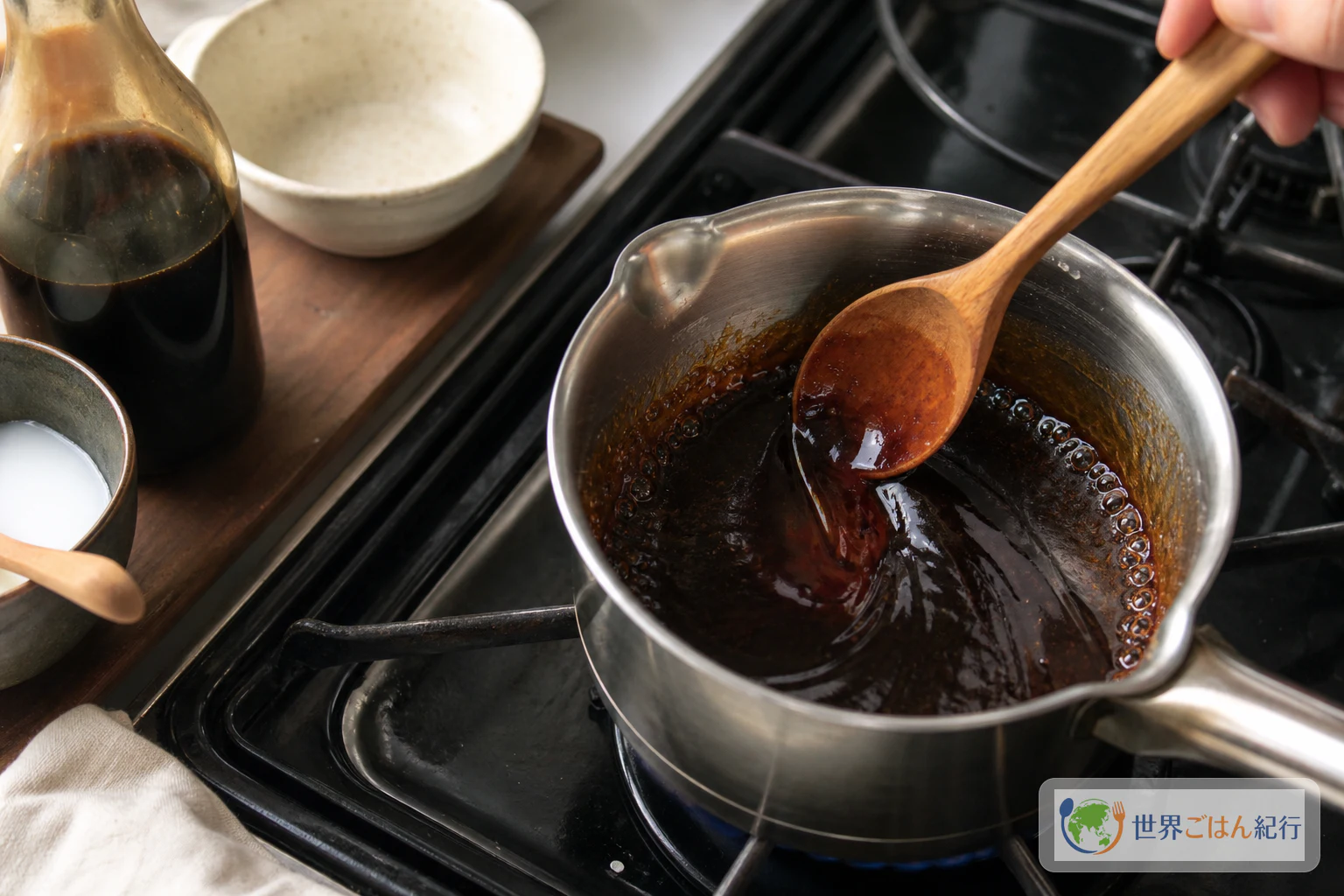
Dark soy sauce is there for the deep color of the soy-paste-style sauce. It also adds sweetness and body, so a small amount is enough. Leftover dark soy can go into sauces for chow mein or Hainanese chicken rice.
A regular skillet works fine. A crepe pan with low sides makes it easier to spread the batter thin and keeps the crepe from creasing when you flip it. If you like cooking thin flour-based dishes, one is worth a look.
Method: cook the crepe, fuse on the egg, roll
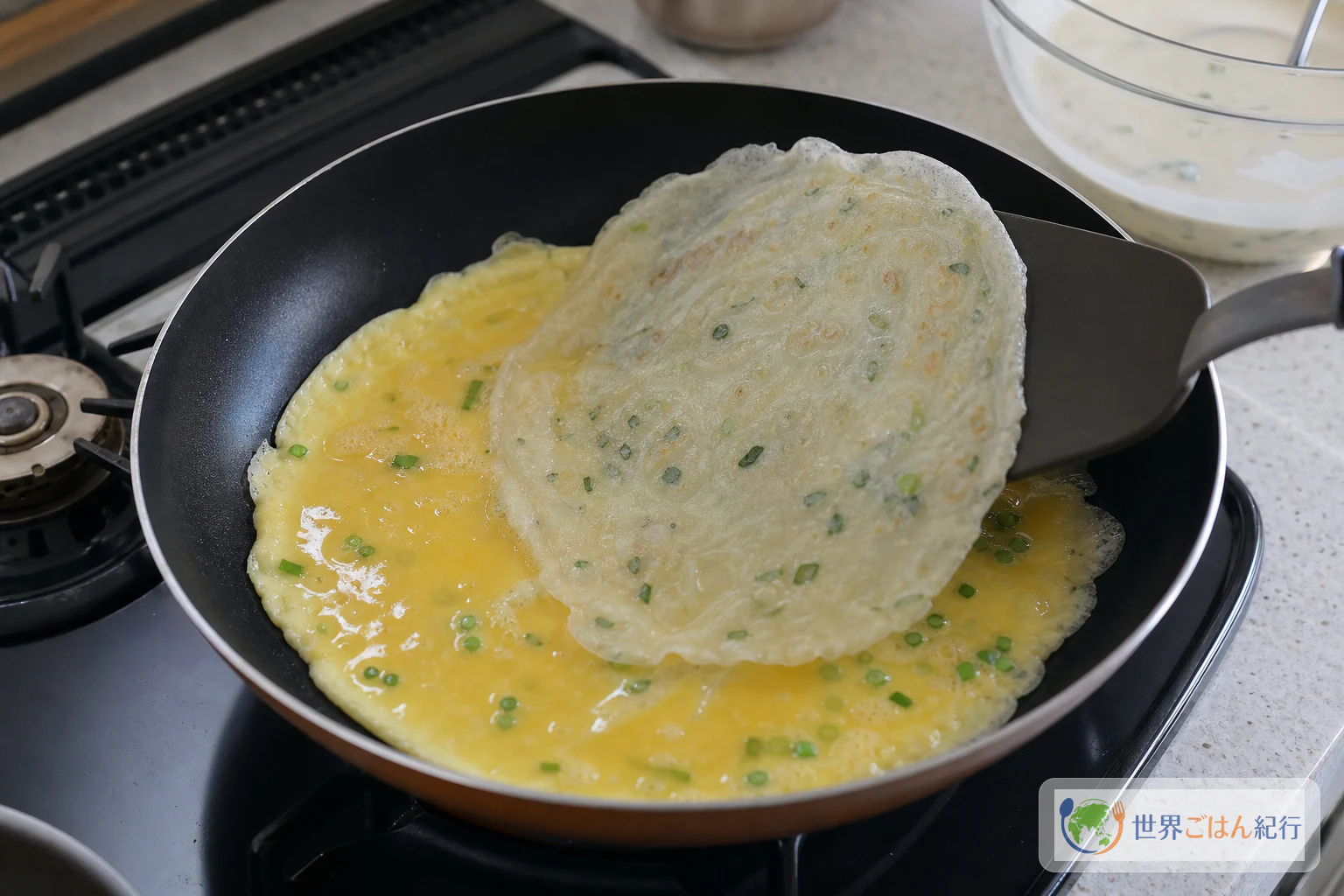
If you try to roll a danbing that was cooked thick, it cracks. Spread the batter thin, cook only the crepe first, then lay it back on the spread-out egg so the egg works like glue. When cooking four in a row, treat the first one as a test of the heat and don't let the pan get too hot.
Danbing troubleshooting
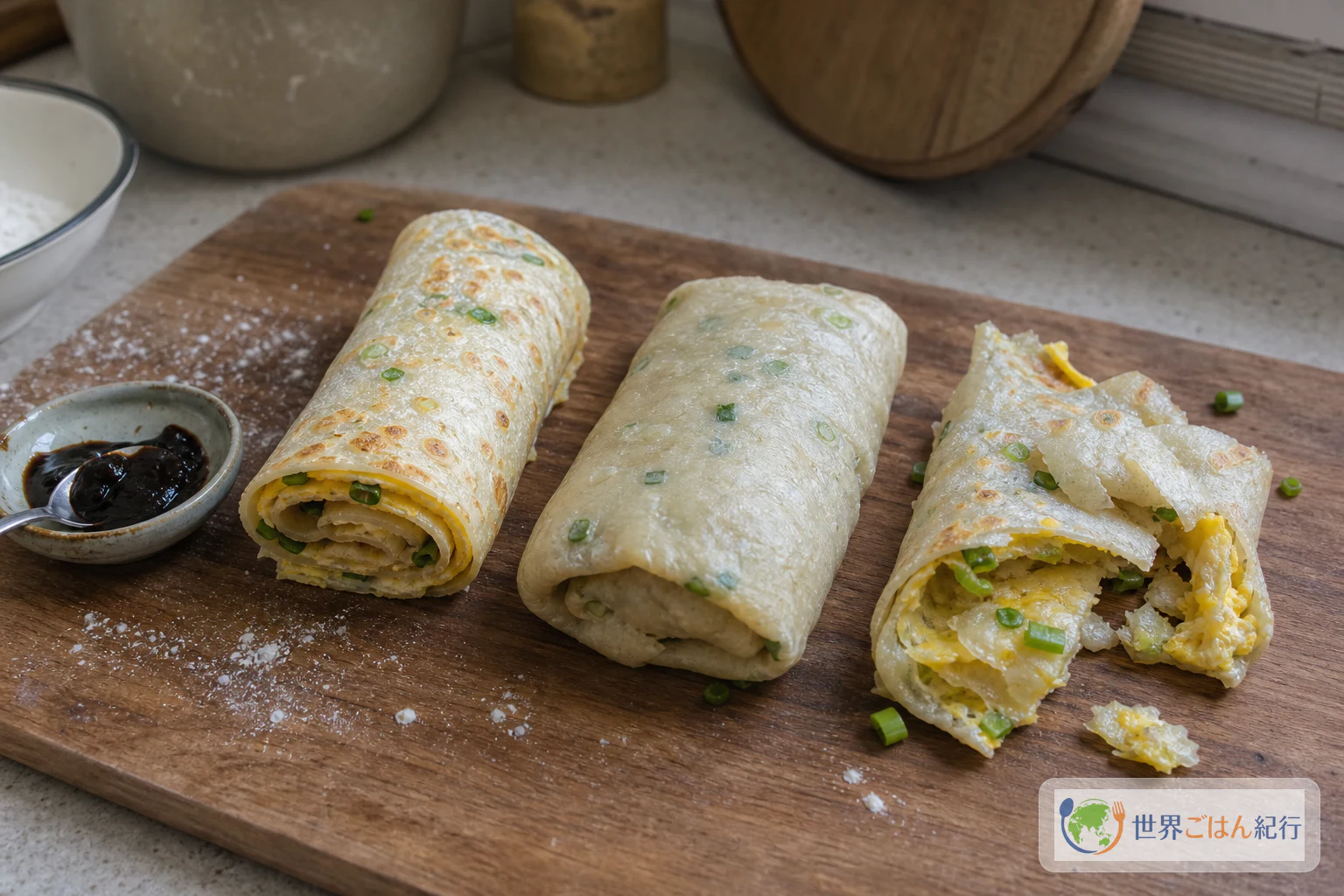
Almost every danbing failure comes down to batter thickness and heat. A thicker batter may look neater, but it's hard to roll. High heat dries the surface while the inside stays raw. Adjust the first crepe using the table below, and the second will go more smoothly.
| Problem | Cause | What to change next |
|---|---|---|
| The crepe is thick | The batter is heavy, or too much was poured | Add 2 tsp (10 ml) water and keep to ¼ cup (70 ml) per crepe |
| The crepe tears | Flipped too early, or too little tapioca starch | Wait until the edge dries, and loosen the bottom all the way around before flipping |
| The egg peels away | The egg dried before the crepe went on | Lay the crepe on while the center of the egg is still glossy |
| Black burnt spots | The pan is too hot | After one crepe, turn off the heat for 30 seconds and cool the bottom slightly on a damp cloth |
| Too chewy | Too much tapioca starch, or cooked too briefly | Stop at 25 g tapioca starch and brown both sides lightly |
The most common mistake at home is an overheated pan. Crepes seem like something you cook fast on high heat. Danbing's loose batter, though, spreads thinner on a cool surface, with the heat added afterward. By the second crepe the pan is already hot, so turn off the heat before pouring and return to medium-low once the batter is spread.
Serving and storing danbing
Taiwanese breakfast shops often serve danbing with soy paste, a sweet soy sauce or chili sauce. Pouring all the sauce over at once softens the edges of the crepe, so serve it in a small dish for dipping. Warm soy milk on the side completes a flour-and-egg breakfast.
| Item | Storage | Reheating |
|---|---|---|
| Cooked crepes only | Refrigerate for 2 days. Sandwich each one in plastic wrap | In a skillet over low heat, 30 seconds on one side |
| Rolled danbing | Refrigerate, same day only | In a skillet over low heat for 1 minute, then flip and 40 seconds |
| Soy-paste-style sauce | Refrigerate for 3 days | In a small pan over low heat for 30 seconds. If stiff, add 1 tsp water |
To make ahead, cook only the crepes. They recover their texture far better than finished, rolled danbing. In the morning, cook the egg, lay a cold crepe on it, and let the two fuse as the crepe warms. The microwave alone leaves the crepe too soft, so finish by drying the surface in a skillet.
Once the basic crepe and egg are reliable, try fillings, the way Taiwanese breakfast shops let you choose. Start with 2 tbsp corn, 20 g cheese or 1 oz (30 g) tuna. With too much filling, the seam opens and the egg and crepe peel apart.
Frequently asked questions
Can I make it with only potato starch?
You can, but the crepe turns a little firmer as it cools. Use 15 g potato starch in place of the 25 g tapioca starch, and reduce the water to 1 cup (220 ml) from the start. If the batter gets heavy as you cook, add water 1 tsp (5 ml) at a time.
Can I use store-bought frozen scallion pancakes?
It saves time. But cong you bing (葱油餅) are layered and oily, so you'll end up with something closer to a scallion pancake with egg (葱抓餅 with egg) than a danbing. Some Taiwanese breakfast shops do use a wrapper close to the ready-made kind, so enjoy it as a different texture from the thin, old-style crepe.
What do I do about the sauce if I can buy soy paste?
If you have soy paste (醬油膏), skip the homemade sauce and put 2 to 3 tbsp in a small dish. If the product is very salty, thin it with 1 tsp water, 1/2 tsp rice vinegar and a pinch of sugar. A sweet product can be used as is, and you can leave the dark soy out of the ingredients.
What should I change for children?
Leave out the white pepper and keep the sauce milder. Cook the egg firmly, and cut the pieces a little smaller than 1 inches (3 cm), to 1 inches (2 cm), so they're easier to eat. Instead of the sauce, serve a small amount of 1/2 tsp mild soy sauce mixed with a pinch of sugar.
What should I pair it with from other Taiwanese food?
For breakfast, warm soy milk, a xiandoujiang-style soup (salty soy milk soup) and fruit are plenty. For dinner, serve danbing as a starter, with barrel chicken as the main and Hainanese chicken rice as the rice dish. Together they bring the aromas of Taiwan and neighboring Chinese cooking to one table.