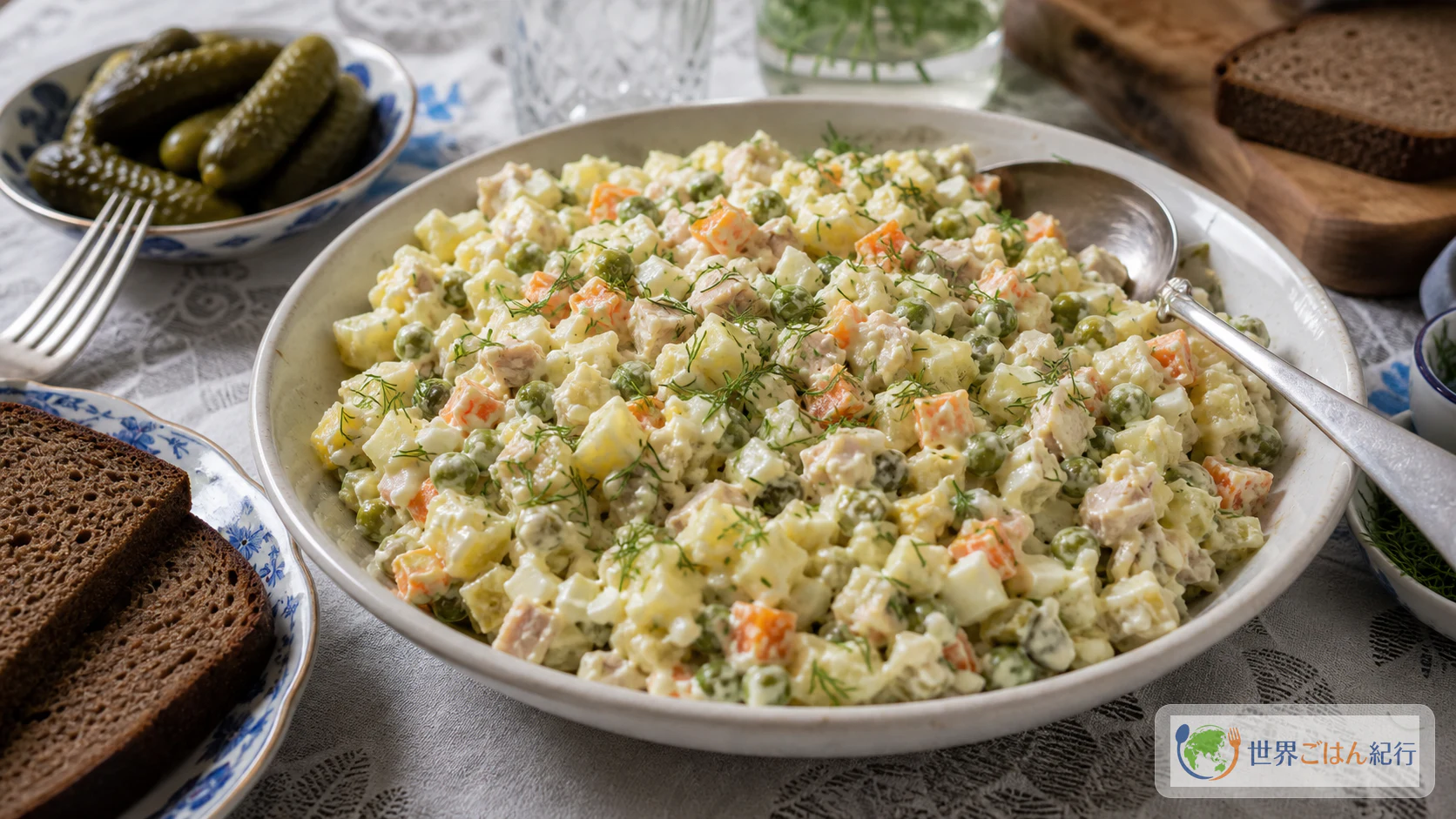
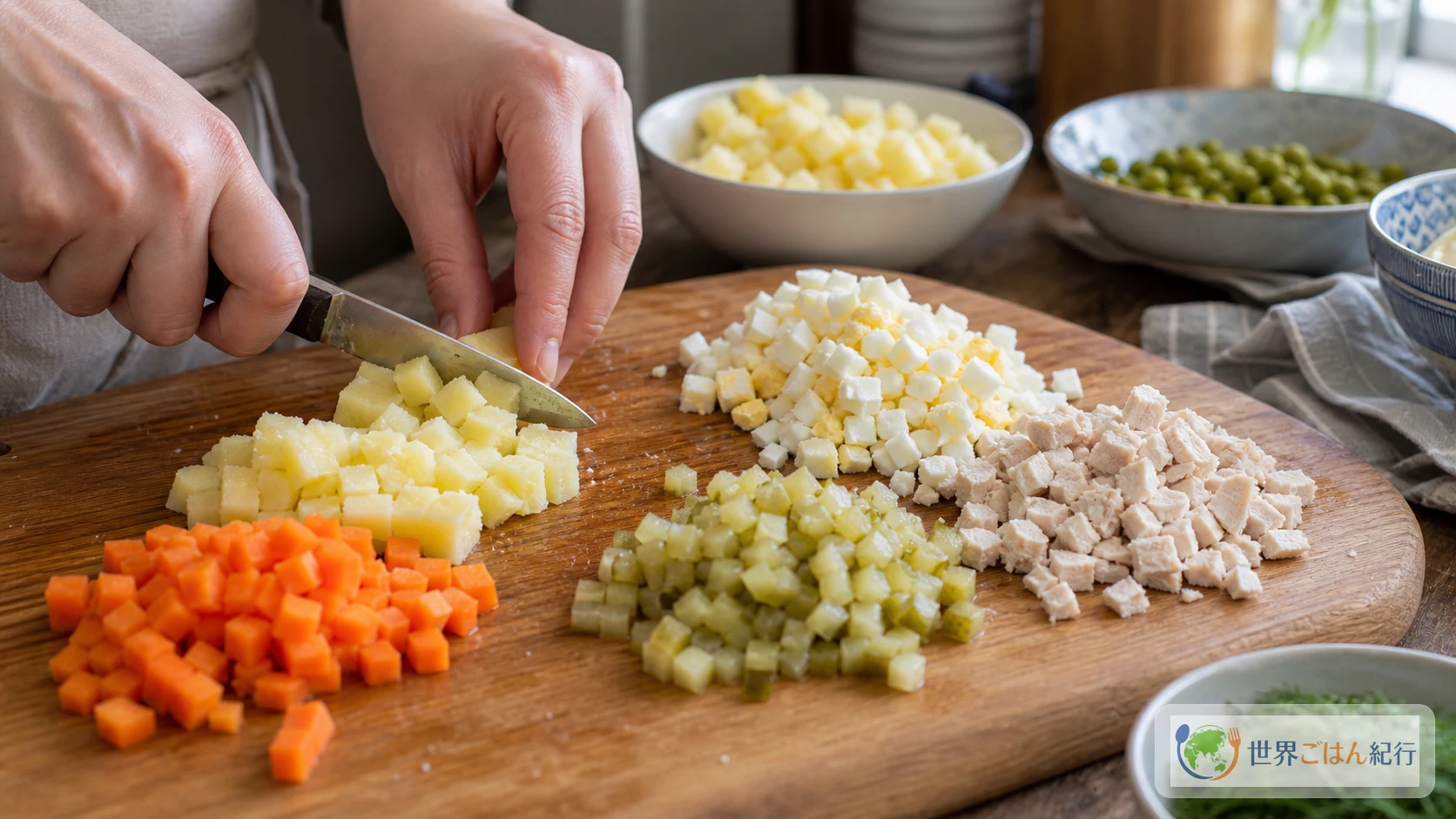
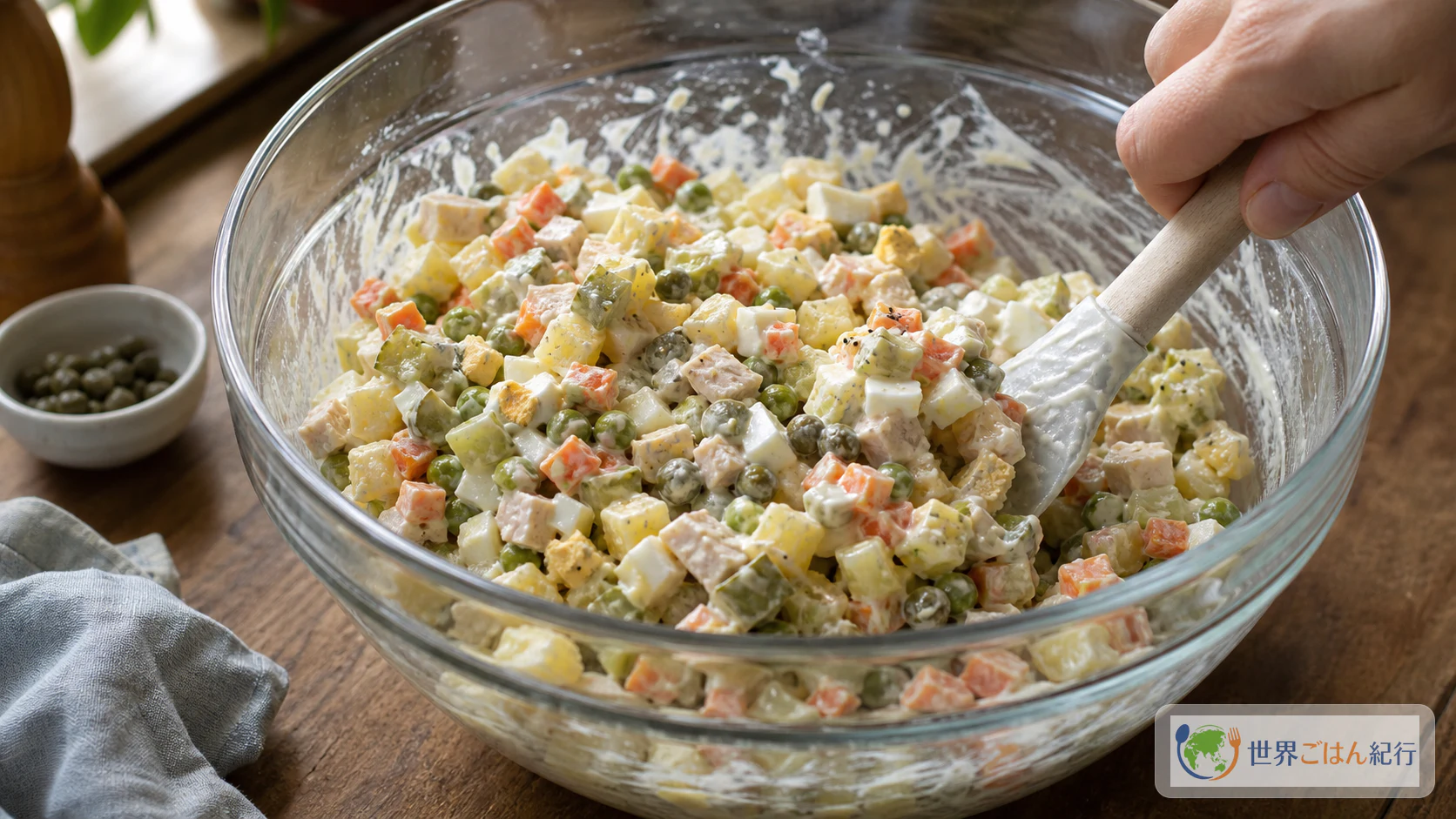
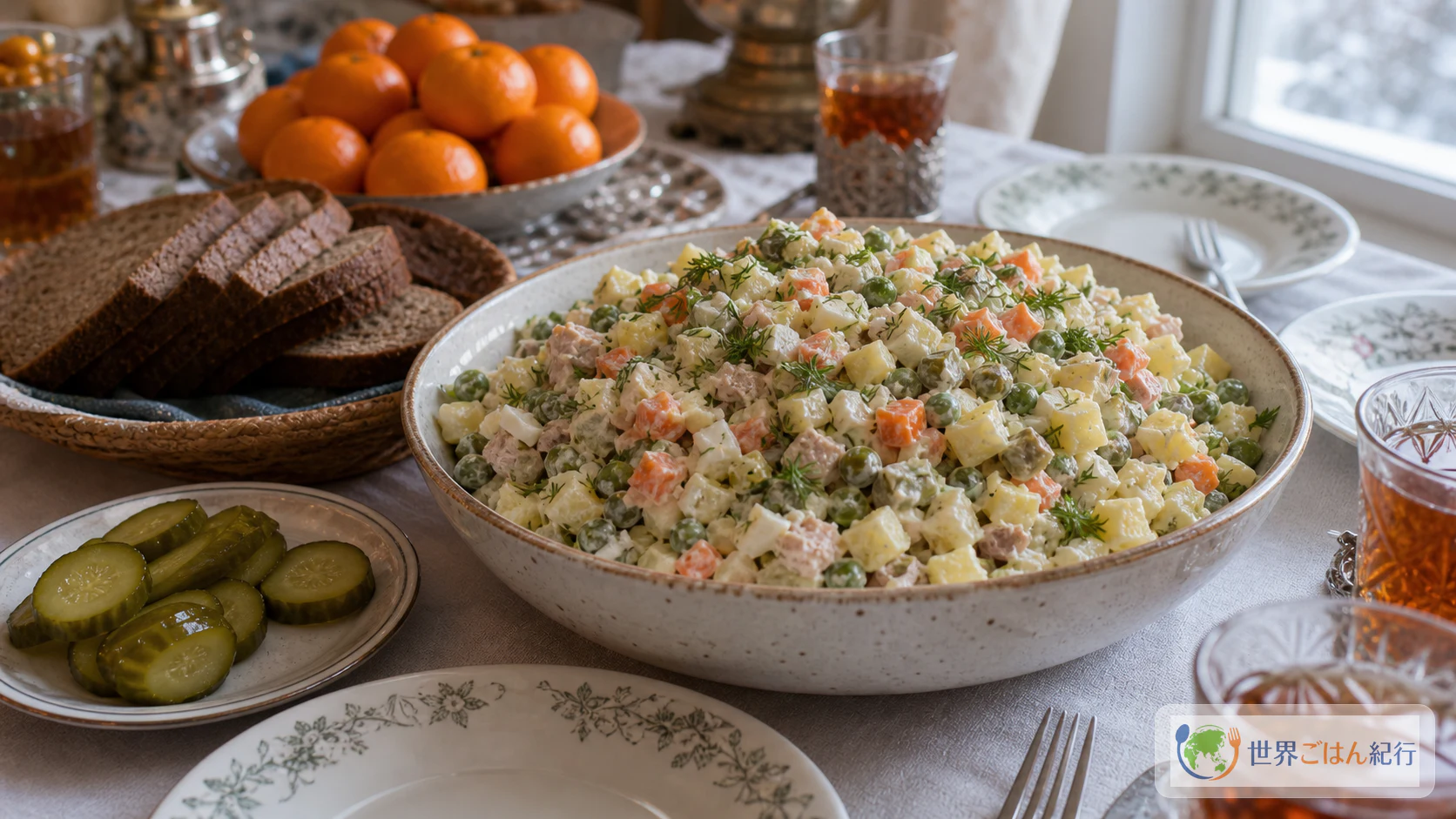
Cut the potatoes into 0.25 inch (7 mm) cubes and the sound of the knife on the board evens out. The egg yolk loosens into the gaps between the ingredients, and the sourness of the pickles cuts the weight of the mayonnaise. This is Olivier salad, "салат Оливье" (salat Olivye) in Russian and sometimes "Russian salad" in English-speaking countries and Spain: small, even cubes of potato, meat, and egg, sharpened with preserved foods and served from a big bowl at New Year. It is cold, yet the outline of the flavor stays clear.
About Olivier salad
From a Moscow restaurant
Olivier salad began in the 1860s at the Moscow restaurant Hermitage. The early versions used hazel grouse, veal tongue, caviar, crayfish tails, and capers, but the blend of the all-important dressing is not known. It was a dish of expensive ingredients, and over time it became a staple far from Moscow, in places including Spain.
At home and abroad
Today's home versions look quite different. After the Second World War in Russia, boiled sausage such as Doktorskaya replaced the hard-to-get wild birds and crayfish, and later chicken and beef versions spread. Pickles took the place of capers, and canned or frozen green peas went in. The salad stopped being a special restaurant dish and became the big bowl that family and friends gather around at New Year, valued on the New Year table across the Russian-speaking world.
Calling it potato salad misses what makes it Olivier: small cubes that include meat and egg, and the sourness of preserved foods. In Spain, Russian salad combines potatoes, carrot, and green peas with tuna, cornichons, capers, and mayonnaise, and is eaten with bread and roasted vegetables. There is no single authentic version with fixed ingredients. What carries the dish into any kitchen is cutting everything to the same size, using one clear source of acidity, and chilling it before plating. Then, even with chicken breast and frozen peas, it still looks like a dish shared a little at a time on a celebration day.
Ingredients
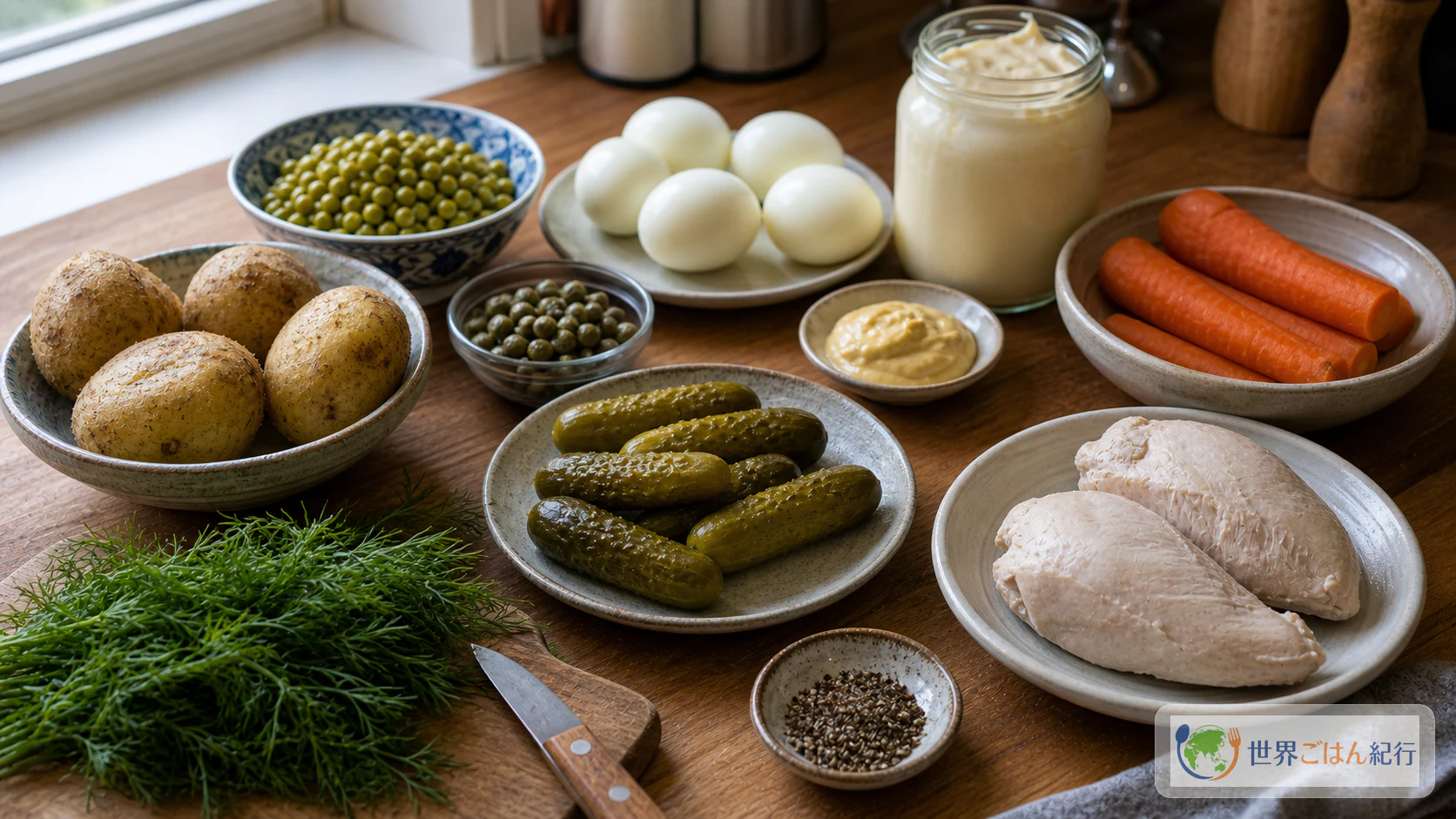
This makes 4 servings. As a starter with bread, it can be shared in small amounts among 6. What decides the flavor is not expensive ingredients but the size of the cubes and low moisture.
Differences when sourcing the ingredients
Some Russian home versions use boiled sausage called Doktorskaya. After the Second World War, hazel grouse and crayfish became hard to get and were replaced with cheaper sausage. Substituting sweet ham or fish sausage can bring sweetness or smoky aroma to the front, so the first time, use chicken breast and put the acidity of the pickles and dill at the center.
For pickles, dill pickles or cornichons with clear saltiness and acidity suit better than sweet-sour cucumber pickles. Frozen green peas thawed briefly keep their color and snap better than canned. Since you use only 8 g of dill, if you don't plan to use the rest for fish dishes or pickle flavoring, switching to dried is fine.
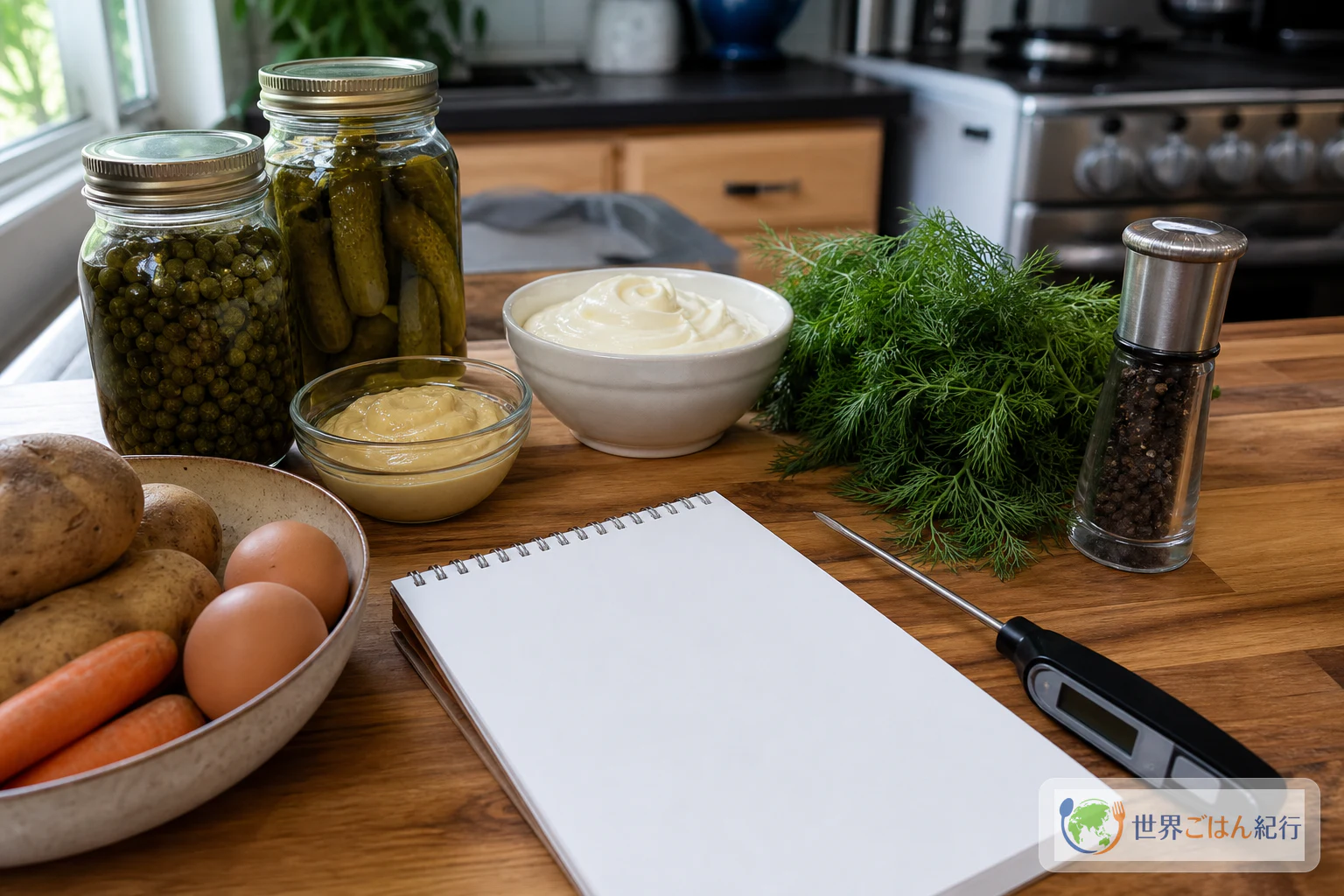
Fresh dill is not always available in the same amount at every shop. Decide first whether to use only 8 g and freeze the rest, or switch to dried dill, and you won't be stuck with a large bunch. Check the quantity and stock before choosing.
Capers are not essential, but they bring back a little of the old restaurant feel of Olivier. 2 tsp is enough, and the leftover can go into pasta, fish dishes, and panzanella.
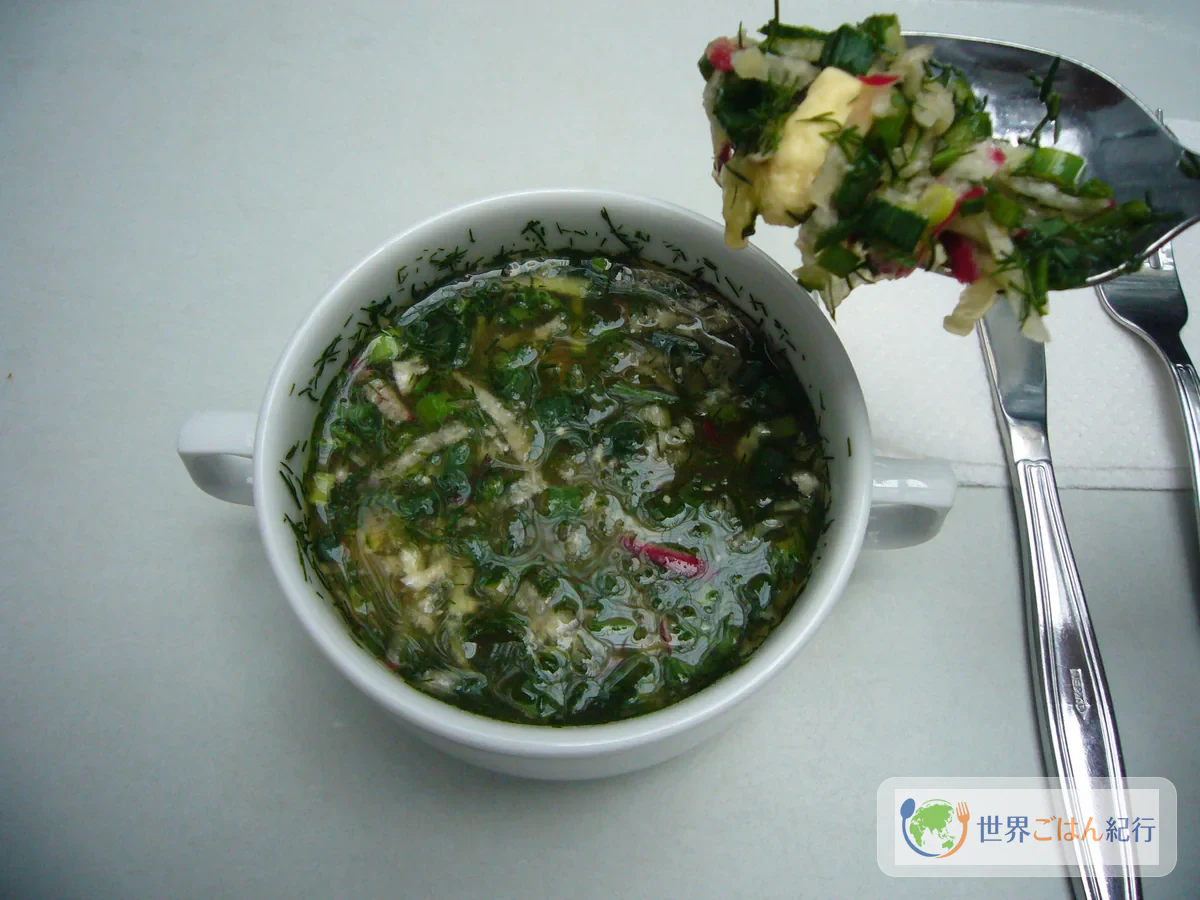
Dill sets the aroma of the salad. Even a small amount lightens the weight of cold root vegetables and egg, so using the leftover in okroshka or fish dishes leaves no waste.
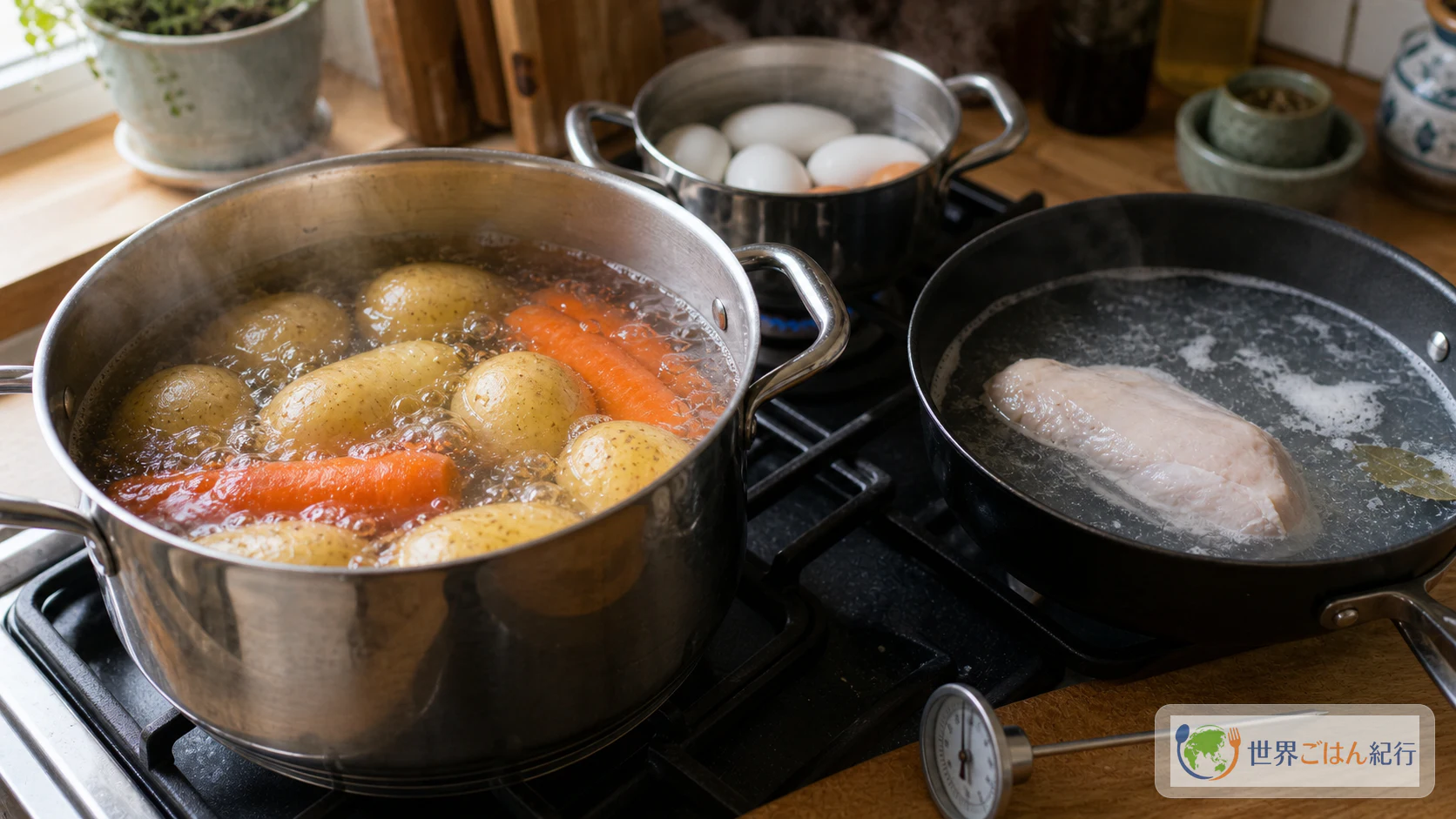
Chicken breast turns fibrous and dry when overcooked, especially once diced. Use a thermometer to check the internal temperature, so you can stop while it is still moist, which suits salad.
Choosing ingredients for Olivier salad
This recipe uses chicken breast instead of the boiled sausage found in many Russian home versions, because its doneness is easier to judge. To go without meat, leave out the chicken and increase the green peas to 4 oz (120 g) and the eggs to 4; it stays satisfying.
Keep the acidity sharp rather than sweet. If you find the aroma of dill strong, replace half with parsley. Swapping the pickles for sweet ones removes the main source of acidity, so if you do, leave out the brine and adjust with lemon juice instead.
For people with allergies, check the labels on the mayonnaise and mustard individually, and keep in mind the eggs.
Common Olivier salad mistakes and fixes
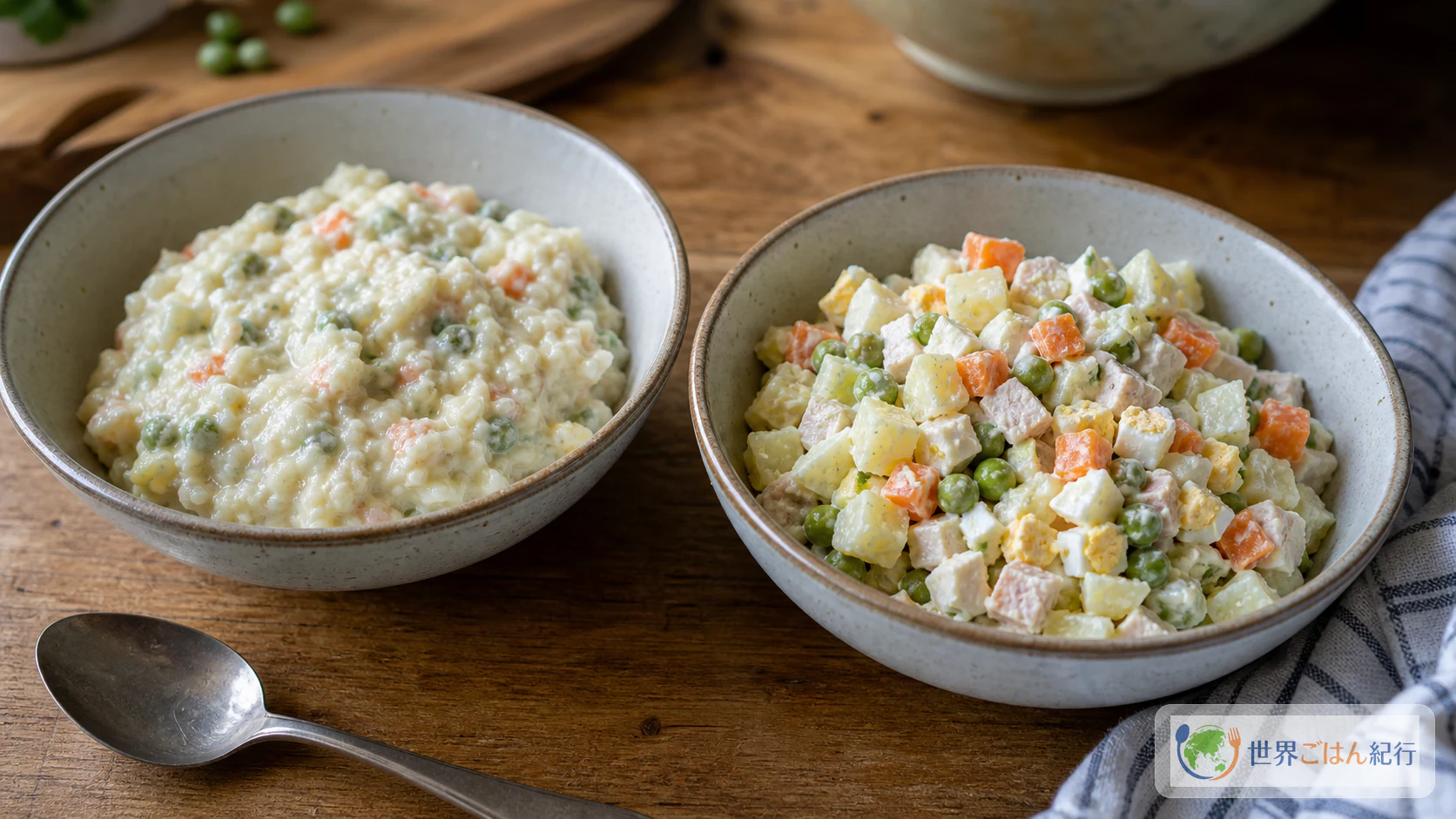
What separates a good Olivier salad is not the amount of mayonnaise but the moisture left in the ingredients. Toss hot root vegetables and the sauce loosens; let droplets from the pickles and peas pool at the bottom of the bowl and the flavor stays thin even after chilling. Chill the ingredients first, before adding any more moisture. After 30 minutes in the refrigerator, the sauce settles into the potato better than it does right after mixing.
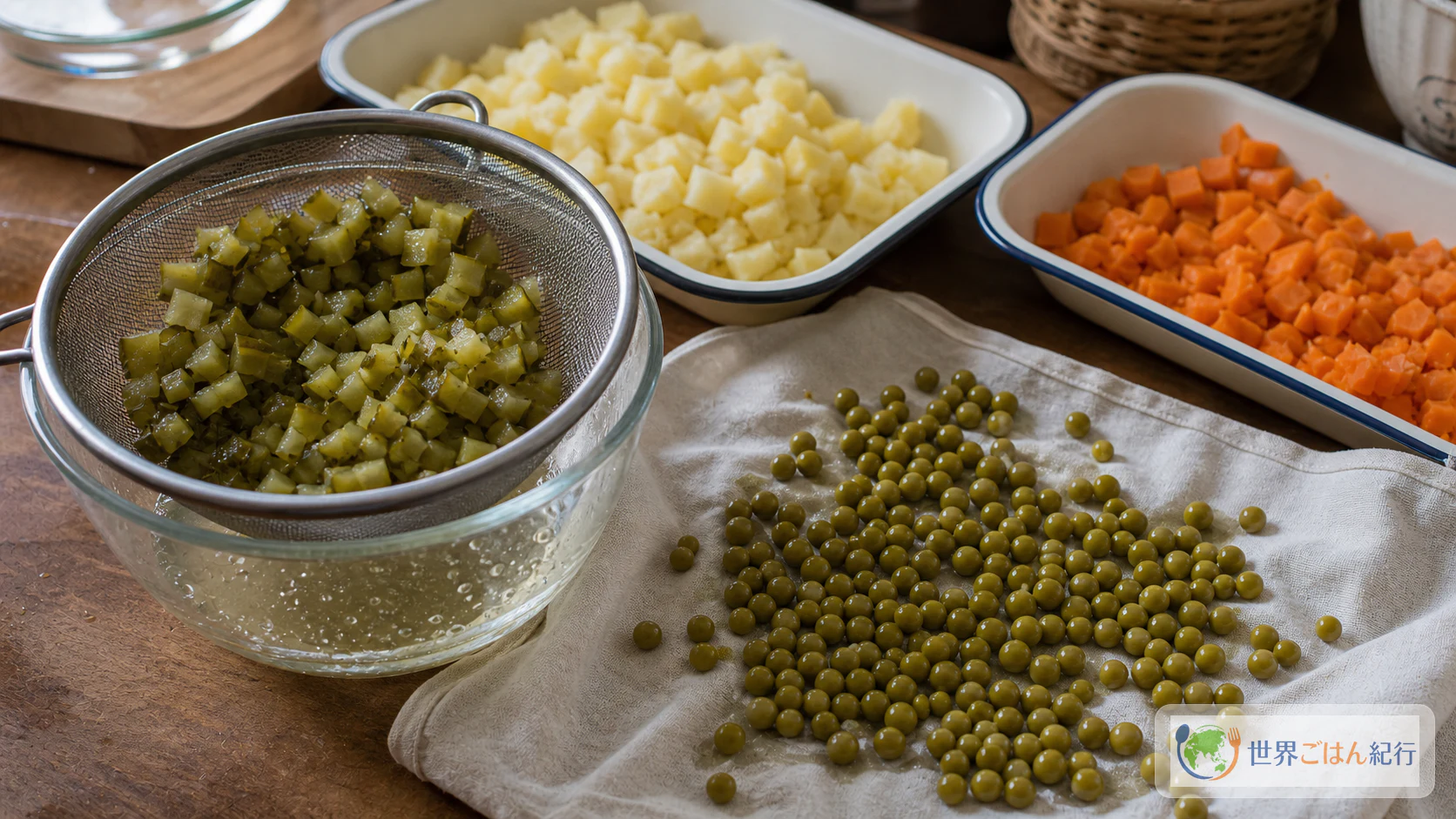
Spread the cut root vegetables on a large plate or tray and cool until the steam stops. Even in a hurry, don't put them hot into the refrigerator; spread them shallow and let the heat go. Tossing chilled ingredients with the sauce keeps the potato corners.
Chop the pickles and leave them in a colander for 5 minutes, then press the surface with paper. Press the thawed green peas lightly without crushing a single one; if no water seeps out, that is enough. If liquid shows at the bottom after tossing, don't add mayonnaise. Add a small amount of coarsely chopped boiled egg or potato and chill.
Bring everything together with the first 4 oz (120 g), rest it in the refrigerator for 30 minutes, then check the firmness. Add 1 tbsp at a time only if it feels dry just before eating. Adding brine or yogurt later raises the water before it raises the acidity.
0.25 inch (7 mm) cubes take the egg yolk and the pickle's acidity in one bite. When 0.25 inch (5 mm) and 0.5 inches (1 cm) pieces are mixed, only the soft potato gets crushed. Picking out the large cubes when you finish cutting saves extra tossing.
Serving, variations, and storage
Serving Olivier salad
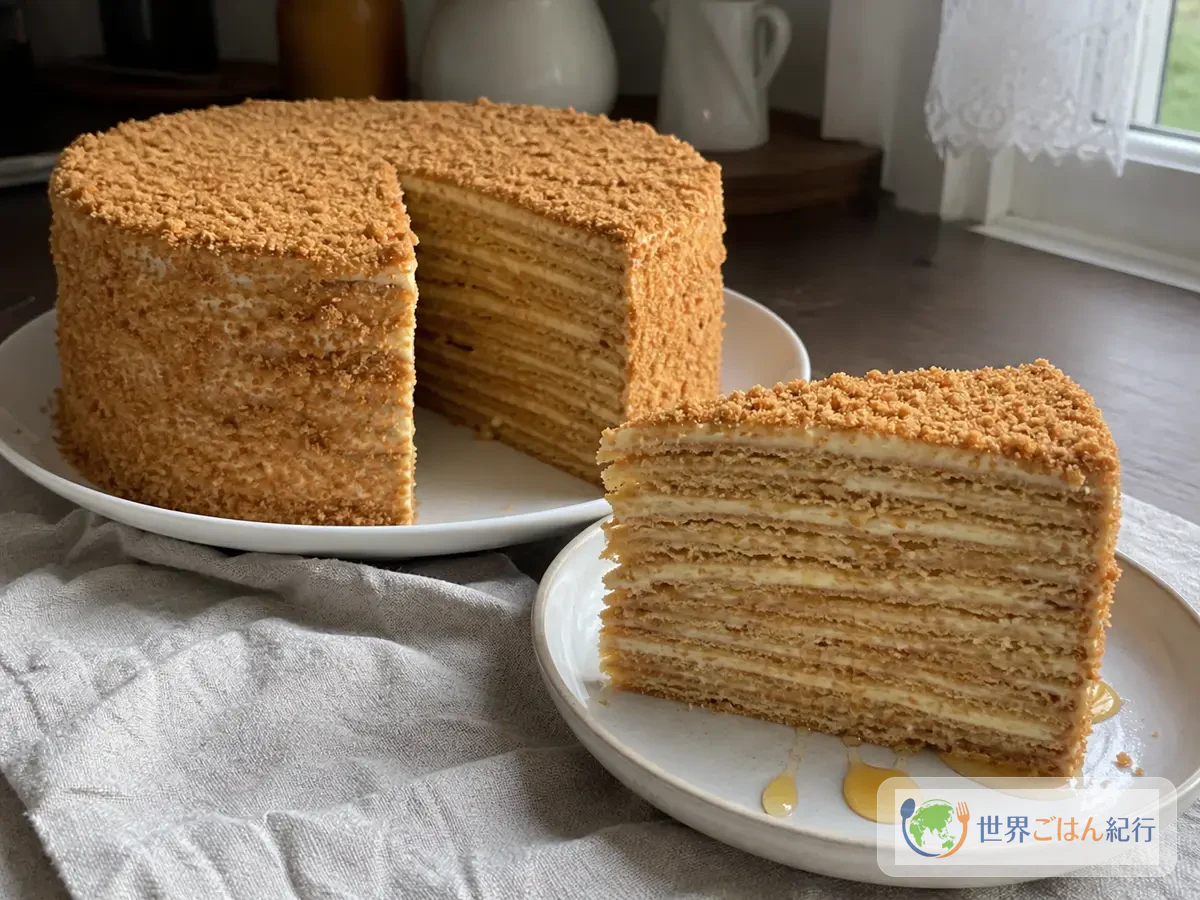
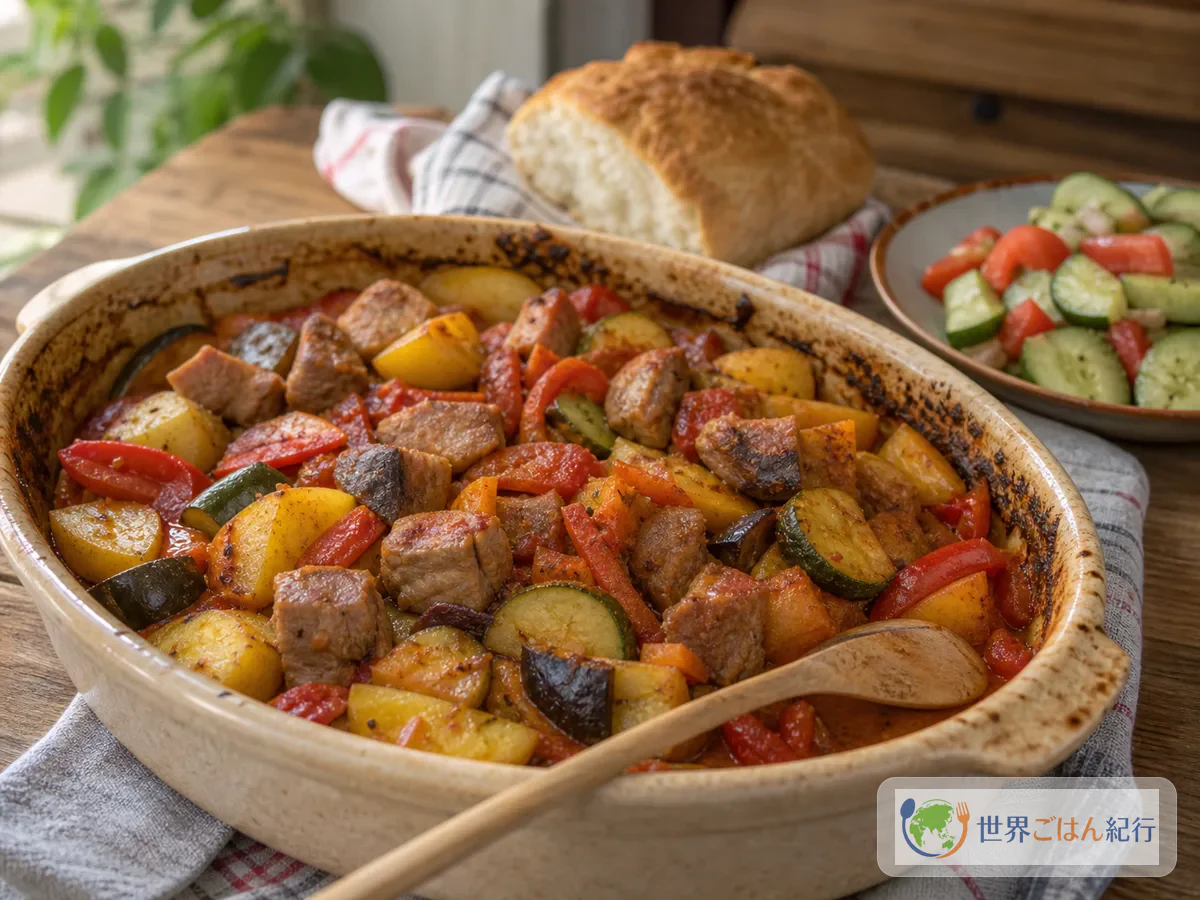
Serve it with dark or rye bread, whose acidity balances the egg and mayonnaise. For a celebration, build the meal as cold starter, warm main, sweet dessert: Olivier first, then warm dishes such as pelmeni or kurnik, which wraps chicken and grain, and medovik to finish. On an ordinary weeknight, it goes just as well with grilled salmon, boiled pork, or a sour soup.
A Spanish-style version
To lean toward Spanish Russian salad, replace the chicken with 5.5 oz (150 g) of oil-packed tuna and add a few black olives. It keeps the name but lands on a different table. If the tuna turns dry from draining too much oil, mix in 1 tsp of oil before reaching for more mayonnaise, and taste to make sure the acidity doesn't get heavy.
Storage and make-ahead
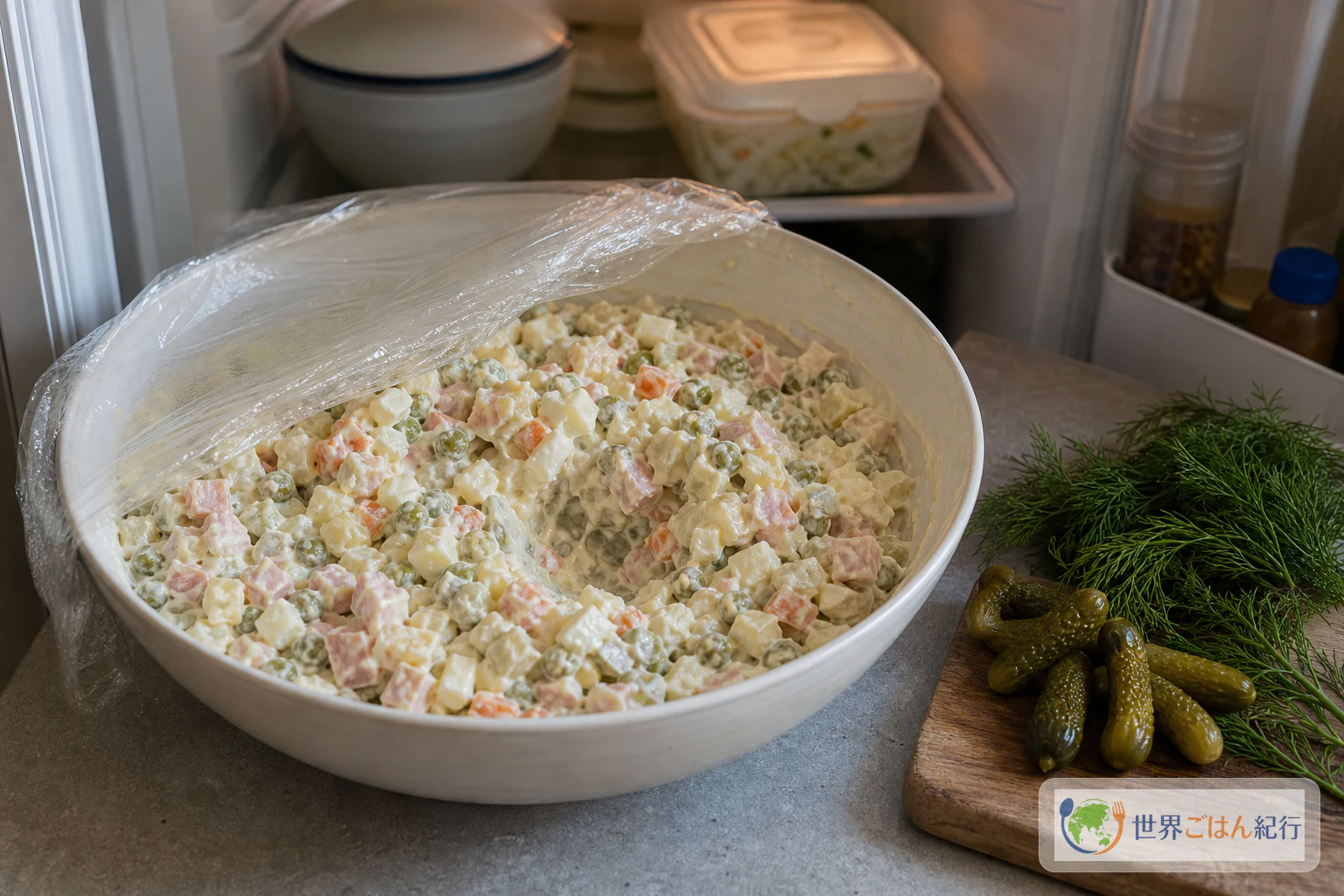
Because it contains chicken, eggs, and mayonnaise, move the finished salad to a clean shallow container and refrigerate it as soon as possible. Put out only what will be eaten at one time and keep the rest in the refrigerator rather than leaving the big bowl sitting out. Once tossed with mayonnaise, aim to finish it within the same day to the next day. Discard anything left at room temperature for long, or with any change in smell or stickiness, without tasting it.
You can cut the ingredients the day before; keep the pickles and green peas in separate containers and remove their moisture once more just before tossing. Freezing doesn't work, because the potato breaks down and water comes out on thawing.
FAQ
Can I make it with ham or sausage?
Yes. Use 9 oz (250 g) of boiled sausage or 7 oz (200 g) of thick-sliced ham in place of the chicken breast. Salt and smoky aroma differ by product, so hold back on salt in the cooking water and sauce, and decide the seasoning after tossing. If you use sweet ham, keep the pickle brine in so the acidity remains.
Which is better, waxy or starchy potatoes?
Waxy potatoes are easier if you want to keep the corners. Starchy potatoes also work if you boil them with the skin on, take them out as soon as a skewer goes in, let them cool completely, and then cut them. Either way, don't cook them until they fall apart in the water.
What if I want less mayonnaise, or can't use eggs?
Cutting the mayonnaise to 3.25 oz (90 g) gives a lighter finish where the cubes show. Don't make up the moisture with brine or yogurt; chill it and check the firmness instead. If you avoid eggs, check the label of an egg-free mayonnaise, leave out the boiled eggs, and add 1.75 oz (50 g) of potato. For egg, mayonnaise, and mustard allergies, keep utensils separate.
Does it not taste like Olivier without capers?
It still does. Capers were part of the old restaurant dish, and adding just 10 g brings extra saltiness and acidity. For the home version, leave them out and use the pickles at 3.25 oz (90 g). If you do add them, drain the jar liquid and adjust the sauce after checking the saltiness.
Sources
Culture and local information
- Russia Beyond, “Delicious Russia: Olivier salad, the immutable part of Russian New Year” (published 2014-01-01, accessed and checked 2026-08-24) https://www.rbth.com/multimedia/video/2014/01/01/delicious_russia_olivier_salad_the_immutable_part_of_russian_32699
- Russia Beyond, “A guide to Russian salad Olivier for New Year” (published 2019-12-26, accessed and checked 2026-08-24) https://www.rbth.com/russian-kitchen/331466-guide-russian-salad-olivier-new-year
- Russia Beyond, “5 popular Russian New Year salads” (published 2019-12-29, accessed and checked 2026-08-24) https://www.rbth.com/russian-kitchen/331494-5-popular-russian-new-year-salads
- The Guardian, “José Pizarro's recipe for Russian salad” (published 2023-07-29, last updated 2025-12-02, accessed and checked 2026-08-24) https://www.theguardian.com/food/2023/jul/29/russian-salad-recipe-jose-pizarro
- Ministry of Health, Labour and Welfare (Japan), “Preventing food poisoning at home” (accessed and checked 2026-08-24) https://www.mhlw.go.jp/stf/seisakunitsuite/bunya/kenkou_iryou/shokuhin/syokuchu/01_00008.html