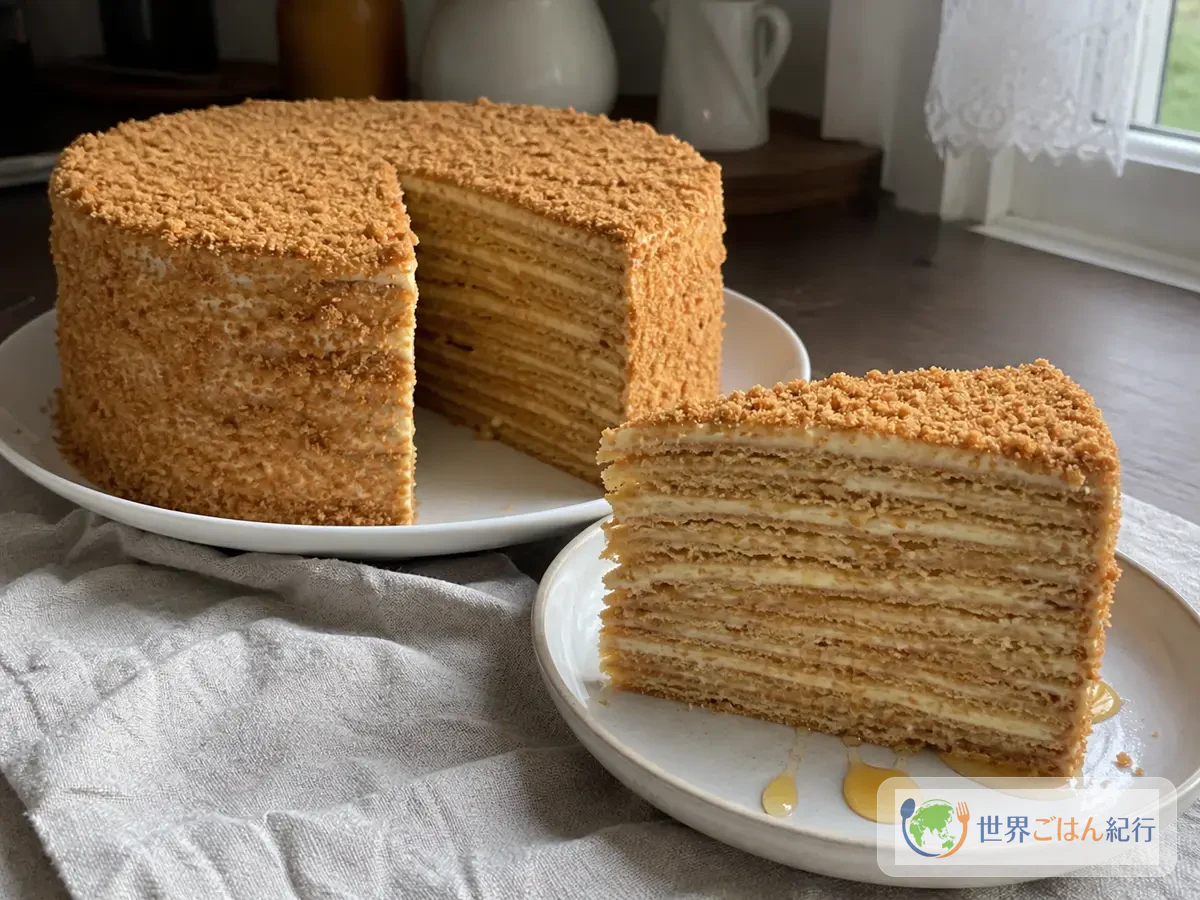


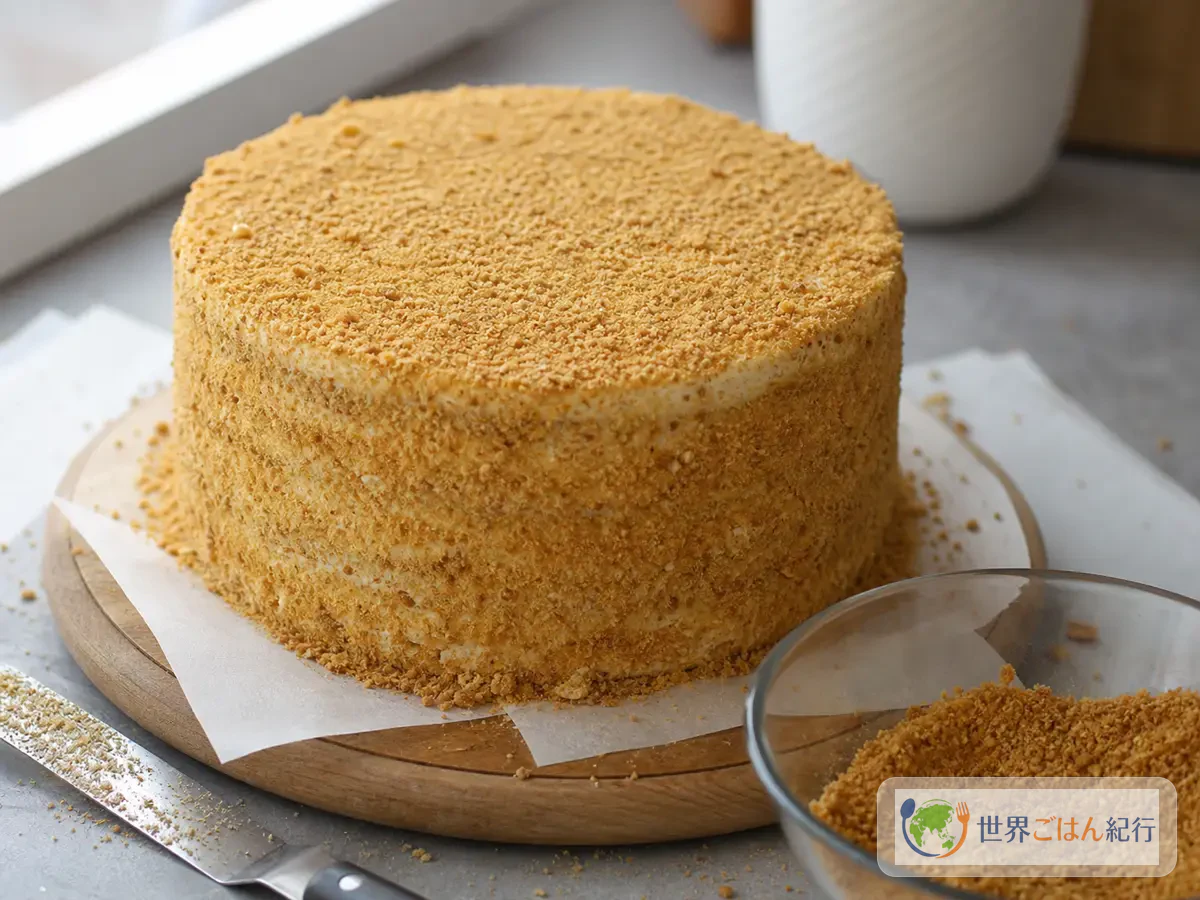
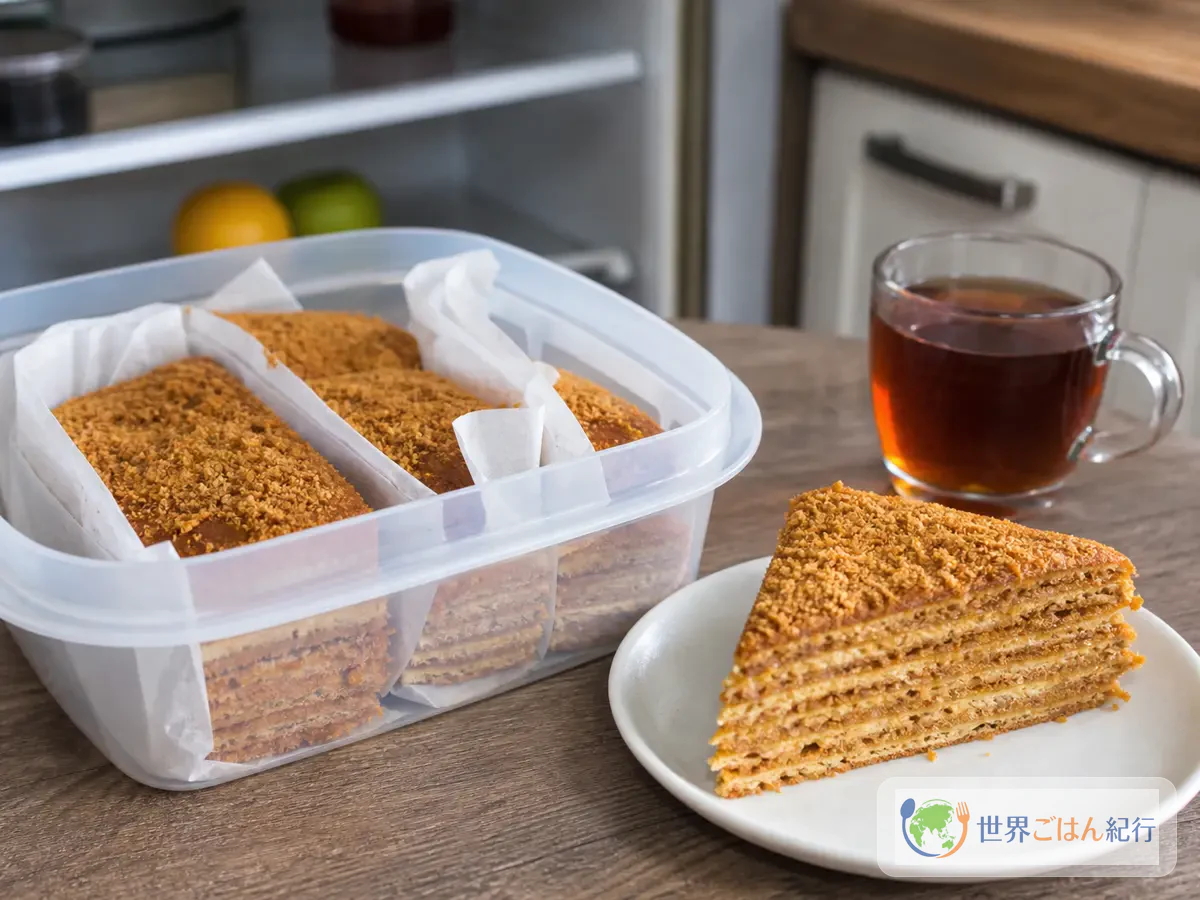
Take the round cake out of the fridge and slide in a knife. A medovik (Медовик) that has soaked up cream overnight lets the blade glide between the layers, and the cut face shows many thin lines. There's no showy fruit or chocolate here. What you get is honey, caramelized sugar and the tang of dairy, and they linger slowly. The Russian word "мёд" means honey, and this honey cake is built from many thin baked layers stacked with a tangy cream close to smetana. It's a cake you finish the day after you bake it.
Medovik and its place on the post-Soviet table
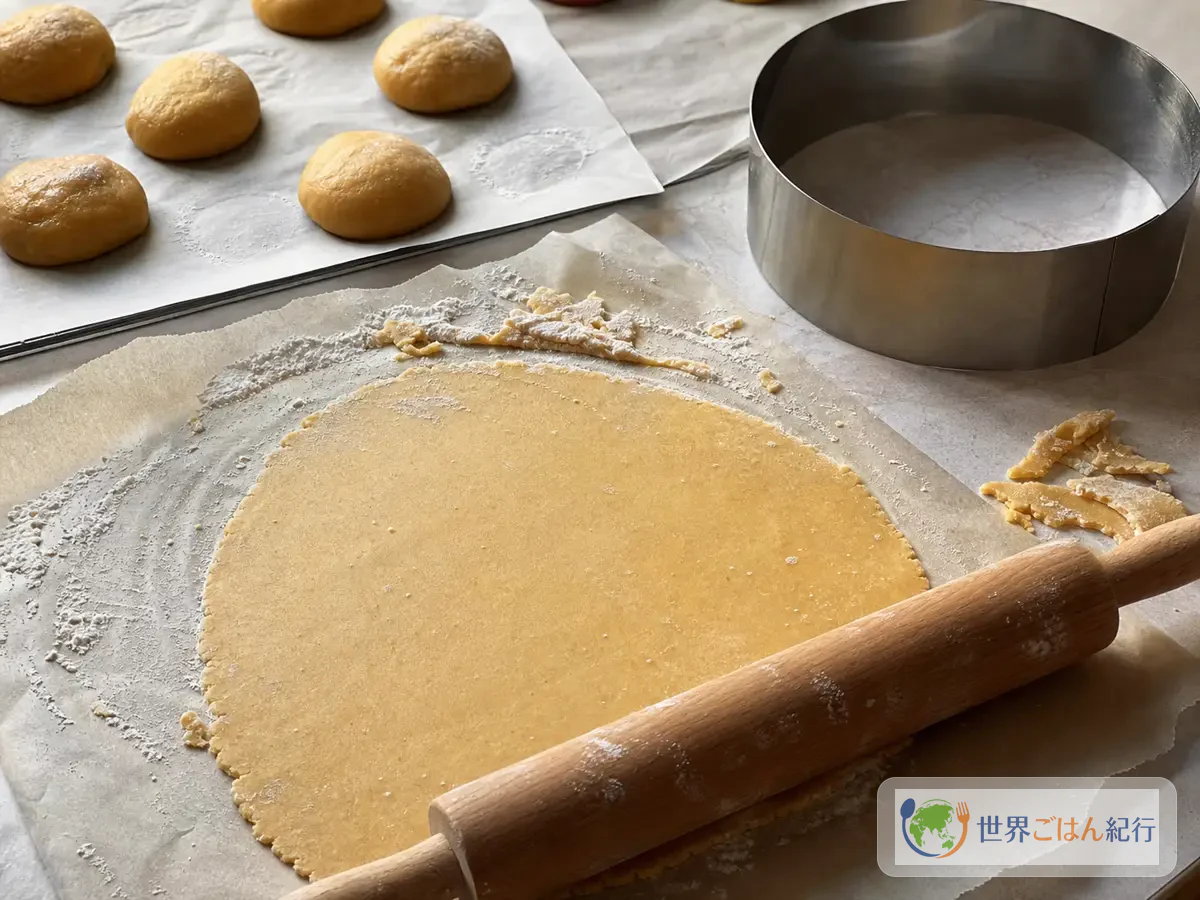
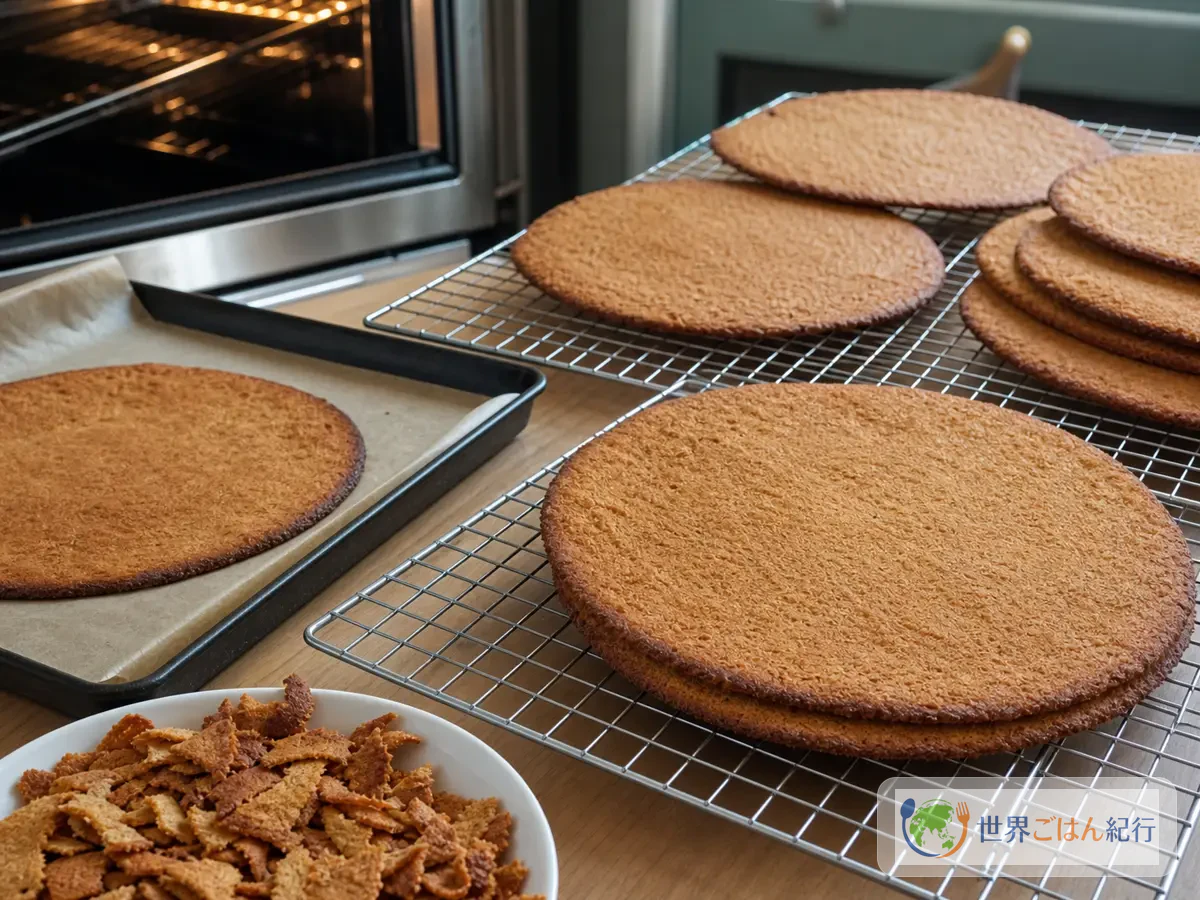
Many honey cakes elsewhere are one thick sponge, but medovik is made differently. You warm honey, sugar and butter over a double boiler, lighten the dough with a little baking soda, then roll it thin and bake it as many separate layers. Fresh from the oven the layers are hard. Overnight they absorb moisture from the sour cream (smetana) cream and come together, soft and moist. Waiting for that change is part of making it.
The ingredients are honey, eggs, butter, flour and sour cream, all things a home kitchen already has. That's why medovik is made in so many kitchens, and why the number of layers, the sweetness of the cream and the aroma of the honey differ from one kitchen to the next. It is still loved across the countries of the former Soviet Union. Neighboring countries have similar honey layer cakes, such as Czech medovník and Polish miodownik.
In Russia, a legend tells of a young confectioner in the 19th century who made this cake for Empress Elizabeth Alexeievna (wife of Alexander I). He didn't know she disliked honey, and she loved the cake anyway. Medovik doesn't appear in 19th-century Russian cookbooks, though, so the story isn't an established origin. The cake became widely popular in the Soviet era.
If vatrushka is a sweet morning bun, medovik is the Russian sweet worth waiting for, cut a little at a time and eaten with tea.
Ingredients and how to think about substitutes
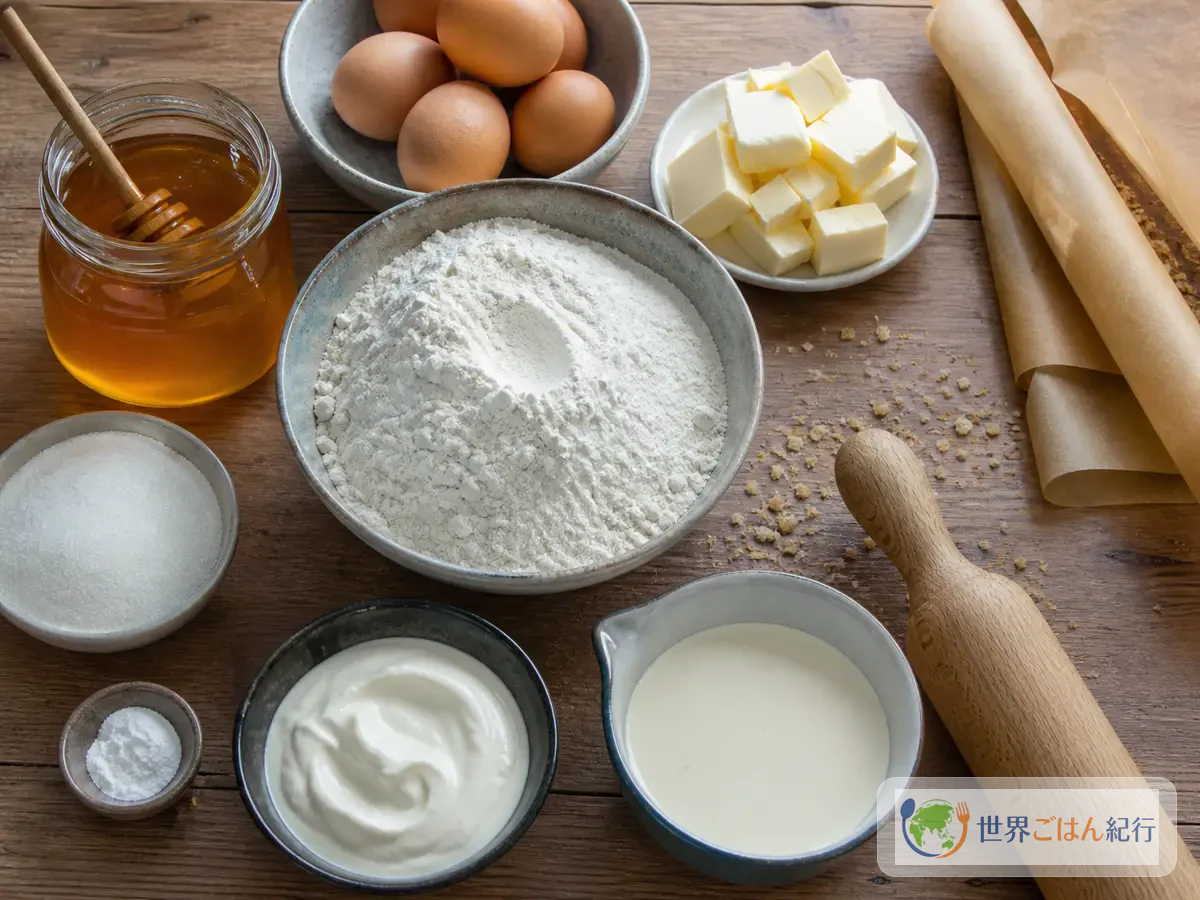
These amounts make one small medovik about 4.5 inches (12 cm) across and 3 inches (7 cm) tall. You bake 8 thin layers, stack 7 of them, and crush the leftover dough and trimmings to coat the outside. A larger 7 inches (18 cm) cake tends to bake unevenly in a home oven, so start small the first time.
This recipe uses wheat, eggs and dairy. Because it is layered with sour cream and heavy cream, don't leave it at room temperature for long, unlike a baked cookie. After assembling, rest it in the refrigerator, and keep it refrigerated after slicing too.
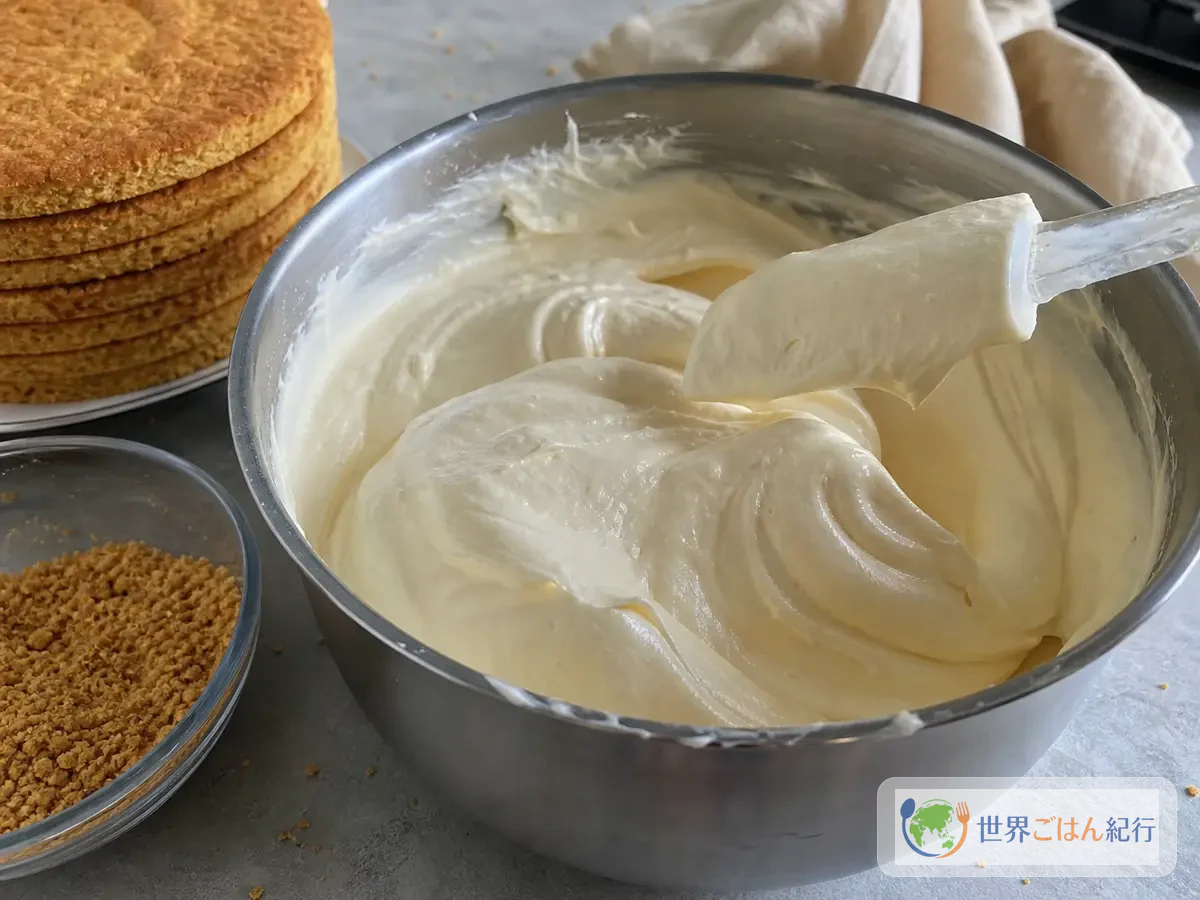
When substituting, protect three things: the aroma of honey, thin layers, and a tangy cream. Swapping honey for maple syrup softens the aroma and makes the cake closer to some other layer cake than to medovik. Without smetana, build tang and lightness with sour cream and heavy cream, and the eating experience gets very close.
Choosing ingredients and tools for medovik
Ingredients
Honey, eggs, butter, sour cream and heavy cream from your local supermarket all work well, so there's no need to hunt for special honey or dairy. If you can't get smetana, combine sour cream and heavy cream to balance tang and richness. For a first attempt, start with a mild-flavored honey and the cake will be easy to enjoy.
Tools

The tools worth having are the ones that prevent failures: a rolling pin to keep the layers an even thickness, a cake ring to guide the small round shape, and a small food processor to turn the trimmings into fine crumbs.
This recipe makes one small cake 4.5 inches (12 cm) across, which keeps the layers manageable in a home oven. A 12 cm cake ring works as a guide for trimming the baked layers into rounds and as a temporary frame while you stack the cream. You can cut around a plate instead, but if your layers tend to shift, a ring makes life easier.
The honey dough is rolled to about 0.125 inch (1–2 mm) thick. Pressing it out by hand tends to leave the center thick, so a rolling pin means fewer failures. You'll get use out of it for other dough dishes too, such as pelmeni and kurnik.
Fine crumbs from the trimmings give the sides of the cake a neat finish. Crushing them in a bag works, but a small food processor is quicker when you want them evenly fine.
Method: bake thin, then stack
With medovik, making many layers of the same thickness matters more than the baking itself. The dough is soft while warm and becomes harder to roll as it cools. Rather than making every layer a perfect circle, rolling thin, baking, and trimming to 4.5 inches (12 cm) at the end is more reliable at home.
Where medovik tends to go wrong
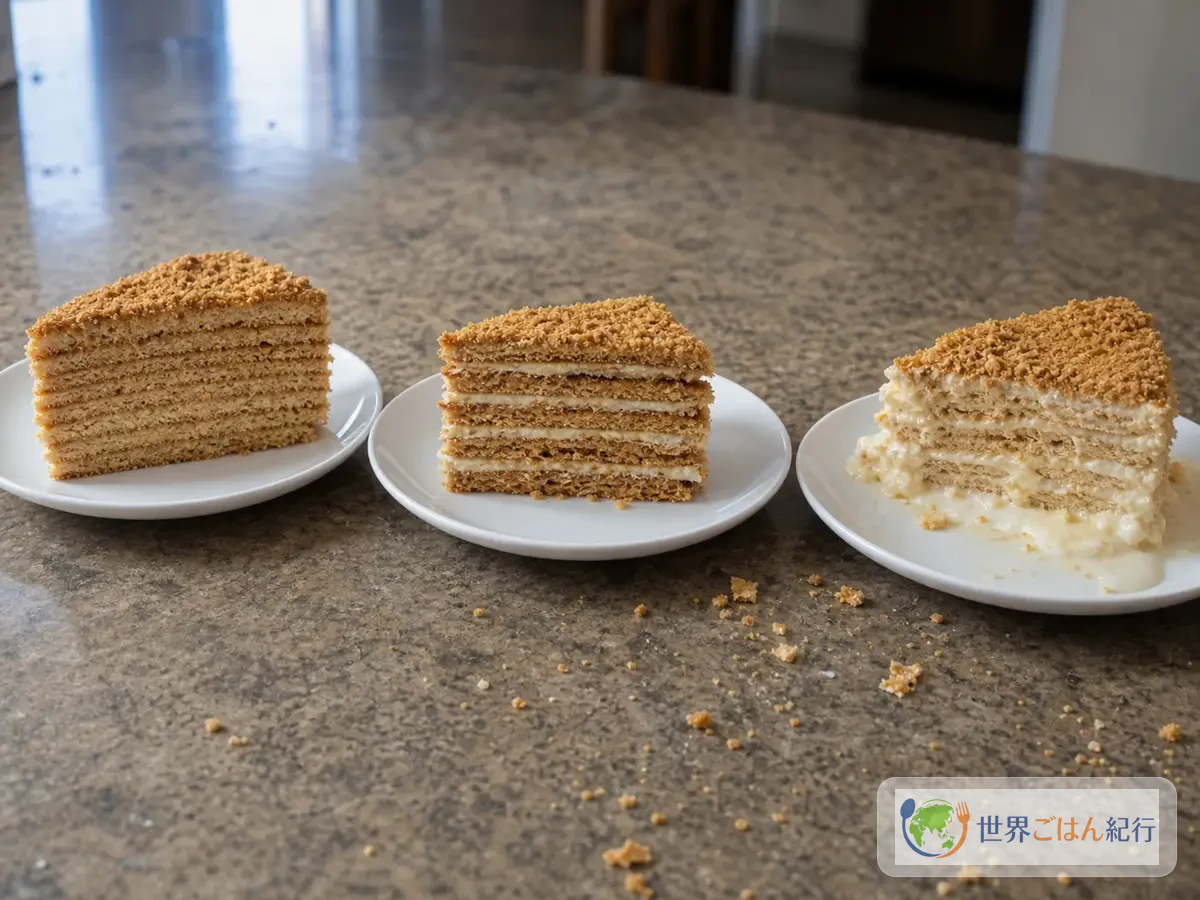
The ingredients are simple, so mistakes show clearly. Too sweet, hard layers and runny cream look like separate problems, but most come down to two things: the thickness of the layers and the moisture of the cream. If the layers are thick, the center stays like a biscuit even after resting in the fridge. If the cream is loose, it slides out sideways as you stack, and by the next morning the cake has slumped on the plate.
| Problem | Cause | Fix |
|---|---|---|
| Hard layers | Dough too thick, too much flour, not enough resting | Roll to 0.125 inch (1–2 mm) and rest in the fridge for 8 hours or more |
| Bitter layers | Overbaked, or the honey mixture boiled hard | Check from 5 minutes at 350°F (180°C). Keep the double boiler on low heat |
| Cream runs | Heavy cream underwhipped, watery sour cream | Drain the sour cream lightly and fold in cream whipped to soft peaks |
| Cream doesn't soak in | Cream too stiff | Whip the heavy cream only to soft peaks. If stiff, add 1 tsp milk |
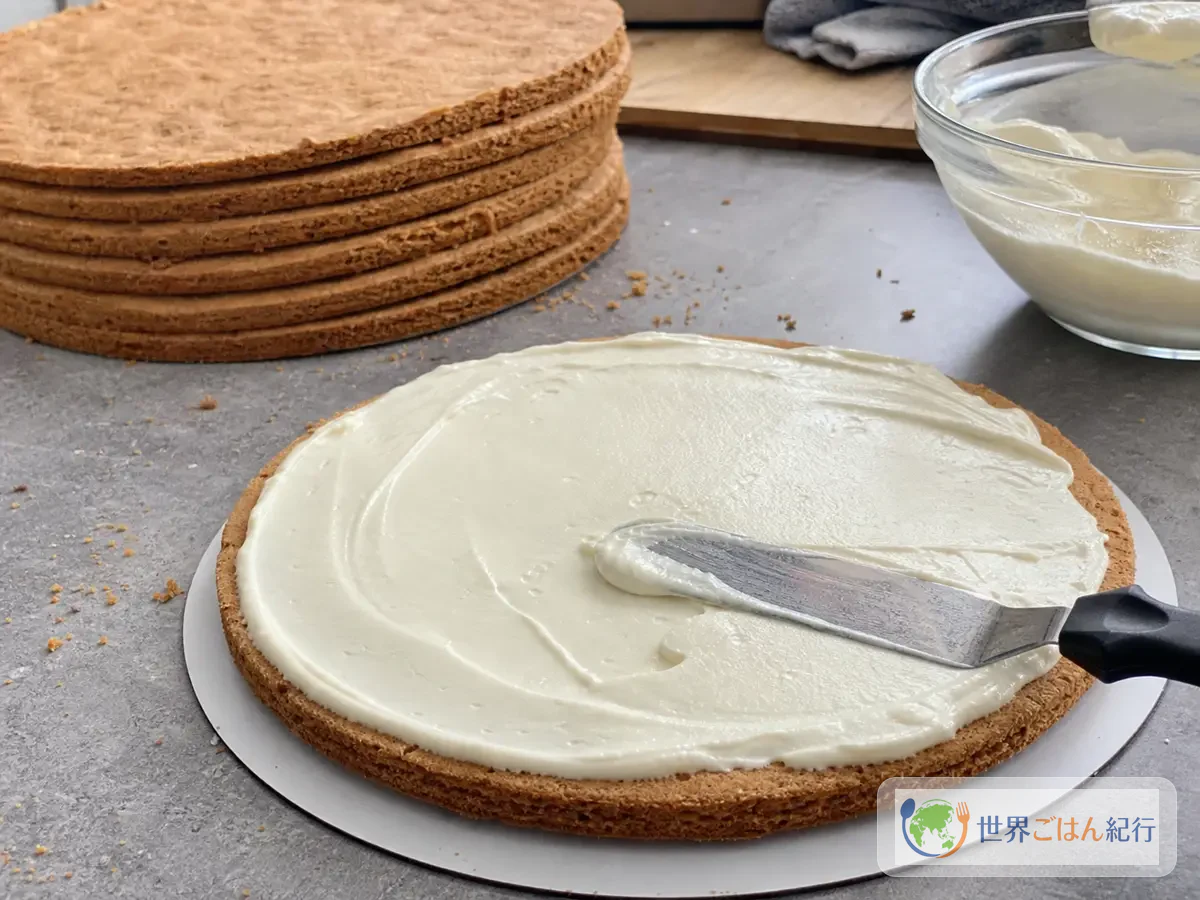
| Slanted cross-section | The center shifted with each layer | Level each layer gently with your palm and turn the plate as you spread |
| Heavy sweetness | Not enough tang in the cream | Add 1 tsp lemon juice and serve with tea or berries |
A common mistake is to find the baked layers "nice and crisp" and eat them that way. They aren't finished yet. Wait until they've taken up the cream's moisture and turned soft enough to cut with a fork.
The tang of the cream matters too. Cooks in Russia and neighboring regions use dairy close to smetana, but sour cream varies in tang and moisture from brand to brand. If the cream tastes flat, add a little lemon juice instead of more sugar. Extra sweetness hides the honey aroma and makes the cake feel heavy after a meal.
Serving, storage and FAQ
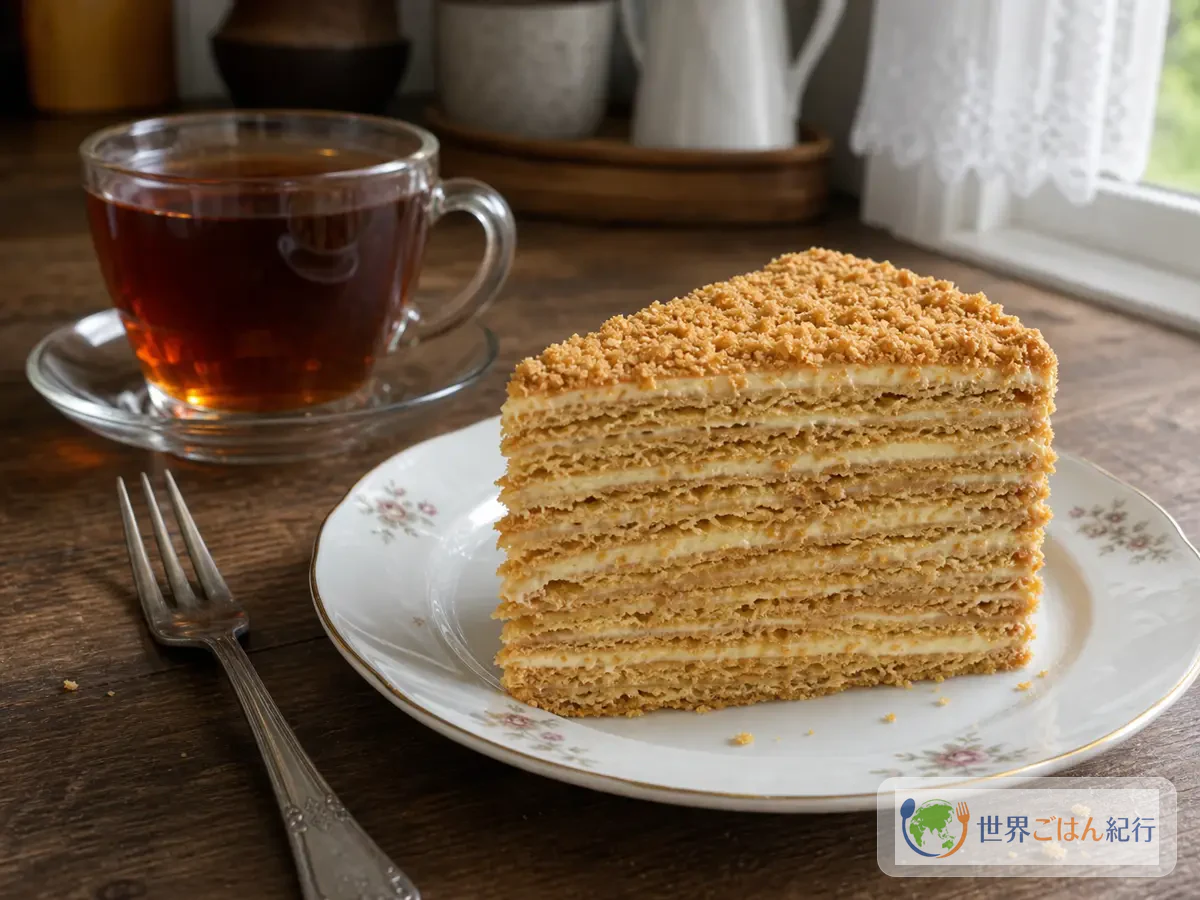
Let medovik sit out of the fridge for about 15 minutes and it releases more aroma than it does straight from the cold. Pair it with strong black tea, unsweetened milk tea or a coffee that isn't lightly roasted. A sweet drink piles too much on top of the lingering honey and cream.
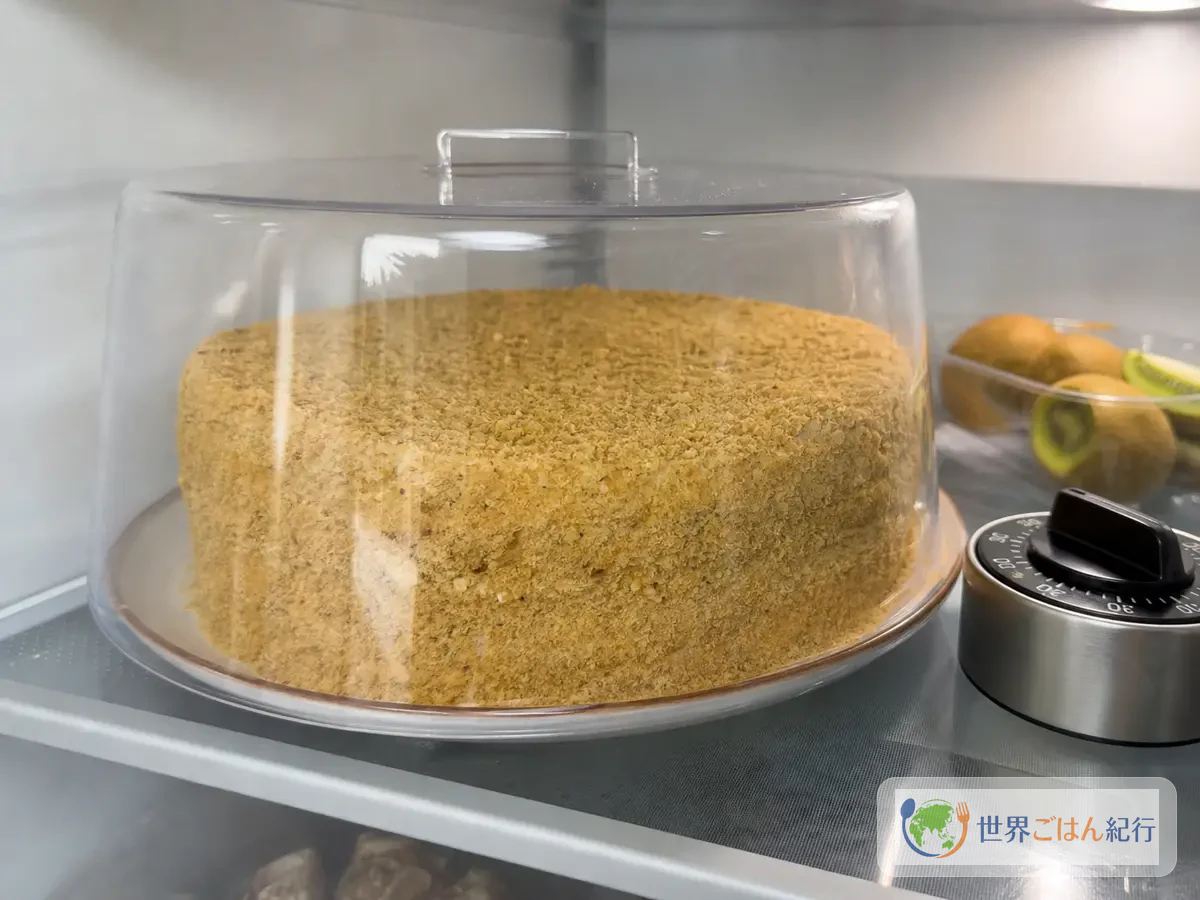
It keeps for about 3 days in the refrigerator. To stop it drying out, press plastic wrap directly onto the cut faces and cover the whole cake with a container. You can freeze it, but the cream's moisture doesn't fully come back and the layers turn slightly crumbly. If you do freeze it, wrap each slice individually and eat within 2 weeks. Thaw in the refrigerator for half a day and take it out 15 minutes before eating.
Can I make it without sour cream?
Yes. 7 oz (200 g) strained yogurt, ¾ cup (200 ml) heavy cream and 2.75 oz (80 g) cream cheese give a good balance of tang and richness. Cream cheese on its own makes the cake heavy, closer to cheesecake than to medovik. For your first time, sour cream soaks into the layers more easily.
What kind of honey works best?
A light honey such as acacia gives an elegant result. A darker, more aromatic honey such as wildflower, or something close to buckwheat honey, gives the depth of a Russian cake. With a strongly flavored honey, a little more lemon juice in the cream balances the heaviness.
Isn't 4.5 inches (12 cm) too small?
Start small. It makes practicing many thin layers easier, and if the cream runs, the damage is limited. For a 7 inches (18 cm) cake, use about 1.8 times the ingredients and bake around 10 layers, checking each one at the same 5–6 minutes.
What if I want to eat it the same day?
Roll the dough even thinner, spread a little more cream, and rest the cake in the refrigerator for at least 4 hours. The true moist cross-section still only comes the next day, though. For guests, the most reliable plan is to assemble the cake the day before and just slice it on the day.
What goes with it for a Russian-style meal?
As dessert, it's best after a meal that isn't all heavy dough dishes. A small slice after cold okroshka or tangy borscht lets the honey sweetness settle nicely. If you do want dough on the table, serve pelmeni as the meal and medovik as the sweet, and you'll taste the range of salty and sweet in Russian cooking.