On a hot evening, the last thing you want is a dish that needs the stove. So open the fridge: cucumbers, radishes, eggs, a little leftover ham, and the potatoes you boiled that morning. Chop everything small and pour cold kvass or kefir over it. What you get sits somewhere between a salad and a soup, and it goes down in easy spoonfuls. This is okroshka, Russia's cold summer soup. It's sour and cold, with plenty of dill and scallions.
What Okroshka Is

A soup of chopping
Okroshka (окрошка / okroshka) is eaten mainly in Russia. Its name comes from "kroshit'," which means to crumble or chop finely, and the name tells you how to make it. Cucumbers, radishes, scallions, dill, boiled eggs, potatoes, and meat or sausage are all cut small, so every spoonful has vegetables, egg, meat, and herbs in even measure. Gazpacho purées its vegetables. Okroshka does the opposite and chops them so each one keeps its texture.
Kvass and the other liquids
Kvass is a traditional Russian drink fermented from rye bread. In summer it's chilled and poured into okroshka. It tastes toasty and sour, like a thin beer, and it's meant to go with a meal. It isn't a sweet juice.

Home cooks differ less in what goes into the bowl than in what they pour over it. Kvass is the classic choice. Since the Soviet period, home versions have also used kefir, whey, ayran, sparkling water, and soured milk, and a later style mixes kefir with sparkling mineral water. So the dish is really a salad-soup built on a fermented drink.
Okroshka and borscht
Borscht is the Eastern European soup that warms you from a pot on a cold day. Okroshka is the one you take out of the refrigerator in midsummer. Both use plenty of vegetables, but borscht simmers them to draw out sweetness, while okroshka chops them to keep their aroma.
Ingredients (serves 4): Think of the Kvass Version and the Kefir Version Separately
Okroshka looks like a dish made from fridge leftovers, but it depends on a few key aromas: scallions, dill, cucumbers, radishes, and eggs. Without these five, it easily turns into a cold potato-salad soup.

This dish contains eggs, dairy, and processed pork. Check the label on ham and sausage: wheat, milk, or egg can appear depending on the product. Cool the eggs and potatoes after cooking, don't leave them at room temperature for long, and keep them in the refrigerator.
Ingredients and tools for this dish
The kefir version is easy to make anywhere and avoids the problem of overly sweet kvass. Choose an unsweetened kefir so the flavor is easier to build.
Even a small pack of dill makes a big difference in aroma. Rather than substituting shiso, look for real dill, at least the first time.
For the kvass version, choose a lightly sweet rye type. A very sweet one tastes good as a drink but feels off in a soup.
Choosing Ingredients for Okroshka
If you try to buy everything exactly right, okroshka gets hard fast. You don't have to import kvass, smetana, dill, horseradish, and bologna sausage. Outside Russia, three questions come up: where to find kvass, how much to thin the kefir, and whether ham or fish-paste sausage can stand in for the meat. Decide what matters most to you, and the dish still works at home.

| Ingredient in doubt | Closer to the real thing | Realistic home choice | Effect on the dish |
|---|---|---|---|
| Kvass | Unsweetened rye kvass | Unsweetened kefir plus sparkling water | Less toastiness, but still sour and cold |
| Smetana | Russian-style sour cream | Sour cream, Greek yogurt | Adds richness; low-fat yogurt alone is too light |
| Dill | Plenty of fresh dill | A little fresh dill plus parsley | Keep fresh dill if you can |
| Meat | Boiled beef, bologna sausage | Boiled ham, boiled chicken, fish-paste sausage | Adds savory depth and salt; can be left out |
| Heat | Horseradish | Whole-grain mustard, prepared horseradish | Hot mustard is strong, so use a little |
| Acidity | The sourness of kvass | Lemon juice, a little vinegar | Too much vinegar drifts toward a vinegared salad |
Kvass or kefir
The kvass version is toasty and sour. It has the complexity of a fermented bread drink, and it's good with the saltiness of meat and ham. The catch is that much of the kvass sold outside Russia is sweet, and in a soup it can taste like sugar water.
For the kvass version, choose one that is "sour with restrained sweetness," not sweet bottled kvass. If you can only find sweet kvass, make the kefir version instead. It comes out better balanced at home.
The kefir version is harder to get wrong, because the lactic sourness carries it. Sparkling water lightens it and makes it easier to eat on a hot day. If this is your first okroshka, start with unsweetened kefir or plain yogurt thinned with sparkling water. Once you have the chopping and salting down, move on to kvass.
Dill and a fine chop
Dill is the one thing to hold on to, especially in the kefir version. Together with the scallions, it gives okroshka much of its character. Chopping finely matters just as much. Big chunks of cucumber and potato turn the soup into a salad with liquid poured over it.
Method: Heat in the Morning, Finish Right Before Eating
The key in okroshka is not to mix everything too early. Chill the ingredients and pour in the liquid right before eating. Mixing early and leaving it makes the cucumber and radish lose their crunch and the potatoes soak up too much liquid.
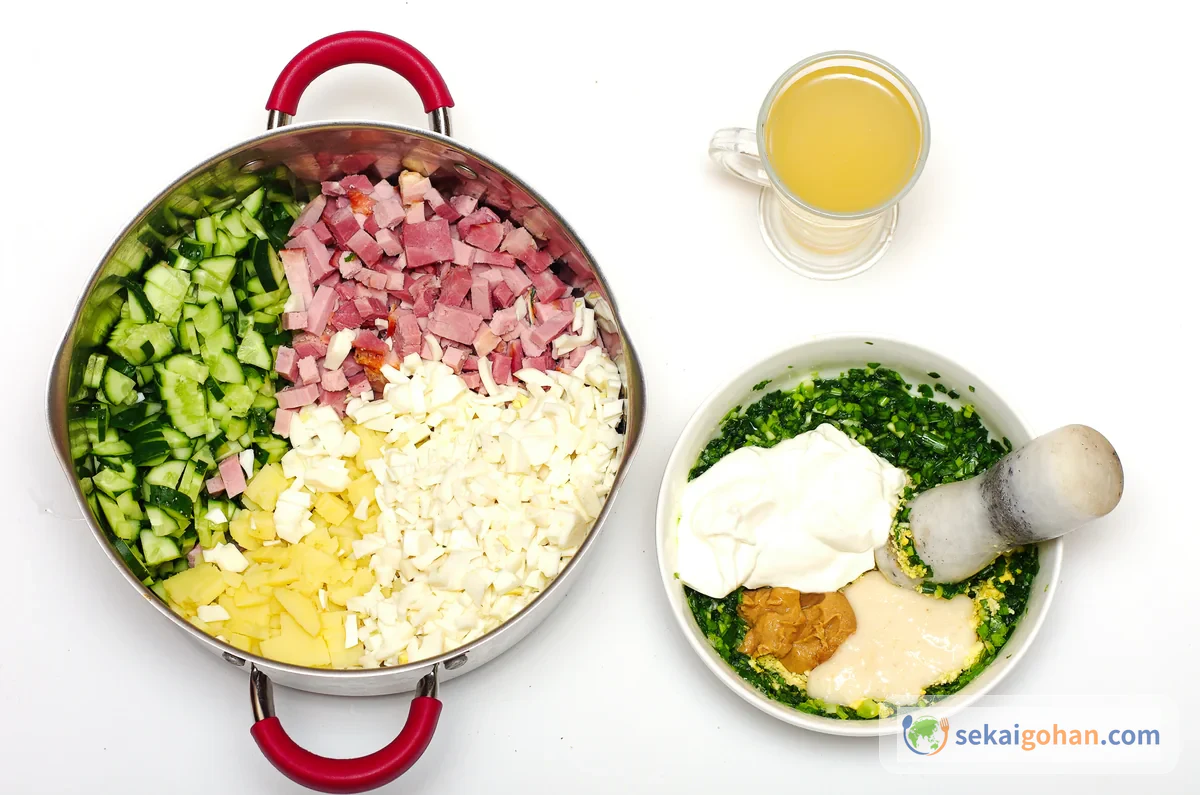
If you make it ahead, store the ingredients and liquid separately. The ingredients alone keep their texture the next day, but once the liquid is mixed in, the potatoes soak it up and the cucumbers release water, blurring the flavor.
Common Okroshka Problems and Fixes
Okroshka looks easy, but it goes wrong in a few predictable ways. It can taste thin, too sweet, or watery, the potatoes can fall apart, or the dill ends up floating on its own. How you chill it and when you salt it matter more than any cooking skill.

Sweet kvass blurs the flavor
If your kvass is sweet, add no sugar. Add a little lemon juice and horseradish instead. If the sweetness still bothers you, use half the kvass and make up the rest with unsweetened sparkling water. Sweet kvass is for drinking; the kvass for soup should be sour.
The cucumber turns watery
A lot of salt on cut cucumber pulls out too much water. Salt-rub only the scallions and dill, and keep the cucumber chilled until just before eating. If you're making it ahead, store the cucumber in its own container so it stays crisp.
The potatoes fall apart
Floury potatoes are fluffy and tasty, but they crumble when you chop them. Boil waxy potatoes in their skins, cool them completely, and then cut them, and the corners will hold. Broken potatoes cloud the soup, so save any leftovers for potato salad the next day.
The flavor is thin
Cold food makes salt harder to taste. Taste right before eating and aim for "slightly salty, as if it were at room temperature." Ham and sausage bring their own salt, so don't settle the seasoning too early.
The dairy separates
Yogurt poured straight into sparkling water tends to clump. First mix the yolk, sour cream, mustard, and a little kefir into a paste, then add the liquid a little at a time so it stays smooth.
Serving Okroshka: Variations, Menus, and Storage

A cold main or a side
Okroshka can be a main dish or a side, depending on how much you serve. A large bowl makes a light dinner. A small cup next to skewers, roast chicken, or sausages cuts the grease with cold acidity. If you ever make Caucasian-style shashlik, okroshka belongs on the same summer menu.
Variations
For a meatless version, leave out the ham and add 1 more potato. That loses some savory depth, so add 1 tsp more whole-grain mustard and a little more sour cream. It eats like a cold potato salad and goes well with a bean dish such as fasolada.
Chicken breast, salt-boiled and finely chopped, makes it lighter than ham does, and you can use the cooking liquid in another soup. It's also a handy way to use up boiled chicken left over from phở gà.
Some versions use salted or smoked fish. Grilled, flaked salted salmon comes close to that. The fish aroma is strong, though, so it works better in the kefir version than in the kvass version.
Building a menu

Okroshka is at its best next to something warm or rich. Its sourness, dill, and the smell of cucumber cut through flour dishes like pierogi, mămăligă, plăcintă, and khachapuri, where cold lactic acid and herbs balance the butter and cheese. For a summer day, try okroshka and black bread at lunch and a small bowl of a stew such as goulash or carbonnade at dinner. Going back and forth between cold and warm dishes shows how seasonal Eastern European cooking is.
Olivier salad is another cold Russian starter, made of diced root vegetables and pickles bound with mayonnaise. It uses the same dill, eggs, and potatoes, so you can make okroshka in summer and Olivier for celebrations without buying anything new. For something sweet after the meal or the next morning, there's vatrushka, baked with a white cheese filling, or medovik, layered with thin honey cake. Both show a side of Russian cooking beyond heavy stews.
Buy extra potatoes, eggs, cucumbers, and dill in one trip and use them through the week. The potatoes and eggs go into okroshka. Leftover dill stirred into sour cream makes a sauce for pierogi, and the cucumbers can become a quick pickle or a yogurt salad the next day. Okroshka is everyday cooking, a way to turn what's in your refrigerator into an Eastern European summer meal.
Make-ahead and storage

On a hot day, chop everything in the morning and refrigerate it, then pour in the cold liquid just before eating. You'll barely stand at the stove, and you still end up with a dish from the other side of the world.
The ingredients alone keep in the refrigerator until the next day; after the liquid is mixed in, finish it the same day. Because it uses eggs and ham, it is not suited to lunch boxes or carrying outdoors for a long time. Eat it soon after taking it out of the refrigerator.
FAQ

Q1. I don't like dill. Can I make it with shiso?
You can, but with shiso alone the flavor moves away from Russian cooking toward a cold salad. Try using half the dill and more parsley and scallions. Even a little dill keeps much more of okroshka's character.
Q2. Can I use fish-paste sausage instead of ham?
Yes. It's salty, soft, and easy to work with. Many brands are sweet, though, so it suits the kefir version better than the kvass version.
Q3. What should I change for children?
Use less horseradish and mustard, and make the kefir version. If the radishes are too sharp, slice them thin and soak them in water for 5 minutes. Ham is salty, so boiled chicken makes it easier for kids to eat.