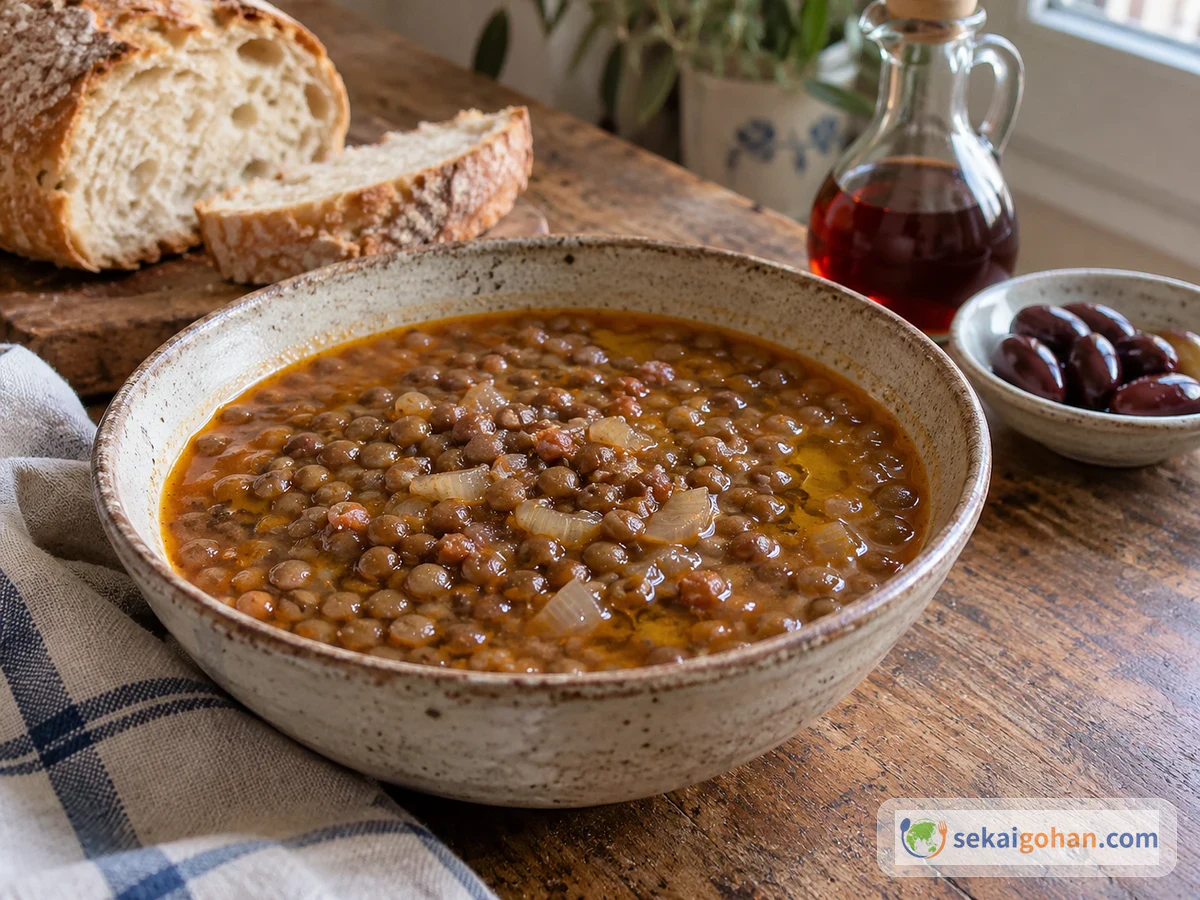
On a winter Sunday in a Greek home, the kitchen fills with the smell of olive oil and beans simmering slowly, and the table is set with feta, bread and a bowl of soup. Ask someone raised in a home like that about the taste of their mother's cooking, and a surprising number will name fasolada. It's dried white beans braised slowly in olive oil with tomato, carrot, celery and onion. It doesn't show up on fancy restaurant menus, and it isn't much to look at, yet it's widely called Greece's national dish.
About fasolada
Greece's national dish
Greece has several dishes called "to ethniko fagito" (the national food), but none is loved across the whole country, made in every region and remembered by every generation the way fasolada is. The name Fasolada (Φασολάδα) comes from the Greek "fasolia" (white beans). At Greek tavernas, the most common lunch is fasolada with feta, horta (boiled greens) and bread. Pair it with Greek moussaka and you have a good picture of the Greek table.
Bean dishes since ancient Greece
Fasolada's earliest ancestor goes back to ancient Athens in the 5th century BC. At the autumn festival Pyanopsia, a bean stew was offered to Apollo. That dish, called "pyanos," was a porridge of chickpeas or lentils stewed with grain, quite different from what Greeks eat today.
The white beans (Phaseolus vulgaris) and tomatoes in modern fasolada both came from the New World and reached Europe in the 15th–16th centuries. So the habit of stewing beans has carried on from antiquity to the present, even though every ingredient in the pot has changed.
Ladera and Orthodox fasting
Fasolada belongs to a family of Greek dishes called "ladera (λαδερά)," literally "oily dishes": vegetables or beans braised in olive oil with plenty of water. All ladera are plant-based and count as "nistisimo (fasting food)," eaten during the fasting periods (nistia) of the Greek Orthodox Church, which total around 180 days a year.
Those days include the 40 days of Lent before Easter, the 15 days before the Dormition of the Virgin and the 40 days before Christmas, when believers give up animal foods. Beans are the most efficient source of protein through these long stretches, and that religious rhythm of eating is a big part of how fasolada rose to be the national dish.
From poor man's food to national pride
In the first half of the 20th century, fasolada was seen as food of the poor. During the occupation in the Second World War there was a severe famine, and at times food of any kind was hard to find. After the war, a middle class that could now afford meat and fish tended to avoid fasolada as food of the past.
That changed in the 1990s, when the health effects of the Mediterranean diet drew worldwide attention and fasolada was reappraised as a food heritage Greece could be proud of. In 2010 the Mediterranean diet was inscribed on UNESCO's Intangible Cultural Heritage list (Greece was one of the nominating countries), and home cooking built on beans and olive oil found a new audience.

Ingredients (serves 4)
In Greece the large white beans "gigantes" from Kastoria and Florina are considered the best quality, but ordinary large white beans from a regular grocery make a perfectly good fasolada. Canned cannellini beans are available at import shops and many supermarkets. If you use canned beans you can skip the soaking and pre-boiling and shorten the cooking time a great deal. Dried beans have the better flavor, but either way the essence of fasolada is not lost.
Choosing beans and olive oil for fasolada
The olive oil shapes the taste of fasolada more than anything else. Greek extra virgin olive oil from the Kalamata region or Crete is best; its balance of pungency and bitterness suits the tomato and beans. Italian or Spanish oil also makes a good soup, but try Greek if you can. Greeks use the same oil for cooking and for finishing.
For the beans, large white beans give the closest texture, and other white beans work well too. Lentils cook too quickly to give fasolada its slow-simmered character, so skip them.
Tips for tender fasolada beans
The enemy of any bean dish is salt added too early. Add it in the last 15–20 minutes of the simmer so the beans soften all the way through. The same principle applies to the lentils in Lebanese mujaddara.
Serving, storing and varying fasolada
The next day's fasolada
Greeks say, "fasolada is for the next day." Overnight in the refrigerator, the beans soak up the soup, the vegetables' savor spreads through everything, and the flavor deepens a great deal. That's why Greek cooks make extra on purpose. Drizzle on a little more olive oil when you reheat it, and it tastes every bit as good as freshly made.

Lemon fasolada
Greece also has a "lemon fasolada" without tomato. Leave out the canned tomatoes, add 3 tbsp lemon juice at the end of the simmer and scatter dill over to finish. The soup turns a yellowish white with a lighter flavor, and in summer it's good eaten chilled.
Spicy version
Add 1 dried chili (seeds removed) during the simmer and sprinkle Aleppo pepper (a coarsely ground Middle Eastern chili) over at the end. It gives the soup a zing like Tunisian chakchouka, and it's especially warming on a cold winter day.
Gigantes plaki style
Use large gigantes beans (large white beans can substitute), use less liquid, and bake in a 350°F (180°C) oven for 1 hour. The tomato sauce reduces richly and the beans brown on the surface. It's a classic Greek meze (appetizer), a separate dish from fasolada with the same roots, and superb with wine.

Chickpea version (revithia)
Use 10.5 oz (300 g) dried chickpeas in place of white beans. In Greece this is a different soup, "revithia soupa," made in almost the same way. Chickpeas have a nutty flavor and go especially well with lemon. As with Indian khichdi, cooks across Eurasia have long combined beans and grains to get complete protein.
Nutrition (per serving, 4 servings)
Fasolada is especially rich in plant protein and fiber. As with Nepali dal bhat, eating beans with grain (bread) covers the essential amino acids.
| Nutrient | Amount |
|---|---|
| Energy | about 500 kcal |
| Protein | about 19 g |
| Fat | about 23 g |
| Carbohydrate | about 55 g |
| Fiber | about 18 g |
| Sodium | about 1,200 mg |
Dried white beans contain about 22 g protein and about 20 g fiber per 3.5 oz (100 g). Greek adults whose diets were closer to the traditional Mediterranean pattern, rich in legumes, vegetables and olive oil, tended to have lower mortality.
More Mediterranean and European dishes
- Mujaddara (Lebanon): A Mediterranean dish of lentils and bulgur
- Chakchouka (Tunisia): A North African dish of tomato and egg
- Koshari (Egypt): Egypt's national dish of beans, rice and pasta
- Goulash (Hungary): The classic paprika stew
- Caldo verde (Portugal): Kale and potato soup
- Svíčková (Czechia): Beef in cream sauce
- How to make carbonnade
- How to make waterzooi
FAQ
Isn't ½ cup (100 ml) of olive oil too much?
Some Greek homes use even more. Extra virgin olive oil is rich in omega-9 fatty acid (oleic acid) and polyphenols and is central to the health effects of the Mediterranean diet. You can cut back, but below ¼ cup (70 ml) the soup loses much of its creaminess and flavor.
Can I make it in a pressure cooker or electric pressure cooker?
Yes. Put in the soaked beans, vegetables, canned tomatoes, 1 quarts (1 L) water and 3.5 tbsp (50 ml) olive oil, cook at high pressure for 25 minutes and release naturally. Then open the lid and finish with salt and the remaining olive oil. In an electric pressure cooker, use the "beans" mode for about 50 minutes.
Is it good when I'm not fasting?
Absolutely. Fasolada grew up as a fasting food, but it's a satisfying everyday meal. If it feels light, serve it with Greek moussaka or grilled fish.