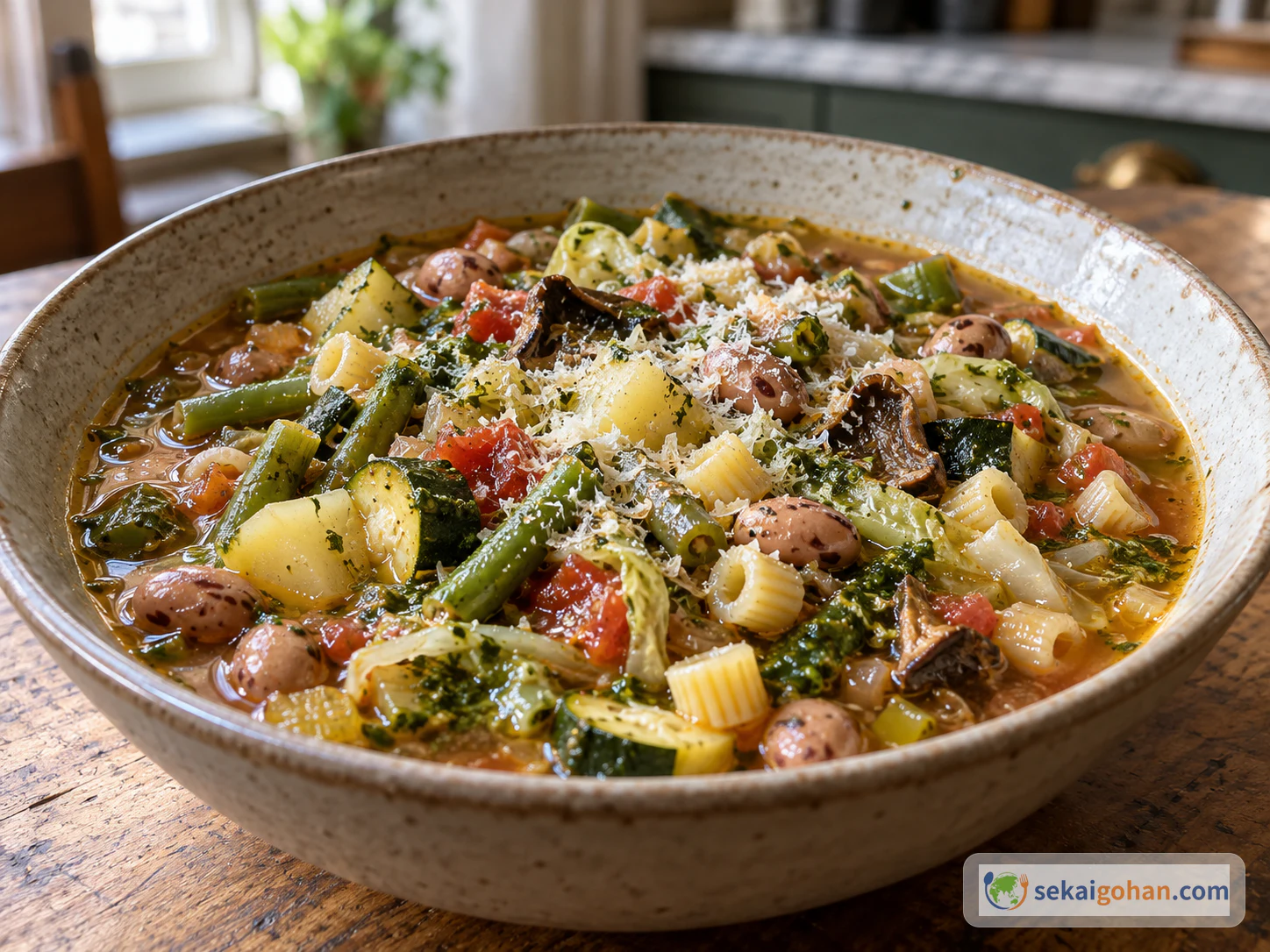
What comes to mind when you think of Portuguese food? Custard tarts, probably, or salt cod. But ask Portuguese people which dish they love most and the answer is caldo verde, "green broth." It is a smooth potato soup with hair-fine ribbons of kale floating on top, the savor of chouriço melted through it and a swirl of olive oil to finish. Potatoes, kale, chouriço and olive oil are the four main ingredients. The result is humble, yet somehow elegant, a home dish born on farms in the Minho region of northern Portugal.
Caldo Verde in Portugal and Beyond
Caldo verde is a national soup, and it shows up on every occasion: at weddings, saints' festivals, Christmas and in front of the football match. It belongs with the great European soups, such as Hungarian goulash and Czech svíčková.

A soup born on Minho farms
Minho is a green farming region, and everything the soup needs is close at hand there. Kale (couve galega) grows year-round, potatoes keep well, and chouriço is a preserved food from pig slaughter. The soup as we know it dates from the 16th century or later. Potatoes arrived in Portugal in the late 16th century; before that, the base was chestnuts or turnips.
Caldo verde abroad
The soup traveled with Portuguese emigrants, and it is loved in Brazil, Massachusetts, France and Luxembourg. In Brazil especially, it is served in large quantities at the June festas juninas (St. John's festival).
Ingredients (serves 4)
Chouriço contains pork. The egg variation uses egg. The vegan version has few allergens, but if you substitute sausages for the chouriço, check the product's ingredients.
Portuguese chouriço is a firm, smoky, dry-cured sausage. Spanish chorizo also comes in a fresh type. Spanish dry-cured smoked chorizo works fine; if yours is fresh, brown it in a skillet first. If you can find neither, a coarse-ground smoked sausage plus 1 tsp of paprika can stand in.
Choosing Ingredients for Caldo Verde
The seasoning is minimal, so the quality of each ingredient goes straight into the flavor. That matters most for the olive oil, the potatoes and the greens.
Use a good extra-virgin oil for the finishing drizzle. If you skimp on it, the soup tastes thin. Portuguese oil is best if you can find it.
For potatoes, choose a waxy variety such as Yukon Gold. It holds together and mashes into a smooth soup, while very floury potatoes can leave it grainy. As with Bosnian burek, the ingredients you pick decide the result.
If you cannot find kale, collard greens or the dark outer leaves of cabbage work well. Komatsuna (about 5.5 oz (150 g)) with 5 shiso leaves is a close stand-in: the crunch of the komatsuna and the slight bitterness of the shiso partly reproduce kale. Spinach is too soft to give the right texture, so keep it as a last resort.
Method
duration: 10 min
Peel the potatoes and cut them into 1 inch (2 cm) cubes. Finely chop the onion into up to 0.25 inch (3–5 mm) pieces and mince the garlic. Even cubes cook evenly and leave no graininess when mashed later. You do not need to soak the potatoes in water: the starch is what thickens the soup.

- Simmer the potatoes
duration: 20 min
Heat 2 tbsp olive oil in a pot over medium heat. Add the onion and sauté for 3 minutes. When it turns translucent, add the garlic and cook 1 minute more. Add the potatoes and 1 quarts (1 L) water and turn the heat to high. Once it boils, reduce to low, cover and cook 15 minutes, until the potatoes break apart under a fork.

- Mash the potatoes
duration: 3 min
Turn off the heat and mash the potatoes with an immersion blender. The key is not to make it perfectly smooth: leave a few small bits. In Portugal the correct result is a soup, not a purée. If you have no immersion blender, roughly crush the potatoes with a potato masher.

- Prepare the kale
duration: 5 min
Remove the thick ribs from the kale leaves. Stack several leaves, roll them up and cut from the end into ultra-fine ribbons up to 0.125 inch (1–2 mm) wide. This fineness is everything. If the ribbons are thick, the texture in the soup suffers. In Portuguese homes people even use a special slicer for this cut.

- Add the chouriço and kale and finish
duration: 5 min
Slice the chouriço into 0.25 inch (5 mm) rounds. Bring the mashed soup back to medium heat until the surface barely trembles. Add the chouriço and simmer for 3 minutes. When fat floats up as red dots and the smoky aroma rises, add the shredded kale and cook for 2 minutes. Stop when the kale is bright green and wilted and the soup keeps a light body. Adjust with salt and black pepper.

Kale goes into the pot for 2 minutes. Cook it longer and it stops being verde (green). Keeping the kale's bright color and bite is the essence of caldo verde.
- Plate
duration: 2 min
Ladle up to 1¼ cups (250–300 ml) per person into soup bowls and arrange 2–3 slices of chouriço in the center, nudged so the green of the kale shows on the surface. Finish with 1/2 tbsp olive oil; a thin golden ring on the surface is enough. Serve with bread, ideally broa, Portuguese cornbread, if you can get it.

Getting the Caldo Verde Texture Right
Aim for about the body of a French-style vinaigrette, so the soup just coats the back of a spoon. It should be thicker than a consommé but lighter than a potage. If it comes out too thick after mashing, add water. If it is too thin, simmer it uncovered for 5 minutes.
Caldo Verde Variations and Nutrition
Vegan version (no chouriço)
Leave out the chouriço and add 2 tsp smoked paprika and 1/2 tsp smoked salt instead to bring back its smoky flavor. You lose the richness of the chouriço's fat, so add 1 tbsp more olive oil at the end.
Egg version (caldo verde com ovo)
Top the soup with a poached egg and break the yolk as you eat. This modern twist is popular in Lisbon restaurants, and it pairs egg with a savory base much like Tunisian chakchouka.
Bacon version
Use 3.5 oz (100 g) thick-cut bacon in place of the chouriço. Cut it into 0.5 inches (1 cm) strips, crisp it first and use the fat as the base of the soup. The bacon's smokiness stands in for the chouriço, and everything comes from an ordinary supermarket.
Turnip version
Replace half of the potatoes with 10.5 oz (300 g) turnips, and finish with sausages plus 1 tbsp miso instead of chouriço. The turnip's sweetness goes well with the bitterness of the kale, and the miso adds depth.
Nutrition (per serving, one of four)
| Nutrient | Amount |
|---|---|
| Calories | 320 kcal |
| Protein | 12 g |
| Fat | 16 g |
| Carbohydrates | 1.25 oz (34 g) |
| Fiber | 5 g |
| Sodium | 580 mg |
FAQ
Q1. Can I make it ahead?
Yes. It keeps for 3 days in the refrigerator, and by the next day the potato starch has blended into the soup and it tastes even better. Kale discolors, though, so it is best to store the soup before adding the kale and add fresh kale when reheating. You can freeze it for 1 month, but the potato starch changes and the texture shifts slightly.
Q2. What if I have no immersion blender?
Crush the potatoes roughly with a potato masher. That is actually the more traditional way, since the soup was being made on Minho farms long before immersion blenders existed. A fork works too, and a few lumps do no harm.
Q3. What should I drink with caldo verde?
In Portugal, Vinho Verde is the standard. The name translates as "green wine," and it is a lightly sparkling white whose light acidity and slight fizz contrast with the warmth of the soup. For a non-alcoholic option, sparkling water with a squeeze of lemon is simple and pairs well.
More European Soups and Stews
- Bacalhau à Brás: another dish from the Portuguese table
- Goulash: Hungarian paprika stew, another of Europe's great national soups
- Svíčková: Czech beef in cream sauce, a classic of Central European home cooking
- Carbonnade: Belgian beer stew for cold northern winters
- Waterzooi (in Japanese): from Belgium, like carbonnade
- Moussaka: Greek eggplant and ground meat bake, a staple of Mediterranean cooking