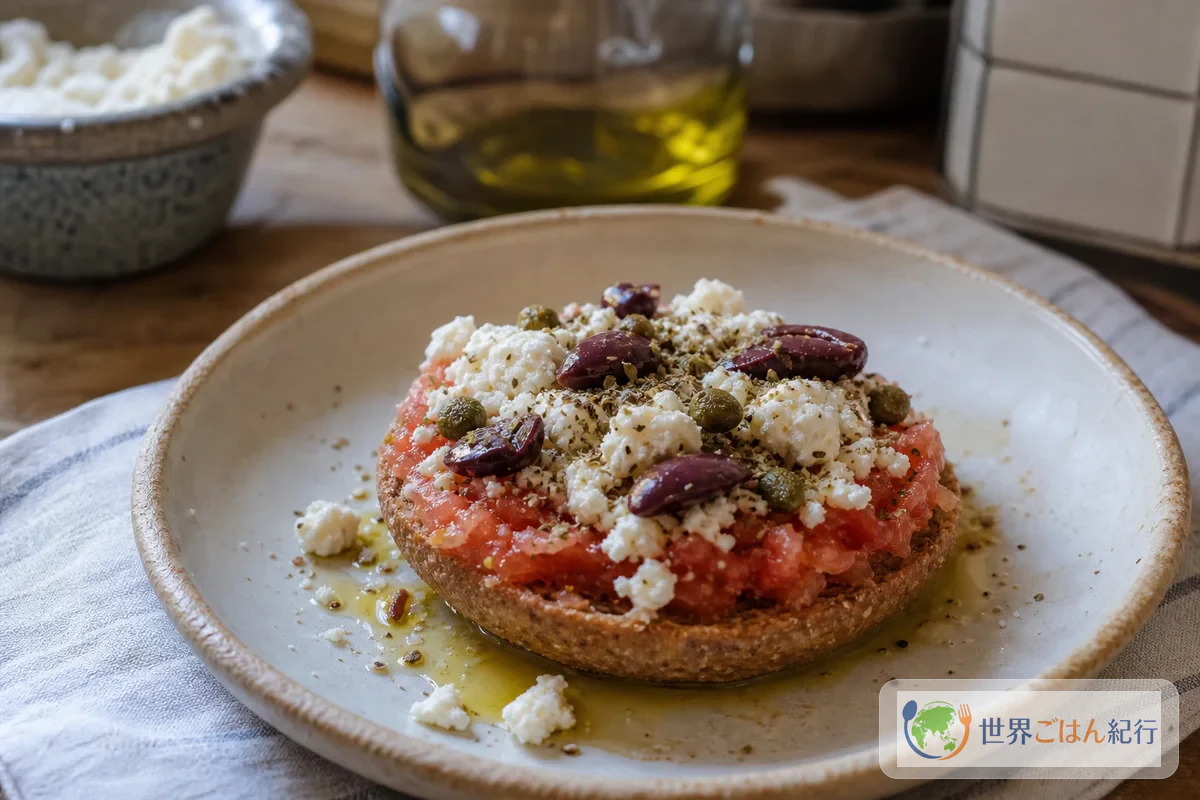
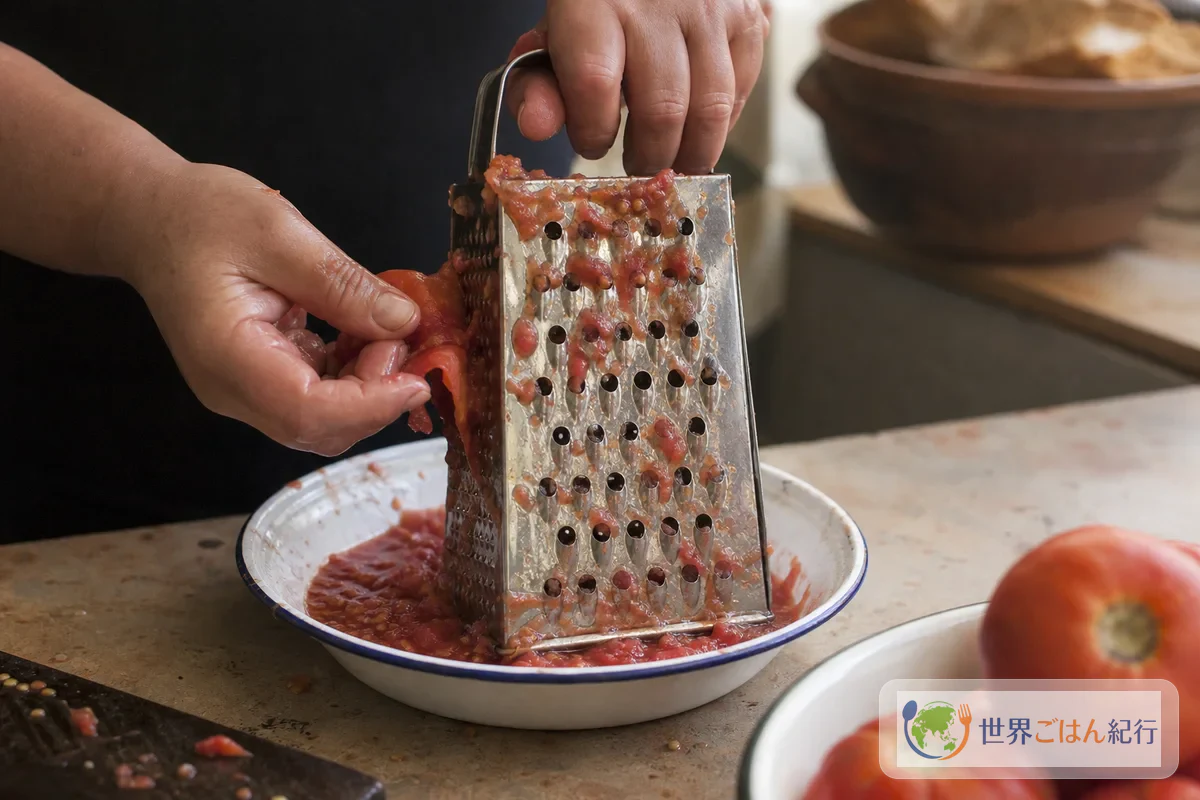
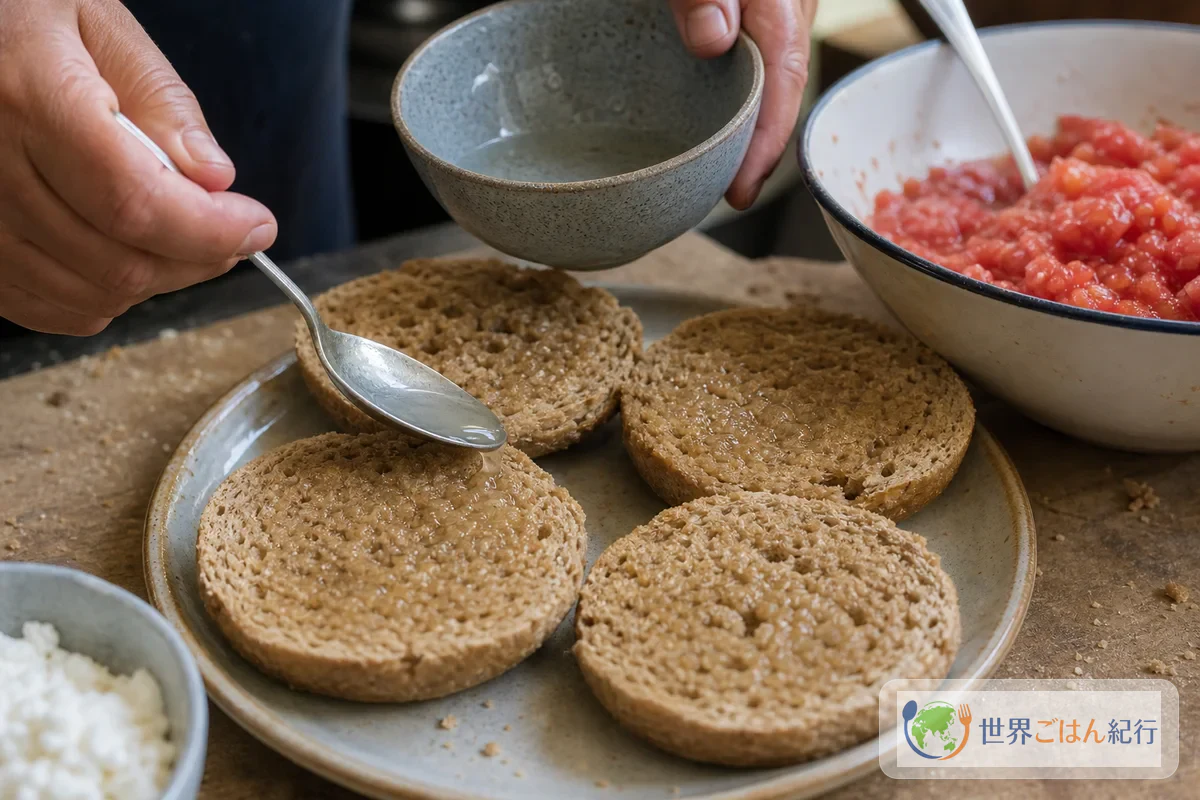
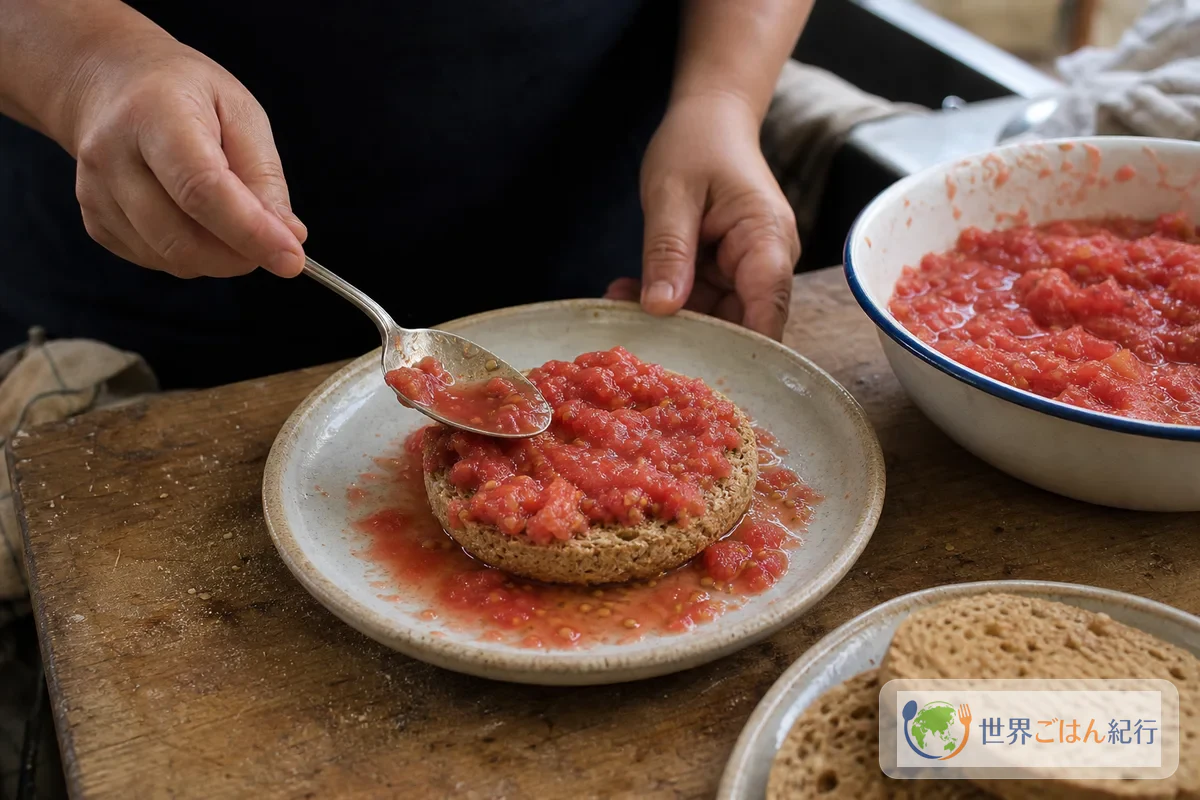
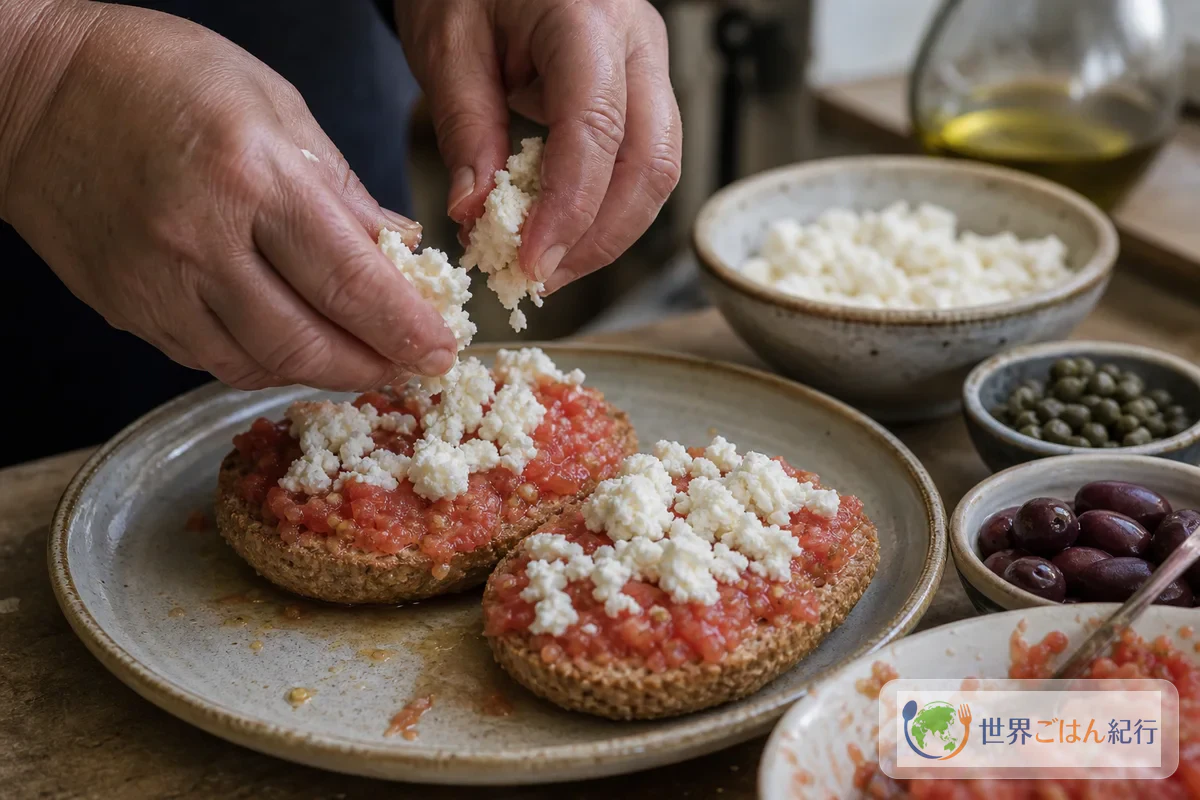
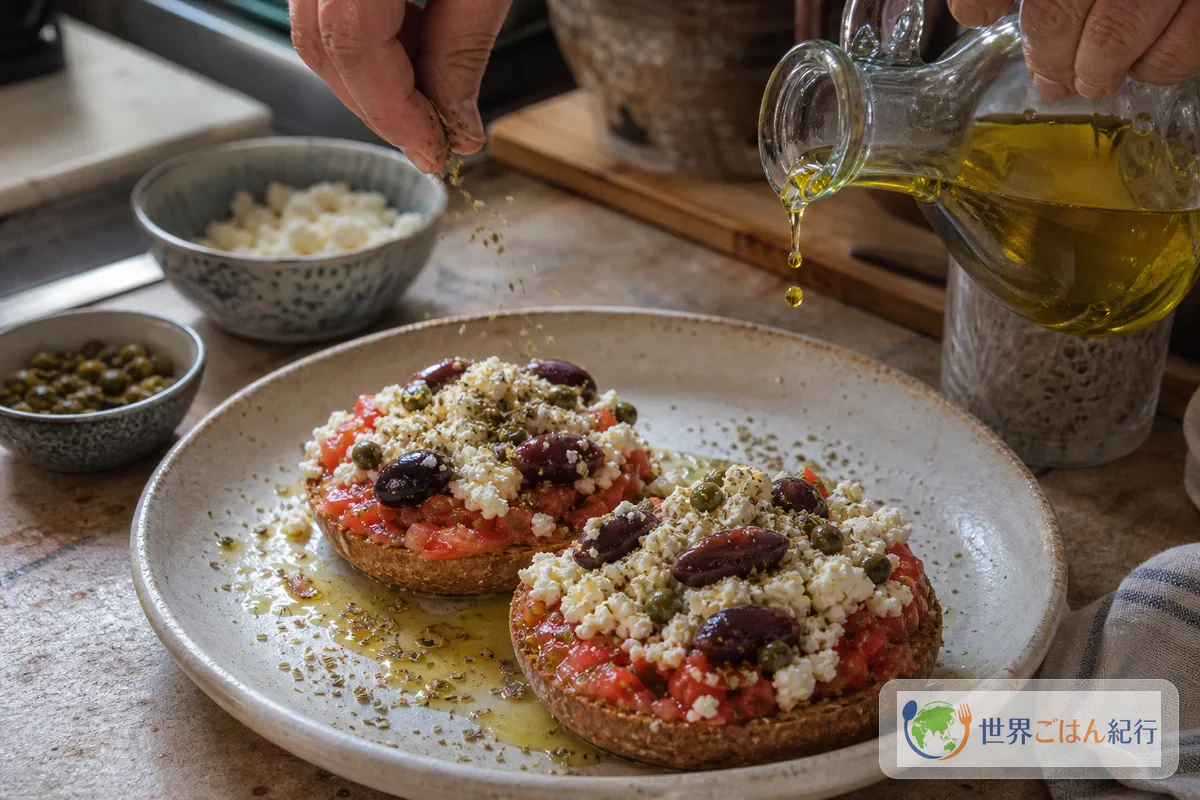
Grate a tomato in a summer kitchen and a green scent rises, different from the one you get when you cut it with a knife. Spoon the coarse pulp and red juice a little at a time onto a hard rusk, and the bread, stone-dry at first, slowly turns back into food on the plate. That change is what makes dakos (ντάκος in Greek) interesting. It's a barley-rusk salad often eaten on Crete: ripe tomatoes, white cheese, olive oil, and oregano layered on dry bread, cold and salty, with a texture that keeps shifting as you eat.
Dakos on the Cretan table
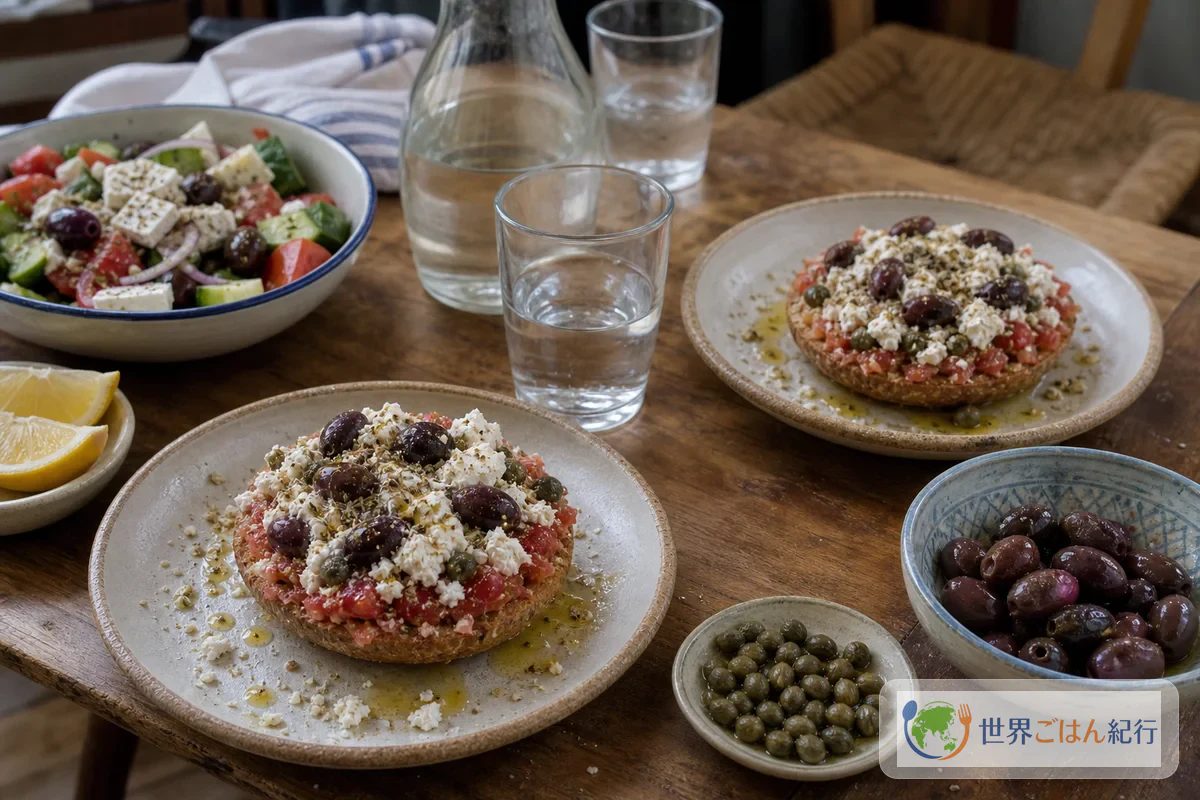
The base is paximadi, the hard, twice-baked bread Cretans keep in the kitchen. The idea is to dry the bread thoroughly once, then bring it back with olive oil and tomato juice when you eat. In hot weather, nobody wants to bake soft bread every day, so the long-lasting rusks wait on the shelf until there are ripe tomatoes. On top go white cheese made from sheep's or goat's milk, aromatic dried oregano, and salty olives and capers.
This is no hot, freshly cooked plate. People assemble it for a light midday meal or on the way back from shopping: the tomato stays cold, the cheese is crumbled, and the oil goes on at the end. Once the rusk starts to take up juice, a little sauce forms at the bottom of the plate, and when you break the bread with a fork, red juice and oil soak into the cross-section.
On Crete you'll also find a form called koukouvagia, and cooks choose different cheeses and cut their tomatoes in different ways. Coastal shops sometimes add more olives and capers. At home, you can keep it light with only tomatoes and cheese.
Dakos has some close relatives. Italian panzanella tosses bread with vegetables, while dakos uses the bread as the base of the plate and adds liquid from above, little by little. Diced tomatoes on soft bread move it toward bruschetta. The cold tomato also links it to Greek salad, which skips the lettuce and puts a big piece of feta on top, and to Spanish gazpacho.
Ingredients (serves 4)
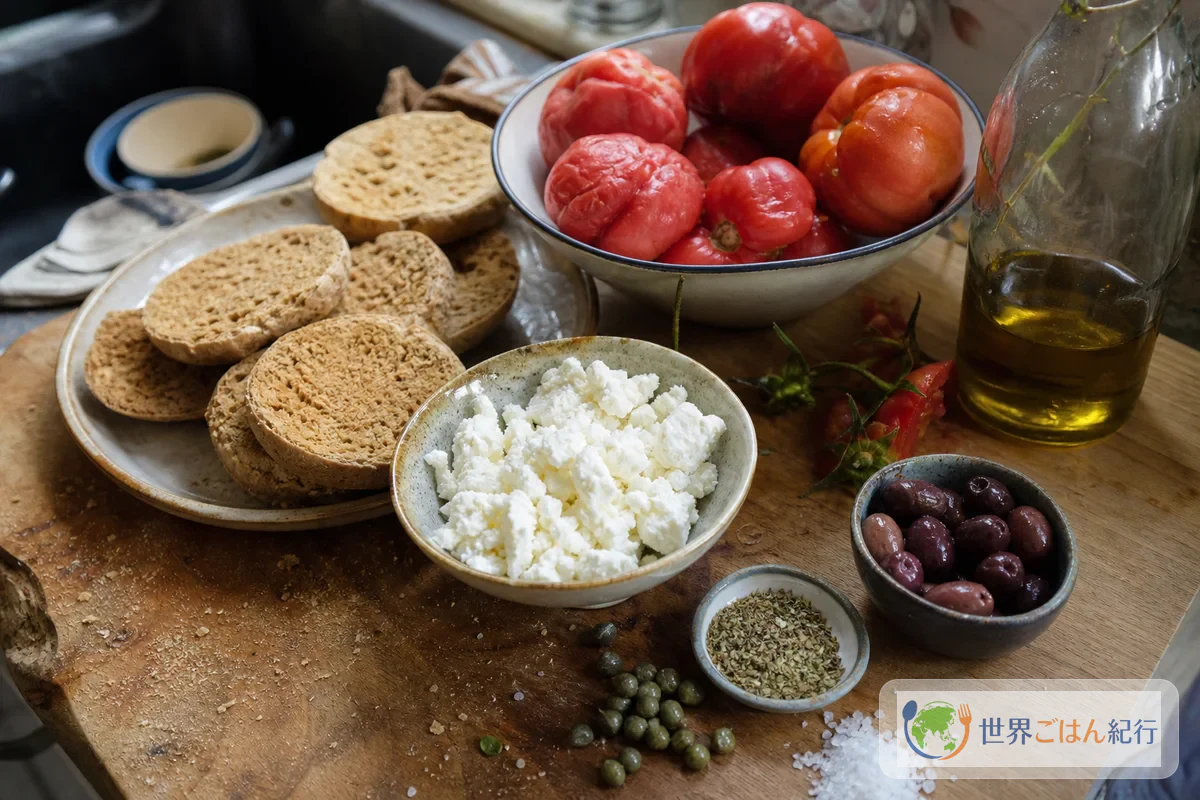
The rusk and bread contain wheat and barley, and the cheese contains dairy. Feta, olives, and capers are high in salt, so for people watching their sodium and for children, reduce the cheese to 4 oz (120 g) and the capers to 12 g.
If you have no paximadi
Dakos is not a bread salad. It is a dish in which dry rusk takes up tomato juice. Use soft bread as it is, and only the surface turns watery while the center collapses limply. If you use country bread or whole-wheat bread instead, slice it 0.5 inches (1.5 cm) thick and bake it in a 325°F (160°C) oven or toaster for 10 to 12 minutes, driving off moisture until the surface is dry and lightly colored.
Rye crispbread is thin, so using 2 sheets stacked per person gives a meal-like feel. Many crackers contain fat or sweetness and tend to turn floury after taking up tomato juice, so think of them as a last resort.
What is worth looking at when shopping
Tomatoes, ordinary bread, and feta are easy to find at a supermarket, and the ingredients table above covers them. Spend more care on the items that change the character of the dish: oregano, Greek olive oil, and capers, which add a little saltiness and sourness. Leftovers can also go into souvlaki, fasolada, and moussaka.
Weak oregano disappears under the tomato and cheese. Rub whole dried oregano between your fingertips before using it, and even a small amount gives the green aroma of Cretan cooking.
Use a good amount of olive oil. If you stretch it with a cheap oil, only an oily feeling remains once it soaks into the rusk, so choose one with a good balance of aroma and bitterness.
You need only a little caper. If salt-packed, rinse about 20 seconds in water; if jarred, drain the liquid lightly before using, so they do not pile on too much over the saltiness of the cheese and olives.
Choosing ingredients for dakos
You don't need every Greek ingredient. Five things matter: hard bread, coarsely grated tomato, white tangy cheese, olive oil, and oregano. With those in place, a substitute for the paximadi or mizithra (see the FAQ below) still keeps the dish on a Cretan table.
Some swaps turn it into something else. Make basil the star and you're heading toward bruschetta; cut mozzarella in large pieces and it's close to caprese. Mayonnaise or a sweet dressing is the worst choice, since the rusk absorbs the oil and sugar and the green scent of the tomato is lost.
Common dakos mistakes and fixes
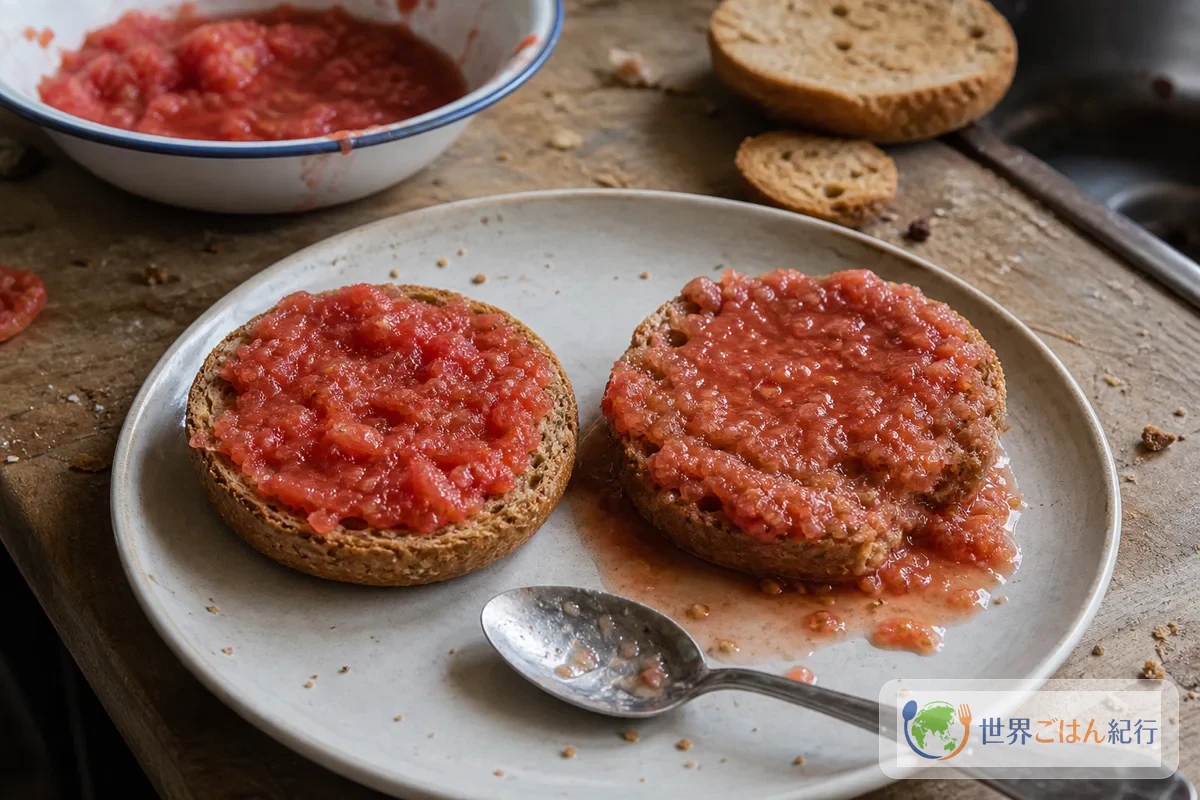
Dakos uses no fire, so the real challenge is softening the rusk to just the right point, without letting it go soggy or leaving it so hard it stabs the roof of your mouth. You also have to balance the saltiness of the tomato, cheese, and olive oil. With so few steps, mistakes show up right away on the plate.
Watch how the liquid goes in first. A hard rusk does not take up water all at once, so if you pour too much at the start, only the surface turns muddy while the center stays hard.
| Symptom | Cause | Fix |
|---|---|---|
| The center is hard and cracks in your mouth | Too little moistening, or too short a standing time | Add 2 tsp of tomato juice at a time and leave for 2 minutes |
| Juice pools on the plate and it collapses | Water or tomato juice was poured on all at once | Break an extra half rusk into it to absorb the excess juice |
| Too salty | The salt of feta, capers, and olives piled up | Grate another 3.5 oz (100 g) tomato and add 1 tbsp (15 ml) oil |
| The tomato flavor is weak | Winter tomatoes with weak sweetness and acidity | Mix in 5.5 oz (150 g) coarsely chopped cherry tomatoes and add 1 tsp (5 ml) red wine vinegar |
| The aroma is blurred | The oregano is old, or the oil is too light | Crush dried oregano with your fingers and add 2 tsp (10 ml) more finishing oil |
The easiest approach is to stop short of softening the rusk completely. Moisten the whole thing and dakos turns from a salad into soggy bread. Leave a crisp part at the edge, and the plate keeps changing as it takes up the tomato juice.
Keep some of the tomato skin, too. Throw away what's left on the grater, but keep the fine bits of skin and rough pulp that fall into the bowl. Pulp that's too smooth runs off the rusk like a sauce, and you lose that simple, homey thickness.
Serving dakos
In Crete, dakos works as both a starter and a light meal. Set it beside grilled fish, grilled chicken, or a bean stew, and the acidity of the tomato cuts the richness of the main. Pair it with souvlaki when you want the aroma of meat, with fasolada for a bean stew, or with moussaka for a solid baked dish. Since it's a bread plate, it sits more naturally with soup or grilled dishes than beside white rice.
Storage and frequently asked questions
Can I make it ahead?
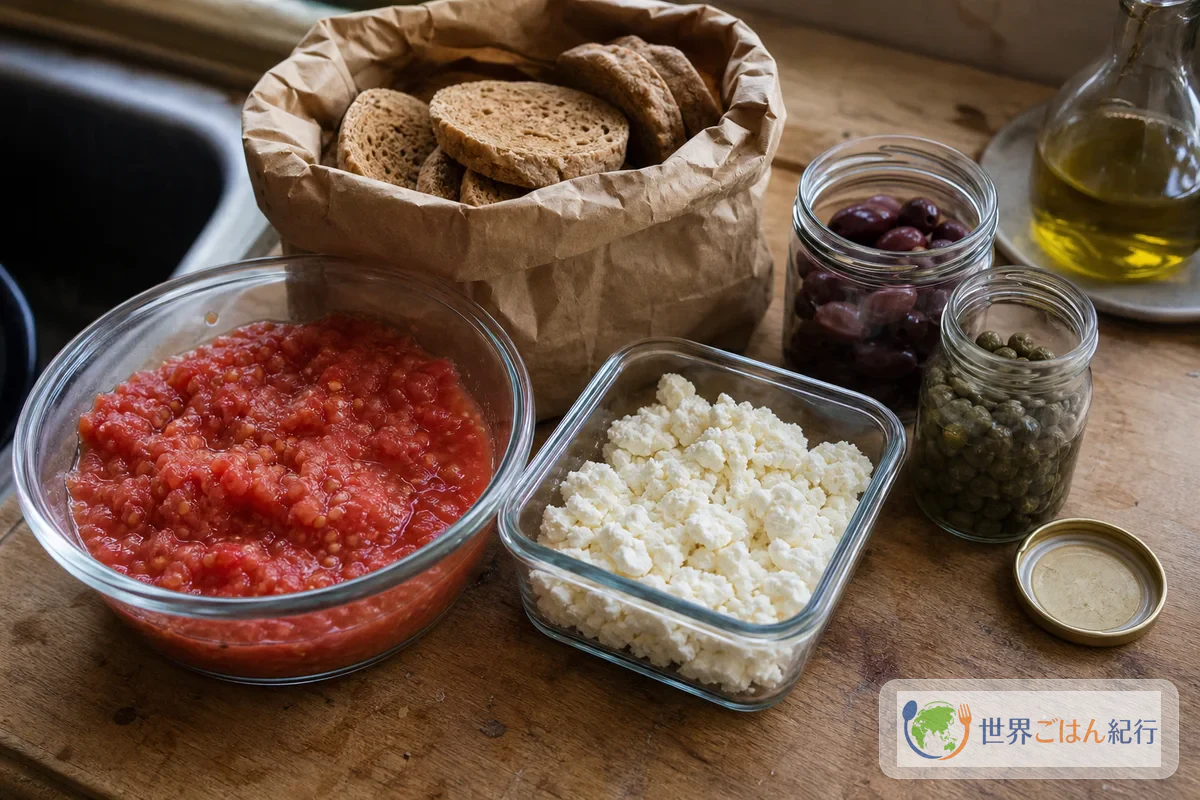
It tastes best eaten within 15 minutes of finishing; the longer it sits, the more the crunch of the rusk disappears. To prepare in advance, grate the tomatoes and refrigerate for up to 2 hours, crumble the cheese and refrigerate for up to 1 day, and keep the rusks dry at room temperature. Assemble right before eating.
What should I buy if I cannot find paximadi?
Choose hard whole-wheat bread, rye crispbread, or thinly sliced country bread, in that order of ease. Bake country bread for 10 to 12 minutes at 325°F (160°C) to dry it, and it stands up to the tomato juice. Soft sandwich bread has too much sweetness and moisture to give dakos its characteristic chew.
What if I cannot get mizithra?
Use feta. If it is very salty, rinse the surface briefly in water and wipe with paper towel, which improves the balance with the tomato. If you use cottage cheese, mix in 1 g salt, 1 tsp (5 ml) lemon juice, and 2 tsp (10 ml) olive oil to make up the tang and richness.
Can I make it with canned tomatoes?
Skip it if you can. Canned tomatoes have an aroma suited to cooking and lack the fresh green note dakos needs. If you must, drain 7 oz (200 g) canned diced tomatoes and mix in 7 oz (200 g) coarsely chopped cherry tomatoes for a brighter mouthfeel.
What do I change for children?
Halve the capers and chop the olives to scatter. Reduce the feta to 4 oz (120 g) and mix in 1.5 oz (40 g) cottage cheese to soften the saltiness. Hard rusk corners are difficult to eat, so after moistening, wait 7 minutes until the edges soften a little.