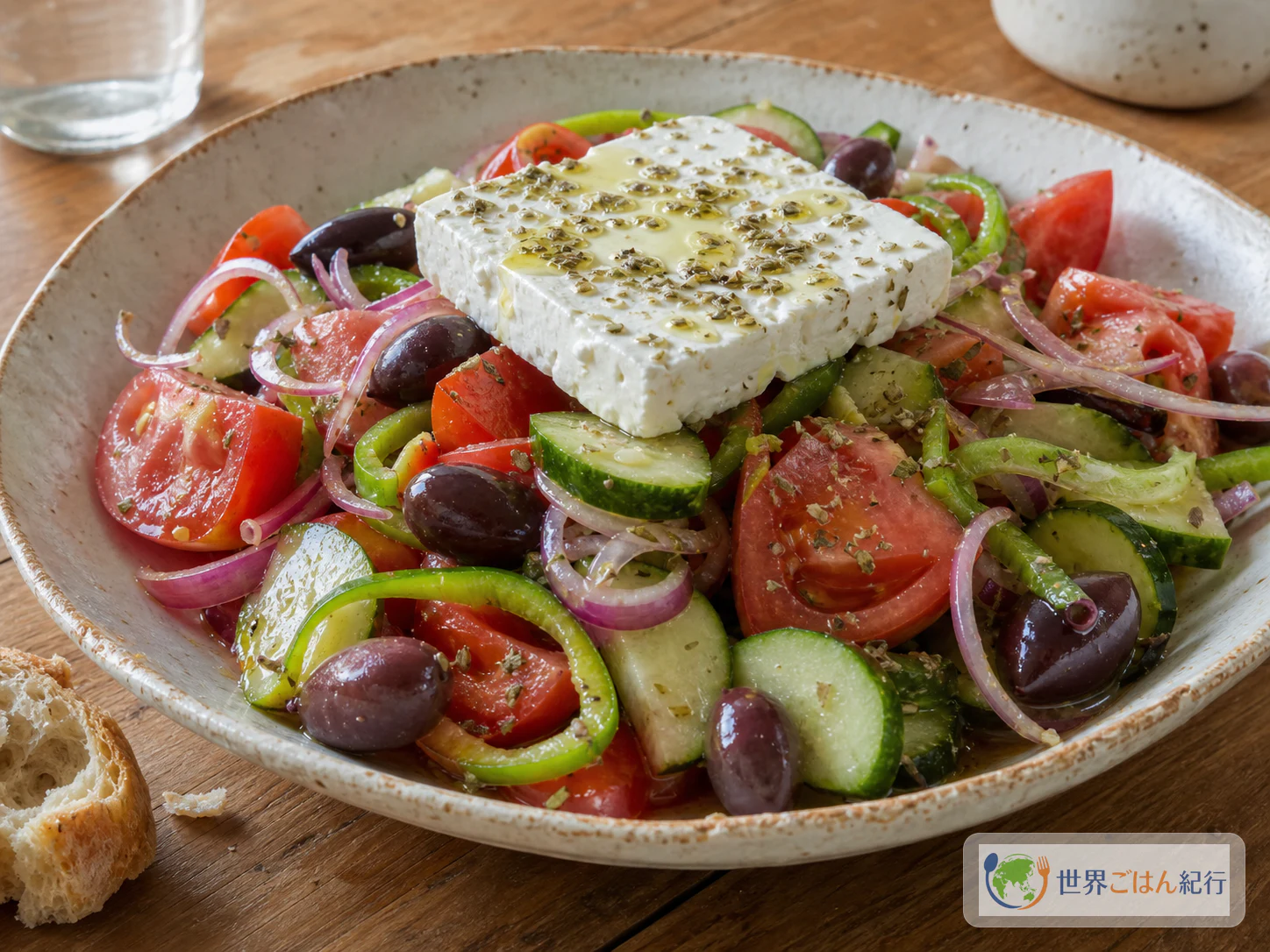
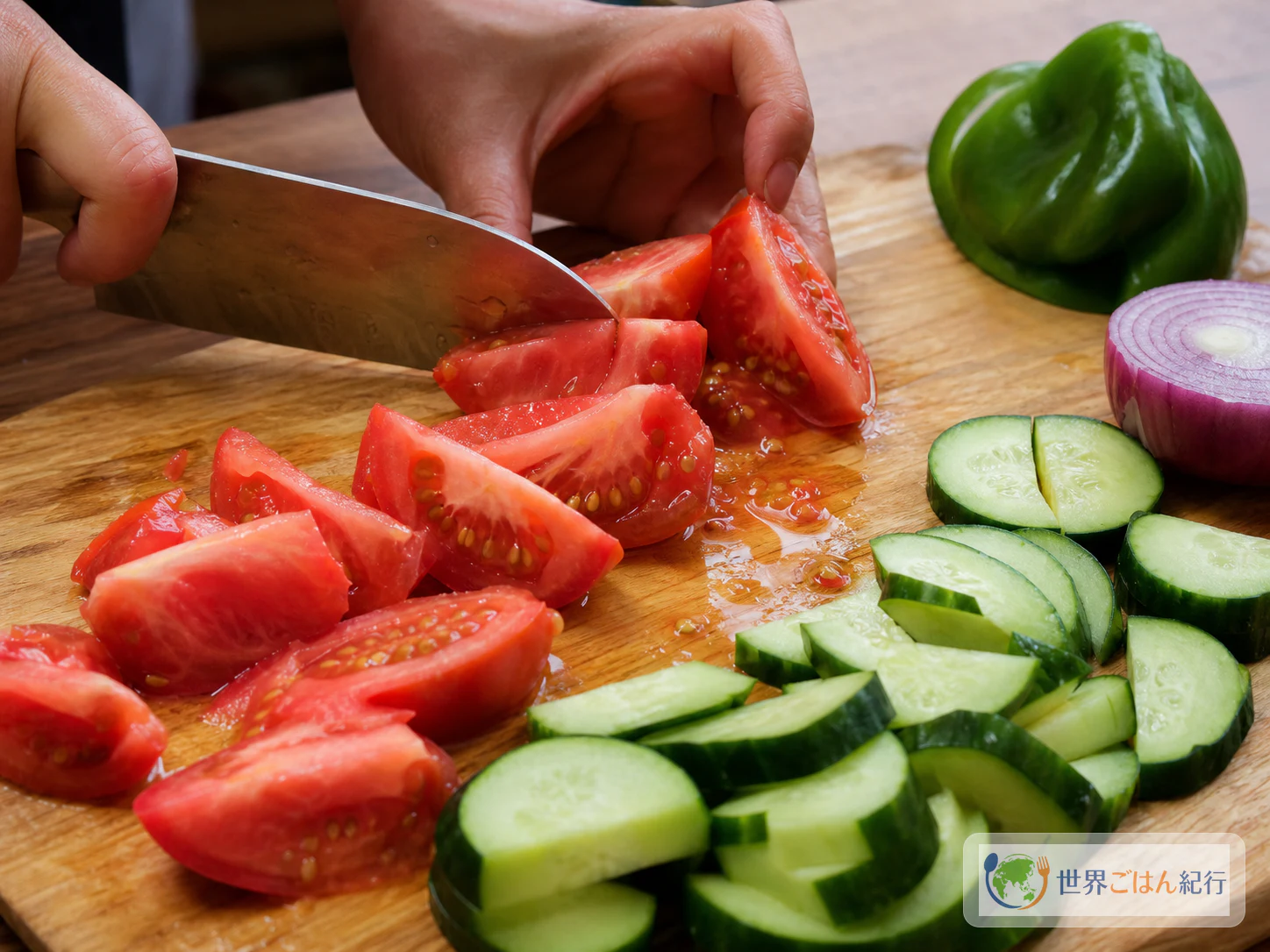
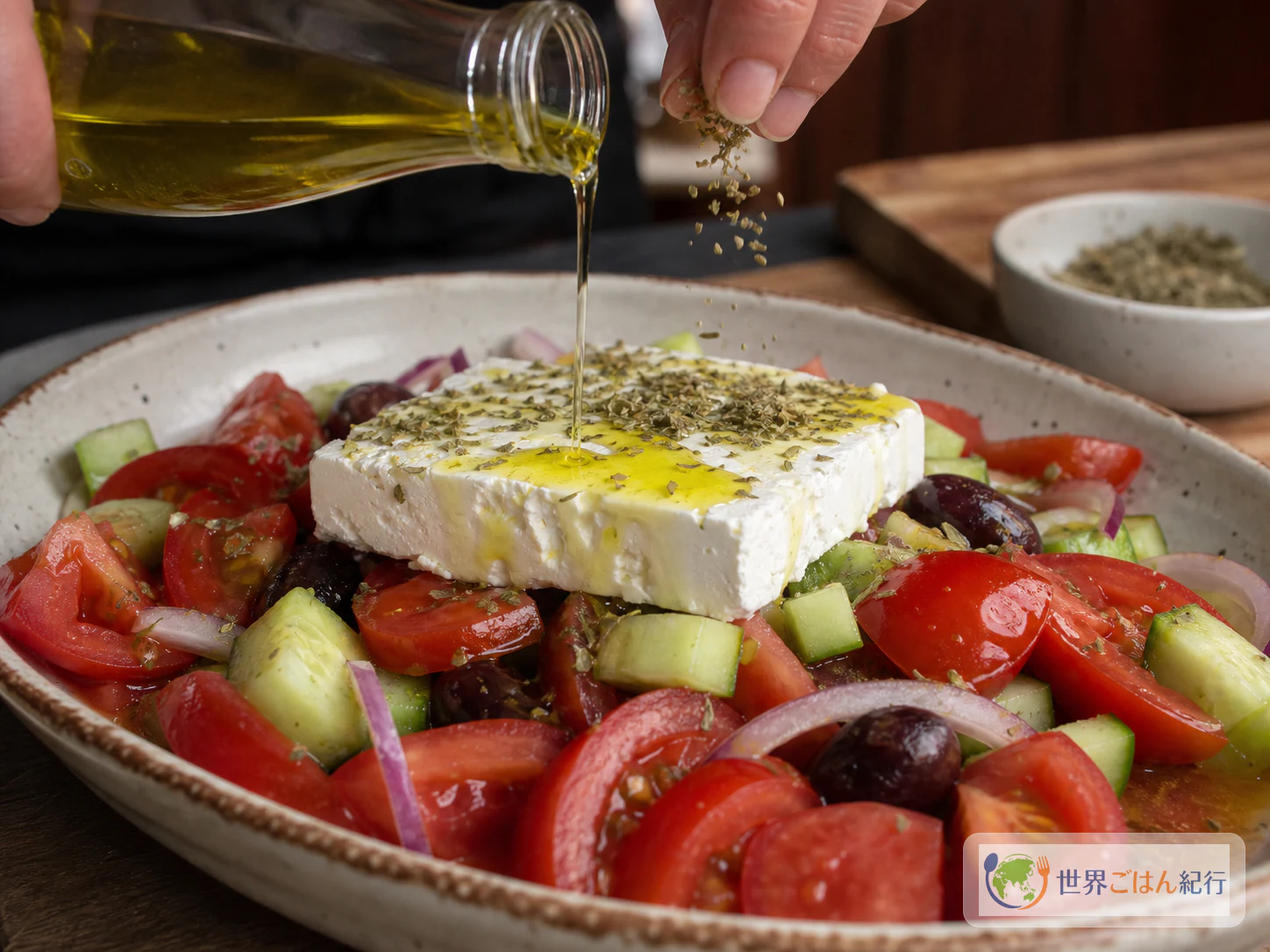
Tomatoes cut into big pieces on a hot day spill red juice across the cutting board. With most salads you'd drain it off to keep the plate neat, but in a Greek salad that juice is the point. Mixed with olive oil and mopped up with bread, it turns a plate of dressed vegetables into a meal. Greeks call it horiatiki, the "village salad": tomato, cucumber, onion, green pepper, feta, olives, oregano and olive oil, salty and juicy with the taste of summer.
Horiatiki, the Greek village salad
In Greece the dish is horiatiki (χωριάτικη σαλάτα / horiatiki salata). The name comes from the way vegetables are cut large and served, as at village and rural tables. Unlike the lettuce-based "Greek-style" salads served in restaurants abroad, the local standard has no leafy greens. Its flavor comes from the moisture and saltiness of summer vegetables.
"Greek salad" is the English-language name. The Greek χωριάτικη means "of the village, rustic."
Horiatiki isn't meant to stay tidy once it's served. Part of the dish is what happens at the table: people break up the feta, pick at the olives, and mop up the tomato juice and olive oil at the bottom of the plate with bread. That last part is perfectly natural at a Greek table, and the end of the salad can be the best bite. Regional habits differ too. On the islands and coasts, capers and sea salt turn up more often, and inland the salad is often set beside grilled meat or a bean stew.
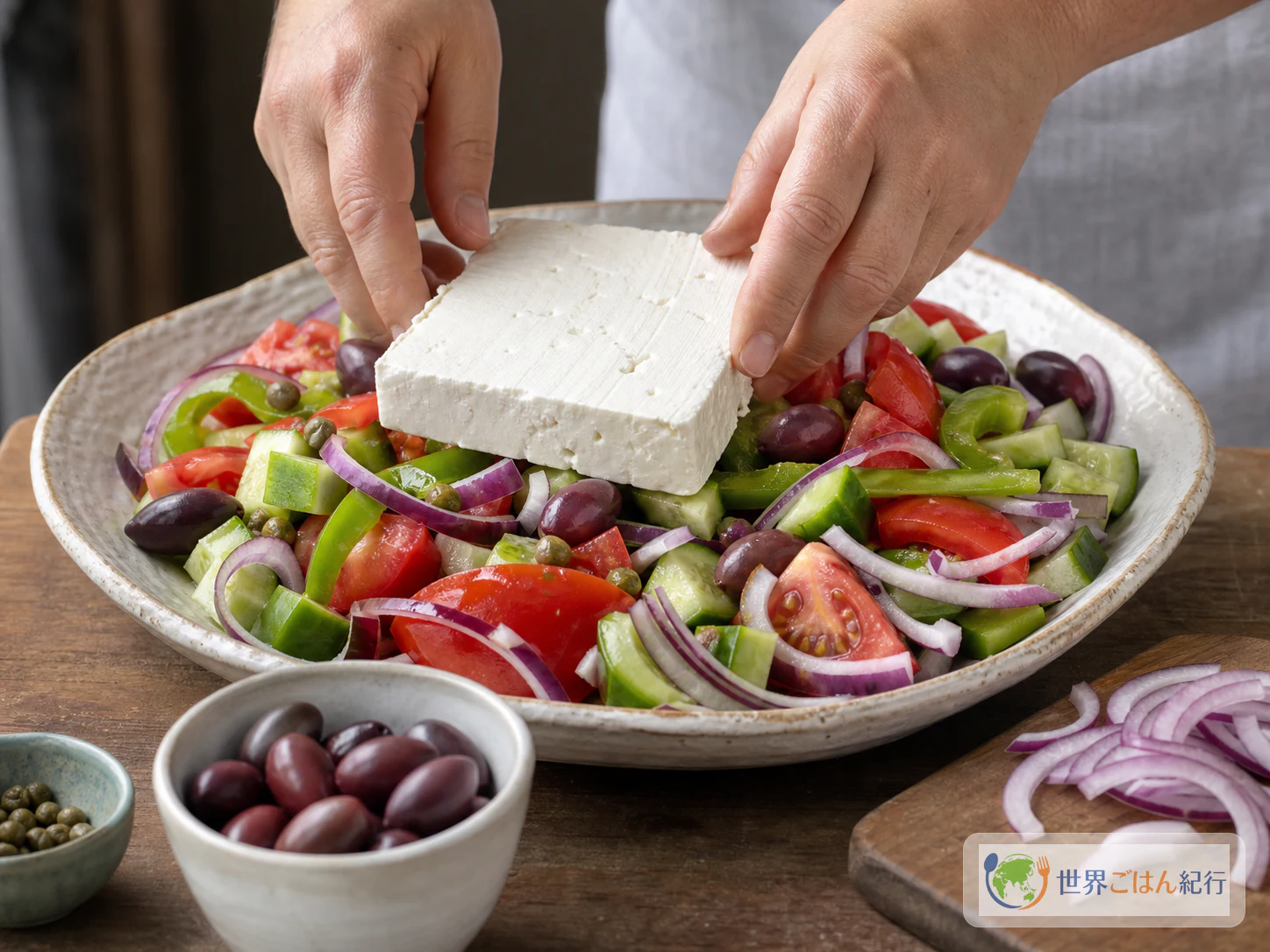
There's no cooking involved, so the challenge lies elsewhere. You want to keep the feta's saltiness from spreading through the whole salad, keep the tomato juice, and use olive oil generously. Crumble the feta finely and mix it in, and the white crumbs dissolve into the juice and the dish looks watery. Set it on top of the big-cut vegetables instead and let each person break it up on the plate. That puts a home salad much closer to a Greek table.
Ingredients (serves 4)
Feta contains dairy. Some breads and pitas contain wheat. Feta, olives and capers are high in salt, so for people watching salt or for children, reduce the feta to 4 oz (120 g) and the capers to 8 g, add no salt, and taste at the end.
What to look for when shopping
Tomatoes, cucumbers, onions and ordinary bread are fine from any supermarket. The things worth looking for are the oregano that sets the direction of the dish, a Greek olive oil that makes the juices at the bottom of the plate delicious, and capers that bring it closer to local practice in small amounts. Leftover ingredients can go into dakos, souvlaki and fasolada.
Oregano with weak aroma loses its outline on top of tomato and cheese. Rubbing whole dried leaves between your fingertips before using gives it the green aroma of Greek cooking even in a small amount.
Olive oil is used in quantity. Padding it out with cheap oil leaves only oiliness when you mop up the juices at the bottom of the plate with bread, so it's worth choosing one with a good balance of aroma and bitterness.
Capers are needed only in small amounts. For jarred ones, drain lightly; for salt-packed ones, rinse in water for about 20 seconds so they don't pile on top of the saltiness of the cheese and olives.
Choosing ingredients for Greek salad
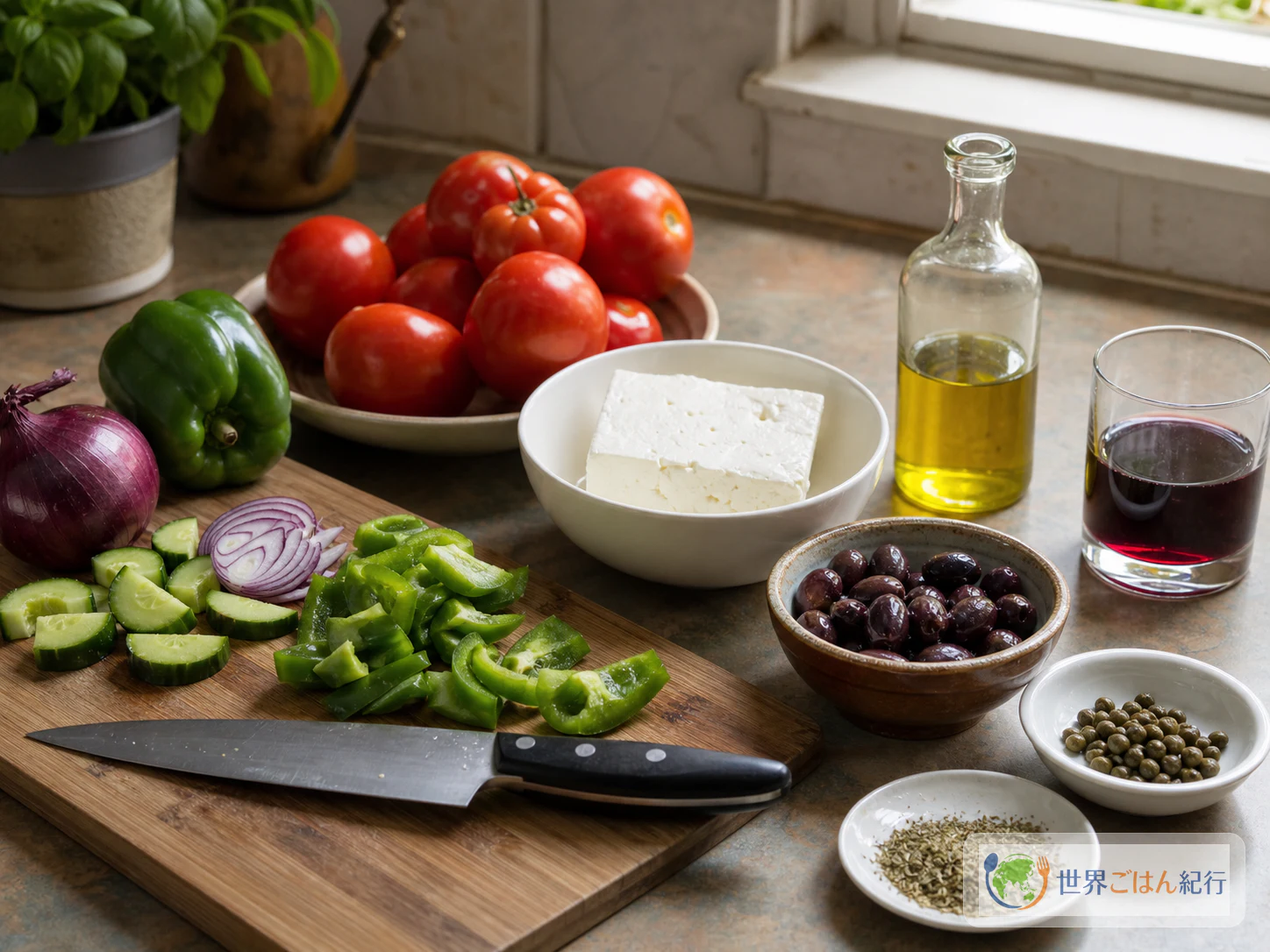
More ingredients won't make this salad better. Lettuce, a sweet dressing or finely crumbled cheese all pull it away from horiatiki. Tomato sweetness and feta saltiness collide in this dish, so decide the cuts and the order before you start.
| Element | Why it creates the local character | Practical solution |
|---|---|---|
| Ripe tomatoes | The juice at the bottom of the plate becomes the sauce | If they lack sweetness, mix in 4 oz (120 g) cherry tomatoes |
| Cucumber | Water and crunch take up the saltiness | If the skin is thick, peel it in stripes |
| Green pepper | Adds a green aroma and bitterness | If it's very bitter, reduce to 1/2 |
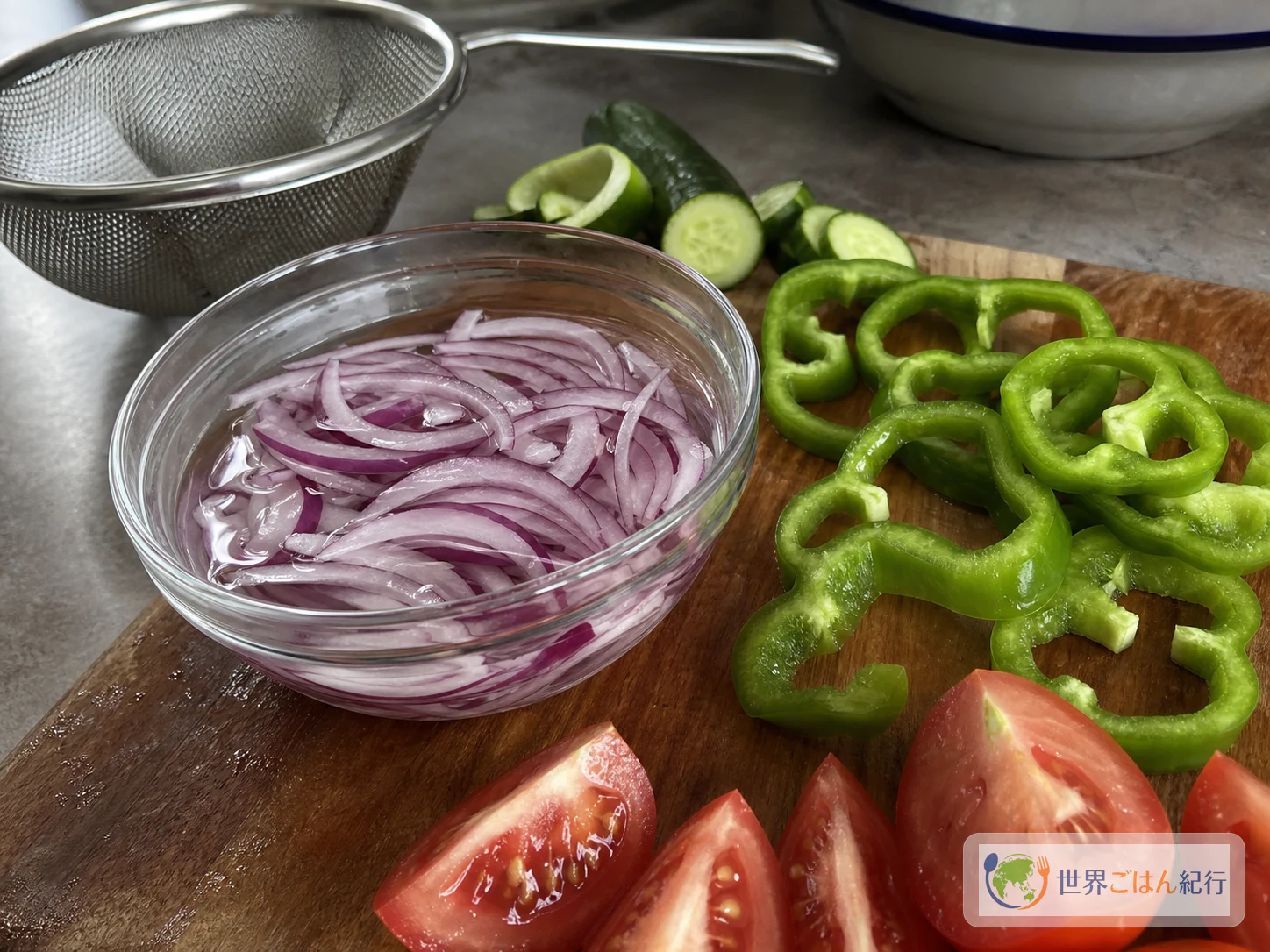
| Red onion | Gives sharpness and aroma | Soak in water for 3 minutes, keeping some of the bite |
| Feta | Saltiness, tang and the look of a white block are the core | Use substitutes only if you can't get it |
| Kalamata olives | Adds fruitiness and salt | Black olives can stand in. Warn people at the table if they have pits |
| Dried oregano | Sets the green aroma of Greek cooking | An old jar has weak aroma. Rub lightly between your fingers before using |
| Olive oil | Mixes with the tomato juice into a sauce to mop up with bread | Use it generously. Choose one whose aroma isn't too heavy |
| Capers | Add salt and tang close to the way it's eaten on the islands | Just 15 g. Too much makes everything salty |
Feta is the core of the dish, so track it down for your first batch. If it's very salty, rinse just the surface quickly and pat it dry with paper towels; the balance with the vegetables gets easier. If you really can't find it, 4 oz (120 g) cottage cheese mixed with 1 g salt, 1 tsp (5 ml) lemon juice and 2 tsp (10 ml) olive oil comes close in tang and white appearance, though it lacks feta's firm texture and the aroma of sheep's and goat's milk. Strained yogurt also gives tang, but it dissolves easily into the juice.
Black olives can replace Kalamata. Green olives bring a sharper sourness and saltiness that makes the whole salad pointed, so if you use them, cut back to about 8. Capers are optional, but a small amount adds an island touch.
Method: don't over-mix, and finish with the juices left in
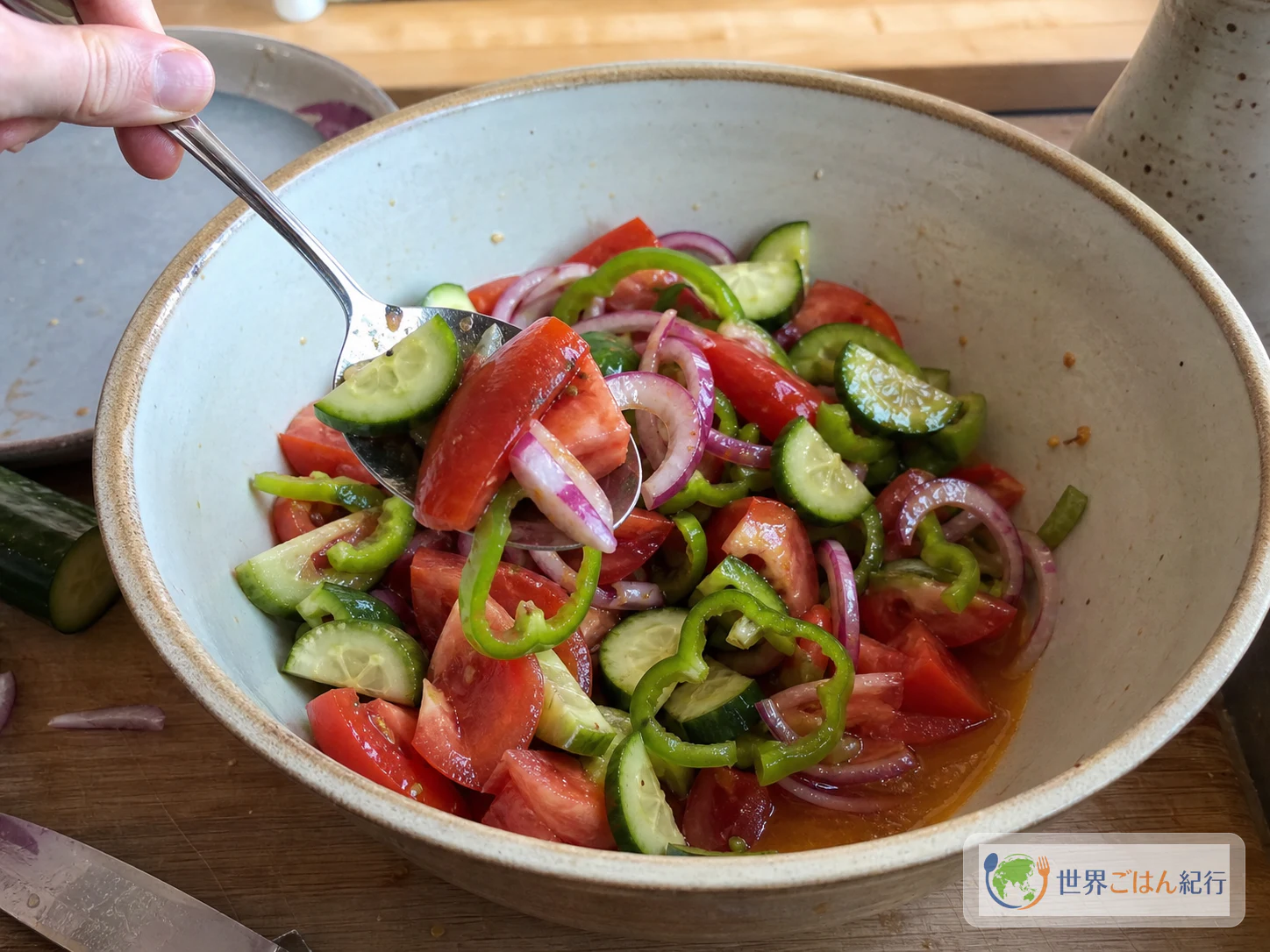
Greek salad is made by cutting cold ingredients big and stacking them. There is no cooking. Prioritize not crushing the vegetables, and not throwing away the tomato juice that collects at the bottom of the plate, over speed.
Fixing a watery or too-salty Greek salad
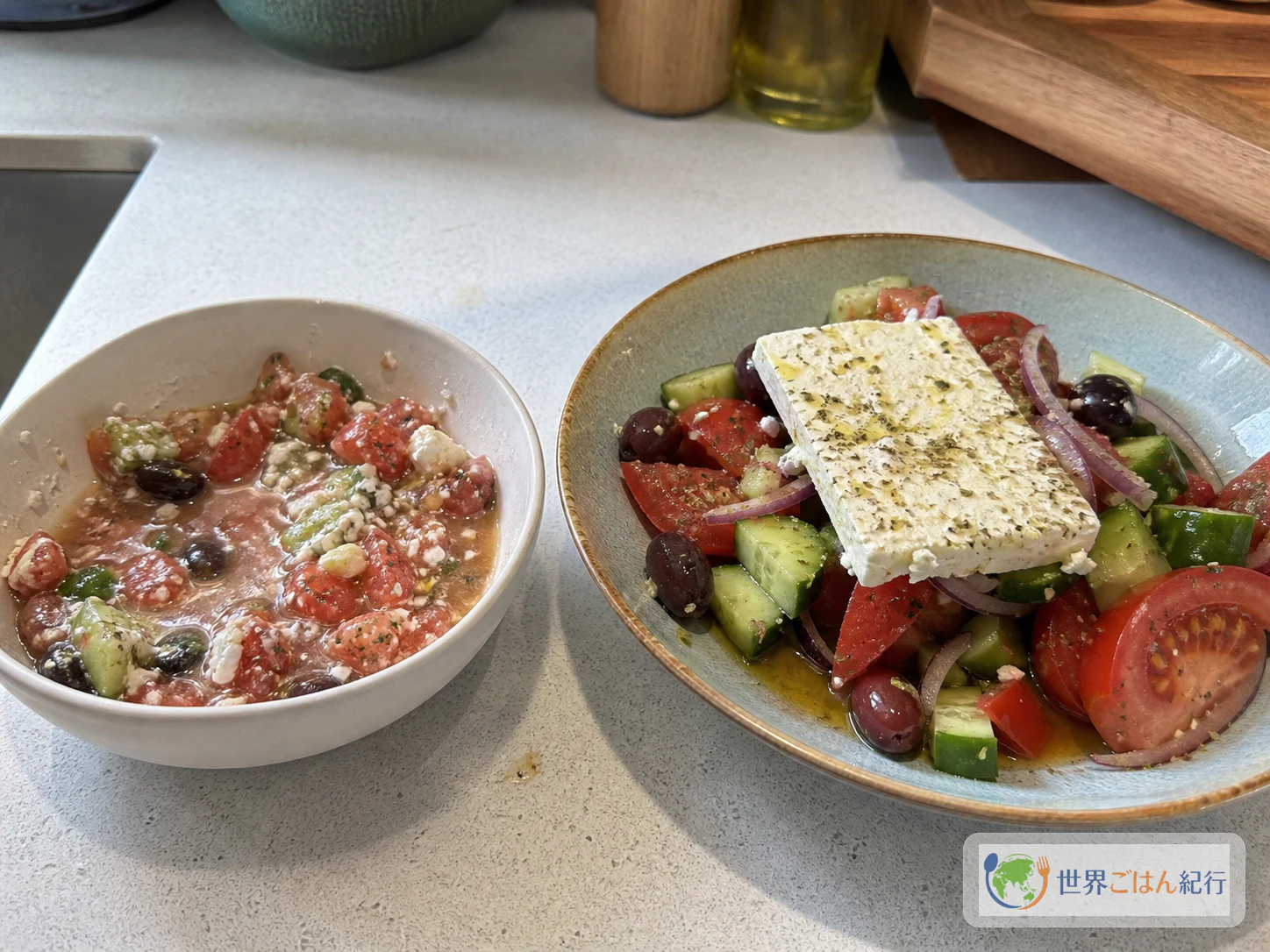
With so few ingredients, mistakes show right away, and most of them show up in the juice at the bottom of the plate. Red juice with a little oil floating on it is a sauce worth mopping up with bread, so don't pour it off; you'd be throwing away the tomato flavor. Clear, thin water means the salt went in too early or the vegetables were cut too small. Learn to tell the two apart and the rest gets much easier.
| Symptom | Cause | Fix |
|---|---|---|
| The bottom of the plate is thin, clear water | Salt went in too early, or the vegetables were cut small | Cut 3.5 oz (100 g) more tomato in big pieces and add it, plus 1 tbsp (15 ml) oil and 0.5 g oregano |
| Everything is too salty | The saltiness of feta, olives and capers stacked up | Add 1/2 cucumber and 1 tomato, and don't add salt |
| The feta scatters like white powder | It was crumbled fine and mixed in | Set the rest of the feta on top in large pieces and serve without mixing |
| It looks like just a pile of vegetables | Not enough olive oil and oregano | Add 1 tbsp oil and a pinch of oregano rubbed between your fingertips |
| The onion is too strong | Soaked too briefly or cut too thick | Take just the onion off the plate, soak in cold water for 2 minutes and return it |
| The tomatoes lack sweetness | Out-of-season tomatoes are watery | Halve 4 oz (120 g) cherry tomatoes and mix them in; don't add vinegar |
Serving Greek salad and building a Greek menu
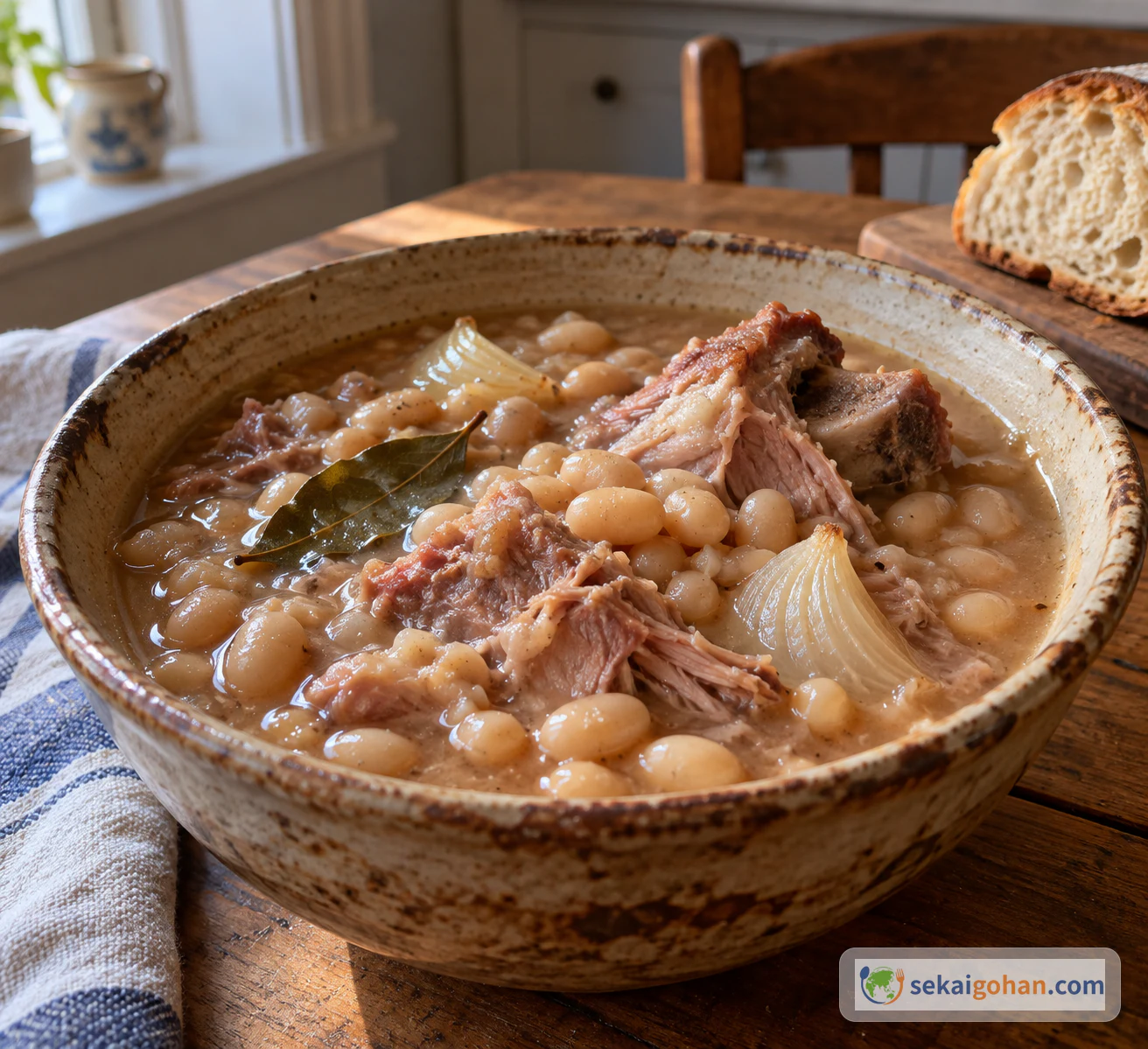
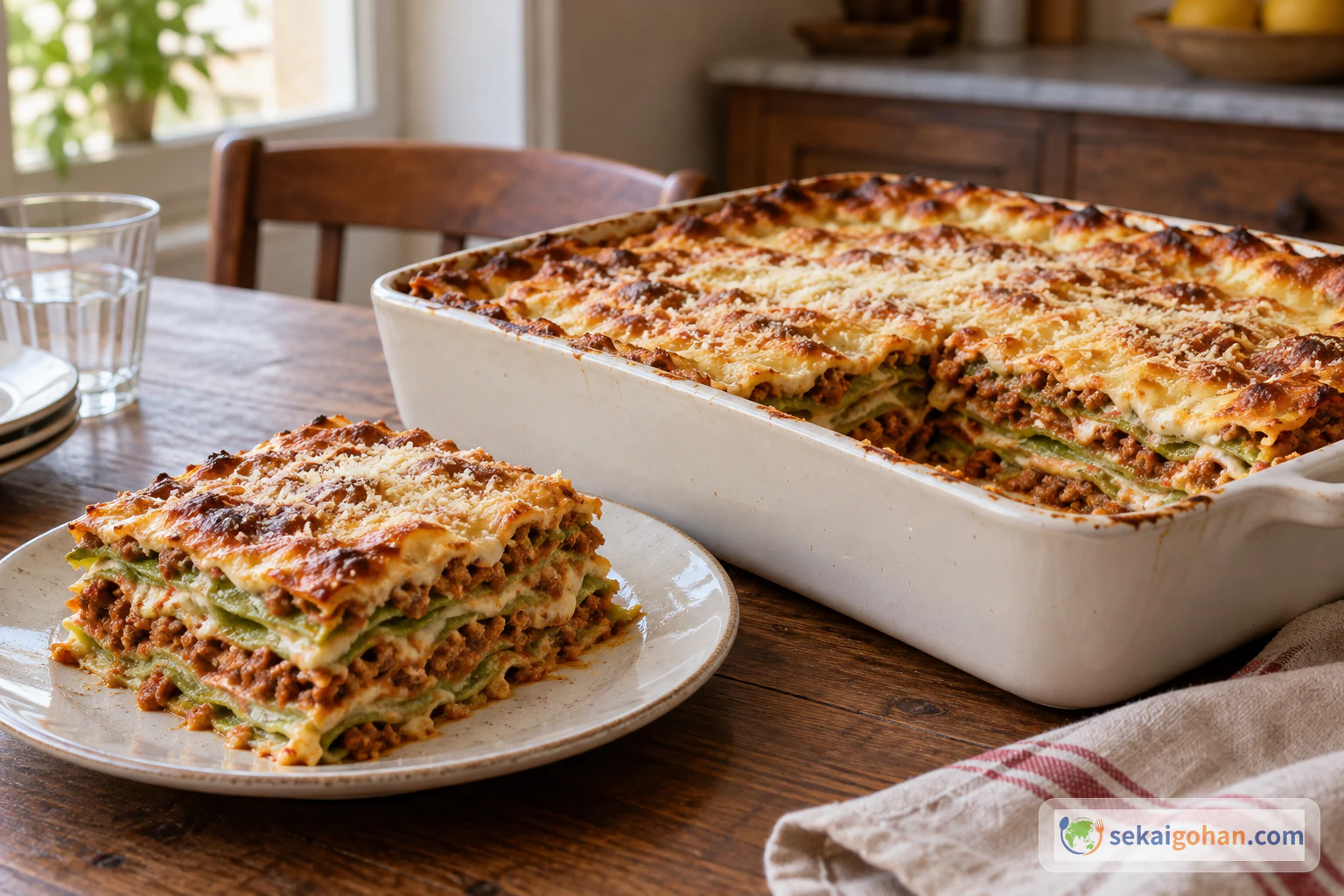
Greek salad sits most easily beside grilled meat or fish. Next to souvlaki, with its similar lemon and oregano aromas, you can even reuse the same ingredients. For a lighter table, pair it with a bean stew like fasolada, and if you're going all out, add a baked dish such as moussaka.
The salad also opens up a range of cold dishes. Dakos is a tomato-and-bread snack from Greece, and Spain's gazpacho shares the same pleasure of tomato juice and bread. For a white side bowl of yogurt and cucumber, try Bulgaria's snezhanka and compare how each dish deals with the water in the vegetables.
Storage and FAQ
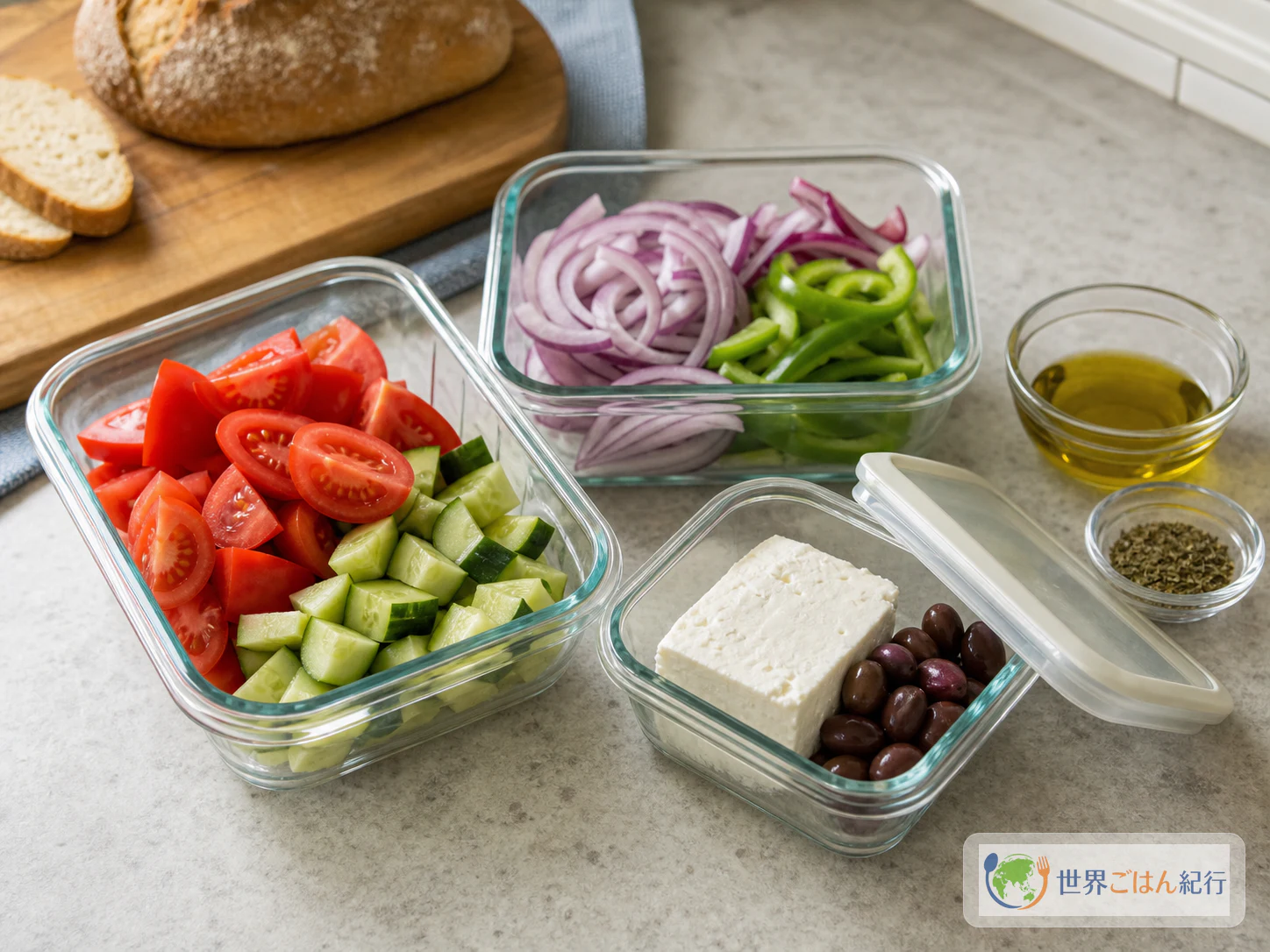
Can I make it ahead?
It tastes best eaten within 20 minutes of finishing. To prep ahead, refrigerate the cut tomatoes and cucumbers for up to 2 hours and the cut onion and pepper for up to half a day, and keep the feta and olives in separate containers for up to 1 day. Add the salt, oil and oregano just before eating.
Can I add lettuce?
You can, but it moves the dish away from horiatiki. Lettuce holds water and spreads the feta's saltiness thinly through the whole salad. If you add it, think of the dish as a "Greek-style salad" and reduce the oil a little to keep it from getting heavy.
What if the olives or capers are too salty?
Rinse the olives quickly in water and pat them dry with paper towels. Salt-packed capers need 20 seconds of rinsing; jarred ones only need draining. A long soak takes the aroma away too. On a day you use very salty feta, leave out the 1 g salt in the ingredient list and taste just before eating.
Is the bread necessary?
If the salad is a small side next to a main dish, it works without. Still, the juice at the bottom of the plate is half the pleasure, and a little baguette, country loaf or pita lets you finish the tomato juice, olive oil and oregano. If you're serving it with white rice, cut the oil to 3 tbsp (45 ml) so it doesn't get heavy.
Can I make it with canned tomatoes?
I don't recommend it. Canned tomatoes have an aroma suited to cooked dishes and lack the green aroma a raw horiatiki needs. If seasonal tomatoes are weak, mix 13.5 oz (380 g) fresh tomatoes with 4 oz (120 g) cherry tomatoes instead. Fresh tomatoes that release juice and seeds when cut give a brighter sauce at the bottom of the plate.