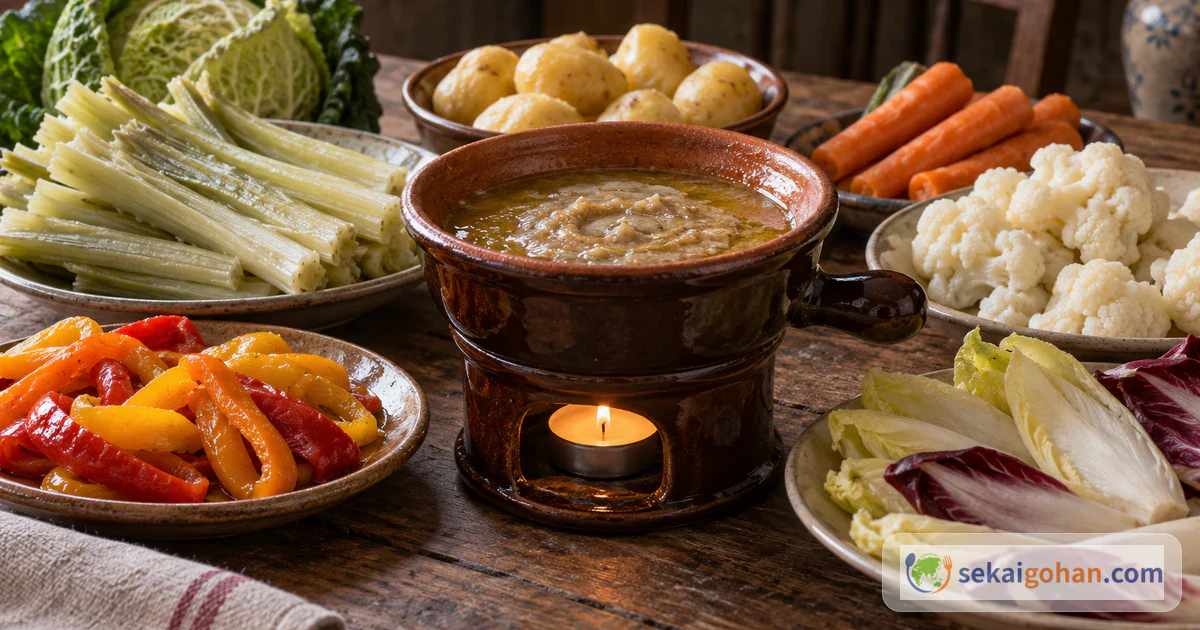
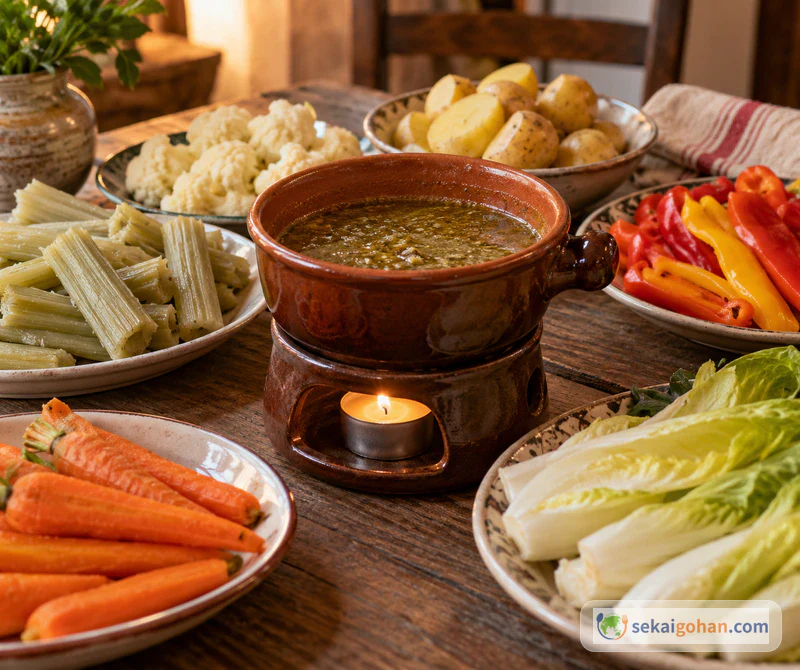
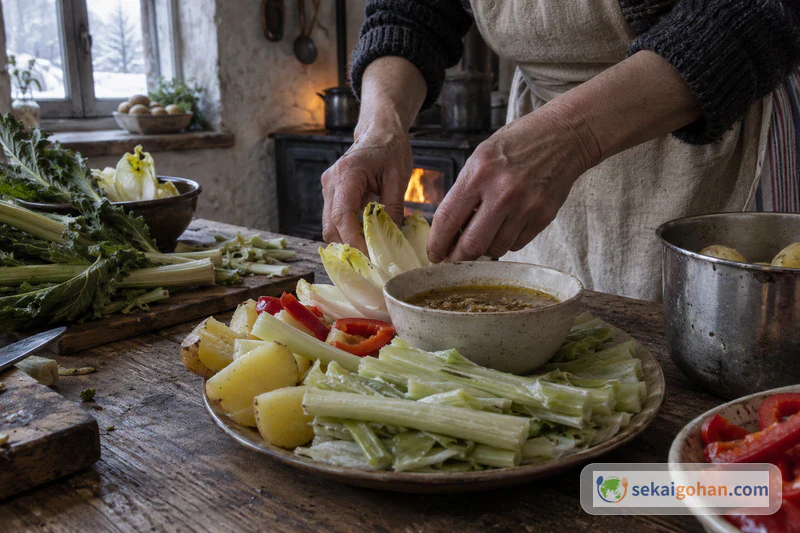
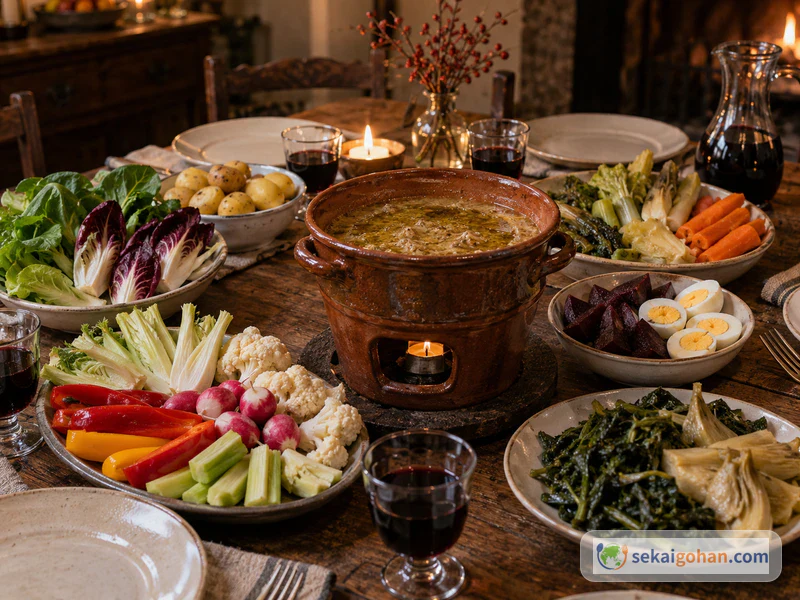
A low dish sits on a winter table in Piedmont, a pale brown sauce warming slowly over a small flame. Around it are red bell peppers, raw celery, boiled potatoes, and cardoon. Whoever reaches out takes a piece of vegetable and dips it into the sauce. Nothing gets poured over anything; you dip each piece of vegetable into the hot sauce. Bagna cauda is built on garlic, anchovy, and olive oil, sometimes with butter. It is salty and mellow, and the vegetables do as much of the work as the sauce.
Bagna cauda in Piedmont
The name, written in Italian as Bagna càuda or Bagna caoda, means "hot sauce" or "hot bath." It is an autumn and winter dish, eaten with a mix of raw and cooked vegetables. The sauce stays warm while everyone gathers around it and works through the vegetables bit by bit. At home, the two hard parts are balancing the saltiness of the anchovy and softening the garlic without coloring it. Let the sweetness of the vegetables meet the saltiness of the anchovy, and be generous with the vegetables.
Anchovies in a landlocked region
Piedmont has no coast, yet anchovy is a key ingredient. A trade route carried salt from Provence across the Alps, and anchovies traveled the same way. They were caught in the Gulf of Lion (Golfo del Leone) and packed in barrels with salt. Fish from the sea traveled the salt road to the mountain kitchen, and a dish pairing strongly salted fish with local vegetables and oil grew out of that.
Garlic was a crop that medieval statutes and rural proclamations required farmers to grow. Olive oil, by contrast, was not produced in large amounts in the region and also had to come from outside.
The "ancioè," mountain people of Val Maira, went from house to house selling anchovies in the cold season. Even a small amount could be bought at the door, which spread the fish to every household.
A dish for the end of the harvest
Bagna cauda has no single inventor. It is a country dish, made to celebrate bottling the new wine in late autumn, and some trace it to Provençal anchoïade. Whatever the origin, the picture is the same: 19th-century farmers gathered around a pot on long winter nights. A communal winter dish from the end of the harvest, it still lives on in home cooking today. Villanova d'Asti also makes a cold summer version, called "bagna fèrgia."
The vegetables and regional differences
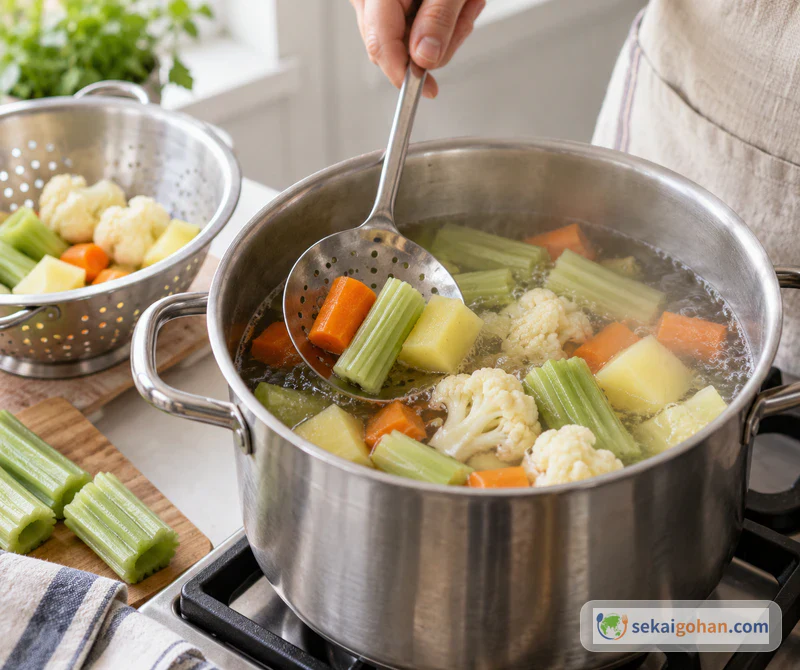
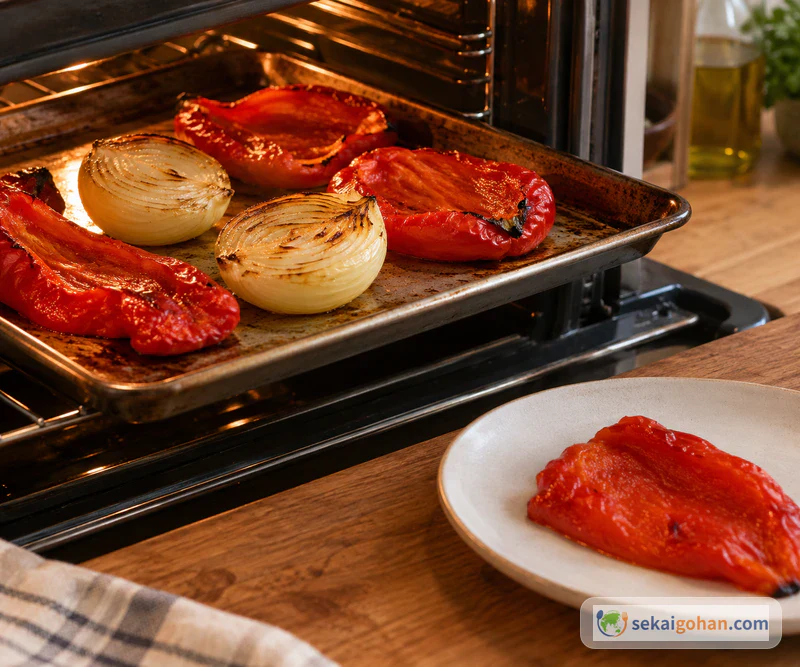
The traditional raw vegetables are cardoon, Jerusalem artichoke (topinambur), cabbage, endive or escarole, celery, carrot, and peppers. Cooked ones include potatoes, onions, beets, cauliflower, and roasted peppers. Names and growing areas differ from town to town, like the "cardi gobbi" of Nizza Monferrato and the cardoon of Chieri, so every table is a little different. Put raw crunch and the sweetness of cooked vegetables on one plate, and the same sauce tastes different with every bite. Really, it helps to think of it as a sauce for eating winter vegetables.
How it is eaten
In Piedmont, each person gets a terracotta fujot (fojòt) of sauce, kept warm by a flame underneath. A few manners apply: never dip a vegetable again after you have bitten it, do not scoop only the thick part from the bottom, and do not make bread the main dipper.
At home, you can keep it warm in a small pot without a dedicated fujot. Use a heavy small pot over low heat and move small amounts into a hot dish. Never set a candle or open flame under an ordinary dish, and even with a real fujot, check that it sits stably and never leave the flame unattended.
Ingredients (serves 4)
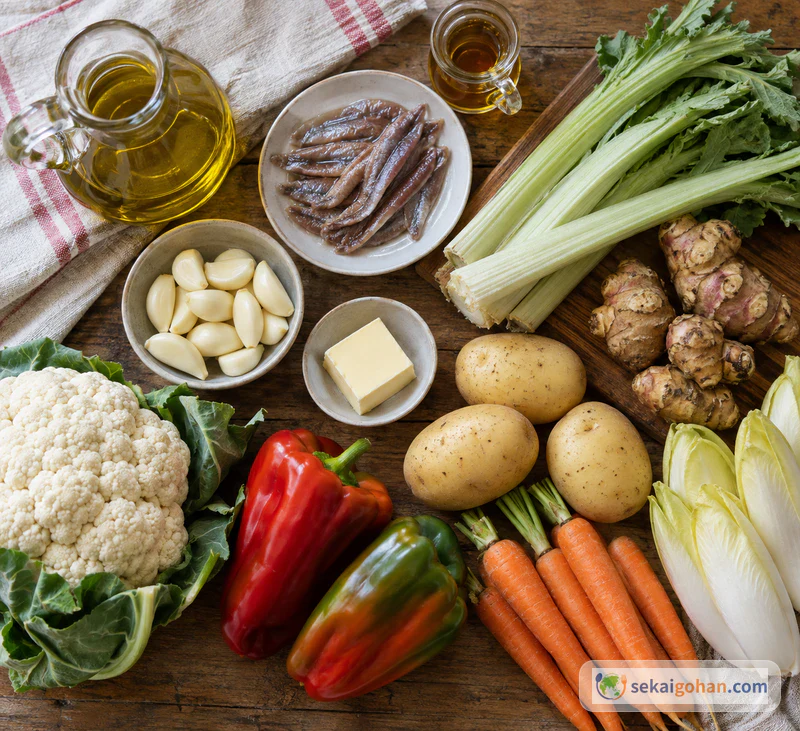
This recipe serves 4 and is scaled to fit a home pot: 6 cloves garlic, 5.5 oz (150 g) salt-cured anchovy, 1 cup (240 ml) olive oil, and 1 oz (30 g) butter. Walnut oil is optional. Prepare plenty of vegetables and finish the sauce at the table.
Anchovy contains fish and butter contains dairy, so do not serve it to anyone with those allergies. Wash vegetables to be eaten raw under running water. If you use the same cutting board for cooked vegetables, cut the raw ones first and wash the board between uses. A sauce of garlic mixed with oil is not a dish to bottle and keep at room temperature. Warm only what you will eat at the table, cool the rest quickly, and refrigerate.
Choosing anchovies, vegetables, and substitutes
Garlic, olive oil, potatoes, celery, bell pepper, and cabbage are easy to find, and they make up the base of the dish. The anchovy is what sets it apart, so start by looking for fillets. Salt-cured fillets are the easiest to break up and dissolve into the oil. With oil-packed fillets, add no salt and taste as you go.
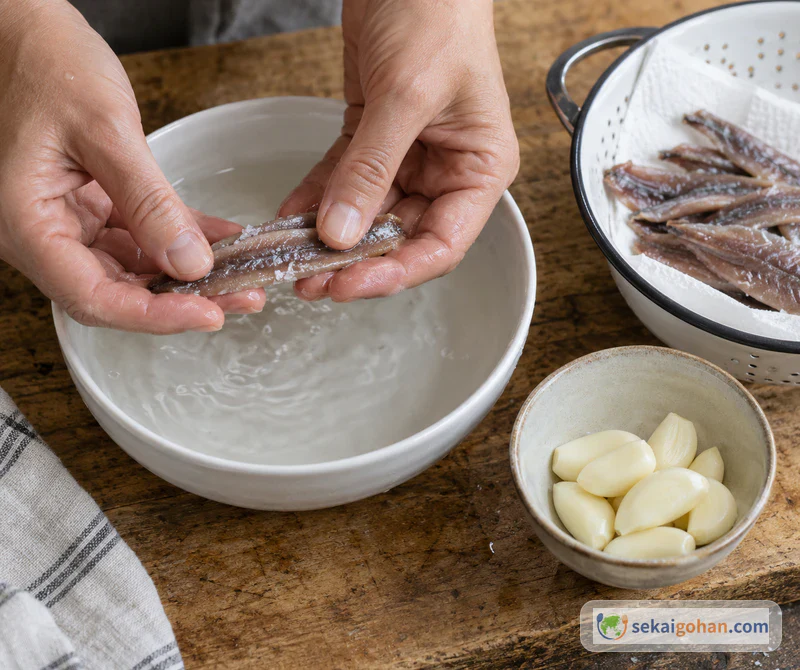
Check the label to see whether the anchovy is described as "fillet," "salt-cured," or "oil-packed." Rinse salt-cured fillets in water or red wine to remove surface salt before use.
A fujot warms one person's sauce, and at home a heavy small pot on a low tabletop burner does the same job. At the table, the goal is to keep the sauce warm, not to heat it; a candle will not bring the oil to a simmer. More than a dedicated vessel, what matters is keeping it warm without scorching.
Cardoon and Jerusalem artichoke are hard to find, and choosing substitutes by role works better than hunting for the same name. Cardoon brings bitterness and fiber, which celery and cabbage cores can stand in for. Jerusalem artichoke has the crumbly texture of a root vegetable, and lotus root or burdock give that texture and earthy scent in another form. Red beet is mainly there for color and earthy sweetness; red turnip makes both milder. Replace vegetables by texture, not by name. The anchovy, garlic, and oil are another matter: swap any of them and it becomes a different dish.
| Local ingredient | Candidate that is easy to get | What changes |
|---|---|---|
| Cardoon | Thick celery, cabbage cores | Bitterness and fibrous quality weaken. Do not overboil, to keep the bite |
| Jerusalem artichoke (topinambur) | Lotus root, burdock | Lotus root is crisp, burdock has a strong aroma, and neither has the sweetness of Jerusalem artichoke |
| Red beet | Cooked red turnip | Color is paler and the earthy sweetness is lighter |
| Endive, escarole | Chicory, outer lettuce leaves | The strength of bitterness changes. The sauce is strong, so choose tender leaves |
| Fujot | Heavy small pot, tabletop burner | Heat retention for one person drops, so move small amounts to keep the temperature |
How to make it
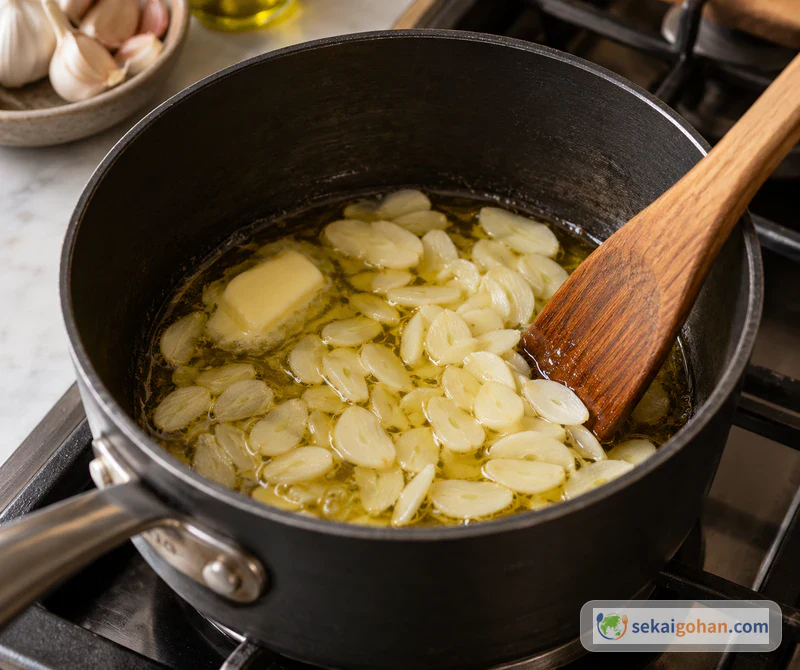
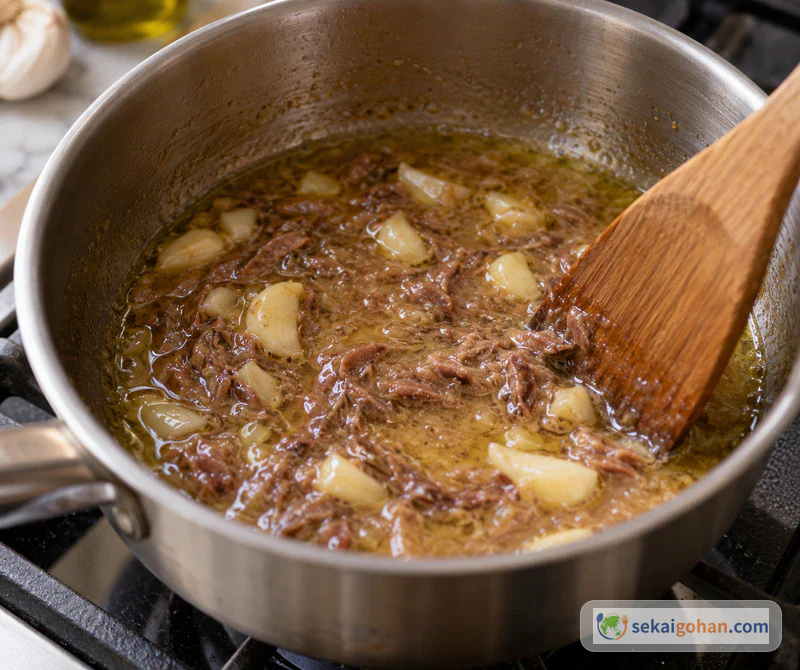
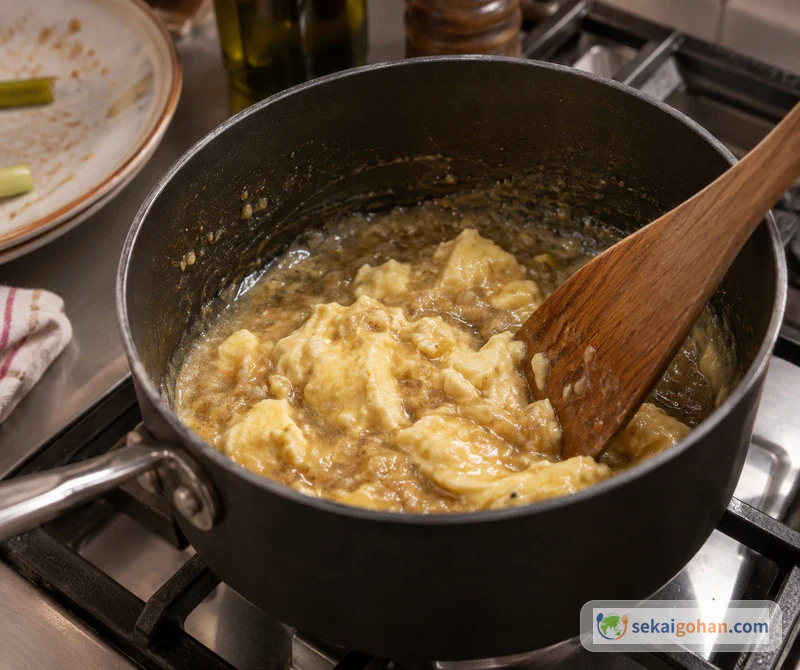
Bagna cauda is not an emulsified sauce. Garlic and fish melt slowly into oil over low heat. A good result is garlic that has not colored and is soft, anchovy with no pieces left, and a flowing brown sauce. Dissolve, do not fry. Watch the sound at the bottom of the pot and the color of the garlic, not only the heat. Mix raw and cooked vegetables to keep a difference in texture.
Fixing scorched, salty, or watery bagna cauda
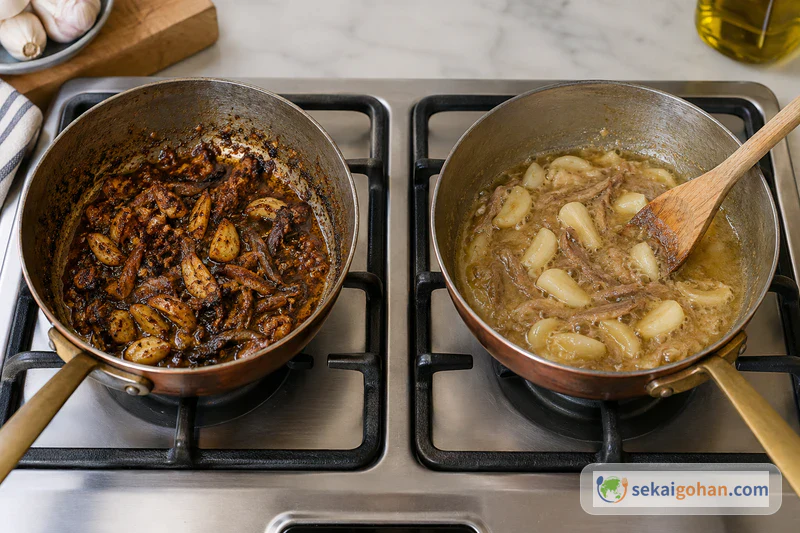
Scorched garlic is the one mistake you cannot undo. Once it turns brown, the bitterness stays, so take out the scorched parts, and if it is still bitter, make a new batch of garlic in a separate pot over low heat. Since scorching cannot be undone, lowering the heat is the best prevention. If pieces of anchovy remain, resist turning up the heat; crush them with a wooden spoon and keep going over low heat.
Separated oil is normal, since bagna cauda is a flowing sauce, so just stir gently before serving. If the flavor is too strong, add warmed olive oil a little at a time. If it is too salty, add no salt and serve more vegetables.
| Condition | What is happening | How to fix |
|---|---|---|
| Garlic is brown and bitter | Heat is too high and it fried in the oil | Remove the brown parts. If bitterness remains, make new garlic in a separate pot, and do not mix in the scorched sauce |
| Anchovy pieces remain | Heating was short, or the pieces were large | Do not raise the heat; crush with a wooden spoon and heat in 5-minute steps |
| Oil looks like it is floating | The sauce has cooled, or the ingredients have little moisture | Warm it over low heat before serving and stir slowly. Do not thin it with a lot of water |
| Too salty | Anchovy was not desalted enough, or salt was added | Add no salt; add a little unsalted vegetables and olive oil |
| Garlic is too sharp | Preparation was short, finished before it softened | If it is not scorched, soften it over very low heat. Next time use the milk soak |
| Vegetables release water | Boiled vegetables were stacked into the hot sauce | Drain the vegetables well and let them cool before putting them on the plate. Do not return water to the sauce |
| Cardoon is hard | Strings remained, or cooking time was short | Remove the strings again and boil more. Do not make people chew the fibers |
In the finished sauce, the garlic crushes under a wooden spoon, no pieces of anchovy can be seen, and it flows slowly when you tilt the spoon. A burnt smell, smoke, or boiling bubbles are not signs of completion. When you dip a vegetable, the sauce should cling thinly to the surface and still drip a little onto the plate.
Serving bagna cauda, leftovers, and variations
The crunch of raw celery, carrot, cabbage, and endive, then the sweetness of boiled potato, cardoon, and cauliflower: going back and forth, you end up comparing the seasons of vegetables with one sauce. Young red wine suits this table, especially young Barbera. Don't pile all the vegetables for 4 onto the plate at once; add only as much as the sauce can take without cooling down.
Leftover sauce can go into spaghetti, polenta, or a fully cooked egg. Wiping the pot with bread is not a traditional finish, so finish the leftovers with egg or polenta. For rice that soaks up a sauce, see risotto, and for another Italian dish built on raw vegetables, try Tuscan panzanella.
In Piedmont, the thick sauce left at the bottom of the pot is gathered up with egg, so nothing is wasted. At home, cook the egg until fully set and eat it on the spot.
The basic sauce is complete as it is, but a few variations change its character. Cream and walnut oil soften or deepen it, while pasta and polenta turn it into a different kind of meal.
| Variation | What changes | Taste and when to use |
|---|---|---|
| Add walnut oil | Replace 1 tbsp (15 ml) of the olive oil | Adds toastiness. A small amount is enough at first |
| Soak garlic in milk | Soak peeled garlic for 2 hours and dry it | Milder sharpness. Do not put the milk in the sauce |
| Add a little cream | Add 1 to 2 tbsp at the finish | Rounder flavor, but the outline of oil and anchovy also weakens |
| Make it bagna fèrgia | Cool the sauce and combine with raw vegetables | Nearly a separate dish, as the summer version of Villanova d'Asti |
| Use with pasta | Toss a little with boiled spaghetti and thin with pasta water | A plate for days when it is hard to serve vegetables. Taste before adding salt |
| Serve with polenta | Put fried polenta on a separate plate | Soaks up the sauce less than bread, and becomes the staple of the table |
| Finish with egg | Add egg at the end of the meal and set it completely | Does not waste the sauce at the bottom of the pot. Do not store it |
Frequently asked questions
Can I substitute anchovy paste?
You can, and it is convenient because it has no pieces. Saltiness and acidity differ greatly between products, though, so do not use it in the same amount as 5.5 oz (150 g) of fillets. Add it in teaspoon amounts, adding oil little by little, and adjust by tasting. For melting at low temperature, salt-cured or oil-packed fillets are still the closest match.
Can I make the garlic smell milder?
Soaking it in milk for 2 hours and wiping it dry reduces the sharpness. Using less garlic also works, but the sauce becomes lighter in body. Do not make up for that by adding more anchovy.
Can I serve all the vegetables raw?
You can. Mixing in cooked vegetables such as potato, cardoon, onion, beet, and cauliflower gives the table more range. Drain boiled vegetables well so their moisture does not get into the sauce, and slice hard vegetables thin or cook them before serving.
Can I eat leftover sauce the next day?
Warm only what you will eat, and move the rest into a shallow clean container. Refrigerate it within 2 hours of cooking. Do not store it at room temperature, either bottled or with garlic left submerged in oil. Reheat it thoroughly before eating, and do not eat it if the smell or appearance is off. Wash the ingredients well before use.
Is it wrong to serve bread?
Traditionally, bread is avoided as a dipper because it soaks up too much sauce; the vegetables are the center of the meal. A little bread on a separate plate is fine. Just don't use so much that it drinks up everyone's sauce.