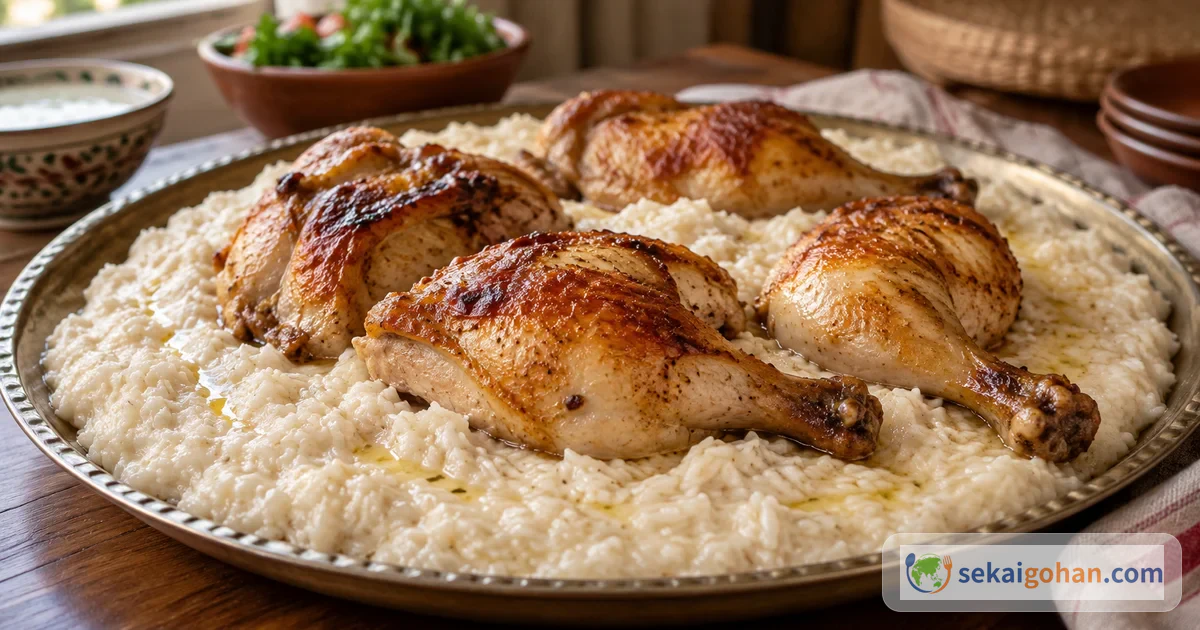
There's a moment when the wooden spoon starts to feel a little heavy at the bottom of the pot, and what you hear is the soft popping of wheat grains rather than the quiet bubble of rice porridge. Then come chicken broth, the sweetness of onion, the sourness of yogurt, and finally a turn of hot ghee. Suddenly the steam in the kitchen smells like home cooking on the Arabian Peninsula. Jareesh (جريش in Arabic) is coarsely cracked wheat simmered slowly in meat or chicken broth and finished with yogurt or laban and the aroma of ghee. It looks close to porridge, but the grains have more presence than rice porridge, and it is far more rustic than risotto.

Jareesh, Saudi Arabia's national dish
In 2023, Saudi Arabia named jareesh its national dish and maqshush its national dessert. Search for Saudi food and kabsa comes up first, but the national dish is not a platter of rice. It is a wheat pot dish that has been cooked in homes for much longer.
If you know Saudi cooking only through fragrant rice dishes like kabsa and Bahrain's machboos, jareesh shows you the other side of the table: wheat cooked until tender in a dry land, the sourness of dairy, and a warm, filling plate valued at celebrations and everyday meals alike. Kabsa is the dish of rice and meat; jareesh is the dish of wheat, milk, broth, and ghee.
Regional styles of jareesh
Jareesh has no single version. In homes in Najd, central Saudi Arabia, the pale version made with dairy is the best known. It softens wheat, which keeps well in a dry land, with meat broth and dairy. Laban or yogurt makes it rich while keeping it sour, ghee over the top rounds out the aroma, and the sweetness of the fried onion lingers at the end.
In the northwest and in some households, jareesh is made red with tomato or tomato paste, which brings sourness and color forward. You'll find how to make it under the variations below.
Among dishes of wheat and meat, Armenian harissa and the Gulf's harees are dishes in which long-cooked wheat is crushed hard toward smoothness. Jareesh leaves the grains of coarse wheat intact to some degree, and it is often made with the sourness of yogurt or laban added.
Making it outside the region comes down to three things rather than any rare spice: finding coarse wheat, choosing the right grain size, and adding the yogurt without splitting it. Get those right, and the Saudi national dish is closer to a home pot than you might expect.
Ingredients (serves 4): coarse wheat and dairy
The key ingredient is the wheat. You will almost never find it sold as 'wheat for jareesh' in ordinary stores. Look for these names: cracked wheat, crushed wheat, coarse bulgur, and broken wheat.

If you buy bulgur, choose coarse grind, number 3 or above, not fine. Too fine and it breaks down quickly; it becomes smooth but loses the grain feel typical of jareesh. Online it is easiest to find by searching "coarse bulgur," "broken wheat," or "cracked wheat coarse."
This recipe uses wheat, chicken, and dairy: ghee or butter, yogurt, and milk. If someone has a milk allergy, don't force a substitute. Make a different wheat dish instead. Read the label on store-bought fried onions, as they can be made in facilities that handle wheat, milk, and nuts.
What is worth sourcing
With jareesh, having coarse wheat and ghee changes the finish. Unsweetened yogurt from a regular store is enough, but the wheat grain and the finishing fat are worth checking when you shop. Beyond those, a heavy-bottomed pot that does not scorch easily in a long simmer helps.
How to make it: no lumps, no scorching, a slow simmer
Jareesh turns on you fast if you rush it. Once the wheat goes in, it scorches easily, and when yogurt goes in, it splits easily. Set the liquid and heat right at the start, then let it simmer slowly, watching the pot.
Jareesh troubleshooting: grittiness and split yogurt
Jareesh goes wrong in texture rather than flavor: a hard core left in the wheat, a scorched bottom, or split yogurt. Avoid those three, and even a family new to Saudi cooking can make it beautifully.

Hard grains
If the grains are still hard after 45 minutes, add hot water rather than raising the heat. Wheat absorbs liquid at a different rate than rice, and how much it needs depends on the product. If it's so stiff that the track of the wooden spoon stays visible at the bottom, add ½ cup (100 ml) of hot water, cover, and cook 10 minutes longer.
Lumps at the bottom
Right after the wheat goes in, it settles to the bottom easily. Leave it alone then and a layer forms on the bottom of the pot, and the lumps stay no matter how much you stir later. Stir constantly for the first 5 minutes, scraping the bottom; after that, once every 10 minutes is enough.
Split yogurt
When cold yogurt hits a hot pot all at once, the milk proteins set and turn grainy. Mix it with the milk in a bowl, stir in a little hot cooking liquid to warm it, then return it to the pot, and it goes in smoothly. Indian yogurt curries and Jordan's mansaf handle dairy the same way.
Bitter fried onion
Fried onion keeps coloring from residual heat after it leaves the pan, so if you take it to the ideal color in the pan, it will be bitter by the time you eat. Pull it at light brown and spread it on paper. Store-bought fried onions only need to be placed on top at the end; don't simmer them.
If it feels heavy at the end, thin it with 2–3 tbsp of hot water instead of milk. Too much milk brings the sweetness of milk forward. Add 1 tsp of lemon juice at the end to bring back the sourness of the yogurt and lighten the mouthfeel.
Serving, storing, and varying jareesh
What to serve with jareesh
Jareesh works as both staple and main on its own, but with dairy and ghee in the pot, something sour or juicy beside it lightens the table. Diced cucumber and tomato tossed with salt, lemon, and a little olive oil is enough. Sweet dates and bitter Arabic coffee also cleanse the palate after a rich wheat dish.

Serving it beside a rice dish like kabsa doubles up on starch, so don't make both on the same day. For a fuller Saudi table, add hummus and tabbouleh; light, vegetable-heavy tabbouleh makes a lighter starter than mujaddara and overlaps less with jareesh. Grilled bell pepper is another easy side.

Storing and reheating jareesh
Jareesh is smoothest fresh, but it can be made ahead. As it cools, the wheat absorbs liquid and turns much firmer, which can be a surprise the next day, so store it planning to loosen it when you reheat.

Once it has cooled, divide it into shallow containers and refrigerate for up to 2 days. Keep the fried onion separate; stored on top, it absorbs moisture and loses its toastiness.
To reheat, add 3–4 tbsp of hot water or milk per serving and warm it in a small pot over low heat. Milk makes it mellower, and hot water brings it back lighter. A microwave works too, but the center tends to stay firm, so stir once partway. If you want more yogurt, stir in only 1 tbsp after the heat is off.
You can freeze it, but the dairy turns the texture a little gritty. For the cleanest result, set portions aside before the yogurt goes in and add the yogurt and milk on the day you eat it. If you freeze the finished dish, eat it within 2 weeks and add extra milk when reheating.
Leftovers make a good breakfast: shape them into small balls the next morning and pan-fry them until crisp outside and soft inside, then top with a fried egg.
Jareesh variations
Make it with chicken and yogurt the first time, then adjust it to your kitchen. As long as you keep the coarse wheat and the slow simmer, it takes many variations well.

Lamb. Use 1 lb (500 g) of lamb shoulder instead of chicken and extend step 3 to 60 minutes, since 25 minutes isn't enough. Lamb is strongly flavored, so keep the yogurt at 10.5 oz (300 g) and add a little more white pepper. If you like mansaf, this one will feel familiar.
Red jareesh with tomato. After frying the onion in step 2, add 1 tbsp of tomato paste and 1 chopped tomato and fry 3 minutes. Reduce the yogurt to 5.5 oz (150 g) and increase the milk to 1¼ cups (300 ml) so the sourness comes together. It looks closer to a Middle Eastern stew, and children usually take to it.
Mushroom, vegetarian-leaning. Leave out the chicken and use 5.5 oz (150 g) of shimeji, 5.5 oz (150 g) of button mushrooms, and extra onion. Swap the water for 1.25 quarts (1.2 L) of vegetable broth and add 1 more tbsp of ghee. It's less traditional, but the aroma of wheat and the mellowness of dairy still come through.
If wheat and meat stews catch your interest, Armenian harissa shows the contrast well, and kabsa and the Gulf's machboos make good rice-side comparisons.
Frequently asked questions

Q1. Can I make it with bulgur?
Yes, but choose coarse, not fine. Bulgur has already been steamed and dried, so it cooks faster than traditional raw cracked wheat. After 35 minutes, check the grains every 10 minutes so it doesn't overcook into a paste.
Q2. Can I make it without yogurt?
You can, but you lose the sourness typical of jareesh. To avoid dairy, make the chicken broth and onion richer and add 1 tsp of lemon juice at the end.
Q3. What happens if I make it with milk only?
Milk alone gives a smooth result, but it lacks sourness and tends to feel heavy. Changing the ratio, for example to 7 oz (200 g) of yogurt and 1¼ cups (300 ml) of milk, keeps the mellowness of milk while softening the sourness a little.
Q4. Is chicken breast OK?
Yes, but it dries out over a long simmer. Simmer it only 15 minutes in step 3, take it out, then shred it and return it once the wheat is done. Since breast is lean, 1 more tbsp of ghee at the end makes it richer.
Sources
The Saudi-published and English-language food-culture information and recipes below were checked, and the quantities were rebuilt on the premise of coarse wheat, chicken, unsweetened yogurt, and a heavy home pot that are easy to obtain.
- Saudi Press Agency, "Culinary Arts Commission Announces Selection of Jareesh as the Saudi National Dish and Maqshush as the Saudi National Dessert": https://www.spa.gov.sa/w1838683 (checking the national dish selection; accessed May 2026)
- Saudipedia, "Jareesh": https://saudipedia.com/en/article/698/society/food-and-drinks/jareesh (checking the dish overview and regional context; accessed May 2026)
- The National, "Saudi Arabia declares jareesh and maqshush national dishes": https://www.thenationalnews.com/lifestyle/food/2023/01/12/saudi-arabia-declares-jareesh-and-maqshush-national-dishes/ (checking press coverage of the national dish selection; accessed May 2026)
The quantities and home heating of the recipe were also compared with the following sources.
- AFAR, "Saudi Arabia's National Dish Is More Than a Meal": https://www.afar.com/magazine/saudi-arabias-national-dish-is-more-than-a-meal (checking the food culture background; accessed May 2026)
- Nestle Family, "Saudi Jareesh": https://www.nestle-family.com/en/recipes/saudi-jareesh (comparing home quantities and cooking steps; accessed May 2026)