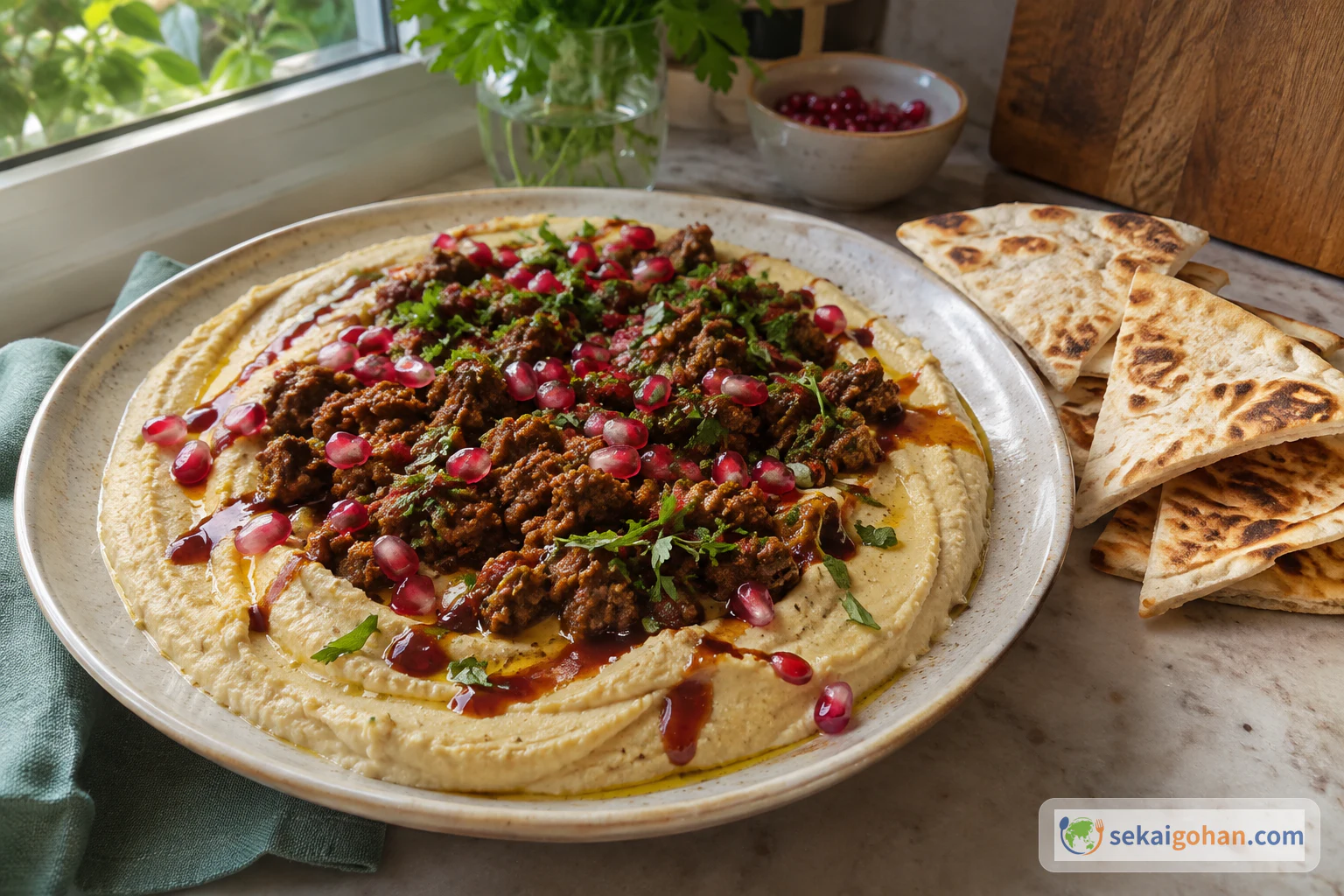
Cut into a chilled white roll with a fork, and thick white cream appears inside a chewy, stretchy dough as the scent of orange blossom or rose water rises. Halawet el jibn, written حلاوة الجبن in Arabic, is a Syrian cheese sweet. Fine semolina and a melting white cheese are worked together in a pot, rolled out thin while still warm, and wrapped around a thick cream called ashta. Cold syrup and chopped pistachios finish it.
Halawet el jibn in Syria and beyond
Halawet el jibn is most often described as a sweet of Hama and Homs in Syria, and you also find it in Lebanon, in Turkey and in diaspora pastry shops. It shares ingredients with knafeh, but knafeh is eaten piping hot, while halawet el jibn is a rolled sweet served cold. Another Syrian sweet, barazek, leans on the toasty flavor of sesame. Here the stars are the elasticity of the cheese and the scent of flower water.
The sweet has three parts: a cold, fragrant syrup, the ashta rolled inside, and the stretchy semolina-and-cheese dough. Swap any one of them for a Western-dessert habit and the result may look similar, but it eats quite differently.
The English spelling varies: Halawet el Jibn, Halawet el Jeben, Halawet el-Jibn and so on. The literal meaning is close to "sweetness of the cheese."
Ingredients (serves 6)

This recipe uses dairy, wheat and nuts. Semolina is derived from wheat. Even if you leave out the pistachios, cheese and dairy are the main ingredients, so if you have a dairy allergy, choose a different sweet.
Ingredients and tools worth thinking about
Milk, heavy cream, mozzarella and cream cheese are easy to find at an ordinary supermarket. What's worth looking for in specialty shops or online isn't the everyday dairy but the flower water, a way to judge temperature, and a tool for chopping pistachios evenly. On the first try in particular, judging the syrup and the cheese dough by feel alone makes over-reducing and under-kneading likely.
Orange blossom water also gets reused in knafeh and basbousa. Since you use it by the teaspoon, rather than hunting for a cheap large bottle, it wastes less to keep one bottle that is easy to use in food.
Stop the syrup at "slightly thickened." With a thermometer it is easier to stop before 217–221°F (103–105°C), and you can also feel the cheese dough suddenly come together once it passes 158°F (70°C).
Pistachios can be chopped with a knife, but large pieces roll off the surface and pieces that are too fine release oil. If you keep making Middle Eastern sweets, a small food processor that chops nuts to a uniform coarse size can also serve for barazek.
Choosing cheese, semolina and cream for halawet el jibn
Outside Syria, the hard part is that local cheeses such as akkawi and majdouli are difficult to find, and ashta has to be approximated. Easy-to-find mozzarella and cream cheese stand in for the cheese, and milk, heavy cream and cornstarch make an ashta-style cream. The result is a little less sweet than in a Syrian pastry shop, but the flower water and pistachios keep it recognizably Syrian.
| Part | The local backbone | A realistic home approach |
|---|---|---|
| Syrup | Sugar, water, lemon, rose water or orange blossom water | Cook lightly to about 217°F (103°C) and add the flower water off the heat |
| Ashta | Thick, high-butterfat cream, or a milk-set pastry cream | Set milk, heavy cream and cornstarch, and chill until firm enough to roll |
| Cheese dough | White cheeses such as akkawi or majdouli with fine semolina | Add cream cheese to low-moisture shredded mozzarella and develop elasticity over low heat |
| Aroma | Flower water, pistachios, cold syrup | Go easy on the fragrance; add a little syrup just before eating |
The type of mozzarella matters. Fresh mozzarella holds a lot of water and is hard to handle at home, so choose a low-moisture shredded or block type, and if you see water in the bag, blot it with paper towels before it goes in the pot. For a little saltiness, a bit of cream cheese does less damage to the aroma than sliced or processed cheese.
Semolina is the one ingredient not to substitute. Its grains give the cheese dough a frame, so it stays smooth and holds together even when rolled thin. Mascarpone alone can stand in for ashta, but without the cooked-milk aroma it loses some of its Middle Eastern character; if you have time, the ashta-style cream gets you closer to that lingering finish.
Method: roll while the dough is warm, then chill and cut
Halawet el jibn is not a sweet to eat with the heat of freshly made. You roll it out thin while it is warm, roll it up, then chill it to settle. If you make the syrup and cream first and cool them, you can move to rolling the moment the cheese dough is ready.
Halawet el jibn failures and fixes
What goes wrong most often is the dough, not the sweetness. Loose dough can't be rolled, and stiff dough tears. Syrup that is too thick sticks to your teeth, while syrup that is too thin just runs off, leaving only fragrance. On your first try, aim for a dough that rolls rather than perfect thinness.
| Problem | Main cause | Fix |
|---|---|---|
| The dough is sticky and can't be rolled | Semolina not cooked enough, cheese too wet | Return to low heat and knead 1 minute. If still loose, add 1 tsp fine semolina |
| The dough cracks | Too cool, uneven thickness, semolina too coarse | Roll while warm and press torn areas back together with your fingers. Use fine semolina next time |
| The cheese turns oily and separates | High heat, nearly scorched on the bottom | Take off the heat and stir for 10 seconds, then return to low heat. Don't boil |
| The cream runs | Ashta-style cream under-cooked or under-chilled | Cook until a streak remains on the bottom and chill at least 30 minutes |
| The syrup turns back into sugar | Too little lemon, over-stirring, over-reducing | Add the lemon juice and don't stir hard once it boils. Stop around 217°F (103°C) |
| The aroma is too strong | Flower water added while hot, too much | Add after cooling off the heat, and stick to teaspoon amounts the first time |
Serving and storing halawet el jibn
Halawet el jibn is easiest to enjoy about 5–10 minutes out of the refrigerator. Too cold and the cheese dough tightens; too long at room temperature and the cream softens. Strong black tea, unsweetened coffee or Arabic coffee with cardamom go well with it, and about 2 pieces per person after a meal keeps the sweetness from getting heavy.
| State | Storage | When eating |
|---|---|---|
| Same day | Refrigerate the rolls before finishing | Cut just before eating and add syrup and pistachios |
| Next day | Airtight container in the refrigerator | The surface dries, so add the syrup just before eating |
| Day 2 | Eat soon, refrigerated | Serve before the aroma of the cream fades |
| Freezing | Not recommended | Thawing makes the cream watery and weakens the dough's elasticity |
It fits nicely after salty, tangy Levantine dishes. Serve hummus, falafel and tabbouleh, then finish with a small serving of cold halawet el jibn, and the dairy sweetness rounds off the meal cleanly. If you'd like to compare Middle Eastern sweets, make the hot cheese sweet knafeh and the syrup-soaked semolina cake basbousa on separate days, and the differences become clear.
Frequently asked questions
Can I make it with mozzarella alone?
Yes. Low-moisture mozzarella alone gives you stretch, but the flavor tends to be one-note, which is why cream cheese is added for dairy richness and a light tang. I don't recommend fresh mozzarella the first time: even at the stated amounts, its water tends to make the dough loose.
Can I use mascarpone instead of ashta?
Yes. If you're in a hurry, mix 9 oz (250 g) mascarpone with 2 tbsp heavy cream, 1/2 tsp orange blossom water and 2 tsp sugar, and it will roll. It leans more toward a Western dessert than the ashta-style cream does. Choose mascarpone if a clean cut surface for guests matters most; choose the cream made in a pot if you want the local dairy aroma.
Is it fine without rose water?
Yes. With orange blossom water alone it still comes together as halawet el jibn, and a lot of both flower waters makes the aroma too strong. On the first try, let orange blossom water lead and keep rose water to 1 tsp or less.
What do I use if I can't find semolina?
Skip cake flour and bread flour; they change the dough's elasticity and slightly grainy mouthfeel, leaving only the stretch of the cheese. Look for "fine semolina" or "durum semolina." If you can only find coarse, crush it lightly in a food processor first, and the dough will tear less.
Can I make it the day before?
Yes. Roll it up, then seal and refrigerate, and do the slicing, syrup and pistachios just before eating. Syrup added the day before loosens the surface and makes the cream look watery. For guests, make the rolls and syrup separately the day before, so on the day you only cut and finish.