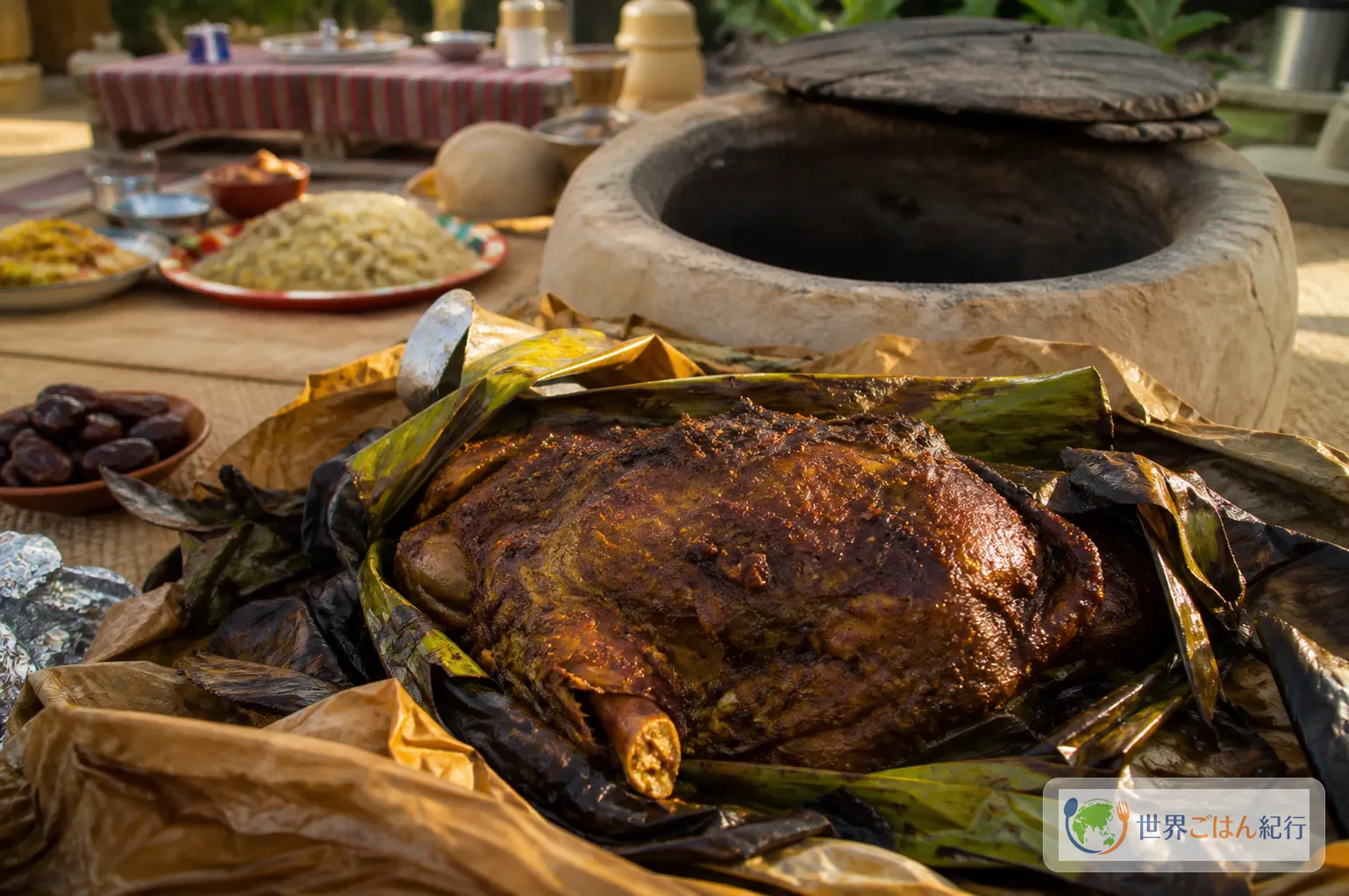
Lift the lid and the steam carries more than spiced rice: the sweetness of cardamom and cinnamon, basmati that has soaked up chicken fat, and at the very end the faintest trace of charcoal smoke. It never pushes as hard as a curry, yet the kitchen suddenly feels far away. This is mandi, written مندي in Arabic, Yemen's meat and rice, especially associated with the Hadramaut region. The rice stays pale and quiet, and it wins you over with the savor of the meat and the lingering smoke.

Mandi and the Hadramaut pit oven

Mandi is closely tied to Hadramaut in southeastern Yemen and to the food culture of the southern Arabian Peninsula. The traditional method uses a vertical pit oven, sometimes called a mifa, similar to a tandoor. Charcoal goes in the bottom, the meat hangs above, and the rice sits beneath it, catching the fat and spices that drip down while the sealed heat steam-roasts the meat until it falls apart.
Mandi's name is often traced to the Arabic for "moist" or "dewy." Think of mandi not as dry grilled meat, but as a dish in which the meat steam-roasts in a sealed oven while the rice catches its juices.
Making mandi without a pit oven
At home, the method comes down to three things: brown the chicken well, cook the rice gently in the chicken broth, and add a short burst of charcoal smoke at the end. The point is to keep the meat and rice working together. The browning and juices go into the broth, the rice cooks in that broth, and the smoke comes last as a memory of the oven. Keep that order and you get real mandi rather than a plain spiced pilaf.
The tricky part is the charcoal. Its aroma is central to mandi, but pushing it indoors is dangerous, so this recipe uses a heavy pot plus a broiler or oven and limits the charcoal to a short smoke in a well-ventilated kitchen. There's a no-charcoal option too, so get the rice and chicken right first.
How mandi differs from kabsa and machboos
Among Gulf-style rice dishes, Saudi kabsa leans on tomato and spices cooked into the rice, and Bahraini machboos puts loomi and rose water up front. They often get lumped together as "Middle Eastern rice dishes," but taste them side by side and they play different roles.
| Dish | Main region | Flavor core | The hard part at home |
|---|---|---|---|
| Mandi | Yemen, around Hadramaut | Meat juices, light spices, charcoal smoke | Adding the charcoal aroma briefly and safely |
| Kabsa | Saudi Arabia | Tomato, loomi, spices cooked into the rice | Not adding too much liquid to the rice |
| Machboos | Bahrain and other Gulf states | Loomi, bezar, rose water | Cooking the rice light without muddying the aromas |
| Biryani | South Asia | Layered cooking, saffron, rich masala | Managing the rice and the filling separately |
Mandi doesn't lean on a fermented dairy sauce like Jordanian mansaf, and it doesn't put charcoal fire front and center like Iraqi masgouf. It's a platter you enjoy for distinct grains of rice and a lingering aroma.
Ingredients (serves 4): mandi from your own pantry

For your first mandi, the essentials are basmati rice, bone-in chicken, cardamom, cinnamon, cumin and a heavy pot to cook the rice in. The charcoal is only for the final aroma, so on days you're unsure about ventilation or handling fire, feel free to skip it. If you skip the charcoal, adding just 1/2 tsp smoked paprika brings the feel closer.
In mandi, it's the separate grains of rice that keep the chicken fat and charcoal aroma from feeling heavy. You can use Japanese-style short-grain rice, but it turns sticky and becomes more of a mandi-style mixed rice. Starting with basmati gives you fewer failures.
Charcoal or no charcoal: how to decide
A common question is whether mandi without charcoal is a different dish. Decide by your kitchen setup.
| Kitchen conditions | Recommended finish | How to build the aroma |
|---|---|---|
| Gas burner, range hood and heatproof small dish, and you're comfortable handling fire | Use a small piece of natural charcoal for just 5 minutes | Set a heatproof small dish in the cooked pot, drip 1/2 tsp oil onto the glowing charcoal and cover immediately |
| You can use an oven or broiler | Skip the charcoal and brown the chicken more deeply | Finish the chicken skin-side up at high heat and mix 1/2 tsp smoked paprika into the rice |
| Induction only, weak ventilation, or kids or pets nearby | Don't use charcoal | Brown the chicken deep golden in a skillet and sharpen the aroma with zahawiq and lemon |
Even with charcoal, smoking longer doesn't make it more authentic. Mandi's smoke should be just noticeable on the first bite. Keeping the rice from turning heavy matters more than adding smoke.
How much loomi and saffron do you need?
Two things that cause hesitation at the store are dried lime (loomi) and saffron. Both show up often in Middle Eastern rice dishes, so it's tempting to think more means more authentic, but for mandi it helps to separate their roles.
Loomi adds tartness and a gentle bitterness. It tends to be central in Saudi kabsa and Bahraini machboos, but in mandi, too much lets the loomi crowd out the charcoal aroma. If you use it, pierce just half a lime, add it to the cooking liquid and remove it before cooking the rice. Skip it the first time and compare on your second try.
Saffron lightly adds aroma and color. It's expensive, so there's no need to use a lot. Soak a pinch in 2 tbsp lukewarm water and drizzle it over before cooking the rice; that's enough. Turmeric can replace the color, but more turmeric brings an earthy taste, so stop between 1/4 and 1/2 tsp.
What's worth buying
With rice dishes, getting the rice, aroma and temperature right pays off more than adding ingredients. Basmati rice, loomi and other Middle Eastern spices, and an instant-read thermometer carry over not just to mandi but also to kabsa and machboos. Look for them at Middle Eastern, South Asian or halal grocery stores, or online.
Choosing ingredients for mandi
Spices, rice and home substitutes
Mandi tastes better when you go easy on the spices. It uses a Yemeni blend called hawaij, but the star isn't the quantity of powder; it's how cleanly the aroma comes through. Cumin, coriander, cardamom, black pepper, turmeric and cinnamon dissolve into the oil, layer with the chicken fat, and then the final smoke comes in.
The traditional setup (an underground oven, hanging meat, charcoal at the bottom) is a building project, not home cooking. The mechanism behind the flavor, though, translates to a home pot.
| Traditional element | What to preserve at home | What you can swap |
|---|---|---|
| Meat steam-roasted above the rice | Brown the chicken first and return the cooking liquid to the rice | Use a heavy pot, oven or broiler instead of a pit oven |
| Charcoal or wood aroma | A short smoke at the end, or deeper browning | If you're uneasy indoors, skip the charcoal and use a little smoked paprika |
| Light long-grain rice | Don't oversoak the basmati, and let it steam over low heat | Jasmine rice is fine. Treat Japanese-style short-grain rice as a different dish |
| Restrained spicing | Build on cumin, coriander, cardamom and cinnamon | Without store-bought hawaij, combine single spices |
| A small dish of tangy red sauce | Serve zahawiq on the side | Reduce the green chili to tame the heat for family meals |
Chicken or lamb
In Yemen and in Gulf restaurants, you often see mandi made with lamb shoulder, shank or young goat. Bone-in chicken thighs are the easiest at home, but for a special meal, lamb makes the fat dripping onto the rice far more aromatic.
| Main ingredient | Best for | What to adjust |
|---|---|---|
| Bone-in chicken thighs | First try, weekend dinner, meals with kids | The base quantities in this recipe. 15 min simmering and 15 min rice cooking cook it through easily |
| Boneless chicken thighs | Days you can't find bone-in | Cut the simmer to 10 min, and just keep it warm on top of the rice while it cooks |
| Lamb shoulder roast | Guests, when you want a true platter feel | Cut 1.5 lb (700 g) into 2 inches (5 cm) cubes and simmer over medium-low heat for 50–60 min before cooking the rice |
| Lamb chops | When you want to show off the browning | Sear both sides in a skillet over medium heat for 3 min each, and cook the rice separately in chicken broth |
With lamb, a longer simmer matters more than extra spice. Cook shoulder too briefly and the aroma comes on strong while the meat stays tough. Simmer until the fibers come apart when pressed with chopsticks, then move on to the rice, and you get the unity of fat and rice you find in Jordanian mansaf or Afghan kabuli palaw.
Method: steam in the pot, then add a short smoke
Mandi looks like a lot of work, but there are only two moments that really need the heat: browning the chicken and making the broth, and cooking the rice over low heat and letting it steam. The charcoal is just a finishing touch, so don't force a long smoke.
Choosing your cooking tools
The base method here is done entirely in a heavy pot. If you have an oven or broiler, using it to deepen the browning of the chicken makes the dish more satisfying even without charcoal.
| Tool | Best use | Watch out for |
|---|---|---|
| Heavy pot | The base method: brown the chicken and cook the rice in the same pot | A thin-bottomed pot scorches rice easily. Once on low heat, don't move it |
| Oven | Roast the chicken at 220°C (425°F) for 8–10 min to crisp the skin | Roast only the chicken after the rice is done. Don't dry out the rice |
| Broiler | Brown the skin hard on no-charcoal days | Medium-high to high for 3–5 min. Stop as soon as it starts to burn |
| Rice cooker | Cook just the rice reliably | Brown the chicken and make the broth in a separate pot, then transfer to the cooker. Skip the charcoal step |
Make it with just the heavy pot the first time, and add the oven or broiler on your second try for the fewest failures. Rather than thinking more tools bring you closer to the original, think of them as more options for browning the chicken.
Burning charcoal indoors produces carbon monoxide. Turn the range hood to high, open a window, and take the charcoal out after a short time. If your kitchen can't be ventilated well, it's fine to skip the charcoal-smoke step.
Common mandi mistakes and fixes

The most common failure is too much liquid for the rice. Basmati looks like it absorbs less water than short-grain rice, but too much water makes the grains break all at once, and they turn short and heavy. The liquid should come 0.25 inch (5 mm) to 0.5 inches (1 cm) above the rice; since that looks different in every pot, measuring 2½ cups (600 ml) gives consistent results.
The second is overdoing the charcoal. Mandi isn't meant to be a smoked dish, and a faint scent when you lift the lid is enough. Leaving the charcoal in too long, dripping too much oil and working without ventilation are the three things to avoid.
The third is only simmering the chicken. It cooks through that way, but the toasty skin and fat never reach the rice and the flavor falls flat. The brown fond left from the initial browning is where the broth gets its savoriness, so aim for pale golden. If it burns black it turns bitter; wipe away some of the burnt bits before adding the water.
Fixing bland, heavy or too-smoky mandi
If it tastes bland, make the zahawiq a little stronger and adjust on the plate rather than adding a lot of salt at once. Mixing salt straight into the rice breaks the grains and ruins the texture.
Heavy rice usually means it was stirred too much after cooking. Uncover to let the steam escape, slide the paddle in vertically and turn the rice over from the bottom just once. Next time, stop the soak at 30 minutes.
If it's too smoky, don't mix it through; move only the strongly scented top layer to a separate plate. Extra lemon and zahawiq, plus a cold side of yogurt or cucumber, soften the bitterness. At home, charcoal aroma comes together better when you stop it short than when you add more.
If the rice seems too wet right after cooking, uncover and cook over low heat for 2 minutes to drive off the water at the bottom of the pot. Then turn off the heat, place a paper towel between the pot and the lid, and let it steam for 5 minutes. Stirring too much breaks the grains, so turn it over from the bottom in big folds only once, at the very end.
Serving, storing and varying mandi
Zahawiq, the red sauce on the side

The thing to set beside mandi is zahawiq, also called sahawiq, a tomato and chili sauce spooned on just before eating. After the chicken fat and charcoal, the tartness of tomato and the green bite of chili make the next mouthful of rice feel light again.
Coarsely chop 2 tomatoes, 1/2 green chili, 1 clove garlic, 1 tbsp lemon juice, 1/4 tsp cumin and 1/3 tsp salt with a knife, or pulse in a blender for just 2–3 seconds. A complete purée turns watery, so stop while a little tomato texture remains. You can use a whole green chili for more heat, but half is plenty the first time so the sauce doesn't bury mandi's aroma.
Serving mandi at the table
Spread on a large platter, mandi is the centerpiece on its own. Taking hot rice and bone-in chicken straight from the platter can crush the rice, though, so split the chicken at the joint into 2 pieces first and scoop the rice gently from the edge to keep the long grains light.
Serve zahawiq in small bowls rather than pouring it over the platter, where the tartness and heat would erase the charcoal and chicken fat. With kids or people who don't like spicy food, make one bowl with just tomato and lemon and another with green chili. That keeps the rice and chicken intact for everyone, and only the adults add the heat.
A cucumber and tomato salad, plain yogurt and thin flatbread round out the meal. Nothing but rice gets heavy, so put something tart, something cold and some herbs in small separate dishes. As with Lebanese mujaddara and Palestinian musakhan, the small dishes alongside the platter set the rhythm of the meal.
Storing and reheating mandi

Once you're done eating, divide the rice and chicken into shallow containers, cool them quickly and refrigerate. Left on a platter, the center never cools and rice that has soaked up chicken fat turns limp and heavy. Spread the rice about 1 inch (2 cm) thick and keep the chicken, still on the bone, in a separate container.
Mandi keeps in the refrigerator for about 2 days. Reheat in a 600 W microwave for 2 minutes per serving, or in a skillet with 1–2 tbsp water over low heat for 4 minutes. Make sure the chicken is steaming all the way through and hot right up to the bone: the safe target for chicken is 165°F (about 74°C) on a thermometer, and this recipe uses 75°C or higher as an easy-to-remember figure.
For a next-day dish, shred the chicken and warm it with the rice in a skillet over medium heat for 3 minutes. Once the rice starts to warm, sprinkle in 2 tbsp water, cover and steam over low heat for 2 minutes to revive rice that has firmed up in the fridge. Spoon the zahawiq on afterward; cooked in, it makes everything watery.
To freeze, wrap the rice flat and use it within 2 weeks to keep its aroma. Take the chicken off the bone, shred it into bite-size pieces and wrap it separately. When reheating, warm the rice first and put the chicken on top at the end, so you don't have to stir the rice over and over.
This recipe uses chicken and almonds (a tree nut). Check store-bought spice labels: some are made in facilities that also handle wheat, dairy, sesame or nuts. Cook chicken to an internal temperature of 75°C (167°F) or higher, or until the juices near the bone run clear.
Mandi variations
Mandi adapts well to your tools and the people at the table, as long as you cook the long-grain rice light, carry the meat's browning into the broth and serve zahawiq on the side.
| Variation | Ingredient or tool to change | Result |
|---|---|---|
| Rice cooker version | Transfer 2½ cups (600 ml) chicken cooking liquid and the rice to a rice cooker | Steady heat, but skip the charcoal step |
| Milder | Leave the green chili out of the zahawiq and add a bit more black pepper | Easy for kids to eat, and works as a tangy side sauce |
| Next-day reheat | Warm leftover rice and shredded chicken in a skillet | Great for packed lunches |
For the rice cooker version, do the initial browning in a pot or skillet. Raw chicken and rice tipped straight into the cooker miss both the toasty browning and the chicken fat melting into the broth. Once the browning and broth are done, though, a rice cooker is a reliable way to steam long-grain rice.
Frequently asked questions
Q1. Is it still mandi without charcoal?
Charcoal aroma is a big part of mandi, but at home, safety comes first. Without charcoal, brown the chicken hard under the broiler or in a toaster oven and mix 1/2 tsp smoked paprika into the rice for a similar feel. Get the browned chicken and light rice right before worrying about the smoke itself.
Q2. How do I change the liquid for Japanese-style short-grain rice?
For 2 Japanese rice cups of short-grain rice (one Japanese rice cup is 180 ml by volume), rinse and use right away without soaking, and keep the liquid between level with the surface of the rice and 5 mm above it. Cook over low heat for 12 minutes and steam for 10 minutes. It will turn sticky, so think of it as mandi-style mixed rice rather than mandi as made in Yemen.
Q3. Can I use chicken breast?
Yes, but thighs suit mandi better. With breast, cut 600 g into large bite-size pieces, brown for 2 minutes per side and shorten the simmer to 8 minutes. Confirm an internal temperature of 75°C (167°F) or higher, and during rice cooking just set it on top of the rice to warm in the steam so it doesn't dry out.
Q4. What if I can't find hawaij?
Cumin, coriander, turmeric, black pepper, cardamom and cinnamon come together well enough for a home version. Cloves are strong, so limit them to 3, and if substituting curry powder wholesale, use no more than 1 tsp. Too much pushes it toward curry rather than a Yemeni rice dish.
Q5. What else goes with mandi on a Middle Eastern menu?
Mandi covers both the starch and the main course. To build a Middle Eastern menu, try Lebanese hummus as a starter and kabsa as a rice dish on another day; they share many of the same ingredients.
To explore the Yemeni table further, set this platter against saltah, which is finished with a layer of hilba, whipped fenugreek. You can reuse the spices while comparing a smoky platter with a piping-hot stew.
Q6. How much can I prepare the day before?
Rinse and soak the rice on the day so the grains don't break. The day before, you can mix the spices, rub the chicken with salt and spices and refrigerate it, and wash the zahawiq ingredients. Take the marinated chicken out of the refrigerator 30 minutes before cooking to take off some of the chill.
Q7. Is it more authentic with loomi?
Loomi gives a Middle Eastern rice-dish aroma, but it isn't essential in mandi. Half a lime leaves a lingering tartness, while one or more pushes the flavor toward kabsa or machboos. Make it without loomi first, then try half a lime the second time and decide which you prefer.
Sources
The English-language sources below were used to check mandi's cooking structure, the ingredients of hawaij and safe temperatures for chicken. The quantities were reworked for bone-in chicken thighs, basmati rice and a heavy home pot.
- Mandi (food) - Wikipedia (context on the pit oven, meat and rice, and zahawiq; accessed May 2026)
- Yemeni cuisine - Wikipedia (spices and table culture across Yemeni cuisine; accessed May 2026)
- Hawaij - Wikipedia (the basic spices in hawaij and their uses; accessed May 2026)
- Goat Mandi with aromatic basmati rice - Maha's Kitchen Secrets (a home adaptation that cooks meat above the rice so the juices drip into it; accessed May 2026)
- Chicken Mandi Recipe (Oven-Baked) - Hinz Cooking (comparison of cooking chicken and rice in a home oven; accessed May 2026)
- Chicken Mandi - Hungry Paprikas (comparison of a home charcoal-smoke step and plating; accessed May 2026)
- Cook to a Safe Minimum Internal Temperature - FoodSafety.gov (safe internal temperature for chicken; accessed May 2026)
- Chicken and Food Poisoning - CDC (safe handling, reheating and storage of chicken; accessed May 2026)
- Safe Food Handling: What You Need to Know - FDA (PDF) (home food safety: cleaning, preventing cross-contamination, cooking and chilling; checked October 22, 2026)