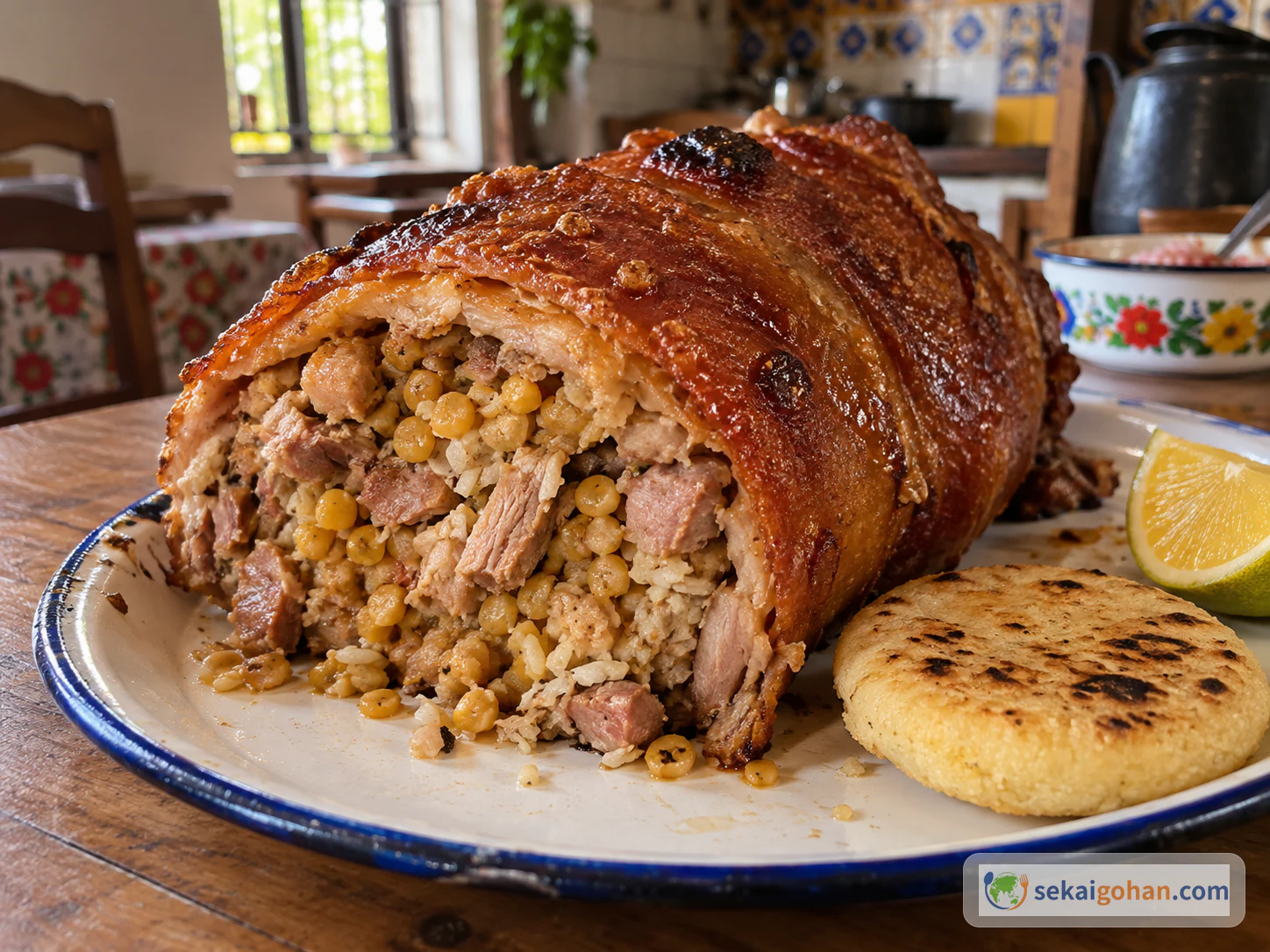
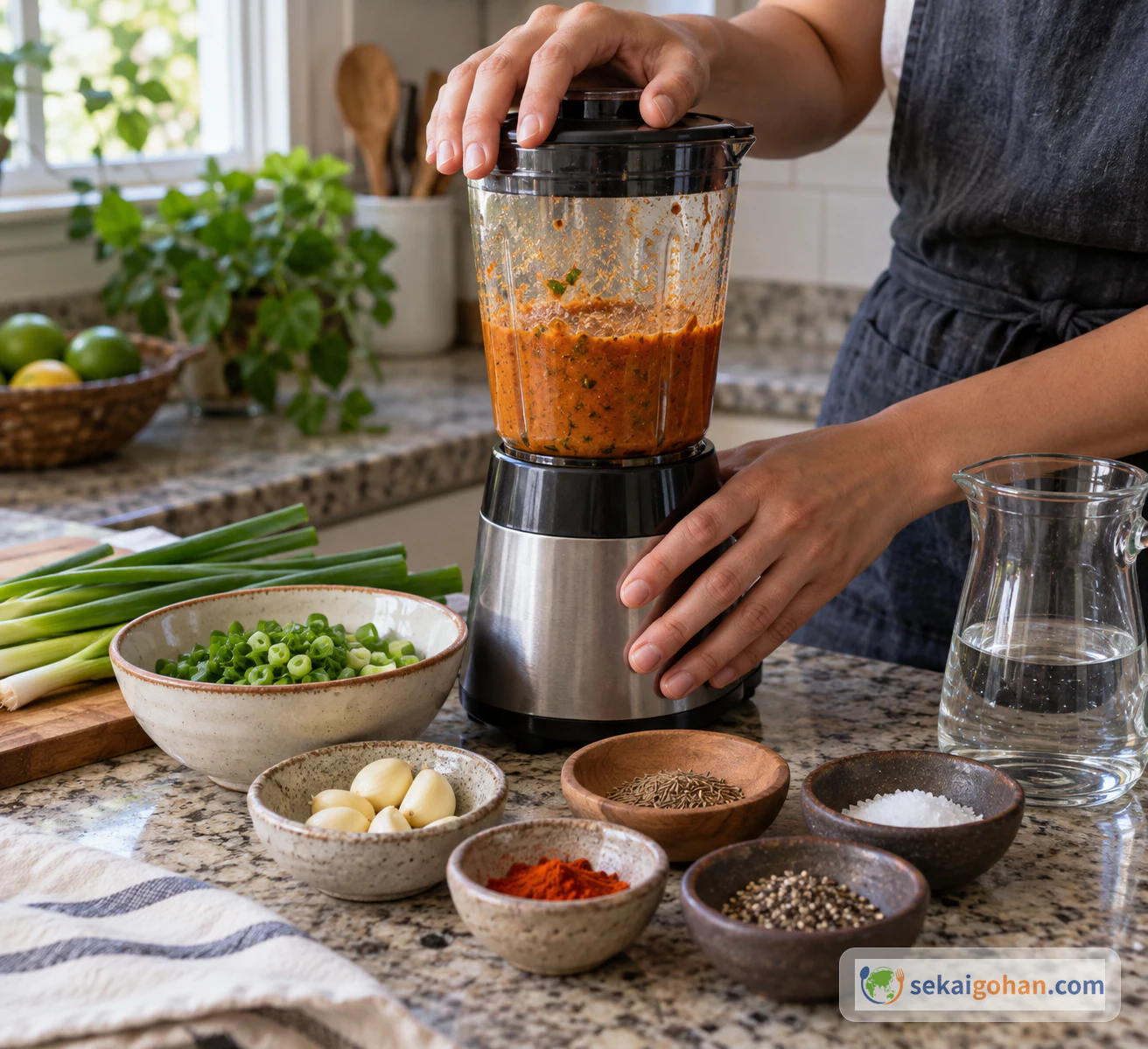
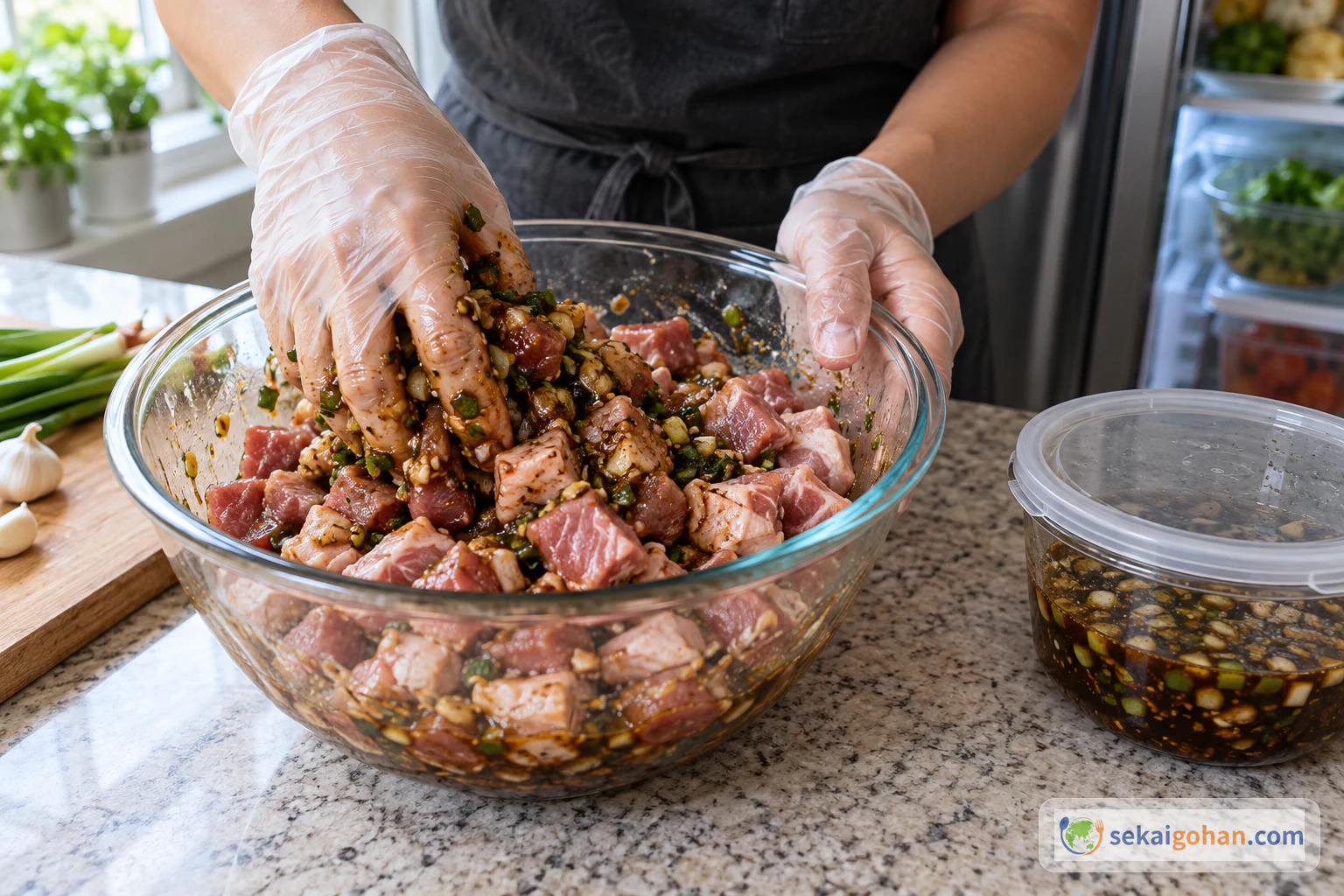
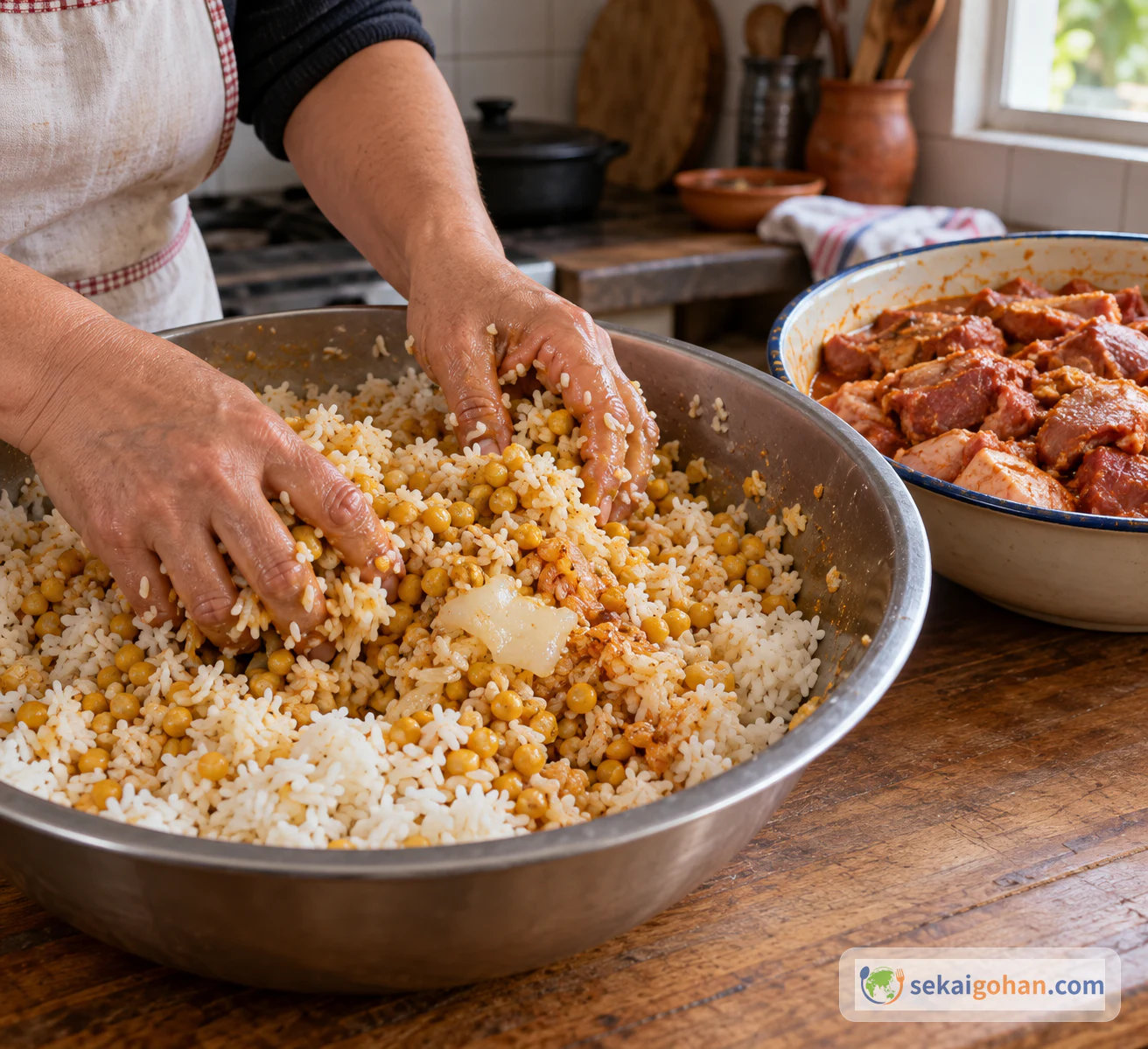
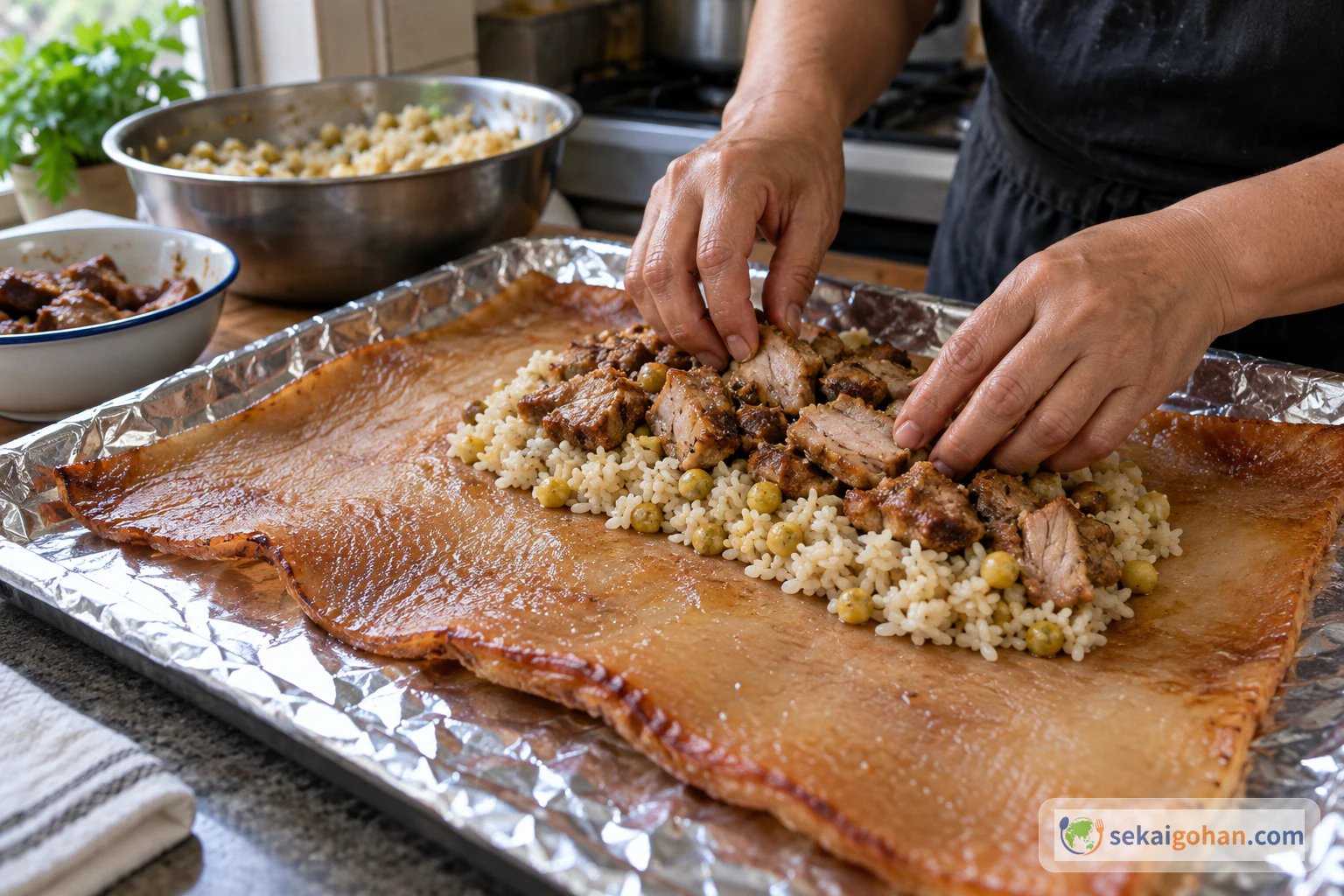
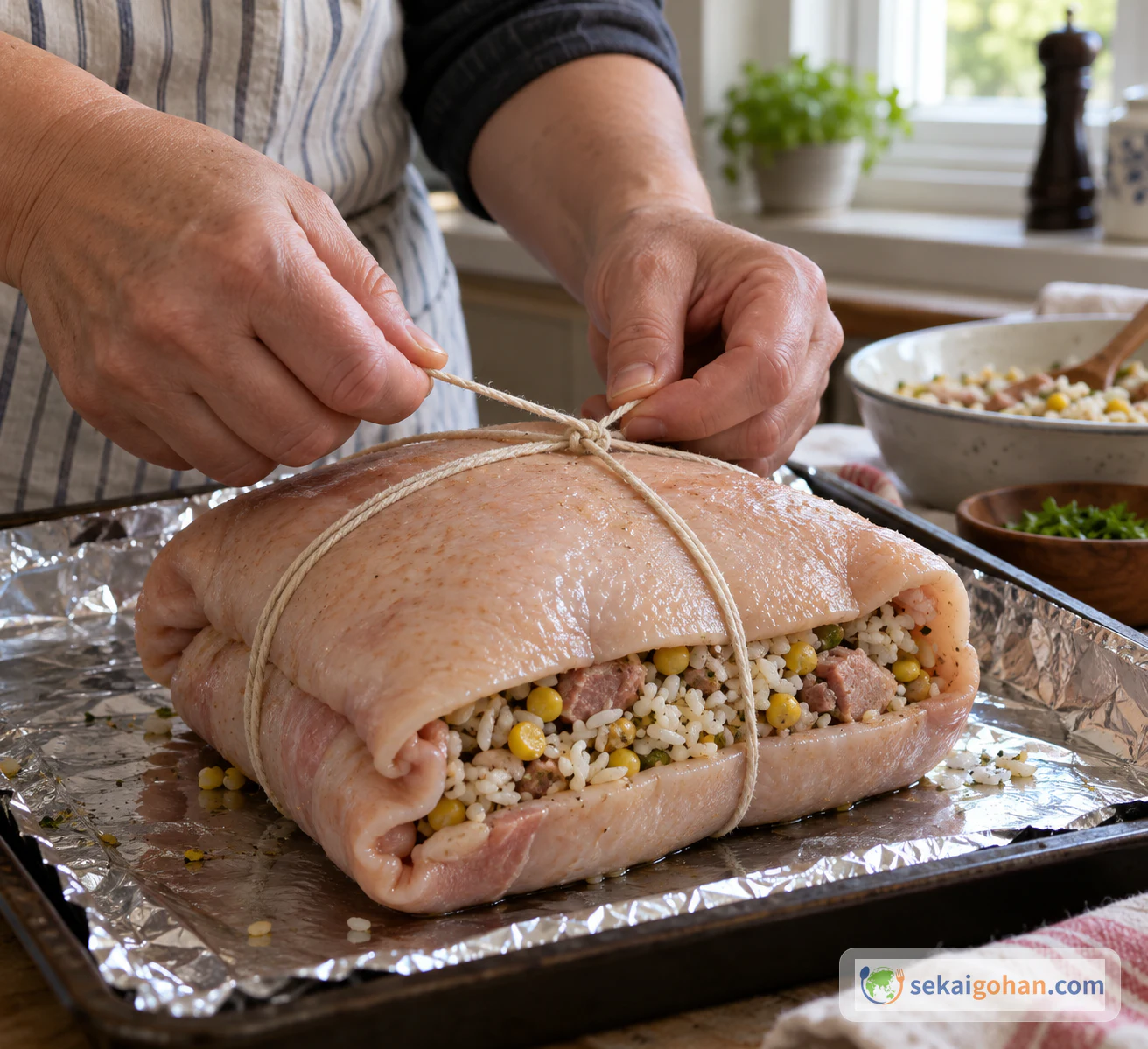
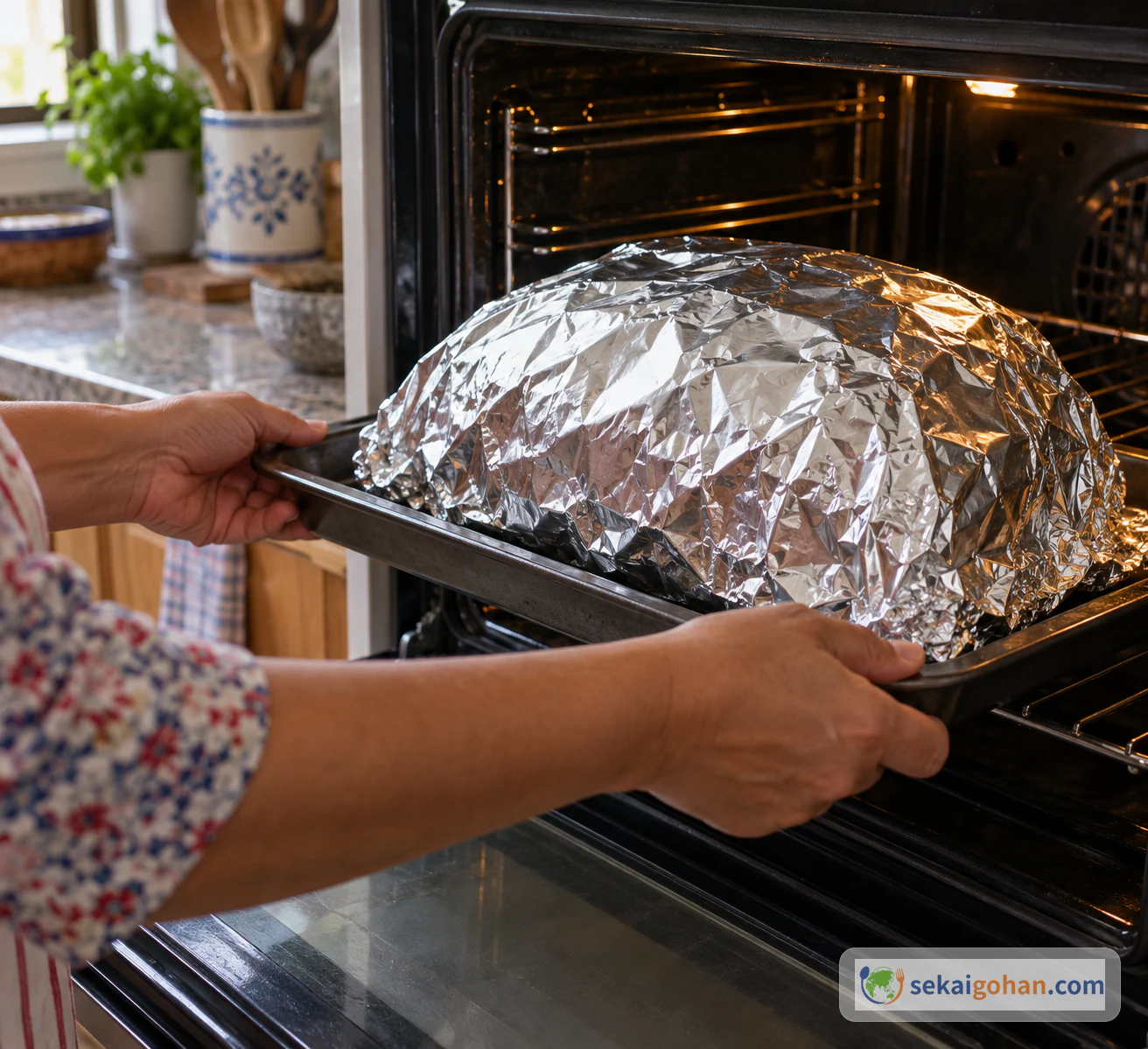
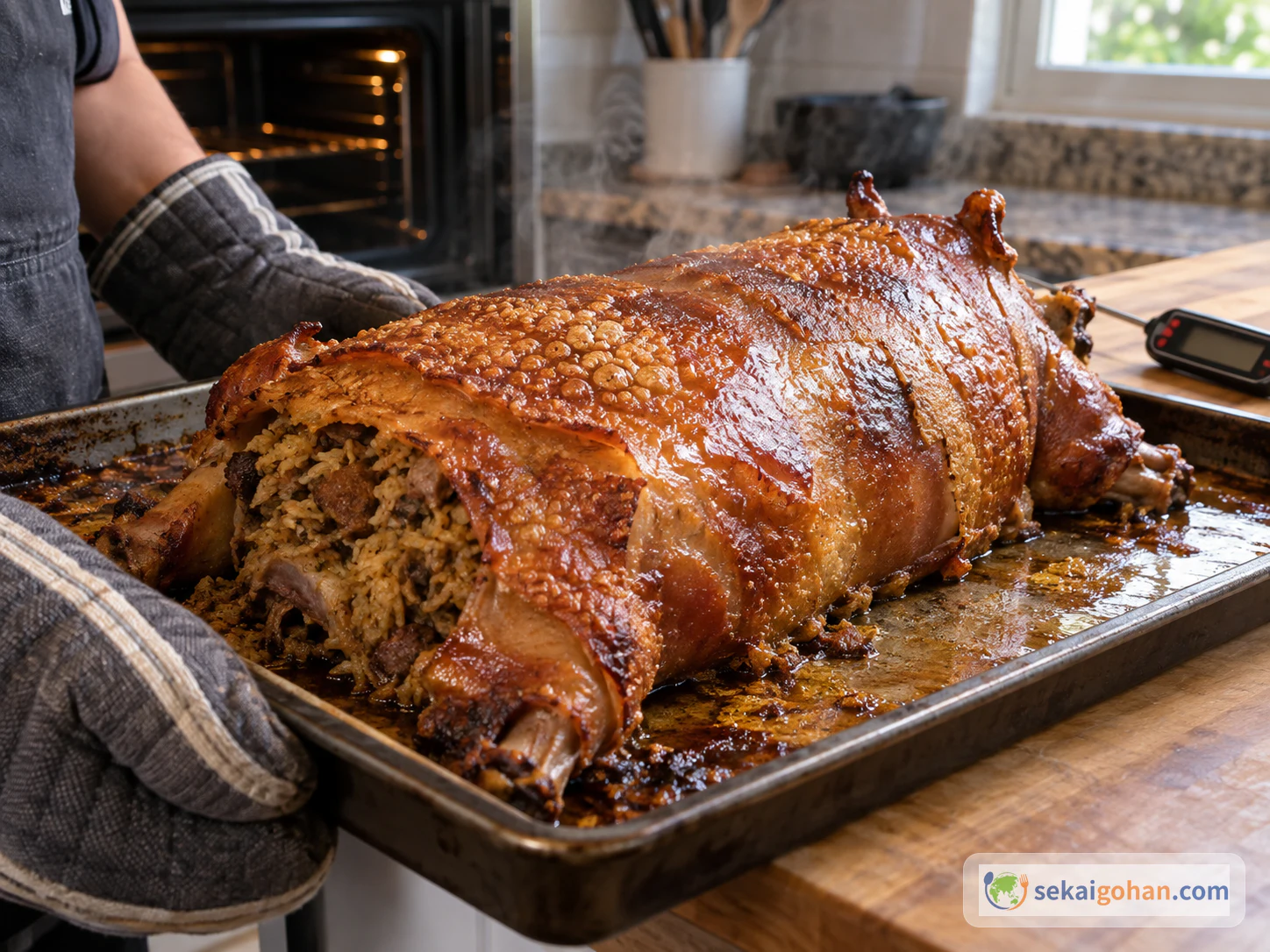
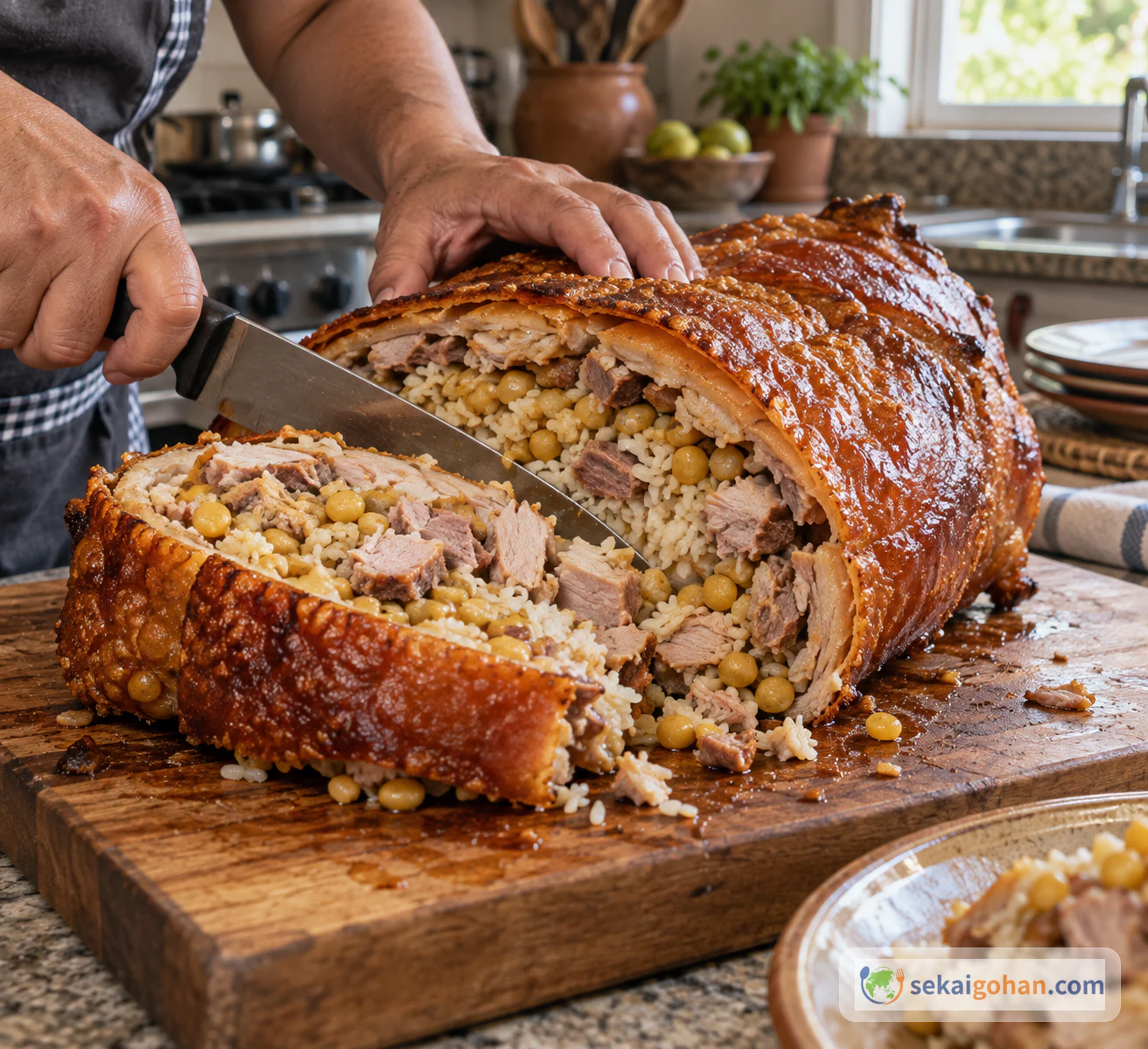
Picture a broad sheet of pork skin laid flat on a foil-lined tray. Down its center go rice and yellow peas, loosened with lard and a rust-colored adobo, and pieces of pork that spent the night soaking up cumin and achiote. Then the skin is rolled up, tied and roasted until it blisters to a deep, crackling gold. When you finally cut it, you can see every layer in the slice: pork, peas and rice, all held inside the skin. This is lechona, the Colombian celebration dish from Tolima, made here at home size. The flavor comes from pork and lard, with cumin, achiote, garlic and long onion for aroma. It's rich and aromatic, not spicy.
Lechona Tolimense and Its Origins
Lechona is often called lechona tolimense. It's pork and peas roasted inside pork skin, and it belongs to Tolima Grande, the area covering Tolima and Huila. In its large festive forms it takes long preparation, and the skin is sewn shut by hand. That's why it turns up at family gatherings, religious festivals and local celebrations. A smaller wrapped form, the cojín ("cushion"), is also sewn closed in skin. This recipe takes the cojín idea and turns it into a compact parcel for six, with rice. Explore more of the country's cooking on the Colombia page.
The names sound alike, but Colombian lechona and Filipino lechon are separate dishes. Their ingredients, form and regional history are all different.
Lechona With Rice or Without
There's no single fixed recipe. Some in Tolima consider rice-free lechona the original form. The traditional cojín uses yellow peas, pork, pork skin, long onion, salt, cumin and coloring. The dried peas soak from the night before and simmer for about 3 hours the next day. Then they're layered with pork inside the skin, and the skin is sewn closed and roasted. Lechona with rice is a regional variation that has taken root in other parts of Colombia, in home kitchens and among Colombians living abroad. That's the version below.
Ingredients: Serves 6, Home Version with Rice
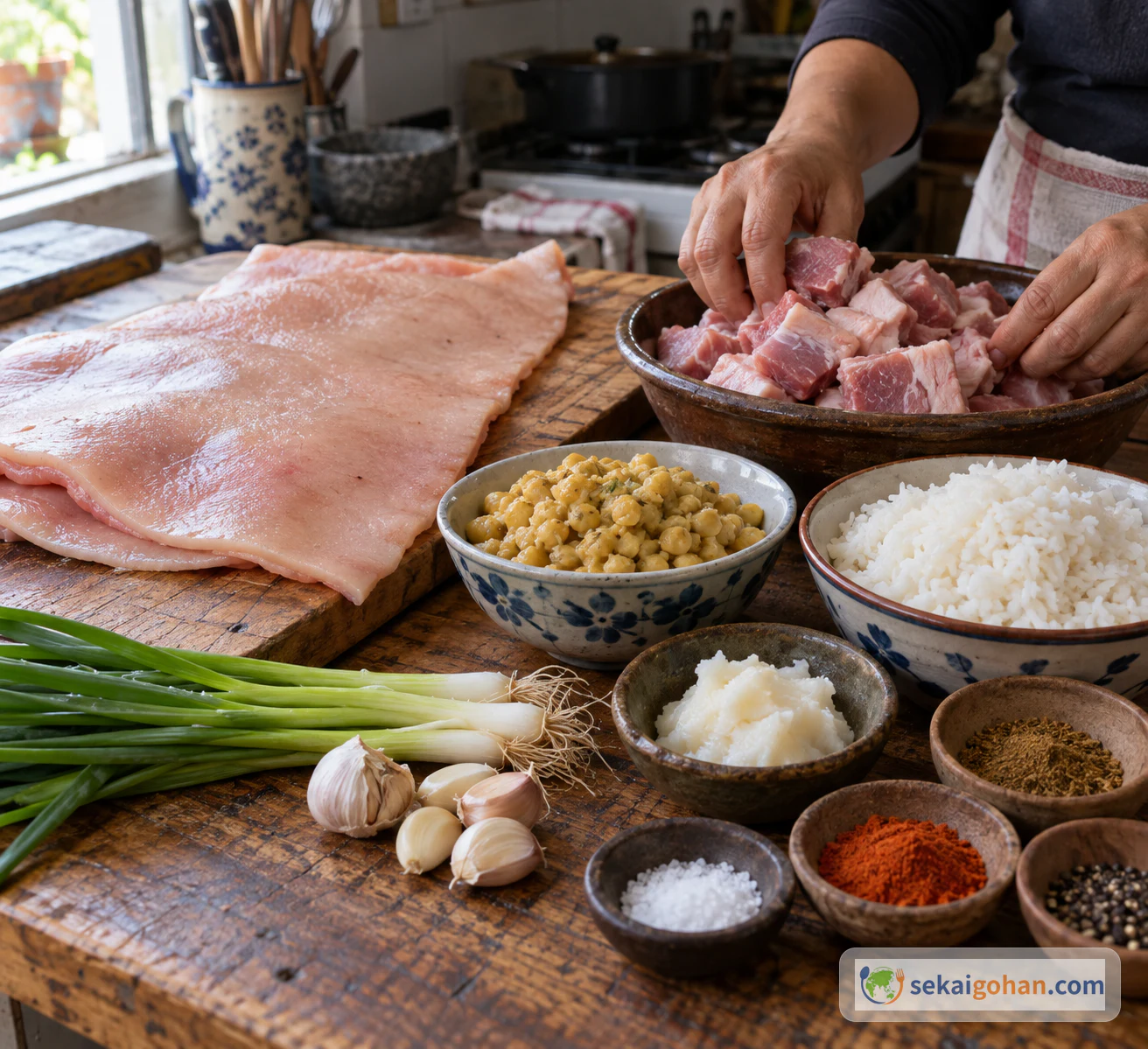
The peas and rice are measured already cooked. This recipe makes six servings.
Of the 2 tsp of cumin, put half into the adobo and 1/2 tsp into the filling. Of the 1 tsp achiote, put 1/4 tsp in the adobo and add achiote to the filling. Salt the skin to taste, separately from the 1 tsp used for the adobo and filling.
None of the listed ingredients is a common major allergen in itself, but check the labels of processed lard and cooked peas for allergens and any cross-contact statements. Keep the raw pork refrigerated while it marinates, and wash cutting boards, knives, bowls and gloves that touched raw pork before using them for anything else.
Equipment
- Blender
- Food thermometer
- Covered container for the reserved adobo
- Bowls for marinating the pork and mixing the filling
- Baking tray
- Aluminum foil, for lining the tray and covering the parcel
- Kitchen twine
- Cutting board and sharp knife
Choosing Pork Skin, Peas and Achiote
Pork skin is the hardest part to find. You need a single piece broad enough to roll around the filling, so ask a butcher rather than relying on the supermarket counter. Tell them you plan to wrap a filling in it. Skin-on pork belly can stand in, but expect a different thickness, shape and fat ratio, and a different result.
Ordinary long green onions, such as Japanese negi, are a reasonable substitute for Colombian long onion (cebolla larga). Their balance of white and green parts and their aroma aren't quite the same.
Cooked yellow or green peas both work, but green peas change the color and aroma of the filling. If you start from dried yellow peas, as traditional Tolima recipes do, cook them first and measure 3/4 cup after cooking.
Look for ground achiote, also sold as annatto powder, at import grocers or online. Paprika gives a similar color, but the aroma is different.
Method: Marinate Overnight, Wrap, Then Roast in Two Stages
Steps 1–2 happen the day before; the pork marinates overnight in the refrigerator. Steps 3–8 happen the next day. Roast for about 90 minutes plus about 30 minutes. Ovens vary, so watch the skin and use a thermometer rather than relying on time alone.
Lechona Troubleshooting
| Problem | Likely cause | What to do |
|---|---|---|
| The skin won't wrap around the filling | The skin is too small, or there is too much filling | Check the skin's area before you start. Take out some filling instead of stretching the skin. Pork belly will not give the same shape |
| The parcel opens during roasting | The twine is loose or too sparse | Tie firmly along the whole length. Traditional recipes stitch the seam closed |
| The skin browns too early | The hot stage is running long, or the rack is too close to the heat | Check often during the 450°F (232°C) stage. If it is about to burn, return the foil or adjust the rack position |
| The skin is pale and soft | The skin was still wet, or the hot stage was too short | Dry the skin completely before salting. Continue the uncovered stage while watching it |
| The outside looks done but the center is uncertain | Roasting time is only a guide | Measure several points, in the thickest pork pieces and the center of the filling. Extend roasting and measure again if needed |
Serving Lechona
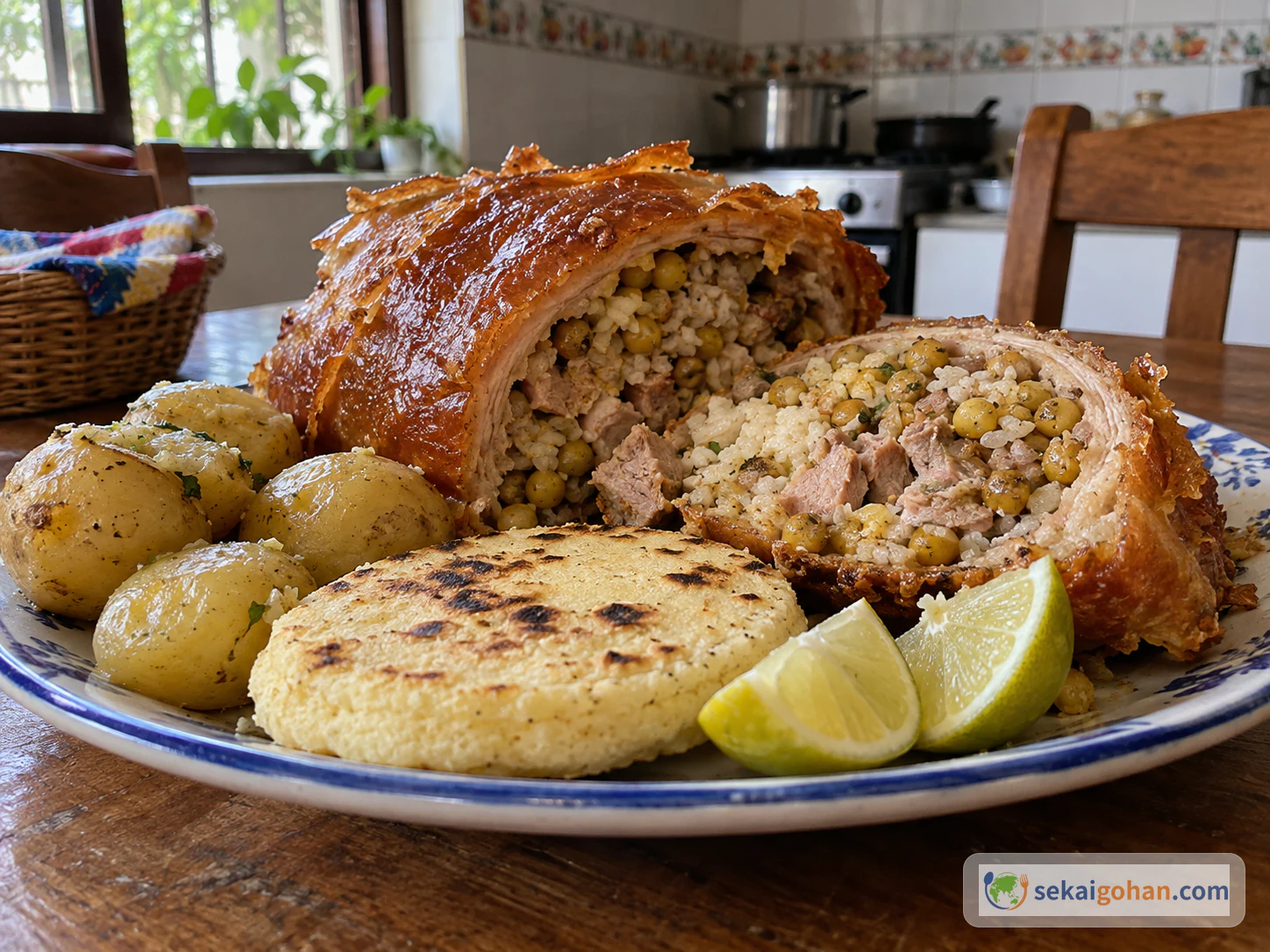
Serve lechona with arepa, potatoes boiled in salted water, and lemon. The lemon cuts through the richness of the pork and lard, and the arepa and potatoes keep the plate plain. In Tolima, the roasted cojín comes with insulsos and arepas orejas e'perro. Those are regional accompaniments, so they're optional here.
Some lechona is roasted as a whole suckling pig instead. That method uses different times and temperatures, and they don't carry over to this parcel.
Frequently Asked Questions
How do I know it is cooked through?
Go by a food thermometer, not the roasting time. Cook pork to 145°F (62.8°C) and let it rest for at least 3 minutes. Take readings in several places, including the thickest pork and the center of the filling, and keep roasting if any of them is short.
How should I store and reheat leftovers?
When you reheat leftovers, bring them to 165°F (73.9°C), measured with a food thermometer.