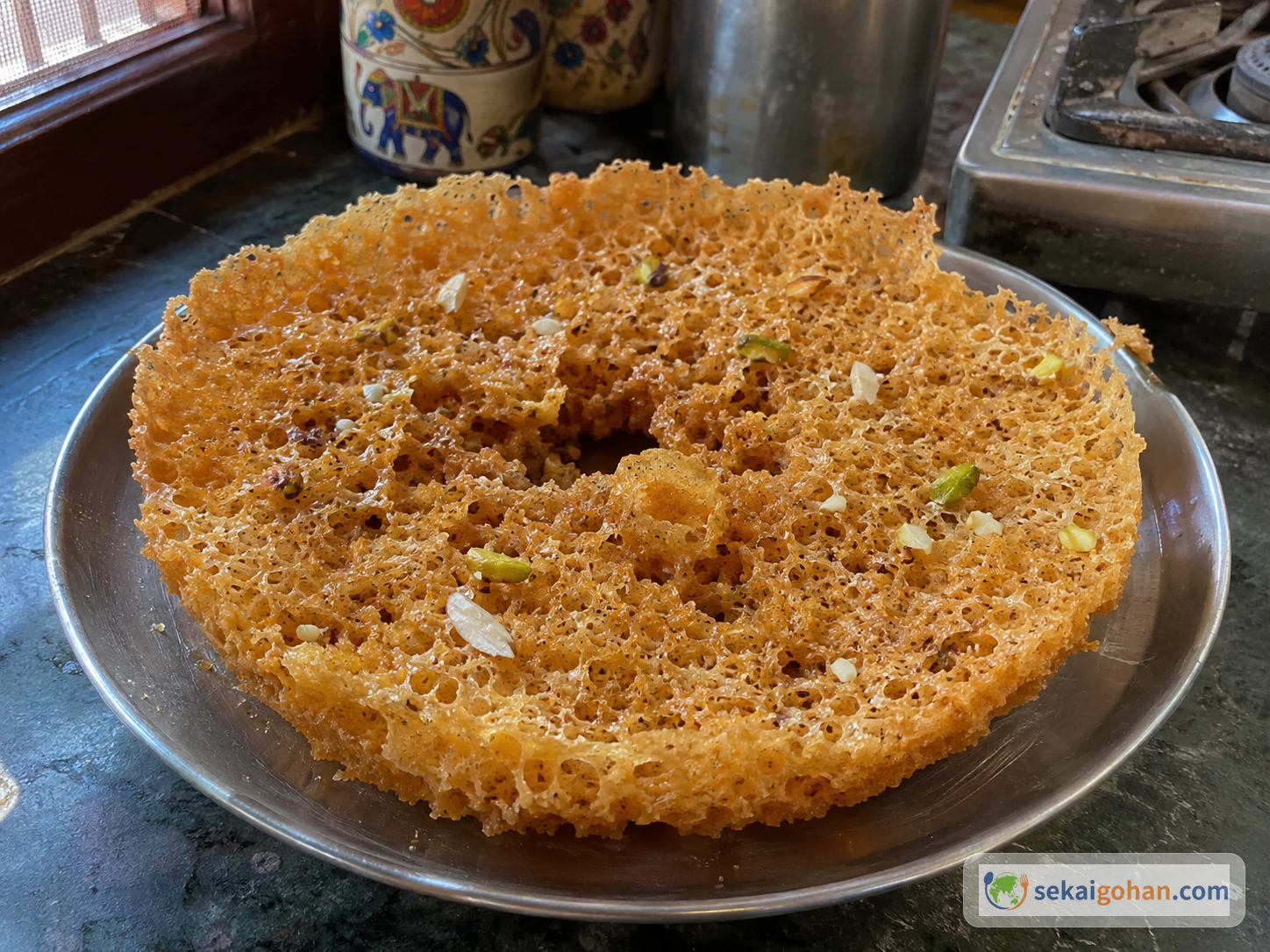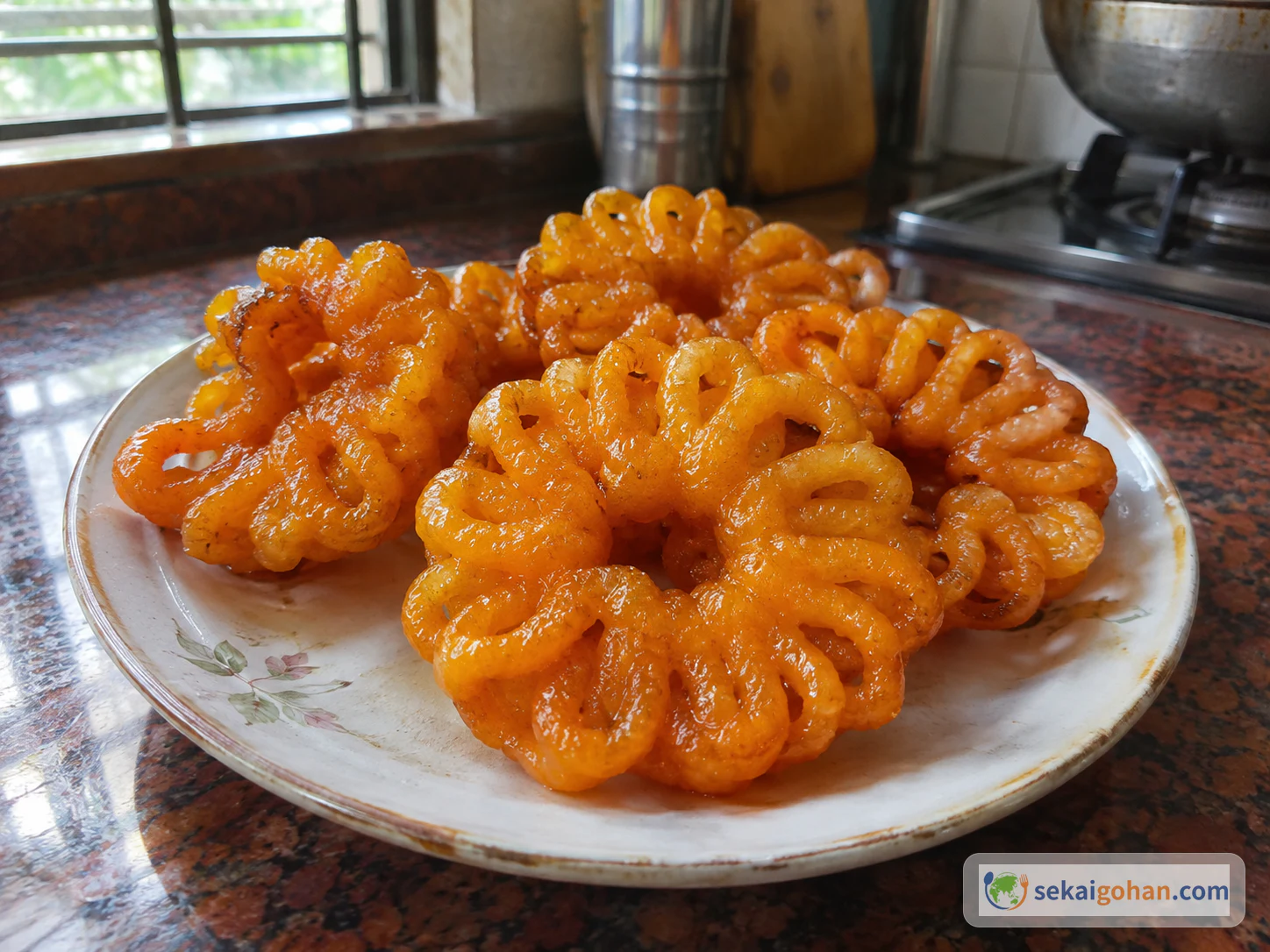
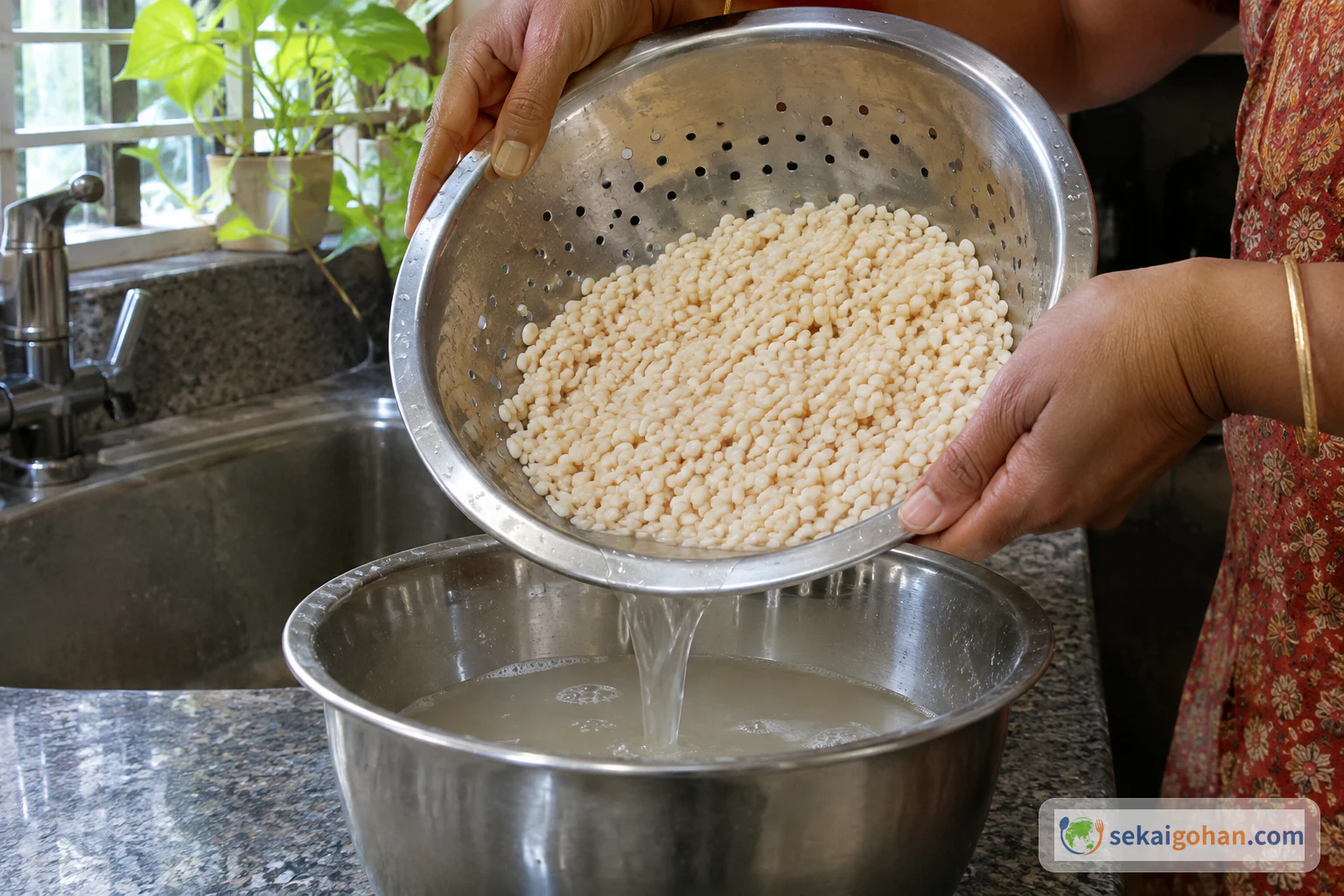
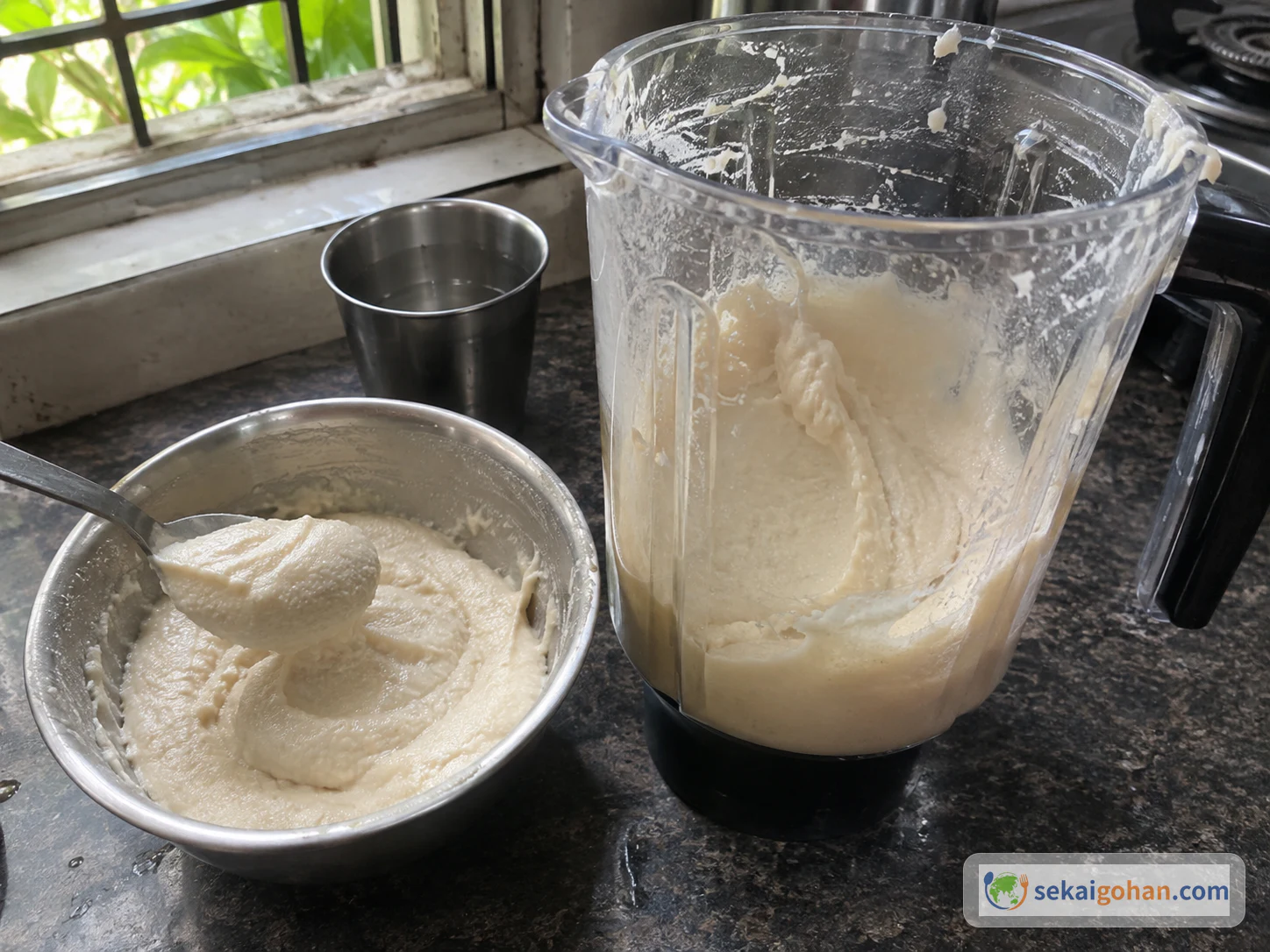
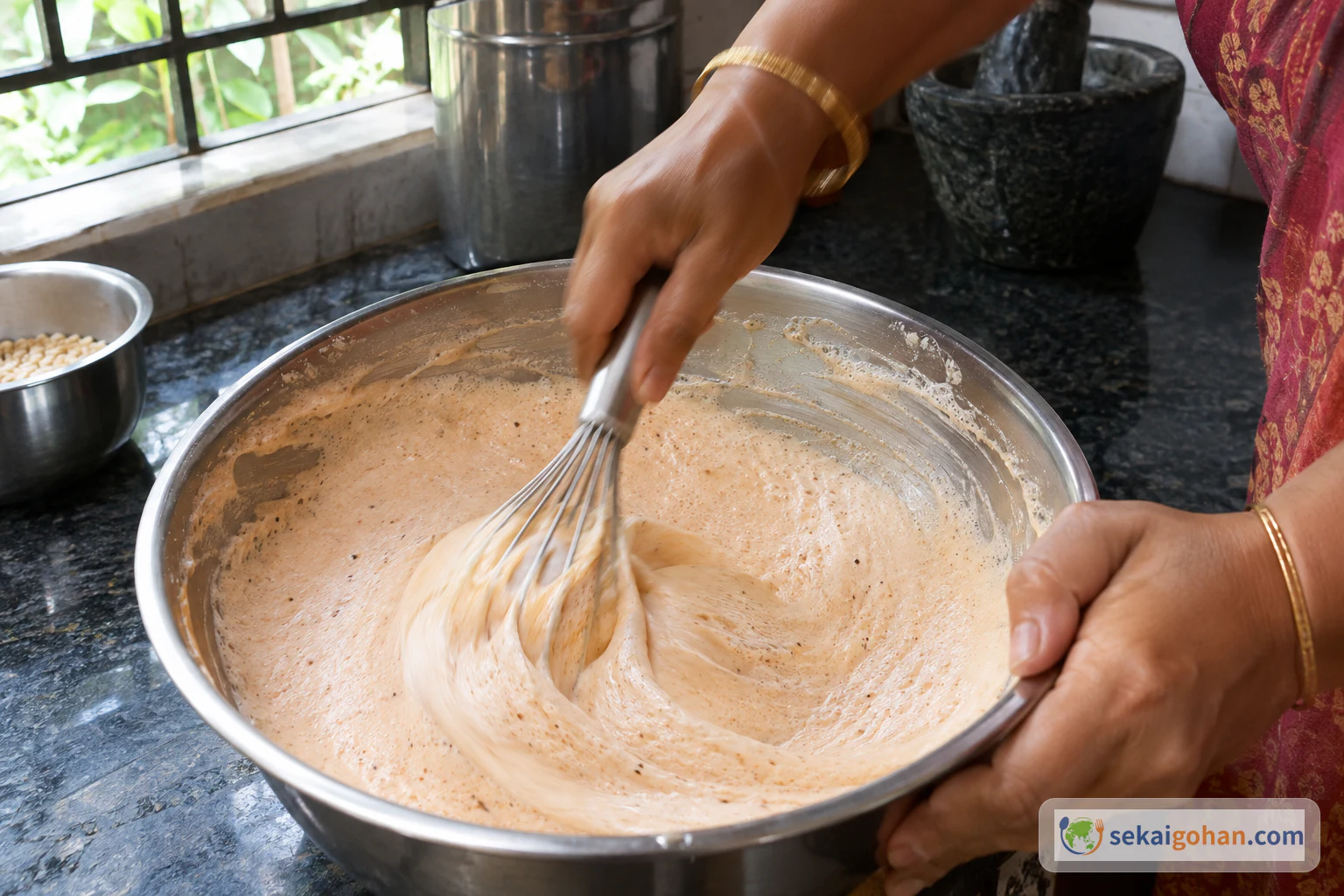
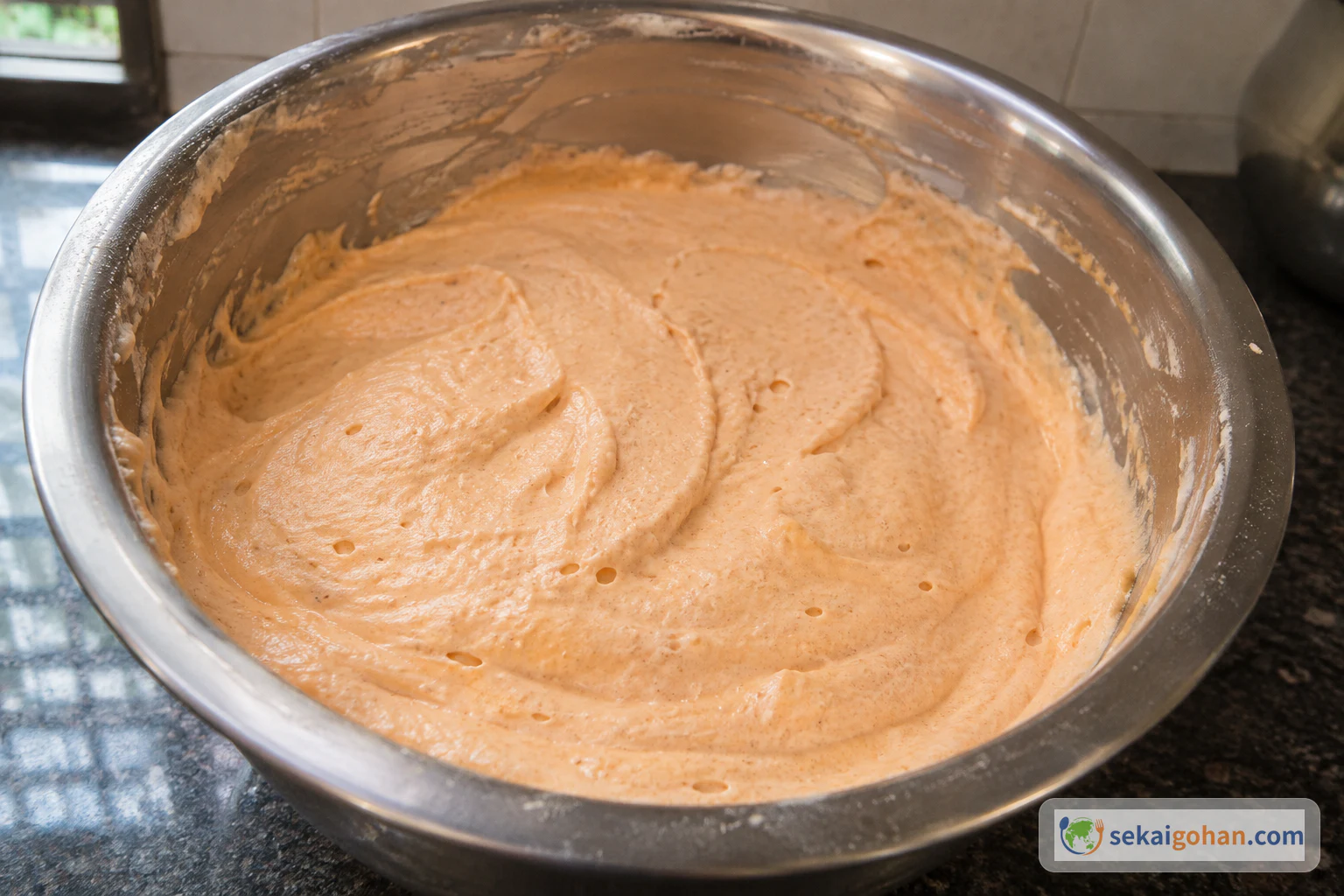
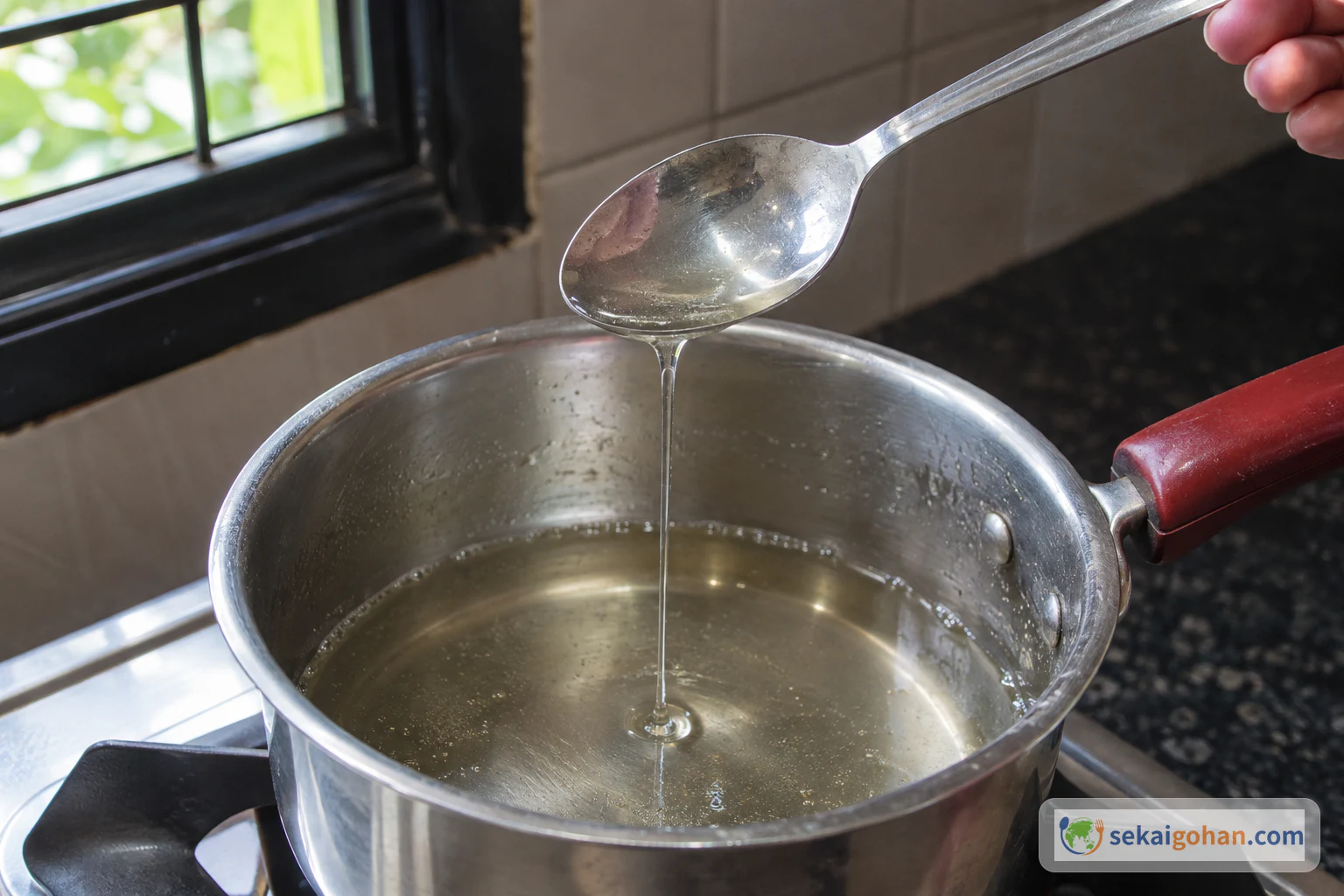
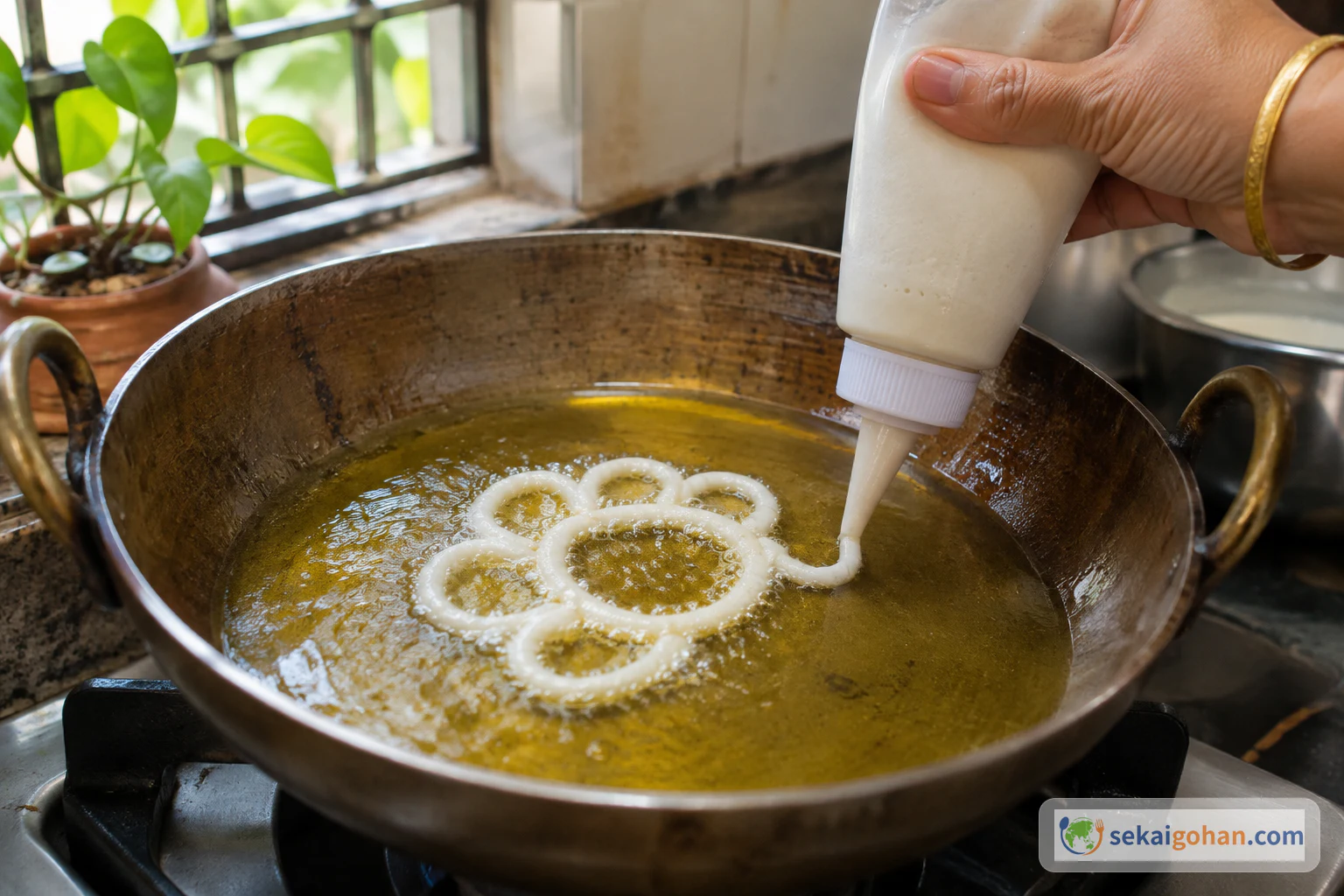
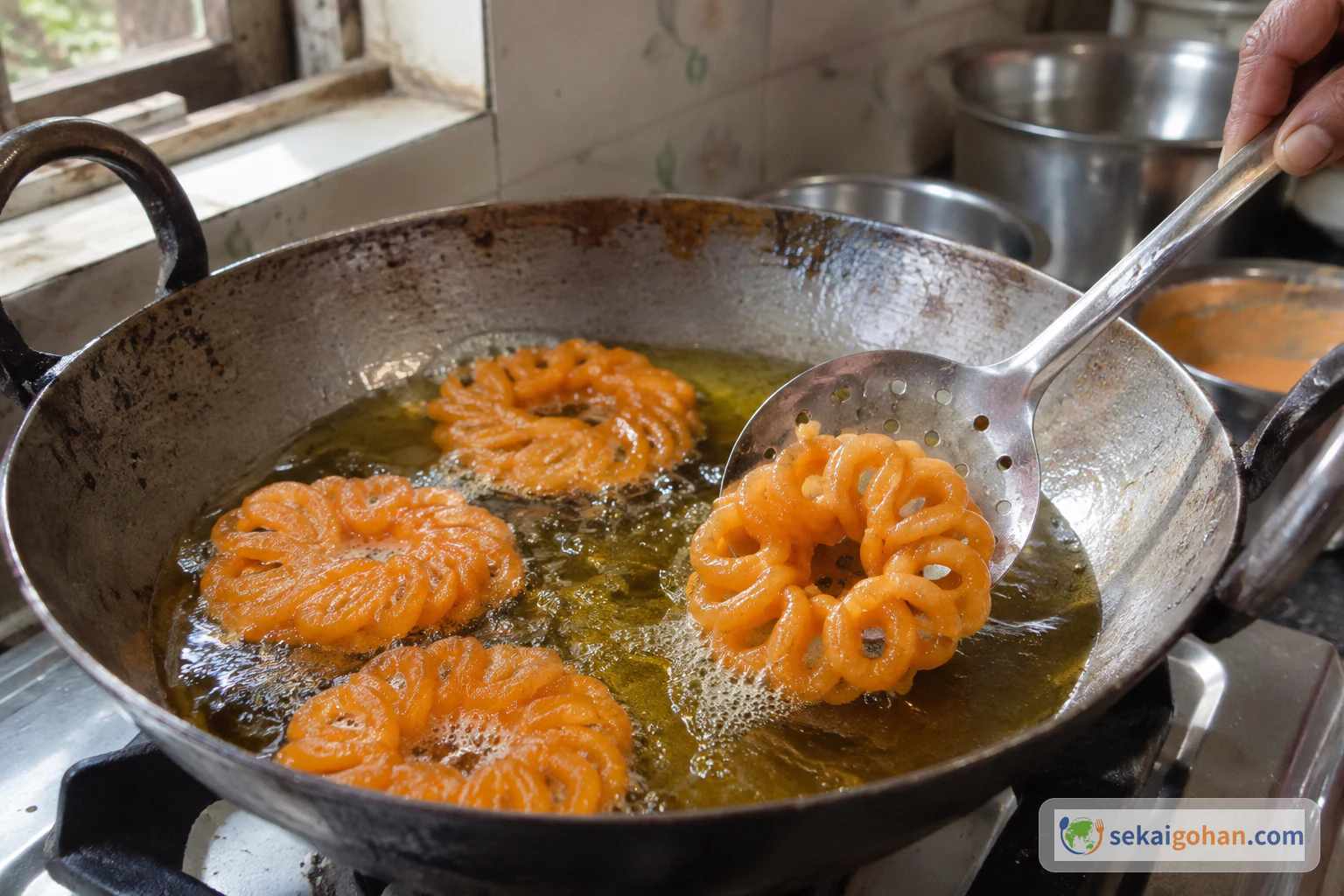
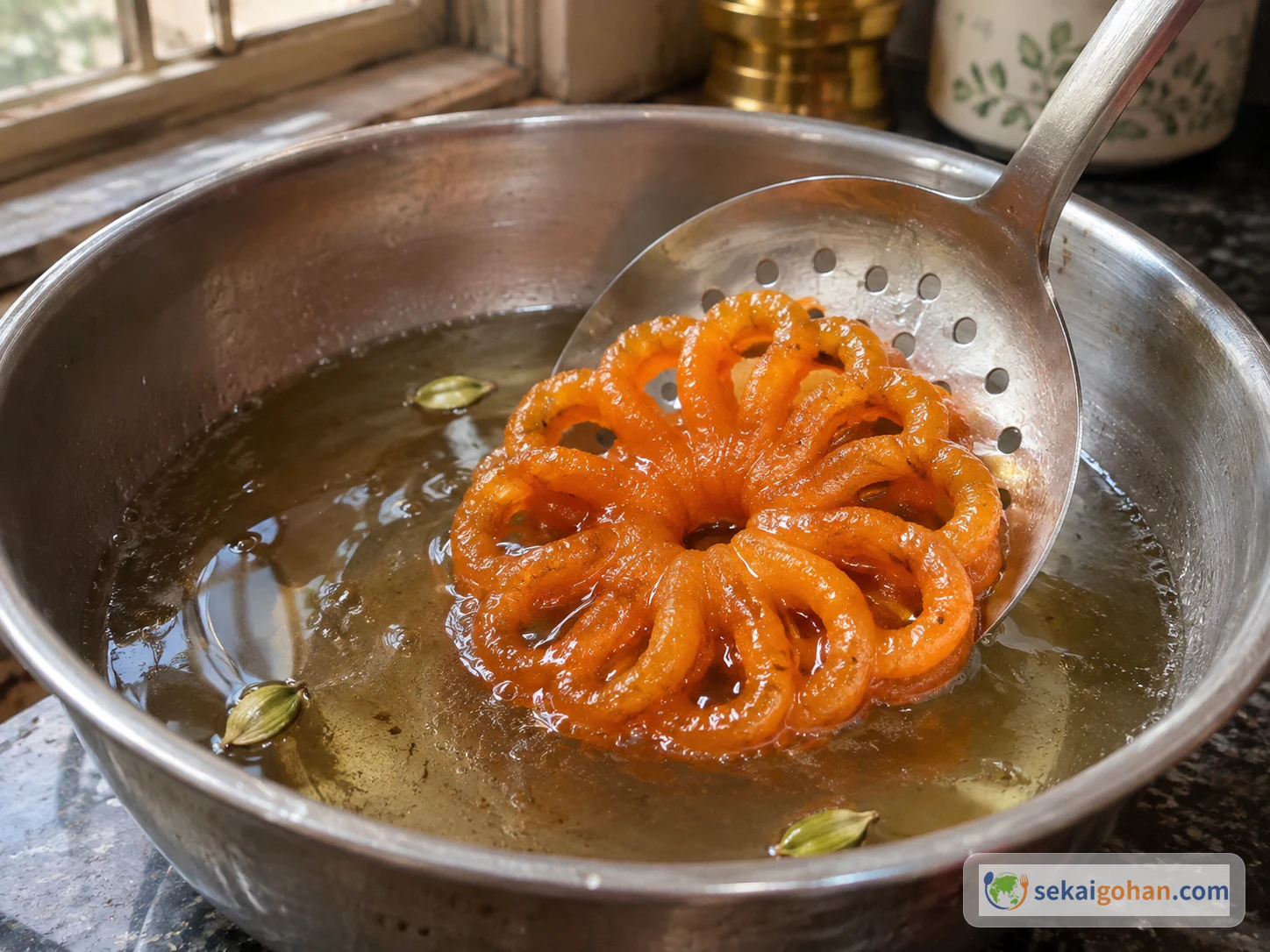
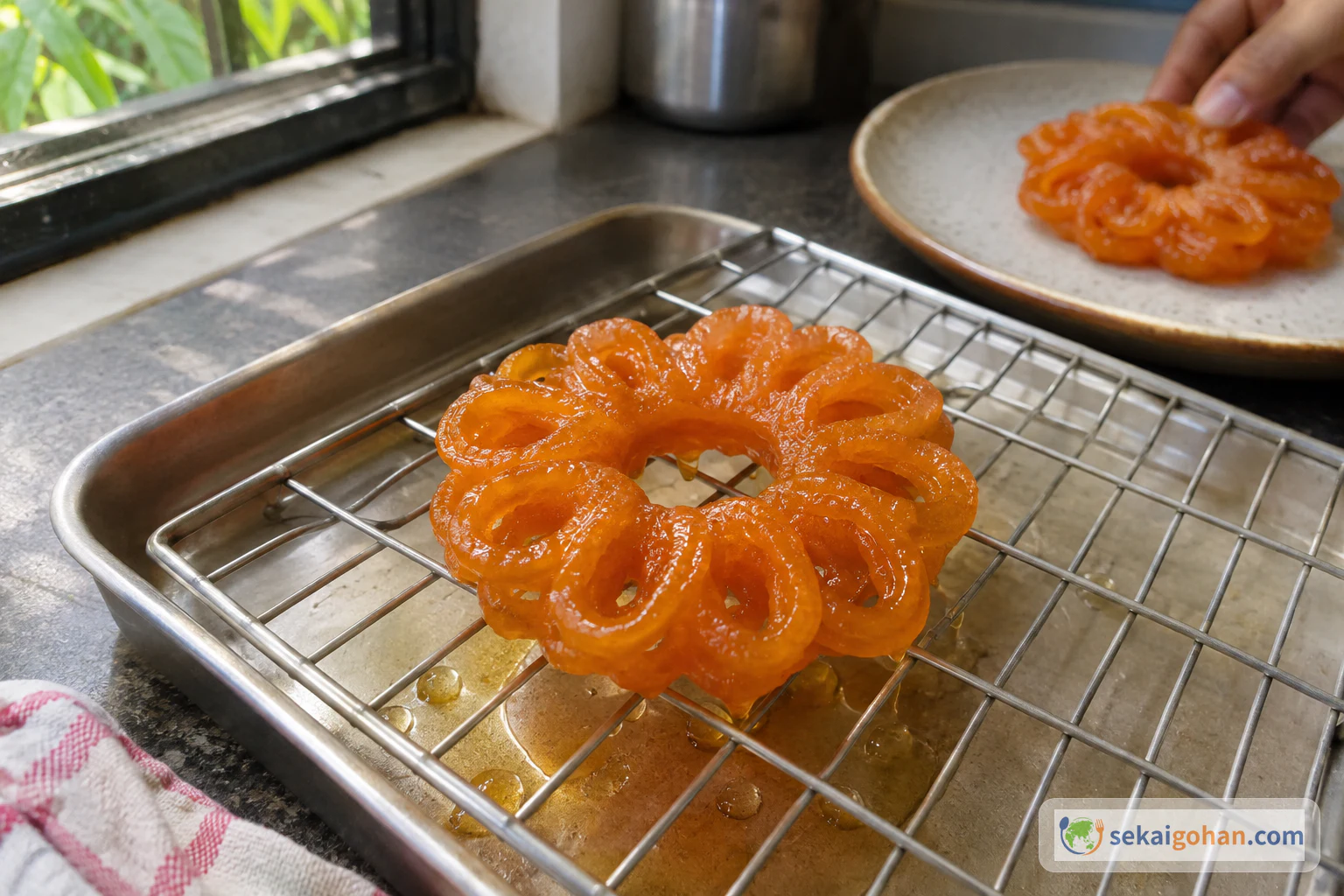
Soaked urad dal goes through the grinder with very little water and comes out as a thick paste, which is then beaten until a drop of it floats in water. From there it is piped straight into hot ghee: first a central ring, then small loops joined around it. When both sides are crisp, the flower goes directly into hot syrup. That is imarti (इमरती), a fried sweet made from split, skinned urad dal and soaked in cardamom syrup. You can see why people love it while you make it: the beaten batter is light, the piping makes a pattern, and each piece moves quickly from pan to syrup.
Imarti, Jalebi and Jaunpur Imarti
At a glance imarti can pass for jalebi, but they are two separate sweets. They differ in shape and thickness. Imarti is made from urad dal, piped in a thick line and formed into a ring with connected outer loops. Names vary, and you may also see it called Jaangiri.
The best-known version is Jaunpur Imarti, a regional product of Jaunpur district in Uttar Pradesh. It also uses urad dal as the main ingredient, has a flower-like ring pattern, and is fried and then soaked in syrup. There is no single fixed formula. Some accounts mention rice, while one list of raw materials names only urad dal, sugar, desi ghee, cardamom and water. Color, soaking time and resting time vary too. The historical claims don't agree with each other, so the origin and any royal connection are uncertain.
Jaunpur Imarti is served at festivals, weddings and rituals. It is given as a gift, offered as bhog or prasad, and eaten at iftar. For more from the country, see India on Sekai Gohan.
Ingredients: Urad Dal Batter and Cardamom Syrup
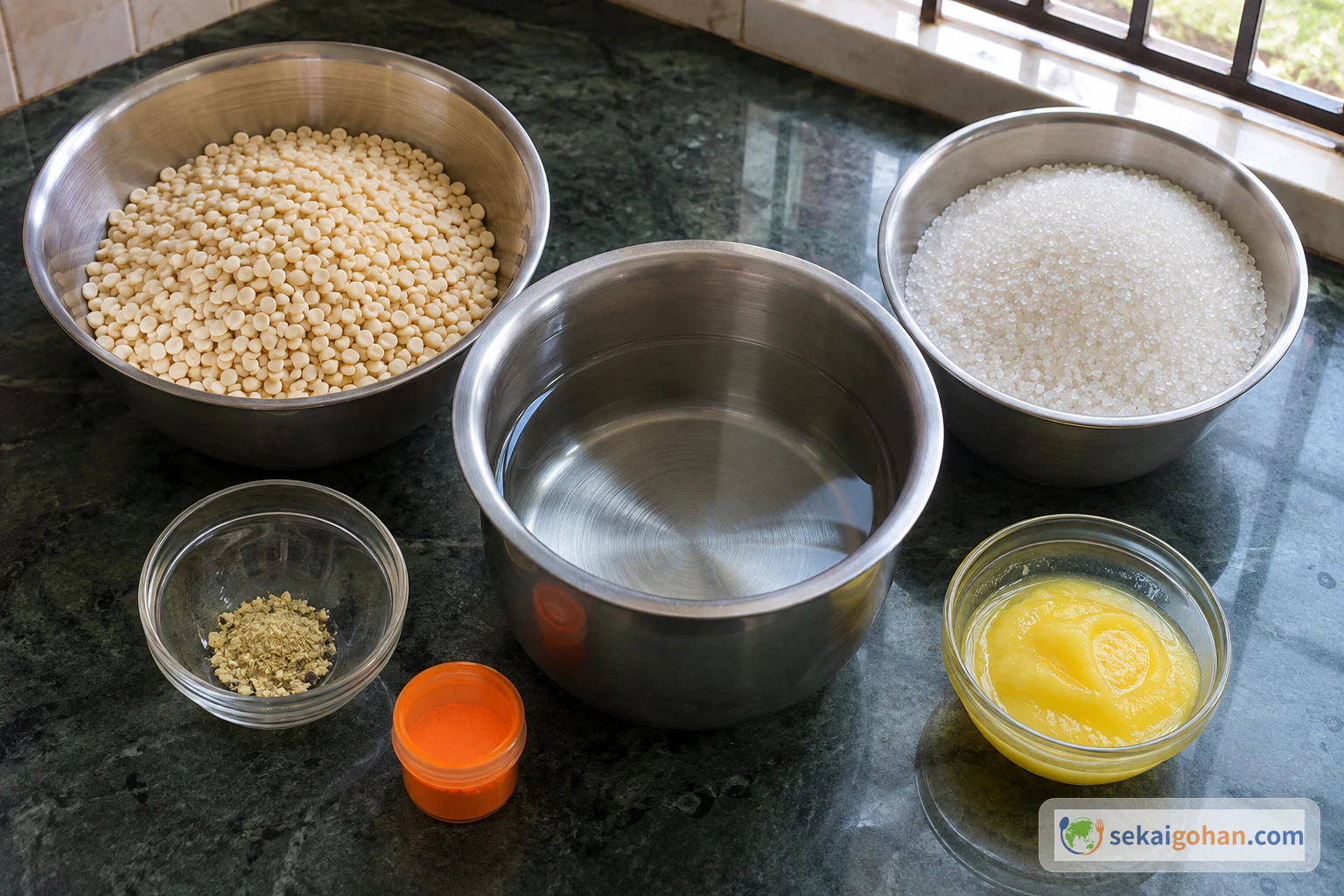
For 4 servings.
This recipe contains pulses. Ghee is made from milk, so this sweet is not dairy-free. Avoid cross-contact when cooking for anyone with an allergy.
Choosing Urad Dal and Saffron Color
Look for split, skinned urad dal. It is sometimes sold as dhuli urad dal, white urad dal or urad dal white split. Whole dal won't give you the right batter. Urad dal is blackgram (Vigna mungo), and the label "husked Bengal Gram" that you sometimes see on it is misleading. Bengal gram (Cicer arietinum) is a different crop, and its chana dal is a different pulse. Measure the 2 cups of dal dry.
Saffron color is a food coloring, not saffron threads, and other red or orange colorings are different products. If you can't find it, leave it out. Only the color of the finished imarti changes, which is better than guessing at an amount of some other coloring.
Equipment
- Measuring cups and a 1/2 tsp measure
- Bowl with a cover, for soaking
- Colander
- Blender or wet grinder
- Large bowl and whisk
- Small bowl of water, for the float test
- Saucepan and spoon, for the syrup
- Deep, heavy pan (kadhai) with a lid that fits
- Fine metal skimmer or slotted spoon, completely dry
- Nozzle bottle or heat-resistant cloth with a hole, for piping
- Rack over a tray, or a plate, for draining
Method: Soak, Beat, Boil, Pipe, Fry, Soak Again
Stay at the pan the whole time you are frying. Keep sleeves and anything flammable away from the heat, and keep children clear of the stove. Use only dry tools, and don't let water or wet hands reach the ghee. Never touch hot syrup with your fingers.
If the ghee catches fire, never use water or flour. If you can do so safely, cover the pan with a lid and turn off the heat. Leave it covered until it has cooled, and call emergency services.
Imarti Troubleshooting and Batter Safety
The batter rests only while you make the syrup. Fry it the same day.
Watch the clock for food safety. Cover the dal and refrigerate it while it soaks overnight. Once the batter is ground, keep it out no more than 2 hours, or 1 hour above 32°C (90°F).
| What you see | What to review | What to do |
|---|---|---|
| A drop of batter sinks | Too little beating, or too much grinding water | Keep beating and test again. Next time, add the grinding water more slowly |
| The rings come apart | Batter too thin, or an unsteady hand | Keep the batter thick and pipe in one spot on the surface. Don't add cornflour |
| The syrup doesn't form a thread | Not boiled far enough | Keep boiling and test again with a spoon. Don't add acid |
| The finish is sticky or hard | Soak time, or how crisp the piece was | Fry until both sides are crisp and soak for 3–4 minutes |
| The batter has passed the time limit | Time since grinding ended | Discard it |
Serving and Varying Imarti
Serving and used ghee
Serve the imarti as soon as it has drained, because its texture changes the longer it sits in the syrup.
The ghee needs care after frying. Don't use it again for more frying. Blue-gray smoke, heavy foam that won't settle, a dark and cloudy look, or a change in thickness all mean the fat has deteriorated. Let it cool before you handle it, and keep it out of the drain. Soak small amounts up in absorbent material and put them in the trash.
Variations
- Change the piping tool: A nozzle bottle and a cloth with a hole both work. Only the tool changes.
- Fry in neutral oil: Expect a different aroma, and a step away from the ghee-based sweet.
- Try a Jaunpur-style version with rice: Some Jaunpur imarti versions use rice. Make it as a separate recipe with its own amounts and order instead of adding rice to this one.
- Shorten the syrup soak: Other recipes use different soak times.
Frequently Asked Questions
Doesn't the batter need to ferment?
Methods differ. Some let the batter stand for hours, while others fry after a short rest or none at all. A long rest at home means controlling temperature, hygiene and discard times, so this recipe rests the batter only while the syrup is made.
How many pieces does this make?
The recipe serves 4. How many pieces you get depends on how large you pipe each one.
Can I make imarti ahead?
No storage period has been established, so fry and serve imarti on the same day. Don't keep the batter for the next day, and don't reuse the frying ghee for more frying.