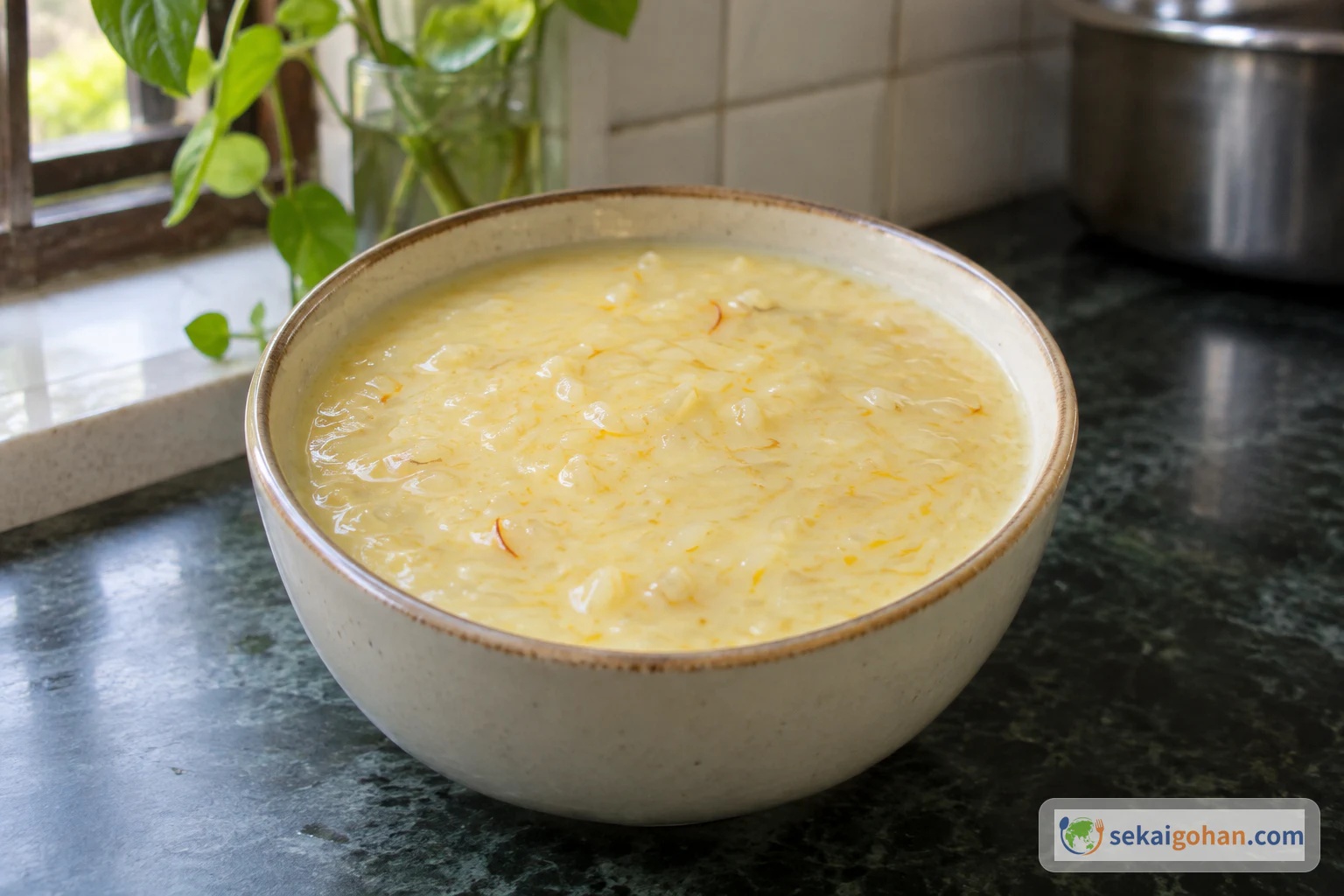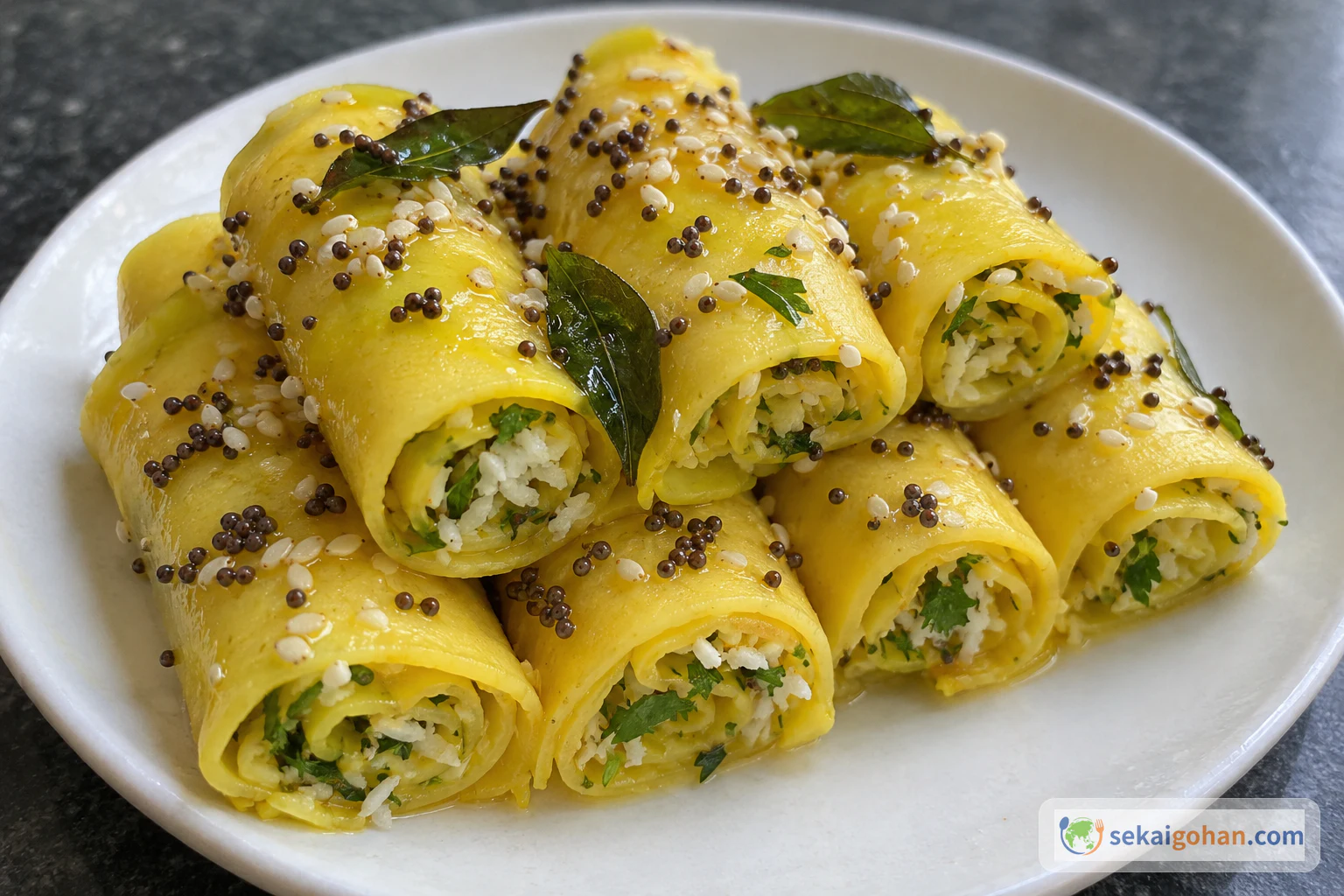
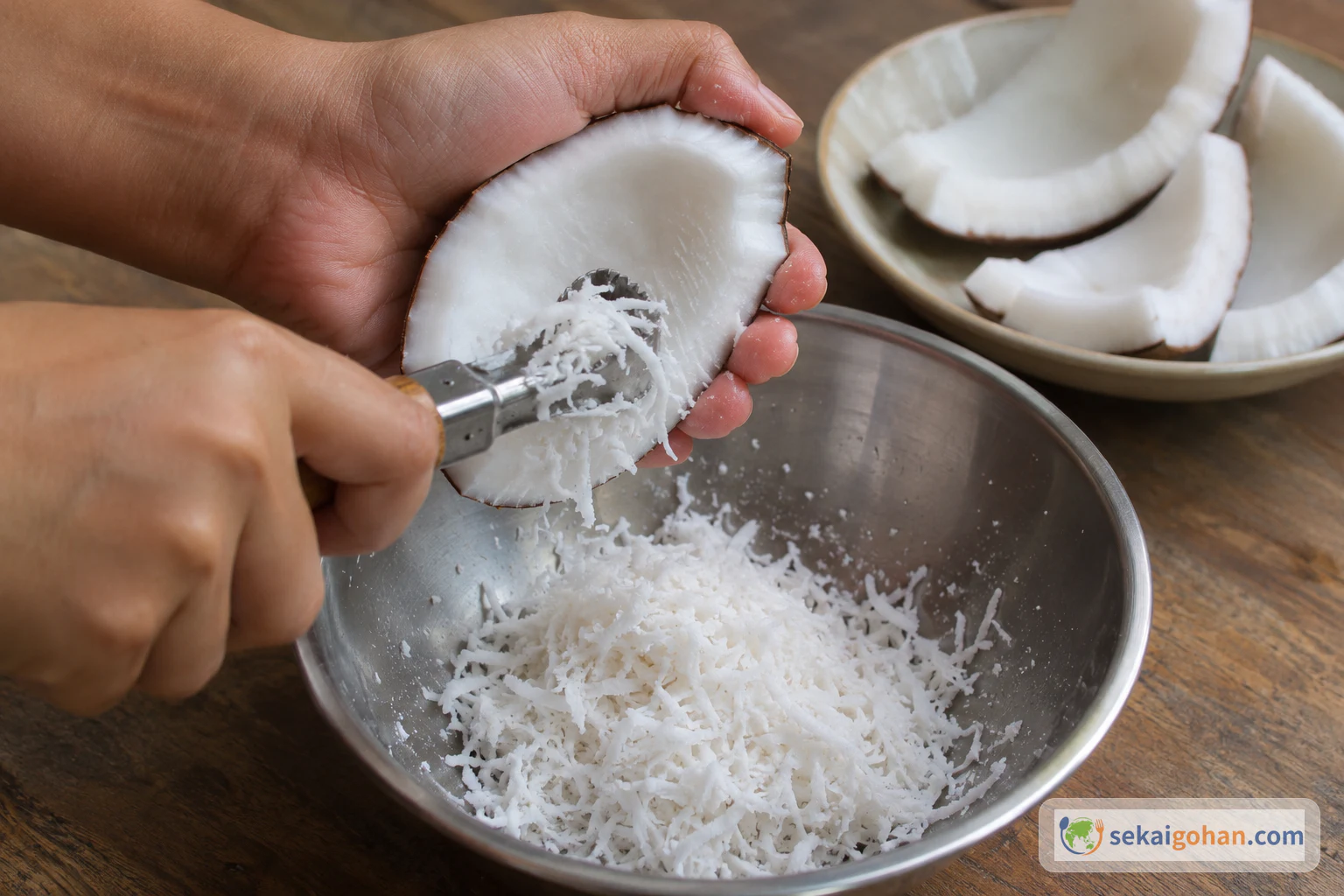
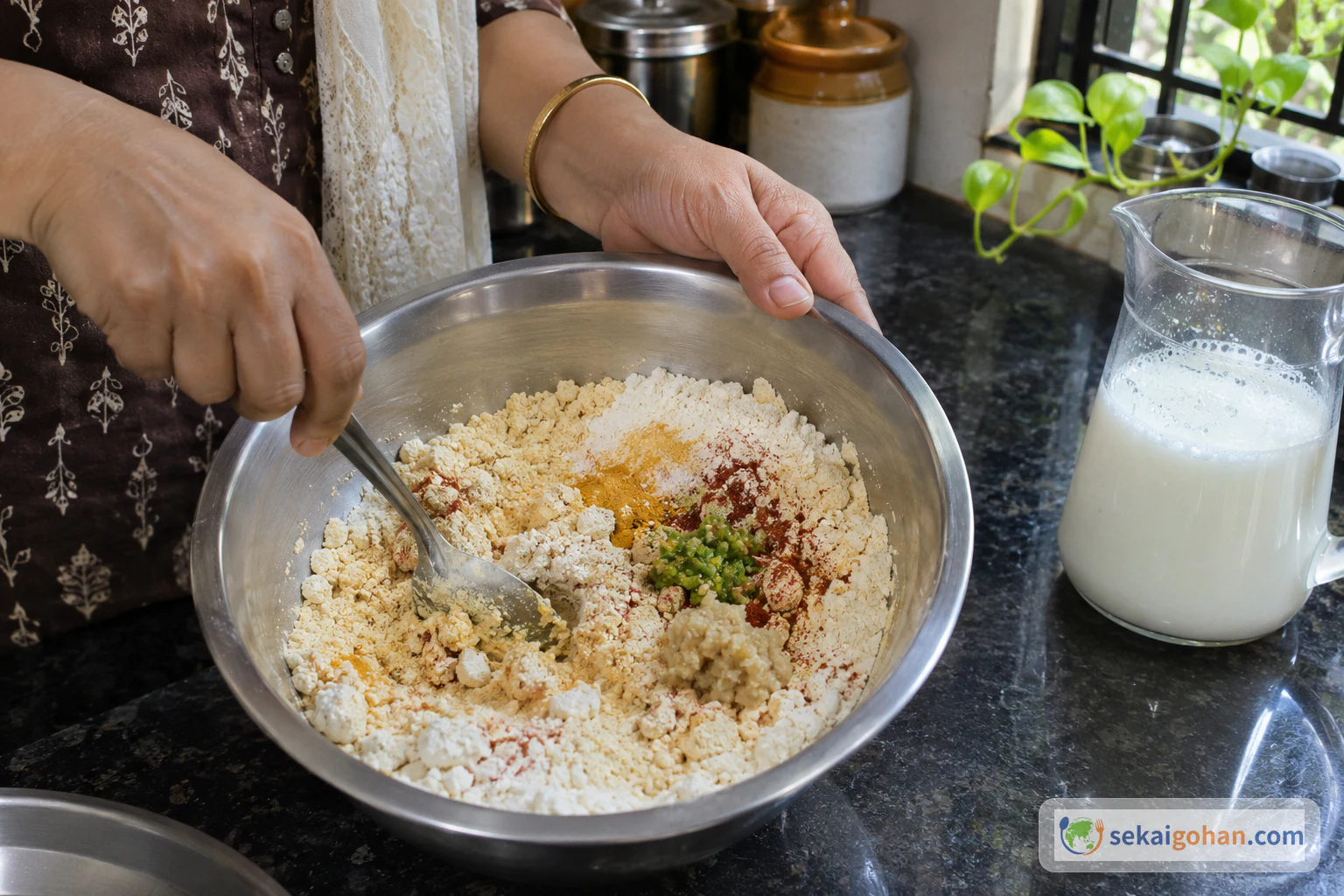
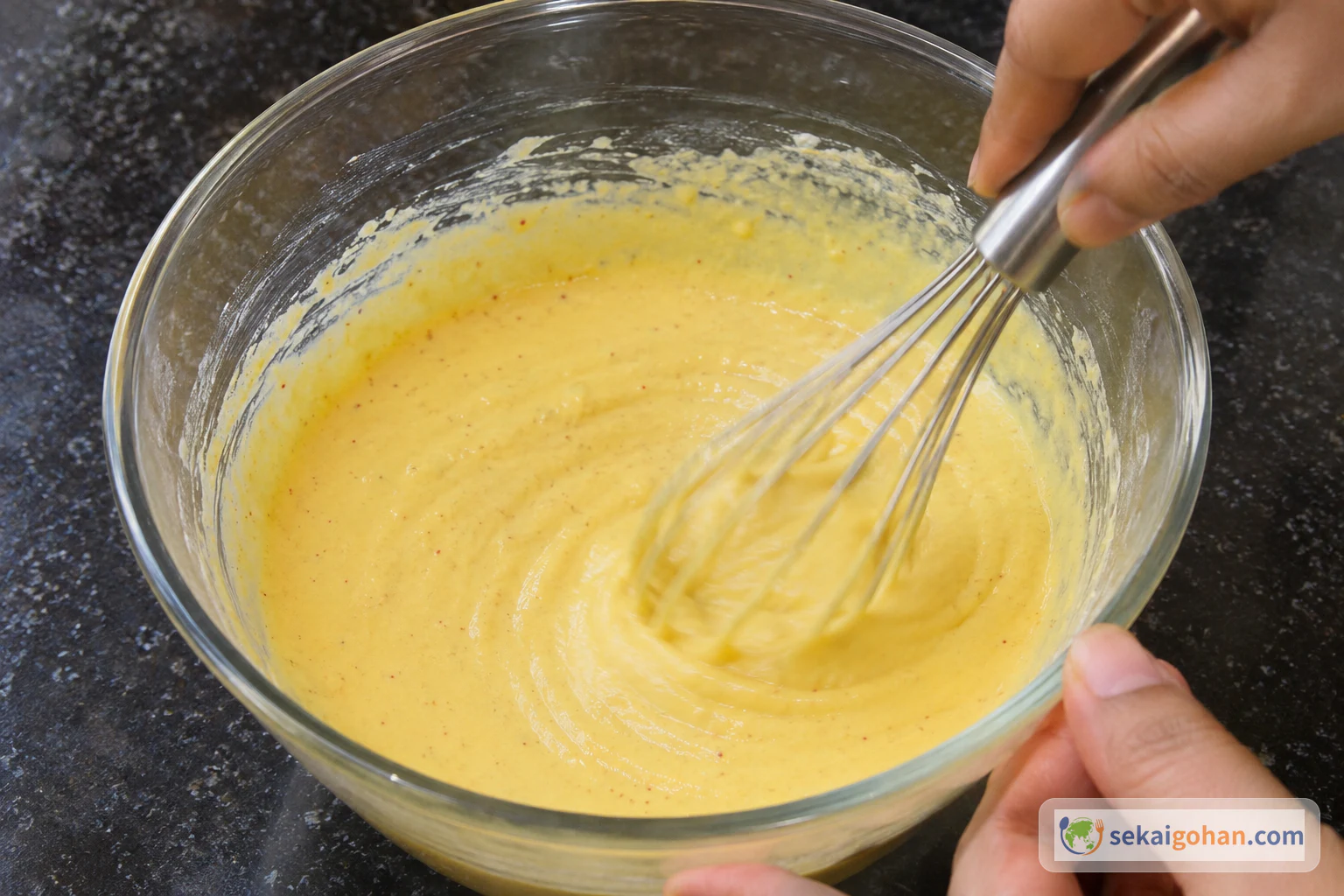
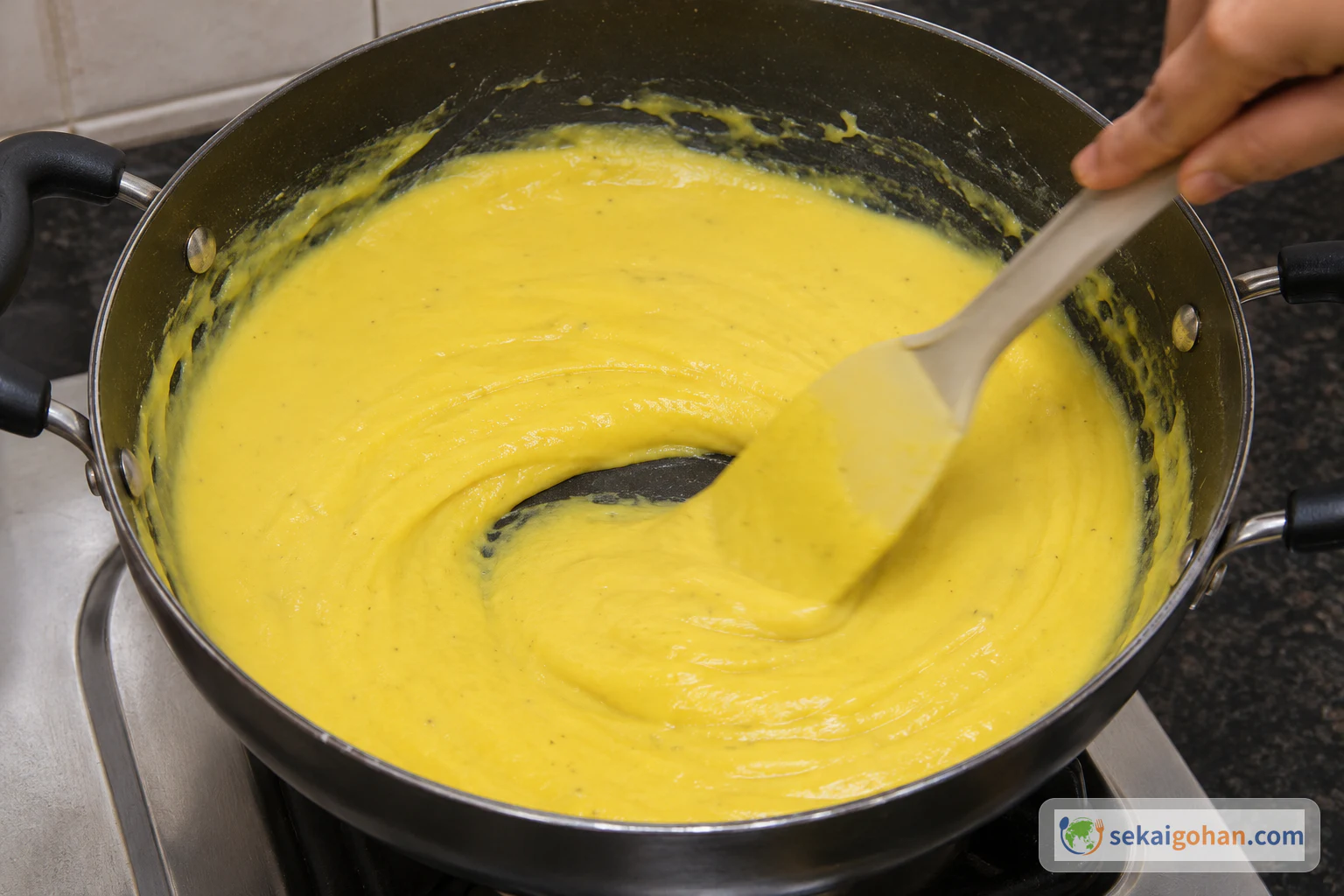
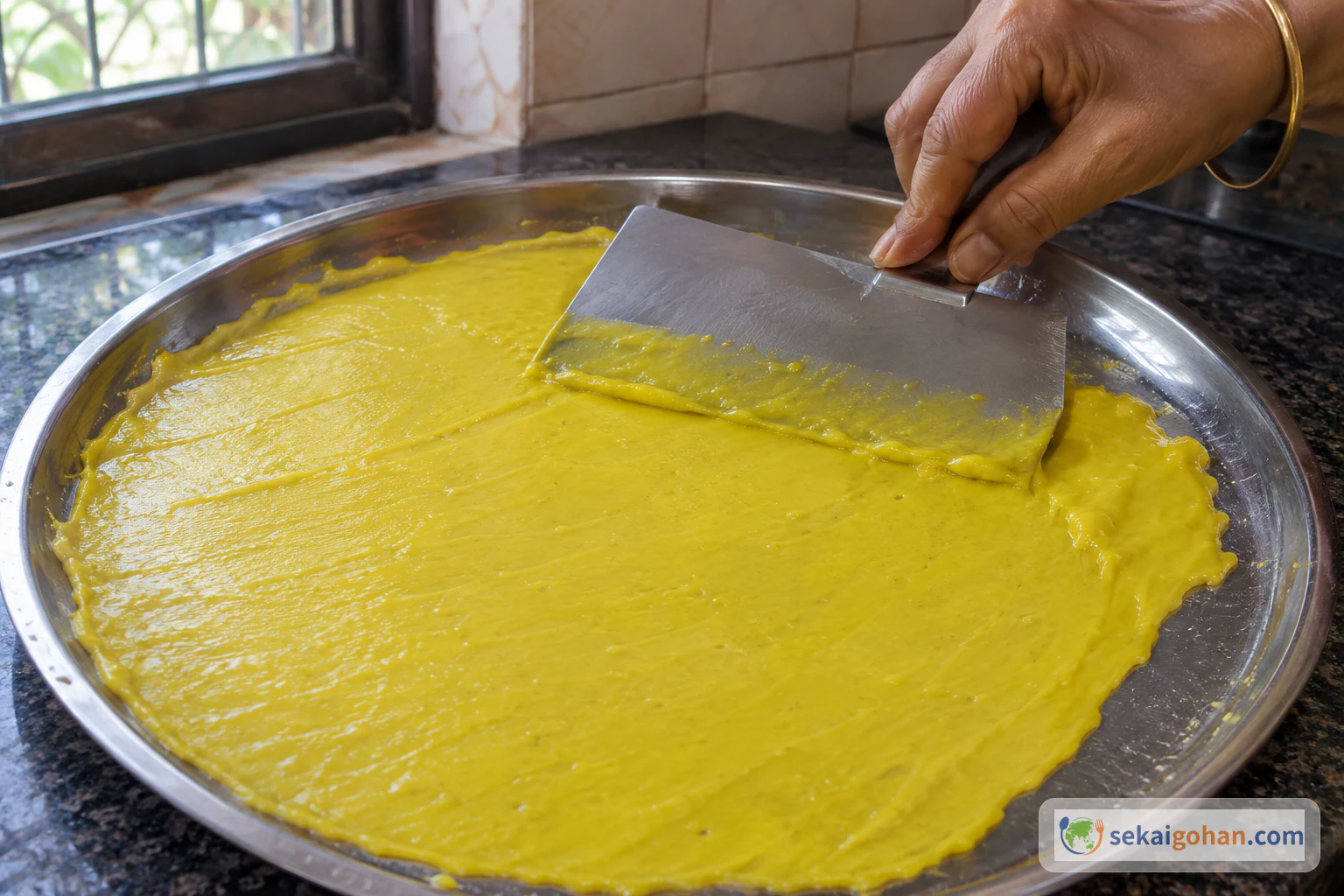
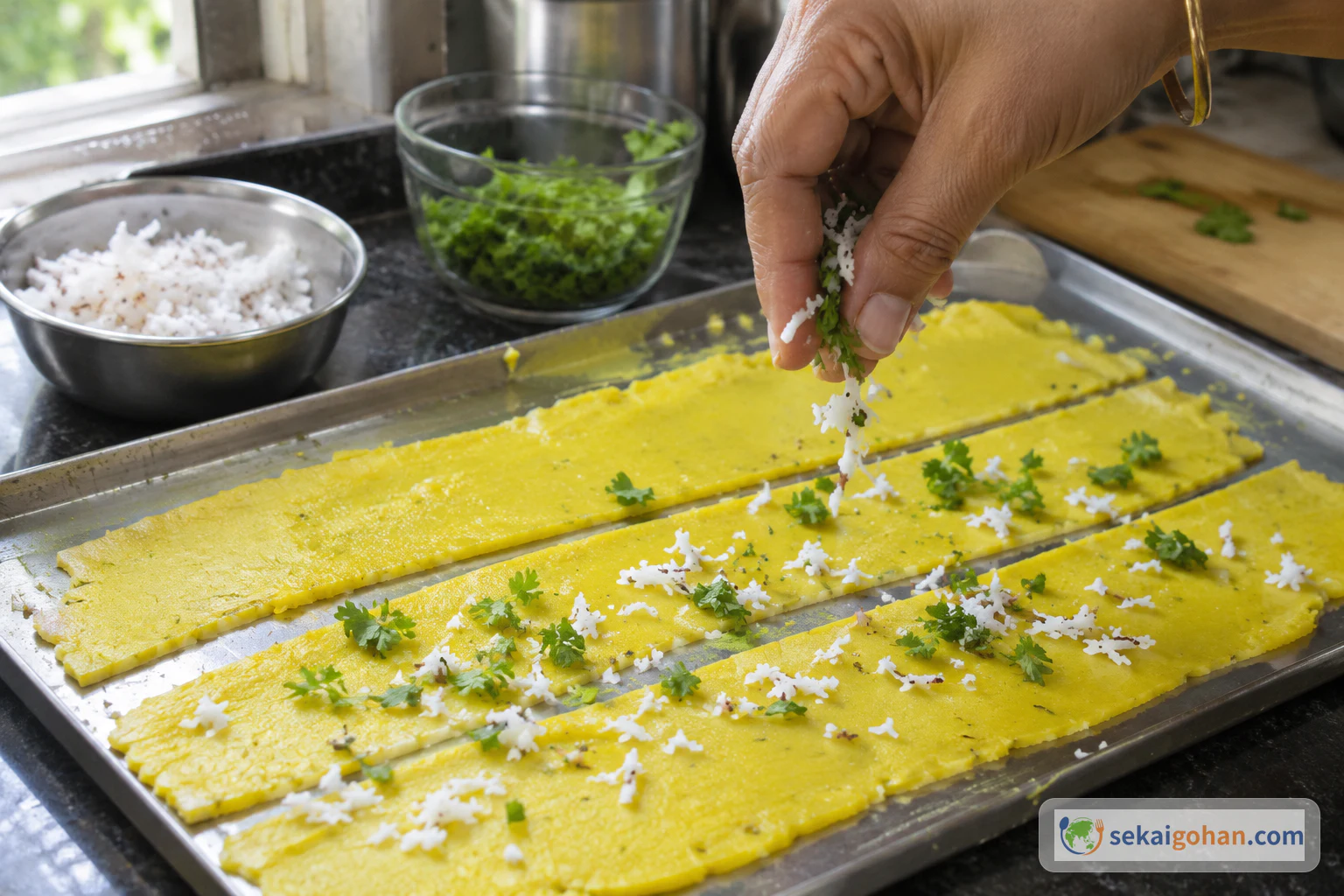
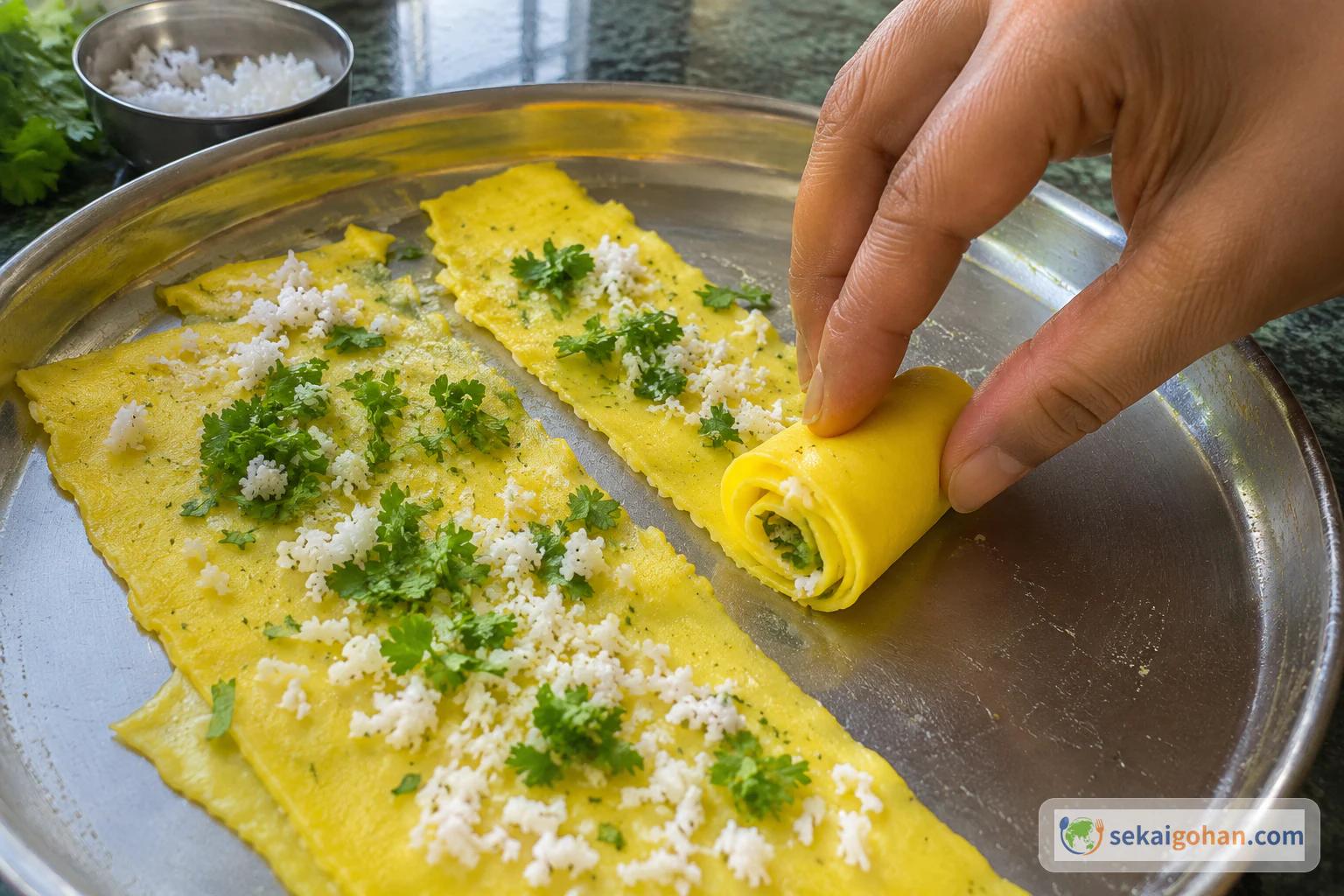
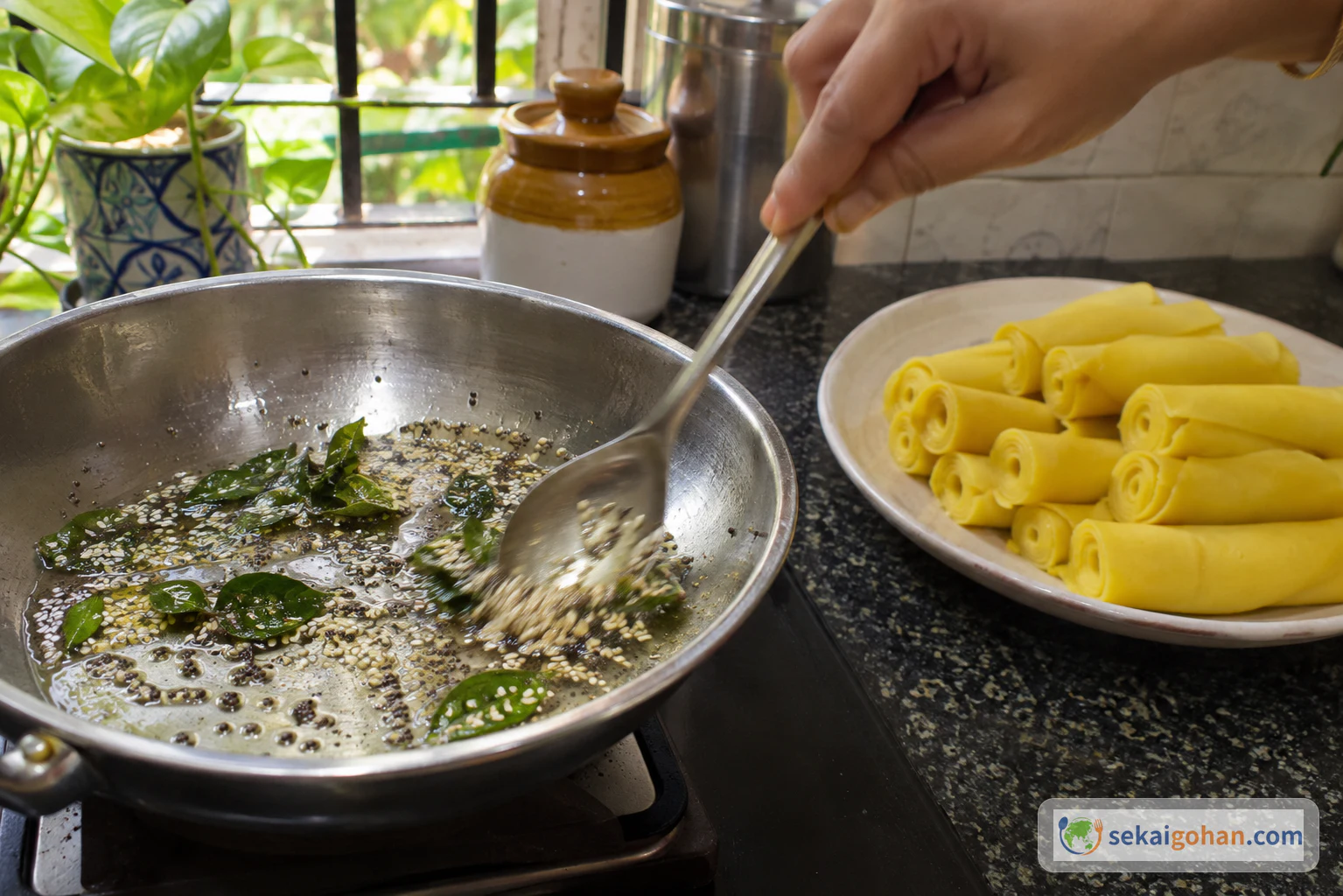
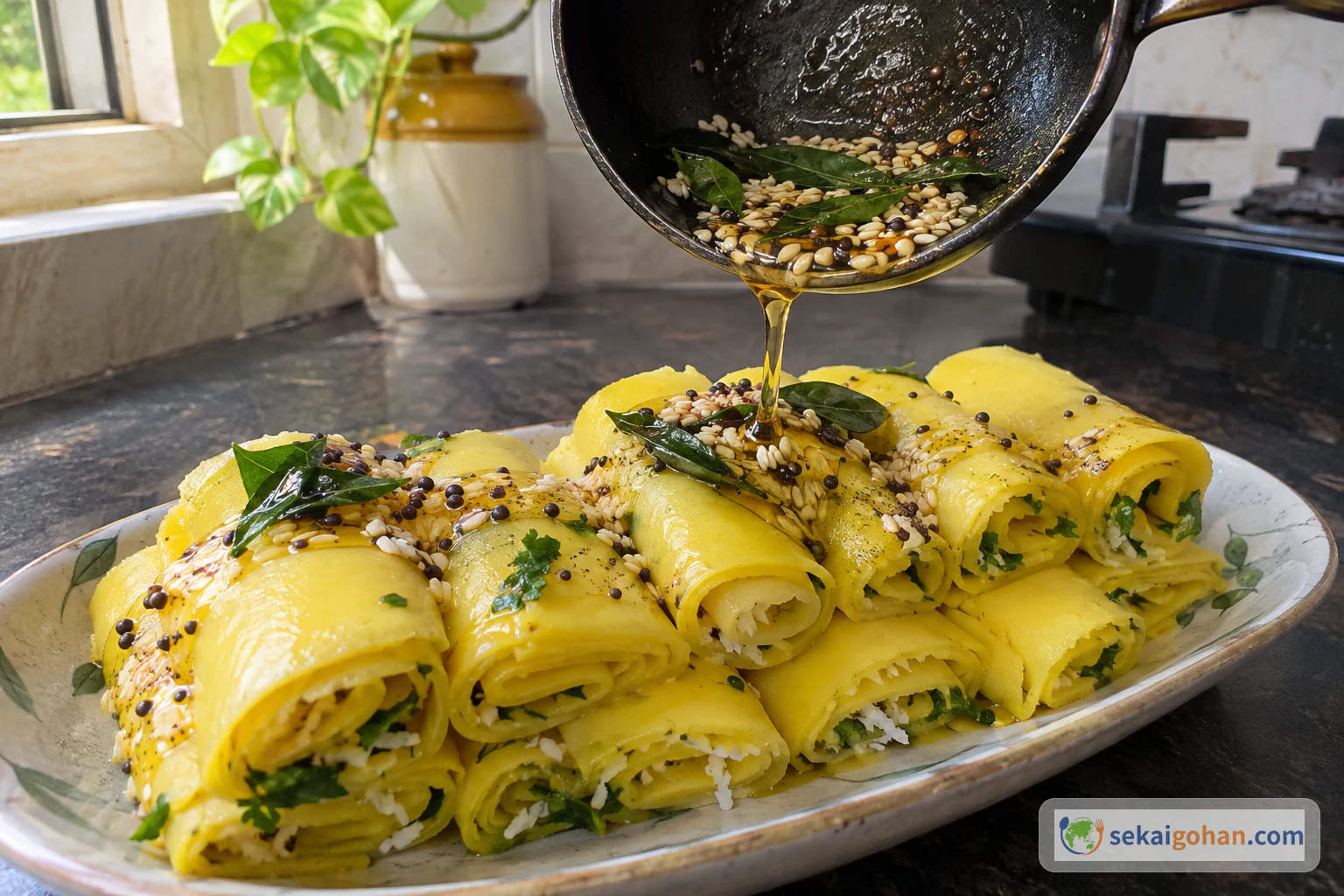
Khandvi starts as a pale yellow batter of gram flour and buttermilk, stirred over low heat until it begins to pull away from the sides of the pan. Then the pace changes. The hot batter goes onto the back of an oiled thali and is spread into a thin, even sheet, left to cool, then cut into strips and rolled around fresh coconut and coriander. A hot tempering of mustard seeds, hing, curry leaves and white sesame goes over the top just before serving.
Khandvi, Gujarat's Soft Gram-Flour Rolls
Khandvi is a Gujarati snack of soft, tightly rolled gram-flour strips. In this version the coconut and coriander stay inside the rolls, and only the cooked tempering sits on the outside. In Maharashtra, a related dish goes by the names Dahivadi or Suralichi Vadi, so this style of dish belongs to more than one region.
Recipes vary from kitchen to kitchen. Most follow the same pattern: besan and a sour dairy ingredient are cooked, spread thin, cooled and rolled, but each cook settles on their own proportions. You can explore more of the country's dishes on our India page.
Ingredients for the Batter, Filling and Tempering
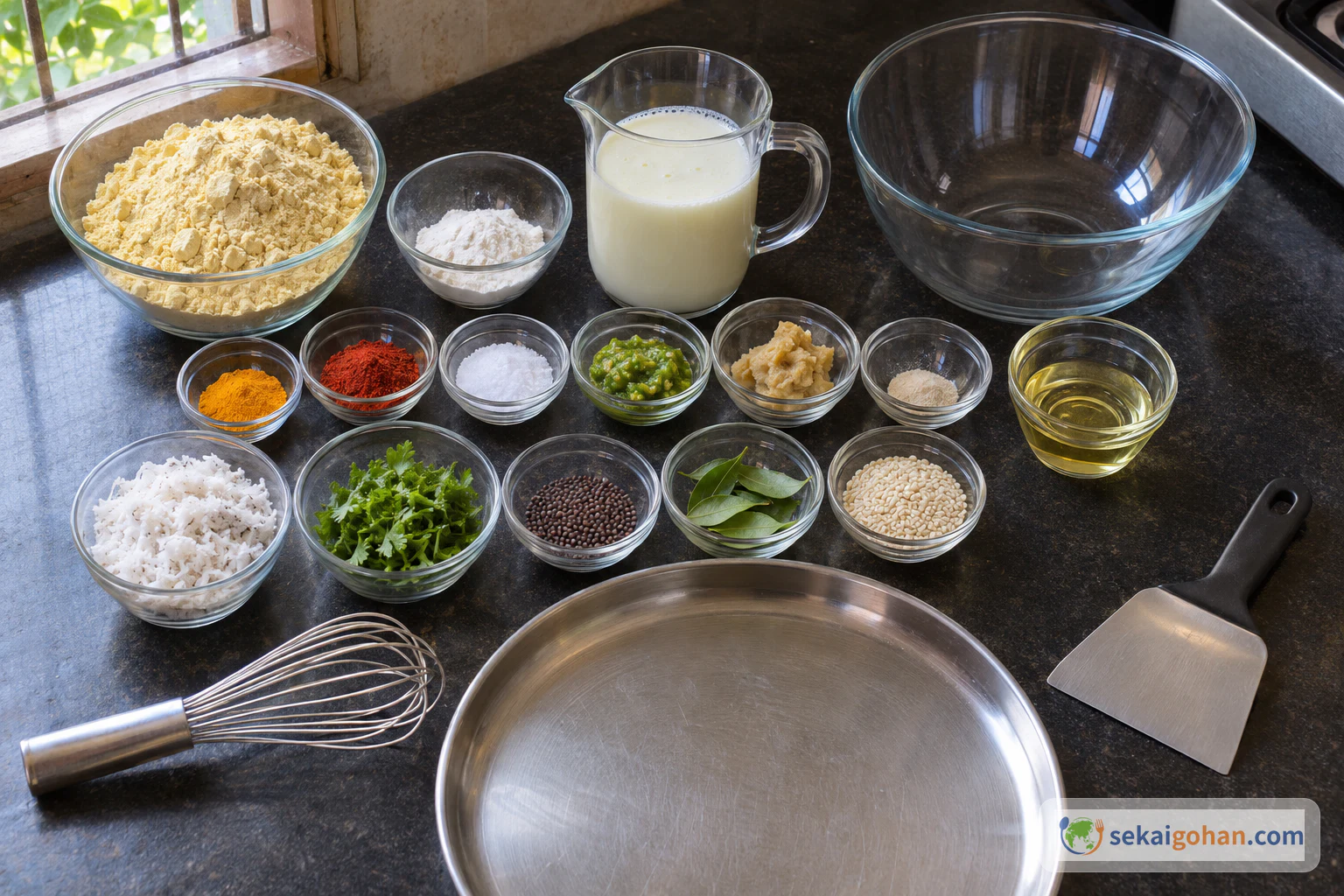
This recipe contains wheat (maida), milk (buttermilk), sesame and mustard, so it is not gluten-free. Compound hing can contain wheat flour or other ingredients, so read its label. Check the ingredients and allergen labeling on your buttermilk as well.
The coconut and coriander are not cooked. They are rolled into the batter after it has been cooked and cooled, so the tempering poured over the outside does not cook or sanitize them.
Choosing Ingredients for Khandvi
- Besan: Choose a flour made from chickpea. Roasted soybean flour, potato starch and wheat flour are different products.
- Maida: Keep this in. It is a small amount, but it is part of the batter.
- Buttermilk: Products vary by store and country, so read the label.
- Red chilli powder: Chilli type and heat vary, so taste your powder before using it.
- Green chilli paste: Bought pastes vary in salt and moisture. Finely chopped green chillies with no added salt work instead.
- Ginger paste: Freshly grated ginger is an easy swap, though its moisture and fiber differ.
- Oil: Use a mild-smelling oil.
- Mustard seeds: Use whole seeds; prepared mustard and mustard paste won't work.
- Curry leaves: Use fresh or frozen leaves. Dried leaves smell different and give a different result.
- Where to look: Indian grocers, import shops and online stores usually carry besan, hing and curry leaves under those names.
Equipment
- Mixing bowl
- Whisk and spoon
- Nonstick kadai or deep frying pan
- Flat spatula
- Flat, heatproof metal thali or plate (the back is used for spreading)
- Brush for oiling the thali
- Wide flat scraper
- Knife and cutting board
- Coconut scraper
- Shallow nonstick pan for the tempering
- Serving plate
Method: Cook, Spread, Cool, Roll, Temper
The photos show the order of work and what each action looks like. For amounts, temperature, doneness and food safety, follow the text.
Khandvi Troubleshooting
Have everything set out before the batter finishes cooking. It has to be spread thin while still hot, and the rolling comes only after it has cooled.
Most problems with khandvi come down to two moments: knowing when the batter is cooked, and getting it onto the thali before it cools.
| What you notice | Likely point to check | What to do |
|---|---|---|
| Lumps in the batter | The buttermilk went in too quickly, or wasn't whisked enough | Keep whisking before the batter goes on the heat, and next time add the buttermilk more gradually |
| The batter hasn't left the sides after 20 minutes | Stoves and pans differ | Keep cooking and watching until the batter pulls away from the sides |
| The batter is hard to spread | It cooled before spreading | Next time, oil the thali ahead and move straight from the pan to the thali |
| The sheet is hard to cut or lift | It has not cooled and set | Let it cool longer before cutting |
| The rolls don't hold, or the texture seems off | Several things can cause this | Review the pull-away sign and the cooling stage. Changing the proportions makes a different recipe |
Khandvi Variations
Each of these changes moves the dish a little away from the base recipe.
- Less heat: Reduce the green chilli paste. The flavor changes along with the heat.
- Dried coconut: If fresh coconut is unavailable, dried coconut can stand in. Its texture differs, so don't swap it in at the same amount.
- No coriander: Leave it out if it's hard to find or you dislike it; the finished dish will taste different.
- Soft wheat flour for maida: Use this if maida is hard to find. The swap still contains wheat.
Frequently Asked Questions
Is khandvi the same as dhokla?
No. Dhokla is made from a fermented batter that is steamed. Khandvi batter is cooked in a pan, spread thin, cut into strips and rolled, with no fermenting stage.
Can I replace the buttermilk with yogurt?
There is no yogurt conversion for the 3 cups of buttermilk. Buttermilk itself can be sour or fresh and sweet, and the recipe doesn't specify which.
How many milliliters is a cup here?
No cup size is given. Measure the flour and buttermilk with the same cup so their proportion stays correct.
Is the coconut and coriander filling cooked?
No. Only the batter is cooked; the coconut and coriander go in after it cools. Wash produce thoroughly under running water, without soap or detergent. Washing reduces bacteria but does not eliminate them, and neither the hot tempering nor the look of the finished rolls shows that they are safe.
Is khandvi gluten-free?
Not this version, because it contains maida, which is wheat flour. Compound hing can also contain wheat flour, so check its label too.
Can I make it ahead or store leftovers?
The recipe gives no storage or reheating instructions and ends at serving.