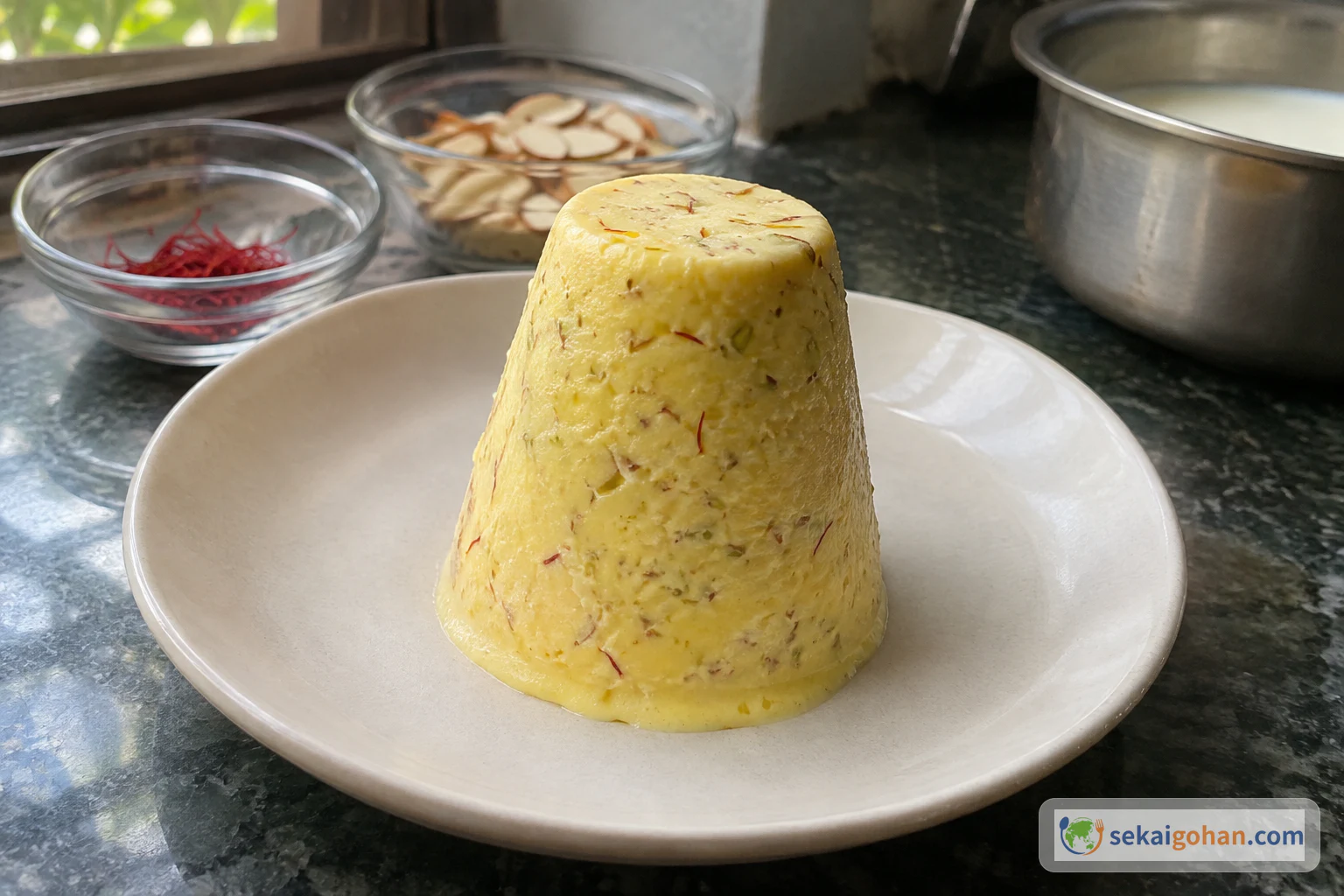
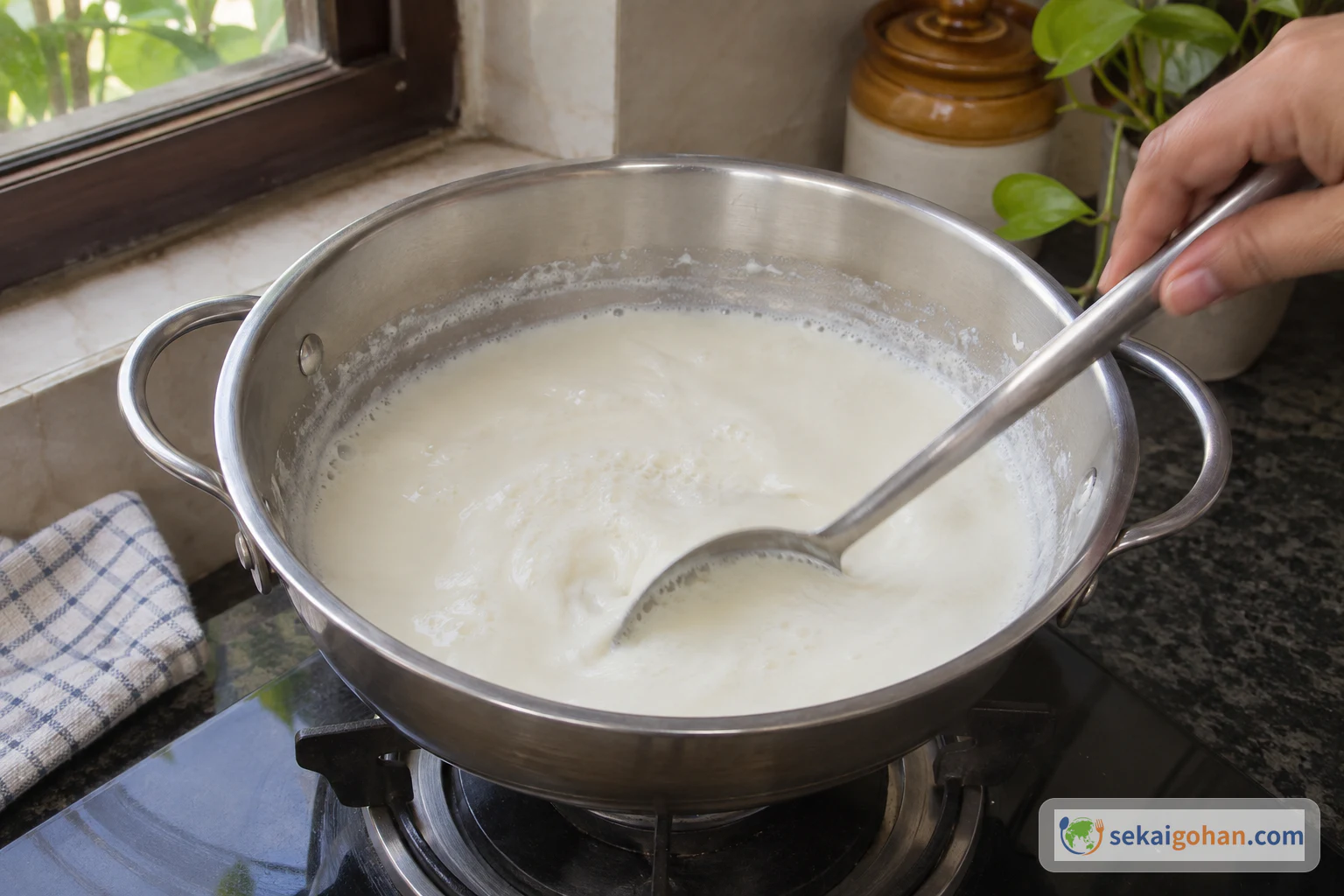
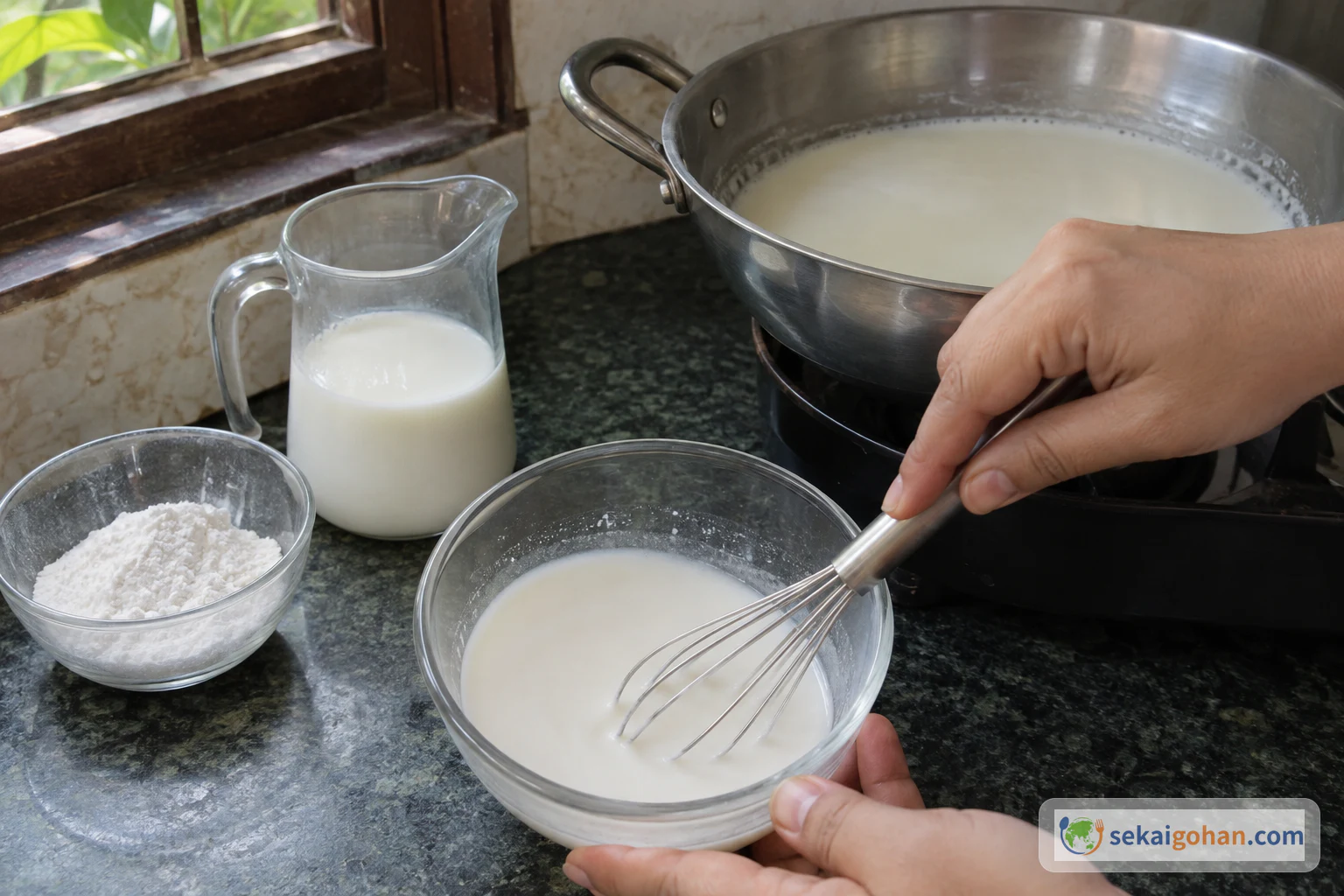
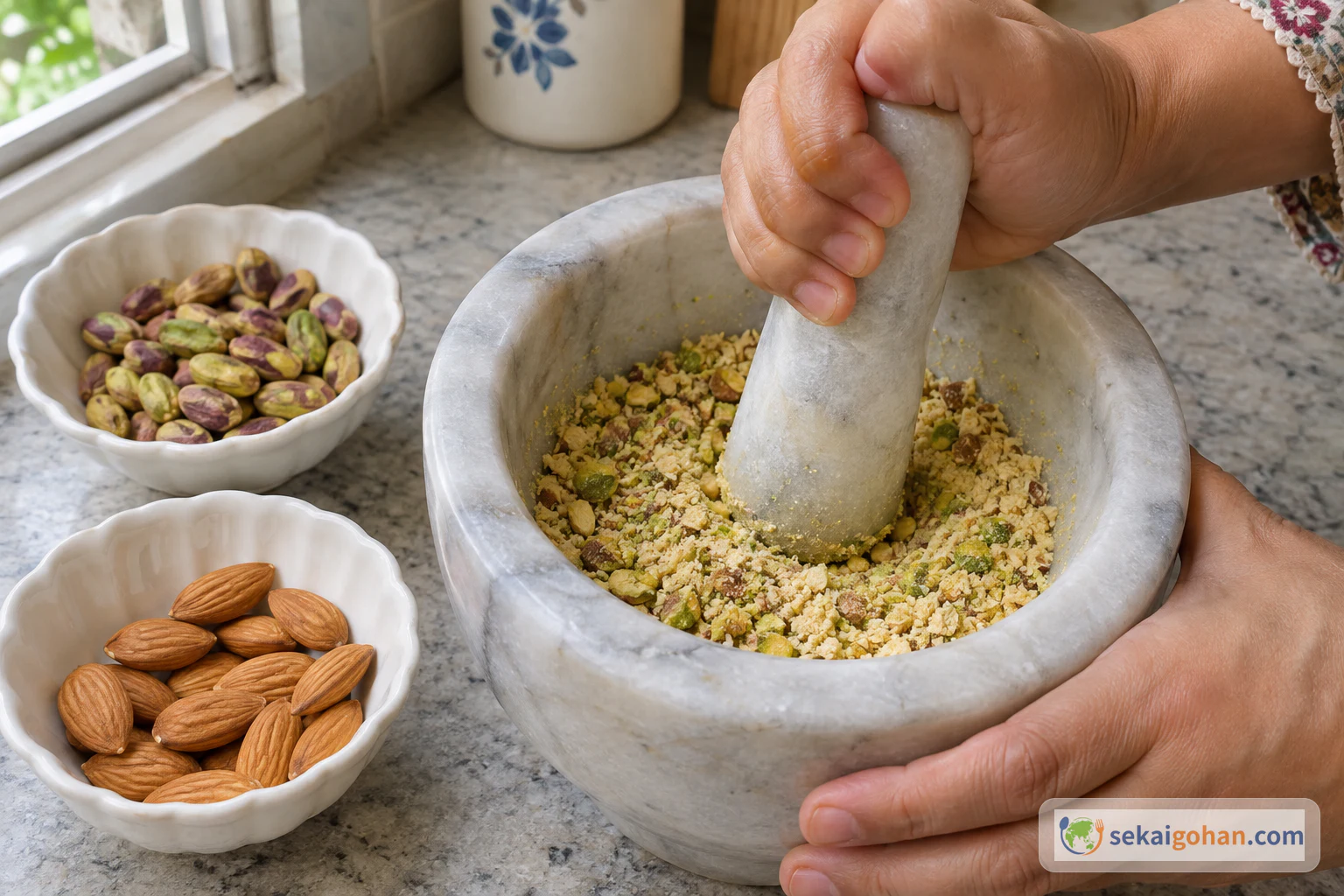
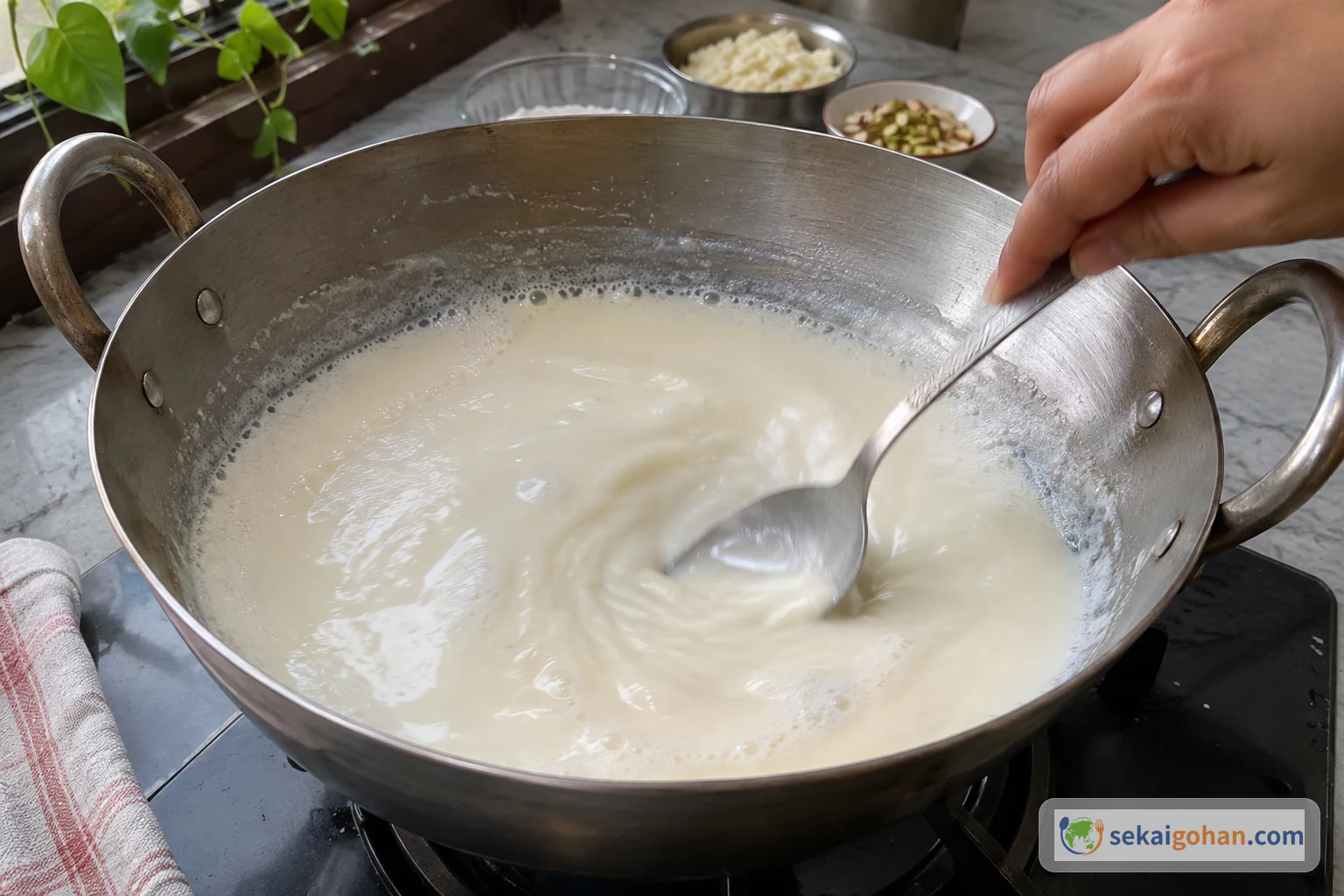
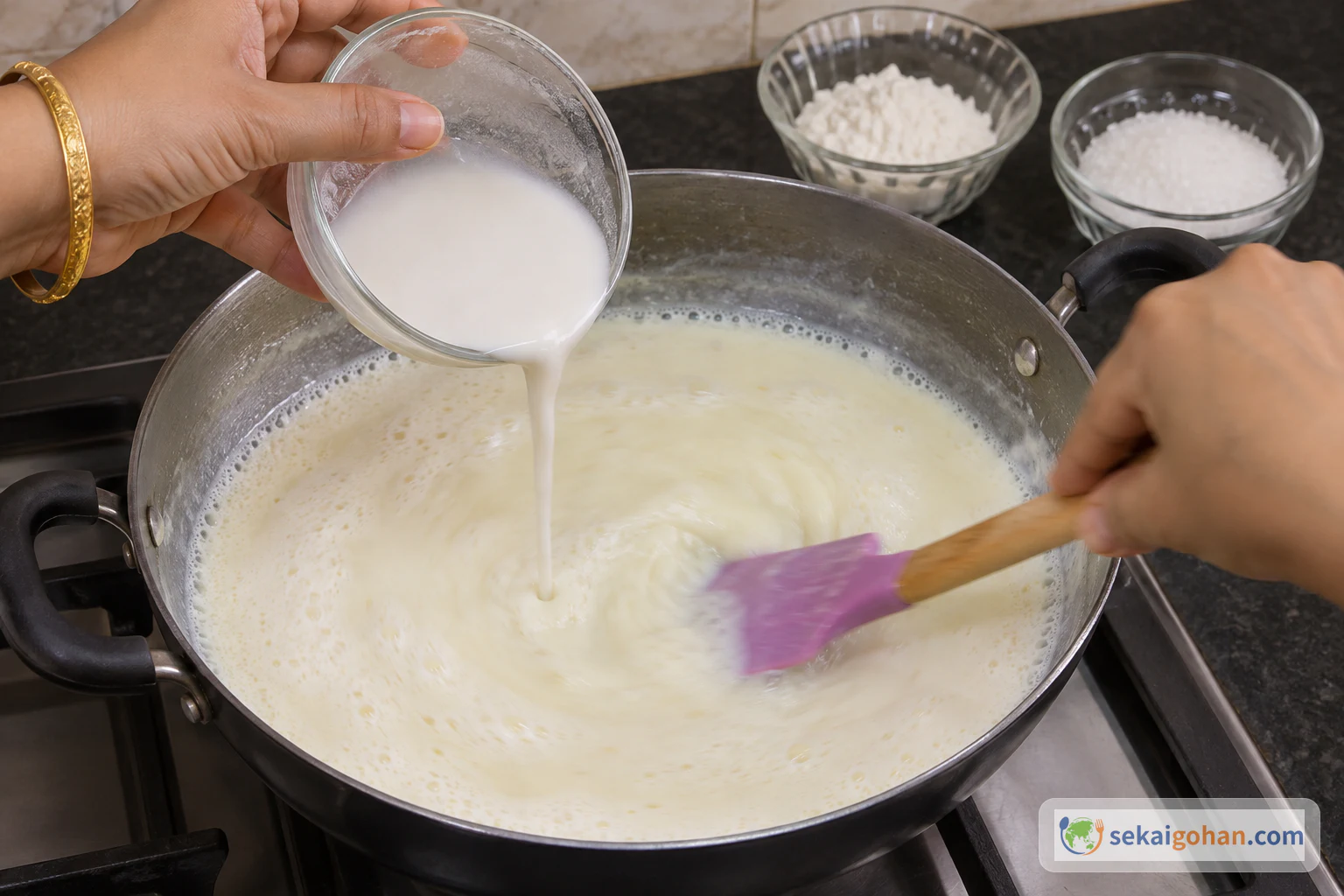
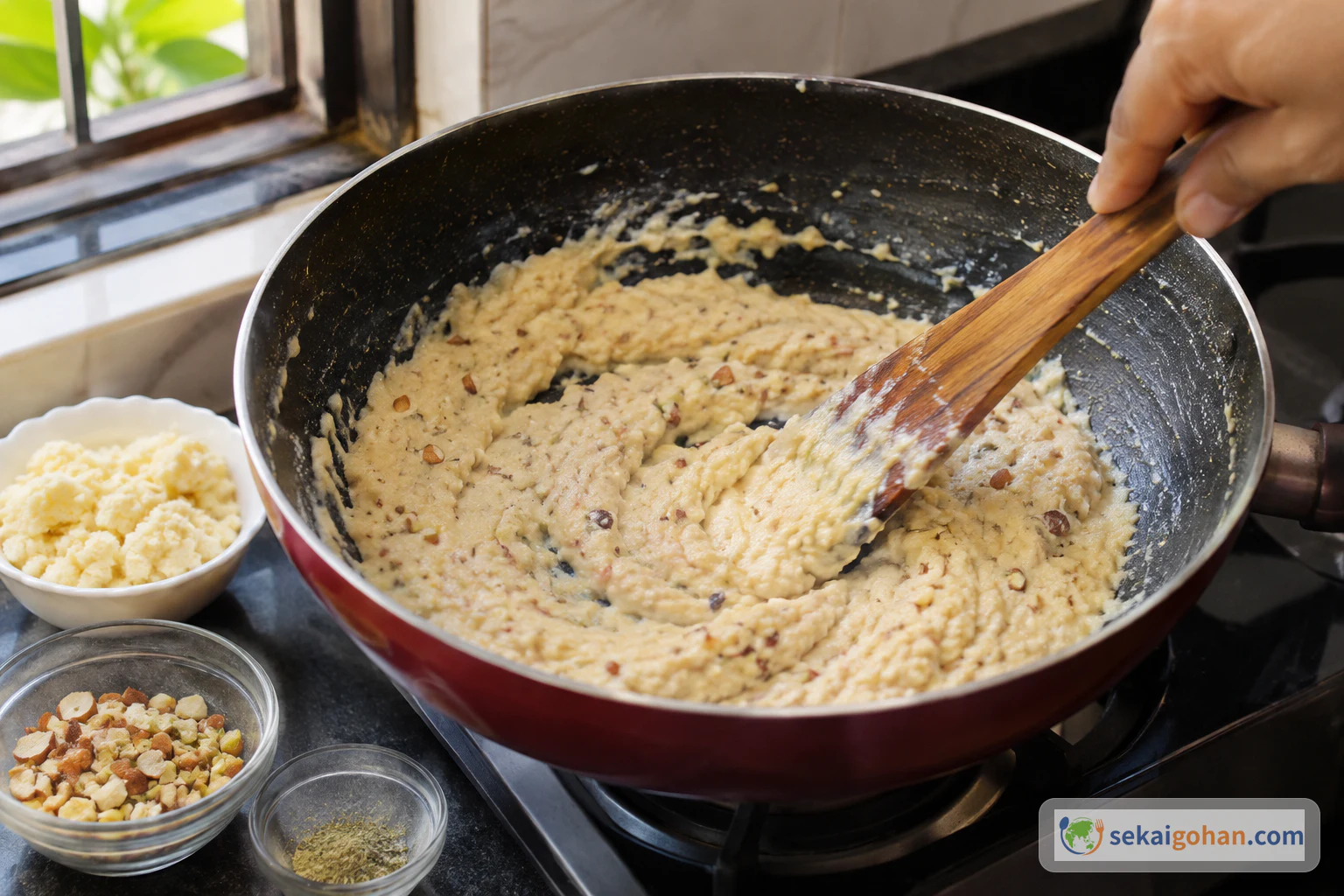
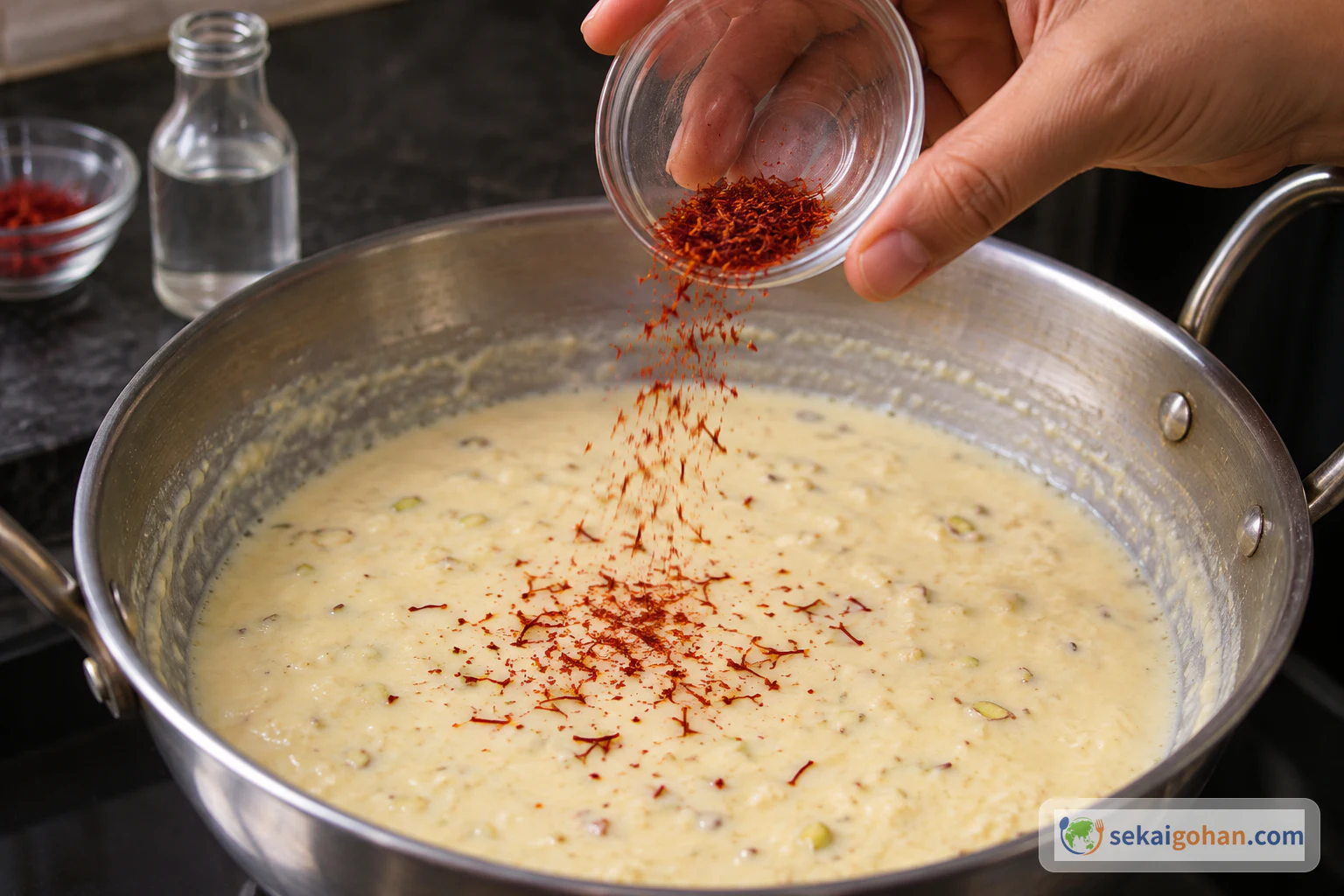
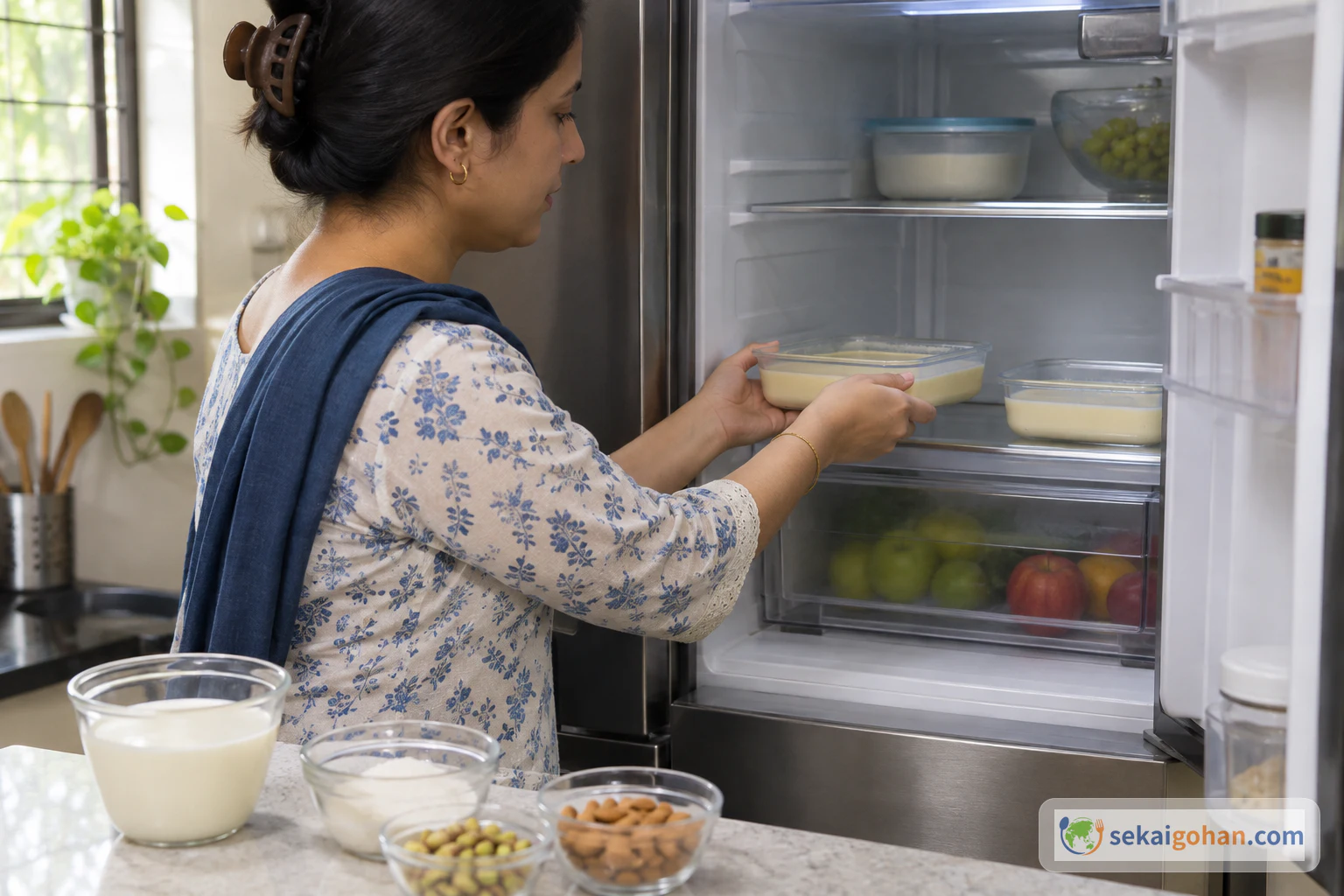
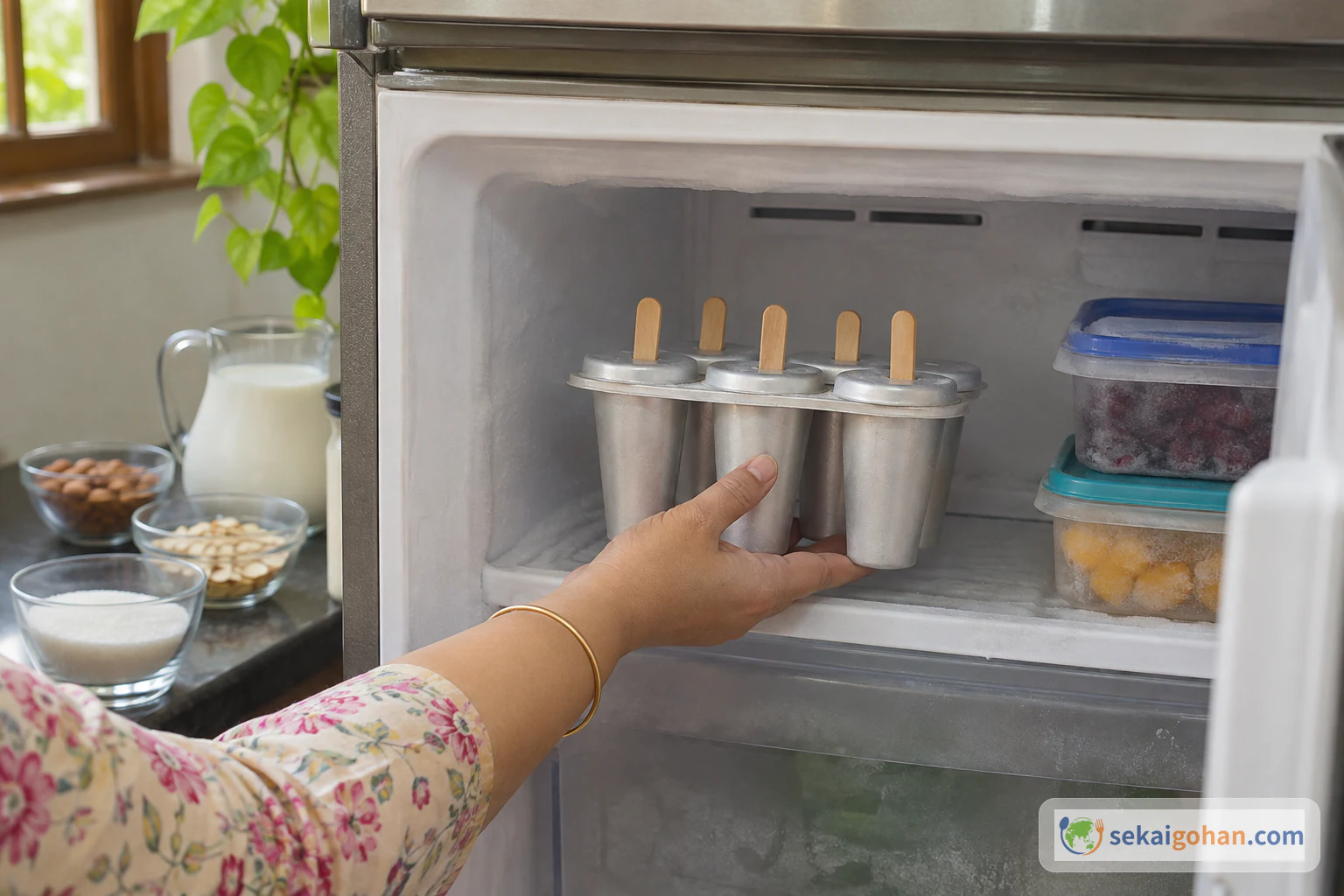
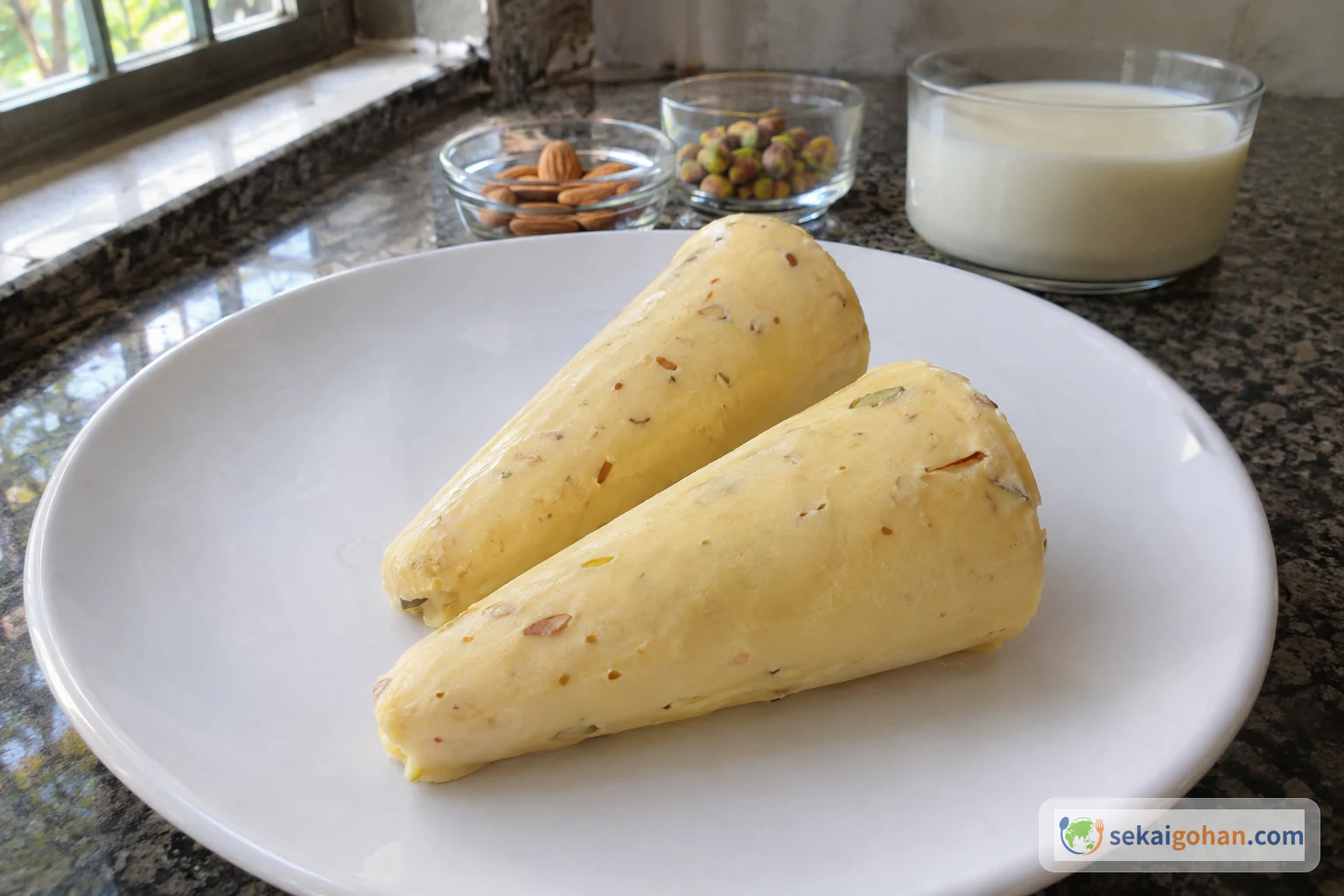
Kulfi sellers turn up in the hot months, and many families remember eating kulfi at Chowpatty in Mumbai with falooda, sabja seeds and rose syrup. Those memories explain why people love this dense frozen dessert so much. Kulfi starts with whole milk, reduced slowly in a wide pan and thickened with a rice flour slurry. Grated khoya, ground pistachios and almonds, and powdered cardamom make it richer. Rose water and crushed saffron go in once the heat is off, so their scent stays bright.
Kulfi in India
Kulfi is one of India's best-loved desserts, and you can explore more of the country's food on our India page. It is a dense frozen dairy dessert that is traditionally not whipped, and it comes in several familiar flavor families. People eat it on sticks or cut into cubes, often after a spicy meal.
Some kulfi recipes call for whisking the base again and again as it freezes. This one is left alone in the freezer, so it keeps its compact texture.
Ingredients for 3 Servings
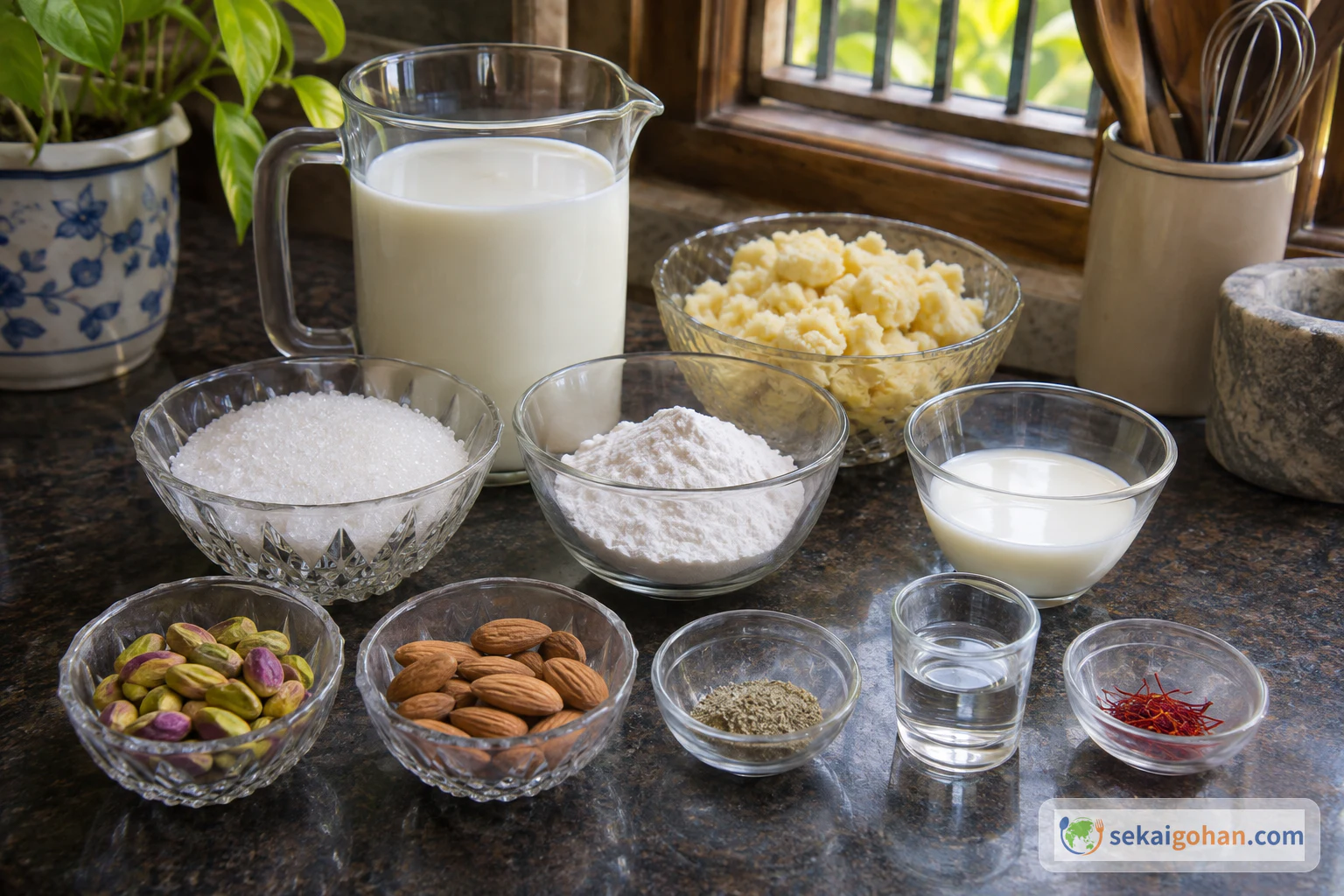
This kulfi contains milk, almonds and pistachios. Check the labels on packaged ingredients as well.
Equipment
- Wide, heavy pan or kadai
- Spatula or spoon for stirring
- Small bowl for the slurry
- Fine grater and a clean dish for the khoya
- Mortar and pestle or a dry grinder for the nuts
- Small mortar and pestle for the saffron
- Small, shallow, heat-compatible food containers
- Freezer-rated food-use kulfi molds with lids
- Butter knife
- Appliance thermometers for the refrigerator and freezer
- Plain serving plate
Choosing Ingredients for Kulfi
Khoya (mawa) is made from evaporated milk solids, so it is solid rather than liquid. Look for it at an Indian grocer and follow the label for storage and cooking. Canned evaporated milk is a different product and cannot be swapped straight in.
Milk should be pasteurized whole milk sold for food use. Raw or unpasteurized milk is not suitable here.
Rice flour is the thickener here. Potato starch and cornstarch are different starches.
Pistachios should be unsalted and already shelled. Rose water should be a liquid sold for food use, which is different from rose essence or kewra water.
Molds must be suitable for the freezer and have food-safe lids. Ordinary drinking glasses are not always freezer-safe, so check before using one.
How to Make Kulfi
Steps 4 to 9 are prep that runs alongside the reducing milk, so keep returning to the pan to stir.
Kulfi Troubleshooting and Safe Cooling
Cooling the Base
Cool the base quickly in the refrigerator. Divide the hot base into small, shallow containers and refrigerate them right away. Keep the refrigerator at 39°F (4°C) or below and the freezer at -18°C or below, and check both with an appliance thermometer.
Perishable food should spend no more than 2 hours unrefrigerated, or 1 hour above 90°F (32°C). Those are maximums, not waiting time, and the base still needs to cool all the way through. Freezing does not destroy harmful germs, so careful handling before freezing matters.
Scorching, Lumps and Stuck Molds
| What you see | What to check | What to do |
|---|---|---|
| Milk catching on the bottom of the pan | Heat level and how often you stir | Keep the heat low, stir often, and scrape the pan sides at the stages given |
| The milk has not visibly reduced after 18–20 minutes | Your pan and burner | Treat the time as a minimum, and keep stirring until it has reduced |
| Small lumps after adding the slurry | Whether the slurry was smooth and you stirred as you poured | Press the lumps out with a spatula |
| The base has not thickened right at 4–5 minutes | Your pan and burner | Keep stirring and go by the thickening, adding the khoya once it has thickened |
| Khoya not spreading evenly | How finely it was grated | Stir on low heat for the 1–2 minutes given, and grate it more finely next time |
| The base is still warm when you want to fill the molds | How long it has been in the refrigerator | Keep it in the refrigerator, and fill the molds only once it has cooled |
| Kulfi still soft after a day | Actual freezer temperature | Check that the freezer is at -18°C or below, and leave the kulfi until frozen solid |
| Kulfi won't leave the mold | Whether it is fully frozen and the edge is loosened | Make sure it is solid, then slide the butter knife around the edge again |
Serving Kulfi and Other Styles
Serve kulfi as soon as it leaves the mold. You can slice an unmolded kulfi, and kulfi from stick molds can be served as it is. One whole kulfi on a plain plate is all it needs, though in India it also turns up in a clay pot (matka) or with falooda, sabja seeds and rose syrup.
Other styles of kulfi each have their own recipe and proportions, so treat them as separate dishes instead of tweaks to this one:
| Style | Type | How it differs |
|---|---|---|
| Malai kulfi | Restaurant recipe | Reduced milk and cardamom, with evaporated milk and cream |
| Mango kulfi | Restaurant recipe | Adds Alphonso mango purée |
| Pistachio kulfi | Restaurant recipe | Uses pistachio paste |
| Full-cream milk kulfi | Separate recipe | Milk reduction with powdered sugar, cardamom, pistachios and saffron |
| Condensed-milk, churned and vegan kulfi | Alternative methods | Different ingredients or methods from this khoya version |
| Served in a clay pot (matka) | Serving style | A way of serving |
| Served with falooda, sabja seeds and rose syrup | Serving style | Accompaniments |
Frequently Asked Questions
What if I can't find khoya?
Look for commercial khoya, or choose a different kulfi recipe. Canned evaporated milk is not a direct replacement.
Can I use cornstarch or potato starch instead of rice flour?
Rice flour gives this kulfi its texture, and the recipe is written for it. Cornstarch, arrowroot and potato starch are all thickeners too, but this recipe uses rice flour.
Do the almonds have to be raw?
No. All the nuts cook in the base, and none are added raw as a garnish.
Can I add more sugar?
The recipe uses 3 tbsp of sugar. Taste the base and add more if you like.
Can I leave out the saffron or nuts?
You can, but you will end up with a different kulfi. If you have a nut allergy, leaving out or picking out the nuts is not enough, so check the other products you use as well.
How long does kulfi take in total?
The 35-minute cooking time does not include cooling or freezing. Freezing takes overnight or a day, until the kulfi is frozen solid.
How long can I keep it?
This kulfi is meant to be eaten right after unmolding. Freezing does not destroy harmful germs.