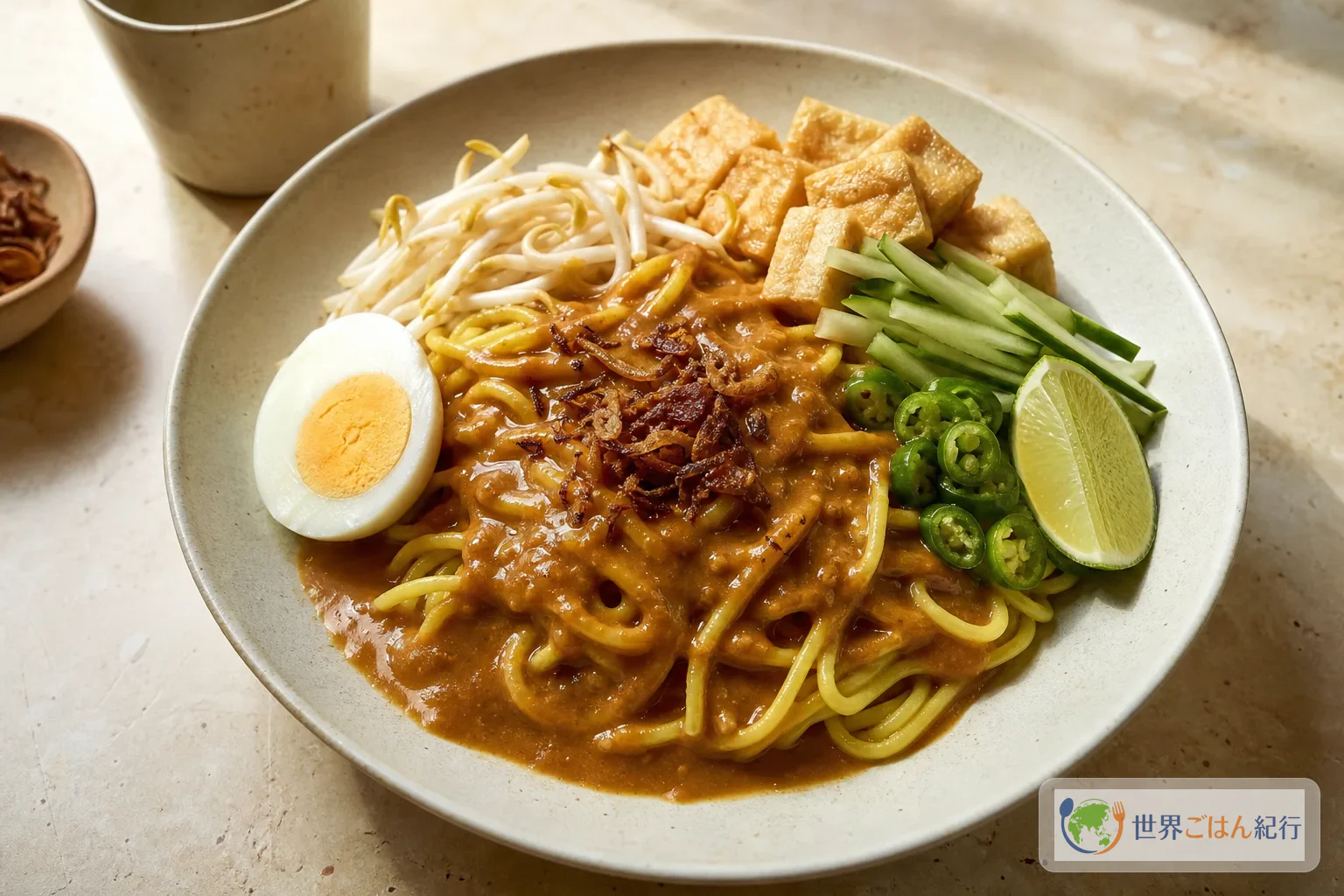
Slide a spoon into the bowl and the ochre gravy slowly creeps back between the yellow noodles. That gravy is the star of mee rebus, a Singapore hawker favorite. It's sweet, salty and full of umami, and sweet potato and aromatics give it body. It goes over boiled yellow egg noodles, followed by a boiled egg, bean sprouts, fried tofu, fried shallots and green chiles, so soft noodles meet toppings with some bite.
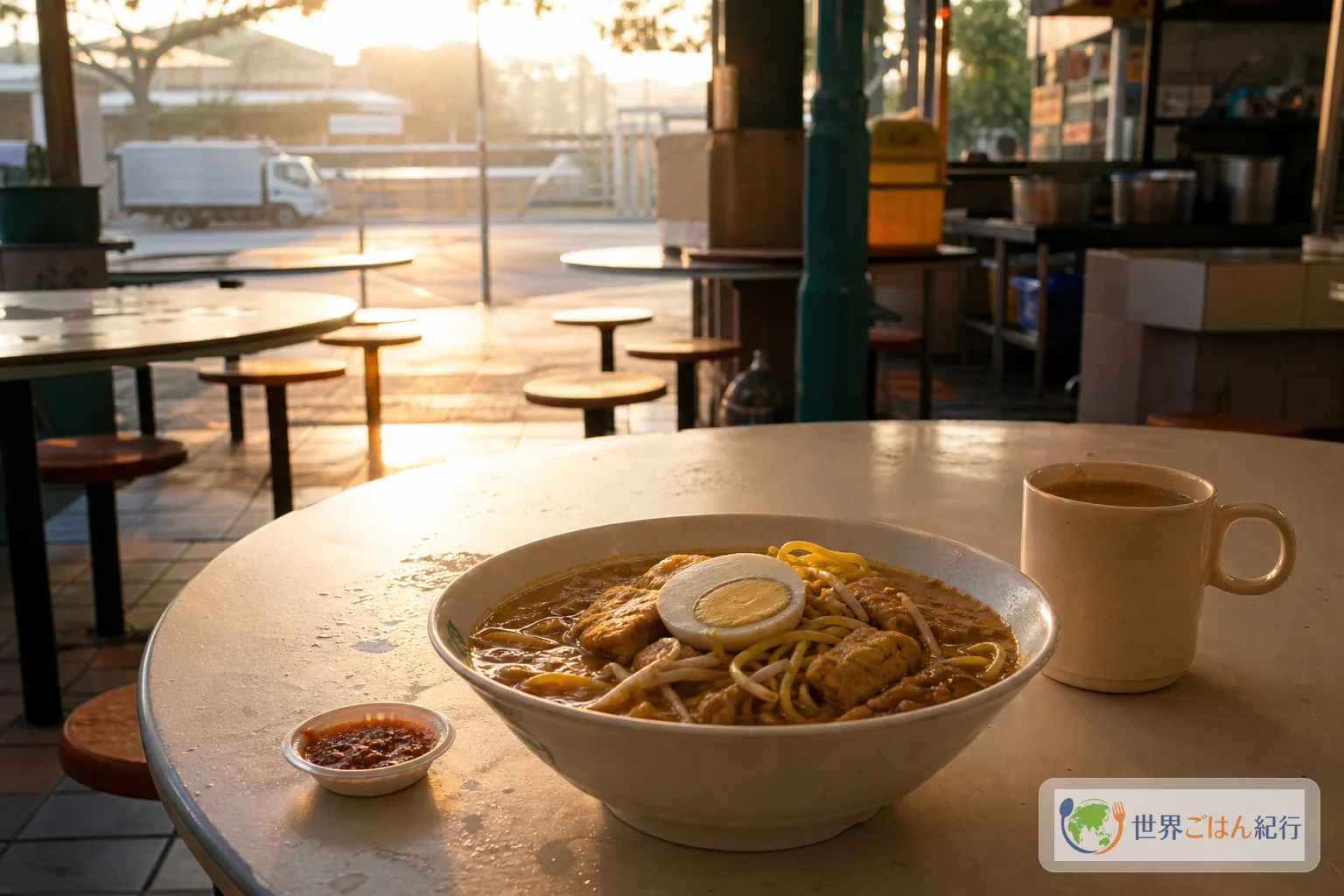
Mee rebus in Singapore's hawker culture
The name joins "mee," meaning noodles, and the Malay word "rebus," meaning to boil. Nobody agrees on a single region or community of origin. It is a dish of the Malay Archipelago, and theories point to Javanese, Indian-Muslim and Peranakan cooks from Penang. Chinese-style yellow noodles, a Malay name, Indian-style spices and each household's own aromatic paste all end up in one bowl, and that mix is what makes it so interesting in Singapore's hawker culture.
People eat it for breakfast, and also as a late-night meal after work on weekends. The usual bowl is noodles with gravy, egg, tofu, green chile and lime. Often the toppings are set out on the table so everyone can build their own.
Regional differences between stalls
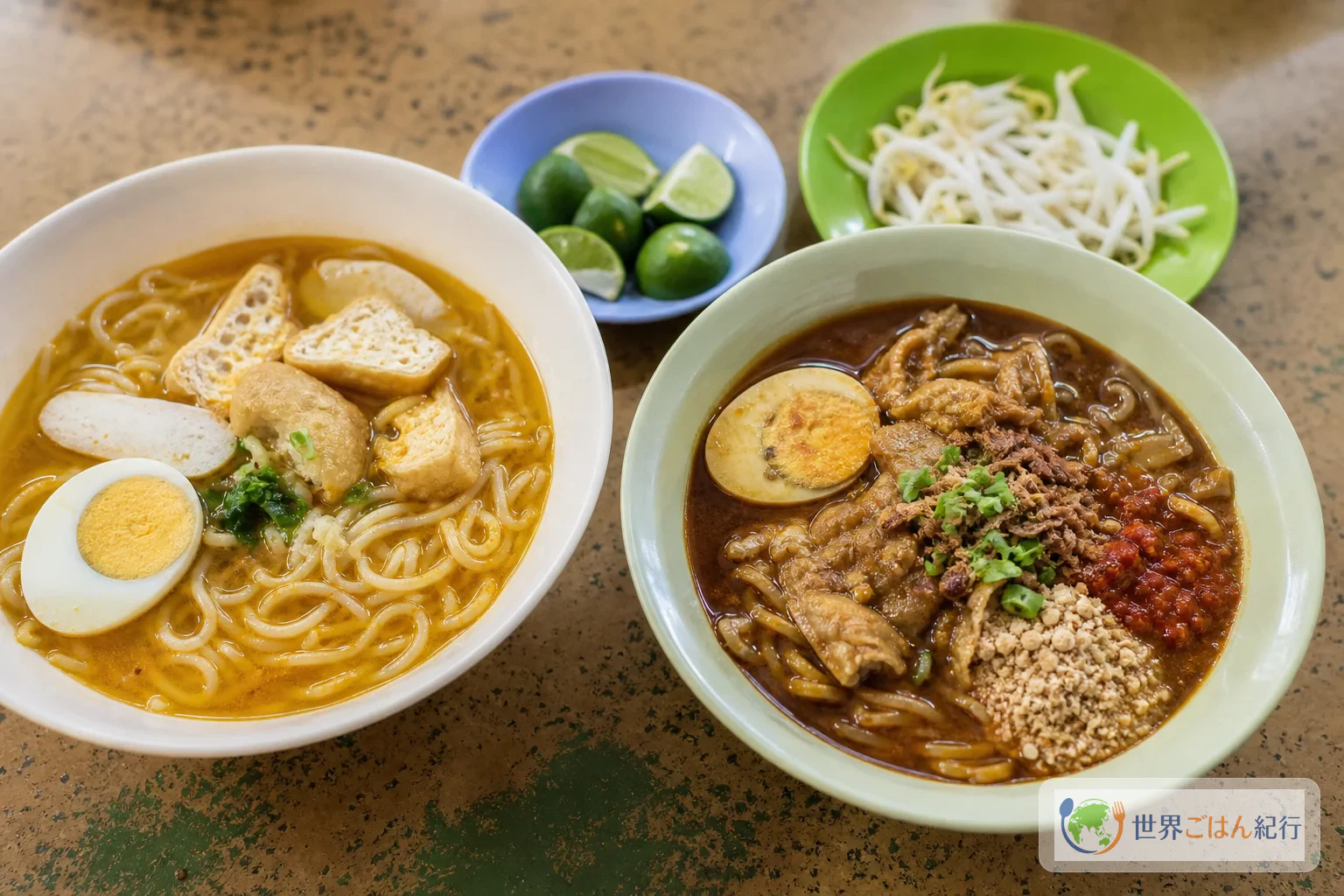
Singapore's stalls don't agree either. Some bowls are sweeter, some lighter, some hotter, and some get extra thickness from peanuts. Some stalls add beef or offal, while others stick to egg and tofu. Think of mee rebus as one name that every home and stall adjusts to taste, not as one authentic bowl.
The flavor and texture of the gravy
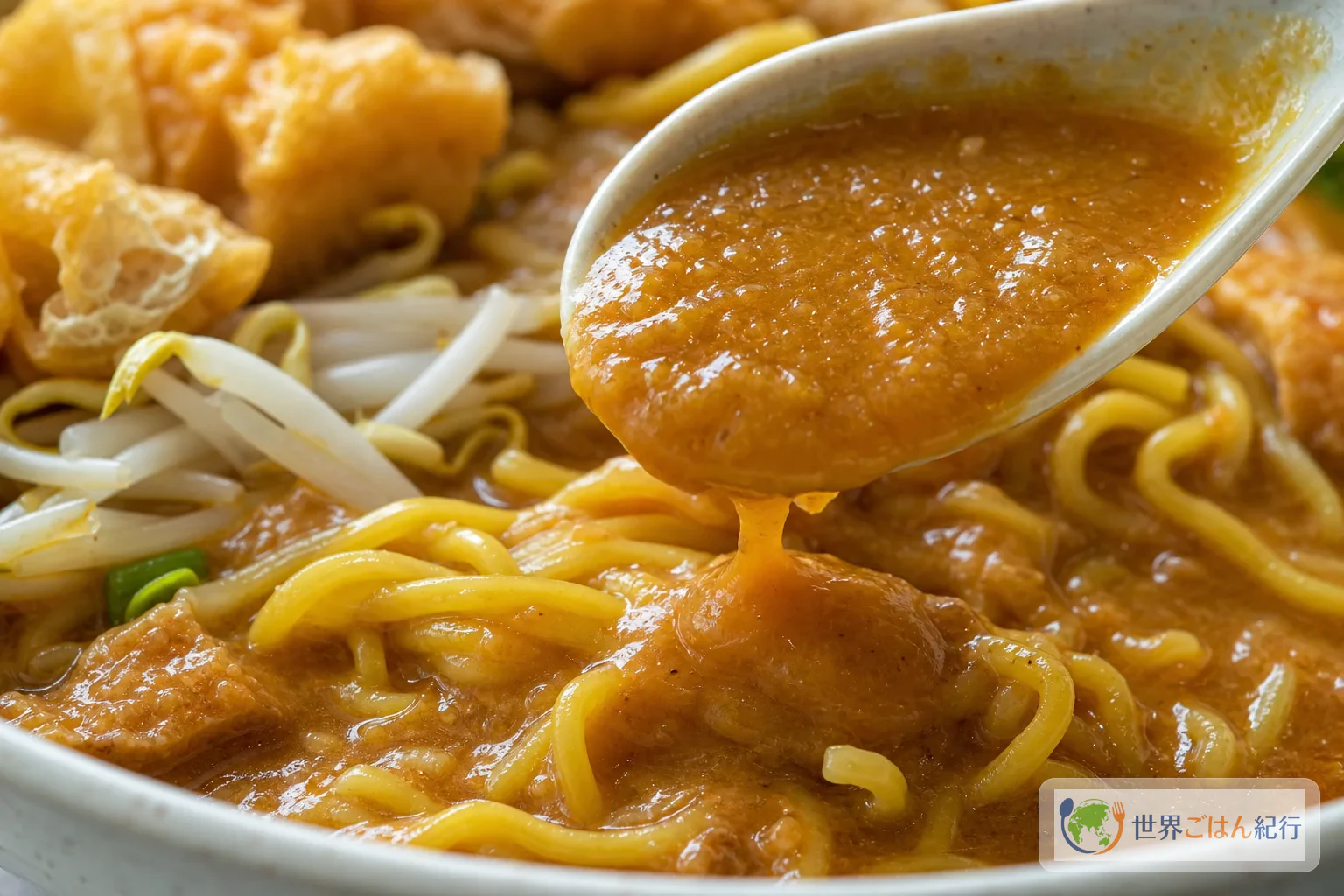
Good mee rebus gravy has body but still flows well enough to slurp the noodles. The flavors arrive in order. First comes the aroma of aromatics and curry powder, then the sweetness of sweet potato, and last the umami of dried shrimp and fermented soybeans, which lingers. Tamarind adds sourness and green chile adds heat. The heat isn't meant to turn the gravy red. It sharpens the outline of the sweetness.
Getting the body right is where most people go wrong at first. If you aim for a runny, curry-like liquid, the gravy comes out thin. If you rush to thicken it with starch, the round sweetness of the sweet potato disappears. And if you add too much tamarind to cut the sweetness, even the depth of the aromatics and dried shrimp turns sharp.
What you want is gravy that leaves a thin coat on the back of a spoon and flows when you tilt it. When you lift the noodles, it shouldn't all drop off at once. It should slide back into the bowl two or three seconds later. Sweet potato and peanuts can both give it body. In this recipe sweet potato does the main thickening, and the peanuts are there for aroma and texture.
Ingredients (serves 4)
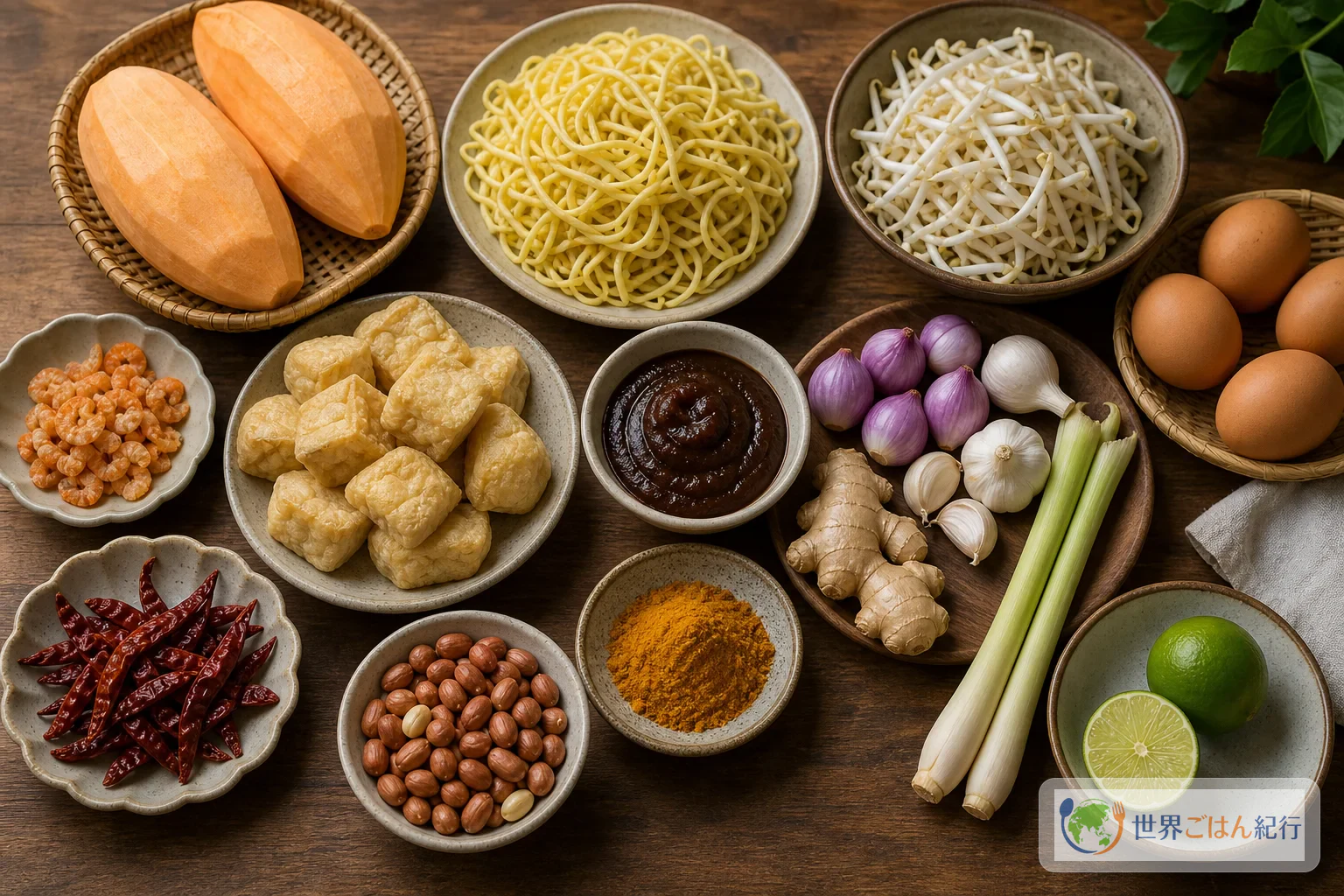
If you make the gravy the day before, the aromas of the dried shrimp, taucheo and lemongrass round out. Boil the noodles and bean sprouts just before eating, though. If you store the gravy mixed with noodles from the start, the noodles absorb the liquid and the good of the gravy is lost.
Sweet potato varies in sweetness, so don't add all the tamarind, sugar and salt at once. Keep room to adjust at the final tasting.
For steady sourness, use tamarind paste. Block tamarind dissolved in water works, but matching the concentration each time adds work. If you make Southeast Asian dishes a few times a month, paste is easier to measure. If you would be left with unused tamarind after this one dish, use lime juice instead of buying more.
Choosing ingredients and substitutes for mee rebus
You don't need every local ingredient, but every substitute changes the bowl a little. Cook the sweet potato, after steaming, until a skewer goes through without resistance. This dish uses dried shrimp, fermented soybeans and peanuts, so if you have a shrimp, soy or peanut allergy, check the substitutions column in the ingredient table. Many yellow noodles contain wheat and egg, so check the ingredients on the package too.
Yellow noodles
Fresh Chinese-style yellow egg noodles are your first choice. Gravy clings to their surface, and they give the bowl a hawker-style texture. Dried egg noodles are fine if you can't find fresh. Thin somen or udon hold liquid differently, though. If you use udon, take it out earlier than the package says, and start with less gravy, adding more later.
Taucheo
Taucheo, salted fermented soybeans, brings saltiness and umami at the same time. Red miso, 20 g, keeps the depth of fermentation, though the color and sweetness change slightly. The dried shrimp and stock already carry salt, so if you use miso, hold off on the 1/2 tsp salt at the start.
Dried shrimp
You notice dried shrimp less when you first taste the gravy than after you swallow, when its aroma lingers. You can leave it out if you dislike it, but swapping in fish sauce puts a different saltiness up front. To avoid shrimp, use a dried shiitake and kombu stock and increase the miso to 25 g, which makes it easier to rebuild the layers of aroma. If you need to avoid shrimp, seafood and fermented seasonings, check the sambal label as well.
Tamarind
Tamarind's job is to tighten the edges of the gravy. If you use a block, dissolve 20 g in 3 tbsp warm water and strain out the seeds and fibers before adding it. That adds more liquid than paste does, so cut the stock by 3.5 tbsp (50 ml) from the start. A salty pickled-plum paste on its own adds too much salt, and lemon juice alone lacks tamarind's round, tropical sourness. If you'd rather not buy something for one dish, use lime juice instead, a little at a time during the last tasting.
Peanuts
Peanuts don't only thicken the gravy, they also add a roasted aroma. For a peanut allergy, leave them out and increase the sweet potato by 1.75 oz (50 g). Cashews give a similar nutty aroma, but their sweetness is different, so cut back on the sugar and taste.
Equipment
No special equipment is needed. A food processor only pays off if you chop aromatics often, for this paste, sambal, curries and dumpling fillings. For a one-time cook, a knife and a mortar (or the bottom of a bowl) do the job and take up less storage space.
Method: connect the thickness of the gravy in the pot
1. Prepare the sweet potato and toppings first
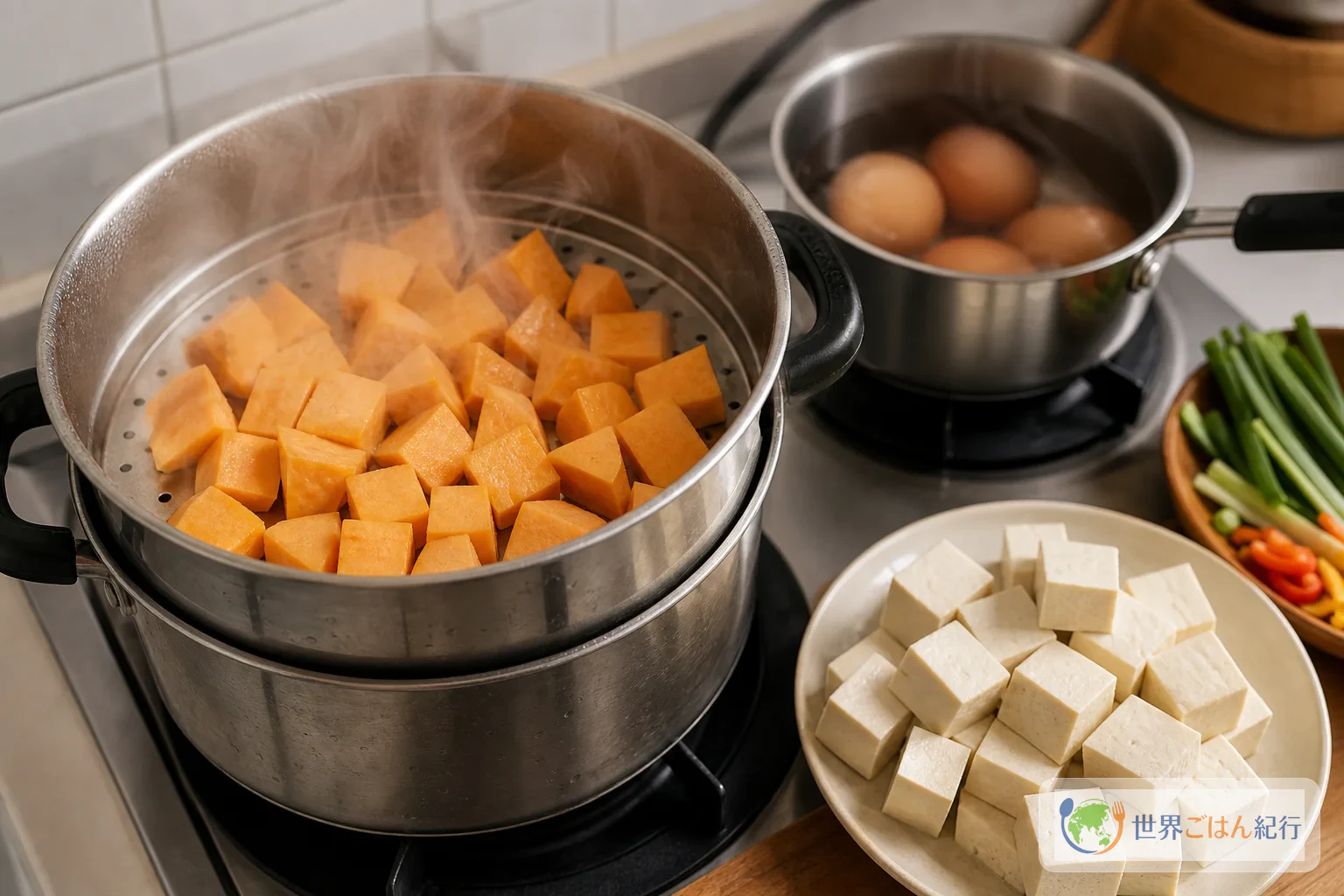
Peel the sweet potato, cut it into 1 inches (2 cm) cubes and cook it for 12–15 minutes in a steamer or in a little water. It is ready when a bamboo skewer goes into the center without resistance and the corners crumble when lifted.
Drain and coarsely mash while hot. You do not have to make a complete paste; it will dissolve into the gravy later. Mash until the pieces crush easily under your thumb, since large hard lumps stay in the mouth.
Boil the eggs for 9 minutes in boiling water, cool in cold water and cut in half. Cut the fried tofu into bite-size pieces and lightly brown the surface in a frying pan. Keep the cucumber, green chile and lime chilled until just before plating.
2. Make the aromatics a paste that falls from a spoon
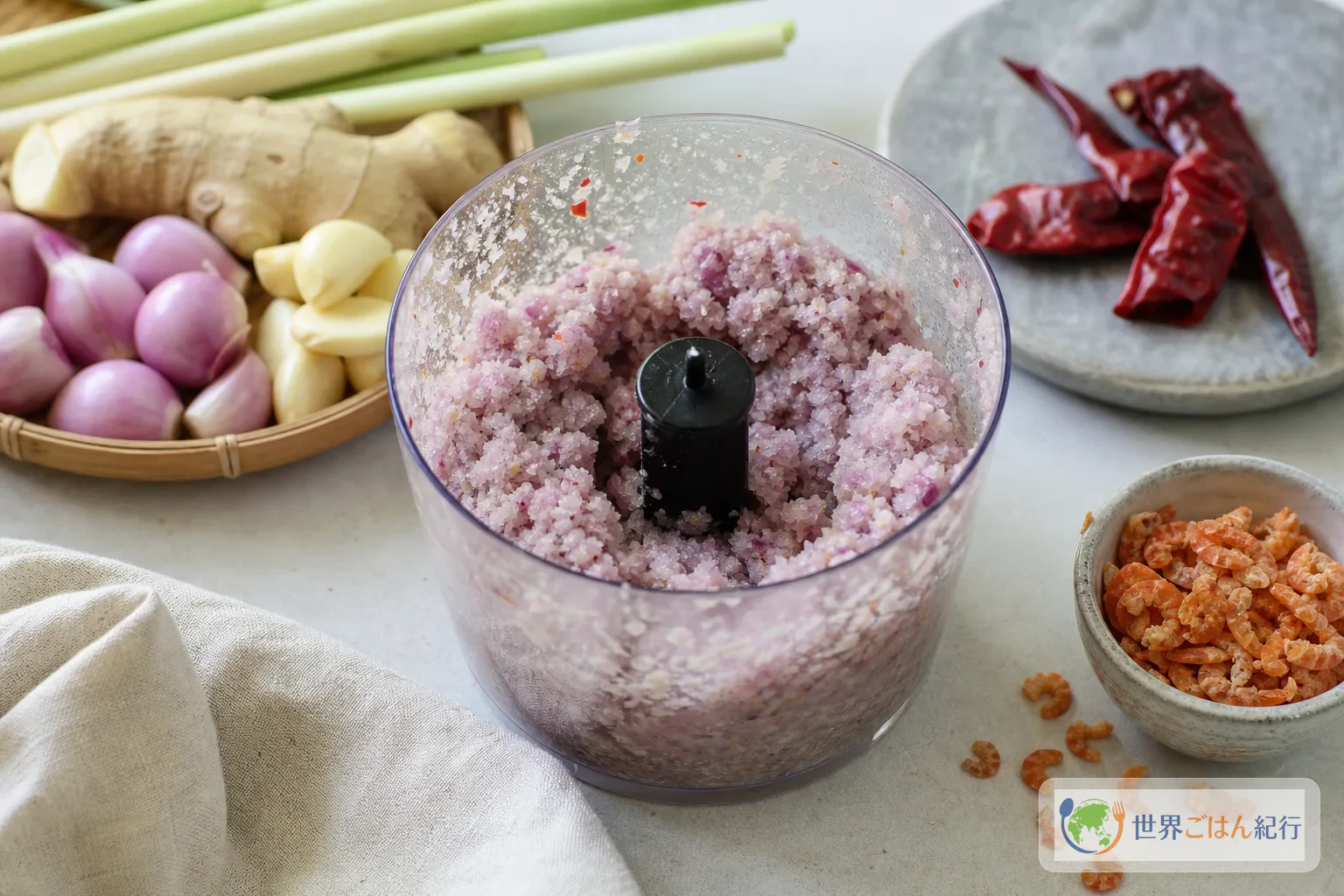
Soak the dried shrimp and red chiles separately in warm water for 10 minutes. Do not throw away the shrimp soaking liquid; if it is not too salty, use only 1–2 tsp of it later.
Put the onion, garlic, ginger, the white part of the lemongrass, the rehydrated chiles, the dried shrimp and the taucheo into a food processor. Add about 4 tbsp water and make a smooth paste that falls slowly from a spoon. If long lemongrass fibers remain, stop, scrape down the sides and run it again.
There is no need to taste the paste here before it goes into the pot. The saltiness of the dried shrimp and taucheo is strong, and before heating it tastes sharp. All you need to watch is the size of the pieces.
If you make pastes often, a food processor saves the work of chopping onion and lemongrass. For a one-time cook, a knife and mortar are enough. Use the processor only for the raw aromatic paste, never for blending hot gravy in a sealed container.
3. Fry the paste in oil to bring out the aroma
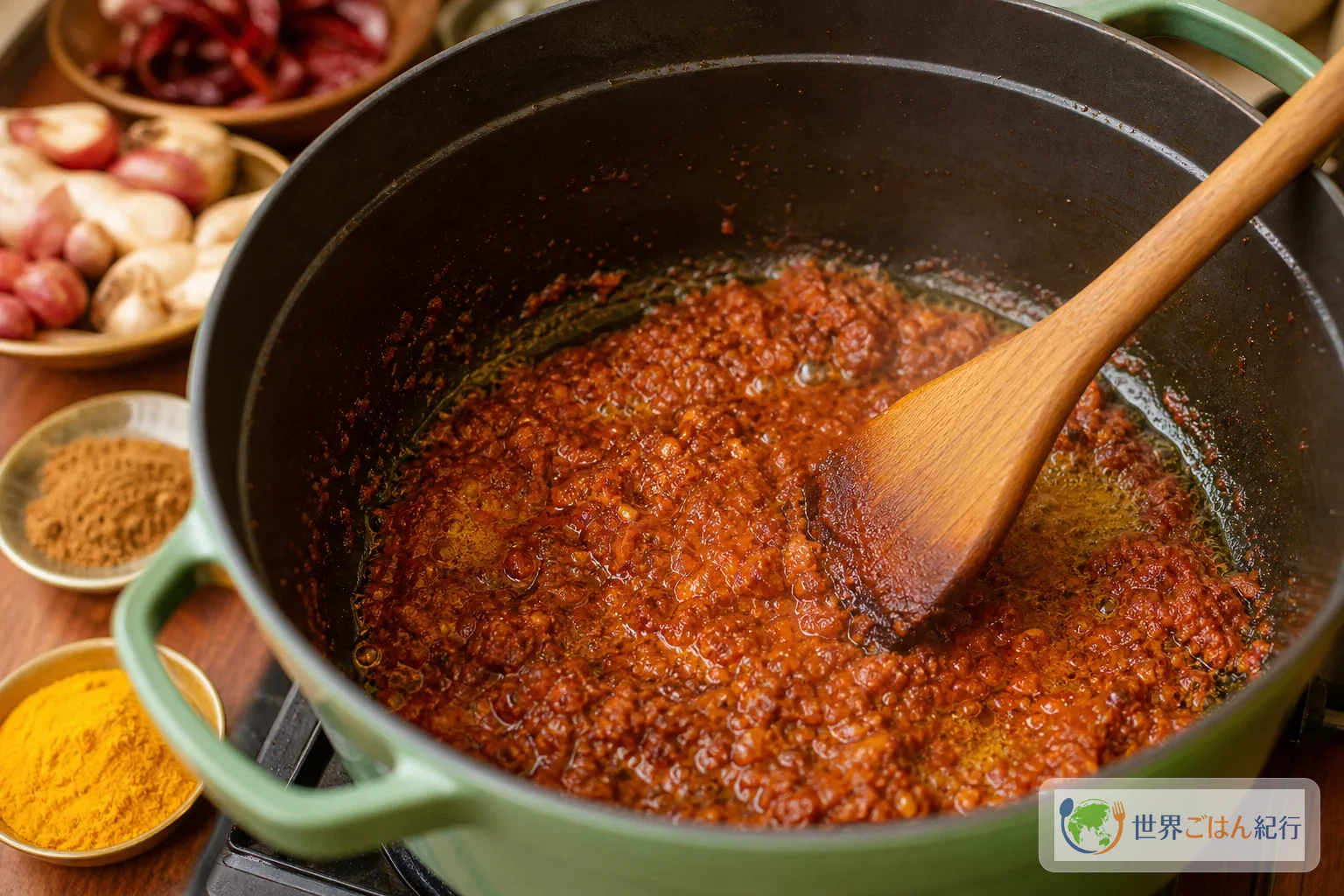
Put 3 tbsp oil in a heavy pot and heat over medium. Add the paste and for the first 2 minutes stir while scraping the bottom of the pot. Because there is a lot of water, the oil may spatter finely. Do not tilt the pot; stir slowly with the wooden spatula held upright.
Fry for 8–10 minutes over medium-low heat. When the watery bubbles get large and the paste begins to come away from the sides of the pot in a mass, that is the sign the aroma has settled. If the raw onion smell remains, do not raise the heat; fry just 2 minutes more.
Add the curry powder, cumin and turmeric and mix for 30 seconds. When the powders have absorbed the oil and turned reddish brown, move on before they burn. Frying too long here brings out the bitterness of the turmeric.
4. Dissolve the sweet potato and finish the gravy
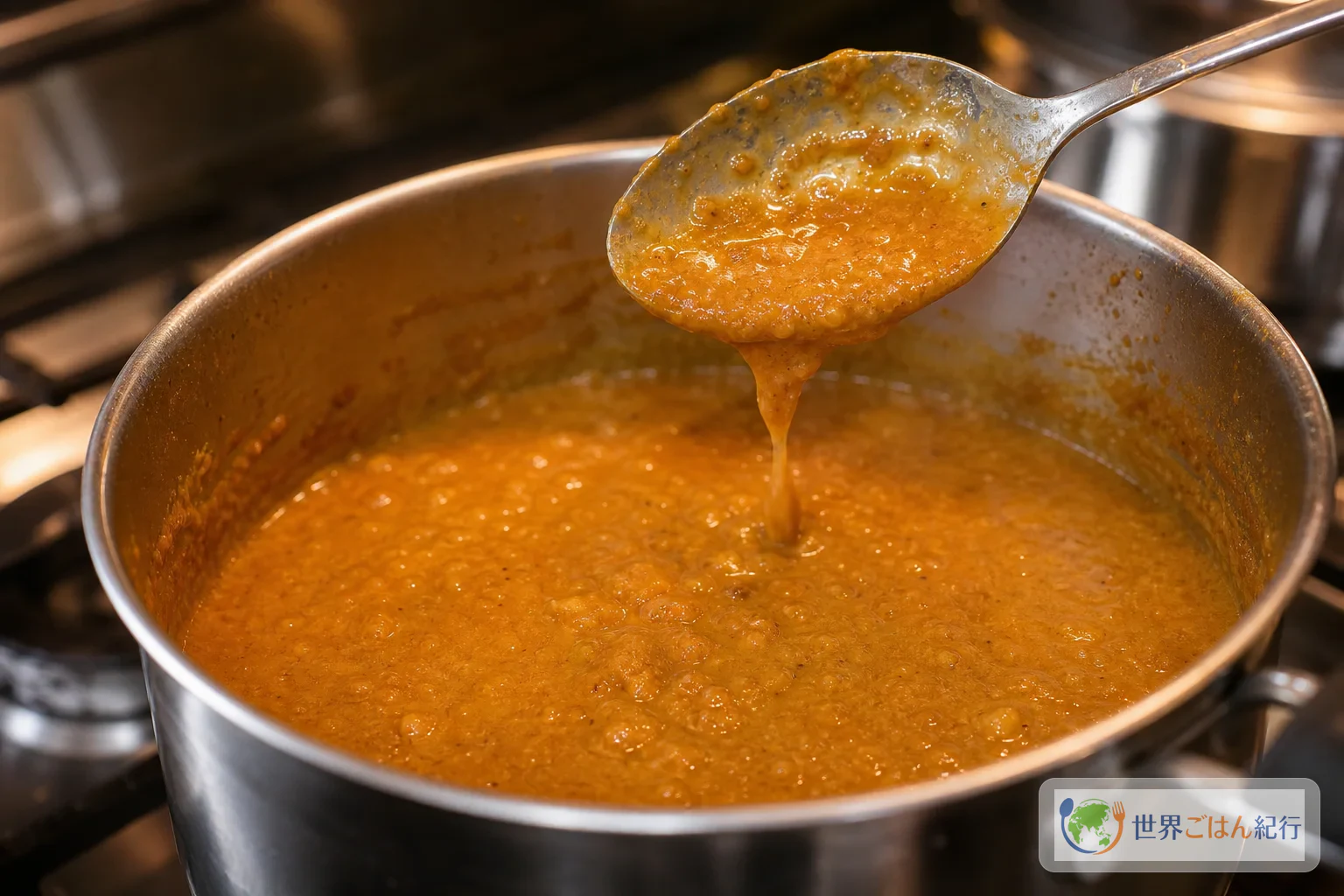
Add the stock in 3 additions, scraping the bottom of the pot each time. Pouring it all at once tends to make the paste lumpy. Add the mashed sweet potato and the dry-roasted, finely crushed peanuts and bring to a boil.
Once it boils, lower the heat, set the lid slightly ajar and simmer for 15 minutes. If the bottom gets heavy partway, add 3.5 tbsp (50 ml) water at a time before it scorches. The body comes not from starch but from simmering the sweet potato until it dissolves.
5 minutes before turning off the heat, add 20 g tamarind paste, the kecap manis and the sugar. Simmer 5 minutes over low heat and then taste. If the sweetness is forward but the aroma is blurry, add tamarind 1 tsp at a time. If it is only sour, bring it back with 2 tbsp stock and 1 tsp sugar. Add the salt last, 1/4 tsp at a time.
When you draw a line across the bottom of the pot with a spatula, the finished gravy should hold the line for about 1 second and then close. If the line stays long, it is too thick. Add 3.5 tbsp (50 ml) stock and simmer 2 minutes to bring it back. Conversely, if it disappears immediately, take the lid off and simmer over low heat for 3–5 minutes.
5. Boil the noodles and bean sprouts separately and plate
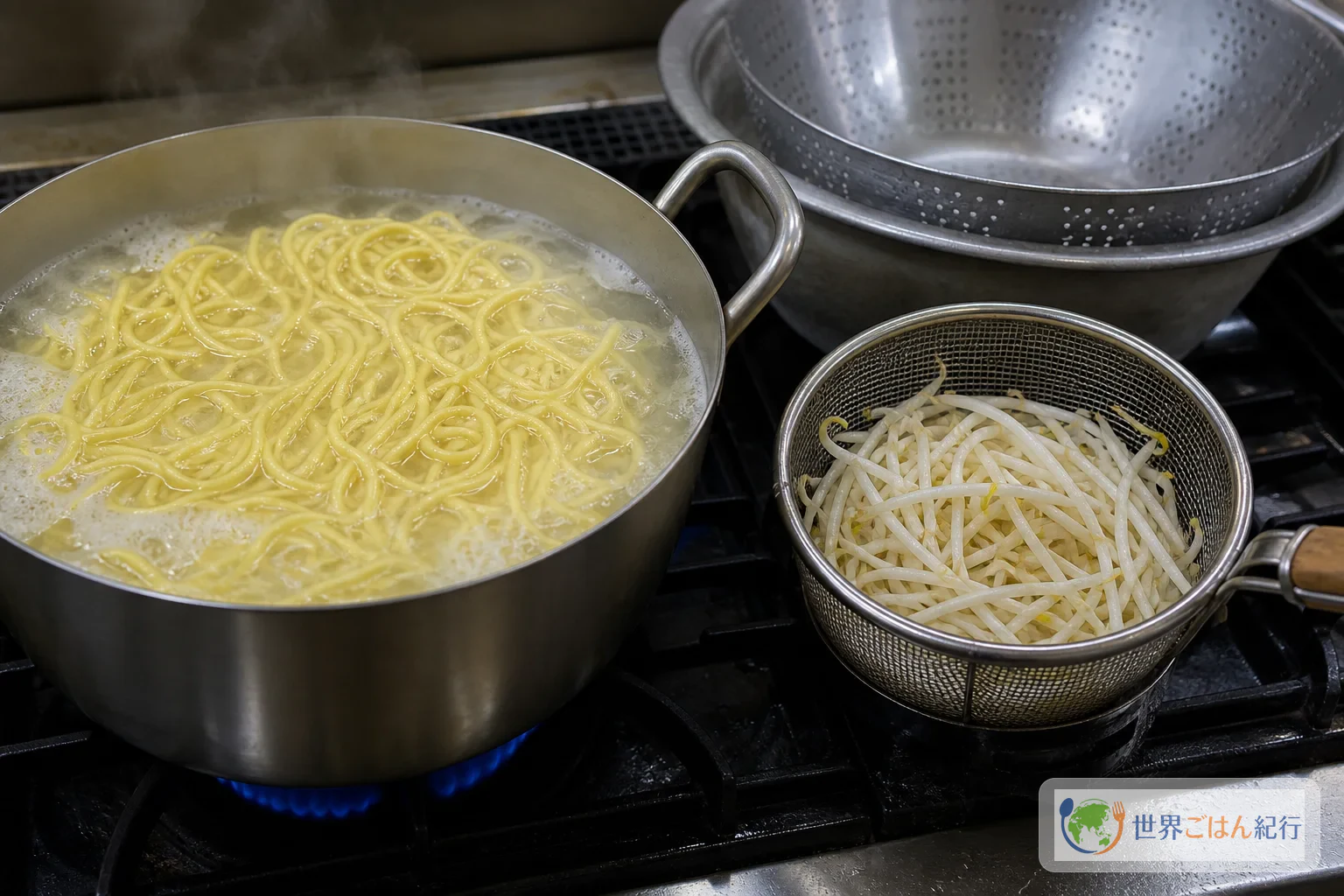
Bring water to a boil in a separate pot and boil the fresh yellow noodles for 30–60 seconds. Even if the package says "pre-cooked," lift them out once they are heated through. Take dried noodles out 30 seconds earlier than the package says, leaving room for them to finish in the gravy.
In the same water, boil the bean sprouts for only 10–15 seconds and move them to a colander. Drain them well but do not leave them long in cold water. If chilled too much, the temperature gap between noodles and gravy widens and the gravy feels stiff in the bowl.
Cut the cucumber into 2 inches (5 cm) strips and slice the green chiles into rounds.
Put the noodles in a bowl and ladle on about 1 cup (220 ml) of reheated gravy per serving. Place the bean sprouts, fried tofu, cucumber, egg, fried shallots and green chile in turn and add lime. Do not mix the sambal in at the start; let each person add a spoonful.
Fixing the mee rebus gravy
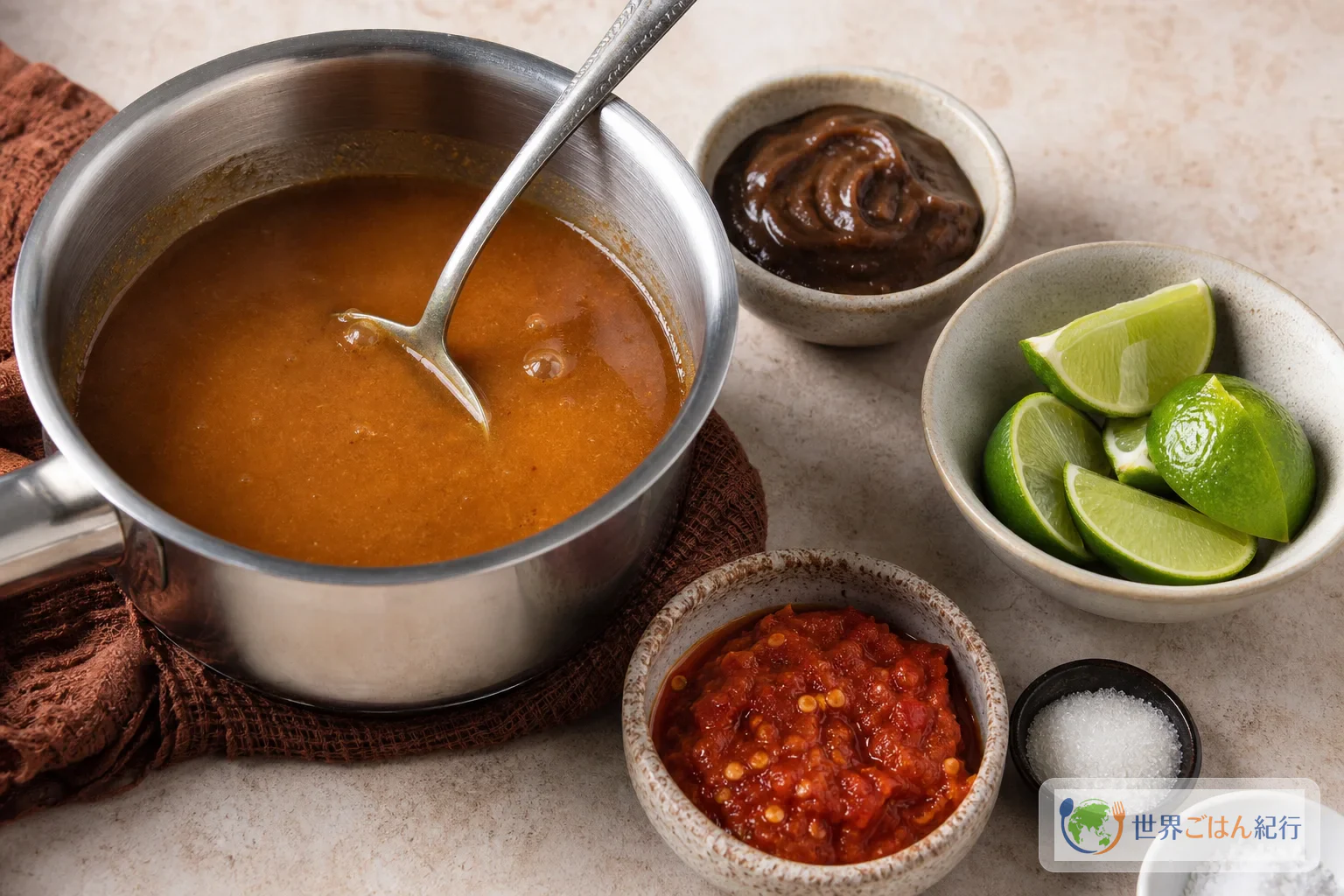
Don't do your final tasting on the gravy alone. Take a bite of noodles, bean sprouts and fried tofu together, then see which of these fits.
Too sweet and heavy
Before you squeeze in lime, add just 1 tsp tamarind. It won't erase the sweetness, but it draws a line of sourness behind it. If the gravy still feels heavy, add 2 tbsp stock. Plain water would dilute the umami too.
Too sour and sharp
Add 1/2 tsp sugar and 1 tsp kecap manis and simmer 1 minute. Right after tamarind goes in, the sourness can stand out on its own, so wait that minute before you judge.
Too thin to cling to the noodles
Take the lid off and simmer over low heat for 3–5 minutes. Hold off on salt until the end. Evaporation concentrates it, and salt added before reducing tends to end up too salty.
Too thick for the noodles to move
Stir in stock 3.5 tbsp (50 ml) at a time. Even gravy that's right in the pot stiffens in the bowl once the noodles soak up liquid. Plate it one notch looser than "stays on the back of a spoon" and it'll be just right by the time you eat.
Serving mee rebus and variations
Put the toppings in the middle of the table and let everyone choose their own. Serve the sambal on the side too, rather than stirring it into the gravy, even if you like heat. Children and anyone who wants less heat can eat the bowl as is, and leftover sambal works the next day for fried noodles or rice. If your household won't finish a jar of hot condiment, green chile and lime alone are enough. When buying sambal, check the label for quantity and for shrimp, fish sauce or fermented seasonings.
To explore the regional styles at home, adjust in this order:
- For the Singapore basic form, keep yellow egg noodles, sweet potato gravy, egg, bean sprouts and fried tofu.
- If you like the sweeter Malay Peninsula style, increase the kecap manis 1 tsp at a time.
- To thicken with nuts, increase the peanuts from 1.5 oz (40 g) to 2 oz (60 g) and add 3.5 tbsp (50 ml) more stock.
- For a more lavish bowl, cook beef or chicken separately and add it on top. Simmered long in the gravy, it starts to feel more like a stew than a noodle dish.
- If you want heat to be the star, keep the chiles out of the pot and serve the sambal on the side.
Noodles and sauces from the same region go well alongside mee rebus and help you use up ingredients. Leftover sambal can bring the heat to Indonesia's nasi goreng. If you like the sweet saltiness of kecap manis, try it next to nasi lemak. And on a day when you want yellow noodles a different way, set it beside Singapore's roti john and compare how each one uses egg and chili sauce.
FAQ
Can I make the gravy the day before?
Yes. Once it has cooled slightly, divide it into shallow containers and refrigerate. To serve, bring it to a boil in a pot and loosen it with stock if it's stiff. Make the noodles, bean sprouts, cucumber and fried shallots on the day.
Don't leave cooked gravy sitting at room temperature. Cool it quickly to 39°F (4°C) or below, or hold it at 140°F (60°C) or above. Shallow containers keep the cooling time short. Reheat to 167°F (75°C) or above for 2 minutes, and warm only what you'll eat.
Can I freeze the gravy?
Yes. Freeze it flat, one serving at a time, and use it within about 2–3 weeks. It may look separated after thawing, but warming it in a pot while stirring in stock 1 tbsp at a time brings it back. Don't freeze it with the egg, noodles or bean sprouts in.
What if the sweet potato is not sweet?
Before adding sugar, check the sourness and saltiness of the gravy. Sweet potato that isn't sweet still gives body, but the aroma is weak. Add kecap manis 1 tsp and sugar 1/2 tsp at a time, then bring back a little tamarind at the end so the gravy doesn't taste flatly sweet.
Can I add starch to thicken?
In an emergency, add a little potato starch dissolved in 2 tsp water. Starch-thickened gravy stiffens suddenly as it cools, though, and it feels different in the mouth from the natural body of sweet potato. Try reducing first, and loosen it with stock if needed.
What if I want to add beef or chicken?
Cook it in a separate frying pan with less salt and add it at plating. Simmered in the gravy, the meat's fat and salt make the gravy harder to taste and adjust. Cook chicken through to the center, and if you make it ahead, store the meat and gravy separately.
Can I make it not spicy?
Yes. Remove the seeds from the dried red chiles and serve the sambal and green chile on the side. As long as you keep the sourness of tamarind, the toastiness of fried tofu and the bite of bean sprouts, the flavor stays clear even without heat.