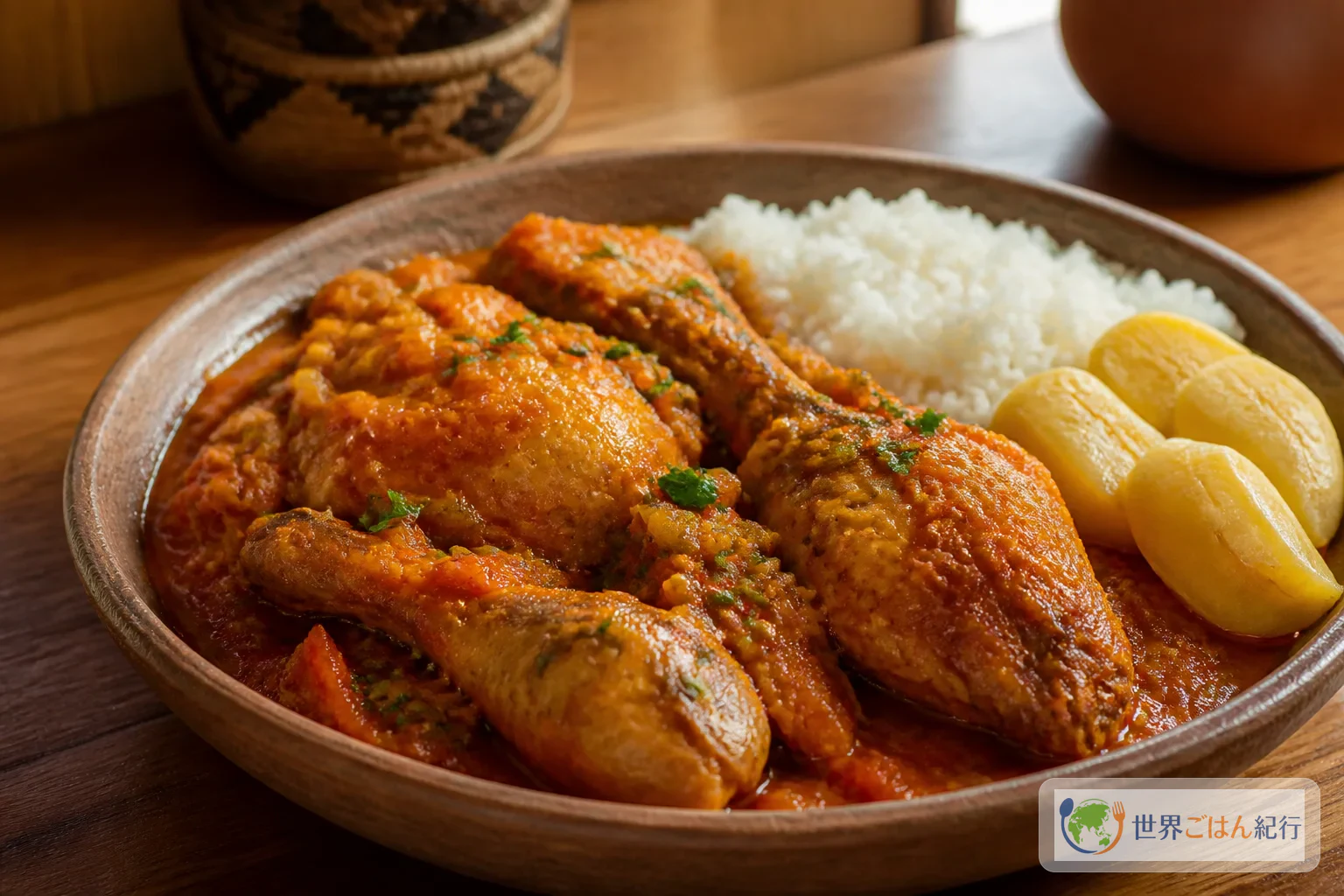
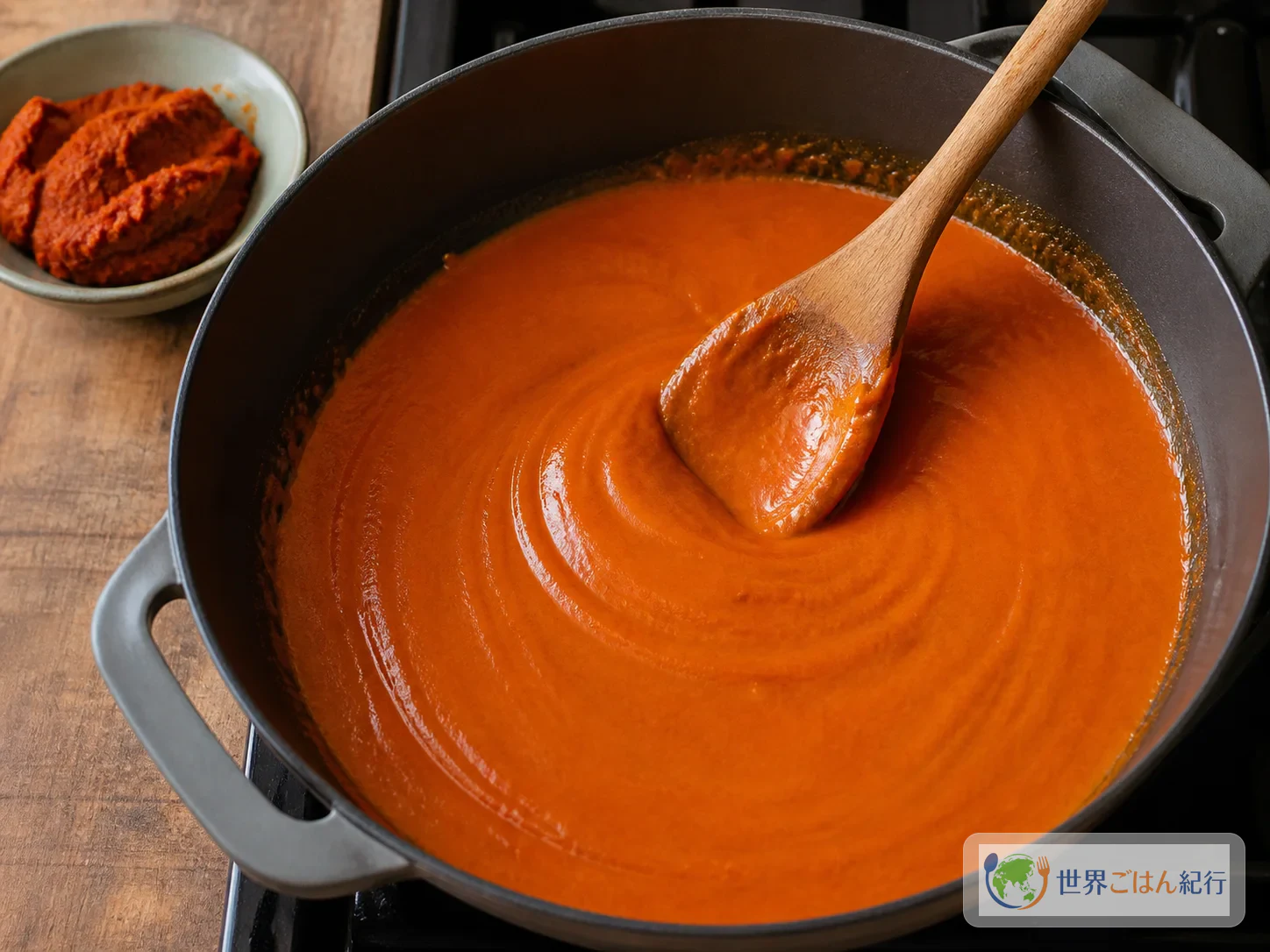
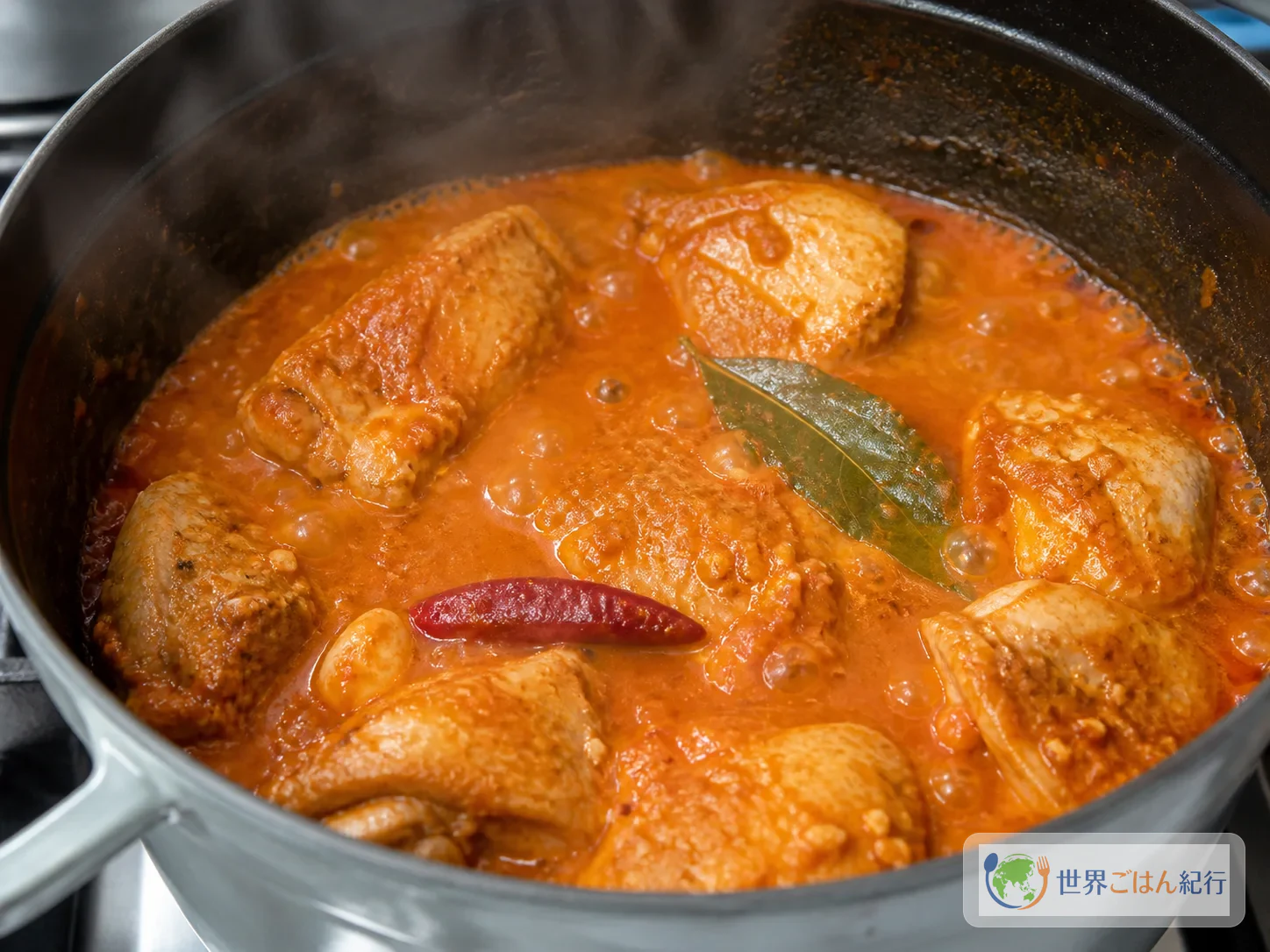
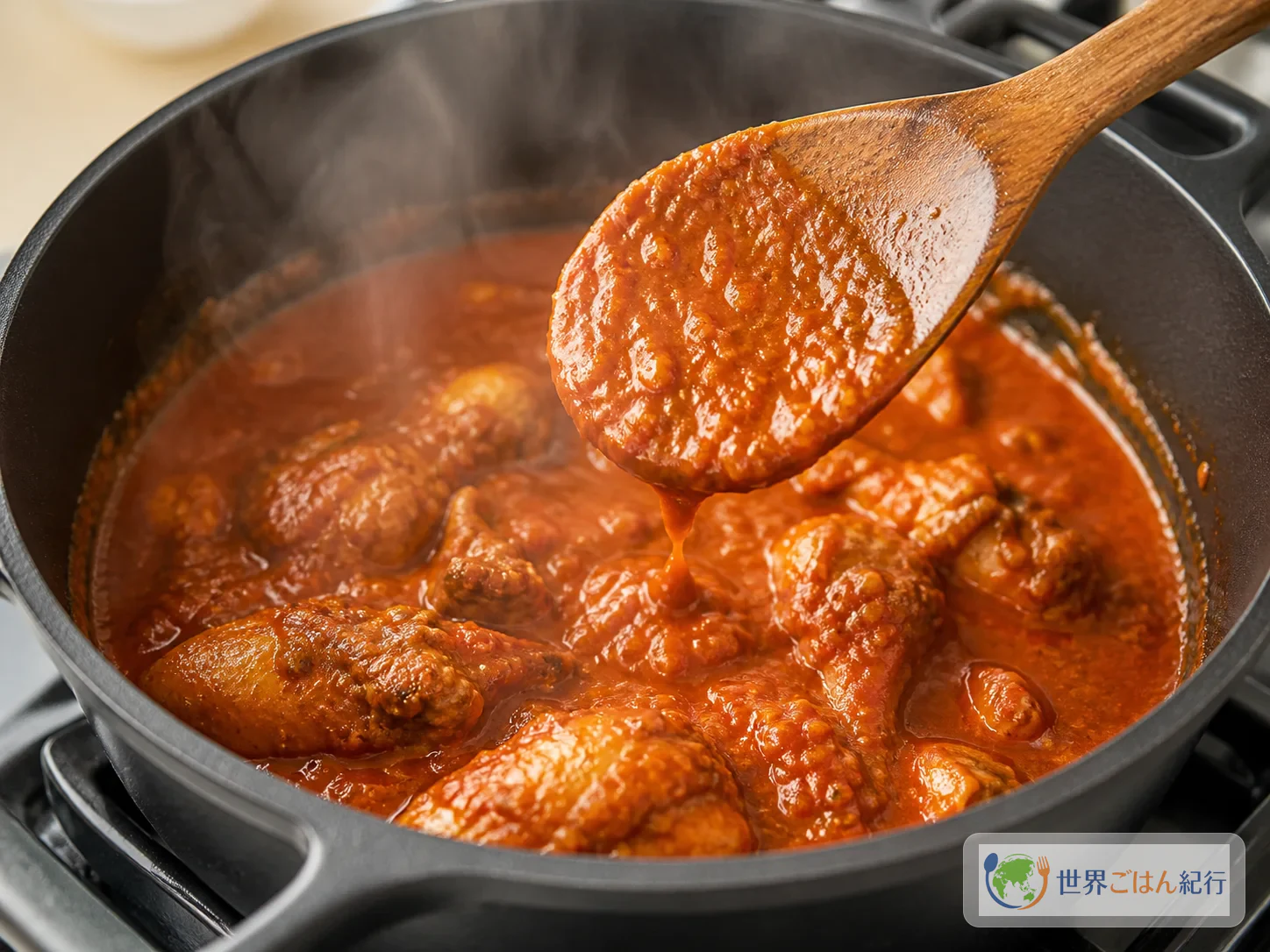
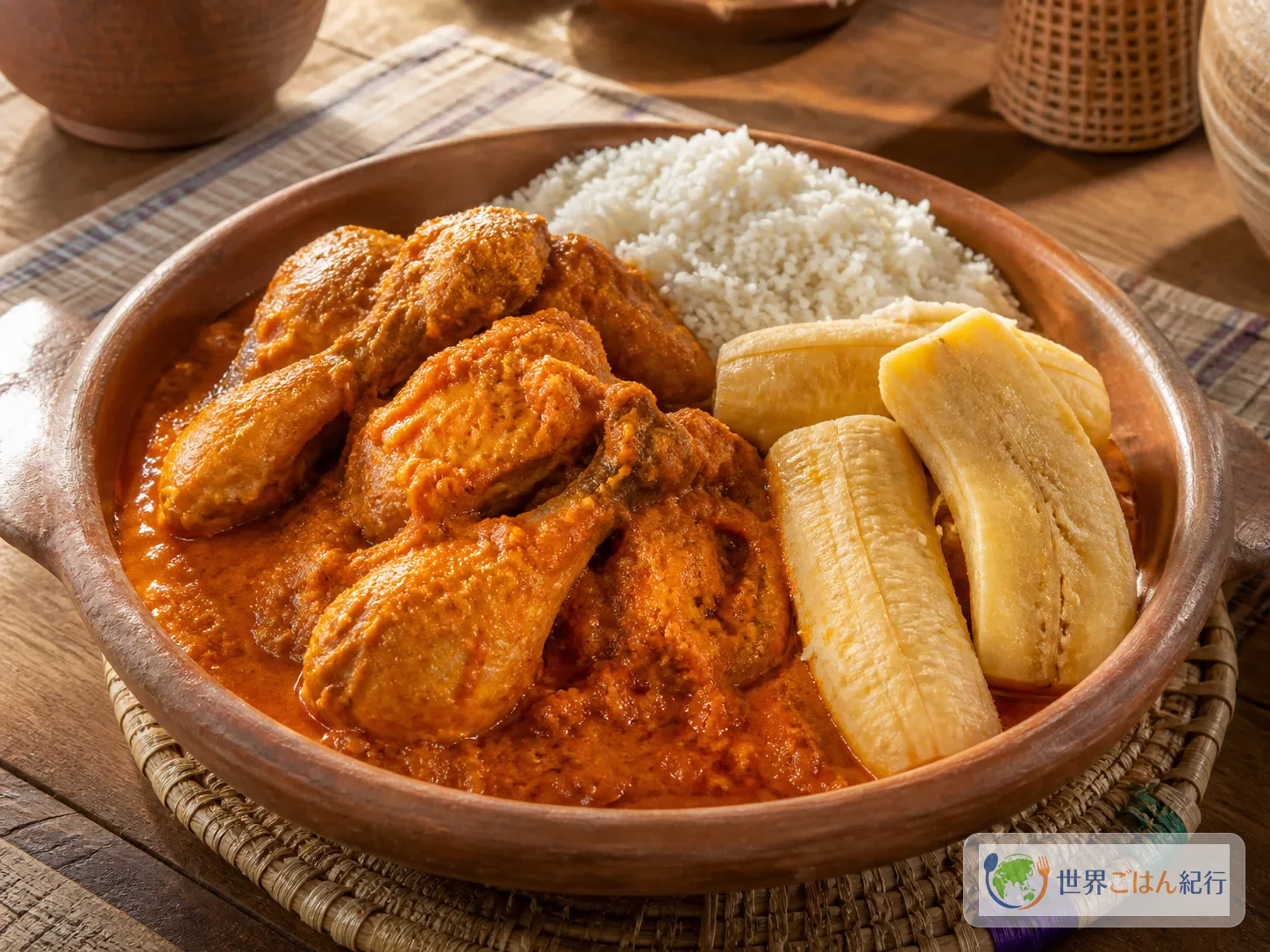
Tilt the pot and the orange sauce slides slowly back, while the red oil on the surface glides ahead of it. The sweetness of fried onion and tomato layers with the nutty richness of palm nut, and the bone-in chicken keeps the toasty flavor of skin that was browned first. This is nyembwe (also written Nyembwé), Gabon's chicken in palm nut sauce, a dinner meant to be spooned over rice and plantain. Cooking it far from Gabon comes down to one swap: palm nut concentrate stands in for the thick extract pressed from fresh palm fruit.
Palm nut concentrate is the sauce; red palm oil is the oil that adds aroma and color. Keep those roles separate and you can bring the backbone of nyembwe into a home pot without extracting the fruit yourself.
Nyembwe and the Gabonese Table
Nyembwé is the word for palm oil in Myene, a Bantu language spoken in Gabon. The dish name Poulet Nyembwe means "chicken in nyembwe." Other countries and regions use spellings such as moambe and muamba.
Names and Versions of Nyembwe
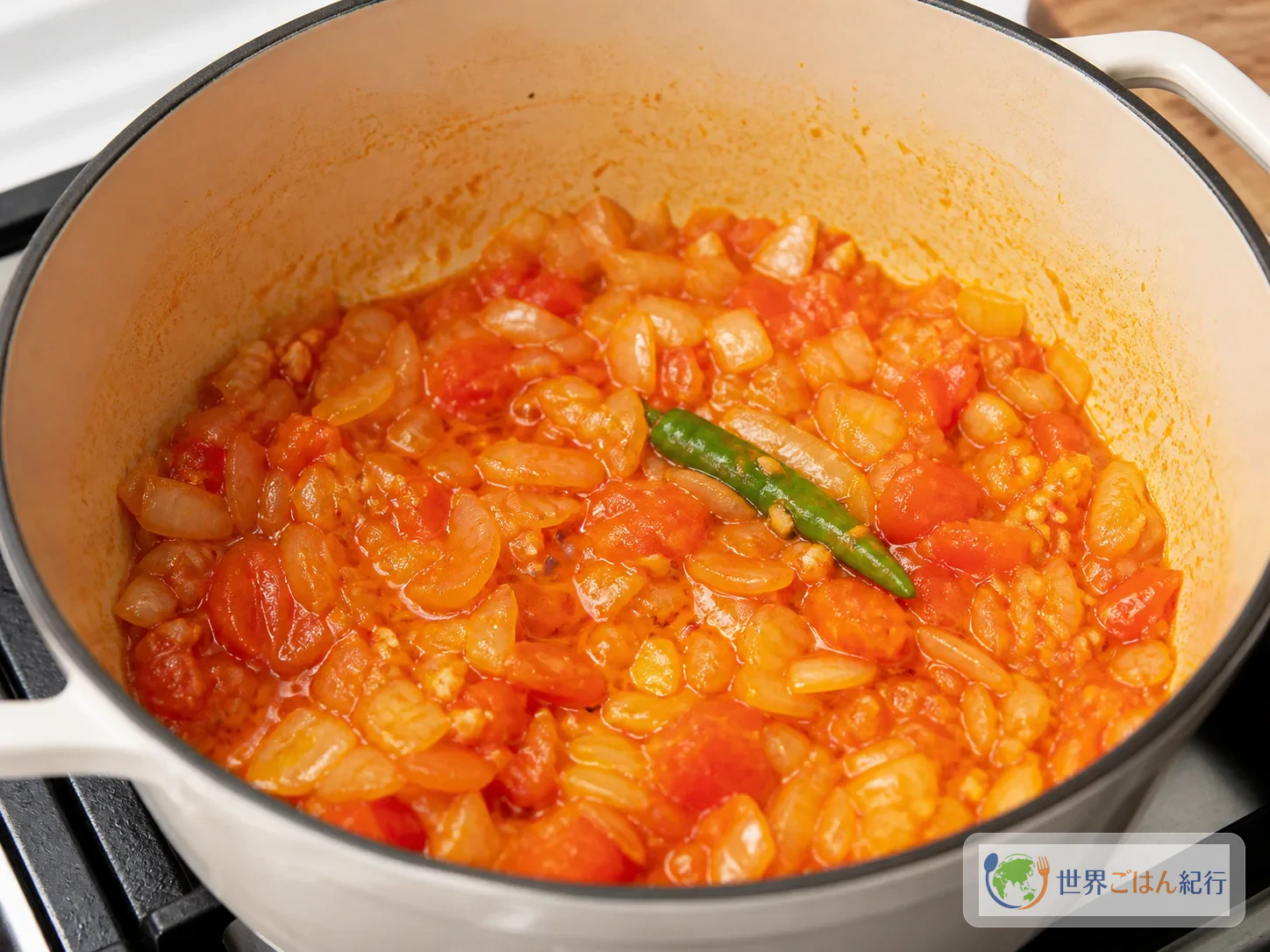
The dish also goes by Poulet Nyembwe, moambe, and sauce graine. Its name puts fat at the center, but the recipe itself varies across the country, and even among Gabonese cooks. Some use smoked chicken, some brown raw chicken and then add it to the sauce, others simmer the sauce first, and some add chile last. One Gabonese recipe fries onion and garlic in palm oil, adds chile, tomato, salt, and bouillon, and then puts the browned chicken into the sauce.
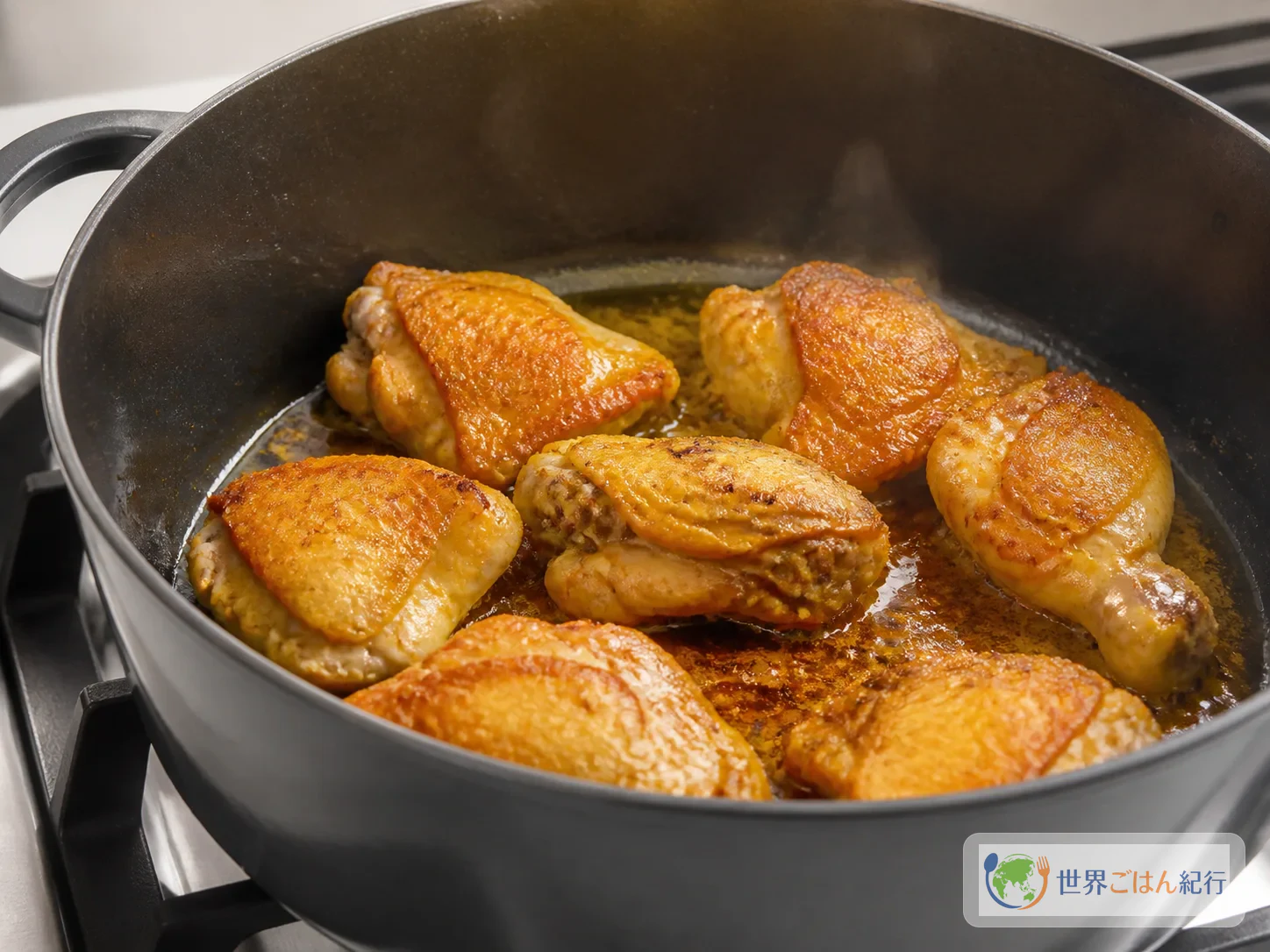
How you prepare the chicken changes the order in which the aromas reach the sauce. With smoked chicken, the smoke layers over the sweet richness of palm nut, and the chile goes in near the end. With raw chicken, browning the skin leaves a toasty flavor on the bottom of the pot, and that oil carries into the onion and tomato. Think of nyembwe as a palm nut sauce at the center, with chicken and staples that shift by place and household.
How Nyembwe Is Eaten in Gabon
Gabon sits on the Atlantic coast, and its food combines ingredients from forest, river, and sea with root crops and grains. On inland and rural tables, the staples are rice, corn, yam, sweet potato, and cassava, with plantain and banana in everyday meals. French influence shows up in city cooking, but nyembwe, made with palm oil, palm nut, and chicken, is a typical home dinner.
The afternoon meal is the main meal of the day, and nyembwe is built on the plate with a staple rather than sipped on its own. When a family shares a stew and a staple, scooping up a little sauce at a time just makes sense. Mashed banana, ripe banana, cassava fufu, and boiled root vegetables all catch the fat-rich sauce one bite at a time. White rice keeps that local way of eating intact, too; it gives the thick sauce something to hold on to.
Palm wine or Gabon's beer, Régab, is often enjoyed with the meal. Serve nyembwe as a dish shared with a staple, rather than as a chicken stew alone, and it stays close to the Gabonese table.
Ingredients (serves 4)
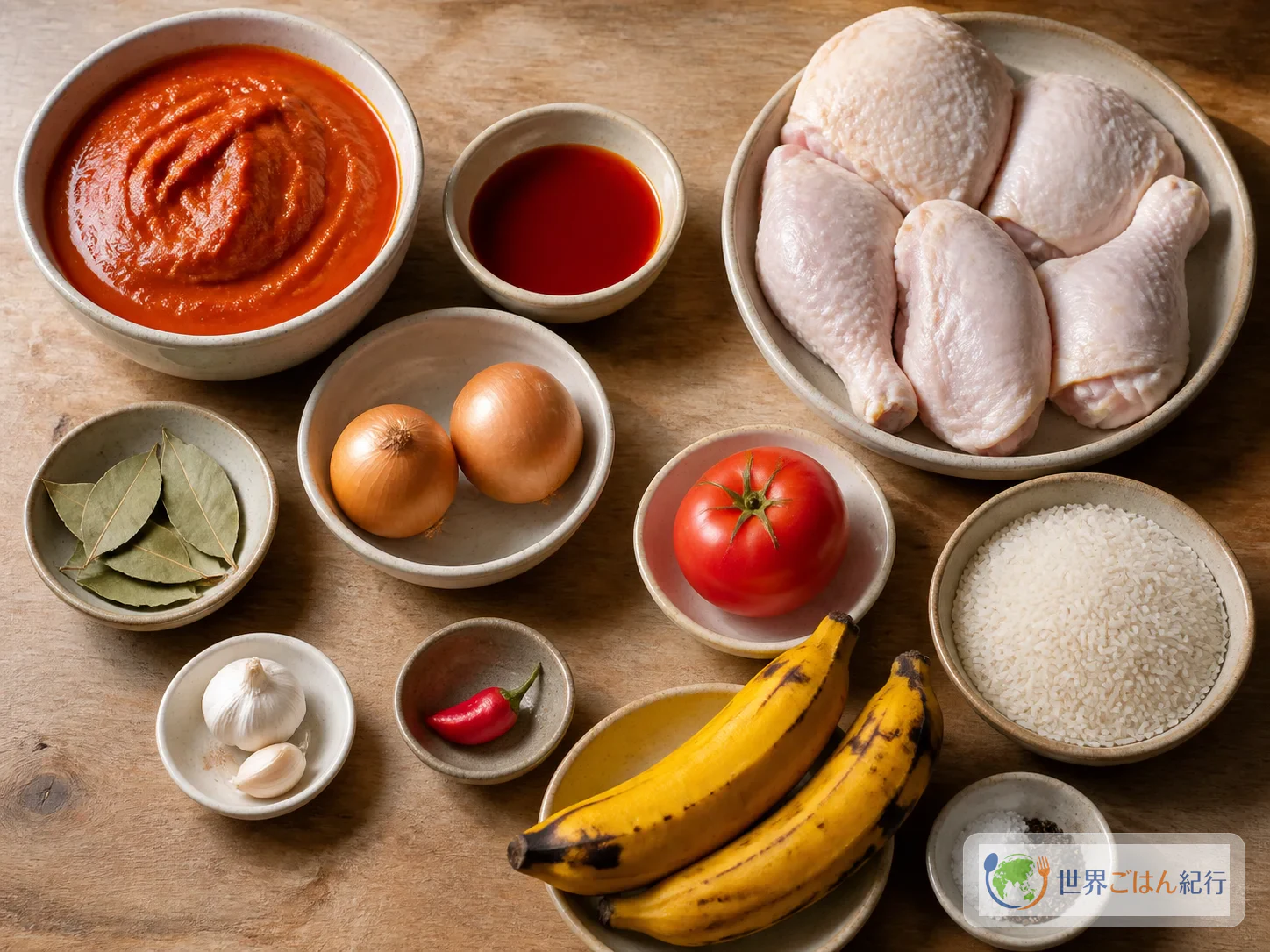
Concentrates differ in salt and water content from brand to brand, so don't add all 6 g of salt at the start.
If you use unsalted water or stock, use 4 g to season the chicken and taste after the final reduction to add the remaining 2 g. With salted stock, cap the total salt at 4 g and adjust at the end.
Plantains aren't always sold at produce counters. If you can't find them, the quantities work with white rice alone.
If you serve cassava fufu, use the separately prepared 1.25 lb (600 g) as the base to catch the sauce.
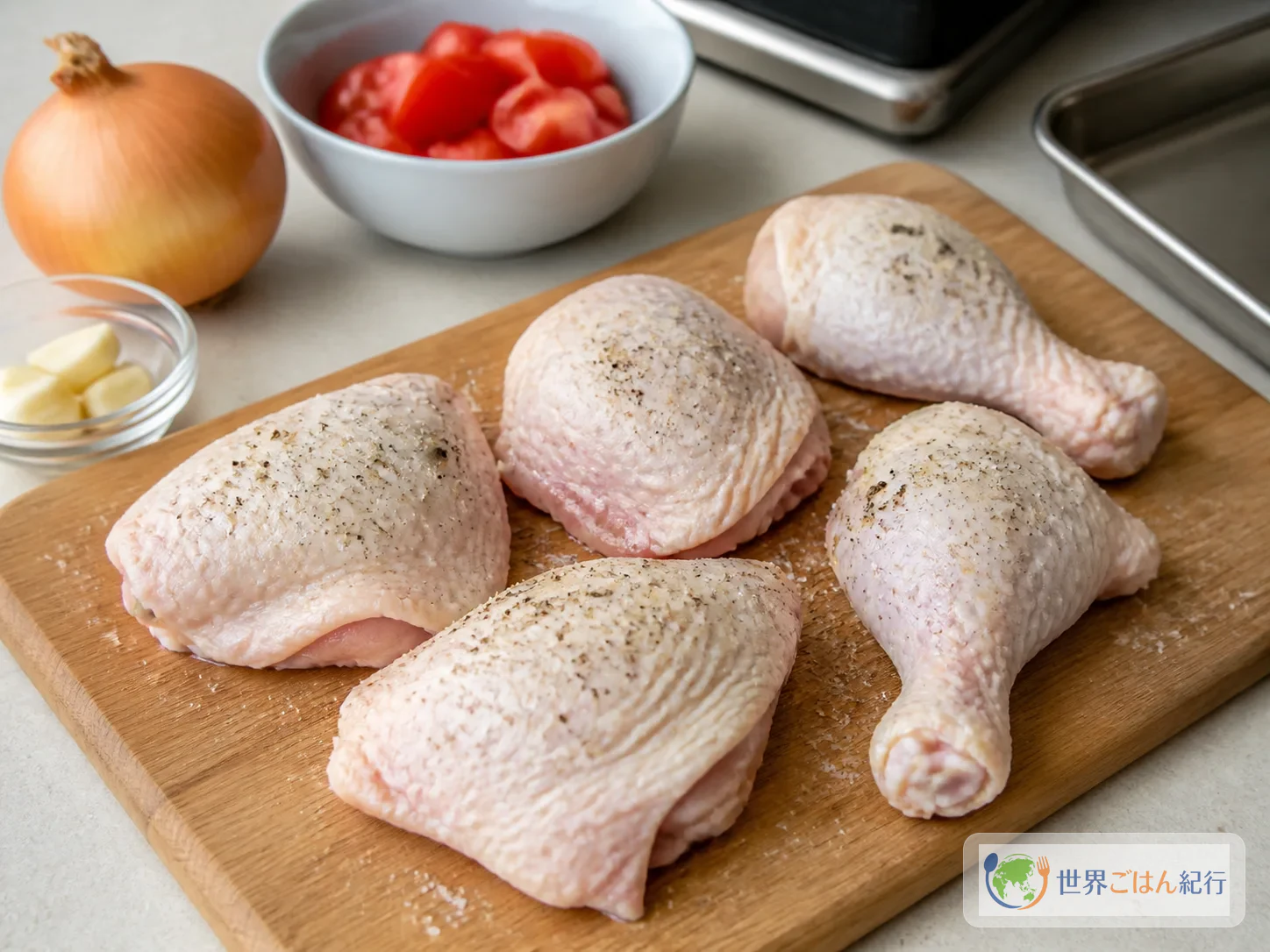
Keep raw chicken refrigerated and wash the cutting board and knife you used with detergent before using them for other ingredients. Cook chicken to an internal temperature of 167°F (75°C) for at least 1 minute, and also confirm that no pink or clear juices remain at the thickest part. Concentrates and red palm oil differ in ingredients and production lines from product to product. If you have a food allergy, check the label and contact the manufacturer.
Choosing Palm Nut Concentrate, Red Palm Oil, and Substitutes
Palm Nut Concentrate
In Gabon, the sauce can start from fresh palm fruit. You boil ripe fruit for a few minutes, mash it when the skins loosen, mix it with water and squeeze out the pulp, strain twice, and then thicken it over low heat. This draws out the most aroma, but it takes fruit, a masher, a strainer, and a long reduction. If you try it, split the work: prepare the sauce one day and cook the next.
Canned or pouched palm nut concentrate has already been extracted and filtered with water, so you are simply thinning it. The fibrous texture and rising aroma won't match fresh fruit, but you still build thickness by boiling off water in the pot.
Coconut milk brings sweetness and richness, though not the earthy aroma of palm nut. It makes a good dish, just a different one, and judging the result is easier if you treat it that way from the start. Red palm oil can't fill in for the concentrate either, so if you can't find concentrate, adding more oil won't solve it.
Red Palm Oil
Red palm oil comes from the same palm, but it doesn't build the volume and thickness of the sauce. You need only 1 tbsp (15 ml), to brown the chicken and pass color and aroma to the onion. Ordinary rice bran oil still browns the chicken, but the pot's orange color and the distinctive oil aroma are weaker; rice bran oil with 2 g paprika restores some of the color. For the aroma, buy the dedicated oil.
For palm nut concentrate, check the product page for the ingredient name ("palm nut concentrate," "palm nut cream"), the quantity, and storage instructions. For red palm oil, check that it is an edible oil suitable for cooking and read the ingredient label. Buy one product for each role.
Method: 8 Steps, Watching the Track in the Sauce
Cooking time is about 70 minutes.
Counting browning the chicken, thinning the sauce, simmering the chicken, and boiling the sides together with prep, you can bring it to the table in about 85 minutes.
Decide how far to reduce not only by minutes but by the track on the bottom of the pot and how the sauce flows off a spoon.
Fixing Nyembwe Sauce: Thickness, Scorching, and Undercooked Chicken
Right after diluting the concentrate with water, the sauce is a bright orange with no rings of oil on the surface. As the chicken simmers, the oil returns in fine lines on the surface, and when the water has cooked down to a point where the wooden spoon track stays 1 to 2 seconds, it is thick enough to cling to rice. If only the oil increases and the liquid at the bottom is loose, remove the chicken and reduce over medium heat 5 minutes at a time.
| State | How to recover |
|---|---|
| Sauce is watery | Remove the chicken and reduce over medium heat 5 minutes at a time, until the spoon track remains 1 to 2 seconds |
| Sauce is too heavy | Add 2 tbsp (30 ml) boiling water and stir over low heat 2 minutes. Stop when it flows slowly as you tilt the pot |
| Bottom scorched | Turn off the heat. Without scraping, move only the surface sauce and the chicken to a clean pot, add 3.5 tbsp (50 ml) boiling water, and warm over low heat 5 minutes. If bitterness remains, start over |
| Center of the chicken is red | Loosen the sauce with 2 tbsp (30 ml) boiling water, cover, and simmer over low heat 10 minutes at a time. Confirm 167°F (75°C) for at least 1 minute at the center |
| Too salty | Remove the chicken, add 2 tbsp (30 ml) unsalted boiling water and 1.75 oz (50 g) tomato, and simmer 5 minutes. When it thins, add 1 g black pepper |
Whenever you add water, make it boiling water. Cold water makes the temperature drop suddenly, which sets the oil and makes the sauce look separated. And if the bottom scorches, leave it alone; scraping spreads the bitterness through the whole pot.
Serving and Variations
Sides for Nyembwe
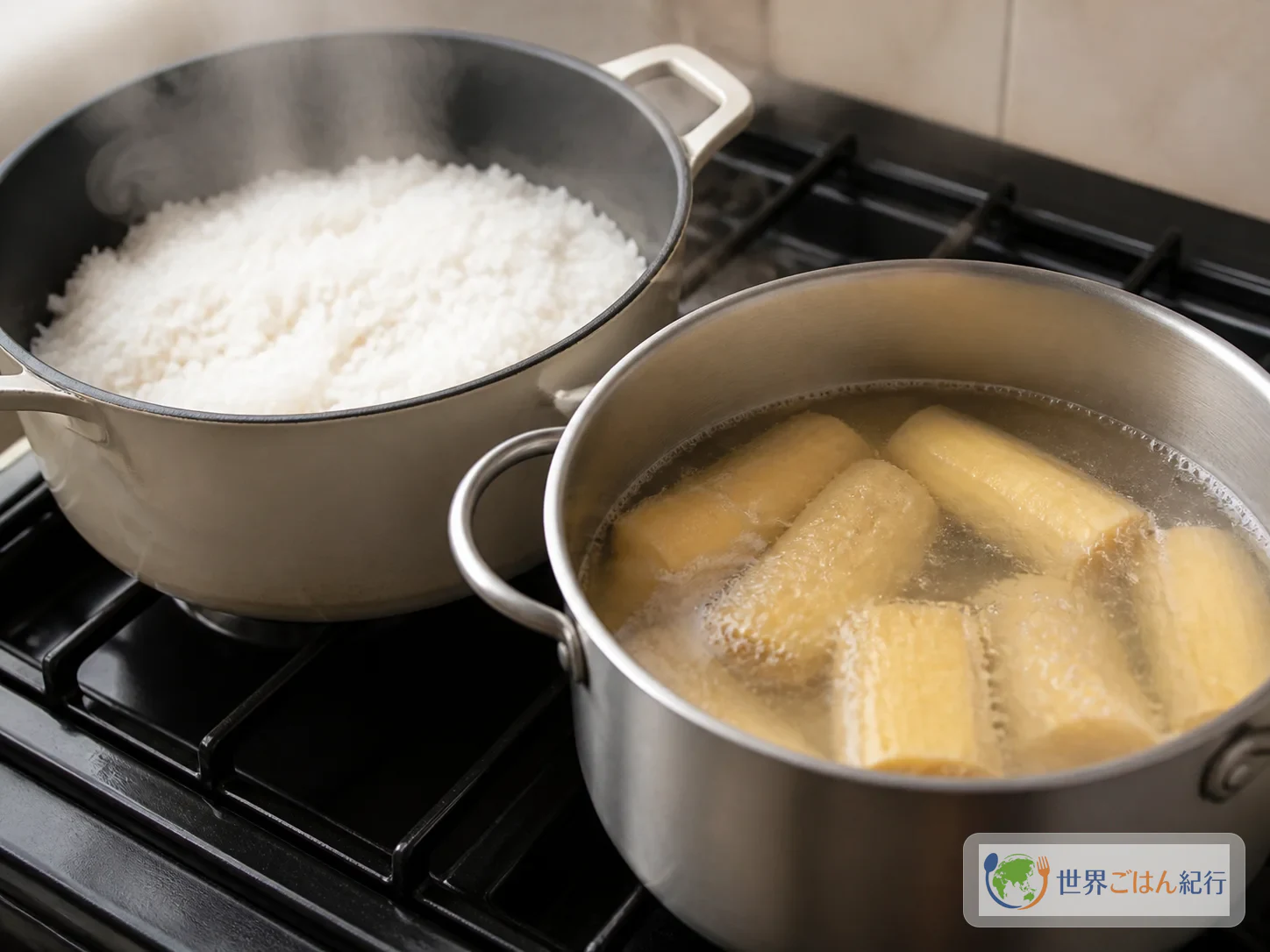
Rice, plantain, cassava, yam purée, and more all work alongside nyembwe. Cook it with white rice the first time, since that makes the sauce's thickness easier to judge. The next time, switch to boiled plantain for a contrast between the sweet fruit and the rich palm nut.
| Combination | Change in flavor and texture | How to choose elsewhere |
|---|---|---|
| Raw bone-in chicken + white rice | The toasty skin and thick sauce cling to rice | The baseline here. Cook the chicken through the center |
| Smoked chicken + plantain | Smoke aroma and a sweet staple come forward | With 1.75 lb (800 g) cooked smoked chicken, shorten the simmer |
| Raw bone-in chicken + cassava fufu | A sticky staple scoops up the sauce | Prepare commercial fufu or cassava flour separately |
| Raw chicken + green plantain | Less sweet, catches the oil of the stew | Cut to 1.5 inches (4 cm) and boil until tender |
| Chicken + hot yellow pepper | Sharp heat arrives after the roundness of the sauce | Use one whole fresh red chile to adjust the heat |
Changing One Thing at a Time
Make the baseline first. From the next pot on, change only one thing, whether the chicken, the chile, or the side, and you'll taste the difference while the richness of palm nut stays put. Change five things at once and you can't tell which one did what.
| Change | Amount and action | What changes |
|---|---|---|
| Switch to smoked chicken | Use 1.75 lb (800 g) smoked chicken, 2 minutes a side in step 2, 20 minutes in step 5. Start with 4 g salt | Smoke aroma and saltiness come forward |
| Lower the heat | Replace 1 red chile with 1.75 oz (50 g) red bell pepper and sauté with the tomato in step 3 | The aroma stays, the lingering heat is gone |
| Make it from fresh fruit | Boil, mash, squeeze, strain, and reduce ripe palm fruit | A stronger fibrous feel and aroma. Extraction takes time |
| Change the staple | Replace 1.25 lb (600 g) white rice with 1.25 lb (600 g) cassava fufu or 2 boiled plantains | The texture for scooping the sauce and the sweetness change |
| Reduce the tomato | Use 3.5 oz (100 g) tomato and increase boiling water to 1½ cups (330 ml) | Less acidity, palm nut richness comes forward |
| Cut the oil | Replace 1 tbsp (15 ml) red palm oil with 2 tsp (10 ml) rice bran oil and add 1 g paprika | The color remains but the aroma of red palm oil is weaker |
Smoked chicken varies in salt and smokiness from product to product. Taste the sauce before adding the remaining 2 g salt, and keep the simmer short so the smoke doesn't take over.
Other African Dishes to Cook Alongside
For another palm nut main, try the similar stew poulet moambe from Congo. Banga soup from southern Nigeria layers the same palm fruit extract with fish and dried shrimp. For staples, there's Ghanaian fufu made from cassava, or Ugandan matooke, mashed green banana that catches a stew nicely. And for a stew built on something other than chicken, try Madagascar's romazava, a mix of leafy greens and meat.
Frequently Asked Questions
Q1. What do I do if I can't find palm nut concentrate?
Use 14 oz (400 g) coconut milk. You won't get the aroma of palm nut or the oil floating on top, but it works for getting a feel for the basic flavor. Next time, make it with palm nut concentrate using the same onion, tomato, and chicken, and the role of each ingredient becomes clear.
Q2. How do I make nyembwe that isn't spicy?
Put the red chile in whole, without splitting it; it gives aroma and lets the heat come out slowly. Split it partway for more heat, or leave it out before simmering for less. You can also replace it with red bell pepper as in the variations table, and serve chopped chile alongside for anyone who wants heat.
Q3. Can I make it ahead?
Once it has cooled slightly, move it to a shallow, clean container and refrigerate; don't leave it at room temperature for long. Eat it by the next day. Reheat only what you will eat in a pot over medium-low heat until the whole thing bubbles, and confirm that the center of the chicken is hot rather than eating it cold.
Store the white rice separately. Keeping cold rice out of the reheated nyembwe keeps the sauce thick.
Q4. What if I'm allergic to palm products?
Palm nut is the fruit of a palm plant, not a common tree nut. But concentrates and oils differ in ingredients and production lines from product to product. If you have a food allergy, check the label, and ask your doctor or the manufacturer whether a substitute is safe for you. If you react to coconut, coconut milk is not an option.