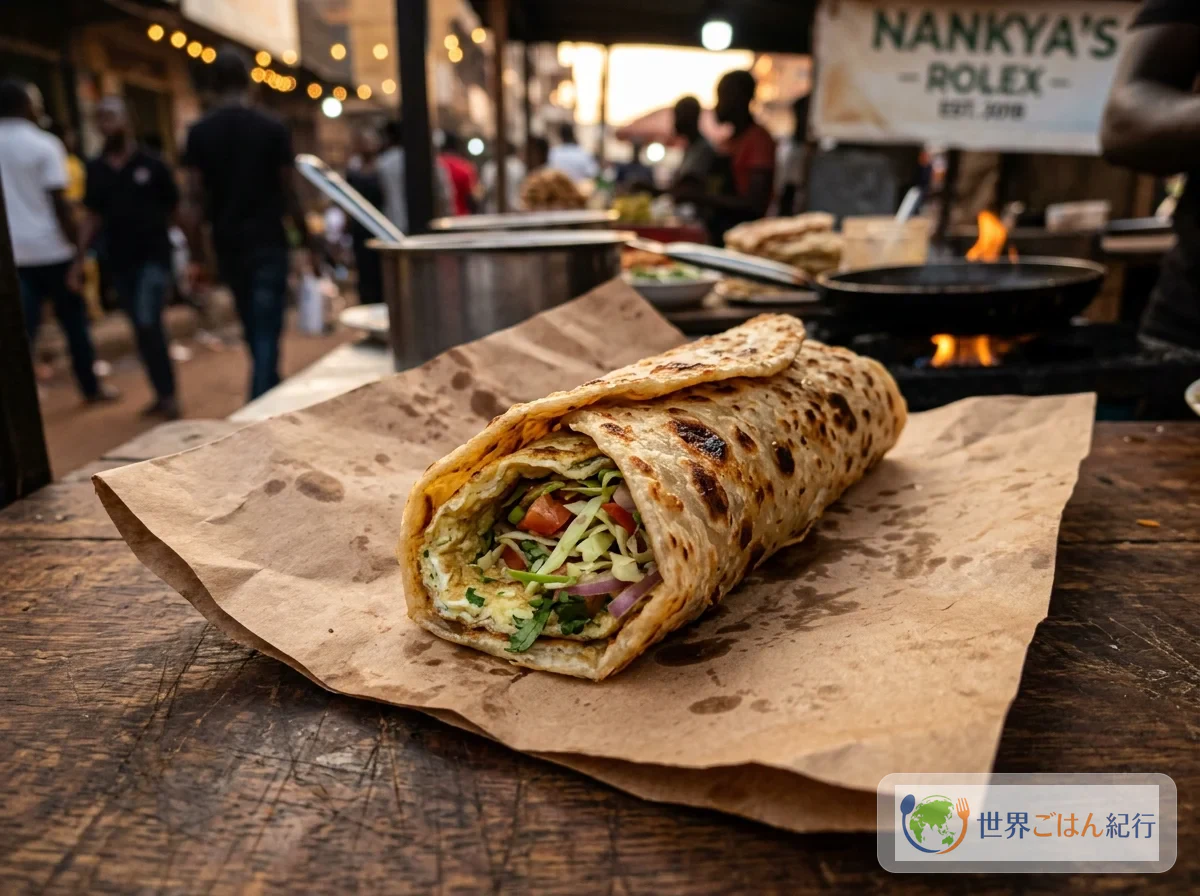
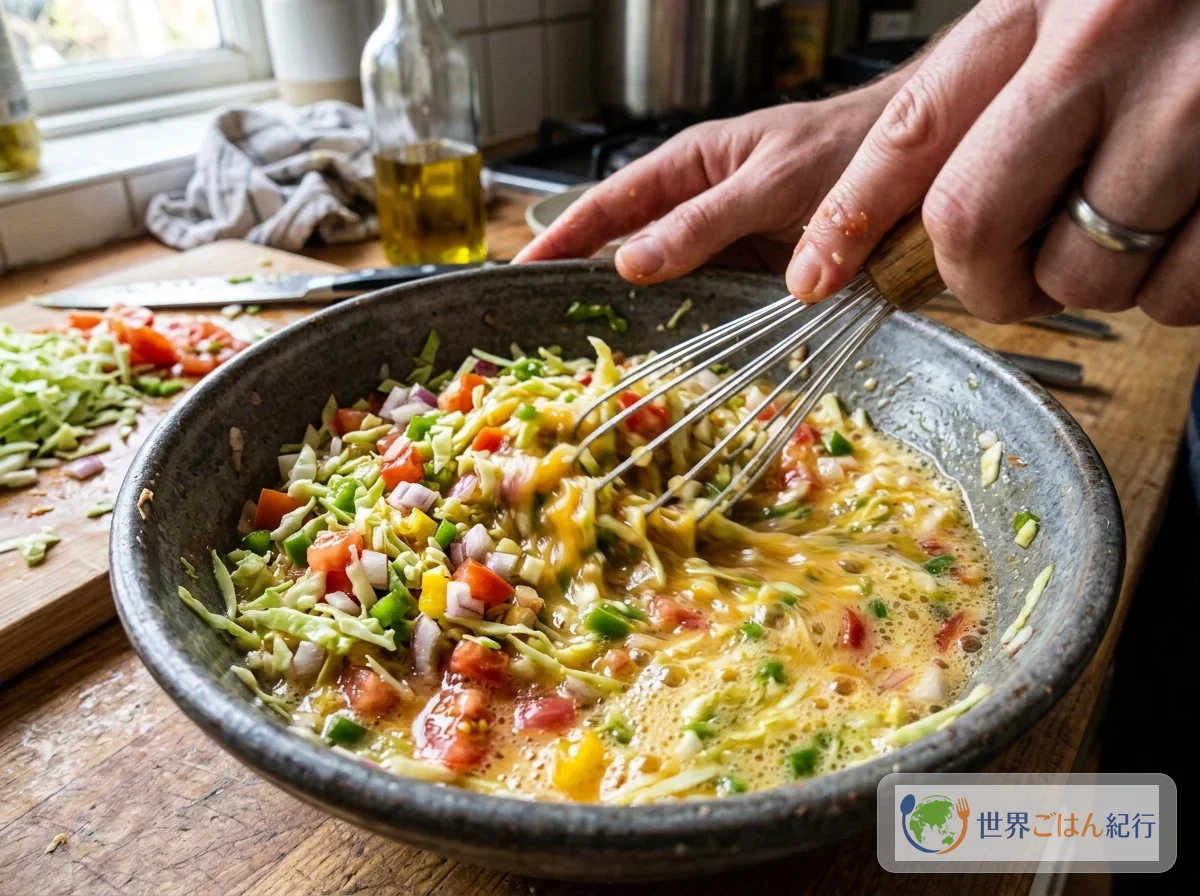
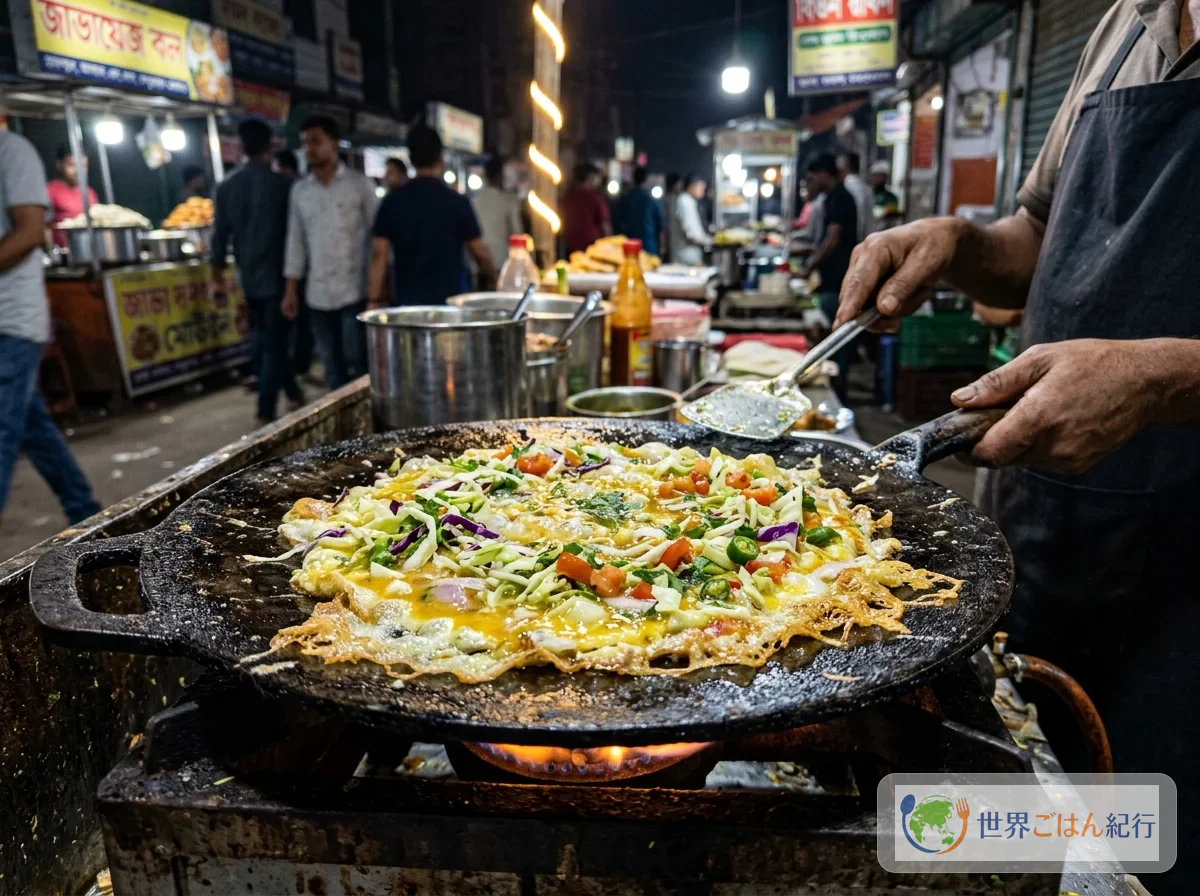
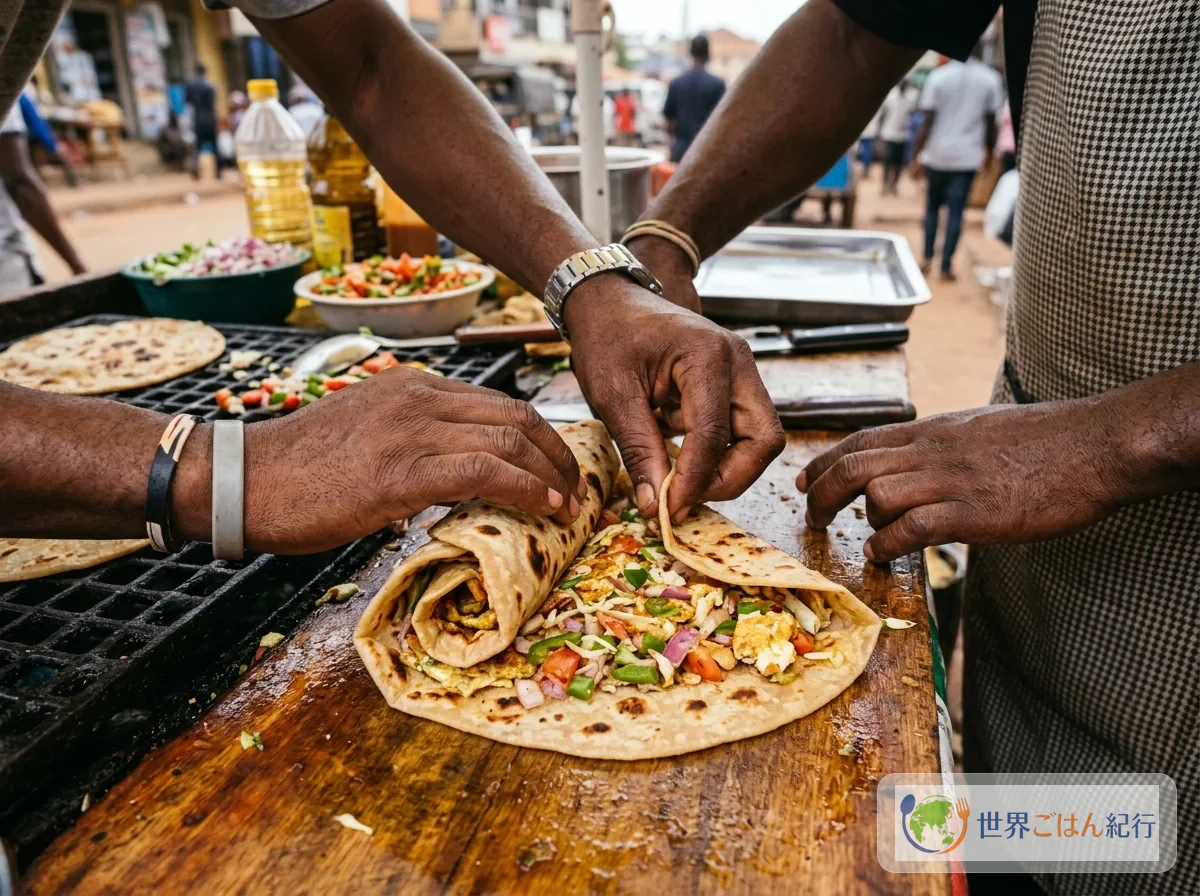
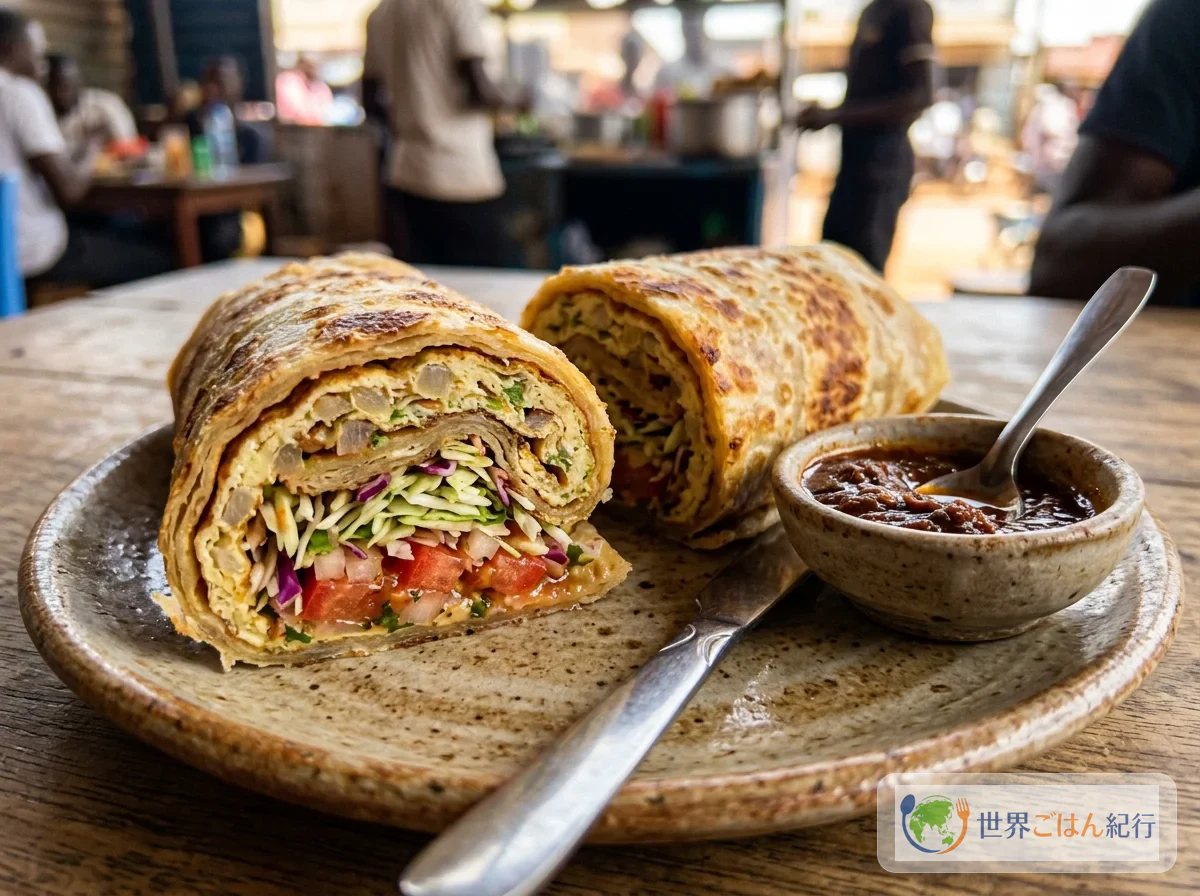
On the griddle, a vegetable omelet sets on a freshly cooked chapati. Once the egg holds together and the bread has taken on color, the cook rolls it all up in one go, and the cut end shows yellow egg and green cabbage inside a savory, browned wrap. Ask for a "rolex" on a street corner in Uganda and this is what you get, cooked to order, wrapped in paper or a bag, and handed over hot. The idea is simple, but small things decide how well it holds together once rolled: the layers in the chapati, the moisture in the vegetables, and how the egg is cooked.
The rolex in Uganda
Name and origin
The name is usually explained as "Rolled Eggs" shortened to Rolex, which describes the dish exactly. No one has confirmed who first gave the name or when the dish became established.
There are two accounts of where it came from. In 2012, a writer recalled someone called Sula who, around 2003 in Wandegeya, Kampala, tried selling a combination of chapati and scrambled egg. A 2018 account places the origin in the Busoga region of eastern Uganda, with the dish then spreading to Makerere University students as an affordable, filling meal. One is a memory of one person's business, the other a regional spread. Taken together, they suggest the rolex took shape where regional eating habits met the demands of the city.
At the stall
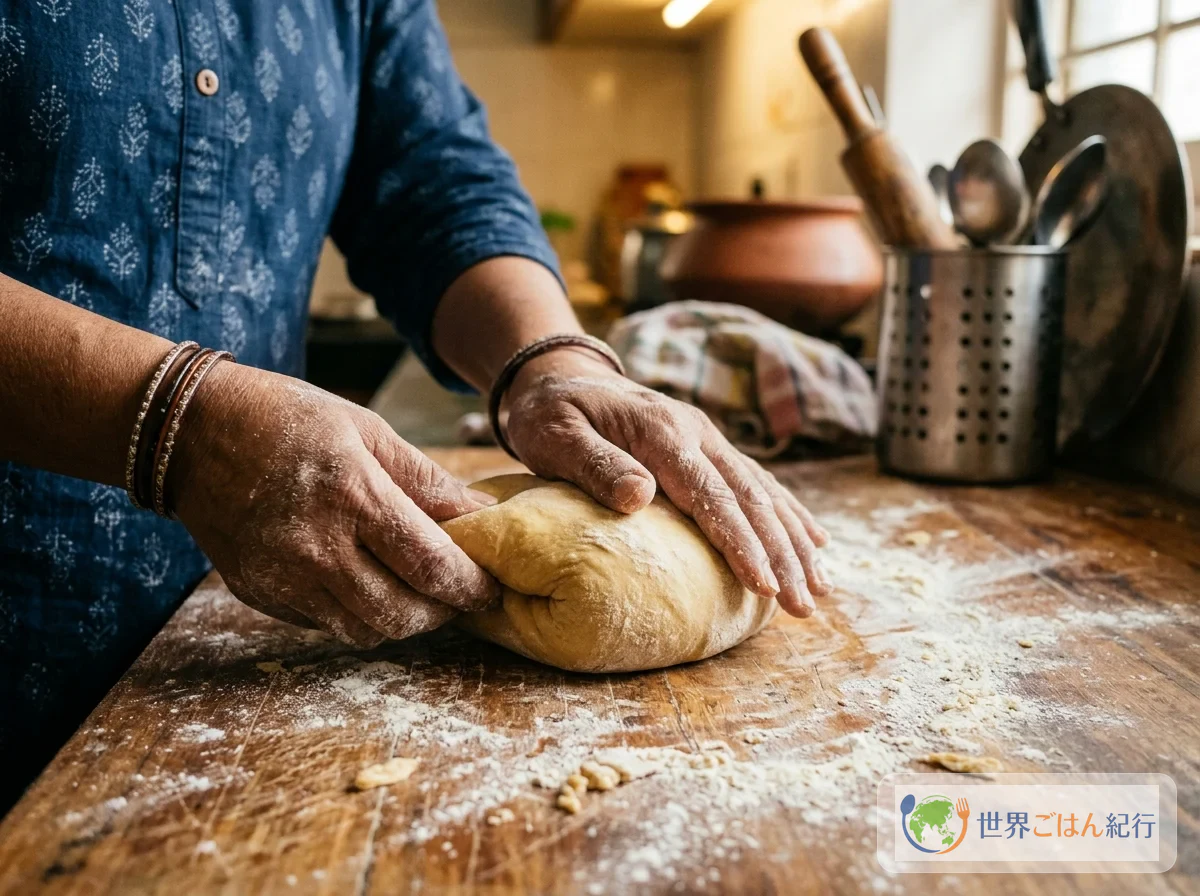
A rolex is made to order. The chapati and egg are prepared separately, then brought together on one griddle. A stall can be as simple as a kneading table, a surface for cooking chapati, a skillet for the egg and a charcoal stove. The cook decides how much filling goes in, so the same name covers everything from a light one-egg snack to a big roll with more eggs.
The dish took hold in Kampala's Wandegeya, Nakulabye, Kabalagala and other areas as a meal for university students and single people. It shows up wherever people gather, too: markets, funerals, prayer meetings, school events and political rallies. Breakfast, lunch, a meal on the way to work, something to fill the stomach late at night. What matters more than the time of day is getting it right off the griddle.
Where Uganda's matooke is the household staple savored as a stew, the rolex is a town meal built on a griddle from flour, egg and vegetables. With so few ingredients, half the fun is cooking while you watch how everything is coming along.
Chapati and Ugandan fillings
Chapati itself entered the food culture through Asian communities in East Africa and the history of the Uganda railway via Kenya. People in Busoga were exposed to Asian cooking early, and they developed the rolex as a regional dish, pairing chapati with egg, vegetables and spices. The result is distinctly Ugandan: a thin flatbread topped with Ugandan eggs, cabbage, tomato and onion, shaped by charcoal cooking and the pace of stall orders.
A living for vendors
The rolex connects the people who start stalls, the traders who carry eggs and flour, and city dwellers who need a meal. In 2025 it was discussed as a job opportunity and a source of national pride, while also raising questions about hygiene in street cooking and the use of urban space.
In 2022, Uganda announced it had trained more than 500 young people in the west in hygiene, customer service, business, finance and waste management, and handed 40 rolex carts to vendors. It is a move to put in place the conditions for makers to keep their trade, not only to advertise it as a tourism resource.
Ingredients (4 rolls)
Chapati
Stalls fill the rolex differently. Some mix raw vegetables into the egg, and others cook the vegetables first. This recipe mixes the cabbage in raw to keep its bite, but remove the seeds from the tomato. Watery tomato put in as it is keeps the egg from setting, and the juice runs out when you roll it.
The chapati contains wheat and the omelet contains egg. If you use store-bought chili sauce or ketchup, check the ingredient label. If you cook the egg soft-set, use egg cooked through to the center for pregnant people, children, older people and people with weakened immune function.
Choosing ingredients and tools for rolex
Flour
All-purpose flour, eggs, cabbage, tomato and onion are all at an ordinary supermarket. The one to order in is atta flour, which gives the chapati its aroma and layers. Mixing atta flour into all-purpose flour adds a little more savoriness when cooked and a bit of resistance when you bite through it. It pushes the bread toward a thin chapati that wraps around the filling, rather than a thick bread like naan.
You only use 1.75 oz (50 g) of atta flour for 4 rolls, so buy it only if you'll make chapati or roti several times. For a single batch, use 10.5 oz (300 g) of all-purpose flour and you'll have no flour left over. Cake flour alone makes a dough that tears easily, so stick with all-purpose the first time. Ordinary whole wheat flour can stand in for atta, but the coarser the grain, the more water it needs and the more easily it tears, so adjust the moisture as you roll it thin.
Skillet or tawa
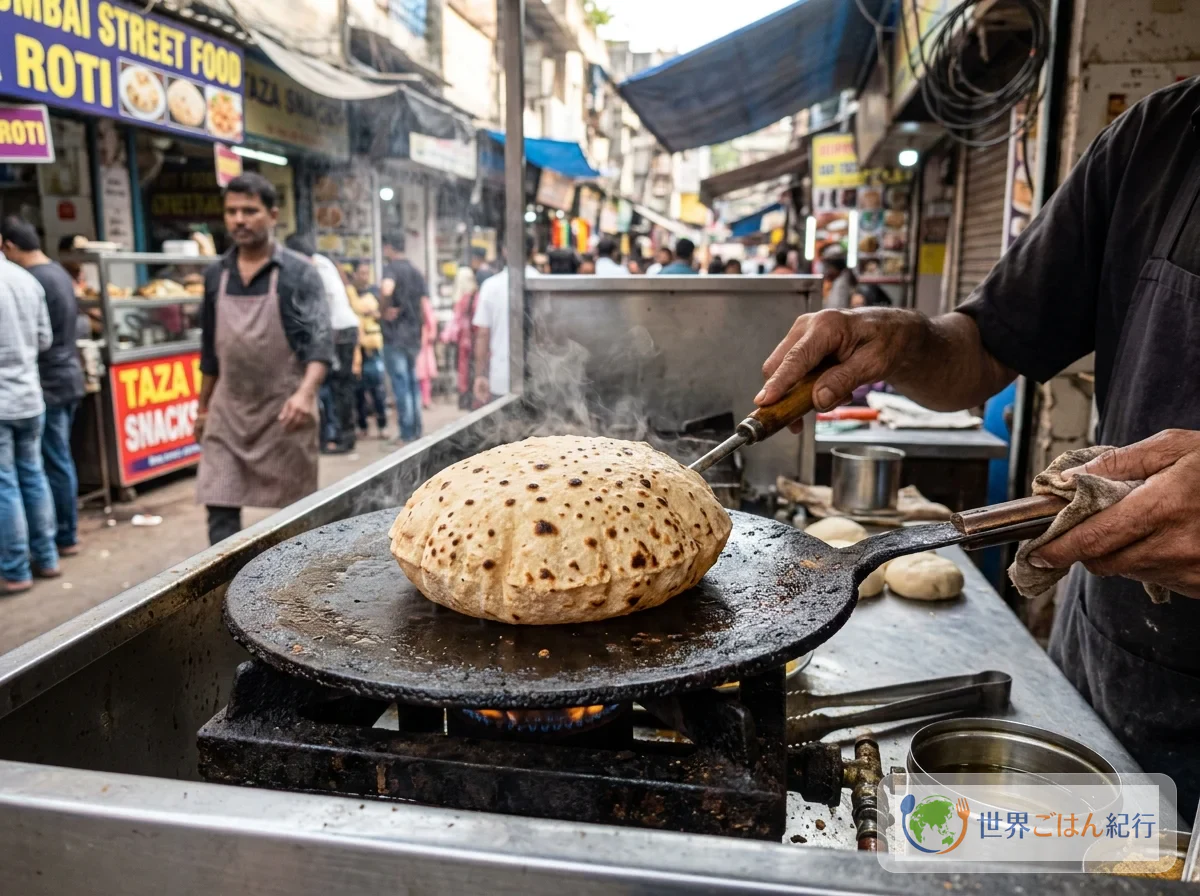
An ordinary skillet 9.5 inches (24 cm) or more across is enough to make 4 at once. A dedicated chapati pan makes sense if you want to cook thin dough into the same circle every time, or want a flat surface without a raised edge. One model is about 9 inches (22.5 cm) across and about 0.125 inch (3 mm) thick, made of aluminum with an oxide coating; the dough here is rolled to 8.5 inches (22 cm) to suit a pan of that size. To protect the surface, don't press hard with a metal spatula, and never run cold water over it while hot.
If you skip the dedicated pan, use a skillet of about 9.5 inches (24 cm) and keep the same heat. The pan only helps you match the circle size and the bubbles on the surface. What really counts at home is a way of cutting vegetables that doesn't release too much water, and a size matched to about 8.5 inches (22 cm).
Common rolex problems and fixes
The dough shrinks and won't spread to 8.5 inches (22 cm)
Right after folding, the gluten is tight and the dough wants to shrink. Rather than pulling it by force, cover it with a wrung-out damp cloth and leave it for 10 minutes. If it still springs back, push it out from the center with the palm of your hand instead of adding more dusting flour. If the cooked chapati turns out hard, warm it for 10 seconds per side in a dry skillet right before adding the egg, and cover it with a cloth so it rolls more easily.
Liquid comes out of the egg mixture and it won't set
The culprits are tomato seeds and water from the cut vegetables. Before cooking, tilt the bowl and spoon off the liquid at the bottom. If it's already in the pan, cook over low heat without moving the egg, divide it into 4 with a spatula and lay the pieces on the chapati. It won't be one neat sheet, but it all gets rolled up anyway, so the taste survives.
For dishes made with chicken eggs, heat to 158°F (70°C) for at least 1 minute. At home too, if you put safety first, heat until the center no longer runs and the whole is set. Safety for the people eating comes before reproducing the soft texture of the stall.
The chapati cracks while rolling
Usually it was overcooked or left to cool too long. Don't push egg into the cracked part; warm the chapati again and then roll. If it has torn completely, gather the filling in the center, fold it in half and cut it with a knife. Next time, take the chapati off the heat as soon as it has taken on color and cover it with a cloth right away.
Storing, varying and serving rolex
Storage
The stall-style texture only exists when it's freshly cooked, so assembling rolls ahead doesn't work. Instead, cool the chapati one at a time and wrap them; they keep in the fridge until the next day, and about 2 weeks frozen. Reheat in a dry skillet and cook the egg and vegetables only when you're ready to eat. Don't leave a finished roll containing egg at room temperature. If any is left over, cool it quickly, refrigerate it and reheat it to the center within the same day.
Regional and stall variations
| Name / regional difference | Filling and shape | How to adapt at home |
|---|---|---|
| Eastern form | Bamboo shoots mixed into the chapati | Shred canned bamboo shoots, pat dry and add 1 oz (30 g) |
| Northern form | Adds cooked vegetables | Stir-fry cabbage and onion for 1 minute, cool, and mix into the egg. Sweeter, with less liquid |
| Double face | 2 eggs and 2 chapati | One big roll to share between 2 people. Gather the filling toward the center before rolling |
| Titanic | A large version with 4 eggs and 2 chapati | Easier to flip one at a time. Don't cook the standard amount for 4 all at once |
| With meat | Adds ground meat, chicken and so on | Put 1.75 oz (50 g) of cooked meat on the omelet, then roll |
| With cheese or heat added | Restaurant and festival variations | Add 20 g of cheese and a little green chile per roll; cut the salt in the egg |
Whatever the filling, it should fit within the circle of the chapati and be easy to eat with one hand. Make the standard version first and change only the filling on the next one, so you can taste the difference while adjusting moisture and salt.
For the northern style, stir-fry the cabbage and onion in 1/2 tsp of oil and keep a little tomato raw for sweetness and acidity; the egg sets faster, which helps first-timers or when your vegetables are watery. Canned bamboo shoots give bite but not the aroma of the local ones, and reducing the cabbage by 1 oz (30 g) keeps the filling from spilling out. For a double face, use 2 chapati and 4 eggs, combine the omelet into one sheet, turn to medium-low after pouring and leave it alone until the bottom sets. To share, set it seam side down and cut on the diagonal.
For the meat version, cook ground beef, chicken or lamb with salt and pepper first. Mixing raw meat into the egg makes it hard to tell if it is cooked, so always cook it separately first. With cheese, reduce the salt in the egg to a pinch, and add the green chile to each roll afterwards so it's easy to divide between children and adults.
Nutrition
These are approximate values per roll for a batch of 4, assuming part of the oil stays in the dough and the omelet. Changing the atta flour, oil or vegetable amounts will change the figures.
| Nutrient | Amount |
|---|---|
| Calories | 560kcal |
| Protein | 20g |
| Fat | 25g |
| Carbohydrates | 2.25 oz (65g) |
| Fiber | 7g |
| Sodium | 650mg |
Dishes to make alongside
- How to make matooke — A Ugandan stew with banana as the staple.
- How to make kikomando — Another Ugandan snack, chapati eaten with a bean dish.
- How to make ugali — Compare East African staples and the culture of putting flour on the table.
- An Introduction to African Cuisine — The flour dishes and street foods of each region.
Frequently asked questions
Q1. Do I cook the vegetables first?
Both ways are common, and each shop has its own habit. Mixing raw cabbage and onion into the egg keeps their bite, while stir-frying them first brings out sweetness and helps the egg set.
Q2. Can I leave the egg soft-set?
Decide by more than taste: consider the egg's freshness, hygiene and who is eating. If you put safety first, cook it through to the center, heating to 158°F (70°C) for at least 1 minute.
Q3. Is it spicy in Uganda?
The basic egg and vegetables usually carry no strong heat, and chili sauce is served on the side. Some variations do add heat, so adding it afterwards makes it easy to suit everyone at the table.
Sources
All sources were rechecked on 19 August 2026. Publication dates of the sources mentioned in the article and historical dates such as when the dish spread have not been changed.
Culture, region and history
- The Guardian. (2016-05-09). "An insider's guide to Kampala, Uganda." https://www.theguardian.com/cities/2016/may/09/insiders-guide-kampala-rolex-uganda-capital: checked for fillings at Kampala stalls, the spread through student districts and the time of day it is eaten. (Accessed and checked: 2026-08-19)
- The Guardian. (2020-08-29). "Meera Sodha's vegan recipe for Ugandan rolex." https://www.theguardian.com/food/2020/aug/29/meera-sodha-vegan-recipe-ugandan-rolex: used for the combination of chapati and vegetable omelet and comparing home methods. (Accessed and checked: 2026-08-19)
- Daily Monitor. (2012-05-19). "Rolex; Made in Uganda." https://www.monitor.co.ug/uganda/magazines/life/rolex-made-in-uganda-1516728: checked for its spread around Wandegeya and Makerere and the recollection about one person's business. (Accessed and checked: 2026-08-19)
- Reuters / Daily Monitor. (2018-08-20). "In Uganda, 'Rolex' means time for an egg snack." https://www.monitor.co.ug/uganda/news/national/in-uganda-rolex-means-time-for-an-egg-snack-1774032: checked for the Busoga account, regional differences and differences in the size of the egg and chapati. (Accessed and checked: 2026-08-19)
- Ivan Nathanael Lukanda / The Conversation, published in Daily Monitor. (2025-01-04). "Uganda's rolex is much more than a street food – it's a national treasure." https://www.monitor.co.ug/uganda/lifestyle/dining-recipes/uganda-s-rolex-is-much-more-than-a-street-food-it-s-a-national-treasure-4878608: checked for stall equipment, the habit of serving after ordering, regional differences and the issues of work and hygiene. (Accessed and checked: 2026-08-19)
- Daily Monitor. (2022-12-08). "The culinary influence of Asians." https://www.monitor.co.ug/uganda/special-reports/the-culinary-influence-of-asians-4029610: checked for the points of contact among chapati, Asian communities, railway history and Ugandan ingredients. (Accessed and checked: 2026-08-19)
- Uganda Ministry of Tourism, Wildlife and Antiquities. (2022). "Ministry ... handsover 40 Rolex carts to vendors in Western Uganda." https://www.tourism.go.ug/single-post/ministry-of-tourism-wildlife-and-antiquities-handsover-40-rolex-carts-to-vendors-in-western-uganda: checked for hygiene and business training for rolex sellers and the handover of carts. (Accessed and checked: 2026-08-19)
Recipes and hygiene
- Boston Medical Center Teaching Kitchen. "Ugandan Rolex." https://www.bmc.org/recipes/ugandan-rolex: checked for resting the chapati, layering with the omelet and handling dough that can be refrigerated or frozen. (Accessed and checked: 2026-08-19)
- Ministry of Health, Labour and Welfare (Japan) and Japan Food Hygiene Association. (2023-10-27). "Guide to hygiene management incorporating HACCP concepts (for small general food businesses)." https://www.mhlw.go.jp/content/12401000/001163083.pdf: checked for the heating standard for dishes using chicken eggs and the handling of allergen information. (Accessed and checked: 2026-08-19)