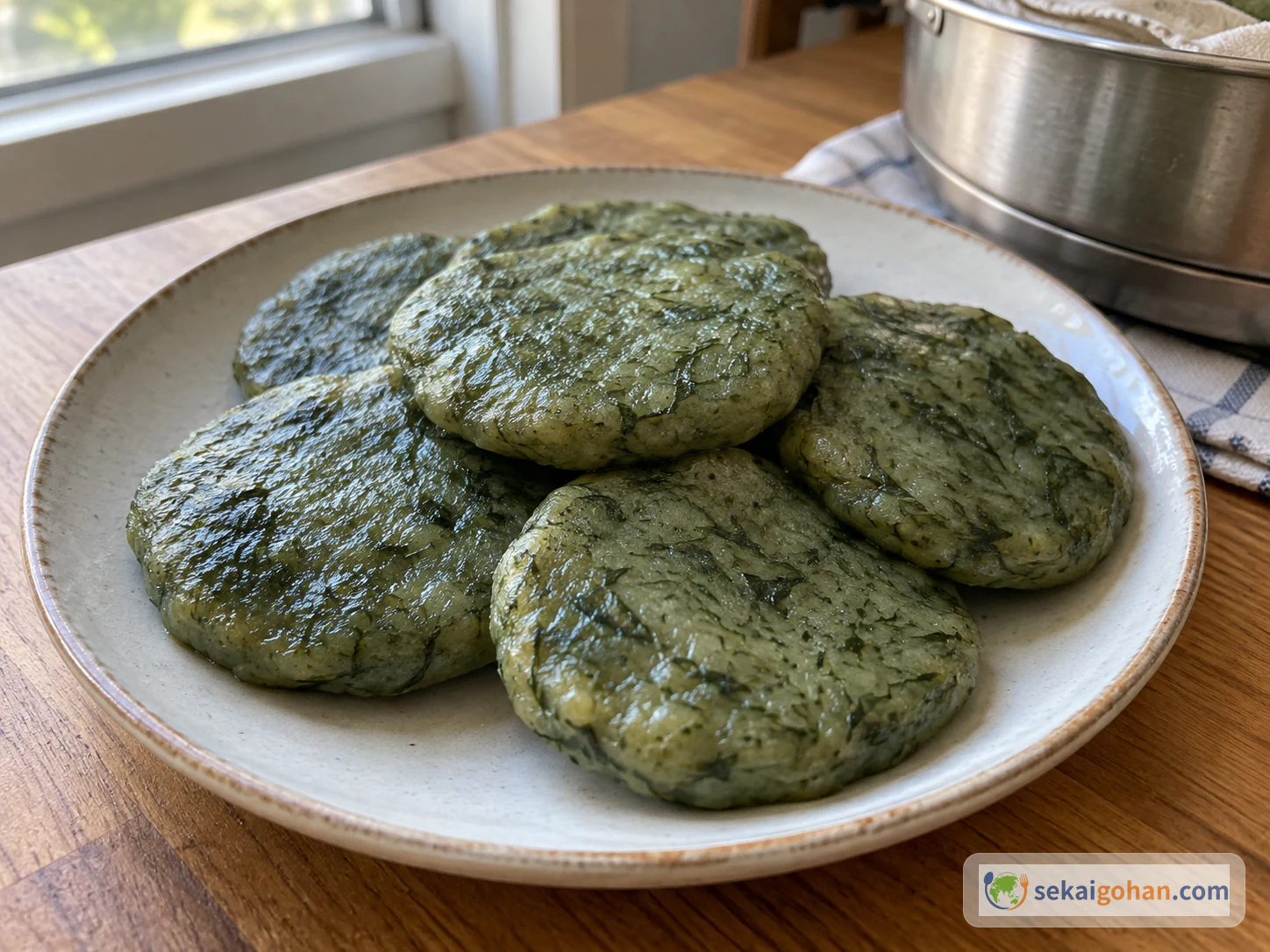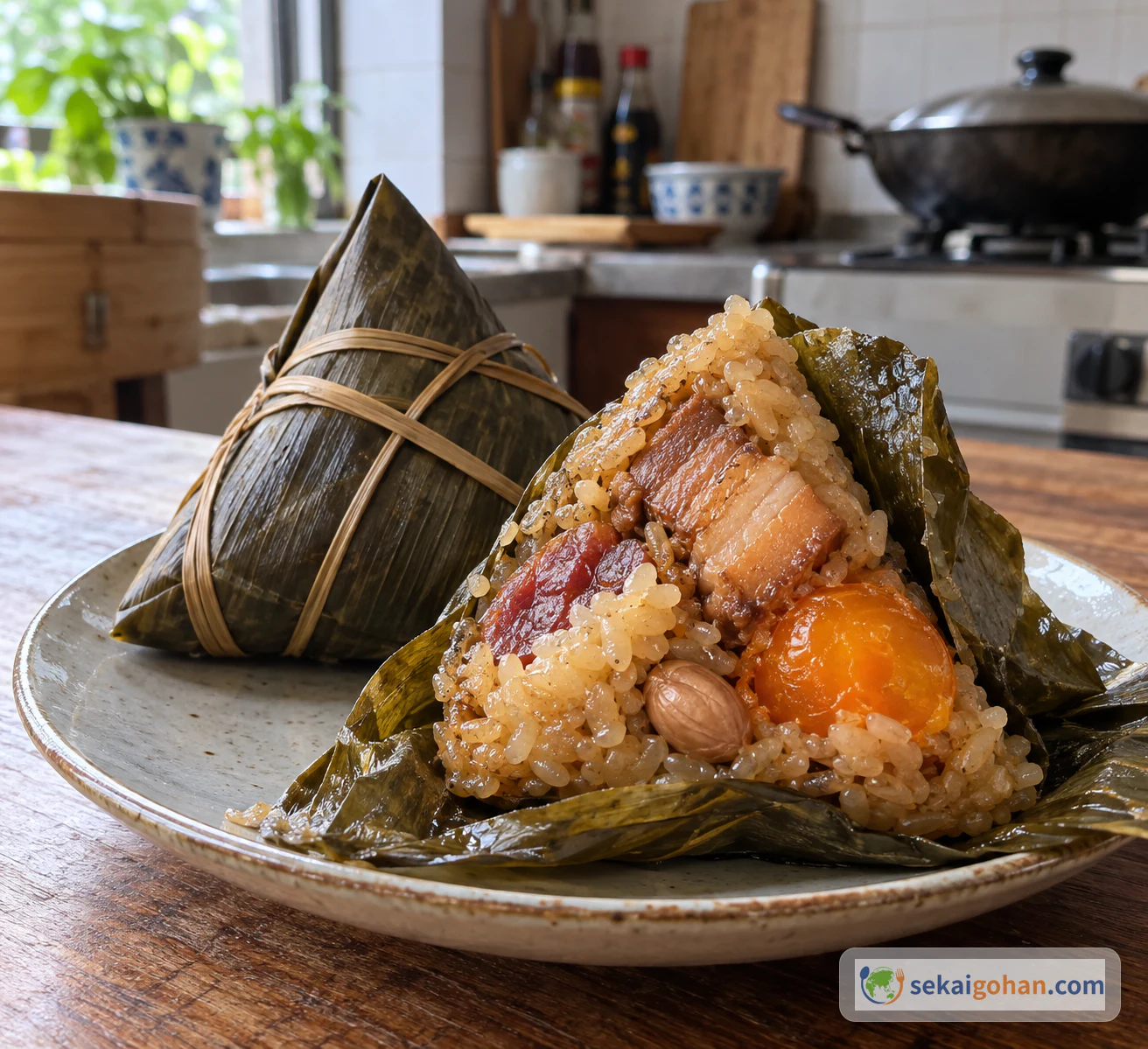
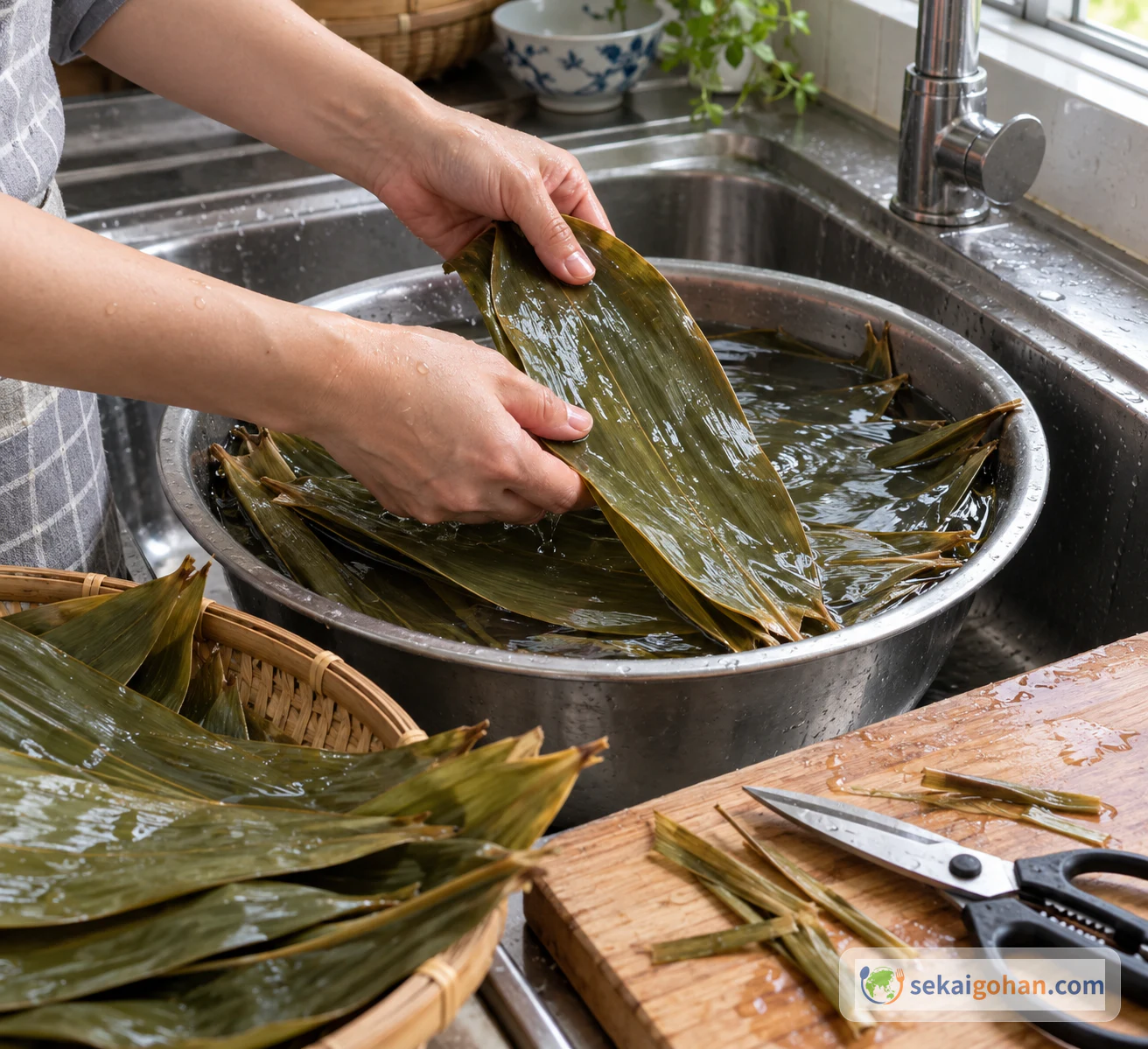
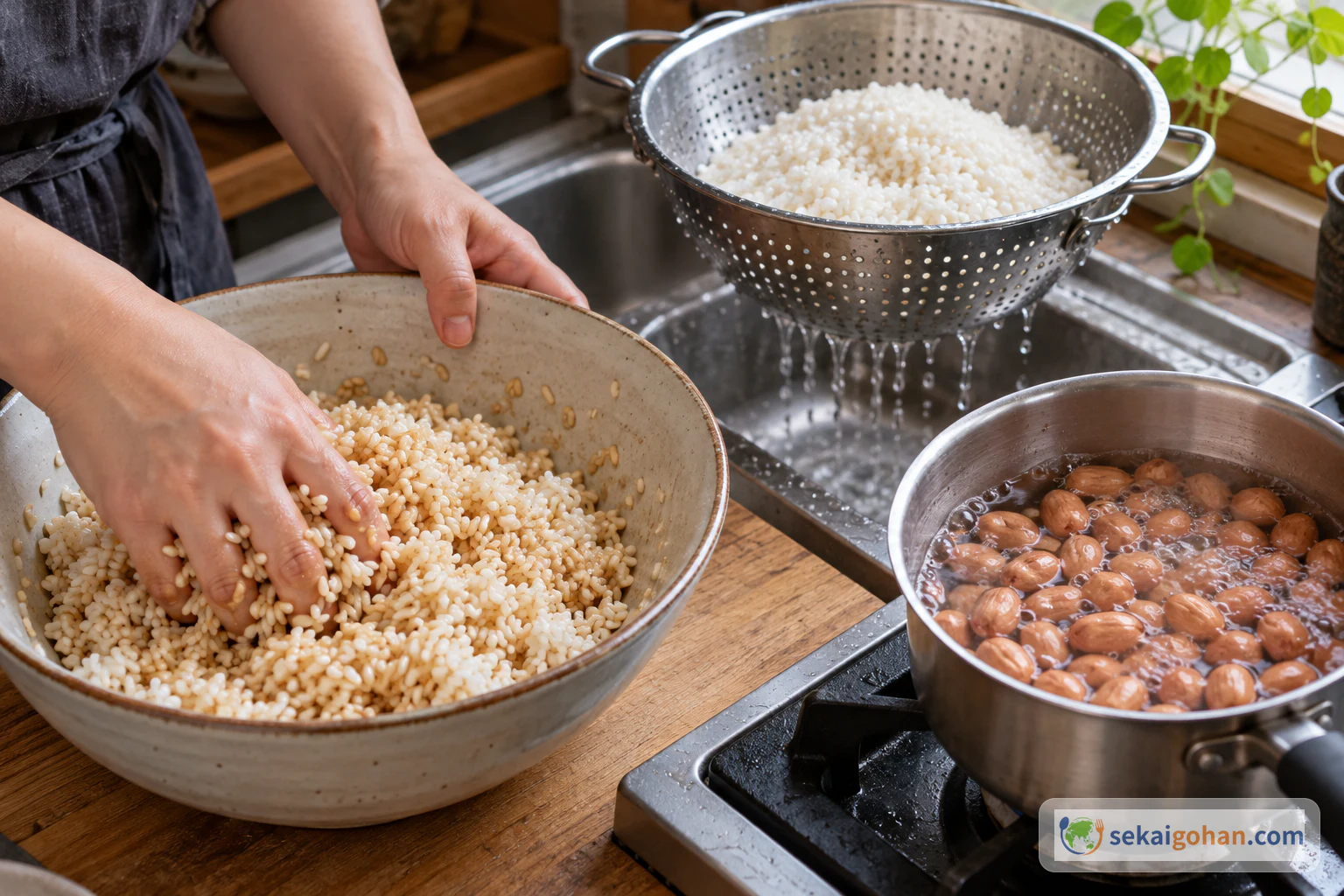
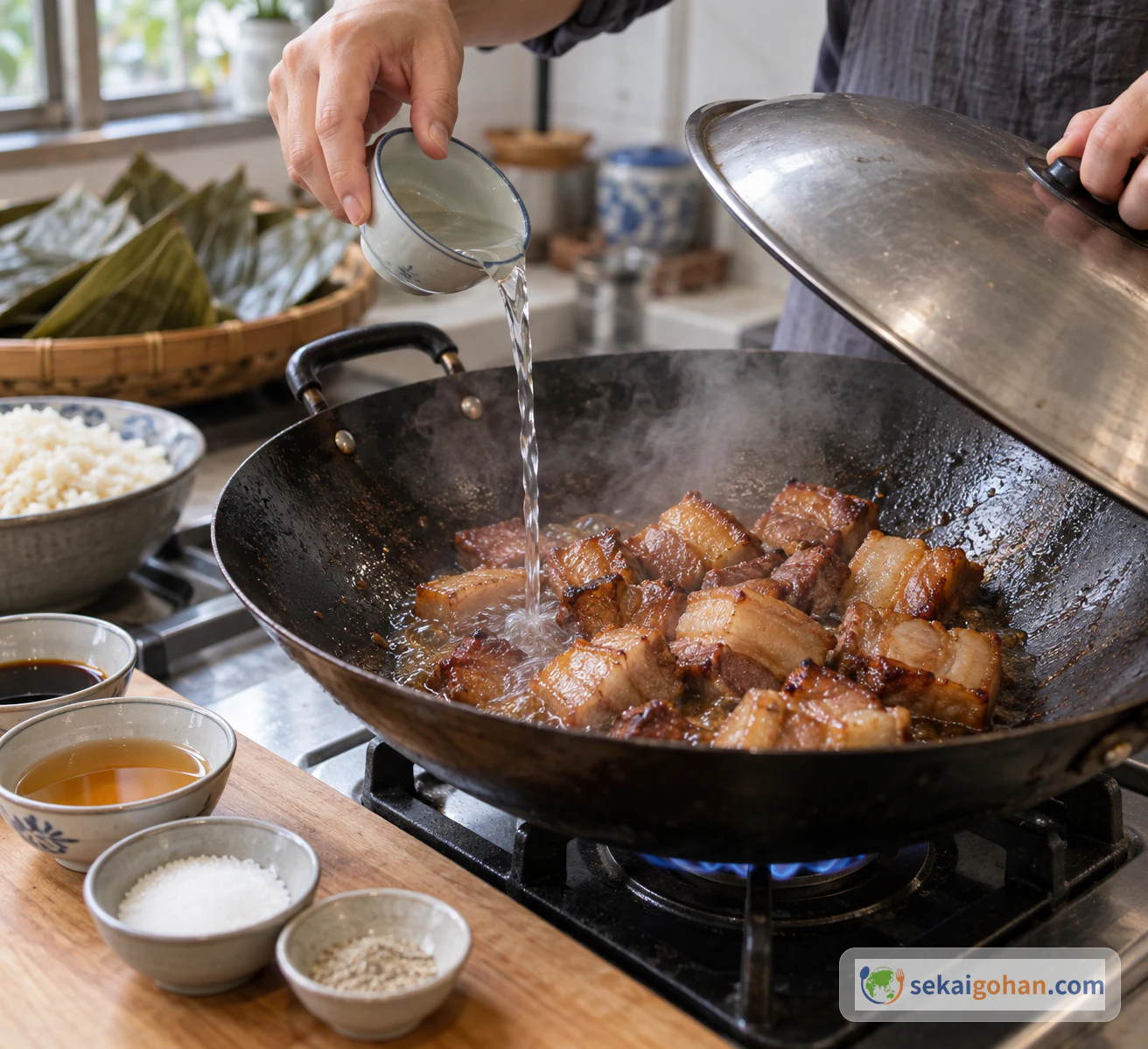
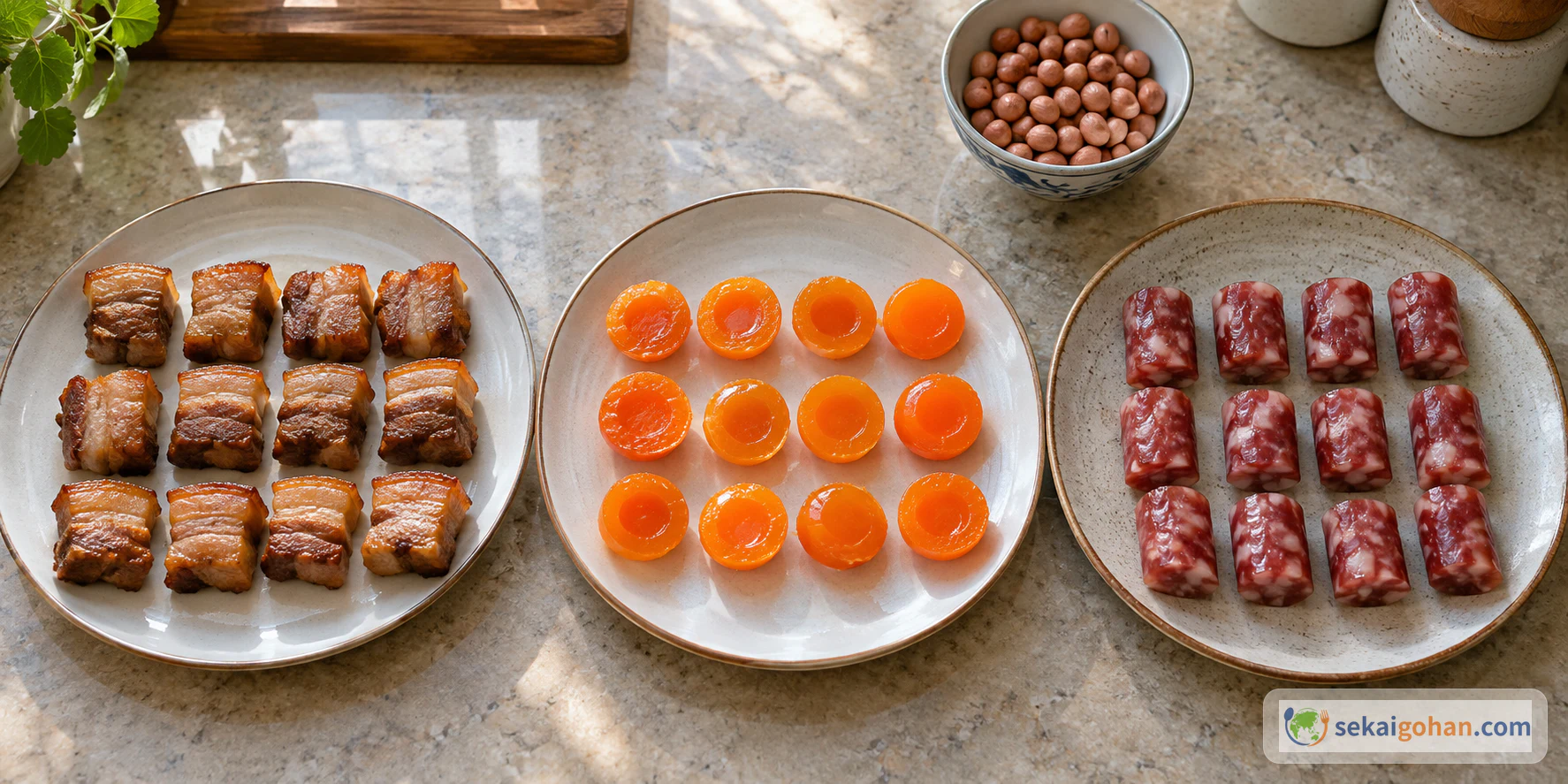
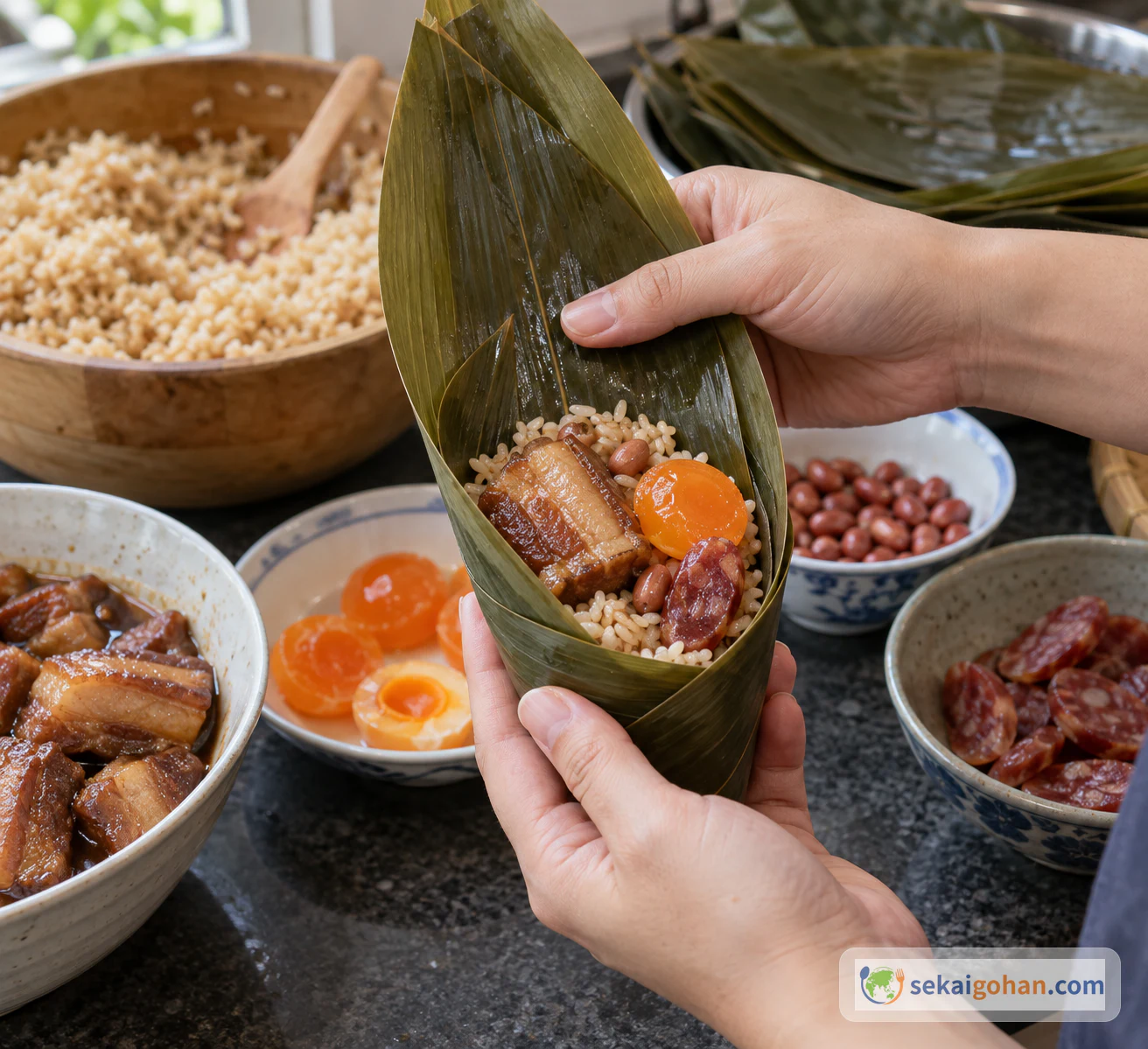
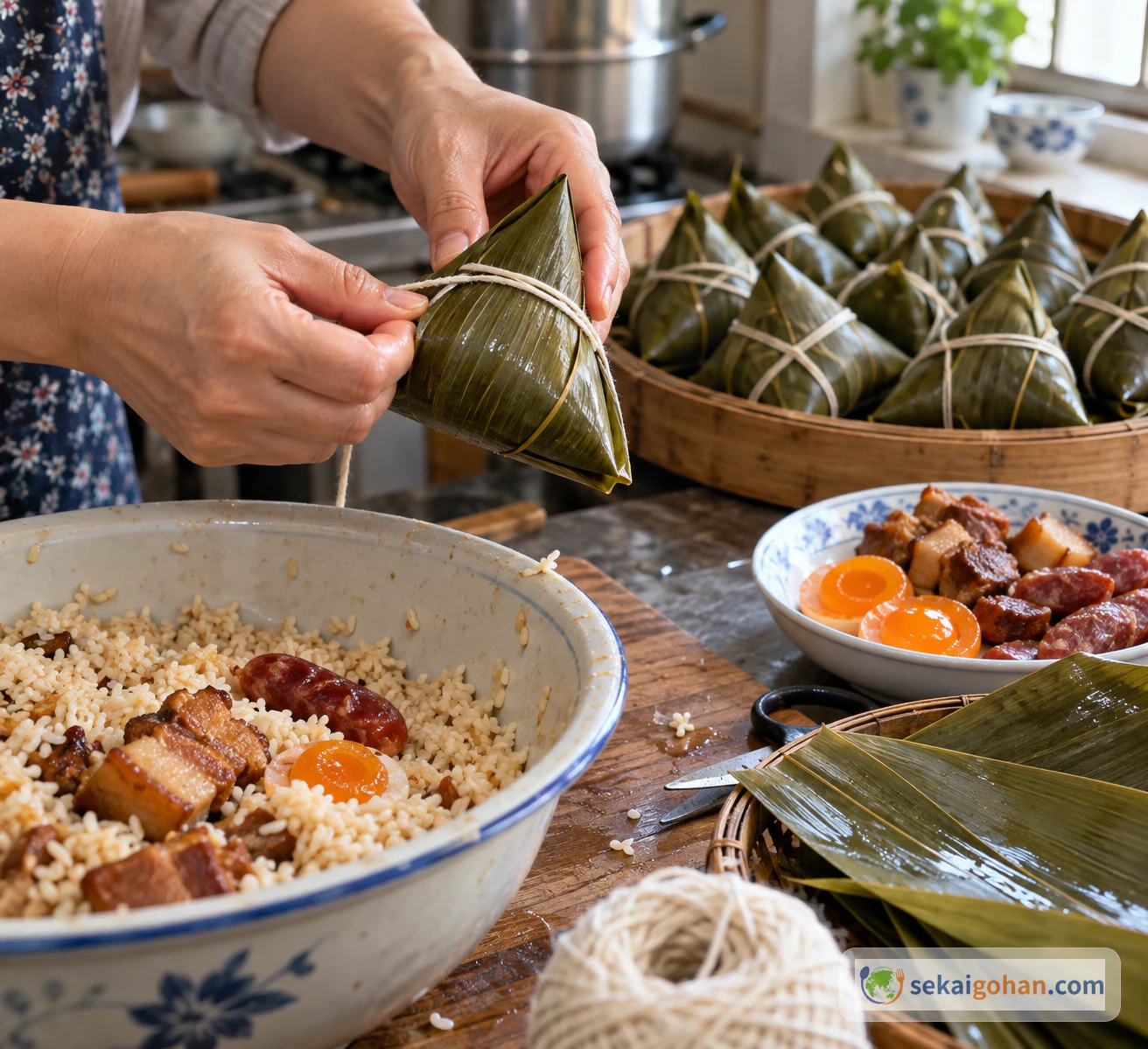
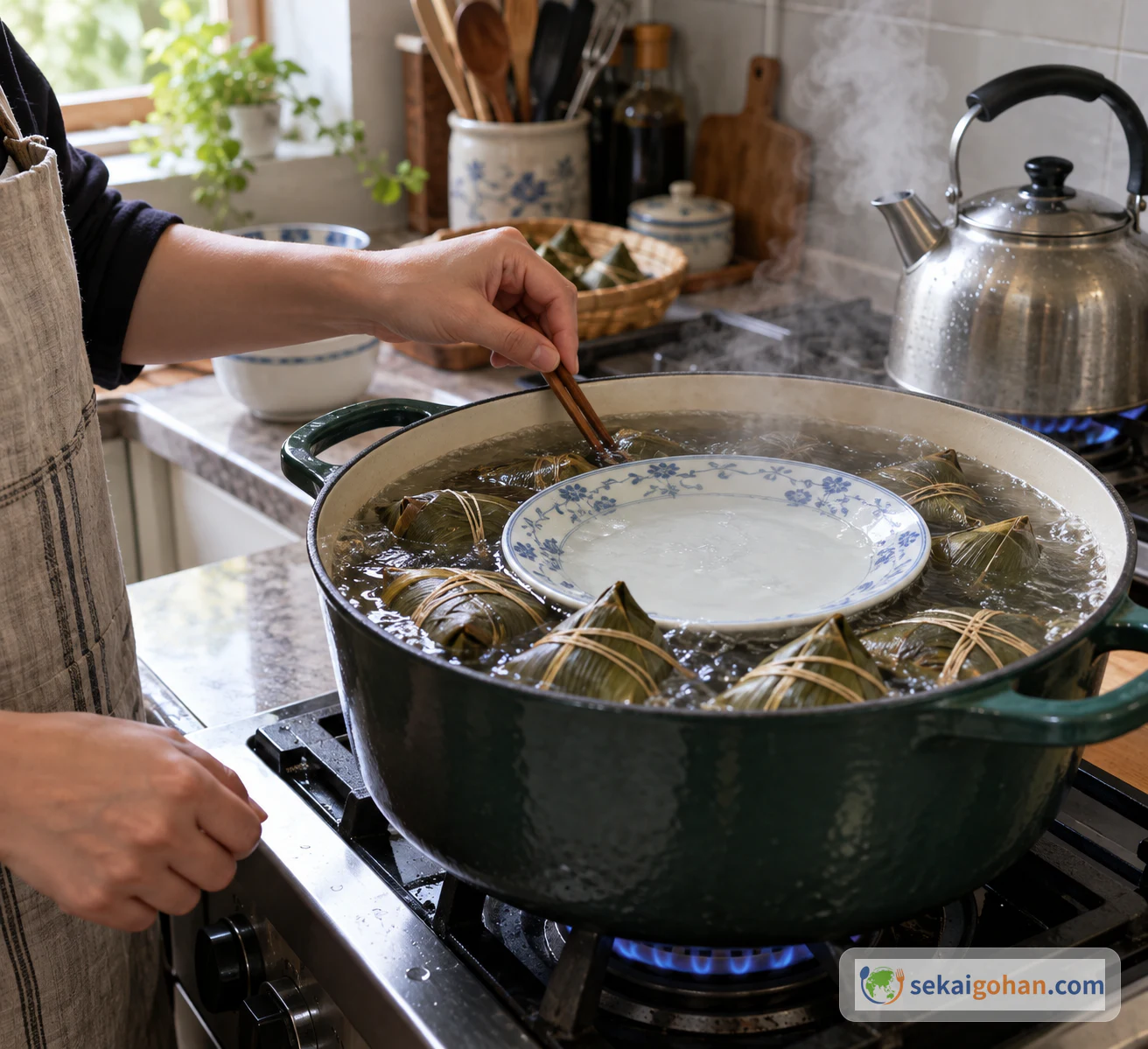
The work starts the night before. Dried bamboo leaves go into water, the glutinous rice soaks in its own bowl, raw peanuts in another, and pieces of pork belly settle into their marinade in the refrigerator. By the next day the leaves are soft and pliable, ready to be folded into cones, layered with rice and fillings, and tied shut one by one. These are zongzi (粽子; joong in Cantonese), glutinous rice wrapped in leaves. In this savory Cantonese style, the rice cooks into one chewy, bamboo-scented piece around a center of pork, peanut, salted egg yolk and Chinese sausage. Preparing them is often shared work, with family gathering the ingredients and wrapping the parcels together.
Zongzi and the Dragon Boat Festival
Zongzi is closely tied to the Dragon Boat Festival, held around the fifth day of the fifth month of the lunar calendar. A well-known legend links the custom to Qu Yuan and the rice offered in his memory. That legend is tradition rather than a settled origin for zongzi or the festival, and older forms of grain wrapped in leaves are part of the picture too.
There is no single standard zongzi across China. In Shanghai, savory zongzi with pork and salted egg yolk sit alongside sweet ones filled with red beans, jujubes or red bean paste, and the city is also known for rice seasoned with soy sauce around a meat filling. Sweet red bean paste fillings are associated with Beijing. Leaves, shapes, cooking methods and fillings vary widely from place to place, well beyond any simple north–south split.
The Cantonese version here takes two days and many hours of simmering. Split into evening prep and the next day's wrapping, though, it fits comfortably into a home kitchen. For more on the country's food, see the China cuisine page.
In Mandarin it is zongzi (粽子); in Cantonese, joong. In English it is often called a "rice dumpling."
Ingredients: Twelve Fully Filled Parcels from One Recipe
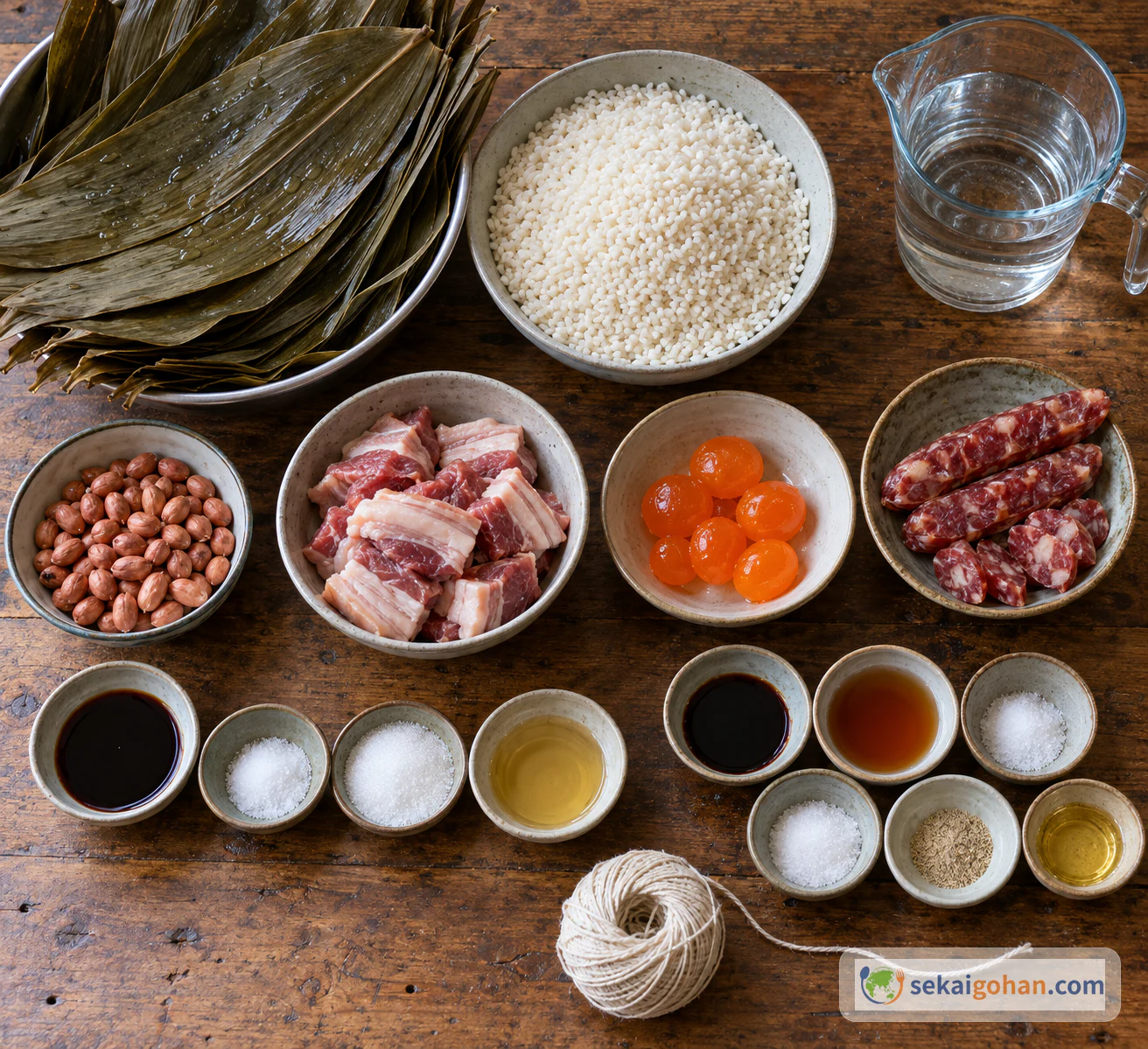
This Cantonese-style recipe makes 12–15 zongzi (15 servings). The pork, egg yolks and sausage each divide into 12 portions, so plan for 12 parcels at the low end of that range, each with every filling.
Measure the rice dry, before soaking. Use a 240 mL cup, a 15 mL tablespoon and a 5 mL teaspoon. A rice-cooker cup is a different size; do not convert the rice or peanuts to weights.
Besides the ingredients above, set aside separate water for each job: soaking the leaves, rice and peanuts; rinsing the leaves; boiling the peanuts for 5 minutes; dampening the twine; cold water to submerge the bundles at the start; and boiling water to top up the pot during cooking. Do not take any of it from the 1/2 cup meant for the pork.
This recipe contains peanuts, egg (salted duck egg yolk) and pork. Soy sauce contains soy, so check its label for wheat. Shaoxing wine, Chinese sausage and salted yolks can contain other allergens too, so read each product's label, including shared-facility statements. Marinate raw pork in a covered container in the refrigerator so its juices do not touch other foods, keep separate boards and utensils for raw meat, and wash hands and tools after handling it.
Equipment
- Several large bowls or containers for soaking the leaves, rice and peanuts separately, with covers
- A covered container for marinating the pork in the refrigerator
- A colander for draining the rice
- A small pot for boiling the peanuts
- A wok or skillet with a lid for braising the pork
- Kitchen shears for trimming the leaf stems
- Cotton kitchen twine that can be used for cooking food
- A large, deep pot that holds all the bundles fully submerged
- A heat-safe plate to weigh the bundles down
- A kettle for boiling top-up water
- A food thermometer, if you have one, for checking the pork
Choosing Ingredients for Zongzi
Bamboo leaves. Look for dried bamboo leaves sold for wrapping food at Chinese grocers or online, and follow the package's washing instructions. Replace any torn leaf rather than patching it. Other leaves change the aroma, the folding and the cooking, so they make a different dish.
Glutinous rice. Use short-grain glutinous rice, and check the label, since grain shape varies by variety. Mixing in ordinary rice changes the texture and how well the parcel holds together.
Light soy sauce. Chinese light soy sauce (生抽) is a different product from Japanese light-colored soy sauce (usukuchi). Any other soy sauce will shift the color, saltiness and aroma.
Shaoxing wine and white pepper. Other cooking wines differ in salt and aroma, and black pepper has a different scent than white, so either swap changes the flavor.
Salted duck egg yolks and Chinese sausage. Chicken egg yolks differ in saltiness and in how firm they become. Lop cheung has a sweetness and spicing that ordinary sausages lack.
Method: From the Evening Before to Hours at the Stove
Steps 1–4 happen the evening before and overnight. Steps 5–9 happen the next day. Cooked or raw, nothing should sit at room temperature for long between steps.
The night before, everything soaks or marinates separately. On the day itself, cook the pork, cut the fillings, wrap, and then let the pot do its long, quiet work.
Zongzi Troubleshooting
| Problem | Likely cause | What to do |
|---|---|---|
| The bottom of the leaf tears | Tough stem end left on, too few layers, a damaged leaf | Trim the stem end, keep the overlap, and replace torn leaves. Check for leaks while wrapping |
| The parcel opens up | Loose folds or slack twine | Recheck the folds and the twine. Use dampened twine, pulled firm but gently enough to leave the leaves intact |
| The rice is hard and dense | Rice pressed in with no room to swell | Fill loosely and follow the soaking and draining steps as written |
| The fillings don't match the parcel count | The recipe's range is 12–15 parcels, but the fillings come to 12 portions | Plan for 12 fully filled parcels rather than stretching the fillings to 15 |
| The water level drops | Long simmering | Check the level often and top up with boiling water so the parcels stay submerged |
Serving and Storing Zongzi
Unwrapping at the table
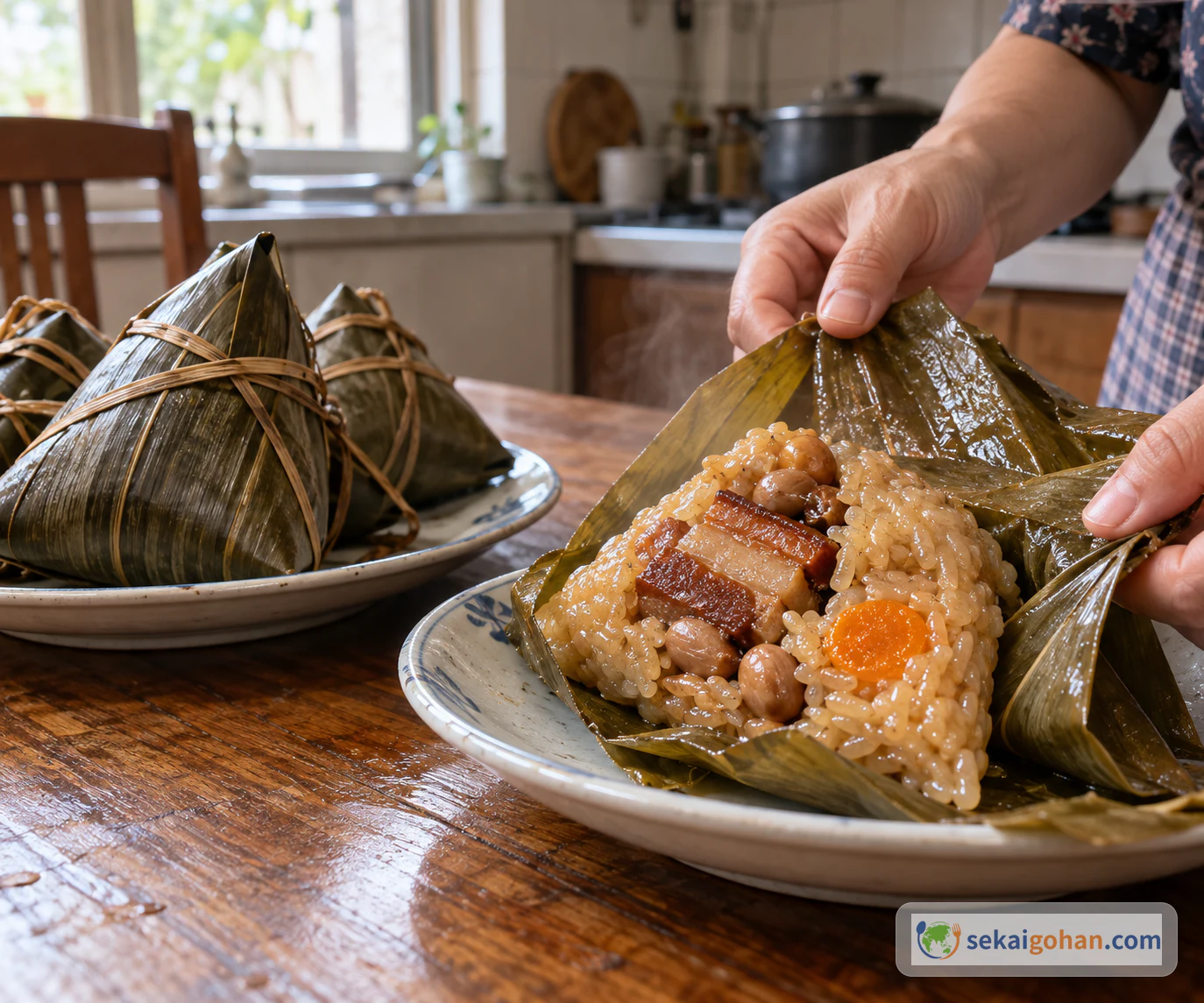
As the leaves fall open, steam rises with their scent, and the rice comes away as one glossy, sticky piece. Cut into it and the layers show: rich pork, the deep orange of the salted yolk, peanuts and sausage tucked inside the rice. Remove the leaves and twine on the plate and share the parcels warm.
For another Cantonese pork dish, try char siu. For another wrapped dish, from Shanghai, see xiaolongbao, and for festive cooking with dried ingredients, Buddha's delight.
Freezing and reheating
Zongzi freeze well. Divide leftovers into small portions and cool them quickly, keeping their time at room temperature short; rice that has sat out stays unsafe even after reheating.
Thaw frozen zongzi in the refrigerator rather than on the counter, then reheat the thawed parcels in boiling water for 15–20 minutes. A parcel still frozen needs longer. Whatever the size, heat until it is hot all the way to the center, at 167°F (75°C) or above.
Variations
Leaving out the peanuts changes the filling and texture. It does not make the dish safe for a peanut allergy, so check the label of every other ingredient too. Skipping the egg yolk gives a simpler parcel with less saltiness and richness.
Frequently Asked Questions
Is zongzi the same as every leaf-wrapped rice dish called a "rice dumpling"?
No. The name covers several traditions. Here, zongzi means the Chinese dish of glutinous rice wrapped in leaves, in one savory Cantonese style. Related dishes elsewhere, such as Vietnam's bánh chưng, are separate.
Is zongzi eaten outside the Dragon Boat Festival?
It is most strongly tied to the festival, but it also appears at other family occasions.
Why simmer for 7–8 hours?
That time fits this recipe's parcel size and pot, counted from when the water comes to a boil and the heat is lowered; other zongzi may need different times. Whatever the time, confirm the pork is cooked through to the center.