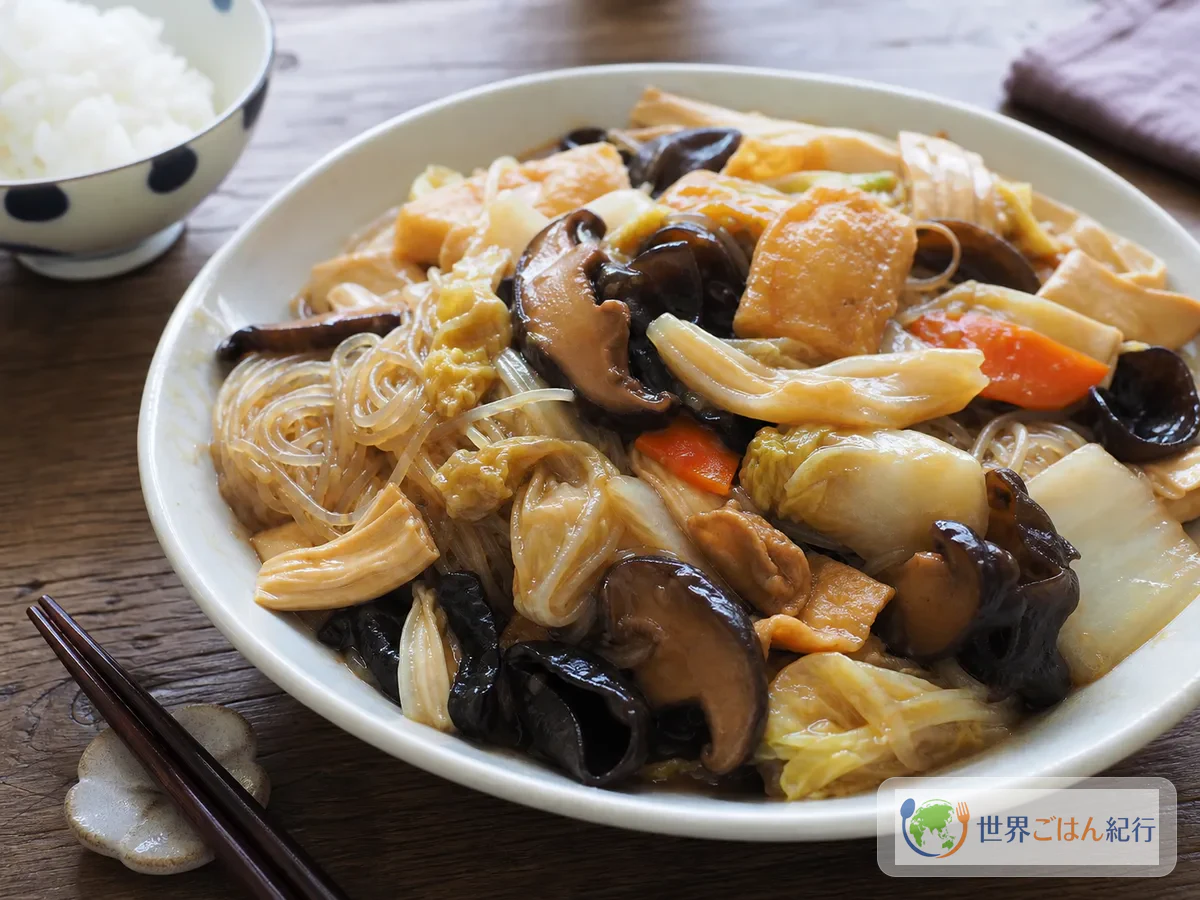
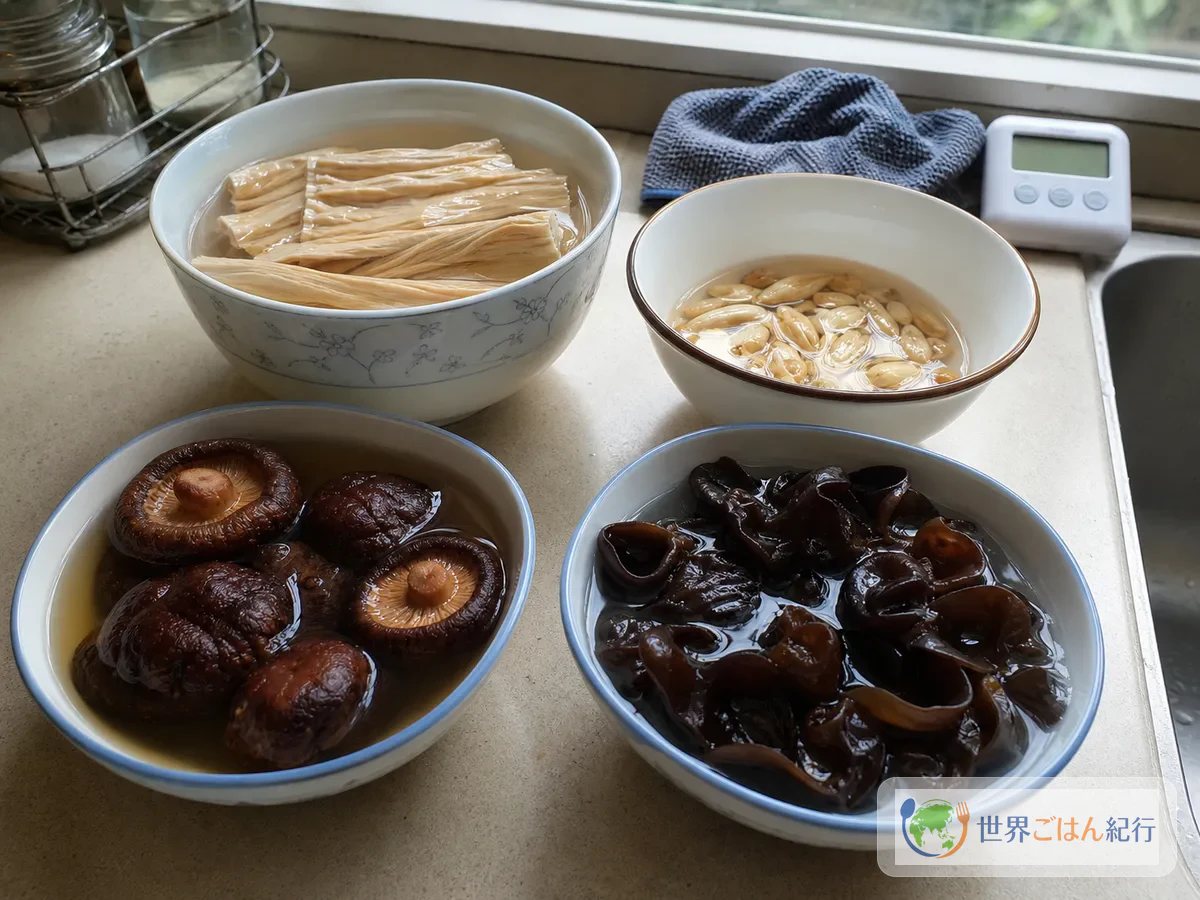
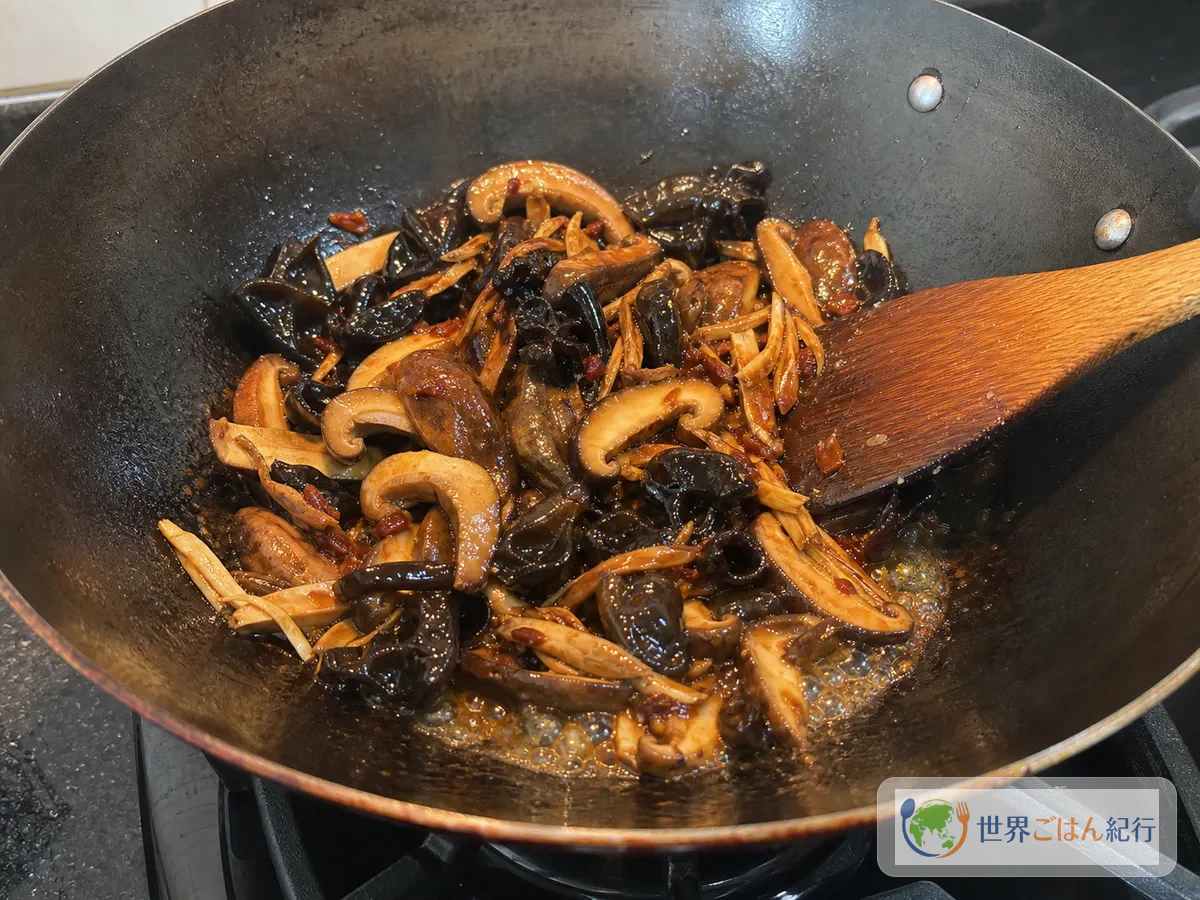
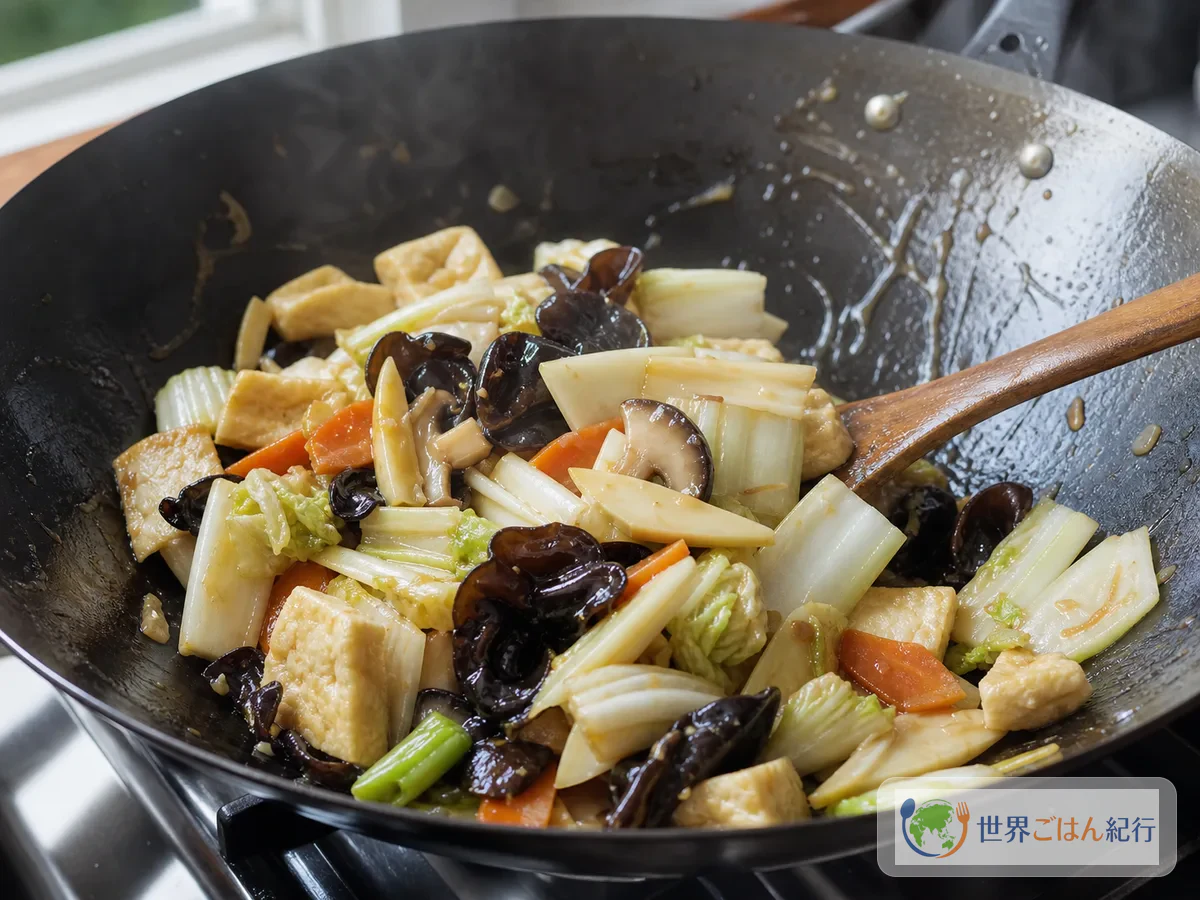
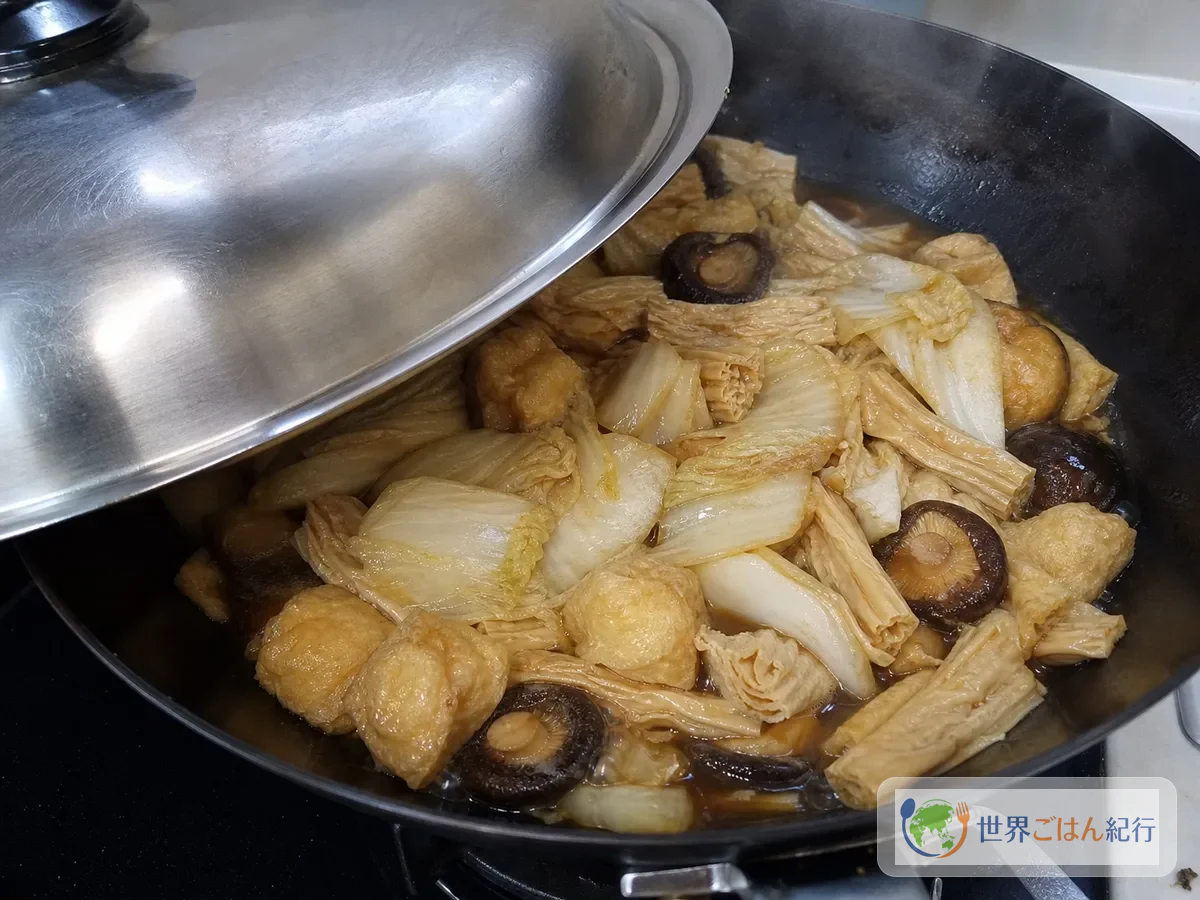
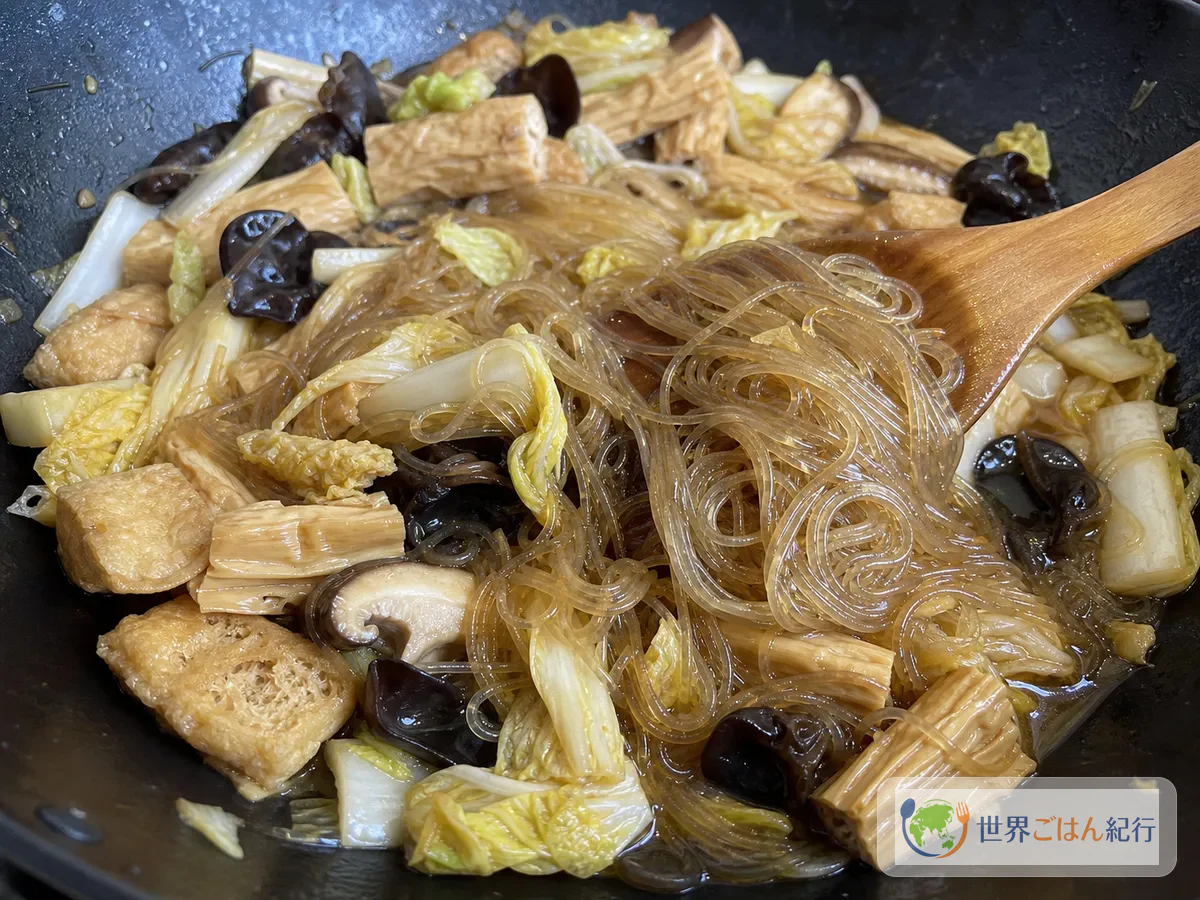
Sink dried shiitake in warm water and the caps, hard as wood at first, slowly regain their roundness. Wood ear goes from small black shards to wavy, ear-shaped ruffles, and dried tofu skin turns from a stack of paper into supple layers. Buddha's Delight (羅漢齋 / Luóhàn zhāi / Lo Han Jai) begins in these hours before anything touches the heat. This braise of vegetables and dried goods sits between Chinese Buddhist vegetarian cooking and the festive home table, and in Hong Kong and Cantonese households it is the vegetarian dish eaten on the first day of Lunar New Year. Its flavor builds quietly, layer by layer, from the soaking liquid, red fermented tofu and the sweetness of napa cabbage.
Buddha's Delight on Lunar New Year morning
A New Year dish from the home kitchen
The "luohan" in the name comes from the arhat, a person who has reached enlightenment in Buddhism, but at home this is not a temple dish. It is eaten on the morning of Chinese New Year at a grandmother's house, alongside small bowls of rice. Relatives gather, and everyone rests their stomach by avoiding meat and fish. The contents of the dried-goods shelf come back a little at a time and end up piled on one big platter, where religious vegetarianism and a household calendar meet.
Dried shiitake, wood ear and tofu skin soaked the day before go into a big pot. When the heat goes on, the kitchen fills not with the smell of roasting meat but slowly with the sweet scent of dried goods and the fermented aroma of red fermented tofu. After the rich feasting, it is a platter that eases the start of the year.
The home version is softer than strict temple food. Some households avoid the five pungent vegetables, and others use a little ginger or scallion. Some versions include black hair moss, while others center on napa cabbage and tofu skin. What matters is that you make up for the meat with places to chew: soy products, mushrooms, glass noodles and fermented tofu.
Cantonese Lo Han Jai and restaurant Buddha's Delight
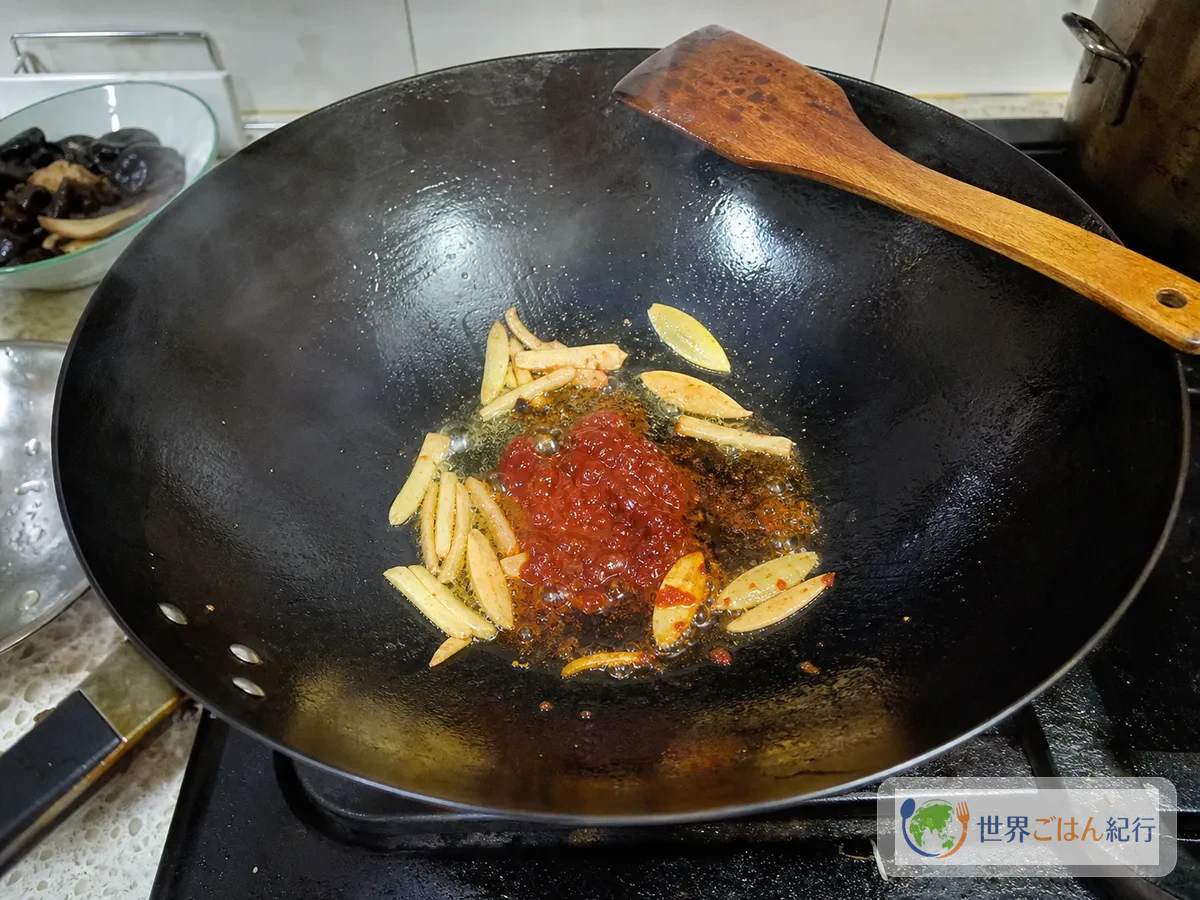
In Cantonese Lo Han Jai, versions that use red fermented tofu, or nam yu, for a red, fermented fragrance stand out. Warm the fermented tofu in oil before adding the dried goods, as in the nam yu braised vegetarian dish, and it gives depth even without meat.
In English-speaking countries the dish is best known as Buddha's Delight, the vegetarian plate on Chinese restaurant menus, and there it leans toward a stir-fry with broccoli, snap peas and tofu. That eats quite differently from Lunar New Year Lo Han Jai. At home you get closer to the New Year version by keeping the soaking liquid, letting the tofu skin drink it up and going easy on the glass noodles, rather than adding more green vegetables. The real test is the bite you pick up with chopsticks: the crunch of wood ear, the layers of tofu skin and the aroma of shiitake should come through in turn.
Among East Asian home dishes, it is the opposite of mapo tofu, which pushes with aromatic oil. Beggar's chicken, a whole chicken sealed in lotus leaf and a salt dough, makes a contrast too: where Buddha's Delight is a quiet plate of dried goods simmered through, beggar's chicken is a wrapped roast whose aroma bursts out the moment it is opened.
The dish is written many ways in English and other languages (Lo Han Jai, Luohan zhai, Buddha's Delight and more). The Chinese "luohan" comes from the Buddhist arhat, and "zhai" is used in the sense of a vegetarian meal.
Ingredients (serves 4)
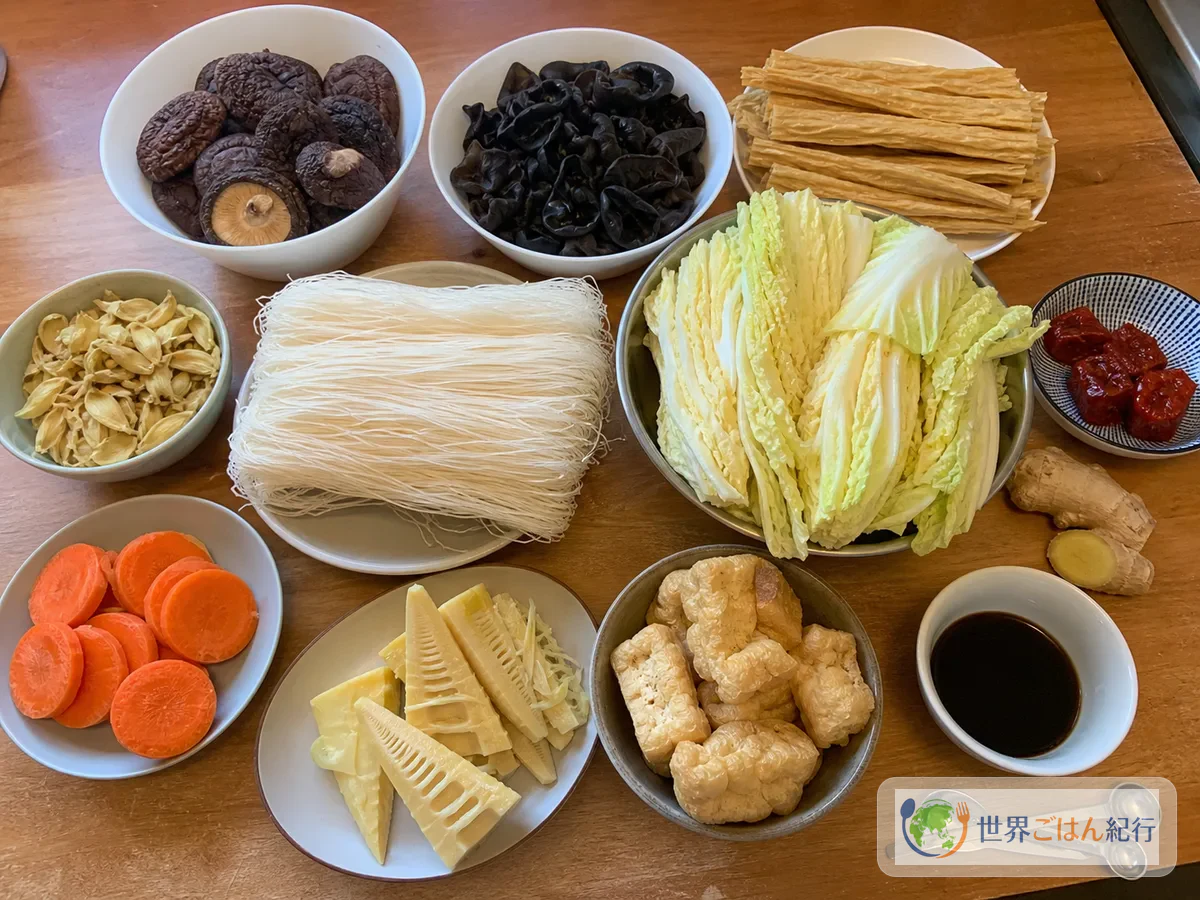
This quantity serves 4 as a main dish with white rice. Because the glass noodles drink up liquid, stop while the dish still has a little liquid left when freshly made. If you are saving it for the next day, use half the glass noodles and add 3.5 oz (100 g) more napa cabbage, and it is less likely to turn heavy when reheated.
This recipe contains soy (tofu skin, fried tofu, red fermented tofu, soy sauce), seasonings that may contain wheat, and, depending on the product, sesame. If you follow a strict vegetarian diet or religious restrictions, check the ingredients of the red fermented tofu, soy sauce and Shaoxing wine. The home version uses ginger, but if you want to match temple-style vegetarian cooking, leave out the ginger too and make the shiitake soaking liquid a little stronger.
Ingredients you can swap, and ones that are hard to replace
The many ingredients refer to the "eighteen luohan." At home, though, what matters is layering the textures of the dried goods more than matching the number of items.
| Role | Ingredients to keep | Possible substitutes | What changes with the substitute |
|---|---|---|---|
| Umami | Dried shiitake and the soaking liquid | Add ½ cup (100 ml) of kombu stock | Less Chinese in character, leaning Japanese |
| Texture | Wood ear, bamboo shoots | Lotus root, king oyster mushroom | The bouncy, jelly-like texture of wood ear is lost |
| Soy layer | Dried tofu skin, fried tofu | Thick fried tofu, fresh tofu skin | Less of the springiness of fuzhu, but easier to make |
| Fermented aroma | Red fermented tofu | White fermented tofu, a little barley miso | The red aroma and saltiness of red fermented tofu weaken |
| Liquid absorber | Mung bean glass noodles | None, or a little kudzu noodle | Without glass noodles it becomes a lighter simmered dish |
The ingredients most worth tracking down at an Asian grocery or online the first time are red fermented tofu, dried tofu skin and dried wood ear. Dried shiitake is easy to find in most supermarkets, and napa cabbage, carrots, bamboo shoots and fried tofu are fine from a regular grocery store. Black hair moss (fat choy) turns up in Lunar New Year cooking, but because of availability and environmental concerns this home version does not use it; the texture is built with wood ear and glass noodles instead.
Red fermented tofu and fuzhu vary a lot by maker. The first time, read the labels in person at an Asian grocery before choosing. Dried shiitake, napa cabbage, carrots, bamboo shoots and fried tofu are enough from an ordinary supermarket.
Choosing and soaking the ingredients for Buddha's Delight
The four ingredients that matter
The vegetables are the easy part; napa cabbage, carrots and bamboo shoots are simple to find. The crux is how far to go with dried tofu skin, wood ear, dried shiitake and red fermented tofu. Try to assemble everything perfectly and you'll stall at the shopping stage, so handle those four properly and let napa cabbage and fried tofu carry the volume.
Even the four vary. Red fermented tofu differs in saltiness from jar to jar, and thin dried tofu skin and thick fuzhu (dried tofu sticks) soften differently. Black hair moss is an auspicious Lunar New Year ingredient, but it is hard to obtain in many places, and its quality and origin are hard to judge. Leave it out: glass noodles give the fine texture and wood ear the dark crunch.
Soaking the day before
Preparation order decides the flavor here more than heat control does. If you put all the dried goods in one bowl, the fast-soaking glass noodles take up too much water and the shiitake soaking liquid turns cloudy. Short on small bowls? Separate only the shiitake, wood ear and tofu skin, and keep the golden needles in a strainer next to the tofu skin.
| When | What to do | Where to keep it | Guide to avoid failure |
|---|---|---|---|
| The night before | Soak only the dried shiitake in water | Refrigerator | Enough water to submerge the mushrooms completely. Don't leave them at room temperature |
| Morning of | Soak the wood ear, golden needles and tofu skin | Refrigerator on a hot day | Wood ear is open, tofu skin is soft enough that it doesn't crack when folded |
| Before cooking | Soak the glass noodles last | Strainer in the kitchen | Don't soak long; stop while still slightly firm |
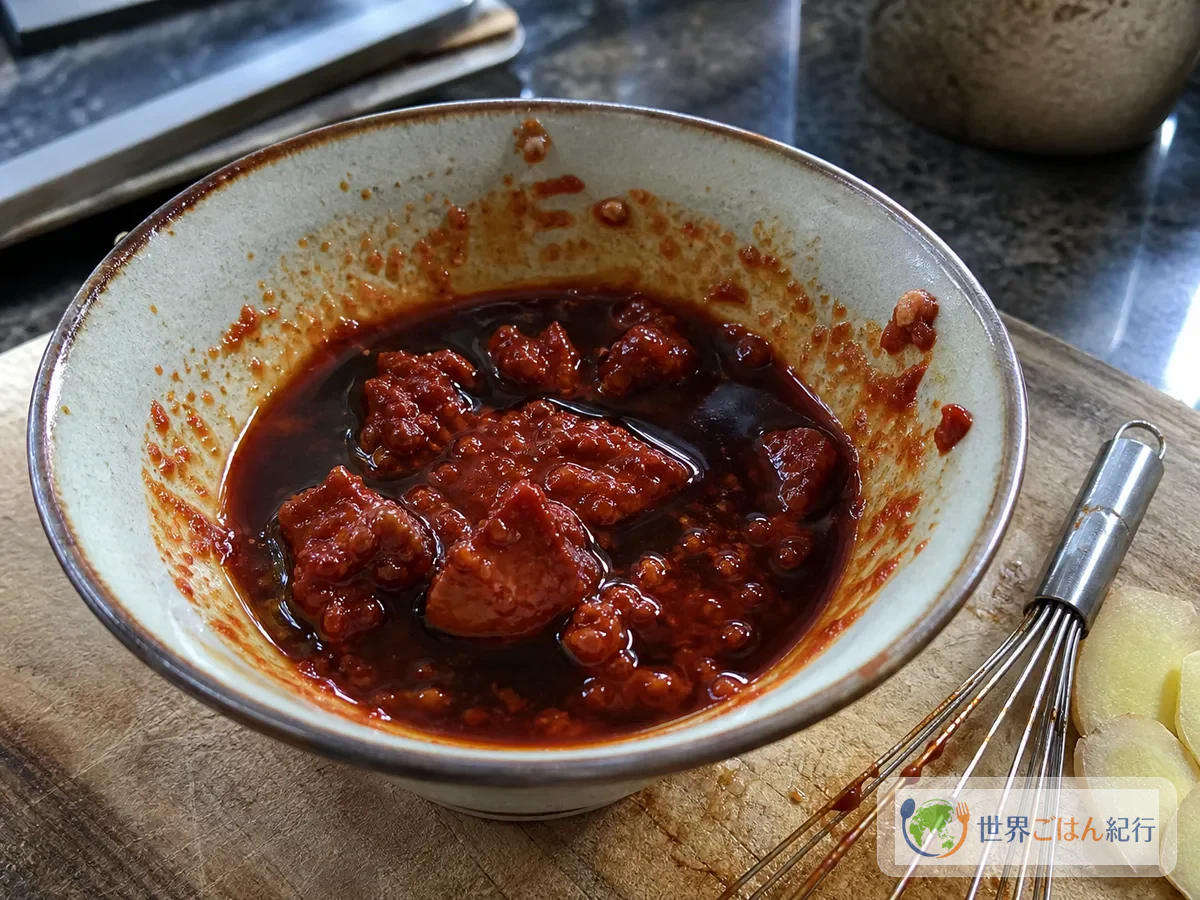
| Just before it goes in the pot | Dissolve the fermented tofu sauce | Small bowl | No lumps left, thick enough to drop into the pot with a wooden spatula |
Dried goods keep well while dry, but once they take up water they spoil easily, so treat them as fresh food from that moment. If you soak everything the day before, keep it all in the refrigerator, wood ear especially. Don't use anything whose soaking water has turned cloudy, or wood ear that has gone slimy or smells sour.
Method: use up even the soaking liquid
Before you start cooking, finish soaking the dried goods, cutting the vegetables and mixing the fermented tofu sauce. If you light the heat under the wok or deep skillet and then go searching for things, the red fermented tofu scorches and the bottom of the pan turns salty before the napa cabbage has released its water.
Common problems with Buddha's Delight
The long ingredient list makes this look difficult, but what goes wrong is easy to pin down. Are the dried goods not softened, is the fermented tofu sauce scorched, or have the glass noodles absorbed too much liquid? Find the closest match in the table rather than trying to fix everything in the pan at once.
| Problem | Cause | How to fix |
|---|---|---|
| Flavor is weak | The napa cabbage went in before the dried goods were coated with sauce | Mix 1 tsp soy sauce and 1 tsp red fermented tofu brine and add it down the side of the pan |
| Too salty | Too much fermented tofu, or the liquid was cooked off | Add 3.5 tbsp (50 ml) water or shiitake soaking liquid, add 3.5 oz (100 g) napa cabbage and simmer 3 minutes |
| Glass noodles clump | They absorbed all the liquid | Add 3.5 tbsp (50 ml) hot water and 1 tsp sesame oil and loosen over low heat for 2 minutes |
| Wood ear is tough | Not soaked enough, or the base was left on | Remove the hard parts and simmer 5 more minutes in soaking liquid |
| Sour smell | Dried goods were soaked at room temperature for a long time | Throw them out and don't use them. On long-soak days, put them in the refrigerator |
Red fermented tofu is strongly salty, so if you add it like soy sauce it quickly turns salty. Its role is a fermented aroma like a little miso, cheese and sake lees combined. Stop at 1.25 oz (35 g) the first time. If you want it stronger, add just 5 g next time.
Serving and storing Buddha's Delight
At the table
Cantonese Lo Han Jai is often piled generously on a big platter on Lunar New Year morning or wherever relatives gather. It satisfies with no meat or fish because the tofu skin, tofu puffs, shiitake and glass noodles each have a different texture. Mound it in the middle and let everyone take a little at a time, and no one ends up with an uneven share of the ingredients.
It's best not piping hot but at a slightly settled temperature, once the glass noodles have taken up the liquid, the edges of the tofu skin are stained reddish-brown and the shiitake soaking liquid has mixed with the sweetness of the cabbage. Restaurants sometimes add green vegetables at the end for color, but at home the cohesion of the braise comes first. If you want green, stir-fry bok choy separately with salt and set it alongside; it brightens the table without diluting the pot.
Building a menu around it
White rice, stir-fried greens with salt and an egg-free Chinese soup are all it needs. Mild plates bring out its fermented aroma better than spicy ones, though a small portion of mapo tofu works as the one strongly scented plate. On a day you're enjoying noodle texture, compare it with Korean japchae (in Japanese). For the idea of eating vegetables over rice, as with Korean bibimbap (in Japanese), the more you keep the textures separate, the more each bite changes. And on weekdays with no time to soak dried goods, buy bok choy and shiitake and turn them into lo mein for a quick dinner.
Storage and make-ahead
Buddha's Delight keeps 2 days in the refrigerator. Once it has cooled slightly, transfer it with its liquid to a clean container. The glass noodles keep absorbing liquid, so if you're planning for the next day, either use fewer from the start or set aside a portion and add the noodles later.
Reheat in a small pot rather than the microwave: add 2 tbsp water or shiitake soaking liquid and warm over low heat for 4 minutes. If the glass noodles have stiffened, wait until the liquid is warm and then loosen them slowly with a wooden spatula instead of pulling them apart with chopsticks. Freezing is not recommended, because the glass noodles and napa cabbage suffer; if you must, freeze only the braised ingredients, portioned out before the glass noodles go in.
More dishes to cook alongside
- Mapo tofu - A spicy counterpoint for comparing fermented seasonings and the aroma of oil.
- Chow mein - The same wok, but a dish that builds aroma over high heat instead of braising.
- Beggar's chicken - A Chinese dish that seals in aroma, a contrast to Buddha's Delight.
- Danbing - A Taiwanese breakfast for when you want a light flour dish the next morning.
- Japchae - Another East Asian dish that makes the texture of glass noodles the star.
Frequently asked questions
Q. Can I make it without red fermented tofu?
You can, but the fermented aroma that makes it Buddha's Delight weakens. Substituting 1 oz (30 g) white fermented tofu is the closest; if you don't have that, mix 2 tsp barley miso, 1 tbsp soy sauce, 1 tbsp Shaoxing wine and 1 tsp sugar. Enjoy that as a vegetarian vegetable braise, and try red fermented tofu next time.
Q. What can I use if I can't find dried tofu skin?
200 g of thick fried tofu works well. Pour boiling water over it to remove surface oil, cut it 1 cm wide and add it in step 5. Fresh tofu skin breaks down easily, so add it for the last 3 minutes of step 6. You lose the springiness of dried tofu skin, but the soy aroma is still there.
Q. Can I add garlic or scallion?
For a home version, yes. Stir-frying 1.5 oz (40 g) of the white part of a leek with the ginger brings up the aroma. If you are making it as temple-style or Lunar New Year vegetarian food, though, leave out scallion and garlic and avoid the five pungent vegetables. This recipe uses only ginger.
Q. Can I make it without glass noodles?
Yes. It becomes a braise with liquid, which is easier to keep refrigerated. Reduce the shiitake soaking liquid to 1 cup (230 ml) and add only 1 tsp worth of starch slurry at the end to bring it together lightly. With glass noodles is better over white rice; without is easier for make-ahead.
Q. Can I soak all the dried goods the day before?
Yes, as long as they stay in the refrigerator. Soaking the dried shiitake overnight brings out more umami. Glass noodles are the exception: soaked the day before, they take up too much water, so the last 10 minutes is enough.
Q. Is it easy to eat for children and older family members?
There is almost no heat, but there is the saltiness and fermented aroma of red fermented tofu. The first time with family, reduce the red fermented tofu to 25 g and the soy sauce to 1 1/2 tbsp. Large pieces of wood ear and tofu skin are hard to chew, so cut wood ear into 1 inch (2 cm) squares and tofu skin into 1.5 inches (4 cm) lengths.