Mul-Naengmyeon: Korean Cold Noodles in Chilled Beef Broth (물냉면)

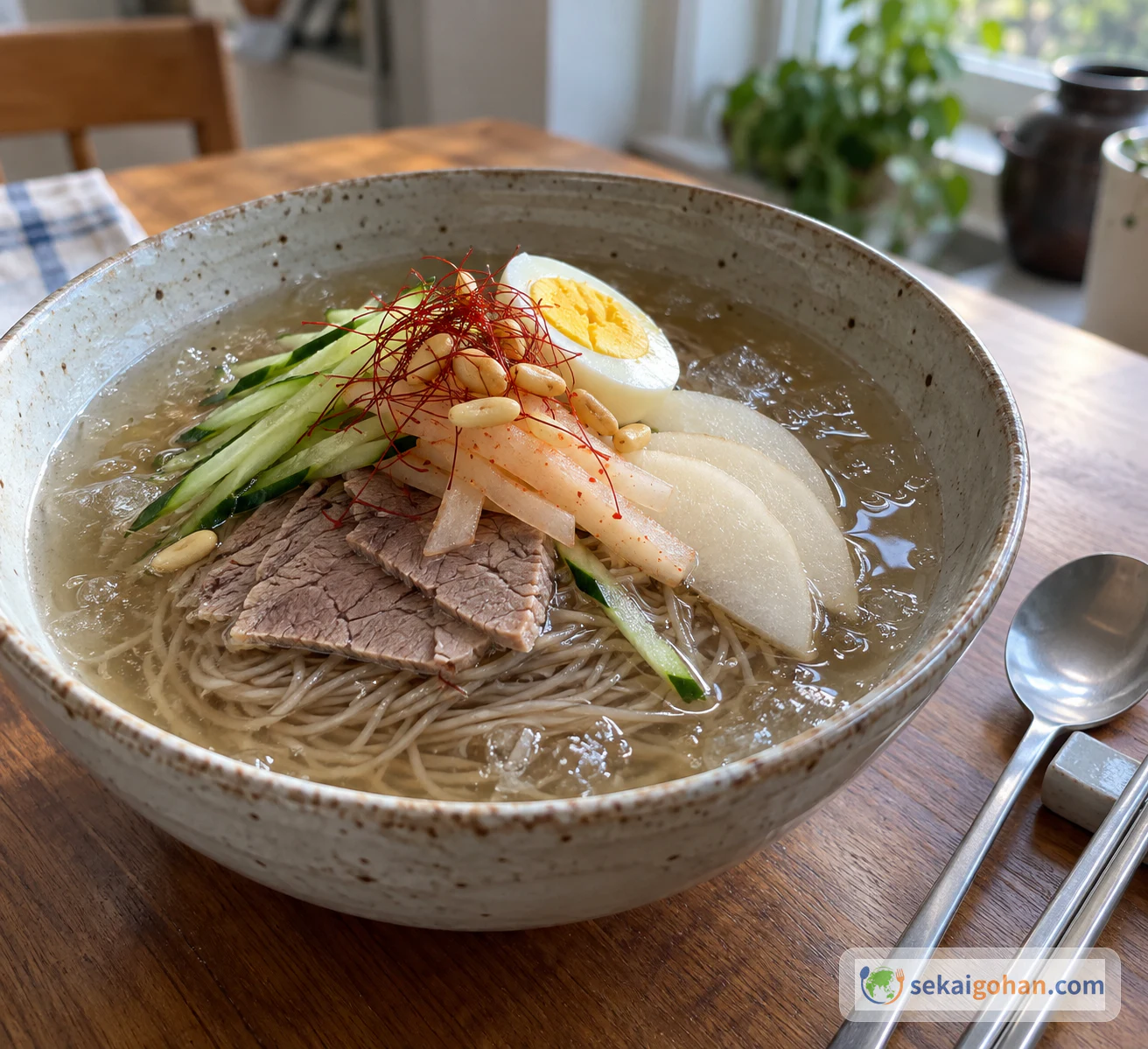
Korean mul-naengmyeon topped with beef, cucumber, radish, pear and boiled egg in chilled beef broth
Cuisine
Korean

How to make mul-naengmyeon, the Korean cold noodle soup in chilled beef broth, following a Korea.net recipe: buckwheat noodles, sliced beef, cucumber, lightly seasoned radish, pear and egg. Covers how it differs from bibim-naengmyeon, Pyongyang and Hamhung styles, choosing noodles and seasonings outside Korea, and cooling the broth safely.

Cooking flow

Cooking steps

STEP11 / 9

Simmer the beef to make the broth

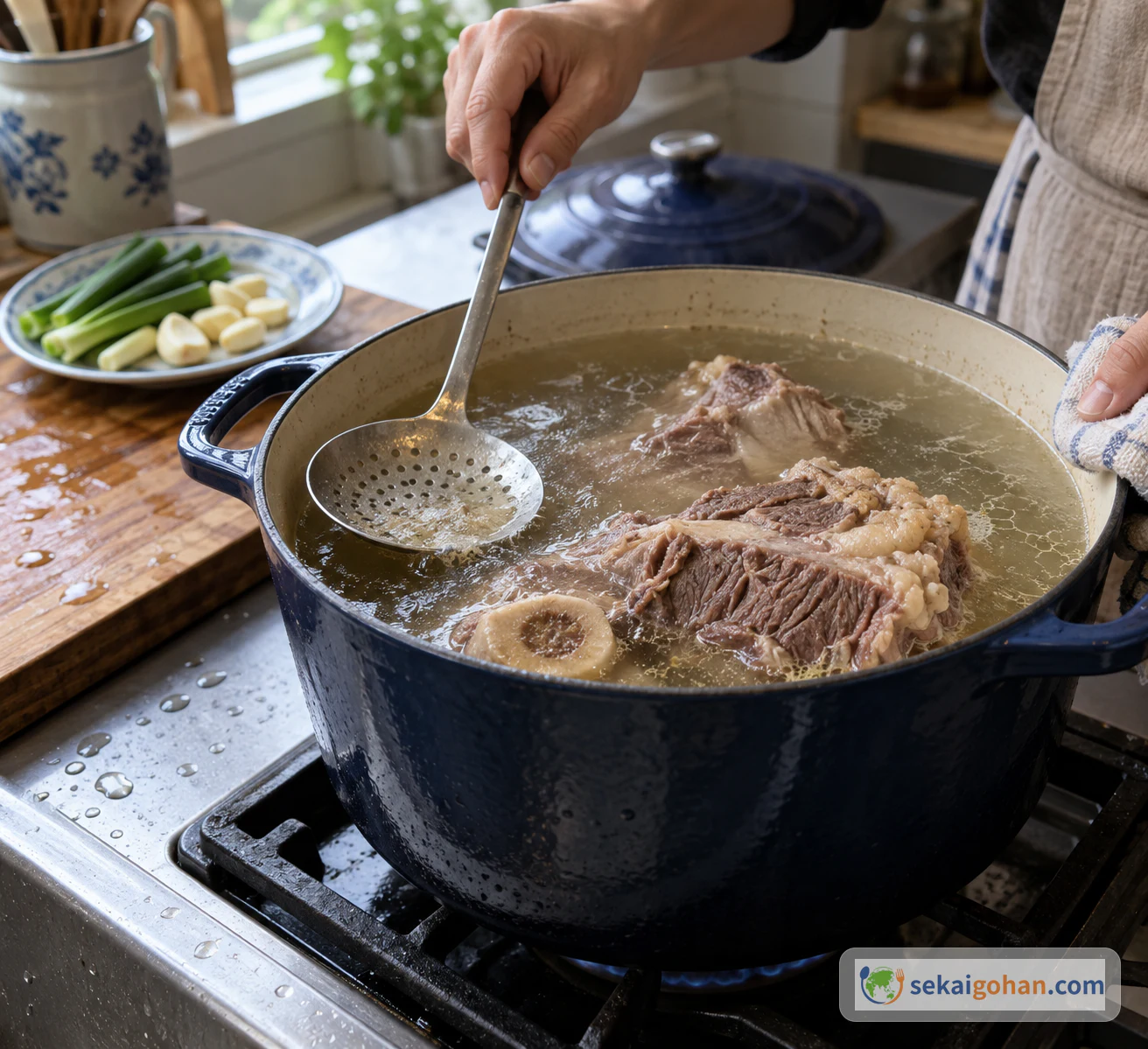
Beef simmering in a pot to make broth for naengmyeon
The beef simmers in water, with green onion and garlic ready to go in for the last 30 minutes

Wipe the surface of the beef with a clean cloth. Put the 10.5 oz (300 g) beef and 3.5 lb (1.6 kg) water in a pot and cook over high heat for 10 minutes. Once it boils, lower to medium heat and simmer for 1 hour. Add the 20 g green onion and 20 g garlic and simmer for another 30 minutes.

Stoves vary, so look at the pot rather than a dial setting: aim for a steady simmer rather than a hard, rolling boil for the whole time.

STEP22 / 9

Cool the broth quickly, skim the fat and season

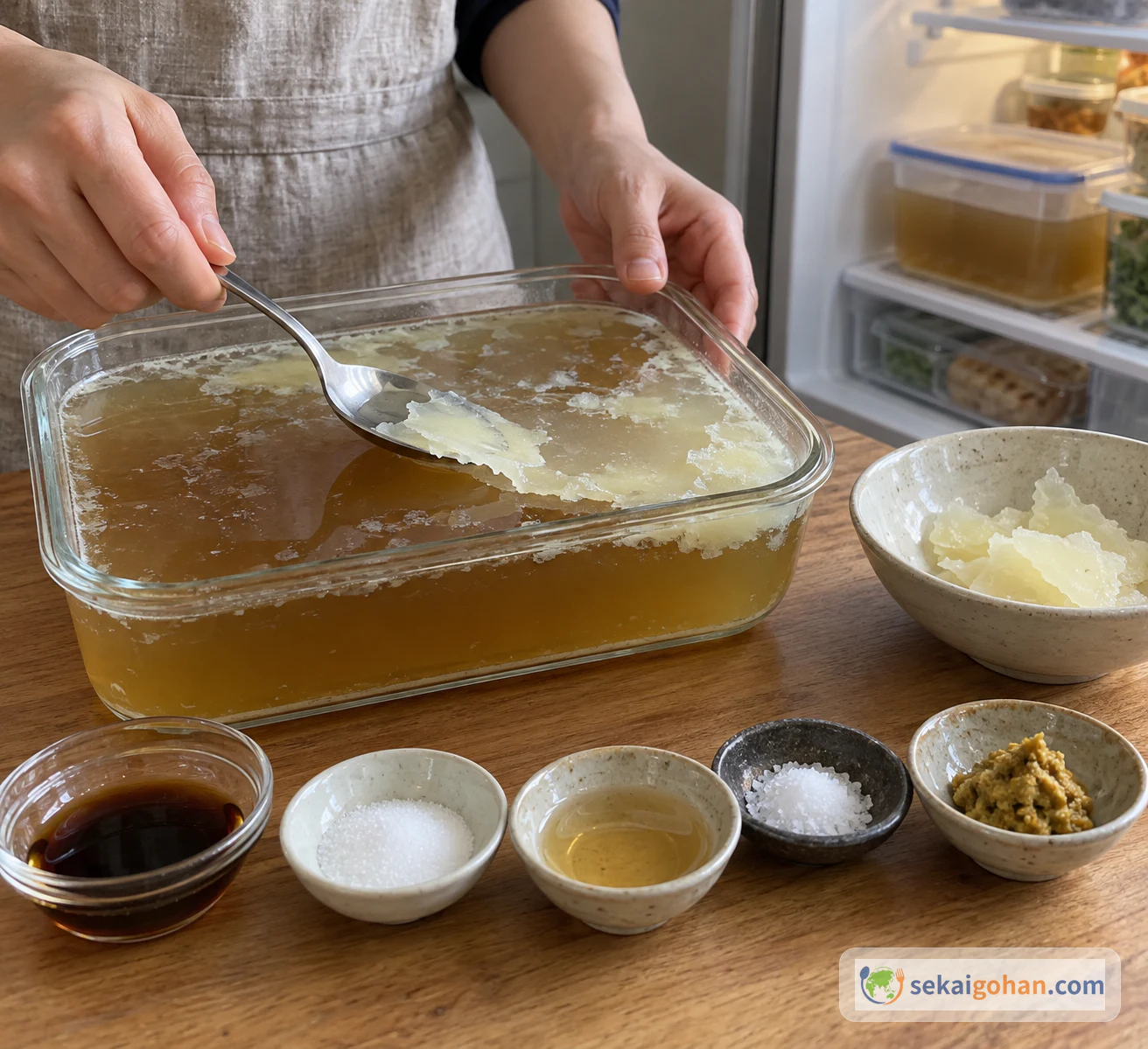
Skimming fat from cooled beef broth and mixing in the seasoning sauce
Skim the set fat from the chilled broth in a shallow container, then add only the soy sauce, sugar, vinegar, salt and fermented mustard

Take the beef out of the pot and slice it thinly. Keep the sliced beef covered in the refrigerator until you assemble the bowls. Divide the broth into shallow containers so it cools quickly, and refrigerate it promptly. Do not leave the large pot standing at room temperature until it cools. Perishable cooked food must go into the refrigerator within 2 hours, or within 1 hour if the surrounding temperature is above 90°F (32°C), and the refrigerator must be kept at 39°F (4°C) or below. The 2-hour limit is for getting the broth into the refrigerator; it does not mean the broth will be at 39°F (4°C) by then.

Once the broth is thoroughly chilled, lift off the fat that has set on the surface. Stir in the seasoning sauce: 9 g clear soy sauce, 24 g sugar, 1.5 oz (45 g) vinegar, 24 g salt and 5.4 g fermented mustard. Keep the broth in the refrigerator until it is well chilled.

STEP33 / 9

Salt the cucumber

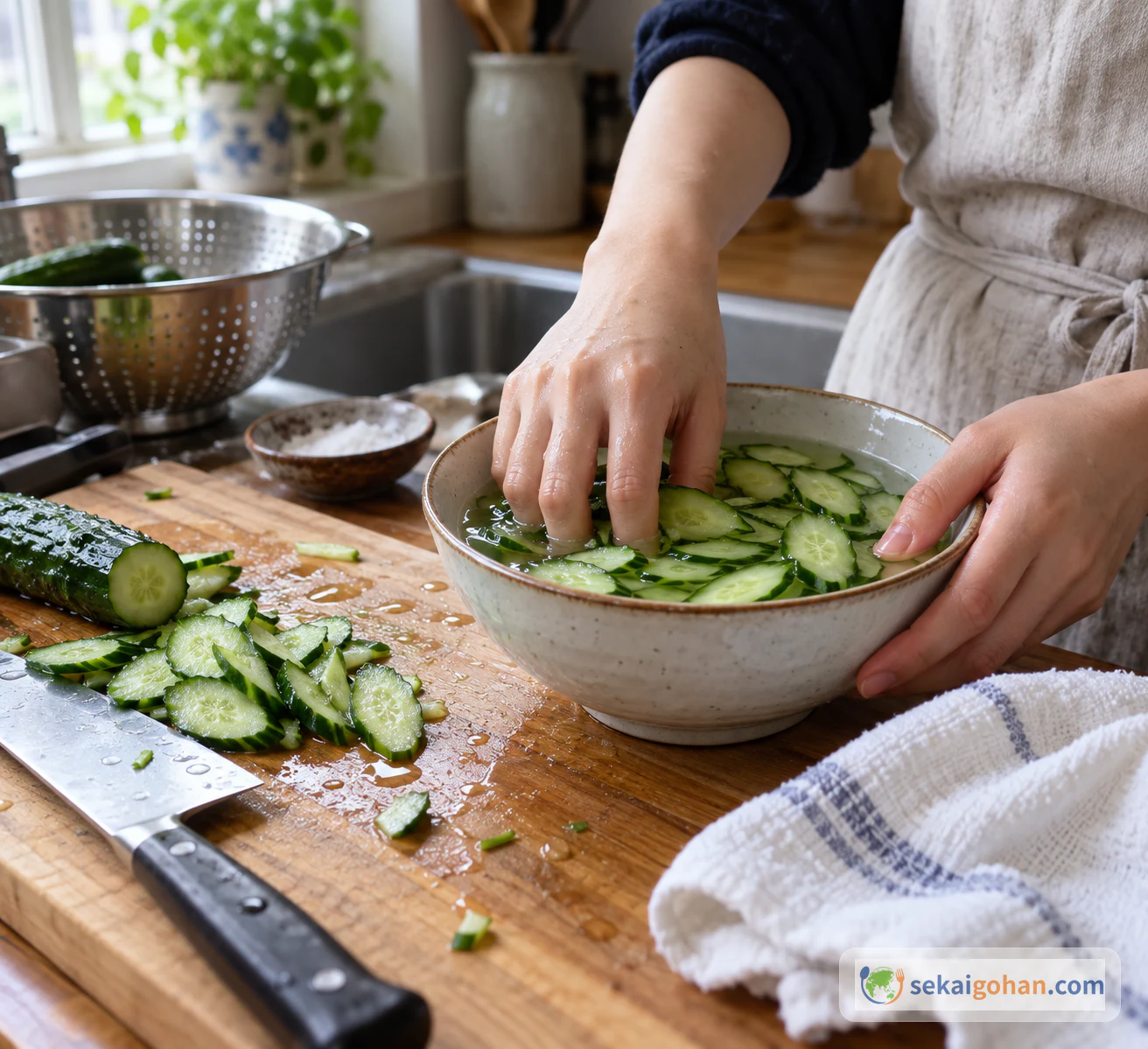
Thinly sliced cucumber soaking in salt water, with a cloth ready for blotting
After 20 minutes in salt water, blot the cucumber dry so it doesn't water down the broth

Halve the 1.75 oz (50 g) cucumber lengthwise and slice it thinly on the diagonal. Mix 2 g salt with 15 g water and soak the cucumber in it for 20 minutes. Then wipe off the moisture with a clean cloth. Excess water on the cucumber dilutes the cold broth once it is poured over.

STEP44 / 9

Quickly season the radish

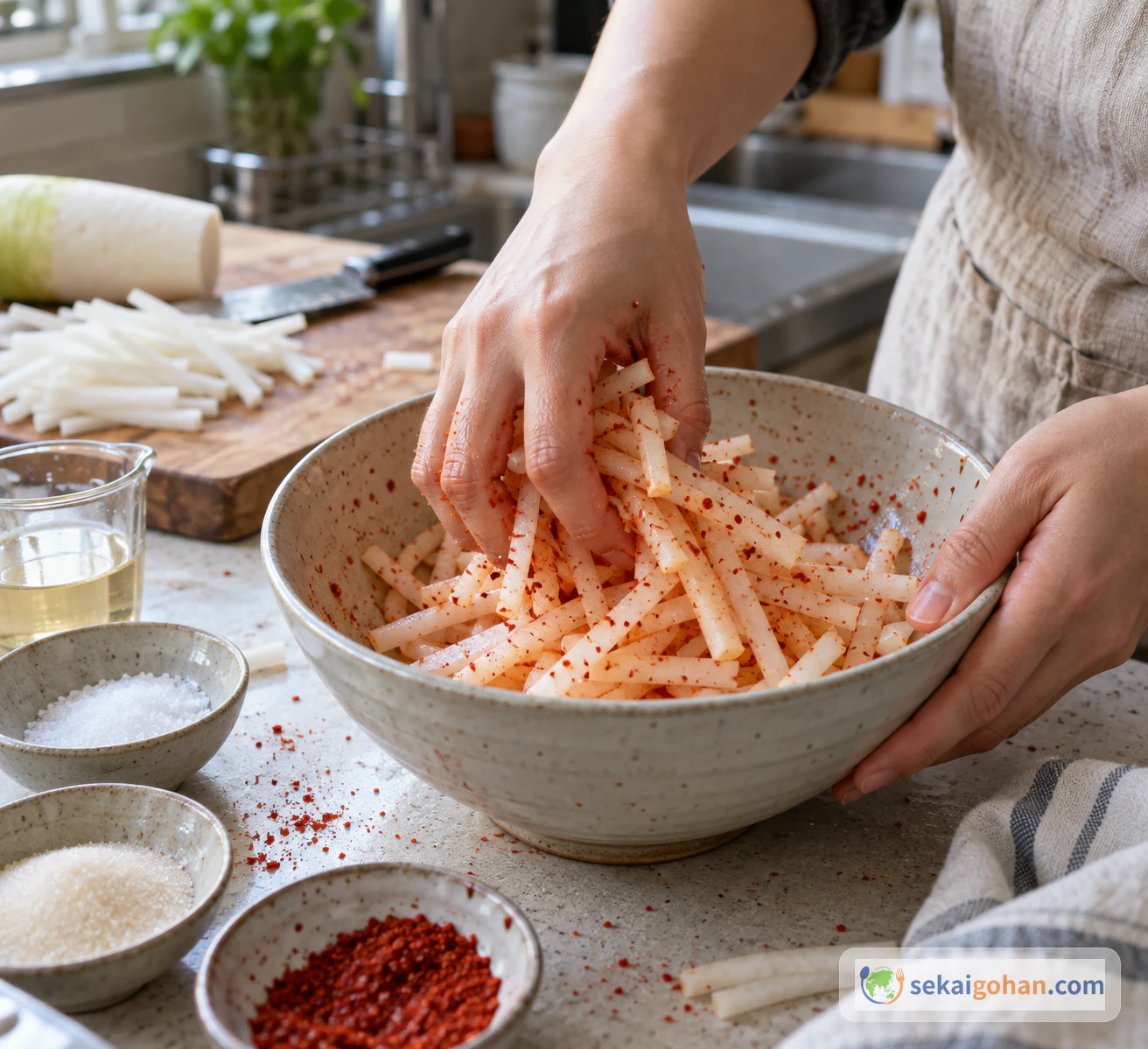
Thin radish strips being mixed with salt, sugar, vinegar and fine red pepper
A light dusting of red pepper and 20 minutes of rest give the radish a gentle sweet-sour edge

Cut the 6 oz (170 g) radish into slices 2 inches (5 cm) long, 1 inches (2 cm) wide and 0 inches (0.2 cm) thick. Mix with 4 g salt, 12 g sugar, 15 g vinegar and 2.2 g fine ground red pepper, and let it sit for 20 minutes. This is a quick sweet-sour seasoning, not kimchi. Don't squeeze the radish afterward.

STEP55 / 9

Prepare the pear, pine nuts and red pepper

STEP 5

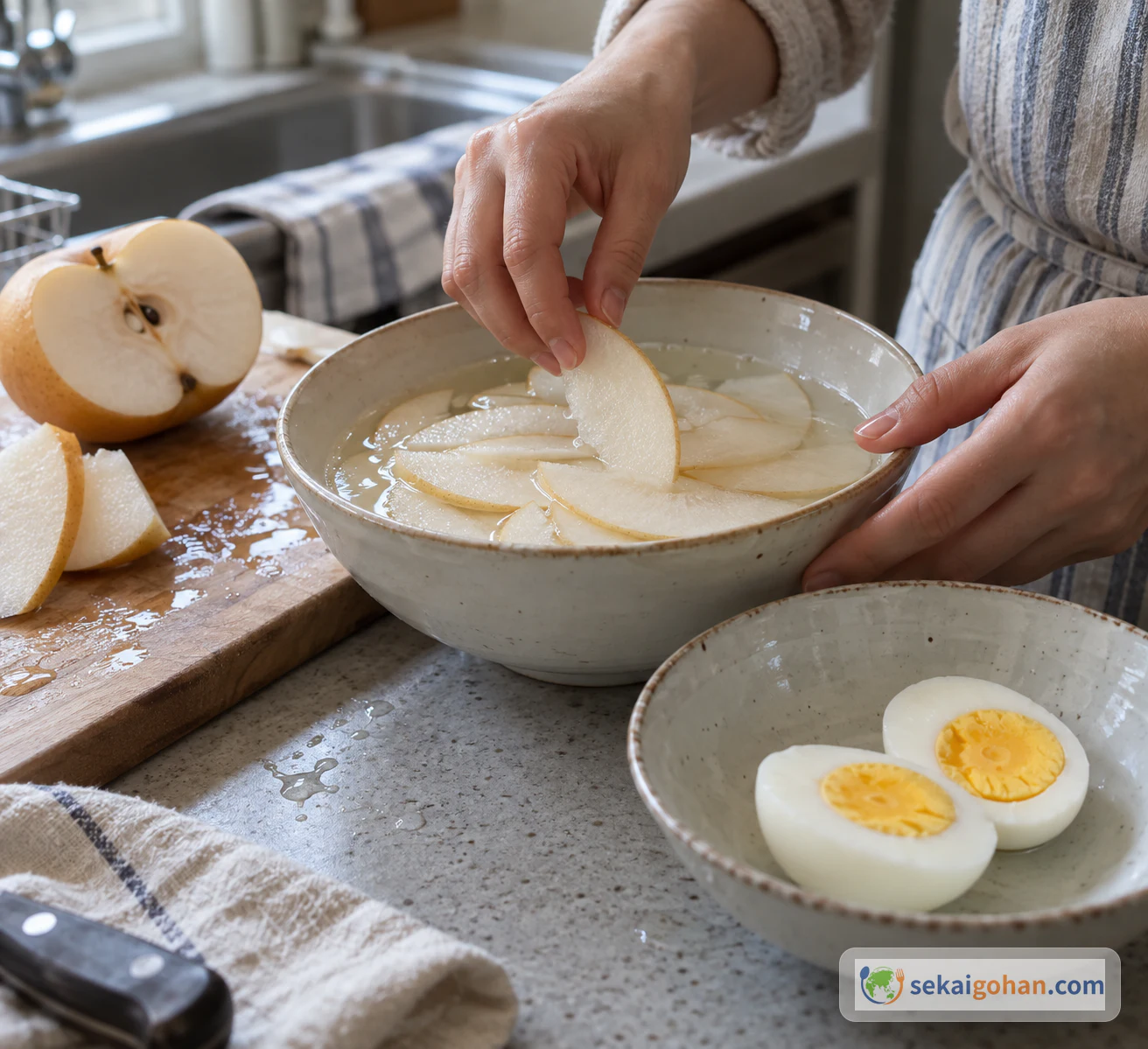
Mix 3.5 oz (100 g) water with 4 g sugar. Peel the 3.5 oz (100 g) pear, cut it into half-moons and soak it in the sugar water. Remove the tips from the 10 g pine nuts and wipe them with a dry cloth. Cut the 0.5 g shredded red pepper into 1–1 inches (2–3 cm) lengths.

STEP66 / 9

Hard-boil the eggs

Pear soaking in sugar water beside a halved hard-boiled egg
Pear half-moons rest in sugar water while the eggs are peeled and halved

Put the 2 eggs in a pot with 2.25 lb (1 kg) water and 4 g salt. Cook over high heat for 5 minutes, then, once boiling, turn to medium heat and cook for 12 minutes. Stove output varies, so make sure the eggs are cooked firm all the way to the center. Cool them in cold water, peel and cut in half. If you are not assembling right away, refrigerate the peeled eggs.

STEP77 / 9

Boil the noodles and rinse in cold water

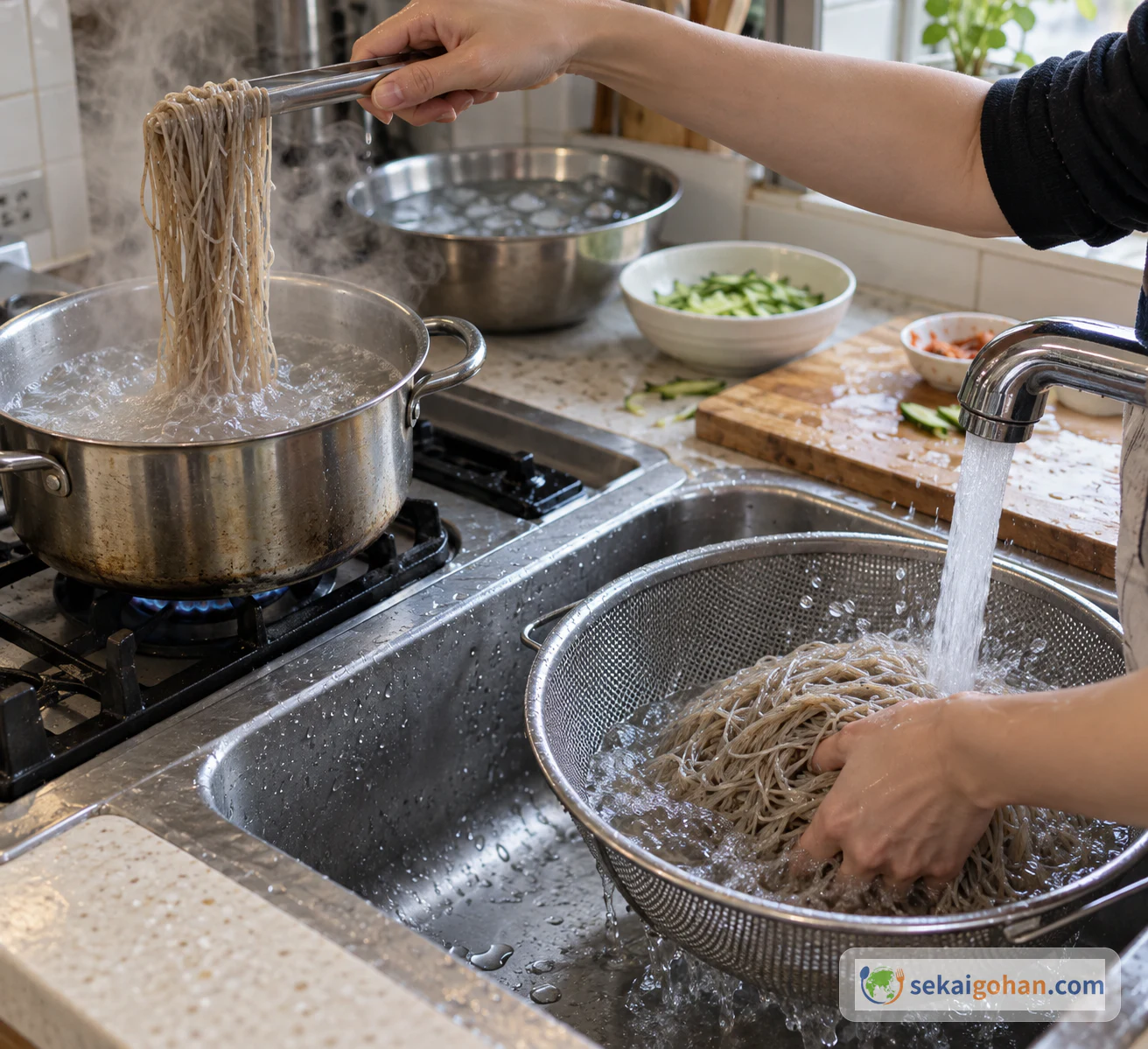
Noodles lifted from boiling water and rinsed under cold running water
Boil and rinse in separate places: the pot for cooking, the colander under cold water for rinsing

Bring the 6.5 lb (3 kg) water to a boil and cook the 14 oz (400 g) noodles for 2 minutes, without adding salt to the water. If your package gives a different time, follow the package. Drain and rinse the noodles well under cold water, then gather them in a colander to drain. Rinsing stops the cooking from residual heat and washes off the slippery surface starch. Keep them draining until you plate.

STEP88 / 9

Arrange the noodles and toppings

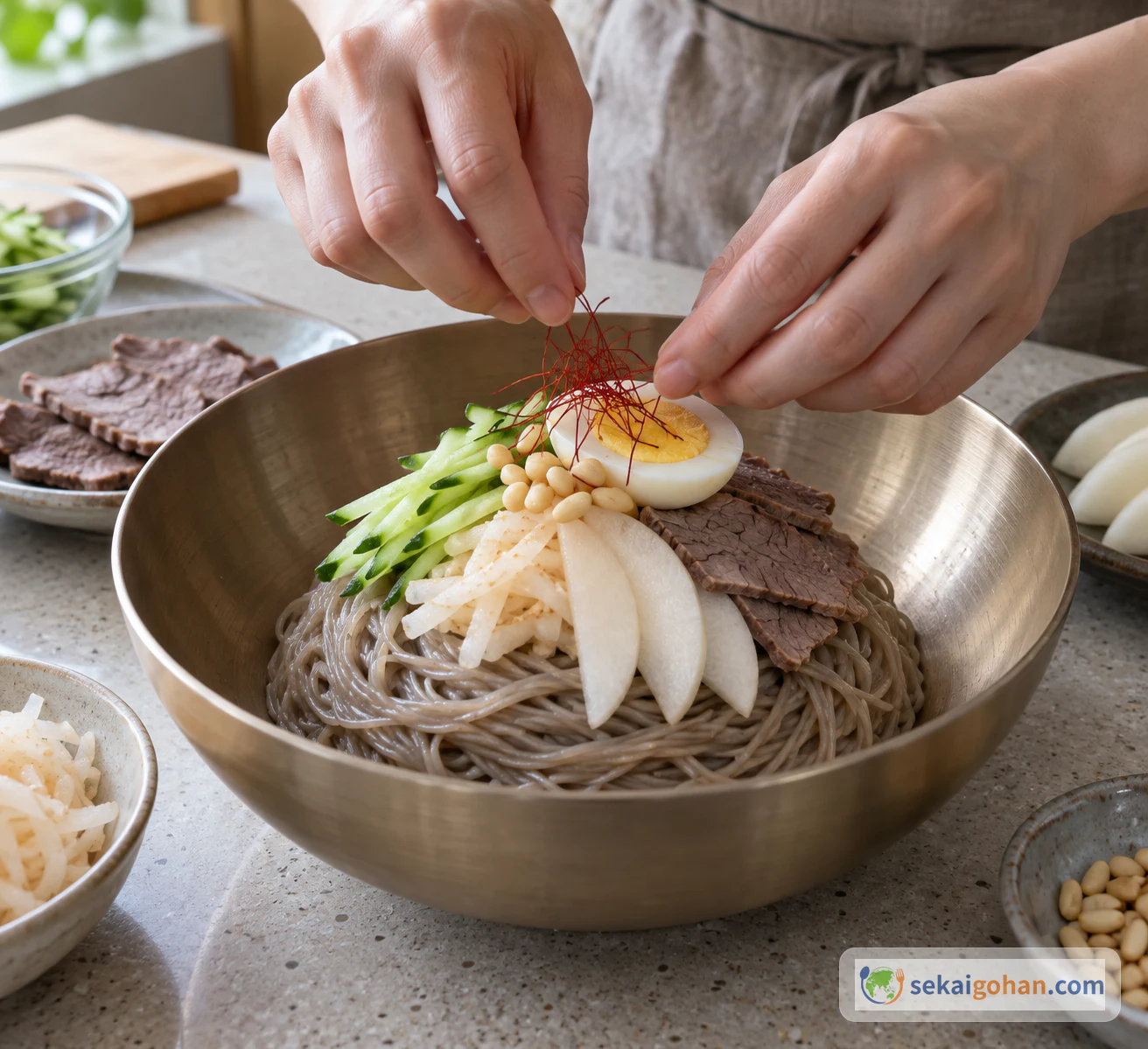
Drained noodles in a bowl being topped with beef, cucumber, radish, pear and egg
Assemble the toppings on well-drained noodles before any broth goes in

Place the drained noodles in each bowl. Arrange the sliced beef, cucumber, radish, egg and pear on top, then finish with the pine nuts and red pepper threads. Every topping from the recipe goes into the bowl.

STEP99 / 9

Pour in the chilled broth and serve

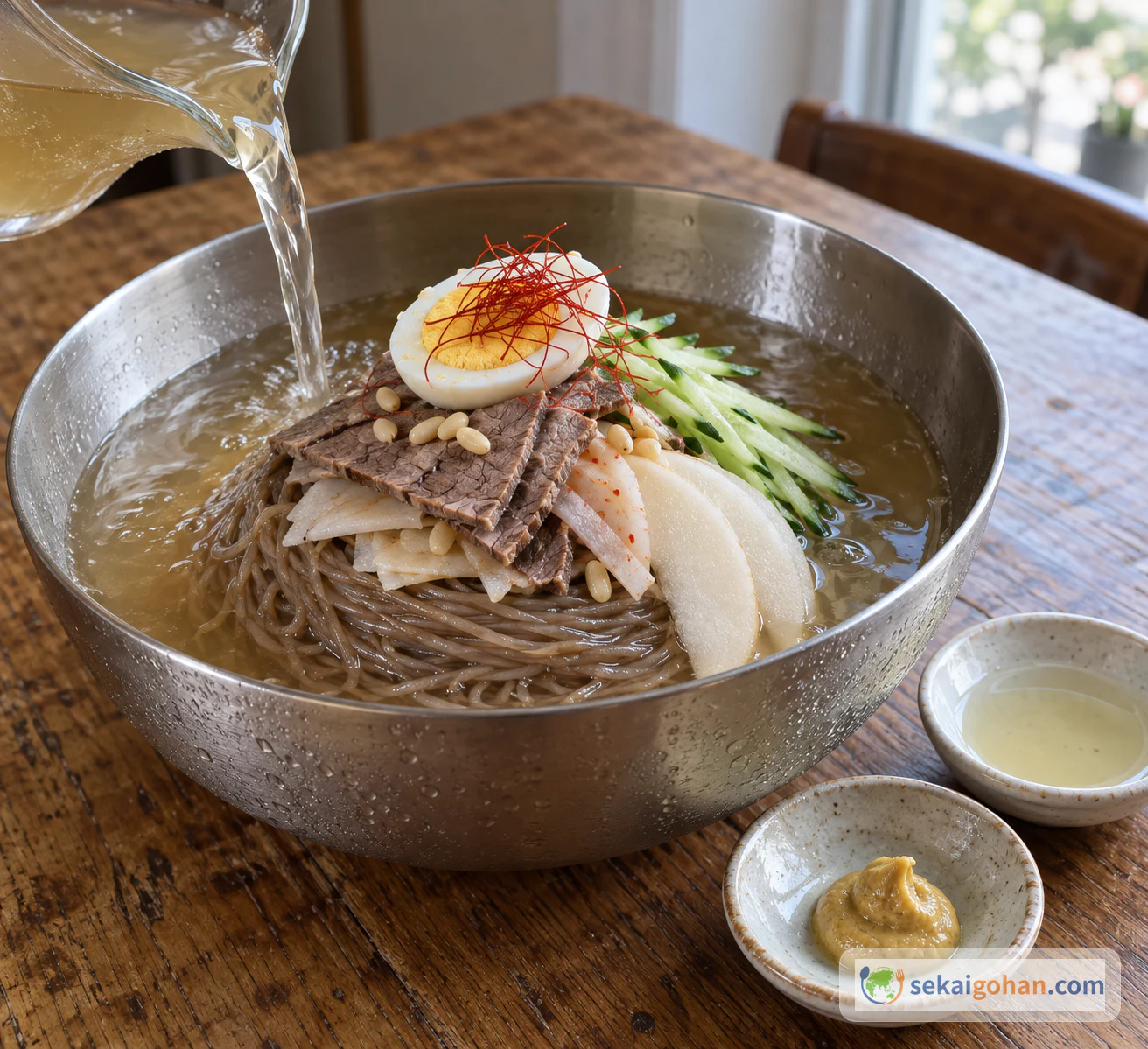
Chilled beef broth poured over mul-naengmyeon, with vinegar and mustard on the side
Pour the cold broth over the toppings; vinegar and mustard can sit beside the bowl for each diner to add

Pour the well-chilled beef broth into each bowl and serve right away. Offer vinegar and mustard on the side so each diner can add them to taste.

0 / 0
Ingredients

Ingredients

1 / 8

Noodles

Ingredient Amount Role and preparation
Buckwheat noodles (dried) 400 g The base of the bowl. Check the package cooking time
Water for boiling noodles 3 kg (15 cups) For the noodles only, not the broth
2 / 8

Beef broth

Ingredient Amount Role and preparation
Beef (brisket shank) 300 g Makes the broth, then is sliced as a topping
Water for the broth 1.6 kg (8 cups) For simmering the beef
Green onion 20 g Added partway through simmering
Garlic 20 g Added with the green onion
3 / 8

Seasoning sauce for the chilled broth

Ingredient Amount Role and preparation
Clear soy sauce 9 g (½ tbsp) See the notes below
Sugar 24 g (2 tbsp)
Vinegar 1.5 oz (45 g) (3 tbsp)
Salt 24 g (2 tbsp)
Fermented mustard 5.4 g (½ tbsp)
4 / 8

Cucumber

Ingredient Amount Role and preparation
Cucumber 1.75 oz (50 g) Halved lengthwise, thinly sliced on the diagonal
Salt 2 g (½ tsp) For the soaking salt water
Water 15 g (1 tbsp) For the soaking salt water
5 / 8

Radish

Ingredient Amount Role and preparation
Radish 6 oz (170 g) Cut into 2 inches × 1 inches × 0 inches (5 cm × 2 cm × 0.2 cm) slices
Salt 4 g (1 tsp)
Sugar 12 g (1 tbsp)
Vinegar 15 g (1 tbsp)
Fine ground red pepper 2.2 g (1 tsp)
6 / 8

Pear

Ingredient Amount Role and preparation
Pear 100 g (1/5 ea) Peeled and cut into half-moons
Water 100 g (½ cup) Mixed with the sugar for soaking
Sugar 4 g (1 tsp)
7 / 8

Eggs

Ingredient Amount Role and preparation
Eggs 4 oz (120 g, 2 ea) Hard-boiled, peeled and halved
Water 2.25 lb (1 kg) For boiling the eggs
Salt 4 g (1 tsp) Added to the egg water
8 / 8

Garnish

Ingredient Amount Role and preparation
Pine nuts 10 g (1 tbsp) Tips removed, wiped with a dry cloth
Shredded red pepper 0.5 g Cut into 1–1 inches (2–3 cm) lengths
0 / 0

Picture a winter room warmed from the floor by ondol heating, with a bowl of icy noodles on the low table. That is how naengmyeon was traditionally eaten, in freezing weather, with soup made from dongchimi, a radish water kimchi ladled from earthenware jars. Many people now think of cold noodles as summer food, but this dish from Korea has winter roots. This version is mul-naengmyeon (물냉면): buckwheat noodles in a clear, truly cold beef broth, with the sweet-sour crunch of radish, cucumber and pear on top.

About Mul-Naengmyeon

What this bowl should keep

A clear beef broth chilled until it is truly cold, the flavor of buckwheat noodles, and the sweet-sour crunch of radish, cucumber and pear.

Naengmyeon (냉면) means "cold noodles," and it names a family of dishes rather than a single recipe. Mul-naengmyeon is noodles served in a cold soup; bibim-naengmyeon (비빔냉면) is noodles dressed in a spicy sauce, with no broth. The two need different balances of noodle, broth and seasoning, so it helps to keep them straight when you shop and cook.

The Broth and Toppings

Mul-naengmyeon is made with dongchimi broth or beef broth, and it is often eaten after galbi. A traditional broth combines beef stock with dongchimi brine. This one uses beef alone, simmered with green onion and garlic, then chilled, skimmed and seasoned with soy sauce, sugar, vinegar, salt and fermented mustard.

On top go sliced beef, salted cucumber, a quick radish pickle, pear in sugar water, boiled egg, pine nuts and fine red pepper threads. The long beef simmer and cooling the broth safely take the most care, so start the broth well ahead of the meal.

Winter Origins

Naengmyeon belonged to winter, eaten in ondol-heated rooms with dongchimi brine drawn from jars kept through the cold months. Where it first came from is unclear; one theory points to the northern mountain regions, but that is not settled. A late Joseon-era record lists naengmyeon among foods eaten around the winter solstice, which shows how long the dish has been tied to winter, though not when it began.

Pyongyang and Hamhung Styles

Two regional styles are especially well known:

Style Noodles Character
Pyongyang style Mainly buckwheat A clean, clear broth
Hamhung style Mainly potato or sweet potato starch Chewy, springy noodles and spicy flavors

This home version leans toward Pyongyang: buckwheat noodles in a clear beef broth.

Ingredients: One Batch
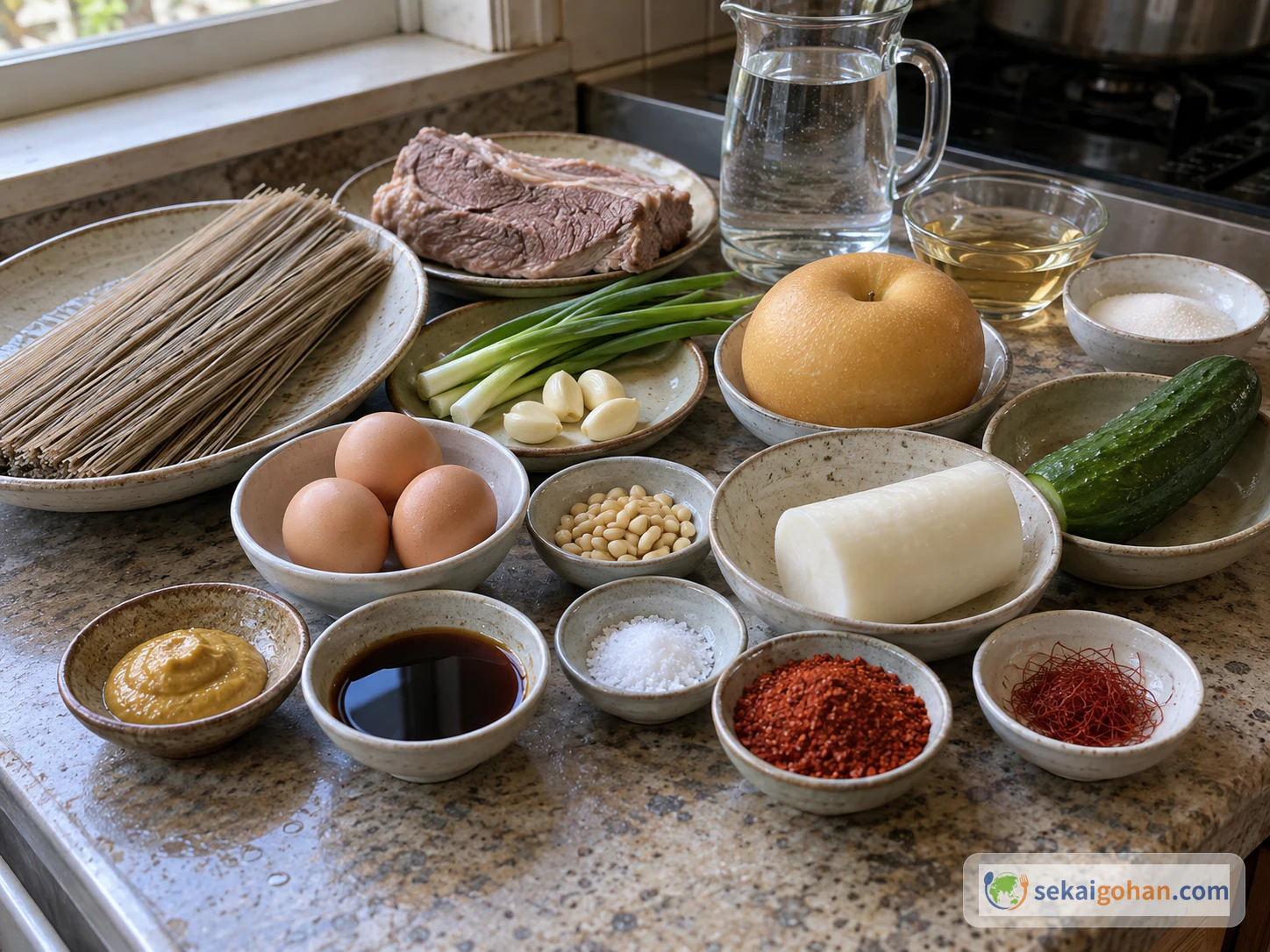
Buckwheat noodles for naengmyeon, beef, green onion, garlic, cucumber, radish, pear, eggs and pine nuts
Every ingredient for the broth, toppings and seasoning sauce, laid out before cooking

These amounts make one batch, with 14 oz (400 g) of dried noodles and 2 eggs. Note that three different waters appear: one for the noodles, one for the beef broth and one for the eggs. Keep them separate, and keep each salt amount with its own component.

Equipment

  • A large pot for boiling the noodles
  • A pot for simmering the beef broth
  • A separate pot for boiling the eggs
  • Shallow containers for cooling and refrigerating the broth
  • A colander for rinsing and draining the noodles
  • Small bowls for soaking the cucumber, radish and pear
  • Clean cloths for wiping the beef, cucumber and pine nuts

Choosing Ingredients for Mul-Naengmyeon

Noodles. Use dried buckwheat noodles. Packaged naengmyeon noodles from Korean grocers vary, with some mostly buckwheat and others carrying a good share of starch, so read the ingredient list and follow the package cooking time when it differs from 2 minutes. Japanese soba can stand in when nothing else is available, but its texture, spring and buckwheat aroma are different.

Beef. Use brisket shank. Beef shin or another braising cut works too, though its fat and gelatin will change the body of the broth.

Clear soy sauce. Japanese light (usukuchi) soy sauce is a different product. Saltiness also varies by brand, so taste the chilled broth before adjusting the seasoning.

Fermented mustard. Mustard sold for naengmyeon at a Korean grocer is the first choice. Japanese-style hot mustard has a different aroma and heat, so the amounts don't carry over one for one.

Pear. Asian pear is the closest match; other pears vary in sweetness and juiciness from fruit to fruit. If you can't find a suitable one, leave it out.

Allergies

This recipe contains egg, buckwheat and soy (from the soy sauce). Packaged noodles can also contain wheat or other starches, so check the label. If anyone has allergies, check the mustard and pine nuts too.

Method: From Beef Broth to a Cold Bowl

Plan the order

The broth needs about 1 hour 40 minutes of simmering and then must chill thoroughly in the refrigerator, so it is convenient to make it ahead, for example the day before. The cucumber and radish each rest for 20 minutes; prepare the pear in sugar water alongside them. Boil the noodles last, right before serving.

Fixing Common Mul-Naengmyeon Problems

Problem Likely cause What to do
The broth tastes greasy Fat was removed while the broth was still warm, or not at all Chill the broth thoroughly so the fat sets on top, then lift it off
The broth tastes flat or thin Water from the cucumber or noodles diluted it, or it was tasted while warm Blot the cucumber dry, drain the noodles well, and judge the flavor only once the broth is cold
The noodles clump or turn soft Cooked past the package time, or left sitting before rinsing Check the package time; 2 minutes is a guide. Rinse in cold water as soon as they are done and keep them draining until you plate
The radish tastes like kimchi Too much red pepper or a long rest Keep to the recipe's amounts and 20 minutes

Storage and Variations

Store the noodles, toppings and broth in separate containers rather than as assembled bowls. Divide cooked food into shallow containers and refrigerate within 2 hours, or within 1 hour if it is above 90°F (32°C), with the refrigerator at 39°F (4°C) or below. That limit is for getting food into the refrigerator; it doesn't have to reach 39°F (4°C) by then.

Eat the beef broth and cooked beef soon. Hard-boiled eggs keep up to one week in the refrigerator, but they're best used early.

A few ways to change the bowl:

  • Adding dongchimi brine. Closer to the traditional broth of beef stock and dongchimi brine. Use dongchimi that is already fermented; fermentation takes 4–5 days.
  • Store-bought naengmyeon broth. A shortcut in place of the beef broth.
  • Vegetable broth instead of beef. A noticeably different flavor and character.

For more Korean dishes, try bibimbap for a one-bowl meal, japchae for glass noodles with a very different texture, and mandu to round out a Korean table.

Frequently Asked Questions

Are naengmyeon and mul-naengmyeon the same thing?

Naengmyeon is the umbrella term for Korean cold noodles. Mul-naengmyeon is the type served in chilled broth; bibim-naengmyeon is tossed in spicy sauce.

Is dongchimi required?

No. This bowl uses beef broth only; dongchimi brine belongs to another traditional style of broth.

Can I make it ahead?

Yes, and the broth is best made ahead. Store the broth, toppings and noodles separately as described above, and boil the noodles just before serving.
Sources