Lift the lid of the pot a little and the sweet smell of lamb, eggplant and potato rises through a red steam of tomato. Chanakhi (ჩანახი / chanakhi) is a Georgian lamb and vegetable stew, and nothing about it involves shaking a pan. You cut everything large, layer meat, vegetables and tomato, and let the flavors pass slowly from one to another under the lid. What comes out is tender lamb, soft eggplant and potato, and tangy tomato juices bright with garlic and herbs, the kind you'll want to scoop up with bread.

About Chanakhi
Chanakhi is cooked slowly with eggplant, potato, tomato, herbs and garlic, traditionally in individual clay pots or heavy pots. The layering is the whole idea. Inside the pot, the fat of the meat, the tomato juices, the oil of the eggplant and the sweetness of the potato move from bottom to top while the ingredients keep their shape. Treat it like an ordinary tomato stew and stir it, and the eggplant and potato fall apart until you can't tell meat from vegetables.

The classic version goes into small clay pots that bake in the oven for over two hours. That's hard to copy at home, since not everyone has small heatproof pots. This recipe browns the meat first, adjusts the moisture of the onion and tomato, then builds the layers and steam-stews them gently on the stovetop over low heat. The dish still melts down on its own, and it's much harder to get wrong on a home stove.
If you want something quicker, chashushuli cooks beef in a rich tomato sauce in less time. The two differ in how they treat the meat: chanakhi keeps its layers, while chashushuli lets the browning dissolve into the tomato. The garlic chicken shkmeruli and the grilled meat shashlik give you a wider picture of Georgian meat cooking.
Ingredients (serves 4): Cut Lamb, Eggplant and Tomato Large
Lamb shoulder suits stewing, and its fat melts into the juices without becoming too heavy. You can use bone-in cuts such as lamb chops, but they are hard to divide at the table, so cubed shoulder is easier the first time. With beef shoulder the aroma will be milder, so extend the cooking by about 10 minutes to soften it.
Cook lamb and beef through to the center, not just the surface. At the end of stewing, check for a core temperature of 167°F (75°C) or above, or a skewer sliding in without resistance and no raw red at the cut face. Don't reuse the cutting board and knife that touched raw meat for vegetables or herbs.
Ingredients and Tools Worth Choosing
Buy the meat, eggplant, potato and tomato at a nearby supermarket. Worth seeking out are coriander, which underpins the aroma of Georgian cooking; pomegranate molasses, which rounds the finishing acidity; and a probe thermometer to check how a large piece of meat has cooked.
Choosing Lamb, the Pot and Substitutes for Chanakhi
Lamb is the star, and shoulder is the cut to look for. You'll find it at specialty butchers and large supermarkets, though not always. Beef shoulder works too. The Georgian aroma is a little weaker, but if you keep the eggplant and tomato layers, the garlic, the herbs and the acidity, it still tastes like chanakhi, and the low heat keeps the beef from breaking down. Pork belly is too fatty and throws off the balance with the tomato.
The pot matters as much as the meat. Some clay pots aren't made for direct flame, so use a flameproof clay pot, a heavy cast-iron pot or a deep enameled pot. No oven is needed.

| Ingredient or tool in question | How to think about substituting |
|---|---|
| Lamb shoulder | Beef shoulder 1 lb (500 g) works. Extend the stewing 10 minutes and add 5 g more finishing herbs |
| Bone-in lamb | Boneless shoulder is easier the first time. Bone-in gives the juices depth but is hard to divide |
| Clay pot | Use a flameproof clay pot, cast-iron pot or heavy enameled pot. A thin pot scorches on the bottom |
| Khmeli suneli | 1 tsp coriander, 1/2 tsp dried basil, 1/2 tsp dried dill, a pinch of fenugreek |
| Purple basil | 10 g sweet basil is fine. Combine cilantro and parsley to make up the green aroma |
| Pomegranate molasses | 2 tsp red wine vinegar works. Use a little only when you want sweet-sourness |
| Ripe tomatoes | 14 oz (400 g) canned diced tomatoes and 1 fresh tomato. With canned only, the acidity stands out, so cook 5 minutes longer |
Method: Build a Browning, Layer, and Steam-Stew
You could simply layer everything and cook it long. In a home pot, though, the savor of browned meat is lost, and the tomato releases plenty of moisture. So brown the meat first, lightly reduce the onion and tomato, then build the layers.
Common Chanakhi Problems and Fixes
Chanakhi looks like a dish you just put in a pot and leave, but when it goes wrong it turns into a generic red stew. The usual causes are vegetables cut too small, heat that's too strong and too much liquid. However tempting it is to stir, leave the layers alone.

| State | Cause | How to rescue |
|---|---|---|
| Juices are watery | Canned tomato had a lot of water, or it was boiled hard with the lid shut | Take the meat and vegetables out to a plate, reduce only the juices 6 minutes over medium heat and return |
| Eggplant collapses | Cut small, stirred often along the way | Next time cut it 1 inches (2.5 cm) thick. Eat this pot as a stew on bread |
| Meat is tough | Boiled hard, stewing time too short | Add 3 tbsp water and extend 15 minutes over low heat. Stop when the meat begins to shred |
| Scorched smell | Not enough liquid on the bottom, thin pot | Move only the unscorched upper part to another pot, add 3.5 tbsp (50 ml) hot water and return to low heat |
| Weak aroma | Herbs added too early, old spices | After turning off the heat add 10 g chopped herbs, a pinch of coriander and 1/2 tsp vinegar |
Serving and Storing Chanakhi
Eating it with bread
Rice works, but bread is the Georgian way and more fun. Wipe up the red juices at the bottom of the pot and you get lamb fat, tomato acidity, sweet eggplant and green herbs in one bite. Baguette, pita or khachapuri all do the job.

When you bring the pot to the table, set the meat in the center with the eggplant and potato showing around it so the layers are visible. Serve it plate by plate: first the meat, then eggplant and potato on top, and finally the juices. If you stir the whole pot, the layers you worked to keep will collapse. Small dishes of chopped cilantro, parsley and red wine vinegar let each person add aroma and acidity, which helps anyone who isn't fond of lamb.
Side dishes
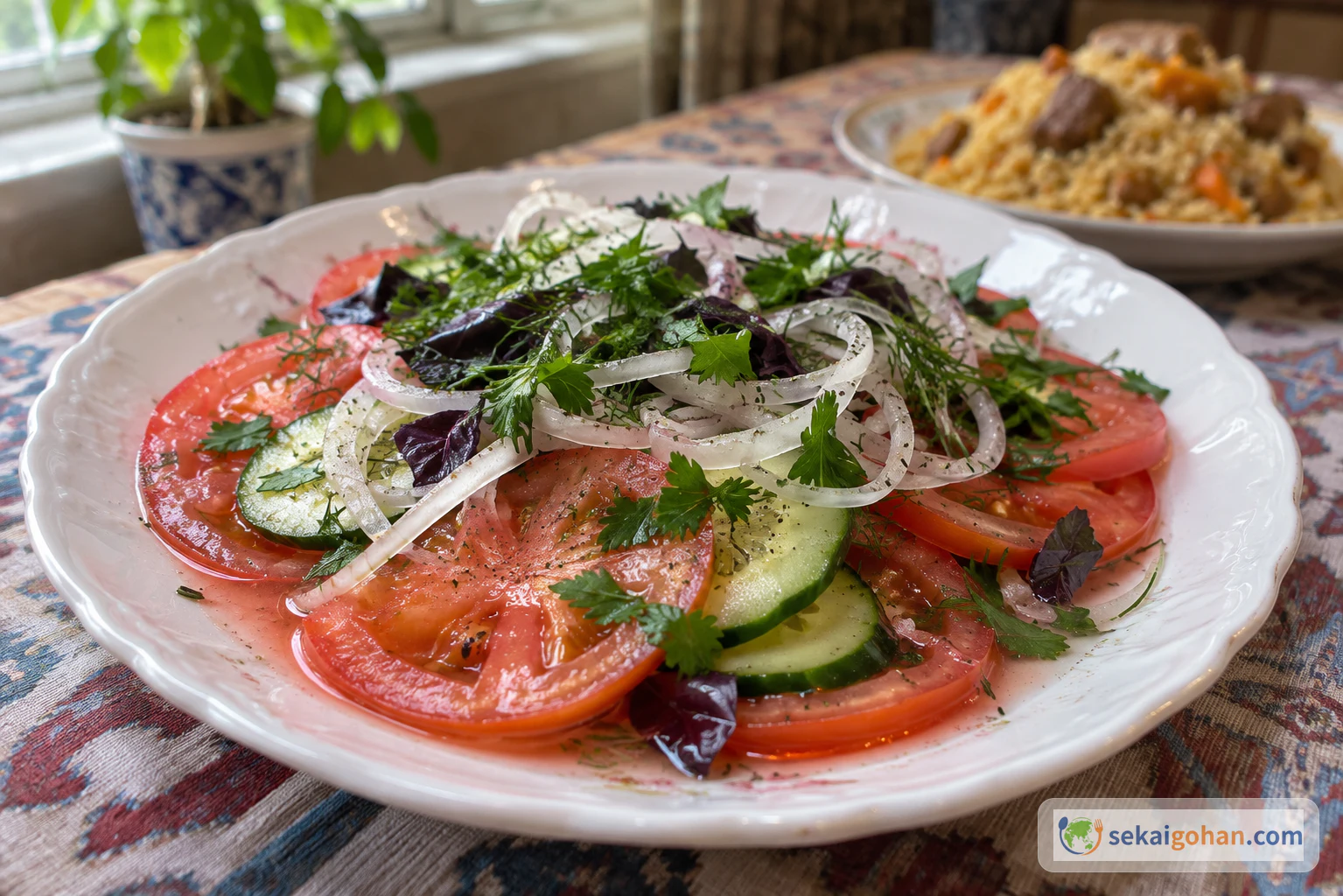
Chanakhi is already hearty, so keep the rest of the table light: a cold herb plate, a cucumber and tomato salad, thinly sliced red onion. For a Georgian spread, a small dish of beans lobio takes the edge off the richness of the meat, and a little walnut-sauce satsivi adds herbs and nuts. Keep some Svan salt on the table for adjusting the aroma, and save the herby chakhokhbili as the main for another day.
Storage and reheating
| Storage | Guide | How to bring it back |
|---|---|---|
| Refrigerator | 3 days | Move to a pot and warm over low heat for 10 minutes. If it threatens to scorch add 2 tbsp water |
| Freezer | 3 weeks | Freeze mainly the meat and juices. Eggplant and potato lose texture |
| Make-ahead | Can be prepared the day before | Add the herbs and acidity just before eating |
| Lunch box | Not recommended | A lot of juices and herbs, and the aroma fades in transport |
If the juices have set the next day, loosen them slowly over low heat with 2 tbsp of tomato juice or hot water rather than plain water, and finish with a few fresh herbs. In a microwave, heat 2 minutes at 600 W, rest 1 minute without stirring, then heat a further 1 minute 30 seconds at 600 W. Stop once it bubbles, since boiling toughens the meat.
Frequently Asked Questions
Can I make it if I dislike lamb?
Use beef shoulder. The aroma is milder than with lamb, so add a little more garlic, coriander, herbs and acidity to keep it from tasting like a plain tomato beef stew. Extend the steam-stew in step 7 to 65 minutes, and keep the heat low until a skewer slides into the meat without resistance.
Is it not authentic without a clay pot?
A clay pot brings atmosphere and holds heat well, but a heavy cast-iron or enameled pot does perfectly well if you keep the heat low and steady and don't over-mix. A thin aluminum pot scorches easily, so if that's what you have, lower the heat further and check the juices at the bottom every 20 minutes.
What temperature if I make it in the oven?
If your pot or casserole is ovenproof but not flameproof, cook through step 6 on the stove, then cover and bake in a 325°F (160°C) oven for 90 minutes. It's done when the meat is tender and a skewer slides easily into the potato. Let it rest out of the oven for 5 minutes before adding the final herbs and acidity.
Should I cook the eggplant first?
Cooking it first gives a toastier flavor, but the eggplant absorbs oil and gets heavy. The first time, layer it in raw for the softness typical of a clay-pot stew. If the squeaky skin bothers you, peel it in stripes before cutting it 1 inches (2.5 cm) thick.
Is pomegranate molasses necessary?
Red wine vinegar alone gives enough acidity. Pomegranate molasses adds a sweet-sour depth to the lamb fat, but too much makes the juices sweet. For 4 servings, start with 1 tsp and go up to 2 tsp.
The potatoes fall apart. Should I change the variety?
Waxy potatoes are the easiest to handle. With floury ones, cut them larger, about 1.5 inches (3.5 cm), and avoid stirring. If they collapse anyway, serve it as a rich stew to eat with bread.
- TasteAtlas, "Chanakhi", https://www.tasteatlas.com/chanakhi (accessed 2026-05-30)
- Georgian Eats, "Georgian Soups & Stews: The Complete Guide", https://georgianeats.com/food-culture/soups-stews/ (accessed 2026-05-30)
- Georgian Journal, "Chanakhi – Georgian Lamb Stew with Eggplant", https://georgianjournal.ge/georgian-cuisine/28392-chanakhi-georgian-lamb-stew-with-eggplant.html (accessed 2026-05-30)
- Wikipedia, "Chanakhi", https://en.wikipedia.org/wiki/Chanakhi (accessed 2026-05-30)