Steam from a red soup rises out of a huge iron pot, the kazan (qazan), in a corner of a Bishkek bazaar in the early afternoon. With each order, the cook piles chewy, thick noodles into a bowl and ladles a generous amount of soup over them, so the red of tomato, the green of bell pepper and the brown of lamb all land together. This is lagman (Лагман), Central Asia's signature hand-made noodle dish: thick, hand-pulled wheat noodles served under a spiced soup of lamb and vegetables stewed in a tomato base. The Kyrgyz version is a true noodle soup, generous and warming, and one of the easiest styles to love on the first try.
Lagman Across Central Asia
Lagman is eaten in Kyrgyzstan, Uzbekistan, Kazakhstan and Tajikistan, and its reach extends into Xinjiang and Gansu in China. Names and seasonings shift slightly from place to place, but the basic idea, hand-made noodles plus a stew of meat and vegetables, is the same everywhere.
Kyrgyz lagman has its own character. Compared with its neighbors' versions, it carries more vegetables and more soup, with a nicely balanced ratio of noodles to toppings. Uyghur lagman, by contrast, leans toward a rich, saucy, soupless stir-fried style.
Beyond the five Central Asian countries (Kyrgyzstan, Uzbekistan, Kazakhstan, Tajikistan and Turkmenistan), lagman is everyday food in Xinjiang and Gansu in China. The name varies slightly, "laghmon" in Tajikistan, "lagmen" in Kazakhstan, "lengmen" in Uyghur, but the basic structure is the same.
From lamian to lagman
The history of lagman follows the Silk Road trade routes. The name comes from the Chinese lamian (拉麺), where la means "to pull," referring to the technique of stretching noodles by hand. As the word moved west it took forms such as "laghmon" and "lagman." Japanese "ramen" comes from the same word, which makes lagman and ramen noodle siblings at opposite ends of the Silk Road.
Lagman grew out of the noodle dishes of northern China, but its seasonings and techniques developed as Uyghur cooking. There is no clear record of when it reached Central Asia. Today, with lamb, tomatoes and bell peppers, it is very much a dish of its own.
In Kyrgyzstan, its popularity is tied to Uyghur traders and the migration of the Dungans (Hui Muslims). In the late 19th century, Dungans fleeing Qing repression settled in Kyrgyzstan and brought their noodle-pulling skills with them, and Karakol, in eastern Kyrgyzstan, still has a large Dungan community. Lagman remains a signature dish of the Uyghurs and Dungans living in Kazakhstan and Kyrgyzstan.
Lagman at home, at the bazaar and for guests
In Kyrgyzstan and Kazakhstan, lagman is an everyday noodle dish eaten at home and in canteens alike. Change the toppings and every bowl is a little different, which is why it turns up on the table again and again.

Through the Soviet era and to this day, it has stayed a staple of bazaars and everyday canteens (ashkhana). Big markets such as Osh Bazaar in the capital, Bishkek, and Jayma Bazaar in the southern city of Osh are lined with eateries where workers fuel up on a bowl.
Lagman also means hospitality. Guests are typically welcomed first with tea and then with beshbarmak or lagman, and labor-intensive hand-pulled noodles make a fitting dish for honoring them.
Some people eat it with chopsticks, others with a fork. At home, set out chopsticks and a soup spoon so you can enjoy both the noodles and the soup.
Ingredients (serves 4)

Shoulder is ideal for lagman. Its moderate fat melts into the soup as it simmers and adds richness. Leg is leaner, so simmer it a little longer or use bone-in meat for a fuller-flavored soup. If you can't find lamb, beef shank or beef plate (short rib meat) works. Lean chicken breast is not a good fit: the richness of the fat is essential in Central Asian cooking.
Lagman Ingredients and Substitutes
Almost everything for lagman is available at an ordinary supermarket. The only real hurdle is lamb, and that is getting easier to find.
| Ingredient | Where to find it |
|---|---|
| Lamb (shoulder or leg) | Butcher shops, halal markets, warehouse stores, online |
| Ground cumin | Supermarket spice aisle |
| Paprika | Supermarket spice aisle, specialty spice shops |
| Ground coriander | Supermarket spice aisle |
| Cilantro | Supermarkets, Asian or Latin grocers |
| Bread flour | Supermarkets |
Beef (plate or shank) is a good substitute. Pork isn't traditional, since lagman comes from Muslim culinary traditions, but at home the choice is yours. Still, lamb's distinctive gamy aroma is what defines lagman's personality. For a first attempt, try beef to get a feel for the flavor, then make the full version with lamb. A large lamb shoulder can be portioned and frozen for several batches.
| Ingredient | Substitute | How it changes the dish |
|---|---|---|
| Lamb | Beef plate or beef shank | Less gamy, but plenty of savoriness |
| Hand-pulled noodles | Thick-cut udon | Similar chewiness; easy and foolproof |
| Cilantro | Mitsuba or flat-leaf parsley | Different flavor, but still fresh-tasting |
| Ground cumin | Curry powder (a little) | Similar direction, less complexity |
Instructions
Make the hand-pulled noodles
The soul of lagman is its hand-pulled noodles. Their slightly uneven thickness, which no machine can copy, changes how they catch the soup and gives every bite a slightly different texture.
Put the flour and salt in a bowl and gradually add the beaten egg mixed with the water while kneading. It will be sticky at first, but after about 10 minutes of kneading the surface turns smooth. Wrap the dough in plastic and let it rest for at least 1 hour. This rest is crucial: as the gluten relaxes, the dough becomes much easier to stretch.
Turn the rested dough out onto the counter and roll it under both hands into a thick rope. Brush the surface thinly with oil and keep pulling. Once it is about 0.5 inches (1 cm) thick, hold both ends and stretch it quickly by swinging it side to side like a pendulum (the "swing method"). The goal is thick noodles 0.25 inch (5–7 mm) in diameter.
Make the soup (vaju)
Lagman's soup is called vaju, a stew of meat and vegetables good enough to stand on its own as a dish.
Tips for Better Lagman

Rest the dough long enough
Lagman noodles depend on the full elasticity of the gluten. Right after kneading, the gluten is tense and the dough snaps when pulled; resting it at least 1 hour, ideally 2, relaxes it so the dough stretches remarkably well. The thin dough for burek works on the same principle with a 30-minute rest, but lagman noodles need a stronger gluten network, so they need twice the time.
Use oil as a film
The oil you brush on while stretching keeps the dough from drying out, reduces friction as you pull, and keeps the noodles from sticking to each other. Coiling the oiled dough in a tray, covering it with plastic and resting it another 30 minutes, an "oil rest," is a common technique for hand-pulled noodles.
Fry the spices in oil
Cumin, coriander, paprika and the other spices are cooked in oil rather than toasted dry; that's the lagman way. Their fat-soluble aromas dissolve into the oil and spread evenly through the soup. Plov also fries cumin in oil, but in lagman the tomato paste goes in too, which cooks off its sharpness and brings its sweetness forward.
Keep the soup and noodles separate
In Central Asia, the noodles and soup are prepared separately and combined just before eating: the noodles go into the bowl and the soup is poured over. That keeps them from soaking up too much liquid and going soft, so they stay springy to the last bite. Laksa is traditionally made the same way. And be generous: lagman is a dish meant to be generous with its soup, with the noodles fully submerged. If the soup runs low as you eat, add more.
Lagman Variations and Serving
Under the single name "lagman," there are really several different dishes, and they vary remarkably from region to region.

Soup lagman (Kyrgyzstan, Kazakhstan)
This recipe's style: hand-pulled noodles in plenty of tomato-based soup with a wide variety of vegetables. It's the most popular style in Kyrgyzstan and Kazakhstan.
Guyru and boso lagman (Uyghur)
Guyru (过油) means "passed through oil." The boiled noodles are stir-fried and tossed in a rich sauce, with no soup, and a plate of it is a common sight in Uyghur restaurants across Central Asia. Much as nasi goreng is a dry stir-fry, guyru lagman is about getting the flavor into the noodles. Boso is the other soupless standard at those restaurants, with the noodles and toppings stir-fried together.
Shivit oshi (Khorezm region of Uzbekistan)
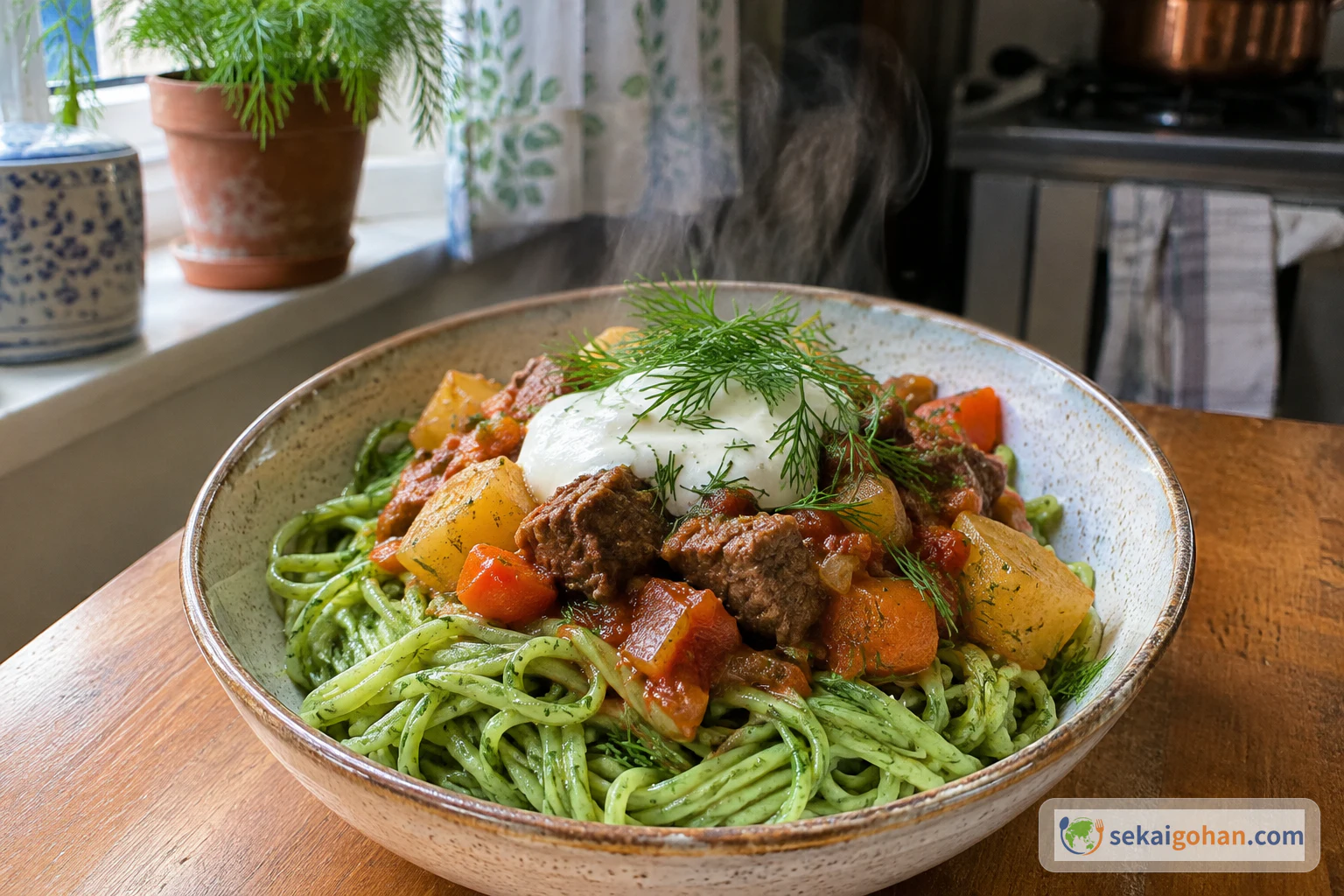
Sometimes called "Khorezm lagman," this is a specialty of Khiva. Green noodles made with fresh dill juice worked into the dough are topped with a beef and vegetable stew and served with yogurt. In the local language, shivit means dill.
| Style | Region | Amount of soup | Features |
|---|---|---|---|
| Soup lagman | Kyrgyzstan, Kazakhstan | Plenty | The most approachable style |
| Guyru lagman | Uyghur | None (stir-fried) | Like stir-fried noodles; rich |
| Boso lagman | Uyghur restaurants | None (stir-fried) | Noodles and toppings stir-fried together |
| Shivit oshi | Uzbekistan (Khorezm) | Little | Green noodles made with dill |
In Kyrgyzstan, tables often have a chili paste called laza. It's easy to make: pour very hot oil over coarse chili flakes (Korean gochugaru works well) and stir. Add as much as you like to your lagman and the heat spreads through the soup. Store-bought chili oil works in a pinch, but homemade laza has more aroma.
More from the Central Asian table and beyond
Lagman has plenty of relatives. Plov, Uzbekistan's spiced rice pilaf, shares cumin and lamb and could be called its rice counterpart. Manti are Central Asia's steamed dumplings, another dish with Silk Road ties, while beshbarmak is Kazakhstan's dish of boiled meat and flat noodles. Qurutob is Tajikistan's bread soaked in a yogurt-based sauce, and Kyrgyz oromo rolls meat and vegetables in thinly rolled dough and steams them.
Farther afield, pad thai shares a cooking method with stir-fried guyru lagman, and Malaysia's spicy laksa pairs a rich soup with noodles. Hungary's goulash combines meat, paprika and tomato in a way that is surprisingly close to lagman's soup.
Frequently Asked Questions
Q1. Are lagman and ramen related?
They share the same root word, lamian, but today they are completely different dishes. Japanese ramen is built on dashi-style broths and uses thin noodles made with alkaline salts (kansui). Lagman centers on tomato, spices and lamb and uses thick hand-pulled noodles without kansui. Think of them as siblings with a common ancestor that evolved differently on opposite sides of a continent.
Q2. What if hand-pulling noodles is too hard?
Thick-cut udon is the closest substitute; among dried pastas, linguine or fettuccine. Even restaurants in Central Asia use machine-made noodles at busy times. If the soup is good, store-bought noodles are perfectly delicious.
Q3. How do I adjust the heat?
The basic recipe isn't spicy. The Central Asian way is to stir in chili oil at the table; if you want it spicy from the start, add 1 tsp of gochugaru when frying the spices. As with pad thai, letting each person adjust the seasoning is part of the tradition.
Q4. Can I make the soup ahead?
Yes, and it's even better that way. Vaju (the soup) tastes more cohesive the next day. It keeps for 3 days in the refrigerator and 2 weeks in the freezer. Prepare the noodles separately and combine them with the reheated soup just before eating.
Q5. What goes well with lagman?
In Kyrgyzstan, lagman is usually served with naan (flatbread) for dipping into the soup, a habit shared with qurutob; any good crusty bread works too. For a salad, the classic Central Asian side is shakarap (shakarob): chopped tomato and onion, often with cucumber, dressed with salt. A squeeze of lemon is a nice addition.
Q6. What is lagman, and is it the same as laghman?
Lagman is a Central Asian dish of thick hand-pulled wheat noodles under a spiced stew of lamb and vegetables in a tomato base. "Laghman" is simply another way of spelling the same name: you will also see "laghmon" in Tajikistan, "lagmen" in Kazakhstan and "lengmen" in Uyghur. This page gives the Kyrgyz soup style, with plenty of soup, and the other regional styles are described under Variations above.
Q7. How can I make it kid-friendly?
Cut back on the cumin and coriander and increase the proportion of tomato. If lamb is a hard sell, use chicken thigh instead. Extra potatoes and carrots make the flavor more familiar.
Final Thoughts: A Bowl of Silk Road Memory
Lagman takes the basic ingredients of nomadic life and turns them into a meal through the craft of pulling noodles. It's a distillation of Central Asian food culture: noodle-making, lamb cookery and the spread of the tomato, all in a single bowl.
Try pulling the noodles in your own kitchen. Let the cumin bloom and simmer the lamb soup. Your hands will be repeating motions cooks have practiced for generations. Don't worry if the noodles don't stretch the way you want, or if they come out uneven. That unevenness is the mark of hand-made noodles, and it's at the very heart of what makes lagman taste the way it does.