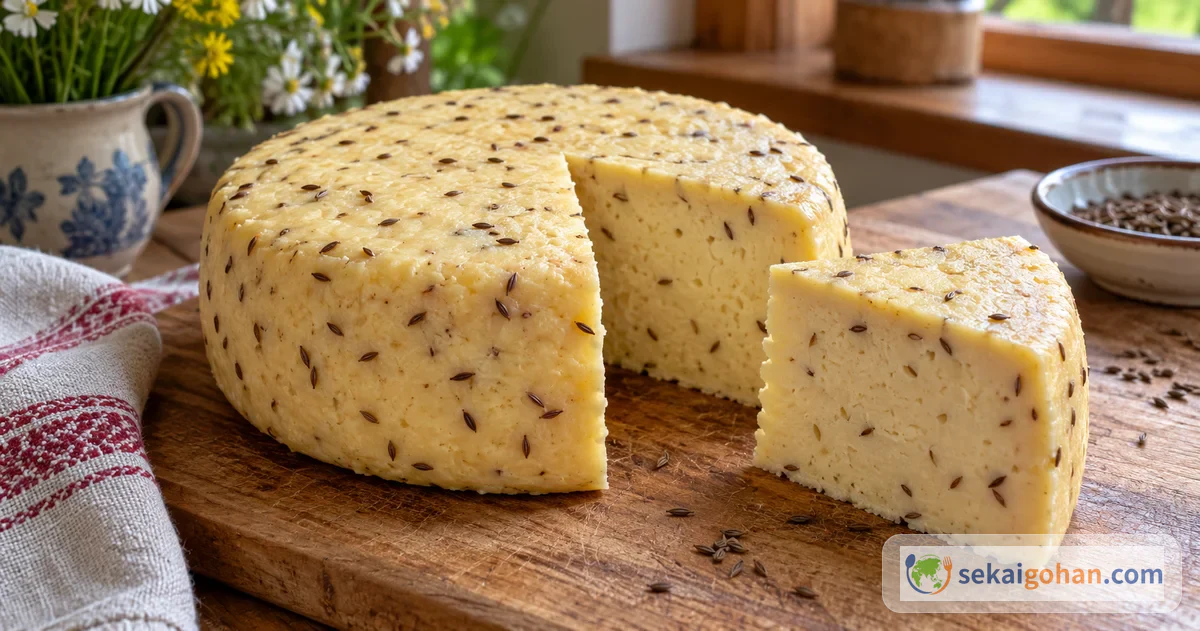
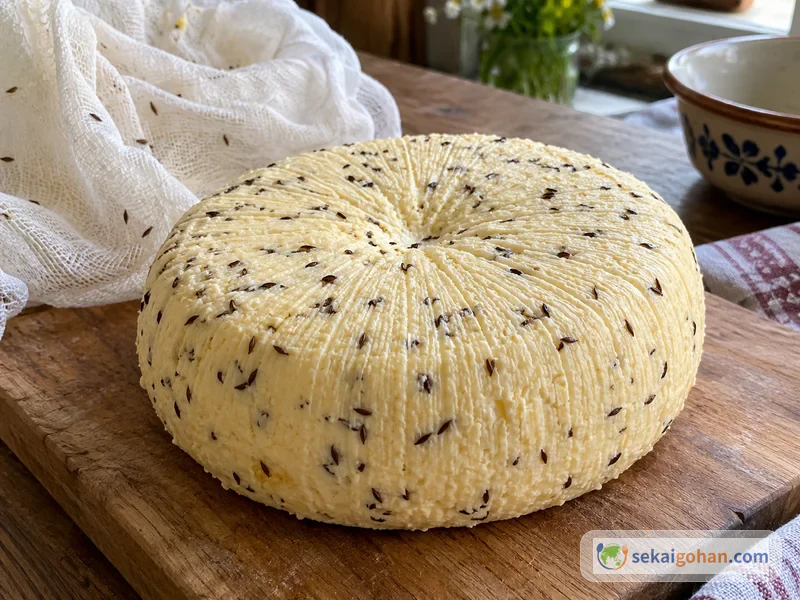
In June, the Latvian night barely gets dark. Bonfires burn in the fields, people wear crowns of flowers and grasses with a mug of beer in hand, and in the middle of the table sits a flat, pale-yellow disc of cheese. This is Jāņu siers, the cheese of the Jāņi midsummer festival. Caraway seeds dot every cut face, and the first bite brings a fresh lactic tang, followed closely by the warm aroma of caraway.
Jāņu siers and the Jāņi festival
A fresh cheese for the home kitchen
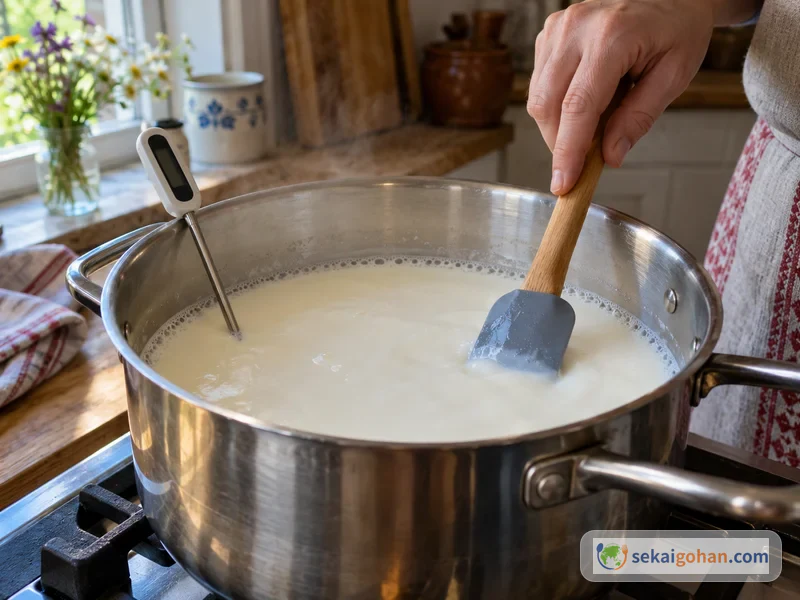
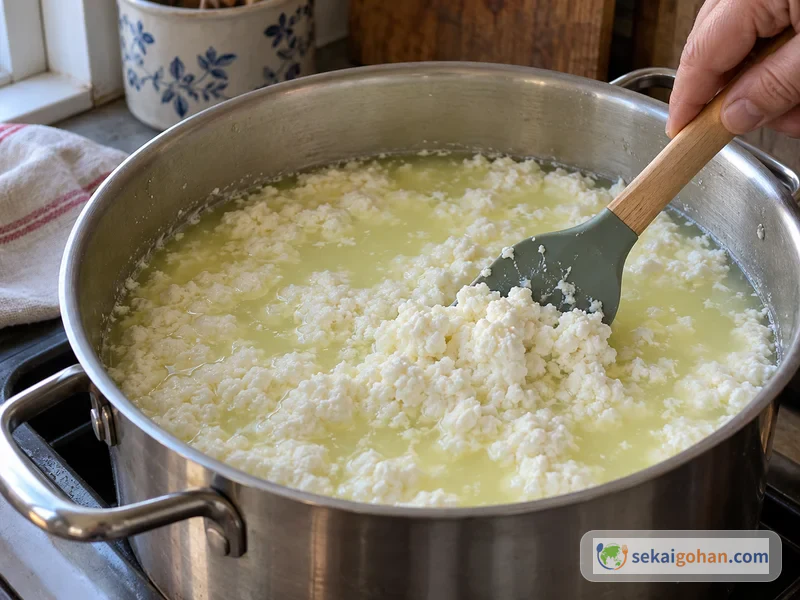
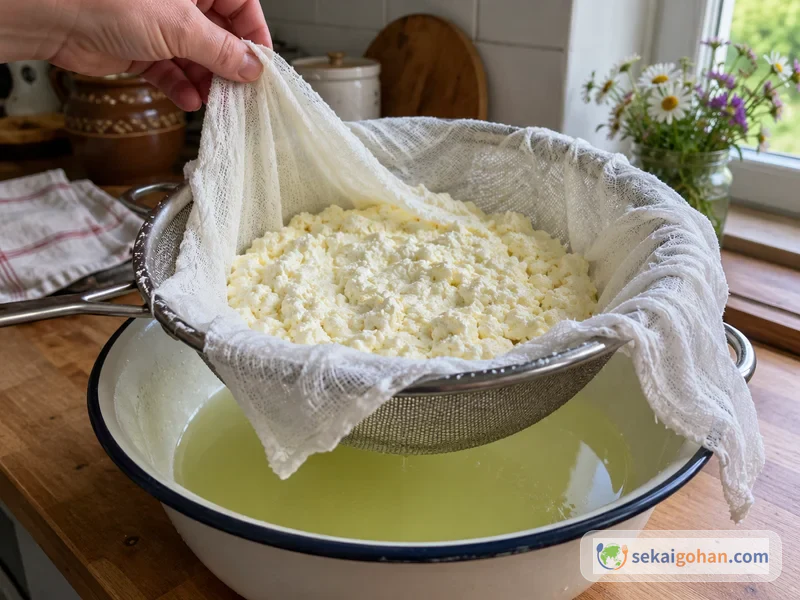
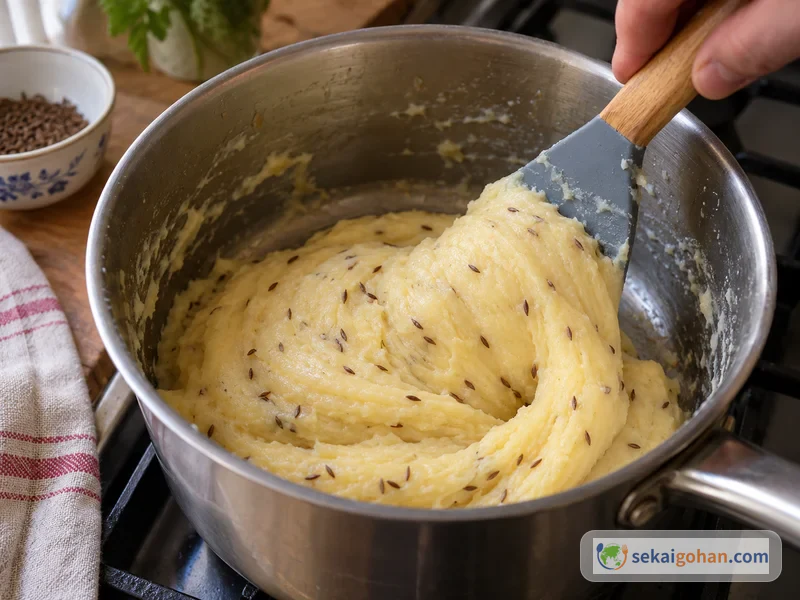
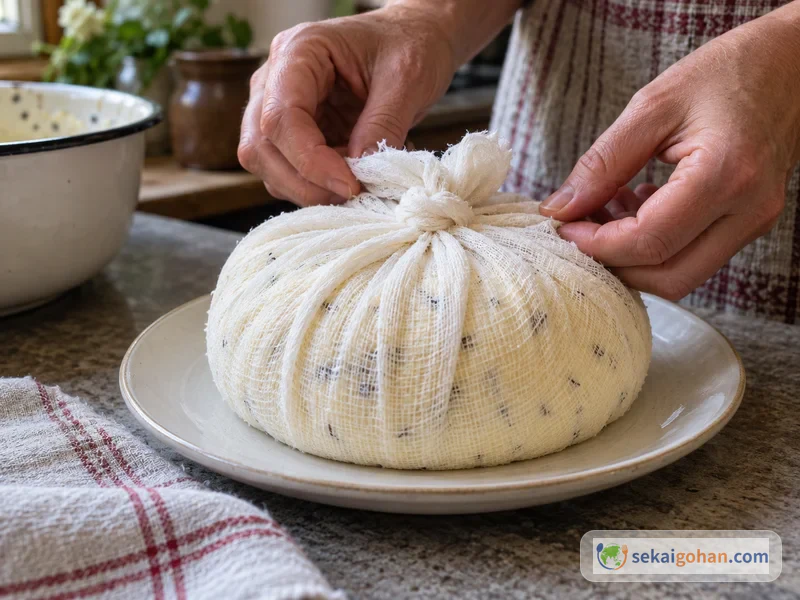
Making Jāņu siers is surprisingly close to ordinary kitchen work, with no aging room and no special cultures. You warm milk, add curds, separate the whey, work in egg, butter, salt, and caraway, then wrap the mass in cloth and let it set into a round. It is a fresh cheese you can make from milk and cottage cheese, so it comes together overnight. The one thing to watch is temperature: heat the milk to 185–194°F (85–90°C) and never let it boil. Get that right and most failures disappear.
The cheese of the shortest night
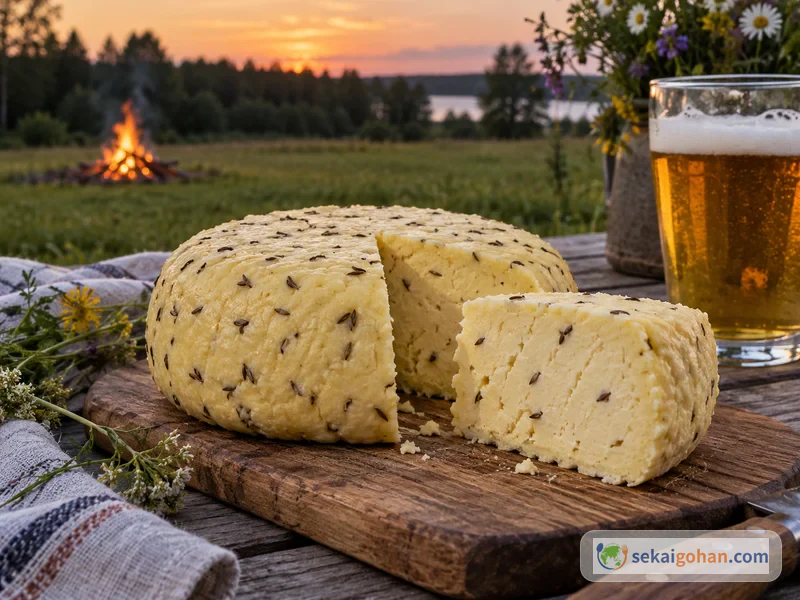
Jāņi, the celebration of the summer solstice, carries more customs than any other festival in Latvia. People decorate the house with flowers, herbs, and grasses, weave wreaths, sing, light bonfires, and prepare special dishes. German crusaders who reached the Baltic coast in the 12th century were astonished at the scale of the festivities around the Jāņi bonfires. Two things are essential to that night: beer and Jāņu siers.
The round shape matters. Around midsummer it was customary to eat round foods as symbols of the sun, and the circular form and yellow color of Jāņu siers are likened to the sun too. Cutting the cheese and sharing it is compared to each person receiving a share of the sun's power.
The name Jāņu siers also appears in Latvian folk songs. In them, wrapping and tying the cheese in cloth is a special ritual: the knot is placed at the center of the circle, and the folds of the cloth are arranged so that they leave rays like sunlight on the surface.
An old recipe with EU protection
The combination of ingredients has barely changed. Milk and curds with butter or cream, eggs, salt, and caraway appear in many 19th- and 20th-century books, starting with one published in Jelgava in 1796.
In November 2015, Jāņu siers was registered as a Traditional Speciality Guaranteed (TSG) in the EU. TSG protects a traditional method and recipe rather than a place name, and the food must have been handed down for at least 30 years to qualify. At the 2003 Latvian regional cheese day it was given the title "King of Latvian cheeses," and today it is made all year, not only at midsummer.
Ingredients (one cheese about 6 inches (15 cm) across, serves 6)
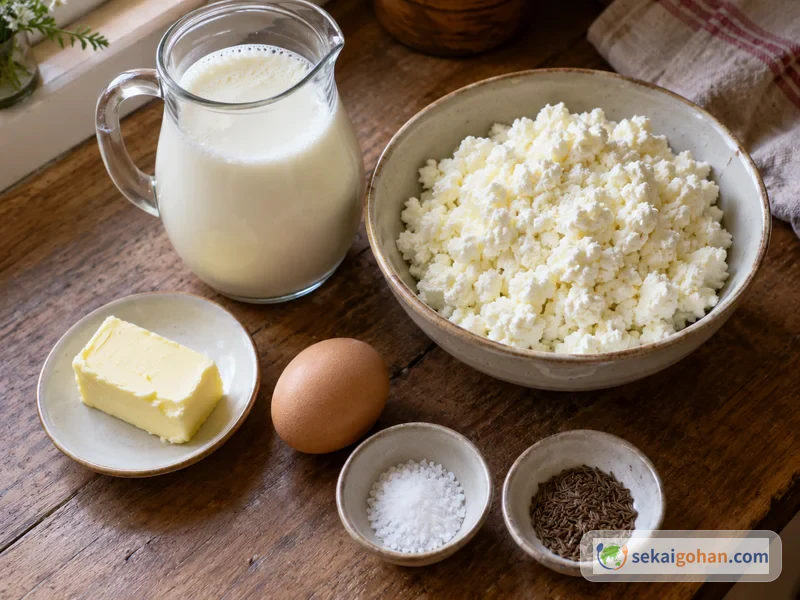
To make 22 lb (10 kg), you need 28–50 L of skimmed milk, 22–28.75 lb (10–13 kg) of skimmed curds, 2.25–2.75 lb (1.0–1.2 kg) of butter, 0.6–1.0 kg of shelled eggs, 40–50 g of caraway, and 100–120 g of salt, all as ranges. The table below scales those proportions down to a home pot and swaps in widely available cottage cheese.
Caraway seeds are often missing from the spice aisle of an ordinary supermarket, so look for them at an import grocery or online. They look like cumin, but the aroma is completely different, and substituting cumin will not give you the scent of Jāņu siers, so this is the one ingredient to get right. Butter can also be swapped for cream. Using cream gives a slightly smoother mouthfeel.
Some cottage cheese contains salt and some does not. Aim for a finished salt content of 1.2–1.8%, so check the salt on the label before deciding how much to add and you avoid an over-salted result. If the label gives no figure, start with 1/2 tsp.
Choosing curds and milk for Jāņu siers
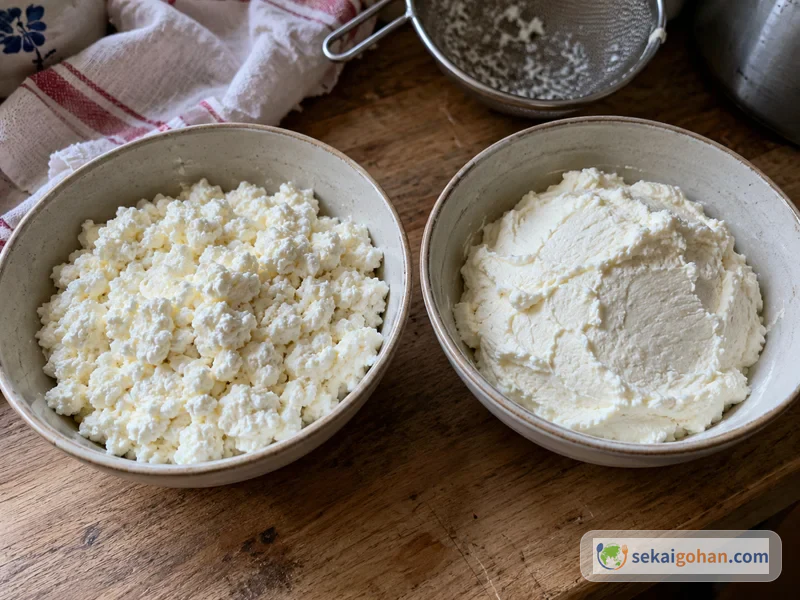
An old tip from those early books still holds: depending on how sour the curds are, add more milk to make the cheese sweeter. Think of it as sourness comes from the curds and sweetness from the milk, and adjusting the proportions at home gets much easier.
Latvian households have traditionally used homemade curds, made by letting milk sour naturally, and their sharpness varies from day to day. Store-bought cottage cheese tends to be mild, so the milk in the table leaves a pleasant, gentle sweetness. As a guide, reduce the milk to 1.25 quarts (1.2 L) if you want more tang, and increase it up to 2 quarts (2 L) if you want it mellower. More milk means more whey and a slightly longer kneading time.
Fat content affects the result too. The registered TSG recipe uses skimmed milk and skimmed curds and sets the fat in the dry matter of the finished cheese at 30% or less, so plain whole milk gives you a slightly richer, softer mass than the Latvian product.
The color of Jāņu siers ranges from pale yellow to yellow, and β-carotene can be added as a colorant. Made at home, the color depends on the amount of egg and butter, and a whitish cream color is quite common.
How to make Jāņu siers
Prep takes about 10 minutes, heating and working the mass about 50 minutes, and setting in the mold with cooling at least 2 hours. A thermometer keeps you from guessing in both the stage where you warm the milk without boiling it and the stage where you knead after adding the egg. A heavy-bottomed pot is less likely to scorch.
Both the stage of warming the milk and the stage of kneading the mass are hot. When straining the hot whey, work with the bowl on a stable surface and watch for burns. This cheese also contains egg and dairy, so it is not suitable for anyone with an egg or milk allergy.
If the mass never comes together while you knead, a lot of whey is still left in the curds. Raise the heat a little and stir in a turning motion across the bottom to drive off moisture. If it instead crumbles apart, it has been heated too long. Bring the temperature back to 65–70°C and keep working without pausing for a smoother result.
Serving Jāņu siers with beer
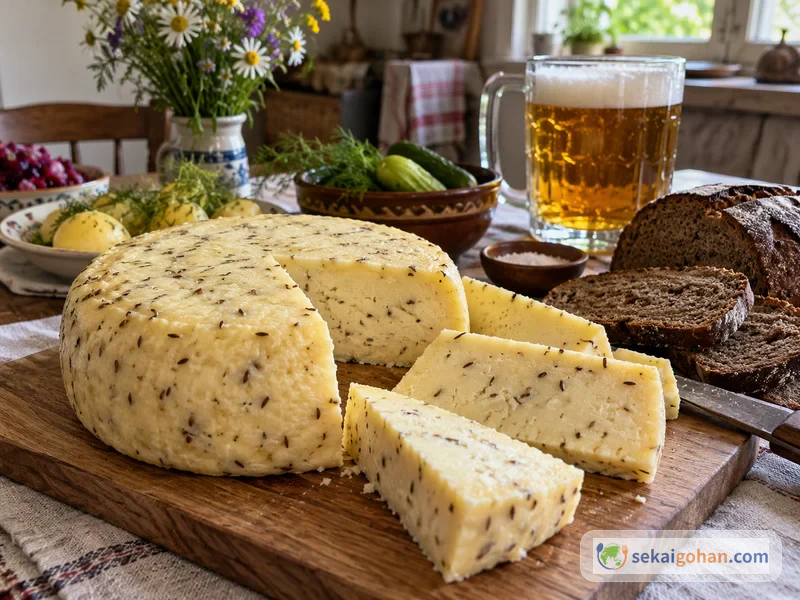
Once the cheese is chilled and firm, cut it radially from the center like a cake. In Latvia it is typically eaten as a snack with light or dark beer, picked up by hand and passed around through the long night by the bonfire, which people traditionally keep going until dawn. Since the aroma rises when you bite into a caraway seed, a reasonably thick slice tastes better than a thin shaving.
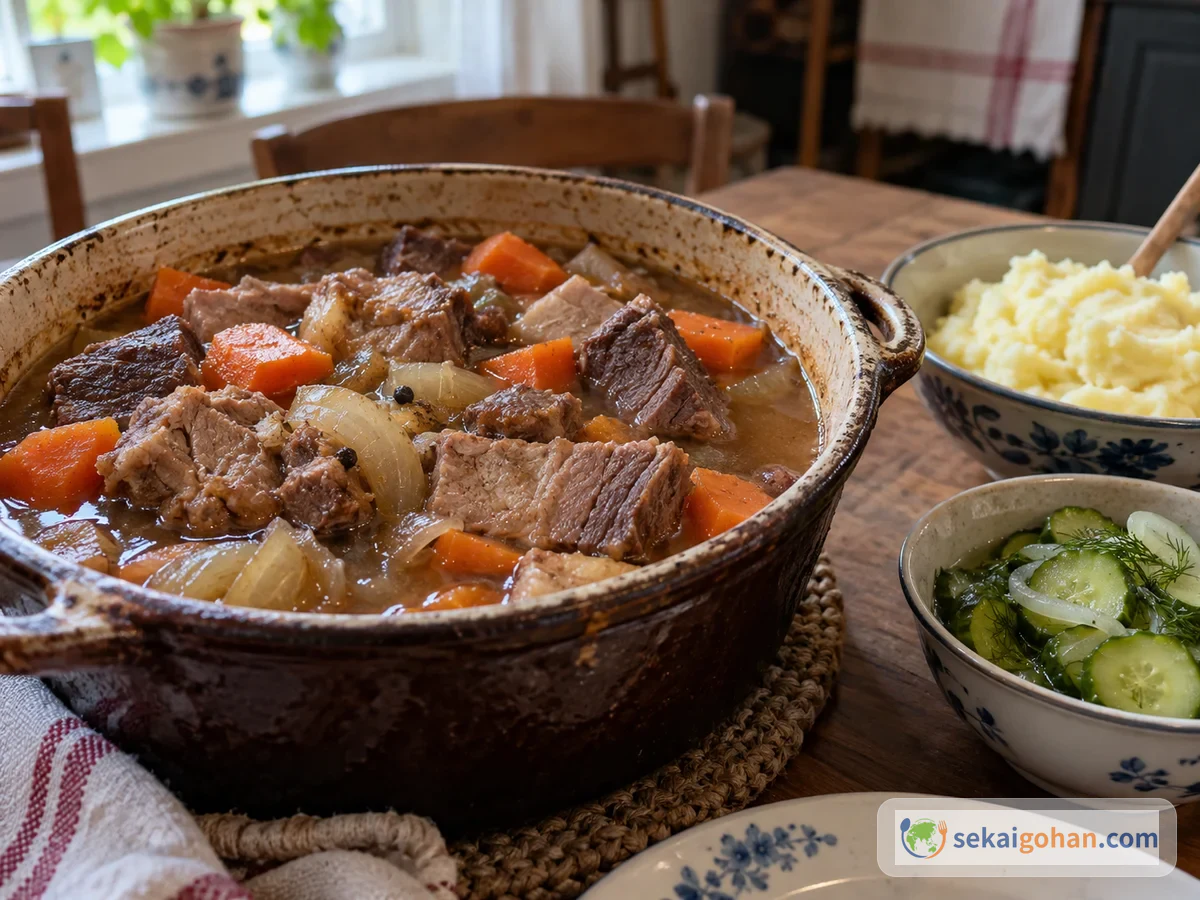
On rye bread it becomes a light meal, and a little honey softens the caraway and tang so it tastes more like a treat. For another Baltic home-cooked dish from the same northern kitchen, try Estonian mulgikapsad, a stew of pork, sauerkraut, and barley.
Frequently asked questions
Can I use cumin instead of caraway seeds?
You can, but it becomes a different dish. Caraway smells fresh and slightly sweet, while cumin is reminiscent of curry and won't give the aroma that defines Jāņu siers. Caraway seeds are available at import grocers or online.
Which is better, curd-style or smooth cottage cheese?
Either works. The smooth type blends into the milk faster and gives a smoother result. If you use the curd type, break it up well by hand before adding it to the milk, and allow a longer kneading time.
The mass won't come together and stays crumbly.
The usual causes are too much whey left in the curds or a temperature that is too low. Keep it at 65–70°C over low heat and keep kneading, pressing against the side of the pot. If whey is coming out into the pot, strain the mass through cloth again and return it to the pot.
What do I do with the whey?
You'll get a fair amount. Once cooled, it can go into drinks, soups, or bread dough as the liquid; if you won't use it soon, it's fine to let it go.
How long does it keep?
Jāņu siers is an unaged fresh cheese and contains egg. Wrap it in plastic, refrigerate, and finish it soon.