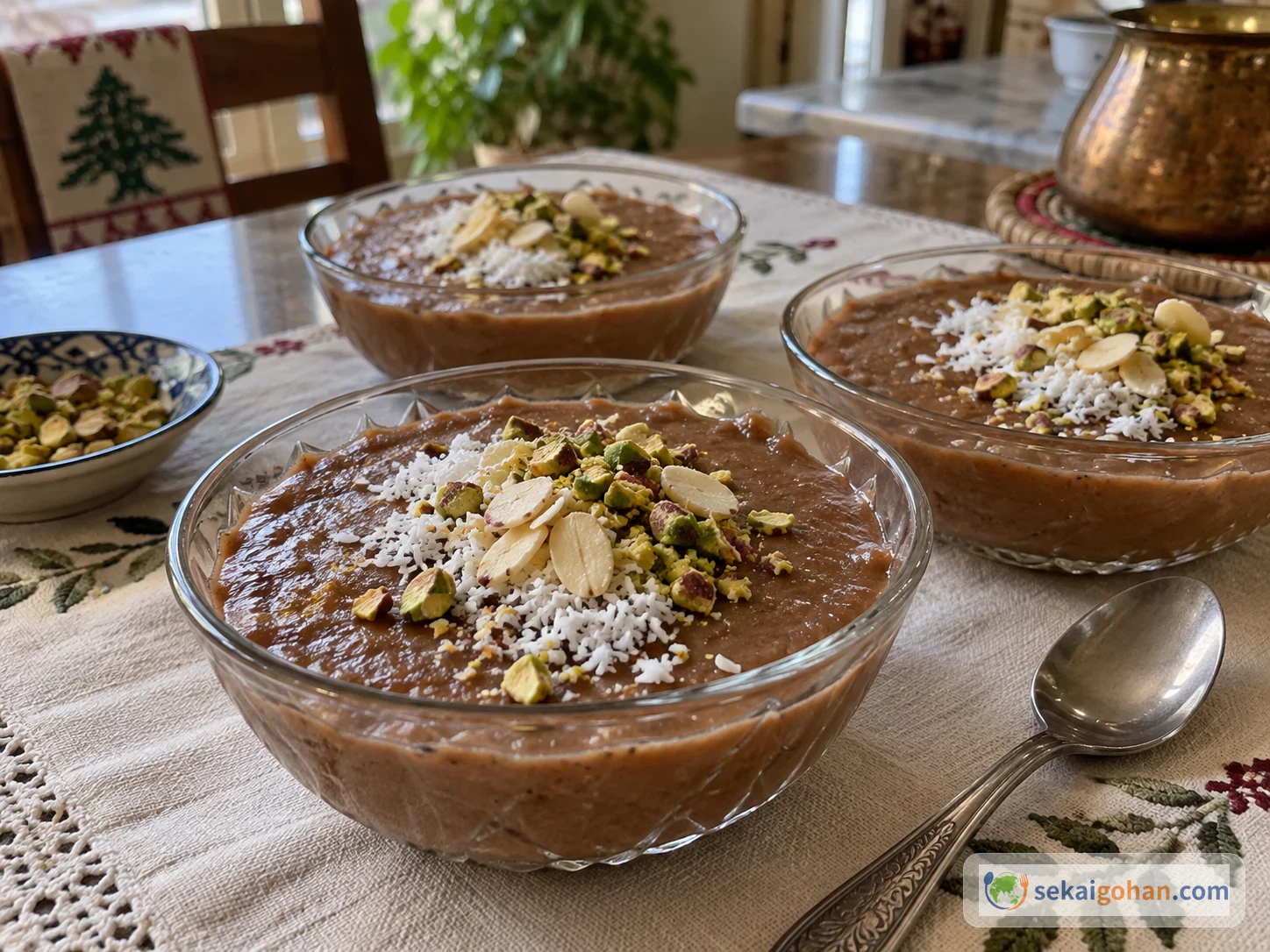
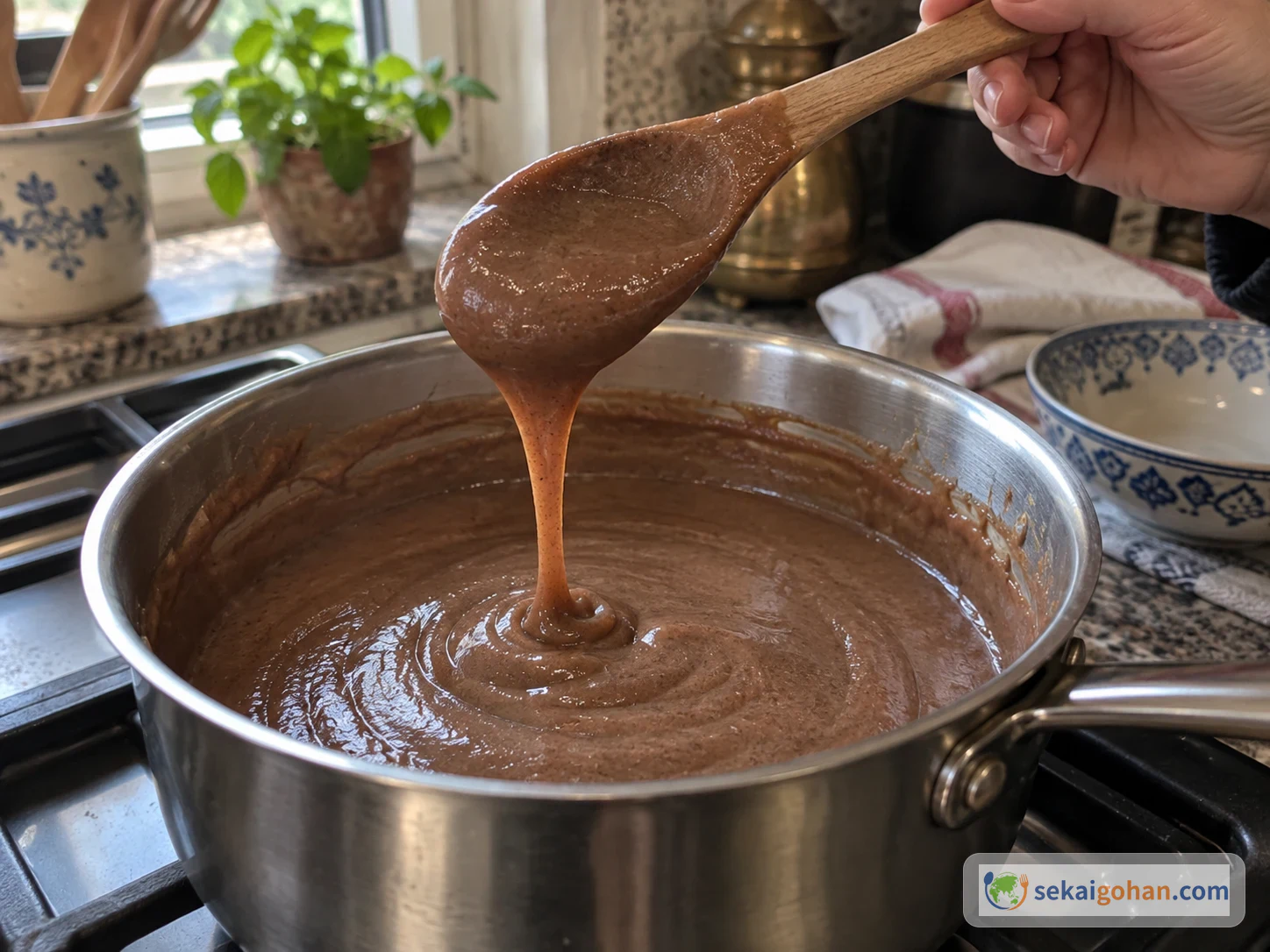
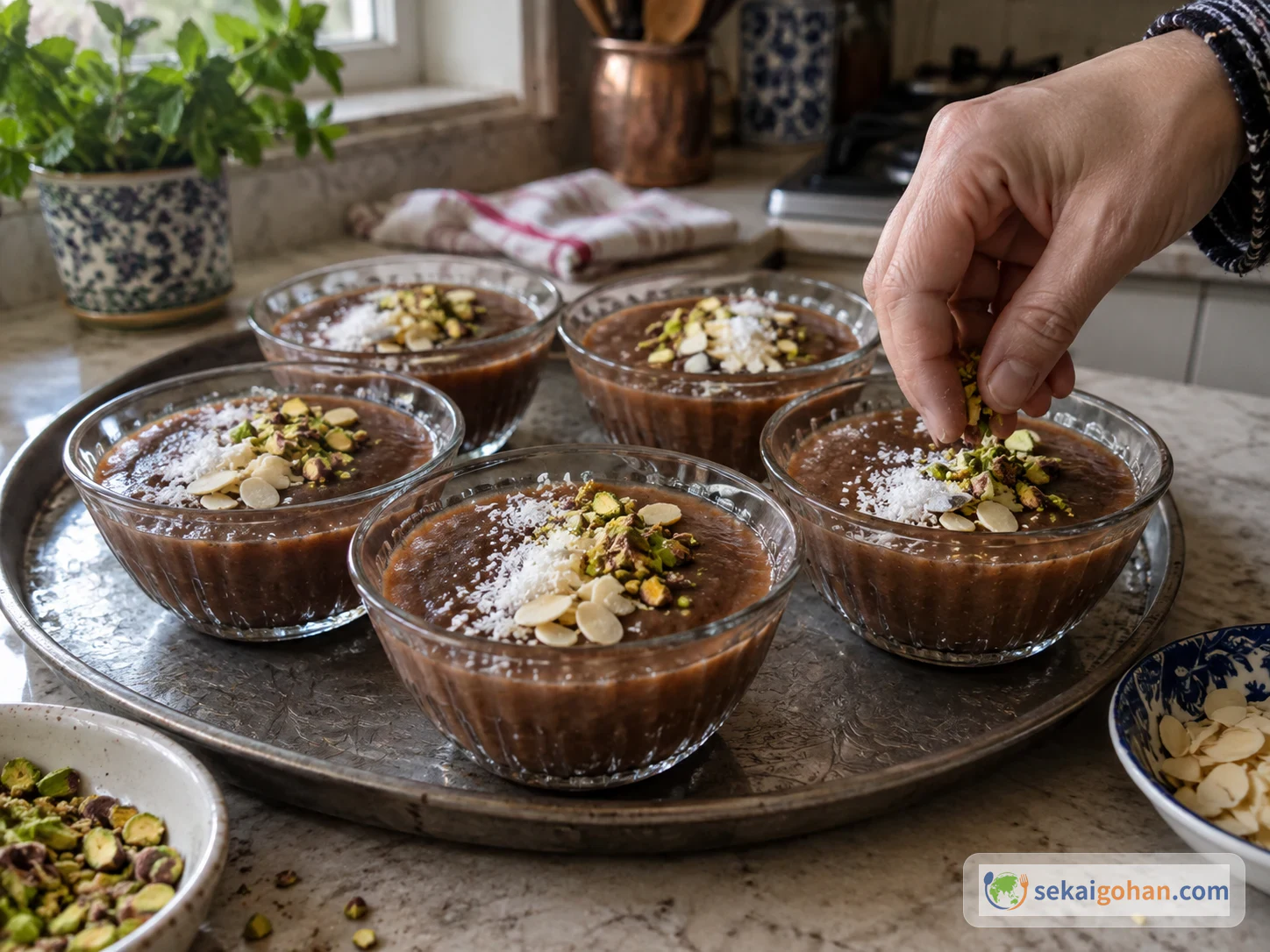
In Lebanon, when a baby is born, family and friends come to visit, and the host hands each of them a small bowl of celebration. Inside is meghli: a smooth brown pudding with white coconut piled on top like snow, scattered with green pistachios and thin slivers of almond. Put a spoon in and you get a gentle sweetness, with the crunch of nuts running through it.
The pudding itself is simple: rice flour, sugar and water cooked together and scented with caraway and cinnamon. The flour, not whole grains of rice, does the thickening, so the texture is soft on the tongue, and the brown color comes from the spices rather than caramel. At home the work is mostly stirring the pot. No oven is involved, and you do need to plan around a long chill in the refrigerator.
Meghli, a Lebanese Sweet for a Birth
Each guest who comes to see the new baby gets their own bowl, and that is the hospitality meghli stands for. You cook one pot, divide it among several bowls, and add the nuts bowl by bowl. The sweet celebrates the birth; it is for the visitors, not food for the baby.
The name meghli is related to the Arabic word for "boiled" or "boiling," and is written مغلي in Arabic. In Latin letters it appears as Meghli, Meghle and other spellings. Nobody knows when or in which town the sweet first appeared.
Meghli turns up at Christmas too, in some Lebanese households. Some cooks link it to Christmas Eve and the birth of Christ, so a newborn's welcome and a holiday table end up sharing the same pudding. It is not a custom every family or denomination follows.
Household differences in aroma and garnish
The basic scent is caraway and cinnamon. Some households also add anise seed, though meghli without it is still perfectly good meghli. Garnishes vary as well: coconut, almonds, pistachios and pine nuts all appear. Some cooks prefer no coconut at all, while others always pile it on, so treat coconut as a garnish you can skip and caraway as the scent you keep.
Some cooks soak the nuts overnight in cold water for a moist texture; others add them dry just before eating. This recipe takes the dry route, with the garnish going on just before serving, so the crunch stands out against the soft pudding. If you want to try soaking, do it in the refrigerator, never at room temperature overnight, and use the nuts right after draining.
How meghli differs from other Lebanese sweets
Lebanese desserts change a lot with the flour and the fragrance. Layali lubnan is a chilled semolina dessert made with dairy, and sfouf is a baked sweet built on anise and semolina. Meghli is rice flour, water and caraway, with no dairy. Each has its own proportions, so don't carry amounts from one recipe into another.
Ingredients (serves 6)
Prepare 6 heatproof small bowls of about ¾–1 cup (200–250 ml). Do not fill them to the brim; divide evenly at about ¾ cup (180 ml) each. This recipe uses 2.75 oz (80 g) rice flour, 4¼ cups (1000 ml) water, 5.5 oz (150 g) sugar, 6 g ground caraway and 6 g cinnamon. For the rice flour, choose fine non-glutinous rice flour, and avoid bread-style rice flour mixes that contain wheat gluten. Measure the water in ml and the flour and sugar by weight.
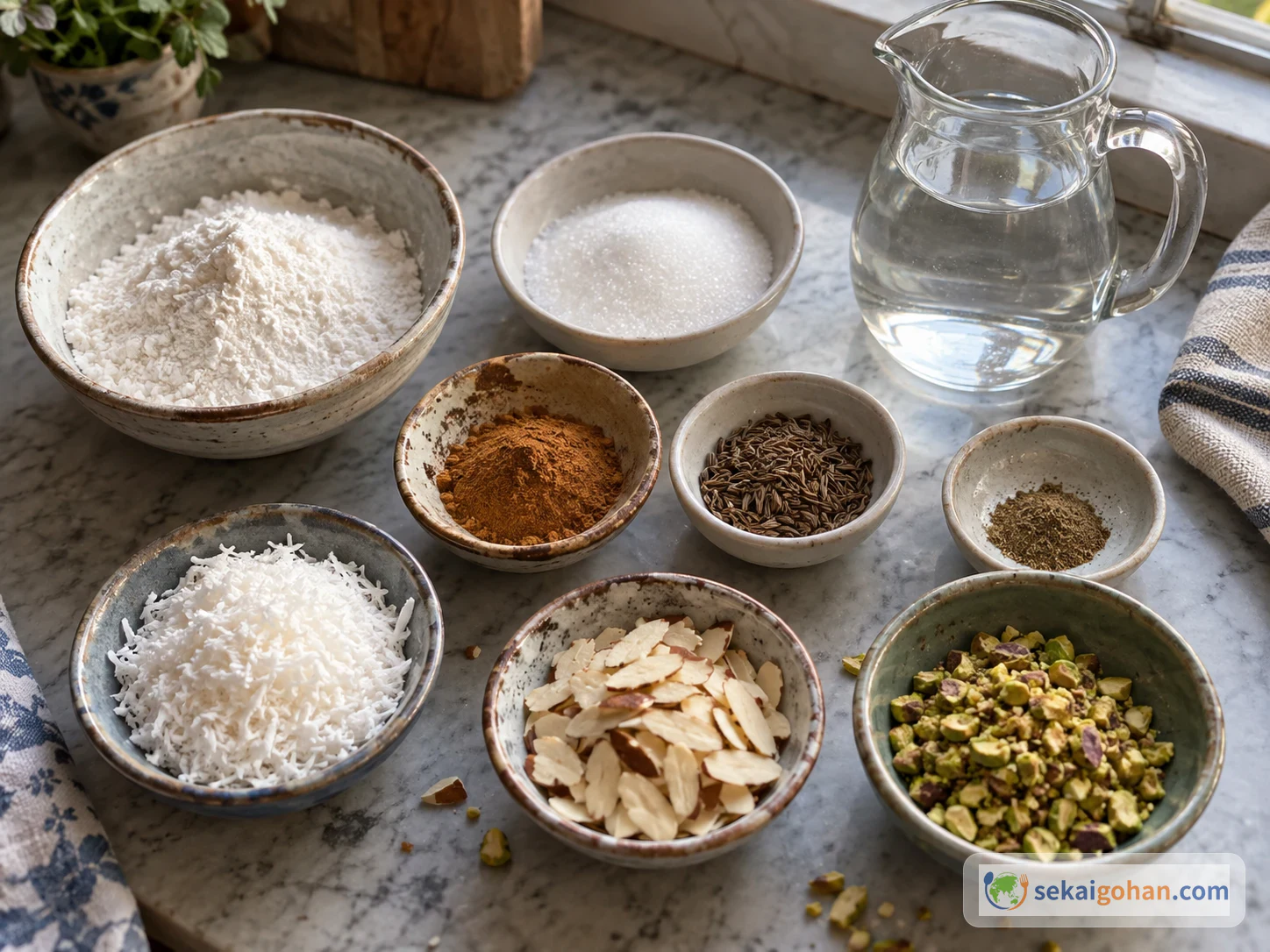
This recipe thickens by cooking the rice flour. No cornstarch, eggs or gelatin are added. To thicken with rice flour alone, scatter the flour evenly while it is still cold, then wait for it to thicken as it cooks. Do not drop the flour into hot water from the start. Changing the type of flour changes the texture and moisture, so do not swap in shiratama or potato starch in the same amount.
Set out the 6 small bowls first and clear a spot in the refrigerator. Light the stove only after the flour, sugar, spices and water are measured. During cooking the rice flour sinks and you must keep stirring the bottom, so arrange things so that you never have to stop to measure or hunt for a bowl. Use the spices in powdered form, not whole. If the grind is coarse, sift it through a fine tea strainer.
Choosing Ingredients for Meghli
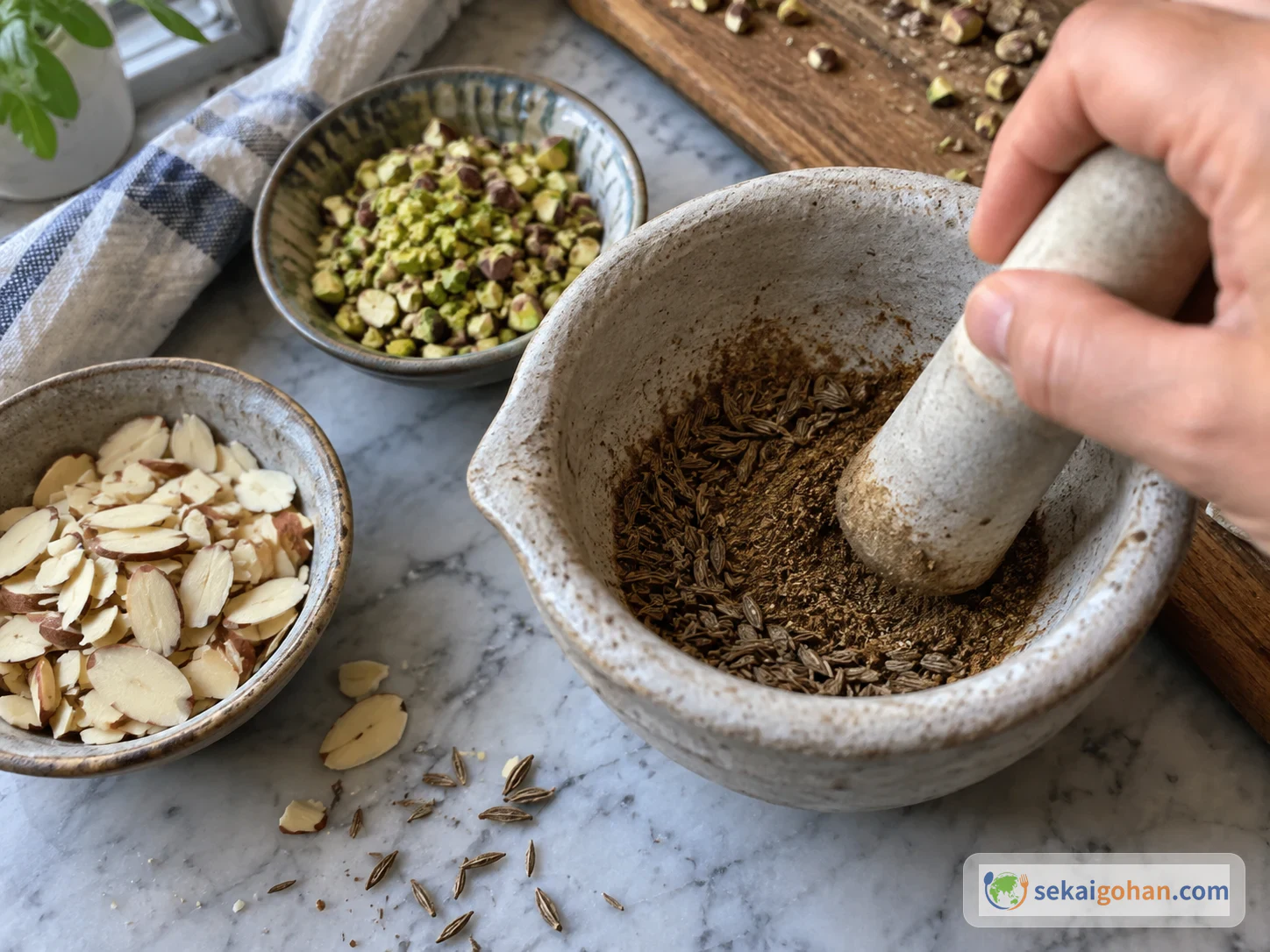
Caraway seed is the one ingredient worth arranging ahead of time; look for it at a spice shop, in the spice aisle or online, and check the common name on the label. Grind whole seeds in a mortar, or use 6 g of powdered caraway as is. Caraway and cumin are different spices, and cumin would change the aroma completely, so keep to caraway.
For rice flour, choose a fine non-glutinous flour for baking, and check that the package lists no other flours or gluten. A coarse flour changes the texture, and glutinous rice flour, shiratama or cooked rice grains won't behave the same way. Use powdered cinnamon; a stick won't give the same aroma or color.
For the garnish, choose unsweetened, unsalted garnish rather than sweetened baking coconut or salted snack nuts. Weigh the pistachios without shells, and note that sliced almonds save you some prep. Even 3 g per bowl makes a clear difference in texture and color. For tools, a mortar, an ordinary heavy pot and a whisk are all it takes.
Fixing Lumps, Thickness and Scorching in Meghli
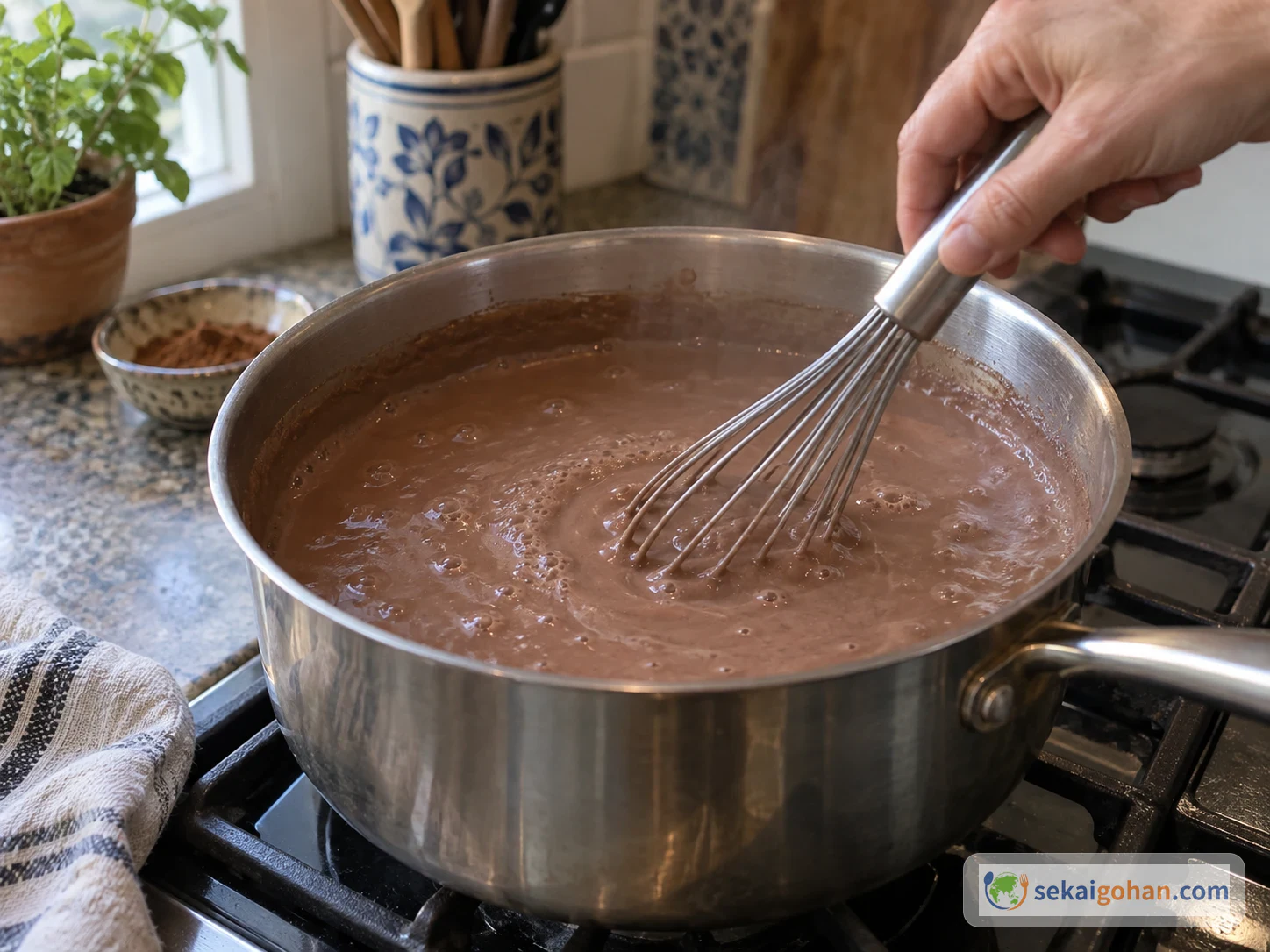
Whisking only in the center leaves flour in the corners of the pot, where it scorches. Stir all the way to the edge of the bottom, tracing the corners, and switch to a wooden spoon to scoop along the bottom as it thickens. Once it boils, stay on low heat and keep stirring, even while you spoon some out to check the thickness. What has cooled on a plate is thicker than the hot liquid in the pot.
Halve every ingredient for 3 small bowls, or double them for 12. Boiling and reducing times change with the quantity and the shape of the pot, though, so for a double batch, confirm by thickness on the back of a spoon rather than by the clock. A big double pot is hard to stir; two pots are easier at home. Adding extra flour to make it set faster gives a different texture from the basic recipe.
When transferring hot pudding, use heatproof bowls and keep the pot handle steady. Avoid suddenly pouring hot liquid into cold thin glass. Do not tilt the big pot and pour all at once; transfer a little at a time with a ladle. Do not let children stand near the pot. If large bubbles surge, lower the heat and keep your face and hands away from the spatter.
If lumps of flour remain
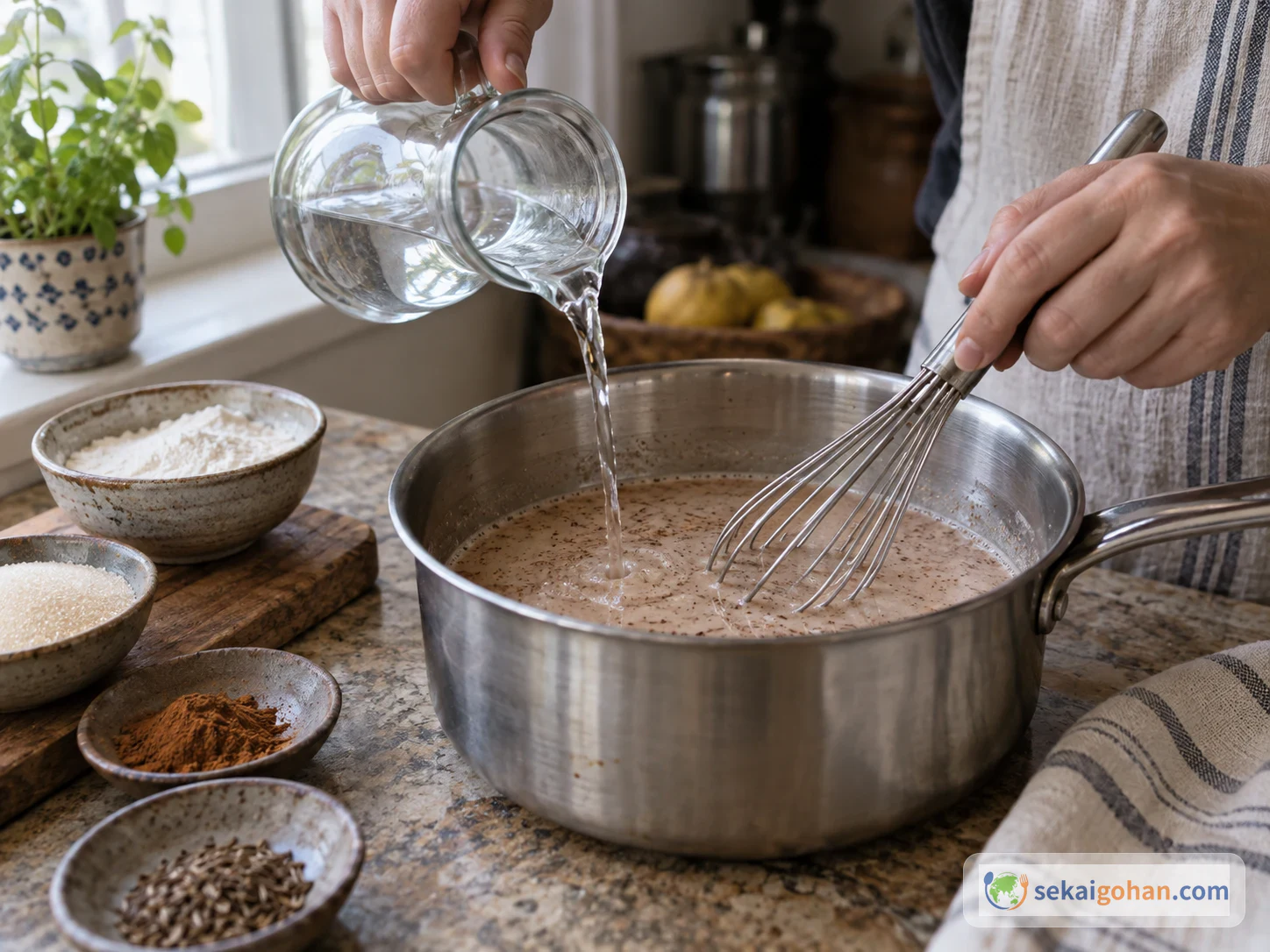
Lumps are easiest to deal with early: fix lumps before heating. Adding the cold water a little at a time at the start prevents most of them, and you can pour the mixture through a tea strainer to break up any that form, then return it to the pot and stir once more, since rice flour and spices sink. If you notice lumps during cooking, turn off the heat and break them up with the whisk, then pass what remains through a heatproof strainer back into the pot and continue over low heat. Avoid putting hot, sticky liquid into a sealed blender.
If it is still runny after chilling
First check that it chilled for at least 4 hours. If it never coated the back of a spoon during cooking, more chilling won't set it. As long as it hasn't been topped and has stayed refrigerated the whole time, you can return it to the pot, stir over low heat until it thickens, then divide into bowls and refrigerate promptly. Anything left at room temperature can't be rescued this way, and sprinkling dry rice flour into the hot pot won't help either.
If it is too firm or smells scorched
If it turned rice-cake-like before you took it off the heat, it reduced too far. While it is still hot, add water 1 tablespoon (15 ml) at a time and stir over low heat until it pours again; the texture will be a little different. If a scorched smell has only just started at the bottom, do not scrape the burnt bottom and move the upper part to another pot. Once bitterness has spread through everything, extra spices or sugar won't hide it. Next time, lower the heat and stir right into the bottom corners.
Serving, Storing and Varying Meghli
Variations
Change one thing at a time so you can compare it with the basic version. The center of the fragrance is caraway, and even when you add anise, the caraway stays.
| Variation | Change for 6 servings | Result and cautions |
|---|---|---|
| Add an anise note | Add 1 g ground anise seed | Adds a sweet fragrance. Keep the 6 g caraway. Star anise is not a same-amount swap |
| Omit the coconut | Set coconut from 18 g to 0 g | The texture of nuts and pudding comes forward. Water and rice flour stay the same |
| Add walnuts | Change 18 g almonds to 18 g unsalted walnuts | Chop walnuts to about 0.25 inch (3–5 mm). Not a substitute for people with nut allergies |
| Serve without nuts | Set 18 g almonds and 18 g pistachios to 0 g | Serve the base alone, or with only edible coconut. Still check utensils and labels |
| Less sweet | Change 5.5 oz (150 g) sugar to 4 oz (120 g) | Milder sweetness, and the spices stand out more. Water, rice flour and chilling time stay the same |
Making ahead and storage
Meghli is a good make-ahead sweet for guests. Portion it and refrigerate promptly at about 4°C (40°F) or below, covered with a lid or plastic wrap, and store the base and the garnish separately so the nuts stay crisp until you top the bowls just before eating. The base keeps up to 3 days in the refrigerator. Don't freeze it; the texture changes after thawing.
Refrigerate within 2 hours of cooking, or within 1 hour when the air temperature is above about 32°C (90°F). Do not wait until the limit; portion it and cool it quickly. Refrigerate it even though it has no dairy. Do not leave the big pot out overnight at room temperature. Reheating will not make pudding that sat out for a long time safe again. Do not eat anything with an off smell or change. If it was left out too long, throw it away even if it looks normal.
Nuts such as almonds, pistachios and walnuts can cause allergies. Check the allergies of the people eating first, and do not use the ingredients in question. Even in a recipe that adds no dairy or eggs, check all ingredients and allergen labels of the store-bought rice flour and toppings. Also watch for contamination from the mortar, cutting board and utensils that handled nuts. The name "nut-free" or "dairy-free" on a recipe alone does not make it safe for everyone. Do not use any ingredient if you are not sure whether it is an allergen.
Nutrition estimate
| Per serving (1/6 of the whole, with the basic garnish) | Approx. |
|---|---|
| Energy | about 209 kcal |
| Protein | about 2.5 g |
| Fat | about 5 g |
| Carbohydrate | about 1.5 oz (39 g) |
These figures are calculated from ingredient weights, not measured, and assume six equal portions with 3 g each of coconut, almonds and pistachios. More nuts, less sugar, a different number of bowls or different products will all shift the numbers.
Frequently Asked Questions
How does it become a pudding without milk?
Rice flour dispersed in water thickens as it heats, a different mechanism from egg custard or gelatin jelly. You cook it until it coats the back of a spoon, then chill it: meghli sets by cooking, then chilling. Keep to water rather than milk.
Can I make it without caraway?
You'll get a pleasant rice-flour and sugar pudding, but it loses the basic fragrance of meghli, so get caraway for your first batch. Meghli isn't a spicy dessert; it's the scent of cinnamon and caraway you're after, not heat.
Can I make it the day before?
Yes. Cook the base the day before and chill it in the bowls for at least 4 hours, covered. The next day it needs no heat at all; just add the nuts and coconut straight from the refrigerator, right before eating.
Is the same garnish fine when making it for a child's celebration?
Meghli is for the guests who come to welcome a baby, not for the baby itself, so adapt the garnish to the people eating. If someone has an allergy, leave out the nuts in question entirely; chopping them finely is not enough.