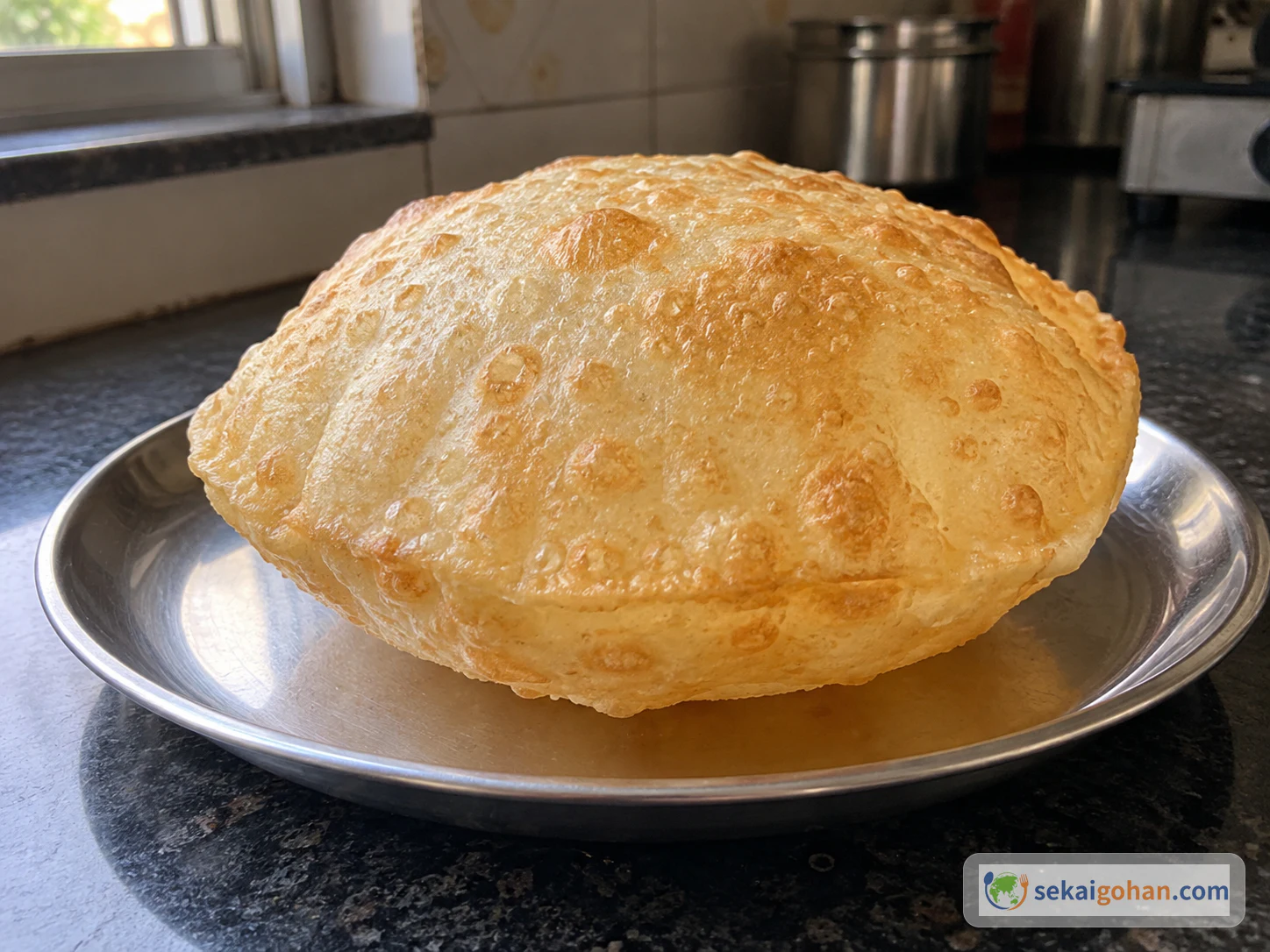
Poke a hole in a crisp puri, stuff it with potato and chickpeas, and pour in green pani. Now you can't wait. Once the shell takes in water it softens within tens of seconds, so it's a race between eating it in one bite and having it fall apart in your fingers. You get that now-or-never feeling even in your own kitchen, and it's a big part of the fun of pani puri.
Pani puri (also called golgappa or puchka) is an Indian street snack: a crisp, hollow fried shell filled with potato and chickpeas, then topped up with spicy, sour mint water. Pani means water, and puri is a thin fried bread. Together they make one of India's best-loved chaats: a hollow fried puri filled with potato and chickpeas, spicy, sour mint water and sweet-sour tamarind chutney. Next to the toasty, fresh-fried pleasure of samosa, pani puri pairs a fried shell with something cold and sour. And unlike chana masala or dal tadka, where the flavor is built in a pot, here the taste comes together as you assemble each one, right before you eat.
Pani puri at the street stall and across India

On Indian streets, the vendor's speed is part of the dish. At a stall they poke a hole in a small puri, add the filling, dip it in the pani and hand them out one after another. Nobody leaves them sitting on the plate. They go straight into the mouth, because the longer a wet shell waits, the more of its crunch it loses.
The name changes with the region. Around Mumbai you'll usually see pani puri, around Delhi golgappa, around Kolkata puchka or phuchka, and in the central-east sometimes gupchup. The sourness of the water, the filling and the heat shift a little too. People often say puchka has a filling where tamarind or black salt comes through strongly, while golgappa puts the heat and aroma of the water first. Every stall does it a bit differently, though, so no name comes with one fixed recipe.
At home, keeping each component's role matters more than gathering every ingredient.
| Role | The core of the local character | Where to land at home |
|---|---|---|
| Shell | A thin, hollow puri that breaks lightly when bitten | Puri for pani puri from an Indian grocery |
| Filling | Potato, beans, onion, herbs, a dry sourness | Potato and chickpeas, plus amchur or lemon |
| Green water | Mint, cilantro, green chili, black salt, cumin | More mint; start with half a green chili |
| Sweet-sour | Tamarind and jaggery | Tamarind paste and cane sugar |
| How to eat | Pour it and eat in one bite right away | Let each person fill their own at the table |
Making your own shells is a step up in difficulty. You knead semolina or wheat flour with water, roll it thin and fry it at high heat until it puffs hollow, and if the thickness or the oil temperature is off, it won't puff. The first time, use store-bought shells and focus on getting the filling and pani right. Make your own shells later, and you'll fail less.
Ingredients (serves 4, about 24 pieces): separate the shells, filling, water and chutney
An amount for a light snack for four, or a starter in an Indian menu. For a party, make more filling and water and add only puri shells.
| Ingredient | Amount | Substitutes & notes |
|---|---|---|
| Puri shells for pani puri | 24 | Look at Indian grocers, online and import stores. Ones that have gone soft from humidity are hard to use |
| Potatoes | 10.5 oz (300g) | Floury types are easy to crush. With waxy potatoes, chop a little coarser |
| Chickpeas (canned) | 4 oz (120g) | Boiled mung beans or black chickpeas also work |
| Red onion | 1/4 (about 1.75 oz (50 g)) | If an ordinary onion, soak in water for 5 minutes |
| Cilantro | 10g | If you dislike it, 5 g green onion |
| Roasted cumin powder | 1 tsp | Dry-roasting cumin seeds and crushing them gives a better aroma |
| Amchur | 1 tsp | If none, 2 tsp lemon juice |
| Chili powder | 1/4 tsp | Start mild |
| Salt | 1/2 tsp | If using black salt, start from 1/4 tsp |
Green pani
| Ingredient | Amount | Substitutes & notes |
|---|---|---|
| Mint leaves | 25g | Remove hard stems |
| Cilantro | 1 oz (30g) | If the roots are clean, a little adds more aroma |
| Green chili | 1/2 | 1/4 to start if a hot variety |
| Ginger | 5g | Grated is fine |
| Lemon juice | 1 tbsp | Lime also works |
| Amchur | 1 tsp | Adds a dry sourness. If none, add 2 tsp more lemon juice |
| Roasted cumin powder | 1 tsp | The axis of the water's aroma |
| Black salt | 3/4 tsp | If none, 1/2 tsp salt and a pinch of sugar |
| Sugar | 1 tsp | Rounds off the sourness and heat |
| Cold water | 2 cups (500ml) | Strain, then chill in the refrigerator |
Tamarind chutney
| Ingredient | Amount | Substitutes & notes |
|---|---|---|
| Tamarind paste | 2 tbsp | If a block, soak in hot water and strain |
| Water | ¾ cup (160ml) | Add more at the end if too thick |
| Light cane sugar or jaggery | 1.5 oz (45g) | Dark brown sugar has a stronger aroma, so start from 1.25 oz (35 g) |
| Roasted cumin powder | 1/2 tsp | Tightens the sweetness |
| Chili powder | 1/4 tsp | Optional |
| Salt | 1/4 tsp | Black salt also works |
Ingredients that give you pause when shopping: look only at the ones that decide the taste
Potatoes, onions and lemons available at an ordinary supermarket need no comment. What is worth seeking out for pani puri are the ingredients that are hard to find in many kitchens and decide the outline of the flavor.
Tamarind is the core of the sweet-sour chutney. Substitute lemon or vinegar alone and the sourness comes but the deep fruity sweet-sour is missing. Beyond pani puri it can also be used in pad thai and other sour Southeast Asian dishes.
Amchur is dried mango powder. In water it gives a dry sourness different from lemon. It can also go into the filling of chana masala and samosa, so if you keep cooking Indian food it is a spice that doesn't go to waste.
Cumin seeds give a clearer start to the aroma than powder. Just dry-roast and crush them, and they can go into both the green pani and the filling. They are a basic spice that can also go to dal tadka and aloo gobi.
Pani puri shells are the key to the dish. Look for them at Indian grocers or online under "pani puri puri" or "golgappa puri," and choose ones with little breakage that arrive dry.
Choosing pani puri shells, tamarind and spices
The heart of the street-stall experience is a thin shell, cold sourness, sweet-sour chutney and eating each one at once. Keep those, and store-bought shells still give you a thoroughly enjoyable plate.
| What you wonder about | Closer to the original | Realistic at home | Effect on the result |
|---|---|---|---|
| Puri shells | Frying thin shells with semolina | Store-bought puri for pani puri | Store-bought shells fail less |
| Black salt | Use kala namak | Salt + lemon + a little sugar | Weaker sulfur scent, but it still works |
| Tamarind | Paste or rehydrated pulp | Paste is easier to handle | Vinegar or lemon alone gives a short aftertaste |
| Sourness | Amchur and tamarind | Use lemon together | The dry sourness is weaker |
| Heat | Plenty of green chili | Adjust from half | For family, serve extra heat on the side |
| Filling | Black chickpeas, mung beans, potato | Potato + canned chickpeas | Texture is enough; don't crush the beans too much |
The one thing not to substitute is the tamarind chutney. You can eat pani puri with green pani alone, but with only sourness and heat the flavor tastes thin. The sweet-sour layer of tamarind is what makes the taste spread when you bite down.
If you can't find puri shells, thin crackers or small rice crackers will do for a chaat-style snack. You can't pour water into them, though, so it really isn't pani puri anymore. For the real dish, look for hollow puri shells.
Method: arrange the work so nothing waits after pouring
There are six steps. Only the boiling of the potatoes and the tamarind chutney involve cooking. The difficulty is less in the cooking than in the order of combining filling, water, chutney and shell just before eating.
Don't make it ahead as a finished dish. A puri that has had pani poured in goes soft after even 1 minute. When serving others, explain first and pour at the table, and fewer pieces get eaten late.
Common pani puri problems and fixes

Pani puri fails because of the order of work more than cooking skill. Opening the shells too early, making the filling too wet, thinning out the pani, or filling pieces and leaving them to sit: avoid those and the dish is quite forgiving.
| Failure | Cause | How to fix it |
|---|---|---|
| Shells crack easily | Shells softened by humidity, hole widened sideways | Store with a desiccant after opening; press the hole in from above |
| Shells are soft | Left to sit after pouring the pani | Eat as soon as it's poured; don't fill ahead |
| Heavy filling | Potato mashed completely | Crush coarsely and keep the chickpeas whole |
| The water tastes grassy | Herbs not strained, too little salt and sourness | After straining, adjust black salt, lemon and sugar |
| Weak flavor | Not enough salt in the pani, no chutney | Add a pinch of salt and tamarind chutney |
| Too hot | Strong green chili | Dilute with ½ cup (100 ml) cold water, 1/2 tsp sugar and a little lemon |
Make the green pani strong and adjust it with water afterward. If all 2 cups (500 ml) go into the blender at the start, you tend to get a weak-tasting water heavy on herbs. After straining, add water a little at a time and taste. You're looking for the point where you get sour, salty and aromatic, in that order.
Shells hate humidity. Keep them in the bag until just before use, and put leftovers in an airtight container. If they've gone limp by the next day, a low oven or toaster can crisp them up again, but they scorch easily, so keep an eye on them.
Serving and storing pani puri
Serving and pairings
Pani puri works better at the start of a meal than as an evening main. The sourness and heat wake up the palate, so a bean curry or rice dish afterward rounds out the meal.
| Combination | Occasion | Reason |
|---|---|---|
| Chana masala | A day built around bean dishes | Reuses the chickpeas; a satisfying finish |
| Dal tadka | A light dinner | Gentle beans after the sourness of pani puri |
| Samosa | A spread of street snacks | Toasty fried food contrasts with the cold pani |
| Raita | A day you want to calm the heat | Cold yogurt rests the mouth |
| Dosa | A South Indian light meal | The sourness of fermented batter echoes the chaat |
At the table, set out the puris, filling, pani and chutney and let everyone make their own, one at a time. It beats filling a portion for each person. For first-timers, all you need to say is "once the water is in, eat it in one bite."
Making ahead and storage
You can make the filling, green pani and tamarind chutney ahead. Finished pani puri doesn't keep.
| Component | How to store | Guide |
|---|---|---|
| Filling | Airtight container in the refrigerator | Until the next day |
| Green pani | Refrigerate; stir before serving | Best aroma the same day |
| Tamarind chutney | Refrigerate | 4 to 5 days |
| Puri shells | Airtight container with a desiccant | Follow the product label |
When you have guests, make the pani and chutney up to 2 hours ahead and chill them, then mix the filling 30 minutes before serving. Keep the shells sealed until they go on the table, and poke the holes at the last minute too. Kitchen humidity alone will weaken the edges of opened shells, and they'll crack when you fill them.
Green pani loses its aroma quickly, so make it the morning of the day or a few hours before eating. Chilling also tightens the flavor, so taste it for salt and sourness again before serving. Cold filling stiffens a little. To use it the next day, leave it out of the refrigerator for 10 minutes and loosen it with 1 tsp lemon juice or 1 tsp pani, right before eating, since a watery filling makes the shells collapse.
FAQ
What is pani puri, and is golgappa the same thing?
Pani puri is a hollow fried puri shell filled with potato and chickpeas and topped with spiced water. Golgappa, puchka and phuchka are regional names for the same kind of snack, and the water, filling and heat differ a little from stall to stall.
How do you eat pani puri?
Fill each shell just before eating, pour in the pani and eat it in one bite. The longer a wet shell waits, the more it softens, so assemble them one at a time at the table.
What goes well with pani puri?
Other street snacks and bean dishes sit well beside it. See samosa or aloo tikki for fried contrast, and raita to cool the heat.
Can I make it without black salt?
Yes. Black salt's distinctive sulfurous aroma gives chaat its character, but salt, lemon, sugar and roasted cumin get you quite close. If you do use black salt, start with less, because the aroma is strong.
Can I make the pani with mint alone?
Yes, but cilantro gives the aroma more depth. Mint alone can taste grassy, so make the lemon juice and roasted cumin a little stronger, then strain and chill the pani.
Can I make a pani puri that isn't spicy?
Leaving out the green chili cuts the heat a lot. Sourness and salt alone taste thin, though, so make the roasted cumin, black salt and tamarind chutney a little stronger. For the adults, serve minced green chili on the side.
What can I do with leftover pani?
Drink it as is as a cold spiced water, or spoon a little over boiled potatoes or cucumber for a chaat-style snack. Its aroma fades by the next day, so to be safe, keep it in the refrigerator and finish it by the next morning.